
Millcreek City Zoning Code
18.41 MIXED
DEVELOPMENT ZONE MD
18.41.010 Purpose
The purpose of the Mixed Use (MD) development zone is to provide for the mixing of a variety of uses (limited commercial, office, residential and light industrial (within enclosed buildings) within a walkable, bikeable setting and to encourage such use mixes near transit stations in the Meadowbrook area, especially near the South Salt Lake and Murray transit stations. In addition to allowing a diverse mix of uses, the Meadowbrook area promotes increased density near transit stations with incentives to attract quality developments providing owner occupied and affordable housing.
Repealed & Reenacted by Ord. 25-12 on 4/28/2025
18.41.020 Applicability
- Properties located in the Meadowbrook area as designated in the Future Land Use Map, or within an area identified in a Station Area Plan are eligible to be rezoned into the Mixed Development Zone.
- In the event there is language elsewhere in this Title that conflicts with language in this chapter, the more restrictive standard shall prevail.
- Development in the Mixed Development Zone may be subject to the requirements set forth in MKZ 18.61, Sensitive Lands.
- In any rezoning process for a mixed use or multi-household development larger than a four-plex, a Development Agreement shall be required at the sole discretion of the City.
Repealed & Reenacted by Ord. 25-12 on 4/28/2025
18.41.030 Permitted Uses And Conditional Uses
- Uses in the Mixed Development (MD) Zone are as determined by Table 18.41-1 Permitted and Conditional Uses in the Mixed Development (MD) Zone. If a use Is not explicitly designated in the table, then the use is prohibited. An applicant seeking a Millcreek Business License may submit a Classification Request by following the procedure as set forth in MKZ 18.15.030 (J), to determine whether a proposed land use aligns with an existing land use listed in Table 18.41-1.
Table 18.41-1 Permitted and Conditional Uses in the MD Zone P = Permitted Use C = Conditional Use Review Required Use MD Specific Use Standards Multiple Household Dwellings (3) C Non-residential use or residential use that is convertible (built to City commercial building code standards) is required for at least 50% of the ground story facing a public street. 24-hour on-site management required for projects with 50 or more residential units. Subject to the design standards within this Chapter. Affordable Housing P Subject to the requirements and incentives for affordable housing as set forth in MKZ 18.78, Affordable Housing Incentives. Home Business P Subject to MKZ 18.76, Special Business Land Use Regulations Live /Work Unit (1)(2) P Only permitted as part of a mixed use development. Residential Facilities for the Elderly or for Persons With a Disability P Limitations as set forth in MKZ 18.74, Residential Facilities for Persons With a Disability. Lodging C Nursing Home or Assisted Living C Public use P Quasi-Public Use C Schools, Public and Private P Religious Assembly P Medical or Dental Clinic P Neighborhood Retail P No commercial building over 20,000 square feet on the first story is allowed. General Retail C No commercial building over 20,000 square feet on the first story is allowed. Commercial Entertainment C No commercial building over 20,000 square feet on the first story is allowed. Retail Food Trucks, Pop-Up Markets, and/or Farmer’s Market P Subject to MKZ 18.58, Temporary Uses and Structures Drive-Up Window C No order window or structure is allowed within 150’ of residential use. Speakers to be oriented away from abutting uses. No order boxes or drive-up windows permitted in a front yard. Neighborhood Service P General Service P Office P Personal Service P Allowed as part of a mixed use development. Mixed Use (3) C Non-residential use or residential use that is in convertible space) is required for at least 50% of the ground story facing a public street. Temporary Uses P As set forth in MKZ 18.58, Temporary Uses and Structures - Table 18.41-1 Notes:
- Live-work units are prohibited within 300 feet of any major intersection.
- Live-work units may only constitute up to 25 percent of any required ground story convertible space built to commercial building code standards.
- Fifty percent (50%) of the ground story facing a public street must have a non-residential use or must be built to commercial standards (“convertible space”). In no case shall commercial standards (non-residential or convertible space) be required for more than 150 lineal feet of property. Property located within 300 feet from a major intersection must have a non-residential use or must be built as convertible space, except as provided below:
- The frontage of any second story non-residential use built to commercial building code standards facing a public street may be calculated into the overall required 50 percent measurement given second story is directly above ground story commercial.
- The 50 percent required ground story facing a public street for non-residential use or residential use that is convertible may be reduced on a case by case basis when commercial uses such as a restaurant or a grocery store are implemented and referenced in a Development Agreement as part of an application to rezone land into the MD Zone.
Repealed & Reenacted by Ord. 25-12 on 4/28/2025
18.41.040 Prohibited Uses, Limitations
- Certain use prohibitions or use limitations are listed in Table 18.41-2. Such use prohibitions or use limitations apply in addition to the general provision that uses not explicitly designated as Permitted Uses or Conditional Uses in Table 18.41-2 are prohibited.
Table 18.41-2 Prohibited Uses and Limitations Use Specific Use Limitations Campgrounds Prohibited for recreational vehicles Commercial Entertainment Prohibited as outdoor use. Must be located in a structure or building Wireless Telecommunication Facilities Must be a Stealth Facility, subject to the standards as set forth in MKZ 18.75, Wireless Telecommunications Facilities. Detention Facility or Jail Prohibited Flea Markets or Swap Meets Prohibited Indoor or Outdoor Gun or Archery Range Prohibited Outdoor Display Prohibited if located more than five (5) feet in horizontal distance from the main building Outside Storage Prohibited if located within view of the street or in any front or side yard facing a street. In all other areas, outside storage must be screened by a minimum of 6’ opaque fence. Pawn Shop Prohibited within 500’ of an arterial/major intersection or within 1,000’ of an established pawn shop or substantially similar business. (1) Automobile, Equipment, or Recreational Vehicle Sales or Rental Prohibited Secondhand Store Prohibited if greater than 5,000 square feet Self-Storage Facility Only allowed if such uses are located in a mixed use building with residential, general retail, or office uses on 100% of the first story facing a public street and if located further than 300’ from an arterial/major intersection but not within 1,000’ of an established substantially similar business. (1) Sexually oriented businesses Prohibited, subject to MKZ 18.76.030 Non-Depository Financial Institutions Prohibited within 300’ of any arterial/major intersection and not within 1,000’ of other established non-depository financial institutions. (1) - Table 18.41-2 Notes:
- Arterial/major intersections are defined as the major streets that cross with 3900 S, and Central Avenue, including West Temple, Main St., and State Street. Each distance is measured as a radius from the applicant’s nearest property line to the intersection ROW line and/or to the property line of the nearest substantially similar business. Any overlap of the radius onto the applicant’s property excludes the entire property.
Repealed & Reenacted by Ord. 25-12 on 4/28/2025
18.41.050 Accessory Structures
Accessory uses and structures shall be subordinate/incidental to the main use and structure. Except for food trucks and residential amenities that are implemented and referenced in a Development Agreement as part of an application to rezone land into the MD Zone, accessory uses and structures shall not be allowed in the front or side yards facing a street.
Repealed & Reenacted by Ord. 25-12 on 4/28/2025
18.41.060 Spatial Requirements
- The minimum setbacks, maximum height and lot size requirements are as set forth in Table 18.41-3 Spatial Regulations for the Mixed Development (MD) Zone.
Table 18.41-3 Spatial Requirements for MD Zones Lot Requirements Minimum Lot or Parcel Area (1) 20,000 square feet Minimum Lot or Parcel Width (2) 100 feet Building Requirements Maximum Building Height (3)(4) 85 feet Maximum Lot or Parcel Coverage (2) 80 percent Minimum Building Height 2 story Yard Requirements Minimum Front Yard Setback 10 feet Minimum Rear Yard Setback 10 feet Minimum Interior Side Yard Setback 10 feet Minimum Corner Side Yard Setback 20 feet Minimum Setback from Big Cottonwood Creek 50 feet, from top of bank from Big Cottonwood Creek. Accessory Structures: Rear And Interior Side Yard Setback 10 feet Accessory Structures: Rear And Interior Side Yard Setback When Abutting Residential Uses 20 feet - Table 18.41-3 Notes:
- No minimum lot area and lot width is required for mixed use buildings that include completely affordable or mixed affordable housing, subject to the standards as set forth in MKZ 18.78, Affordable Housing Incentives.
- No maximum lot coverage is required for mixed use buildings that include completely affordable or mixed affordable housing, subject to the standards as set forth in MKZ 18.78, Affordable Housing Incentives.
- Mixed use buildings that include completely affordable or mixed affordable housing, subject to the standards as set forth in MKZ 18.78, Affordable Housing Incentives, have a maximum building height of 100 feet.
- For buildings abutting legally established single-household or two-household dwellings, or a Residential Zone Boundary, the side and rear yards abutting such uses shall be increased by one foot (1’) for every two feet (2’) that the structure exceeds 25 feet in height.
Repealed & Reenacted by Ord. 25-12 on 4/28/2025
18.41.070 Site Design Standards
- Buildings shall orient their street facing facades parallel to a street.
- Corner lots are deemed to have two front yards.
- Any façade parallel to or within 60 degrees of the property frontage along a street as defined in MKZ 18.97, Definitions, is deemed to front the street, as depicted in Figure 18.41.1.
Figure 18.41.1 Street Frontage Illustration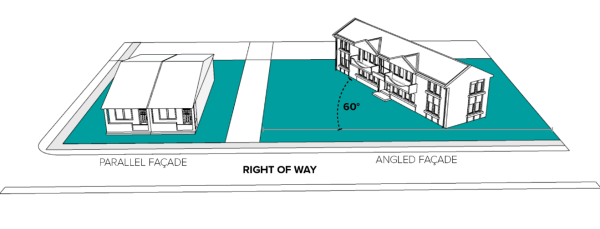
- Buildings shall have a ground story entrance facing towards the nearest street. When a property abuts more than one street, at least one ground story entrance is required on the street facing façade of the building where the greatest amount of pedestrian traffic is anticipated. Direct pedestrian access to the nearest street is required for all buildings.
- Windows shall constitute at least 50 percent of first story street-facing facades, and windows shall be at least 50 percent transparent. When a residential use occupies the first story, windows shall constitute 33 percent of the first story street-facing facades. On double or triple-frontage lots, living screens may replace up to 50 percent of the window requirement for the façade along the lowest anticipated pedestrian traffic frontage. Windows shall constitute at least 25 percent of all upper story street-facing facades. Interior lighting is required.
- No parking is allowed between the building(s) and the street. Parking shall meet the requirements as set forth in MKZ 18.63, Parking and Mobility Standards.
- Vehicular entry gates are prohibited as part of any mixed use development containing residential uses unless the gate services a structure or podium. Gates must be situated in a manner that does not pose a traffic hazard due to vehicle queues waiting to enter through the gate.
- The front yard setback is the build-to-line within three hundred feet (300’) of any major intersection. At least 50 percent of the front elevation of the building(s) must be built within 10 feet of the build-to-line. Build-to lines may not encroach upon the front yard setbacks established in this Chapter. A build-to-line is defined as the line at which construction of a building façade is to occur on a lot, running parallel to the front property line, and ensuring a uniform (or more or less even) building façade line on the street.
- Garbage and recycling shall be designed to accommodate and efficiently manage the collection, storage, and removal of garbage in harmony with the neighborhood to minimize detrimental effects of the collection, storage, and removal on any use within the development or abutting uses. Dumpster enclosures are required. No refuse dumpster or dumpster enclosure structure shall be located closer than 10 feet to any perimeter property line. Enclosure structures must have a minimum of three sides that reflect or emulate the materials, design, and quality of the overall development. All developments shall provide recycling services.
- All utilities shall be located underground except for existing overhead transmission lines. All utility equipment shall be screened from view as set forth in MKZ 18.64.050.
- Fencing and screening shall be installed by the developer between incompatible uses and/or incompatible zones as set forth in MKZ 18.64, Landscape Standards, and MKZ 18.66, Fences and Walls.
- Building Materials. Exterior materials of a durable or resilient nature such as brick, stone, stucco, prefinished panel, composite materials, or other materials of similar quality, hardiness, and low maintenance characteristics shall be used. No single material is allowed to exceed 50 percent of street-facing facades. Other materials may be considered for soffits, or as an accent or architectural feature. Twenty-five year guarantee architectural shingles and/or other longer lasting roof materials are required.
- Mixed-use buildings shall incorporate the following building massing standards:
- Stepbacks. Buildings greater than 40 feet in height shall have a minimum 10-foot (stepback between the first or second stories and third story when along Streets, Property Frontages, Public Parks, and along the Big Cottonwood Creek.
- Façade articulation. The primary façade plane shall not exceed 40 feet in length without full height articulation. The articulation shall be a minimum of two feet (2’) in depth or projection from the primary façade plane and shall be a minimum of five feet (5’) in width.
- Change in height. The top of the building shall change in height by at least five feet (5’) every 30 feet of façade length.
- Indentations or recesses. The building shall feature indentations or recesses such as alcoves or arcades at least five feet (5’) in depth along the façade at maximum of 75-foot intervals. Such indentations or recesses shall be a minimum of one story in height.
- Terraces. Unless required as a stepback, usable terraces (a larger balcony intended as a private resident leisure space or commercial leisure space) at least 10 feet in depth along the street facing facades.
- Open space shall be provided for residential uses in the amount of the lesser of 20 percent of the property or at least 250 square feet per dwelling unit. One hundred (100) square feet per dwelling unit may be private open space, and 150 square feet per dwelling unit must be common open space. The required common open space shall be usable land areas that may include rooftop balconies and terraces but are not otherwise occupied by buildings, dwellings, structures, parking areas, streets, public park strips, curbs, gutters, sidewalks, walking paths, driveways, or alleys and shall be accessible by all residents of the mixed use development.
- Residential uses shall include some commercial uses along the public street or be constructed as convertible space.
- Uses adjacent to Big Cottonwood Creek shall include a usable open space buffer area next to that creek, defined as the top of bank of Big Cottonwood Creek plus 50 feet as a minimum. Such areas are recommended for a trail system.
- Parking for developments in the MD zone shall follow the requirements of MKZ 18.63, Parking and Mobility Standards. Additionally, developments shall comply with the following requirements:
- Parking required for each residential dwelling unit must be in a structure, a podium, a private garage, or a carport. Carports shall be either located to the back of the building or screened as set forth in MKZ 18.64, Landscape Standards.
- Parking Location. For residential and mixed use developments with eight (8) or more dwelling units, parking is not allowed between any building façade and the property line along a right-of-way. Such parking shall not encroach on the side or front setbacks.
- Private Garage Requirements. If a private garage is utilized, it must meet the following standards:
- Two parking space garages require a minimum unobstructed size of 22 feet wide by twenty 20 feet in length, or 20 feet wide by 22 feet in length,
- Single parking space garages require a minimum unobstructed size of 10 feet wide by 22 feet in length, or 11 feet wide by 20 feet in length.
- All private garages must have a minimum unobstructed height of seven (7) feet for the entire required length and width of the private garage, except for interior staircases.
- Garage doors shall use complementary colors and include windows.
- Private garage doors and private garages shall not be the only means of access to a dwelling.
- Vehicular Access to Private Garages.
- Vehicle access serving a private garage shall be at least 26 feet in width.
- Where such drives serve units with opposing garages, where garages face each other, a minimum of 25-year square feet of landscaping shall be required at the edges of each driveway, between each dwelling unit.
- Developments with 25 feet or more units and lot or parcel widths of 150 feet shall provide a driveway for each garage with a minimum width of 12 feet and minimum unobstructed depth of 20 feet.
- Tandem Spaces in Podiums and Structures. Tandem spaces in conjunction with garages may be allowed only for residential uses with a minimum size requirement of 20 feet in length and 10 feet in width per parking space, up to a maximum of two (2) contiguous spaces per unit.
- Vehicular Entry Gates Prohibited. Vehicular entry gates are prohibited as part of any multi-household development unless the gate services a structure or podium. Gates must be situated in a manner that does not pose a traffic hazard due to vehicle queues waiting to enter through the gate.
- Parking is prohibited within the required fire access and turnaround facilities.
- Tandem parking or parking in a private garage or driveway shall not be included in any required guest parking calculation.
- Additional standards for Three-Household and Four-Household Buildings:
- Private or Shared Driveways. No more than two (2) units may share a driveway.
- No driveway or combined driveway with the abutting unit shall exceed 24 feet in width unless such driveways are separated by a minimum five feet (5’) wide irrigated planter that includes at least one (1) shrub and one (1) medium size tree.
- Driveways located on a street with a right-of-way greater than or equal to 66 feet shall prohibit backing out onto the public street.
- Sidewalks. As required elements of a development, interior sidewalks shall be at least five (5) feet wide installed to serve the development, including connecting ground story pedestrian entrances to internal aisleways and streets, connecting parking to buildings on the site, and connecting the development to the public street. Sidewalks shall comply with the Standard Plans for Public Works Construction.
- Mechanical Equipment and Utilities.
- All mechanical equipment such as HVAC systems shall be screened from view from the ground level vantage point along an abutting street or private vehicular access as set forth in Buffer Type C as set forth in MKZ 18.64.050 (C).
- Utility equipment shall be screened from view as set forth in Buffer Type C as set forth in MKZ 18.64.050 (C).
Repealed & Reenacted by Ord. 25-12 on 4/28/2025
Amended by Ord. 25-38 on 9/8/2025
Amended by Ord. 26-52 on 7/27/2026
18.41.080 Recreational Amenities
- For residential developments with eight (8) or more dwelling units, recreational amenities are required as set forth in Table 18.41-4 Required Number of Recreation Facilities.
Table 18.41-4 Required Number of Recreation Facilities Total Number of Bedrooms Total Number of Recreational Facilities 8-50 1 51-150 2 151-225 3 226-300 4 301-400 5 401-500 6 501+ 7 plus 1 additional amenity for each 100 bedrooms above 600. - Recreational Amenities may include the following and subject to the following criteria:
- Sport Courts:
- Large sport courts such as basketball, tennis, volleyball or similar shall be regulation size and each court may count as one (1) amenity up to a limit of three (3).
- Small sport courts such as pickleball, handball shuffleboard, horseshoes or similar may count as one (1) amenity for every three (3) courts up to six (6) courts totaling two (2) amenities.
- Swimming Pools, Hot Tubs, Saunas:
- 1,000 square feet pool surface area plus a cooling deck with a minimum width of ten feet (10) in all areas may count as one (1) recreational amenity.
- 2,500 square feet pool surface area plus a cooling deck with a minimum width of twenty feet (20) in all areas may count as two (2) recreational amenities.
- 5,000 square feet pool surface area plus a cooling deck with a minimum width of twenty feet (20) in all areas may count as three (3) recreational amenities.
- A hot tub or sauna area with a minimum eight (8) person capacity may count as one (1) recreational amenity.
- Picnic Area. A picnic area may be considered as one (1) recreational amenity, up to a limit of two (2), should it meet all the following criteria:
- The seating area is covered by a pavilion, gazebo, pergola, or similar shelter covering a minimum of 500 square feet;
- Tables with seating and /or benches for a minimum of fifteen (15) persons;
- At least one fixed cooking grill is provided; and
- A least one trash receptacle is provided.
- Dog Park. A dog park may be considered as a recreational amenity if it meets all the following criteria:
- The dog park enclosure is 3,000 square feet minimum;
- The enclosure is fenced by a minimum five foot (5) tall fence meeting the requirements of MKZ 18.66, Fences and Retaining Walls;
- No point of the enclosure may be less than thirty feet (30) in width;
- The enclosure shall include a minimum of one (1) dog waste station which shall include a bag dispenser and waste receptacle to be installed along the perimeter of the enclosure for every 3,000 square feet of the associated dog park; and
- One twenty-five (25) square foot animal washing bay with associated plumbing shall be provided in conjunction with the dog park.
- Community /Amenity Centers may be considered as a recreational amenity should it meet all the following criteria:
- Gym, fitness center and/or weight room may count as one (1) recreational amenity if it is a minimum of 750 square feet and appropriately equipped for fitness activities.
- A game room that is a minimum of 750 square feet and includes at least three (3) dedicating game spaces for activities such as table tennis, billiards, air hockey, or similar may count as one (1) recreational amenity.
- A business center, workshare space, teleconferencing spaces that total a minimum of 500 square feet may count as one (1) recreational amenity. A maximum of one business center may be utilized as an amenity.
- A lounge, movie theatre, or party or similar gathering room that is a minimum of 750 square feet may count as one (1) recreational amenity.
- Lawn or gathering area for non-organized sports may be considered one (1) recreational amenity as set forth in the following criteria:
- The lawn or gathering area is a minimum of 5,000 square feet and at least sixty feet (60) wide in all areas.
- Landscaping must be done in a manner that preserves the openness of the area for such activities.
- The lawn or gathering area is not located within drainage storage areas.
- No more than one (1) recreational amenity may be awarded for a lawn or gathering area on a given project.
- Trails may be considered as recreational amenities as set forth in the following criteria:
- Trails 1,000- 2500 feet in length may count as one (1) recreational amenity.
- Trails over 2,500 feet in length may count as two (2) recreational amenities.
- No more than two (2) amenities may be awarded for trails on a given project.
- Six feet (6) foot minimum width shall be maintained for the entirety of the trail.
- The trail shall feature demarcated lanes for non-motorized use such as bicycling, walking, skating, or jogging.
- The trail may or may not be paved but shall be constructed of a dust-free surface.
- Playgrounds may be considered as recreational amenities as set forth in the following criteria:
- Active recreational area that is a minimum of 2,500 square feet may count as one (1) recreational amenity.
- No more than two (2) recreational amenities may be awarded for playgrounds on a given project.
- Playgrounds shall feature a variety of facilities, including equipment for younger children.
- When abutting any parking area, road, or other hazardous place the playground must be fenced with an open-style fence, as set forth in MKZ 18.66, Fences and Retaining Walls.
- Recreational Amenities not listed may be considered by Planning Director at the time of site plan submittal, provided that the applicant demonstrates that all of the following criteria is met by the proposed amenity:
- The amenity serves a clear recreational function and serves as a clear enhancement to the quality of life for the residents of the development.
- The proposed amenity is of similar or better standards to the amenities provided in this section.
- The amenity is of a permanent nature.
- The proposed amenity will not be of nuisance to residents or neighboring properties.
- Sport Courts:
Repealed & Reenacted by Ord. 25-12 on 4/28/2025

