
Millcreek City Zoning Code
18.43 NEIGHBORHOOD
COMMERCIAL ZONE C-1
18.43.010 Purpose
The purpose of the Neighborhood Commercial Zone (C-1) is to provide areas for lower intensity neighborhood commercial development that accommodates the everyday needs of nearby residents. Such zones do not usually generate traffic from regional markets.
Repealed & Reenacted by Ord. 25-12 on 4/28/2025
18.43.020 Applicability
This chapter applies to development in the Neighborhood Commercial (C-1) Zone. Development in the Neighborhood Commercial Zone may be subject to the requirements set forth in MKZ 18.61, Sensitive Lands.
Repealed & Reenacted by Ord. 25-12 on 4/28/2025
18.43.030 Permitted Uses And Conditional Uses
- Due to the greater potential for detrimental effects, permitted uses over one acre in size shall follow the conditional use procedure as set forth in MKZ 18.15.030 (A), Conditional Use Permit.
- Uses in the Neighborhood Commercial (C-1) Zone are set forth in Table 18.43-1 Permitted and Conditional Uses in the Neighborhood Commercial (C-1) Zone. If a use is not explicitly designated in the table, then the use is prohibited. An applicant seeking a Millcreek Business License may submit a Classification Request by following the procedure as set forth in MKZ 18.15.030 (J), to determine whether a proposed land use aligns with an existing land use listed in Table 18.43-1.
| Table 18.43-1 Permitted and Conditional Uses in the Neighborhood Commercial (C-1) Zone | ||
| Land Use | C-1 | Limitations/references |
| P= Permitted, C= Conditional Use Review Required | ||
| Residential | ||
| Affordable Housing | P | Subject to the requirements and incentives for affordable housing as set forth in MKZ 18.78, Affordable Housing Incentives. |
| Dwelling, Multiple Household | C | Only permitted as part of a mixed use development, subject to the development standards as set forth in MKZ 18.43.090. |
| Home Business | P | Permitted in legally-established dwellings in the C-1 Zone. Subject to MKZ 18.76, Special Business Land Use Regulations. |
| Residential Facility for the Persons With a Disability, Nursing Home, or Assisted Living | P | Limitations as set forth in MKZ 18.74, Residential Facilities for Persons With a Disability. |
| Civic and Institutional Uses | ||
| Public Use | P | |
| Quasi-Public Use | P | |
| Schools, Public and Private | P | |
| Religious Assembly | P | |
| Commercial | ||
| Mixed Use | C | |
| Neighborhood Retail | P | No commercial building over 20,000 square feet is allowed in the C-1 zone. In addition, no business in the C-1 zone shall occupy a space greater than 5000 square feet. |
| Retail Food Trucks, Pop-Up Markets, and/or Farmer’s Market | P | Subject to MKZ 18.58, Temporary Uses and Structures |
| Neighborhood Service | P | |
| General Service | P | |
| Office | P | |
| Personal Service | P | |
| Caretaker Dwelling | P | a. Property owner shall record an affidavit stating the caretaker dwelling will not be leased, rented, or sold separately. b. Caretaker dwelling shall consist of a minimum habitable floor area of 600 square feet and not to exceed a maximum habitable floor area of 1,200 square feet. c. Caretaker dwelling shall be subject to the off-street parking requirements in MKZ 18.63, Parking and Mobility Standards. d. Parking spaces for caretaker dwelling cannot be included in any parking reduction request including shared parking. e. Home businesses with a customer base visiting the caretaker dwelling shall be prohibited. |
| Temporary Uses | P | As set forth in MKZ 18.58, Temporary Uses and Structures |
Repealed & Reenacted by Ord. 25-12 on 4/28/2025
18.43.040 Prohibited Uses, Limitations, And Special Requirements
Certain use prohibitions or use limitations are listed in Table 18.43-2. Such use prohibitions or use limitations apply in addition to the general provision that uses not explicitly designated in the table are prohibited.
| Table 18.43-2 Prohibited Uses, Limitations and Special Requirements in the Neighborhood Commercial (C-1) Zone. | |
| Uses | Specific use limitations or special requirements |
| Detention Facility or Jail | Prohibited |
| Indoor or Outdoor Gun or Archery Range | Prohibited |
| Outside Storage | Prohibited if located within view of the street or in any front or side yard facing a street. In all other areas, outside storage must be screened by a minimum of 6’ opaque fence. |
| Outdoor Display | Prohibited if located more than five (5) feet in horizontal distance from the main building. |
| Automobile, Equipment, or Recreational Vehicle Sales or Rental | Prohibited |
| Wireless Telecommunication Facility | Must be a Stealth Facility, subject to the standards as set forth in MKZ 18.75, Wireless Telecommunication Facilities. |
| Drive-up Window | Prohibited |
| Kennel | Outdoor Kennels are prohibited. |
| Sexually Oriented Business | Prohibited |
| Pawn Shop | Prohibited |
| Retail Tobacco Specialty Business | Prohibited |
| Automobile, Equipment, and Recreational Vehicle Sales and Rental | Prohibited |
| Secondhand Store | Limited to a maximum of 2,500 square feet |
| Self-Storage Facility | Prohibited |
| Non-Depository Financial Institution | Prohibited |
| Flea Markets or Swap Meets | Prohibited |
| Commercial Entertainment | Outdoor Commercial Entertainment prohibited. |
| Campground | Prohibited |
| Impound or Tow Lot, Salvage Yard, or Junk Yard | Prohibited |
| Short-Term Rental | Only allowed as part of a mixed use development, provided a valid Millcreek business license has been issued and is in good standing with respect to the property. Further limitations are as set forth in MKC 5.19, Short Term Rentals. |
Repealed & Reenacted by Ord. 25-12 on 4/28/2025
18.43.050 Accessory Uses
Accessory uses and structures shall be subordinate/incidental to the main use and structure. Except for food trucks, accessory uses and structures shall not be allowed in the front or side yards facing a street.
Repealed & Reenacted by Ord. 25-12 on 4/28/2025
18.43.060 Spatial Requirements
The minimum setbacks, maximum height and lot size requirements are as set forth in Table 18.43-3 Spatial Requirements in the Neighborhood Commercial (C-1) Zone.
| Table 18.43-3 Spatial Requirements in the Neighborhood Commercial (C-1) Zone | |
| Lot Requirements | |
| Minimum Lot or Parcel Area | None required |
| Minimum Lot or Parcel Width | None required |
| Building Requirements | |
| Maximum Building height | 35 Feet, subject to height transition requirements. Height projection allowances set forth in MKZ 18.72.040 may exceed the maximum building height up to 10 feet. |
| Maximum Lot or Parcel Coverage | 70 Percent |
| Minimum building height | 1 story |
| Yard Requirements | |
| Minimum front yard | 15 Feet |
| Minimum rear yard | If located abutting a Residential Zone Boundary, 25 feet, otherwise not required |
| Minimum interior side yard | If located adjacent to Residential Zone Boundary, 10 feet, otherwise not required |
| Minimum corner side yard | 20 Feet |
| Accessory structures: rear and interior side yard | 1 Foot |
| Accessory structures: rear and interior side yard when abutting residential use | 10 Feet |
Repealed & Reenacted by Ord. 25-12 on 4/28/2025
18.43.070 Special Regulations
Establishments in the C-1 Zone shall be permitted only under all the following conditions:
- Business shall be conducted entirely within an enclosed building, except for the parking and servicing of automobiles, and service to people in automobiles, except that any type of restaurant may have outdoor dining. Outdoor music associated with the restaurant shall comply with the Salt Lake County Health Department Noise ordinance.
- All products, whether primary or incidental, shall be sold on the premises.
- Business Uses and Conditions shall be free from objectionable and unreasonable odor, dust, smoke, noise, vibration, or similar problems.
Repealed & Reenacted by Ord. 25-12 on 4/28/2025
18.43.080 Design Standards
- Entrances and Windows. Commercial and residential entrances to the first story of commercial and mixed use buildings shall front on the street. On double or triple-frontage lots or parcels, entrances are required where the greatest amount of pedestrian traffic is anticipated, but in all cases must front on a street. Windows shall constitute at least 50 percent of first story street-facing facades, and windows shall be at least 50 percent transparent. On double or triple-frontage lots or parcels, living screens may replace up to 50 percent of the window requirement for the façade along the lowest anticipated pedestrian traffic frontage. Windows shall constitute at least 25 percent of all upper story street-facing facades.
- Frontage. For the purposes of this chapter, any façade that is parallel to or within 60 degrees of the property frontage along a street is deemed to front the street, as illustrated in Figure 18.43.1.
Figure 18.43.1 Street Frontage Illustration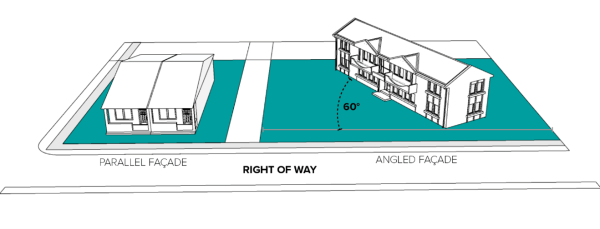
- No more than one row of parking is allowed between the building(s) and the street within 300 feet of any major intersection. No parking is allowed between the street and the building in any area identified as a City Center or a Village Center on the adopted Millcreek Future Land Use Map.
- Corner lots or parcels are deemed to have two front yards.
- Build-To-Line. The front yard setback is the build-to-line within 300 feet of any arterial/major intersection. At least 50 percent of the front elevation of the building(s) must be built within 10 feet of the build-to-line. Build-to-lines may not encroach upon the front yard setbacks established in this Chapter.
- Signage for commercial or office uses is as set forth in MKZ 18.65, Signs.
- Garbage and Recycling. The development shall be designed to accommodate and efficiently manage the collection, storage, and removal of garbage in harmony with the neighborhood to minimize detrimental effects of the collection, storage, and removal on any residence within the development or abutting neighborhoods. If dumpster enclosures are provided for the development, no refuse dumpster or dumpster enclosure structure shall be located nearer than 10 feet to any perimeter property line. Enclosure structures must have a minimum of four sides that reflect or emulate the materials, design, and quality of the overall development. All developments shall provide recycling services.
- Parking for Mixed Use developments is set forth in MKZ 18.63, Parking and Mobility Standards.
- Building Materials. Exterior materials of a durable or resilient nature such as brick, stone, stucco, prefinished panel, composite materials, or other materials of similar quality, hardiness, and low maintenance characteristics shall be used. Unless the building façade is entirely brick or stone, no single material is allowed to exceed 50 percent on all street-facing facades, excluding windows. Windows are not allowed to be less than 50 percent of the gross street-facing facade square footage. Other materials may be considered for soffits, or as an accent or architectural feature. Twenty-five-year guarantee, architectural shingles and/or other longer lasting roof materials are required. Stucco, EIFS, unfinished concrete, or metal siding shall comprise no more than 20 percent of any façade.
- Building Massing and Façade Articulation. All buildings that are not faced entirely in brick or stone shall be designed to have at least three of the following massing or façade articulation design elements, as depicted in Figure 18.43.2:
Figure 18.43.2 Building Massing Standards Illustration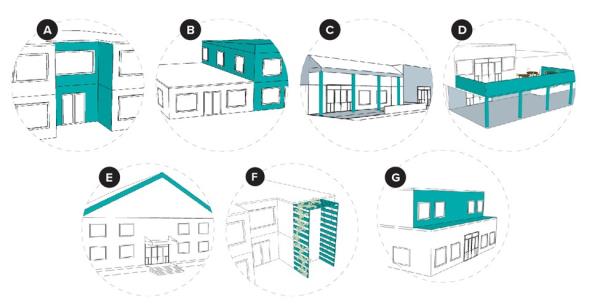
- Façade articulation. The primary façade plane shall not exceed 40 feet in length without full height articulation. The articulation shall be a minimum of two feet (2’) in depth or projection from the primary façade plane and shall be a minimum of five feet (5’) in width.
- Change in height. The top of the building shall change in height by at least five feet (5’) every 30 feet of façade length.
- Indentations or recesses. The building shall feature indentations or recesses such as alcoves or arcades at least five feet (5’) in depth along the façade at maximum of 75-foot intervals. Such indentations or recesses shall be a minimum of one story in height.
- Terraces. Unless required as a stepback, usable terraces (a larger balcony intended as a private resident leisure space or commercial leisure space) at least 10 feet in depth along the street facing facades.
- Pitched roofs. The primary structure is covered by a pitched roof with a minimum pitch of 3/12. Parapets are not considered to meet this requirement.
- Architecturally integrated trellises. Architecturally integrated trellises shall be attached to the wall and cover at least 20 percent of a wall and shall project a minimum of 18 inches from the primary façade and have accompanying landscape planting material.
- Stepbacks. Stepbacks shall only meet this requirement if not otherwise required.
- Setbacks. For the purposes of this chapter, where setbacks are measured from a right-of-way containing a fully improved sidewalk, setbacks from a right-of-way shall be measured from the edge of the sidewalk that is nearest to the front facade of the building. Where fifty percent or more of the abutting lot frontage is developed, the front yard setback shall not be less than the average of existing buildings located within 300 feet on the same side of the street, as measured in both directions from the center point of the frontage to be developed, but a front setback shall never be less than fifteen feet.
- Landscaping shall be installed as set forth in MKZ 18.64, Landscape Standards.
- Perimeter fencing shall be installed as set forth in MKZ 18.66, Fences and Retaining Walls.
- Lighting shall be installed as set forth in MKZ 18.68, Outdoor Lighting.
- Access between uses. Vehicular and pedestrian access between uses that does not force vehicles out to the adjacent street is required.
- Utilities. All utilities shall be located underground. Utility equipment shall be screened from view. Overhead telephone, cable, fiber optic, or transmission power lines must be located underground.
Repealed & Reenacted by Ord. 25-12 on 4/28/2025
18.43.090 Additional Requirements For Mixed Use Developments
Mixed Use developments shall meet the following standards, as indicated in Figure 18.43.3:
Figure 18.43.3 Mixed Use Standards Illustration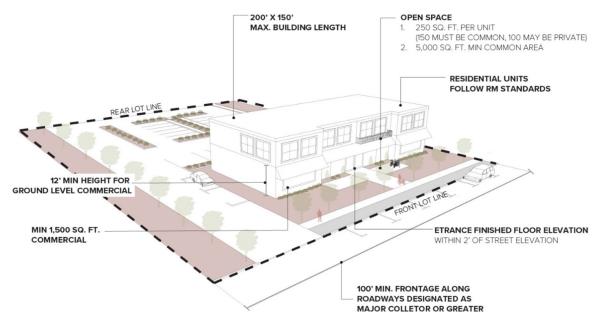
- Minimum Frontage Requirement. If the mixed use development includes residential uses, the mixed use site shall have a minimum of 100 feet of frontage along a major collector, minor arterial, or other principal arterial road as identified in the Roadway Functional Classification Map of the Millcreek Transportation Master Plan.
- Finished Floor Elevation. The finished floor elevation of entrances on a ground story commercial space fronting a street shall be no lower or higher than two feet (2’) from the street elevation, as measured at the edge of asphalt, or top of curb, where a building abuts a public sidewalk.
- Up to two facades may have a maximum building length of 200 feet and all additional facades may have a maximum building length of 150 feet.
- Parking. Parking shall meet the requirements as set forth in MKZ 18.63, Parking and Mobility Standards. In addition, the following standards apply:
- Entry Gates Prohibited. Vehicular entry gates are prohibited as part of any mixed use development containing residential uses unless the gate services a structure or podium. Gates must be situated in a manner that does not pose a traffic hazard due to vehicle queues waiting to enter through the gate.
- Tandem Spaces in Podiums and Structures. Tandem spaces in conjunction with garages may be allowed only for residential uses with a minimum size requirement of 20 feet in length and 9 feet in width per parking space, not to exceed two contiguous spaces for each unit.
- Tandem parking or parking in a private garage or driveway shall not be counted as guest parking or commercial user parking.
- Private Garage Requirements. If a private garage is utilized, it must meet the following standards:
- Two parking space garages require a minimum unobstructed size of 22 feet wide by 20 feet in length, or 20 feet wide by 22 feet in length.
- Single parking space garages require a minimum unobstructed size of 10 feet wide by 22 feet in length, or 11 feet wide by 20 feet in length.
- All private garages must have a minimum unobstructed height of seven (7) feet for the entire required length and width of the private garage, except for interior staircases.
- Garage doors shall use complementary colors and include windows.
- Private garage doors and private garages shall not be the only means of access to a dwelling.
- Minimum Commercial Floor Area Required. Mixed-use developments are required to have commercial uses as set forth in the following standards:
- A mixed use development shall have at least 1,500 square feet of commercial floor area.
- Minimum First Story Height for Ground Story Commercial Space. Ground stories containing commercial space, including live/work units, shall be at least 12 feet in height.
- Buildings containing affordable housing are exempt from the minimum commercial floor area requirements.
- Residential standards. Residential dwelling units in mixed-use developments shall follow the standards as set forth in MKZ 18.39, Residential Mixed (RM) Zone except as follows:
- Open space shall be provided for residential uses in the amount of at least 250 square feet per dwelling unit. One hundred square feet per dwelling unit may be private open space, and 150 square feet per dwelling unit must be common open space.
- The required common open space shall be usable land areas that are not occupied by buildings, dwellings, structures, parking areas, streets, public park strips, curbs, gutters, sidewalks, driveways, or alleys and shall be accessible by all residents of the mixed use development.
- Buildings erected for the principal purpose of providing an amenity or required interior common amenity spaces may be included as open space as set forth in MKZ 18.39, Residential Mixed (RM) Zone.
- Required open space may be an area of land or water set aside, or reserved for use by residents of the development, including an expanse of lawn, trees, plants, fully accessible landscaped roof areas, or other natural areas. Drainage basins may not be utilized toward required open space.
- Common open space may be distributed throughout the development and need not be in a single large area. Projects with over twenty dwelling units shall include a single and contiguous landscaped passive open space sufficient for outdoor activity with a minimum area of 5,000 square feet.
Repealed & Reenacted by Ord. 25-12 on 4/28/2025
18.43.100 Additional Standards For Vertically Integrated Mixed Use
A vertically integrated mixed use building shall consist of commercial uses on the ground story with residential uses or office uses on upper stories and is subject to the following standards, as illustrated in Figure 18.43.4:
Figure18.43.4: Commercial Space Configurations Diagram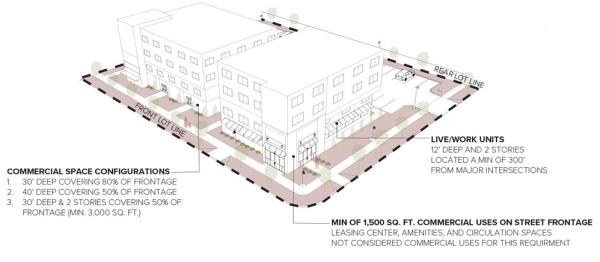
- Commercial Frontage and Minimum Depth of Ground Story Commercial Space. No less than 50 percent of the building’s front façade shall be occupied by commercial uses. Such commercial uses shall utilize one of the following configurations:
- Commercial spaces with a minimum depth of 30 feet as measured perpendicular to the frontage shall occupy at least 80 percent of a building’s ground story front façade.
- Commercial spaces with a minimum depth of 40 feet as measured perpendicular to the frontage shall occupy at least 50 percent of a building’s ground story front façade.
- Commercial spaces that occupy a minimum of two stories and shall have a minimum depth of 30 feet as measured perpendicular to the frontage and shall occupy at least 50 percent of a building’s ground story front façade. In no event shall the minimum required commercial square footage be less than 3,000 square feet.
- Commercial spaces in a live/work unit shall have a minimum depth of 12 feet as measured perpendicular to the frontage, provided the commercial space in a live/work unit is a minimum of two stories and is not located within 300 feet of a major intersection as defined in MKZ 18.44.060, Site Layout Standards.
- Ground Story Use Requirements. The ground story of a mixed use shall comply with the following requirements:
- Live/Work Units. Live/Work units may be used to meet the requirement for commercial uses, provided that the entire ground story of the live/work unit meets the design and use criteria listed in this chapter and is operated as an allowable commercial use in this Chapter. Commercial spaces in a live/work unit that are used to calculate the minimum commercial use or frontage requirements provided in this chapter shall not be used for residential purposes, parking, or storage.
- Residential Amenities as Commercial Uses. For the purposes of this chapter, leasing offices serving on-site residential and commercial uses, lobbies, required parking, elevators, stairwells, and any residential amenity spaces are not considered commercial uses.
Repealed & Reenacted by Ord. 25-12 on 4/28/2025
18.43.110 Additional Requirements For Mixed Use On Commercially Significant Development Sites
A site is determined to be a Commercially Significant Development if any of the following apply:
- The development site is greater than one acre in area.
- The development site is located within a Village Center, Retail/Office, or Employment/Commercial Future Land Use Designation on the adopted Millcreek Future Land Use Map.
- The development site is located within 600 feet of the following intersections, as measured as a radius from the nearest property line to the intersection right-of-way line:
- 4500 South and Highland Drive
- 2000 East and 3300 South
- 900 East and 3300 South
- Any Mixed Use Development on a Commercially Significant Development Site shall meet the following requirements:
- The development must include commercial uses for at least 30 percent of the mixed use development’s gross floor area of buildings abutting a street.
- Frontage Requirements. Commercial uses are not required on facades of mixed use developments that are not located on a street identified in the Millcreek Transportation Master Plan Roadway Functional Classification Map as a Major Collector, a Minor Arterial, or an Other Principal Arterial.
- Live/Work Units. Live/Work units may be used to meet the requirement for commercial uses, provided that the entire ground story of the live/work unit meets the design and use criteria listed in this chapter and is operated as an allowable commercial use in this Chapter. Commercial spaces in a live/work unit that are used to calculate the minimum commercial use or frontage requirements provided in this chapter shall not be used for residential purposes, parking, or storage.
- Parking and Vehicular Access. In addition to meeting the requirements of MKZ 18.63, Parking and Mobility Standards, any required residential parking shall be located in an enclosed parking structure, podium, private garage, or carport.
Repealed & Reenacted by Ord. 25-12 on 4/28/2025

