
Millcreek City Zoning Code
18.63 PARKING
AND MOBILITY STANDARDS
18.63.010 General Provisions
- Purpose. The purpose of this chapter is to reduce street congestion and traffic hazards in the City by incorporating efficient, attractive facilities for off-street parking, loading, bicycle parking, and internal automobile and pedestrian circulation as an integral part of every use of land.
- Applicability.
- When any building or structure is erected, enlarged, or increased in capacity, when any change of land use occurs, or when any new land use is established, off-street parking, loading, and bicycle parking shall be provided according to the standards of this chapter.
- Plans Required to Obtain Building Permit. All applications for a building permit shall be accompanied by a site plan showing a parking layout that complies with the provisions of this chapter, including ingress and egress, loading areas, internal automobile, bicycle and pedestrian circulation, and landscaping. The plan shall be reviewed and approved by Planning Director in a manner consistent with the provisions of this chapter. Parking requirements may be calculated separately for each business or land use in a building.
- If a land use changes and parking becomes inadequate, the City may require a revised site plan to evaluate the need for additional required parking.
HISTORY
Repealed & Reenacted by Ord. 25-12 on 4/28/2025
Repealed & Reenacted by Ord. 25-12 on 4/28/2025
18.63.020 Vehicle Parking Requirements
- General Parking Design Specifications
Figure 18.63. 1 General Parking Design Specifications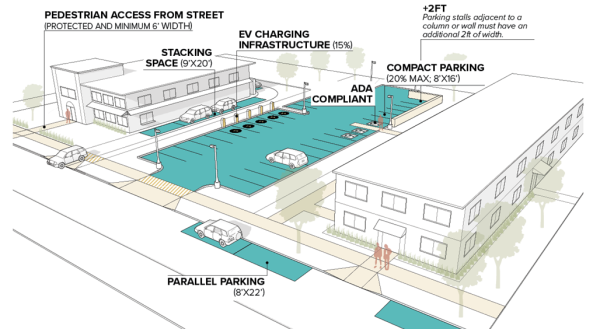
Figure 18.63.2 Minimum Parking Space Dimensions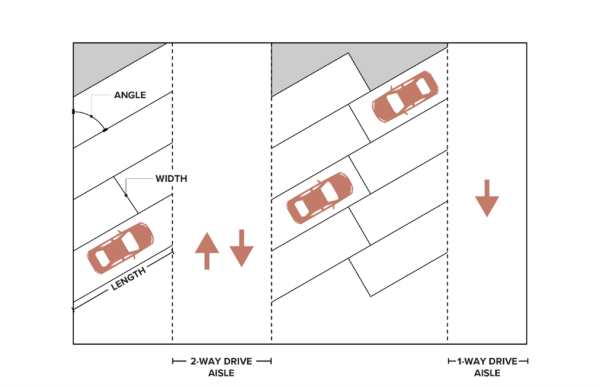
- All on-site parking facilities required by this section shall comply with the minimum parking and maneuvering space standards specified in this section, and the landscape standards as set forth in MKZ 18.64.100, Parking Lot Landscaping, and shall comply with the standards as depicted in Figures 18.63.1, General Parking Design Specifications, and 18.63.2, Minimum Parking Space Dimensions.
- Minimum Parking Space Dimensions. The arrangement and type of parking spaces as set forth in Table 18.63-1, Minimum Parking Space Dimensions Table and in Figures 18.63.1 and 18.63.2, shall determine the minimum dimensions for parking spaces.
Table 18.63-1 Minimum Parking Space Dimensions Table Parking Angle or Type Standard Width Standard Length Compact Width (3) Compact Length (3) 90° 9’ (1) 18’ 8’ (1) 16’ 45° 9’ (1)(2) 18’ (2) 8’ (1)(2) 16’ (2) 60° 9’ (1)(2) 18’ (2) 8’ (1)(2) 16’ (2) Parallel 8’ (1) 22’ None None Stacking 9’ (1) 20’ None None
Table Note 1. Parking spaces located adjacent to walls must be one foot (1’) wider to accommodate door opening clearance and vehicle maneuverability. Parking spaces located adjacent to columns, such as in parking structures or under canopies, also must be one foot (1’) wider, except for columns placed within four feet (4’) of the front or back of the parking space. The parking space width must be the clear width measured from the inside edge of a column to the inside edge of a column. Table Note 2. Angled parking space dimensions are measured as a rectangle at right angles within the angled space. Table Note 3. A maximum of 20 percent of the total required spaces may be compact spaces. - Access and Maneuverability
- Off-street parking spaces shall be accessed from private roadways, not from public streets. One-way drive aisles for angled parking be a minimum of 12 feet wide. Two-way drive aisle for angled and 90-degree parking shall be a minimum of 24 feet wide.
- A minimum six-foot (6’) wide pedestrian path from a street as defined in MKZ 18.97, Definitions, to the entrance(s) of the building shall be provided. Pedestrian paths must be protected from vehicular traffic by grade separation, bollards, landscaping, planters, or other similar methods. Pedestrian paths that cross internal traffic shall be raised and clearly striped as pedestrian priority areas.
- Vehicular cross access to adjacent parking lots serving nonresidential uses shall be provided. Should a neighboring property have a topographical change of more than four feet (4’) from the logical cross access point, this requirement shall not apply.
- Surfacing
- Required parking, associated access drives, and required internal walkways shall be surfaced with an asphaltic or concrete/cement or other binder pavement, to provide a durable and dustless surface.
- Surfaces shall be graded and drained to dispose of all surface water accumulated within the area and arranged and marked to provide the orderly and safe loading or unloading, parking, and storage of vehicles.
- Any parking area surface exceeding the number of minimum parking spaces by 10 percent, as established in this ordinance, shall incorporate low impact storm water retention practices as set forth in MKZ 18.64.100, Parking Lot Landscaping, throughout the parking lot.
- Maintenance. Every public or private parking area, including commercial parking lots and outdoor sales lots, shall be maintained according to the requirements of this chapter.
- Parking Structures or Podiums. In any Town Center, Meadowbrook, or Village Center identified in the adopted Future Land Use Map where a proposed use shall demand a parking lot of 200 or more spaces, a parking structure or podium is required to accommodate at least 50% of the parking demand. Parking structures or podiums shall incorporate commercial uses fronting the street for at least 75% of the linear footage facing any public right-of-way. Any other part of the façade facing a public right-of-way shall incorporate decorative front facades facing the street to minimize the visual impact and provide screening of the use.
- Electric Vehicle (EV) Charging Infrastructure.
- EV charging infrastructure is divided into three levels:
- Level 1 is considered slow charging. Voltage including the range from 0 to 120.
- Level 2 is considered medium charging. Voltage is greater than 120 and includes 240.
- Level 3 is considered fast or rapid charging. Voltage is greater than 240.
- For non-residential parking lots with eight (8) or more spaces, at least 15percent of all spaces in a parking area shall provide Level 2 or Level 3 EV charging infrastructure to accommodate the potential future hardwire installation of a Level-2 or Level 3 EV charging station.
- For Multiple-Household residential uses with eight (8) or fewer units, a minimum of one Level 2 EV charging station infrastructure must be provided to accommodate the potential future hardwire installation of a Level-2 EV charging station. If a dwelling unit has a dedicated parking space or spaces, at least one dedicated Level 1 or Level 2 outlet shall be provided at the dedicated parking space for the use of the dwelling unit.
- For Multiple-Household residential uses with more than eight (8) units, at least 20 percent of the required minimum parking spaces shall provide Level 2 EV charging infrastructure to accommodate the potential future hardwire installation of a Level-2 EV charging station. If a dwelling unit has a dedicated parking space or spaces, at least one dedicated Level 1 or Level 2 outlet shall be provided at the dedicated parking space for the dwelling unit’s use.
- For Mixed Use developments, the commercial and residential EV charging spaces requirement shall be calculated independently using the standards in MKZ 18.63.020 (A)(7)(c) and MKZ 18.63.020(A)(7)(d), then combining the standards to determine the total number of required EV charging spaces. EV spaces for residential portions of the project may be publicly accessible.
- All charging outlets shall be placed in areas accessible to the parking space and shall maintain minimum clearances and placements as set forth in all applicable building codes.
- A parking space dedicated as an electric vehicle charging station may count toward a minimum parking requirement provided that the electric vehicle charging station is not limited in function to a singular vehicle manufacturer.
- The required electric vehicle parking space shall be located in the same lot as the principal use.
- EV charging stations may be provided with on-street parking, however charging infrastructure must not impede the required walkways, rights-of-way, or other access areas. Charging cords shall be retractable or have a place to hang the connector and cord sufficiently above the pedestrian surface. Any cords connecting the charger to a vehicle shall be configured so that they do not cross a driveway, sidewalk, or passenger unloading areas.
- EV charging infrastructure is divided into three levels:
- Lighting. Lighting used to illuminate any off-street parking area shall comply with the standards set forth in MKZ 18.68, Outdoor Lighting.
- Accessible Parking Spaces. For all parking areas, the accessible parking spaces required to satisfy the Americans with Disabilities Act shall be provided within the total number of stalls required.
- Design Specifications for Residential Uses with Four or Fewer Units.
- Access. A driveway shall be provided for vehicular access from the street or right-of-way to the required parking spaces of any dwelling.
- Driveways accessing a street in excess of 66 feet in width shall include a means to prevent backing out onto the street, such as a circular drive or a perpendicular paved area to the driveway that enables the driver to turn the vehicle around, so that the vehicle can access the street without backing out onto the street. If such driveways are required, the required front yard landscaping set forth in MKZ 18.64.080 is waived for the driveway area.
- Width. Residential driveways shall not exceed 35 feet in width, although lots or parcels with two driveways shall have one of the driveways restricted to 12 feet and such driveways shall be separated by a minimum of 20 feet.
- Surfacing. The driveway shall be constructed of a durable, hard surface such as: concrete (including permeable concrete), asphalt (including permeable asphalt), brick, pavers, stone, or block. Gravel is prohibited as a surfacing material for driveways. The number, location, and width of driveways shall comply with the specifications set forth in MKC 14.12.110 and MKC 14.36.060. Driveways over 150 feet in length are subject to approval by the fire marshal.
- Landscaping. The area within the front yard not occupied by a driveway or parking surface set forth above shall be landscaped as set forth in MKZ 18.64, Landscape Standards.
- Electric Vehicle Infrastructure. New residential developments and any addition to a single-household dwelling, two-household dwelling, three-household dwelling, or four-household dwelling where the gross floor area is changed, modified, or expanded by 50 percent shall provide a 220-240-volt / 40 amp outlet on a dedicated circuit and in close proximity to designated vehicle parking to accommodate the potential future hardwire installation of a Level-2 electric vehicle charging station.
- Charging outlets shall be placed in areas accessible to the parking space and shall maintain minimum clearances and placements as set forth in all applicable building codes.
- Private Vehicle Parking and Storage
- A private vehicle may park in the front, side, or rear yard of a dwelling, provided the it is parked on a paved surface in compliance with this chapter.
- If a private vehicle is parked or stored on any other type of surface, private vehicles must be behind the front line of the dwelling and screened from view from public streets or neighboring properties with an opaque fence at least six feet (6’) tall.
- Recreational Vehicles (RVs)
- Residential Driveways in a Front Yard.
- Recreational vehicles shall not be parked within a front setback of a residence unless they are parked on a paved surface in compliance with this chapter.
- Recreational vehicles parked on driveways must be at least 10 feet back from the edge of the street or the public right-of-way, whichever is greater.
- Recreational vehicles parked on a driveway in the front yard must be licensed, operable and parked perpendicular to the street.
- Side or Rear Yards.
- Recreational vehicles may be parked or stored on a parking pad in a side or rear yard. A parking pad for a recreational vehicle shall extend the full length and width of the vehicle or trailer. Parking pads shall be constructed of a hard surface as defined in this Chapter, or of six inches (6”) of compacted gravel and must be kept weed free.
- Recreational vehicles shall not be stored in excess of twenty-four (24) consecutive hours in the public right-of-way, including any portions of the public right-of-way that are not improved.
- Residential Driveways in a Front Yard.
- Commercial vehicles. Commercial vehicles shall not be parked or stored on residential property, except in the following circumstances:
- Commercial vehicles may be parked on a property in conjunction with lawfully permitted construction, maintenance, or site development activities so long as said activities are diligently pursued.
- One commercial vehicle may be parked behind the front line of the dwelling and screened from view from public streets or neighboring properties, as well as an opaque fence or opaque gate that is at least six feet (6’) tall.
- One commercial vehicle may be parked in the front yard or side yard of a dwelling, in any R-1 or R-2 zone upon approval of a site plan amendment application, filed by the applicant pursuant to MKZ 18.15.030 (D), provided that all of the following criteria are met:
- No other commercial vehicle is parked or stored on the property.
- The operator of the vehicle is required to be on call twenty-four (24) hours a day to use the vehicle in response to an emergency;
- The commercial vehicle is parked on a paved surface in compliance with this Chapter;
- The commercial vehicle is parked entirely on private property, not parked on or over the street or sidewalk; and
- The commercial vehicle does not exceed Class 5 (two-axle, six-tire single-unit trucks) in the Federal Highway Administration vehicle classification.
- Access. A driveway shall be provided for vehicular access from the street or right-of-way to the required parking spaces of any dwelling.
- Minimum Parking Requirements
- Unless otherwise specified by this Chapter, each development or land use listed in Table 18.63-2 Minimum Vehicle Parking Requirements shall provide the minimum number of on-site parking and stacking spaces in accordance with Table 18.63-2 Minimum Vehicle Parking Requirements
- Parking calculations are based on gross square footage.
- When the required number of vehicle parking is computed as a fraction, the requirement is rounded to the nearest whole interval. Fractions less than one-half are rounded to the next lowest whole number.
- Unlisted Uses. For uses not expressly listed in Table 18.63-2 Minimum Vehicle Parking Requirements, the Planning Director or their designee shall have the authority to make the following determinations, in conjunction with a site plan application based on the following considerations:
- A use that is listed in Table 18.63-2 Minimum Vehicle Parking Requirements is deemed similar to the proposed use, in which case the similar use requirement may be applied; or
- A newly established parking minimum requirement may be determined for an unlisted use by referencing standards in parking resources published by the National Parking Association, American Planning Association, Institute of Traffic Engineers (ITE), Urban Land Institute, International Conference of Shopping Centers, or through a parking study commissioned by the City and performed by a professional transportation engineer licensed to practice in the State of Utah. Parking studies shall follow the format and procedure set forth in MKZ 18.69, Required Studies and Plans.
Table 18.63-2 Minimum Vehicle Parking Requirements Use Minimum Requirement Notes RESIDENTIAL USES Residential Facility for the Elderly or for Persons With a Disability A minimum of 4 parking spaces plus 1 parking space for every 5 residents. If the number of residents who own or operate a motor vehicle exceeds the number of parking spaces required for Residential Facilities for Persons With a Disability, additional parking shall be provided to ensure that every resident who owns or operates a motor vehicle has a lawfully located off-street parking space. Mobile Home Park 2 spaces per unit Single-Household Dwelling, Two-Household Dwelling, Three-Household Dwelling and Four-Household Dwelling 2 spaces per unit One space must be covered parking, except for single-household dwellings and two-household dwellings developed as affordable housing. Existing dwellings that lack one covered space as of March 12, 2018 are exempt from a covered parking requirement. Accessory Dwelling Units 1 stall per unit Multiple-Household Dwelling in the CCOZ or MD zones, including senior (55+) housing (5 or more units) (2)(3) 1.0 spaces per studio unit 1.0 space per one bedroom unit 1.5 spaces per two-bedroom unit 2 spaces per unit for units with three or more bedrooms 0.25 spaces per unit for visitor parking Multi-Household Dwelling in all other zones, including senior (55+) housing (5 or more units) (2)(3) 1.0 spaces per studio unit 1.25 space per one bedroom unit 1.5 spaces per two-bedroom unit 2 spaces per unit for units with three or more bedrooms 0.25 spaces per unit for visitor parking Affordable Housing (1)(2)(3) 0.50 spaces per studio unit 0.75 space per one bedroom unit 1 space per unit with two or more bedrooms 0.25 spaces per unit for visitor parking The application must demonstrate that units are allocated as permanent affordable housing, either through deed restriction, covenant, or other means of legal documentation deemed acceptable by the City Attorney. INSTITUTIONAL USES Religious assembly, auditoriums, and other places of public assembly 1 space per 300 square feet in the primary seating area Daycare, Preschool and Nursery Schools 1 space per 400 square feet of gross floor area If drop-off facilities are present, a minimum of 3 stacking spaces shall be provided Primary Schools and Middle Schools 1 parking space per classroom If drop-off facilities are present, a minimum of 6 stacking spaces shall be provided High School 1 space per classroom plus 1 space per 5 non-bussed students If drop-off facilities are present, a minimum of 3 stacking spaces shall be provided Trade School, College, or University 1 space per classroom plus 1 space per 4 students Homeless Resource Center 1 space per 15 beds Hospitals 1.5 spaces per bed in the total facility Nursing Homes 4 parking spaces plus 1 parking space for every 5 beds. Detention Facility/Jail 2 spaces per 3 employees and 1 space per each service vehicle stored on site. Parking for non-standard size vehicles such as busses is required if such vehicles are to be stored outdoors in parking areas. ENTERTAINMENT AND RECREATION USES Amusement Center 1 space per 150 square feet Dance Halls, Concert Halls, Club Licensees 1 space for each 150 square feet Movie Theater 1 space per 10 seats Stadiums 1 space per 1,000 square feet of seating area Gym or Fitness Studio, low volume (4) 1 space per 250 square feet Gym or Fitness Studio, high volume (5) 1 space per 150 square feet Soccer, Baseball, or Football field 20 spaces per field area Tennis, Pickleball Handball and Racquetball facility 1 space per court Swimming Pools (Commercial and Public) 1 space per 1,000 square feet of usable area COMMERCIAL USES Fuel Station 1 space per 300 square feet plus 2 stacking spaces per fueling pump Fueling pumps may not be located within twenty-four (24) of a property line or street or thirty (30) of a Residential Zone Boundary line. Stacking spaces may not infringe on vehicular access ways. Canopies over fuel pump islands shall be set back not less than ten (10) feet from any street property line and not less than ten (10) feet from any Residential Zone Boundary. Automobile Service and Repair 2 spaces for each service bay If towing service is provided, sufficient area shall be located on-site for temporary storage of vehicles and the tow truck. Automobile, Equipment, or Recreational Vehicle Sales 1 customer parking space per 400 square feet of gross floor area in the automobile sales area or 4 parking spaces, whichever requirement is greater. Depository Financial Institutions 1 per 400 square feet If drive through windows, or automobile use Automated Teller Machines (ATM) are provided, a minimum of 3 sacking spaces shall be provided Lodging 1 space per room Professional Offices 1 space per 400 square feet for the first 20,000 square feet plus 1 space per 1000 square feet excess of 20,000 square feet. Medical, Dental, Veterinary Offices 1 space per 300 square feet Mortuary or Funeral Home 1 per 300 square feet Restaurants without drive a drive-up window 1 space per 150 square feet of seating area Restaurant with a drive-up window 1 space per 150 square feet of seating area plus 4 stacking spaces from place of order and 4 stacking spaces from pick up window. Stacking spaces may not infringe on vehicular access ways. A traffic study subject to the standards as set forth in MKZ 18.69, Required Studies and Plans is required to verify that the minimum stacking spaces are sufficient, which is applicable to a change of use. Retail Sales and Shopping Centers 1 space per 300 square feet of gross floor area for the first 20,000 square feet plus 1 space per 1000 square feet of gross floor area in excess of 20,000 square feet. Personal Service 1 per 300 square feet INDUSTRIAL Manufacturing and Industrial Uses 1 space per 3 employees plus 1 space per company vehicle Flex Space 1 space per 1,000 square feet up to 40,000 square feet, plus 1 space for each 2,000 square feet over 40,000 square feet Warehouse 1 space per 2000 square feet of gross floor area for the first 20,000 square feet plus 1 space per 3000 square feet of gross floor area in excess of 20,000 square feet. Self-Storage Facility 1 per 50 units, plus 1 per 400 square feet of office area, plus 2 vehicle stacking spaces for security gate. Aisles suitable for temporary loading and unloading may be counted as required parking stalls Table Note 1. "Affordable housing", as used in this table, is defined as a development that is the recipient of a low-income housing tax credit or other public financing and in which all units in the project provide affordable housing to a target population with a household income less than or equal to 80 percent of Salt Lake County's area median income for a time period of at least 30 years.
Table Note 2. Off-street parking requirements for residential units will be based on the number of bedrooms as defined in MKZ 18.97, regardless of how the rooms are labeled (such as "den", "office", "bonus room", and "flex space").
Table Note 3. If a room within a residential unit meets the criteria of a bedroom, it will be considered a bedroom for the purposes of determining parking requirements.
Table Note 4. “Low Volume Gym or Fitness Studio,” as used in this table, is defined as a gym or fitness studio that is less than 5,000 square feet in area.
Table Note 5. “High Volume Gym or Fitness Studio,” as used in this table, is defined as a gym or fitness studio that is 5,000 square feet in area or larger.
- Reductions, Alternative Plans and Required Studies
- Stacking Study. For uses with a drive through window, a stacking study is required to determine if the minimum stacking required by this Chapter is sufficient for the proposed use. Stacking studies shall follow the format and procedure set forth in MKZ 18.69, Required Studies and Plans. A reduction or increase in stacking requirement may be approved by the Planning Director pursuant to the following criteria:
- The stacking study shall be commissioned by the City, conducted by a professional transportation engineer licensed to practice in the State of Utah, and paid for by the applicant;
- The study calculates the projected demand for stacking at the site in comparison to the requirements of Table 18.63-2 Minimum Vehicle Parking Requirements;
- The stacking study demonstrates that the proposed site plan will not exacerbate an existing deficiency in circulation, stacking, or parking;
- Any proposed stacking spaces are sufficient for the use and will not result in blockage of rights of way, internal parking, or circulations spaces;
- If a reduction in stacking spaces is requested, the stacking study shall provide industry-standard evidence of similar uses in similar contexts indicating a lesser number will meet or exceed the intent of this Chapter due to any of the following:
- The likelihood that patrons or tenants have reduced car ownership or drive less;
- The availability and practicality of walking, bicycling or transit access supporting the use; or
- Other transportation demand management plans proposed by the applicant.
- Transit Proximity Reduction. The minimum number of required parking spaces may be reduced up to 20 percent for uses that are located within one-quarter mile of a high frequency transit station such as light rail, commuter rail, or bus rapid transit (BRT) lines.
- Valet Parking Program. A valet parking program is a parking plan with personnel retained to assist parking at a drop-off area and exclusively controls the parking of vehicles into valet spaces until they are returned to a pick-up area. A valet parking program may reduce the required parking of a use up to 90 percent of the required parking minimum if the valet program meets the following requirements:
- A valet parking plan must include the following:
- A document detailing the location of valet parking lots, pick up and drop off areas, stacking spaces, and egress/ingress information.
- A document detailing the hours of operation, staffing required, a minimum lease period of 10 years, and any other applicable operational procedure information.
- A parking study commissioned by the City, conducted by a professional transportation engineer licensed to practice in the State of Utah, and paid for by the applicant must show that the proposed valet program provides sufficient peak time parking.
- A minimum of eight percent (8%) of the required parking is reserved for self-parking.
- Valet parking lots, located on a major street with a minimum width of 66 feet, must be on the same side of the street as the use they serve. Valet parking lots may be provided on the opposite side of the use being served, of a minor street, a street with a width less than 66 feet.
- A valet parking plan must include the following:
- Shared Parking. Shared use of required non-residential parking spaces may occur where two or more uses on the same or separate sites are able to share the same parking spaces because their parking demands occur at different times. Shared use of required nonresidential parking spaces is allowed, subject to approval by the Land Use Authority, and provided that the following documentation is submitted in writing with the site plan application:
- Names and addresses of the property owners that are engaging in a shared parking agreement.
- A parking study commissioned by the City, conducted by a professional transportation engineer licensed to practice in the State of Utah, and paid for by the applicant demonstrating the shared spaces are sufficient for each use at peak times. The parking study must include a breakdown of uses, comparing the peak times of weekday night, day, evening, and weekend day and evening hours as set forth in Table 18.63-3 Shared Parking Percentage Requirements.
- A map of shared parking areas along with number of parking spaces to be shared.
- A legal instrument such as an easement or deed restriction that guarantees access to the parking for both uses.
- In determining the total requirements for shared parking facilities, the Planning Director or Planning Commission shall use Table 18.63-3 Shared Parking Percentage Requirements according to the following guidelines:
- For each applicable general land use category, calculate the number of spaces required for a use as if it were the only use (refer to the schedule of minimum off-street parking requirements).
- Use the figures for each individual land use to calculate the number of spaces required for that use for each time period specified in the table (six time periods per use).
- For each time period, add the number of spaces required for all applicable land uses to obtain a grand total for each of the six time periods.
- Select the time period with the highest total parking requirement and use that as the total number of parking spaces required for the site on a shared parking basis.
- For uses not listed in Table 18.63-3 Shared Parking Percentage Requirements, or in otherwise unique circumstances, the Planning Director shall determine the required parking for the six time periods. These determinations shall be made in accordance with the National Parking Association, International Council of Shopping Centers (ICSC) American Planning Association, Urban Land Institute (ULI), Institute of Traffic Engineers (ITE) or other reputable sources of parking data.
Table 18.63-3 Shared Parking Percentage Requirements General Land Use Category Weekdays Weekends 12:00 a.m. -7:00 a.m. 7:00 a.m. -6:00 p.m. 6:00 p.m. -12:00 a.m. 12:00 a.m. -7:00 a.m. 7:00 a.m. -6:00 p.m. 6:00 p.m. -12:00 a.m. Office and Industrial 5% 100% 5% 0% 5% 0% Retail 5% 100% 80% 5% 100% 60% Restaurant 50% 70% 100% 70% 50% 100% Hotel 100% 65% 100% 100% 65% 100% Residential 100% 50% 80% 100% 75% 75% Theater/Entertainment 5% 20% 100% 5% 50% 100% Religious Assembly 0% 30% 50% 0% 100% 75%
- Offsite Parking Credits
- If offsite parking is available either on public property or on property provided by deed, lease, or easement by a public entity or private landowner for offsite parking, which parking is within 300 feet as measured from the closest property lines of a particular land use, credits may be given toward the parking requirement for said land use.
- In cases where multiple businesses or land uses qualify to use the same parking spaces for offsite parking credits, the credits shall be pro-rated for each land use. In calculating the pro-rated offsite parking credits, the Planning Director shall consider such factors as:
- The amount of frontage a property has on the street;
- The total number of parking stalls required for a given land use; and
- The potential that future development in the immediate vicinity creates further demand for parking spaces. The Planning Director may also use Table 18.63-2 Minimum Vehicle Parking Requirements for land uses in different general categories to consider shared offsite parking.
- If offsite parking is provided by deed, lease, or easement, the deed, lease, or easement shall require the owner and/or heirs, successors or assigns to maintain the required number of parking spaces for a minimum duration of at least ten (10) years. The City shall be notified when a lease or easement is terminated. If for any reason the lease or easement is terminated during the ten (10) year minimum contractual period, the lessee shall either replace the parking being lost through the terminated lease or easement or obtain approval for alternative parking requirements as found in this Chapter. A business license may be suspended until a new lease is secured for off‐site parking.
- Following approval of a building permit or conditional use permit, the lease or easement shall be recorded, referencing and appearing on the title to both the primary use property and the property to be used for off‐site parking. Off‐site parking areas shall include, at a minimum, one pedestrian connection to the primary use. The City shall approve such connections to the off‐site parking areas. A pedestrian connection shall be installed prior to the use of an off‐site parking area if one does not exist.
- Street Parking Credits. When striped public parking spaces are present along the street frontage of a site, those spaces may contribute to the minimum parking requirement, subject to the following criteria:
- Striped on-street parking spaces must abut the frontage of a given site. Parking spaces on the opposite side of the street may not contribute to the required parking.
- Striped on-street spaces may contribute up to 50 percent of the parking minimum requirement.
- In the case that street parking is constructed as an improvement in conjunction with an approved site plan, the striped on-street spaces may contribute up to 75 percent of the parking minimum requirement.
- These spaces may not be used for community parking credits.
- Stacking Study. For uses with a drive through window, a stacking study is required to determine if the minimum stacking required by this Chapter is sufficient for the proposed use. Stacking studies shall follow the format and procedure set forth in MKZ 18.69, Required Studies and Plans. A reduction or increase in stacking requirement may be approved by the Planning Director pursuant to the following criteria:
- Alternative Travel Mode Reduction. For sites providing enhancements, a total reduction of up to 15percent of the minimum parking requirement may be granted by the Planning Director at the time of site planning if the site provides one or more of the following enhancements:
- Enhanced walkways that exceed the minimum required sidewalk width by two feet (2’) with enhanced landscaping adjacent to the walkways.
- A paved plaza must be located between the primary structure and the right-of-way, covering at least 10 percent of the site’s square footage. The plaza must provide seating and shade trees.
- Enhanced bicycle parking is provided by exceeding the minimum requirement by at least 50 percent.
- If a site fronts a bus stop, additional enhancements at the stop such as benches, a shelter, or similar amenities are provided.
- Provisional Parking. Provisional parking is defined as an area or areas within a parking lot where the spaces shown on the approved parking plan are landscaped rather than paved. The site plan must show that the provisional parking spaces comply with the Chapter’s parking stall size requirements and the maneuverability and aisle requirements as set forth in this Chapter.
HISTORY
Repealed & Reenacted by Ord. 25-12 on 4/28/2025
Amended by Ord. 25-38 on 9/8/2025
Amended by Ord. 26-52 on 7/27/2026
Repealed & Reenacted by Ord. 25-12 on 4/28/2025
Amended by Ord. 25-38 on 9/8/2025
Amended by Ord. 26-52 on 7/27/2026
18.63.030 Off-Street Loading Requirements
- Loading Space Design Requirements
- Minimum Dimensions: Each loading space shall be at least 10 feet wide, 25 feet long and 14 feet high.
- Loading spaces must be located on the same property that they are intended to serve.
- For industrial and commercial uses, a loading space may occupy any required yard or court only if it is enclosed by a brick or stone wall not less than six feet (6’) in height.
- Loading spaces for Multiple-Household dwellings must be located in an easily accessible area that will eliminate deliveries and moving vehicles from frequently blocking the right-of-way or other major internal access drives.
- Off-Street Loading Requirements
- Each development or land use listed in Table 18.63-4 Minimum Off-Street Loading Requirements shall provide the minimum number of on-site loading spaces in accordance with Table 18.63-4 Minimum Off-Street Loading Requirements.
- When the computation of the required loading spaces results in a fraction, the requirement is rounded to the nearest whole interval. Fractions less than one-half are rounded to the next lowest whole number.
- Reductions of up to 100 percent of the loading space requirement may be considered at time of site planning by the Planning Director, which shall be considered according to the following criteria:
- The required number of loading spaces is unnecessary due to the nature of the proposed use;
- Reducing the requirement will not result in frequent delivery traffic blocking the right-of-way or high-traffic internal circulation areas.
| Table 18.63-4: Minimum Off Street Loading Requirements | |
| Use | Minimum Requirement |
| Multi-Household dwelling with 15 or more units | 1 loading space per 150 units, maximum of 3 |
| Commercial and industrial uses with no docking facility up to 10,000 gross square feet | 1 space |
HISTORY
Repealed & Reenacted by Ord. 25-12 on 4/28/2025
Repealed & Reenacted by Ord. 25-12 on 4/28/2025
18.63.040 Bicycle Parking Requirements
- Bicycle parking spaces shall be:
- Located on the same lot as the principal use;
- Located and designed to prevent damage to bicycles by cars;
- Located so as not to interfere with pedestrian movements;
- Located in a highly visible, well-lighted area that is located near the entrance(s) to the building;
- Located to provide safe access from the spaces to the public right-of-way or bicycle lane;
- Designed with racks to accommodate a range of bicycle shapes and sizes, and to allow the frame and wheel(s) of each bicycle to be supported and secured against theft without interfering with adjacent bicycles;
- Racks shall be anchored to resist removal by vandalism and resistant to rust or corrosion.
- Bicycle parking spaces that meet the above requirements may be located within the building.
- The proposed bicycle parking spaces shall be clearly shown on the site plan indicating location and type.
- Multiple-Household residential uses with more than eight (8) units shall provide an on-site enclosed and secured bicycle storage room with racks for the use of the residents.
- Bicycle Parking Requirements. Bicycle parking facilities shall be provided for any new commercial, office, manufacturing, industrial, Multiple-Household residential, recreational, public and/or quasi-public use for which automobile parking is required; or for modification or change of any use listed above that results in the need for additional automobile parking facilities and is required for all principal uses as outlined in Table 18.63-5 Bicycle Parking Requirements.
| Table 18.63-5: Bicycle Parking Requirements | |
| Use | Minimum Requirement |
| Residential, Multi-Household with 3-8 units | 2 spaces per 4 dwelling units |
| Residential, Multi-Household with more than 8 units | 2 spaces per 4 dwelling units, 50% of which must be in an enclosed and secured bicycle storage room or in private garages |
| Office | 2 publicly available spaces per establishment or 1 space per 15,000 square feet, whichever is greater |
| Restaurant | 4 publicly available spaces per establishment |
| Retail | 2 publicly available spaces per establishment |
| School | 1 space per classroom |
HISTORY
Repealed & Reenacted by Ord. 25-12 on 4/28/2025
Amended by Ord. 26-52 on 7/27/2026
Repealed & Reenacted by Ord. 25-12 on 4/28/2025
Amended by Ord. 26-52 on 7/27/2026

