
Millcreek City Zoning Code
18.45 INSTITUTIONAL
FACILITIES ZONE IF
18.45.010 Purpose
The purpose of the Institutional Facilities (IF) Zone is to promote institutional projects, and supporting commercial, of regional significance that are developed as campuses to increase employment and economic vitality in Millcreek while enforcing design that is sensitive to single-household neighborhoods. The development standards in this chapter regulate impacts that may be caused to immediate neighborhoods. The permitted uses under this zone are intended to meet the needs of Millcreek residents. It is the intent of Millcreek to restrict the IF Zone to specific locations that facilitate the creation of valuable centers or future center study areas, as defined in the adopted Future Land Use Map of the Millcreek General Plan.
Repealed & Reenacted by Ord. 25-12 on 4/28/2025
18.45.020 Applicability
This chapter applies to development and uses in the Institutional Facilities Zone. Development in the Institutional Facilities Zone may also be subject to the requirements set forth in MKZ 18.61, Sensitive Lands. In addition, the following standards apply:
- Any campus located in the IF Zone shall have a minimum area requirement of three acres.
- For rezone considerations, the City Council may impose larger area requirements to mitigate any detrimental effects described under MKZ 18.15.030 (A).
- Any campus located in the IF zone must be a contiguous group of parcels not separated by a public right-of-way.
- In the event there is language elsewhere in MKZ Title 18 that conflicts with language in this chapter, the more restrictive standard prevails.
Repealed & Reenacted by Ord. 25-12 on 4/28/2025
18.45.030 Neighborhood Contact And Outreach
- Purpose. Institutions are encouraged to be active and invested in the nearby community. This section is intended to promote ongoing communication between campus institutions and other uses and to provide courtesy notices of large construction projects that may impact abutting properties.
- Any development, modification, addition, alteration to any use on a property located in the IF zone or intended to be rezoned to the IF zone that exceeds 10,000 square feet in gross square footage or exceeds 30 feet in height require a mailed notice. Notice shall be mailed at least fourteen days prior to submitting for a permit or application to Millcreek, including building permit, to property owners within 300 feet of the campus perimeter.
- The notice shall at a minimum consist of general timeline of construction, scope of work, anything in the construction that may interrupt regular flow of traffic or that takes place in a public right-of-way and contact information of the project manager or a designee that can answer questions or address concerns.
- Exemption. If the scope of the project has already met the requirements of MKZ 18.14.090 as part of a land use review process, it is exempt from the neighborhood contact requirements.
Repealed & Reenacted by Ord. 25-12 on 4/28/2025
Amended by Ord. 26-07 on 1/26/2026
18.45.040 Permitted Uses And Conditional Uses
- All uses in the IF zone are subject to MKZ 18.45.090 (D), Required Mitigation.
- Uses in the Institutional Facility (IF) Zone are as set forth in Table 18.45-1 Permitted and Conditional Uses in the Institutional Facility (IF) Zone. If a use is not explicitly designated in the table, then the use is prohibited. An applicant seeking a Millcreek Business License may submit a Classification Request by following the procedure as set forth in MKZ 18.15.030 (J), to determine whether a proposed land use aligns with an existing land use listed in Table 18.45-1.
| Table 18.45-1 Permitted and Conditional Uses in the Institutional Facilities (IF) Zone | ||
| Land Use | IF | Limitations / References |
| P= Permitted C= Conditional Use Review Required | ||
| Accessory uses, Accessory Buildings and Structures | P | |
| Nursing Home or Assisted Living | P | |
| Eating and Drinking Establishments, Dine-In | P | |
| Public Parking Lot or Parking Garage | P | Only permitted as an accessory use. |
| Drive-Up Window | P | Only permitted as an accessory use to Depository Financial Institutions or Pharmacies. Not allowed within 150 feet of a residential use. |
| Auditorium, theatre, or meeting facility for the purpose of education, business, or entertainment | P | Only permitted as an accessory use. An entertainment use in the IF zone may not occupy a space greater than 5,000 square feet, excluding parking and required site improvements. |
| Temporary Uses | P | |
| General Retail | P | |
| General Service | P | |
| Hospital | C | |
| Medical or Dental Clinic | C | |
| Lodging | C | May not exceed 40 feet in height. |
| Personal Services | P | Only permitted as an accessory use. Each Licensed Massage Therapist who is not an employee of the business licensee shall have a Millcreek business license. |
| Office | P | Only permitted as an accessory use. |
| Public Use | P | |
| Quasi-Public Use | P | |
| Schools, Public and Private | P | |
| Religious Assembly | P | |
| Residential Facility for the Elderly or for Persons With a Disability | P | Subject to standards in MKZ 18.74, Residential Facilities for Persons With a Disability |
| Schools, Public and Private | P | |
| Accessory Buildings | P | Accessory Buildings are subject to the Bulk and Yard Requirements found in Development Standards established in MKZ 18.59, Accessory Structures |
| Temporary Uses | P | As set forth in MKZ 18.58, Temporary Uses and Structures |
Repealed & Reenacted by Ord. 25-12 on 4/28/2025
18.45.050 Prohibited Uses, Limitations, And Special Requirements
Certain use prohibitions or use limitations are listed in Table 18.45-2. Such use prohibitions or use limitations apply in addition to the general provision that uses not explicitly designated in the table are prohibited.
| Table 18.45-2 Prohibited Uses in the Institutional Facilities (IF) Zone |
| Detention Facility or Jail as a principal use |
| Indoor or Outdoor Gun or Archery Range |
| Outside Storage |
| Outdoor Displays |
| Dwellings |
| Automobile, Equipment, or Recreational Vehicle Sales or Rental |
| Outdoor Kennel |
| Sexually Oriented Businesses |
| Retail Tobacco Specialty Business |
| Self-storage Facility |
| Non-Depository Financial Institution |
| Outdoor Commercial Entertainment |
| Automobile Service and Repair |
| Pawn Shop |
Repealed & Reenacted by Ord. 25-12 on 4/28/2025
18.45.060 Spatial Requirements
- The spatial requirements are as set forth in Table 18.45-3 Spatial Requirements for the Institutional Facilities (IF) Zone.
Table 18.45-3 Spatial Standards Measurement Type Measurement Minimum lot width 300 feet Maximum building height As set forth in MKZ 18.45.070 and MKZ 18.72, Building Height (1) Maximum lot coverage 80 percent Minimum open space 20 percent (2) Minimum building height 1 story Minimum front yard setback 20 feet Minimum rear yard setback 10 feet Minimum rear yard setback when abutting a Residential Zone Boundary 20 feet Minimum side yard setback 10 feet Minimum side yard setback when abutting a Residential Zone Boundary 20 feet Minimum side yard setback abutting a public street 20 feet Accessory structure minimum side yard setback abutting a public street 20 feet Accessory structures: rear and side yard setback 10 feet Accessory structures: rear and side yard when abutting a Residential Zone Boundary. 20 feet Accessory structure minimum and maximum height 1 story Parking structure minimum setback 20 feet Parking structure maximum height 60 feet - Table 18.45-3 notes
- Greater height may be granted if the proposed development can follow all conditions under section MKZ 18.72, Building Height.
- The required open space shall be land areas that are not occupied by buildings, dwellings, structures, parking structures, streets, curb-gutter-sidewalk, driveways, or alleys. Said open space may be an area of land or water set aside, or reserved for use of the development, including an expanse of lawn, trees, plants, fully accessible landscaped roof areas, or other natural areas. Open space also includes common walkways, formal picnic areas, and recreational areas. Open space may be distributed throughout the development and need not be in a single large area. Open space may include sensitive areas, such as areas with thirty percent or greater slope, fault zones, flood plains, high water tables, and wetlands, if they have been designed as an integral element of the project. A five percent reduction in open space is permitted for civic uses to ensure adequate parking, and transit needs are met.
Repealed & Reenacted by Ord. 25-12 on 4/28/2025
18.45.070 Building Height Requirements
- For campuses 10 acres in size or more, the height of main buildings on campus must comply with the following conditions, as illustrated in Figure 18.45.1:
- On a portion of the campus within 60 feet of a lot or parcel line abutting a Residential Zone Boundary the maximum height is 35 feet
- On a portion of the campus that is more than 60 feet but within 100 feet of a lot or parcel line abutting a Residential Zone Boundary the maximum height is 75 feet.
- On a portion of the site that is more than 100 feet away from the campus perimeter, as determined by a boundary survey prepared by a surveyor licensed to practice in the State of Utah, the maximum height is 100 feet.
Figure 18.45.1 Building Height Requirements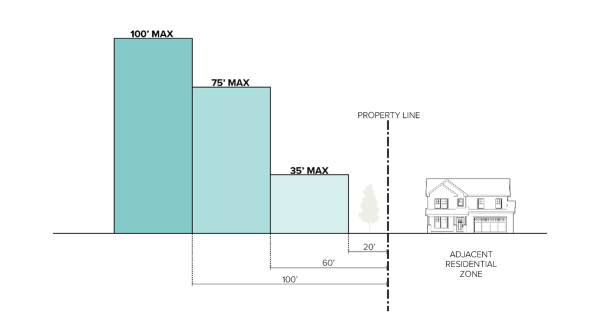
- For campuses that are less than 10 acres the height of main buildings and parking structures on campus must comply with the following conditions:
- On a portion of the campus within 60 feet of a lot or parcel line abutting a Residential Zone Boundary the maximum height is 35 feet.
- Maximum height for all buildings is 45 feet.
- Height Projection Allowances identified in MKZ 18.72.040 are subject to the following standards:
- For buildings greater than 60 feet from a campus perimeter or a Residential Zone Boundary, the maximum increase in height for allowable height projections is 22 feet.
- For buildings less than 60 feet from a campus perimeter or a Residential Zone Boundary, the maximum increase in height for allowable height projections is 14 feet.
- Stepbacks. For buildings that are greater than 40 feet in height and that are within 100 feet of a campus perimeter, a 20-foot stepback of any building façade, facing any street or Residential Zone Boundary, is required between the bottom of the first story and the top of the third story and upper stories.
Repealed & Reenacted by Ord. 25-12 on 4/28/2025
18.45.080 Design And Use Standards For General Retail And General Service Uses
General Retail and General Service uses are subject to the following requirements:
- Business shall be conducted wholly within an enclosed building, except for the parking of customer vehicles, except that any type of eating and drinking establishment may have outdoor dining. Outdoor music associated with the eating and drinking establishment shall comply with all applicable noise ordinances.
- All products, whether primary or incidental, shall be sold on the premises.
Repealed & Reenacted by Ord. 25-12 on 4/28/2025
18.45.090 Site And Design Standards
- Entrances. All entrances to buildings and parking lots and parking garages that connect to or abut a public right-of-way must be located and designed to provide pedestrian access to any transit stops located along the right-of-way, so that the entrances have the shortest possible path from transit stop to building.
- Parking and Traffic Mitigation.
- Parking lot and parking garage design must accommodate transit stops located along a public right-of-way. Parking lots and parking garages must have safe pedestrian paths leading from a transit stop to a building.
- As part of any site plan review or subdivision approval, the City may require ingress, egress, and access easements to secure vehicular and pedestrian access throughout a campus without forcing vehicles to use abutting public rights-of-way.
- More than one ingress/egress to a public right-of-way for each campus is required. No ingress/egress to a public right-of-way may be located nearer than 200 feet to an intersection.
- Generators, Emergency Power Systems, and Medical Gas Supply System Tanks. New generators, emergency power systems, and medical gas supply system tanks shall be located no closer than 30 feet from a Residential Zone Boundary. All such systems shall be screened from view from abutting residential properties with fencing or landscaping. All such systems shall incorporate sound attenuation designs, including but not limited to sound walls, sound baffles, or appropriate landscaping.
- Required Mitigations.
- Nuisances and Noise. All uses in the IF zone shall be free from objectionable and unreasonable odor, dust, smoke, noise, vibration, or similar problems. The noise level emanating from any use or operation shall not exceed the limits in the applicable Salt Lake County Health Department regulations regarding noise control.
- Interior Street Lights. Street and pedestrian lighting for streets on the interior of the campus is required. Outdoor lighting is subject to the requirements as set forth in MKZ 18.68, Outdoor Lighting. No on-site light poles may be located closer than 10 feet from the public right-of-way.
- Garbage and Recycling.
- The campus shall be designed to accommodate and efficiently manage the collection, storage, and removal of garbage in harmony with the neighborhood to minimize detrimental effects of the collection, storage, and removal on any residence within the development or abutting neighborhoods. Enclosure structures must have a minimum of four sides that emulate the materials, design, and quality of the overall development. All developments shall provide recycling services.
- For any structure or object used for garbage collection, or recycling such as a dumpster, the minimum setback from the property line is 20 feet. Garbage or recycling collection is not allowed within 30 feet of a property line that abuts a Residential Zone Boundary.
- Screening Requirements Along a Residential Zone Boundary. Any development in the IF zone within one hundred feet (100’) of a Residential Zone Boundary must incorporate at a minimum two (2) of the following options for screening:
- Any noise source that may in the course of 24 hours emit a noise that is greater than 50 decibels measured from 20 feet away from the noise source in any direction must provide adequate screening directly around the structure or object emitting noise.
- A masonry wall and evergreen trees that reach heights of 25 feet to 30 feet dispersed along a campus boundary that abuts a Residential Zone Boundary. The distance allowed between trees shall be 20 feet or less.
- Shrubs or tall grasses shall be used within a setback to increase the likelihood of absorbing sound. Shrubs or tall grasses must be dispersed throughout the entire length of the setback along a Residential Zone Boundary. Shrubs must be no greater than 10 feet apart and grasses must be no greater than five feet (5‘) apart.
- Mechanical buildings or structures, loading docks, utility structures are not located within 100 feet of a Residential Zone Boundary. Roof-mounted mechanical or utility structures on buildings taller than 75 feet in height are exempt from this requirement.
- Perimeter Fencing. Fencing is required for non-residential uses that abut residential uses, and shall comply with the standards as set forth in MKZ 18.66, Fences and Retaining Walls, except as provided below:
- Fence materials may consist of metal picket, wood, masonry, or composites. Vinyl is prohibited as a fencing material. Exterior fencing along a public right-of-way shall be limited to brick, stone, or block, or pre-cast concrete and be set back a minimum of five feet (5’) from the campus perimeter or right-of-way line to allow for a landscaping buffer designed in accordance with MKZ 18.64, Landscape Standards, to soften long expanses of walls.
- To ensure maximum pedestrian connectivity, fencing between IF parcels is not required.
- Architecture and Windows.
- Building Materials. Exterior materials of a durable or resilient nature such as brick, stone, stucco, prefinished panel, EIFS, composite materials, or other materials of similar quality, hardiness, and low maintenance characteristics shall be used. No single material can exceed 50 percent on street-facing facades. Other materials may be considered for soffits, or as an accent or architectural feature. Twenty-five-year guarantee, architectural shingles and/or other longer-lasting roof materials shall be used.
- Windows shall make up at least 50 percent of first story street-facing facades and shall be at least 50 percent transparent.
- Corner Lots or Parcels. Corner lots or parcels are deemed to have two front yards.
Repealed & Reenacted by Ord. 25-12 on 4/28/2025

