
Millcreek City Zoning Code
18.39 RESIDENTIAL
MIXED ZONE RM
18.39.010 Purpose
The purpose of the Residential Mixed (RM) Zone is primarily a residential zone intended to be a transitional zone between low density residential neighborhoods and commercial uses. It primarily accommodates medium to high density residential development/complexes including single-household dwellings, duplexes, three and four household dwellings, multiple household dwellings, and mixed use where a limited list of non-residential uses are allowed. Mixed use developments are required for properties near certain intersections as set forth in this chapter.
Repealed & Reenacted by Ord. 25-12 on 4/28/2025
18.39.020 Applicability
This chapter applies to development in the Residential Mixed Zone. Development in the Residential Mixed Zone may also be subject to the requirements set forth in MKZ 18.61, Sensitive Lands.
Repealed & Reenacted by Ord. 25-12 on 4/28/2025
18.39.030 Permitted Uses And Conditional Uses
Uses in the Residential Mixed (RM) Zone is as set forth in Table 18.39-1, Permitted and Conditional Uses in the Residential Mixed (RM) Zone. If a use is not explicitly designated in the table, then the use is prohibited. Certain use prohibitions or use limitations are listed in Table 18.39-1. Such use prohibitions or use limitations apply in addition to the general provision that uses not explicitly designated in the table are prohibited. An applicant seeking a Millcreek Business License may submit a Classification Request by following the procedure as set forth in MKZ 18.15.030 (J), to determine whether a proposed land use aligns with an existing land use listed in Table 18.39-1.
| Table 18.39-1 Permitted and Conditional Uses in the Residential Mixed (RM) Zone | ||
| Land Use | RM | Limitations/References |
| P= Permitted, C= Conditional Use Review Required | ||
| Residential Uses | ||
| Accessory Dwelling Unit | P | Permitted in Legally-Established Single Household Dwellings. Limitations set forth in MKZ 18.71, Accessory Dwelling Unit Standards. |
| Dwelling, Single-Household | P | |
| Dwelling, Two-Household | P | |
| Dwellings, Three- or Four-Household | P | |
| Dwellings, Multiple-Household up to 32’ building height and up to 25 units | P | Mixed-use shall be required for developments located within 500’ of specified intersections. See additional standards below. |
| Dwellings, Multiple-Household over 32’ building height or more than 25 units | C | Mixed-use shall be required for developments located within 500’ of specified intersections. At least three units shall have primary façade and primary entrance facing the street in developments with more than six units |
| Affordable Housing | P | Subject to MKZ 18.78, Affordable Housing Incentives |
| Home Business | P | Subject to MKZ 18.76, Special Business Land Use Regulations |
| Home Daycare or Preschool – up to 6 children | P | Subject to MKZ 18.76, Special Business Land Use Regulations |
| Home Daycare or Preschool – 7 to 12 children | C | Subject to MKZ 18.76, Special Business Land Use Regulations |
| Live/Work Unit | P | Only permitted in association with requirements for mixed use developments as set forth in MKZ 18.43.090. |
| Residential Facilities for Elderly Persons or Persons With a Disability | P | Limitations as set forth in MKZ 18.74, Residential Facilities for Persons With a Disability |
| Nursing Home or Assisted Living | C | |
| Short-Term Rental | P | Provided a valid Millcreek business license has been issued and is in good standing with respect to the property. Further limitations are as set forth in MKC 5.19, Short Term Rentals. |
| Commercial Uses | ||
| Depository Financial Institution | P or C | Permitted Use within legally-established commercial buildings. Conditional Use when located within mixed use. Drive-up Windows are prohibited. |
| Mixed Use | C | |
| Commercial Daycare or Preschool | C | Allowed within legally-established commercial buildings or within mixed use. |
| Gym / Fitness Studio | C | Allowed within legally-established commercial buildings or within mixed use. |
| Medical or Dental Clinic | P or C | Permitted Use within legally-established commercial buildings. Conditional Use when located within mixed use. |
| Office | P or C | Permitted Use within legally-established commercial buildings. Conditional Use when located within mixed use. Drive-up Windows are prohibited. |
| Personal Service | C | Permitted Use within legally-established commercial buildings. Conditional Use when located within mixed use. Drive-up Windows are prohibited. |
| Eating or Drinking Establishments, Dine-In | C | Allowed within legally-established commercial buildings or within mixed use. Drive-up Windows are prohibited. |
| Neighborhood Retail or General Retail | P or C | Permitted Use within legally-established commercial buildings. Conditional Use when located within mixed use. Drive-up Windows are prohibited. |
| Civic and Institutional Uses | ||
| Public Use | C | |
| Quasi-Public Use | C | |
| Religious Assembly | P | |
| Schools, Public and Private | P | |
| Miscellaneous Uses | ||
| Accessory Uses, Buildings and Structures | P | As set forth in MKZ 18.59, Accessory Structures |
| Temporary Uses | P | As set forth in MKZ 18.58, Temporary Uses and Structures |
Repealed & Reenacted by Ord. 25-12 on 4/28/2025
Amended by Ord. 25-38 on 9/8/2025
Amended by Ord. 26-52 on 7/27/2026
18.39.040 Spatial Requirements
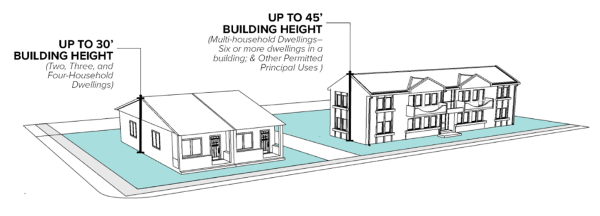
- The minimum setbacks, maximum height and lot size requirements are as set forth in Table 18.39-2 Spatial Regulations for the Residential Mixed (RM) Zone and are illustrated in Figures 18.39-1 and 18.39-2.
- Setbacks. Where fifty (50) percent or more of the abutting lot frontage is occupied by a building façade, the front yard setback shall not be less than the average of existing buildings located within three hundred (300) feet on the same side of the street, as measured in both directions from the center point of the frontage to be developed, but a front setback shall never be less than fifteen (15) feet.
- A lot or parcel containing an existing legally-established two-household dwelling may be subdivided, subject to the standards as set forth in MKZ 18.26, Division of Legally-Established Two-Household Dwellings.
Figure 18.39.1 Spatial Regulations Diagram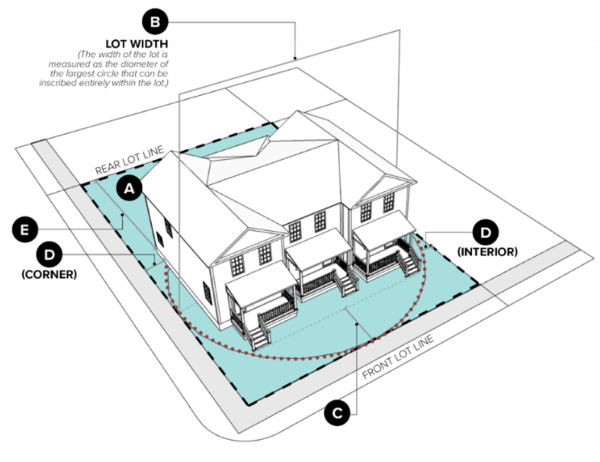
Table 18.39-2 Spatial Regulations for the Residential Mixed (RM) Zone Single-Household Dwellings (1) Two, Three, and Four- Household Dwellings Multiple-household Dwellings– Five or more dwellings in a building Other Permitted Principal Uses Principal Buildings Minimum Gross Land or Parcel Area (A) 6,000 sf per dwelling unit 3,000 sf per dwelling unit 2,000 sq ft per dwelling unit, except affordable units and individually owned units require 1,500 sq ft per unit 20,000 sf Minimum Lot or Parcel Width (B) 60 feet None None None Maximum Building Height 30 feet 32 feet 45 feet(2) 45 feet(2) Maximum Lot or Parcel Coverage 35% 40% 50% 50% Maximum Building Length None None 150 feet 150 feet Minimum Front Yard Setback (C) 20 feet 20 feet 20 feet 20 feet Minimum Interior Side Yard Setback (D) 8 feet 10 feet 10 feet 10 feet Minimum Interior Side Yard Setback, where abutting a residential zone boundary (3) 8 feet 10 feet 25 feet 25 feet Minimum Corner Side Yard Setback (D) 20 feet 20 feet 20 feet 20 feet Minimum Rear Yard Setback (E) 10 feet 10 feet 20 feet 20 feet Minimum Distance Between Residential Buildings 5 feet 5 feet 10 feet 10 feet - Table 18.39-2 Notes:
- Additional Requirements for Single-Household Dwellings. Single-Household dwellings are subject to the building envelope requirements for the R-1-6 zone as set forth in MKZ 18.36.040 and MKZ 18.36.050.
- Height Transition Requirements. Buildings or structures within 100 feet of a Residential Zone Boundary shall not exceed 30 feet, excluding Height Projection Allowances identified in MKZ 18.72.040.
- The Minimum Interior Side Yard Setback, where abutting a residential use boundary may be reduced to the standard Minimum Interior Side Yard Setback where the abutting use is an institutional use, a commercial use, and industrial use, or a cemetery.
Figure 18.39.2 Maximum Building Height Diagram
Repealed & Reenacted by Ord. 25-12 on 4/28/2025
Amended by Ord. 25-38 on 9/8/2025
18.39.050 Site Design Standards
Developments with more than two dwelling units within the RM Zone must meet the following site layout requirements:
- Street Frontage. Development along any right-of-way must face the street and buildings must be oriented parallel to the right-of-way as much as practical.
- Building Entrances and ground level living space.
- Functional residential entrances are required on any street-facing façade.
- First story entrances shall be oriented to common areas using the following hierarchy:
- Street
- Courtyard or common open space
- Auto courts / alley
- First story entrances shall include a porch of at least 60 square feet and a fence, wall or hedge no taller than four feet (4’). Such areas are included in the open space requirement.
- Dwelling units shall have a minimum ground level living space of at least 150 square feet with a minimum width of 10 feet, as illustrated in Figure 18.39.3. Garages, utility / laundry rooms, hallways, bathrooms, and workshops do not count as living space for this purpose.
Figure 18.39.3 Ground Level Living Space Diagram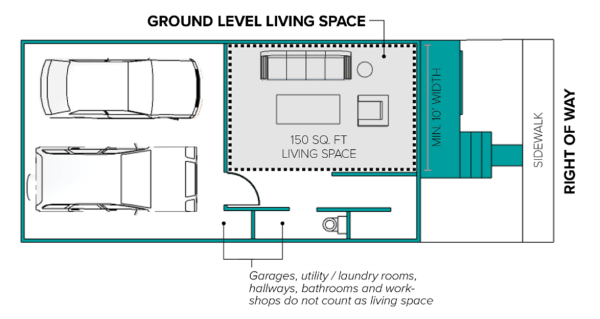
- Multiple Building Types. When a development consists of multiple building types, each building in the development must comply with maximum building height and building length requirements for the building type, as well as the following requirements:
- Maximum lot coverage: Maximum lot coverage shall not exceed 50 percent.
- Interior Side Yard Setbacks: Minimum interior side yard setbacks shall follow the requirements for multi-household dwellings with five or more units in a building.
- Setbacks between buildings: Where two building types abut each other in a development, the setbacks between the buildings shall follow the requirements for multi-household dwellings with five or more dwellings in a building.
- Minimum Lot area Per Unit: The minimum lot area for a development with multiple building types shall be the sum of the lot area required for each building type times the number of units of that building type. In no case shall the total area required be less than 2,000 square feet per unit, regardless of building type.
- Interior Streets and Driveways. The design of public and private streets within a development shall follow Millcreek standards for road widths as established by the Millcreek Transportation Master Plan and the development standards identified in MKC Title 14.
- Sidewalks. As required elements of a development, interior sidewalks shall be at least five (5) feet wide installed to serve the development, including connecting ground story pedestrian entrances to internal aisleways and streets, connecting parking to buildings on the site, and connecting the development to the public street. Sidewalks shall comply with the Standard Plans for Public Works Construction.
- Parking and Vehicular Access. Parking for developments in the RM zone shall follow the requirements of MKZ 18.63, Parking and Mobility Standards. Additionally, developments shall comply with the following requirements:
Parking required for each residential dwelling unit must be in a structure, a podium, a private garage, or a carport. Carports shall be either located to the back of the building or screened as set forth in MKZ 18.64, Landscape Standards.- Parking Location. For residential and mixed use developments with eight (8) or more dwelling units, parking is not allowed between any building façade and the property line along a right-of-way. Such parking shall not encroach on the side or front setbacks. Parking may not encroach into a side or rear yard setback, abutting a property that is in an R-1, R-2, R-4, or AG zone.
- Private Garage Requirements. If a private garage is utilized, it must meet the following standards:
- Two parking space garages require a minimum unobstructed size of 22 feet wide by 20 feet in length, or 20 feet wide by 22 feet in length.
- Single parking space garages require a minimum unobstructed size of 10 feet wide by 22 feet in length, or 11 feet wide by 20 feet in length.
- All private garages must have a minimum unobstructed height of seven (7) feet for the entire required length and width of the private garage, except for interior staircases.
- Garage doors shall use complementary colors and include windows.
- Private garage doors and private garages shall not be the only means of access to a dwelling.
- Tandem Spaces in Podiums and Structures. Tandem spaces in conjunction with garages may be allowed only for residential uses with a minimum size requirement of 20 feet in length and 10 feet in width per parking space, up to a maximum of two (2) contiguous spaces per dwelling unit.
- Vehicular Entry Gates Prohibited. Vehicular entry gates are prohibited as part of any multi-household development unless the gate services a structure or podium. Gates must be situated in a manner that does not pose a traffic hazard due to vehicle queues waiting to enter through the gate.
- Parking is prohibited within required fire access and turnaround facilities.
- Tandem parking or parking in a private garage or driveway shall not be included in any required guest parking calculation.
- Additional standards for Three-Household and Four-Household Buildings:
- Private or Shared Driveways. No more than two (2) units may share a driveway.
- No driveway or combined driveway with the abutting unit shall exceed 24 feet in width unless such driveways are separated by a minimum five feet (5’) wide irrigated planter that includes at least one (1) shrub and one (1) medium size tree.
- Driveways located on a street with a right-of-way greater than or equal to 66 feet shall prohibit backing out onto the public street.
- Open Space. Common and private open space shall be provided for residential uses in the amount of at least 30 percent of the gross site area of the building or development in the RM zone.
- For purposes of this section, gross site area means the total area of the development excluding anything in the public right-of-way.
- The required common open space shall be usable land areas that are not occupied by buildings, dwellings, structures, parking areas, streets, public park strips, curbs, gutters, sidewalks in a right-of-way, driveways, or alleys and shall be accessible by all residents of the development.
- The area of a building erected in the RM zone for the principal purpose of providing an amenity or required interior common amenity spaces may be included as open space. Said open space may be an area of land or water set aside, or reserved for use by residents of the development, including an expanse of lawn, trees, plants, fully accessible landscaped roof areas, or other natural areas.
- Private outdoor open space serving individual dwelling units shall be counted toward the total open space requirement.
- Common open space also includes formal picnic areas, and recreational areas. Common open space may be distributed throughout the development and need not be in a single large area.
- Open space amenities and gathering places shall reflect the market that the development is attempting to attract.
- Fencing. Fencing for developments in the R-M zone shall follow the requirements of MKZ 18.66, Fences and Retaining Walls. In addition, perimeter fencing shall be installed by the developer between incompatible uses and/or incompatible zones, as set forth in MKZ 18.64, Landscape Standards.
- Garbage and Recycling. The development shall be designed to accommodate and efficiently manage the collection, storage, and removal of garbage to minimize detrimental effects of the collection, storage, and removal on any residence within the development and abutting neighborhoods.
- Collection of garbage and recycling for four-household dwellings and multiple-household dwellings must occur on the property, and not on a public right-of-way.
- Dumpster enclosure structure shall not be located nearer than 10 feet to any perimeter property line and shall not be located in between the primary structure(s) and the right-of-way.
- Dumpster and recycling enclosure structures must have a minimum of four sides, including an opaque gate on one side, that emulate the materials, design, and quality of the overall development. All developments shall provide recycling services. Enclosures and gates must be a minimum of six feet (6’) in height and must completely screen the contents within from view.
- Mechanical Equipment and Utilities.
- All mechanical equipment such as HVAC systems shall be screened from view from the ground-level vantage point along an abutting street or private vehicular access as set forth in Buffer C of MKZ 18.64, Landscape Standards.
- Utility equipment shall be screened from view as set forth in Buffer C of MKZ 18.64, Landscape Standards.
- Privacy. Each residential or mixed use building in the RM zone shall provide adequate visual and acoustical privacy for dwelling units.
- Fences, walks, barriers, landscaping, and sound reducing construction techniques with a maximum transmission of 55 decibels in the walls and ceilings shall be used to enhance the privacy of its occupants, the screening of objectionable views or uses, and the reduction of noise.
- Where balconies or patios are provided for residential buildings, balconies or patios shall have a 50% opaque fence or screen that is at least three feet tall.
- Rooftop Gardens and Rooftop Patios. For any development abutting a Residential Zone Boundary, rooftop gardens or rooftop patios are prohibited within 100 feet of a Residential Zone Boundary, unless the rooftop garden, patio or amenity space is not located above the highest occupied story of a building in the RM zone or is obstructed from view from the zone boundary by at least twenty (20) feet of occupied floor space, as illustrated in Figure 18.39.4.
Figure 18.39.4 Rooftop Patio Diagram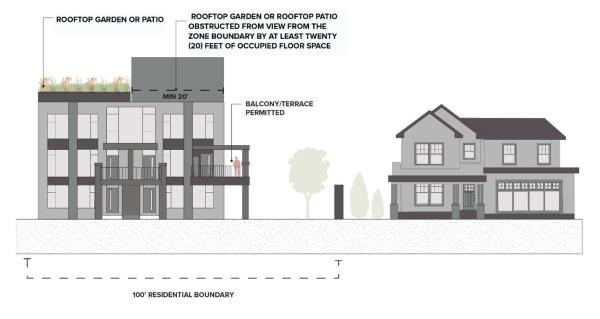
- Outdoor Lighting. Outdoor lighting shall comply with the standards set forth in MKZ 18.68, Outdoor Lighting, and the following additional standards:
- Interior Street and Parking Lot Lighting. Street and pedestrian lighting for streets on the interior of the development is required. The fixture height shall not exceed 25 feet, and no poles shall be located within 10 feet of any property line.
- Yard Lights. An energy efficient LED street-oriented yard light shall be required per street facing façade where public street lighting is inadequate per the following:
- Maximum height of eight feet (8’).
- Minimum lighting capacity of 0.2-foot candles and/or 500 lumens.
- Yard lights shall be located within five (5) feet of the public right-of-way.
Repealed & Reenacted by Ord. 25-12 on 4/28/2025
Amended by Ord. 25-38 on 9/8/2025
Amended by Ord. 26-52 on 7/27/2026
18.39.060 Building Materials And Massing Design Standards
- Building Massing and Façade Articulation. Buildings with brick or stone comprising 80 percent of all facades, excluding windows and doors, shall be designed to have at least two of the following massing or façade design elements, as illustrated in Figure 18.39.5. All other buildings in the RM zone shall be designed to have at least four of the following massing or façade design elements.
- Visual breaks along the street-facing façade such as horizontal articulation in the plane of the façade by at least two feet (2’) (A).
- Changes in height at the top of the building by at least 10 feet for every 30 feet of façade length (B).
- Changes in materials, color, texture, or pattern for greater than 50 percent of the building façade (C).
- Indentations or recesses at least five feet (5’) in depth along the street facing facades at 50-foot intervals (D).
- Usable terraces of at least 10 feet in depth along the street facing facades, unless required as a stepback. Usable terraces must provide either private or common leisure space (E).
- Pitched roofs. The primary structure is covered by a pitched roof with a minimum pitch of 3/12. Parapets are not considered to meet this requirement (F).
- Step backs of at least 10 feet where not otherwise required on facades facing streets with a 66-foot right-of-way or greater (G).
Figure 18.39.5 Building Massing and Façade Articulation Diagram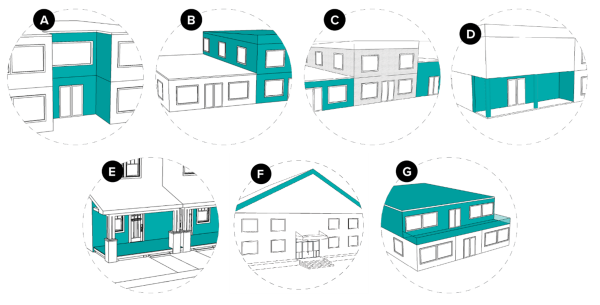
- Building Massing and Façade Variation for Developments Containing Multiple Buildings.
- No more than two abutting buildings or buildings within 300 feet of the development shall exhibit the same or substantially the same architectural design for street facing façades.
- All buildings in the development shall provide variation in all façades, including but not limited to the use of materials and relief, to avoid monotonous design. For purposes of this section relief means: foundation jogs over two feet, bay or box windows, cantilevered living areas, recessed garages, pitched roofs versus flat, building length reduced by at least 20%, rooftop terraces where none exist at other locations, functional street facing balconies where none exist at other locations, and/or usable front porches of at least six feet in depth that extend across 40 percent or more of the front façade.
- At least three units for every 150 feet have the primary entry along the primary street facing facade.
- Developments with five (5) or more residential dwelling units must meet one of the following additional standards if structures are greater than 30 feet in height:
- A 10-foot stepback is utilized between the first or second stories and third story on the façade of any building over 30 feet in height. The step back must be present on any façade that faces any street, property frontage, and Residential Zone Boundary.
- The building over 30 feet in height incorporates brick or stone on at least 80 percent of all facades, excluding windows and doors. Brick or stone facades supersede the varying materials requirements for upper stories.
Repealed & Reenacted by Ord. 25-12 on 4/28/2025
18.39.070 Windows
Windows or doors shall comprise at least 25 percent of each story of any street-facing façade. Buildings on streets with a right-of-way width of 80 feet or greater the street facing façade windows shall be increased to 30 percent.
Repealed & Reenacted by Ord. 25-12 on 4/28/2025
18.39.080 Building Materials
- Except for single-household dwellings and two household dwellings, exterior materials of a durable, resilient nature shall be used such as brick, stone, stucco, prefinished panel, composite materials, or other materials of similar quality, hardiness, and low maintenance characteristics, as depicted in Figure 18.39.6. Identification of materials is required as part of a complete application submittal. If the City staff question the proposed materials based on the specified materials in this ordinance, a materials board may be required providing samples of the proposed materials. Materials must meet the following requirements:
Figure 18.39.6 Building Materials Diagram
- Except for brick or stone, no single material is allowed to exceed 50 percent on any street-facing facade, excluding windows.
- Other materials may be considered for soffits, gables, or as an accent or architectural feature.
- Twenty-five-year guarantee, architectural shingles and/or other longer-lasting roof materials are required.
- Stucco, EIFS, architecturally finished concrete, or metal siding shall comprise no more than twenty percent (20%) of any façade visible from a street or from an abutting property that is located in an R-1, R-2, R-4, or AG zone.
- A change of materials is required between the ground story and upper stories.
- Renewable Energy Incentive. Projects with solar power arrays, windmills/turbines, or functional geothermal systems, suitable to generate 50 percent or more of the development’s electrical demand shall be permitted an additional five feet (5’) in height and not required to be screened from view. Solar carport rooftops are encouraged. Wind power generators shall have a setback from any property line equal to their height and not exceed a sound level of 60 dB as measured from a point on the ground at least 30 feet from the wind power generator.
Repealed & Reenacted by Ord. 25-12 on 4/28/2025
18.39.090 Required Features
- Storage. Each residential dwelling unit for developments with three or more dwelling units shall be required to contain interior storage equal to 100 cubic feet.
- Washer and Dryer Connections. All multi-household residential developments shall include either washer and dryer connections for each dwelling unit or an on-site laundry.
- Balconies or Patios. All residential units shall have a private balcony and/or patio with a minimum of 60 square feet with a minimum five-foot (5’) depth.
- Management. Twenty-four-hour on-site management is required for all residential developments consisting of more than 50 dwelling units.
Repealed & Reenacted by Ord. 25-12 on 4/28/2025
Amended by Ord. 25-38 on 9/8/2025
18.39.100 Design Standards For Non-Residential Buildings
Design standards for non- residential buildings in the RM zone shall follow the Site Layout Standards as set forth in MKZ 18.44.060, the Building Massing Standards as set forth in MKZ 18.44.070, the Building Materials Standards as set forth in MKZ 18.44.080, and the applicable design and use standards as set forth in MKZ 18.44.090.
Repealed & Reenacted by Ord. 25-12 on 4/28/2025
18.39.110 Design Standards For Mixed Use Buildings
Design standards for mixed use buildings in the RM zone containing residential uses shall follow the design requirements found in MKZ 18.44.090 (H).
Repealed & Reenacted by Ord. 25-12 on 4/28/2025
Amended by Ord. 25-38 on 9/8/2025
18.39.120 Recreational Amenities
- For residential developments with eight (8) or more dwelling units, recreational amenities are required per Table 18.39-3 Required Number of Recreational Amenities.
Table 18.39-3 Required Number of Recreational Amenities Total Number of Bedrooms Total Number of Recreational Amenities 8-50 1 51-150 2 151-225 3 226-300 4 301-400 5 401-500 6 501+ 7 plus 1 additional amenity for each 100 bedrooms above 600. - Recreational Amenities may include the following, subject to the following criteria:
- Sport Courts:
- Large sport courts such as basketball, tennis, volleyball or similar shall be regulation size and each court may count as one (1) amenity up to a limit of three (3).
- Small sport courts such as pickleball, handball shuffleboard, horseshoes or similar may count as one (1) amenity for every three (3) courts up to six (6) courts totaling two (2) amenities.
- Swimming Pools, Hot Tubs, Saunas:
- One thousand (1,000) square feet of pool surface area plus a cooling deck with a minimum width of 10 feet in all areas may count as one (1) recreational amenity.
- Twenty-five hundred (2,500) square feet of pool surface area plus a cooling deck with a minimum width of 20 feet in all areas may count as two (2) recreational amenities.
- Five thousand (5,000) square feet of pool surface area plus a cooling deck with a minimum width of 20 feet in all areas may count as three (3) recreational amenities.
- A hot tub or sauna area with a minimum eight (8) person capacity may count as one (1) recreational amenity.
- Picnic Area. A picnic area may be considered as one (1) recreational amenity, up to a limit of two (2), should it meet all the following criteria:
- The seating area is covered by a pavilion, gazebo, pergola, or similar shelter covering a minimum of 500 square feet;
- Tables with seating and /or benches for a minimum of 15 persons;
- At least one fixed cooking grill is provided; and
- A least one trash receptacle is provided.
- Dog Park. A dog park may be considered as a recreational amenity if it meets all the following criteria:
- The dog park enclosure is 3,000 square feet minimum;
- The enclosure is fenced by a minimum five foot (5’) tall fence meeting the requirements of MKZ 18.66, Fences and Retaining Walls;
- No point of the enclosure may be less than 30 feet in width;
- The enclosure shall include a minimum of one (1) dog waste station which shall include a bag dispenser and waste receptacle to be installed along the perimeter of the enclosure for every 3,000 square feet of the associated dog park; and
- One 25-square-foot animal washing bay with associated plumbing shall be provided in conjunction with the dog park.
- Community /Amenity Centers may be considered as a recreational amenity should it meet all the following criteria:
- Gym, fitness center and/or weight room may count as one (1) recreational amenity if it is a minimum of 750 square feet and appropriately equipped for fitness activities.
- A game room that is a minimum of 750 square feet and includes at least three (3) dedicated game spaces for activities such as table tennis, billiards, air hockey, or similar may count as one (1) recreational amenity.
- A business center, workshare space, teleconferencing spaces that total a minimum of 500 square feet may count as one (1) recreational amenity. A maximum of one business center may be utilized as an amenity.
- A lounge, movie theatre, or party or similar gathering room that is a minimum of 750 square feet may count as one (1) recreational amenity.
- Lawn or gathering area for non-organized sports may be considered one (1) recreational amenity as set forth in the following criteria:
- The lawn or gathering area is a minimum of 5,000 square feet and at least 60 feet wide in all areas.
- Landscaping must be installed in a manner that preserves the openness of the area for such activities.
- The lawn or gathering area is not located within drainage storage areas.
- No more than one (1) recreational amenity may be awarded for a lawn or gathering area on a given project.
- Trails may be considered as recreational amenities as set forth in the following criteria:
- Trails 1,000 feet to 2,500 feet in length may count as one (1) recreational amenity.
- Trails over 2,500 feet in length may count as two (2) recreational amenities.
- No more than two (2) amenities may be awarded for trails on a given project.
- Six-foot minimum width shall be maintained for the entirety of the trail.
- The trail shall feature demarcated lanes for non-motorized use such as bicycling, walking, skating, or jogging.
- The trail may or may not be paved but shall be constructed of a dust-free surface.
- Playgrounds may be considered as recreational amenities as set forth in the following criteria:
- Active recreational area that is a minimum of 2,500 square feet may count as one (1) recreational amenity.
- No more than two (2) recreational amenities may be awarded for playgrounds on a given project.
- Playgrounds shall feature a variety of facilities, including equipment for younger children.
- When abutting any parking lot, street, or other hazardous place the playground must be fenced with an open-style fence, subject to the standards as set forth in MKZ 18.66, Fences and Retaining Walls.
- Recreational Amenities not listed may be considered by the Planning Director at the time of site plan submittal. In order to approve of such alternate amenities, the applicant must demonstrate all of the following criteria is met by the proposed amenity:
- The amenity serves a clear recreational function and serves as a clear enhancement to the quality of life for the residents of the development.
- The proposed amenity is of similar or better standards to the amenities provided in this section.
- The amenity is of a permanent nature.
- The proposed amenity will not be of nuisance to residents or neighboring properties.
- Sport Courts:
Repealed & Reenacted by Ord. 25-12 on 4/28/2025

