
Millcreek City Zoning Code
18.66 FENCES
AND RETAINING WALLS
18.66.010 Purpose
The purpose of this chapter is to promote the use of high-quality materials in fences and retaining walls, while providing privacy, safety and security for individual properties and pedestrians through design, height, materials, and placement.
Repealed & Reenacted by Ord. 25-12 on 4/28/2025
18.66.020 Applicability
- All fences and walls shall comply with the standards of this chapter.
- Any fence and/or walls in existence prior to the adoption date of this ordinance may remain, provided that the fence and/or wall satisfies all three of the following criteria:
- The fence and/or wall existed before the adoption date of this ordinance and complied with the standards in effect at that time,
- The fence and/or wall has been maintained continuously in good condition since the adoption of this ordinance,
- The fence and/or wall does not encroach into a public right-of-way or violates a clear view area.
- The provisions of this chapter may be superseded by specific regulations found in other chapters.
Repealed & Reenacted by Ord. 25-12 on 4/28/2025
18.66.030 Permit Requirements
- Department approval required. Unless otherwise stated, fences or retaining walls that comply with this section are permitted by right without the need to obtain a site plan approval from the Planning Director.
- Building permit. A building permit shall be obtained for fences exceeding seven feet (7’) in height and retaining walls with a height greater than four feet (4’) of unbalanced fill, or walls supporting a surcharge, or as required by the currently adopted version of the International Building Code (IBC) or International Residential Code (IRC).
- Review of Construction Drawings. Prior to construction, all fencing and walls for new development shall have construction drawings submitted to the City for review and approval by the City Engineer. These drawings shall be considered part of the project improvements for bonding and occupancy purposes. Such plans shall include existing and proposed fences, style, material, heights, site plan and profile views, and original and finished grades as measured within four feet (4’) of both sides of the fence.
Repealed & Reenacted by Ord. 25-12 on 4/28/2025
18.66.040 General Requirements
- Fencing may be described as open-style or opaque fencing, as depicted in Figure 18.66.1. Open-style fencing is when a minimum of 70% of the fence area is transparent. Opaque fencing is where more than 70% of the fence area is obscured.
Figure 18.66.1 Fence Types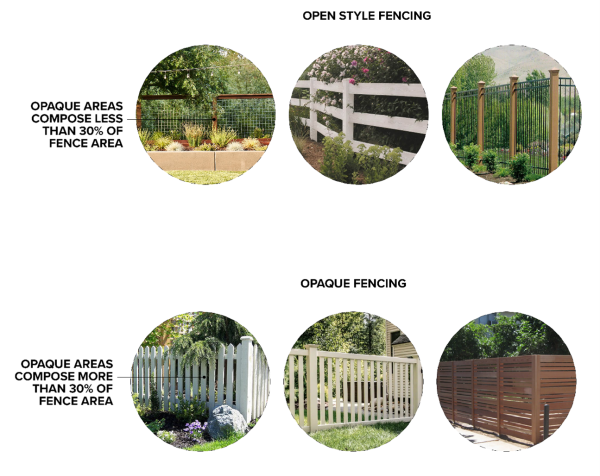
- Waste Receptacles. All waste receptacles associated with commercial uses or multiple-household dwellings of more than four units shall be enclosed by a minimum six-foot (6’) high masonry or precast wall and shall include solid steel access doors. The color and materials of waste receptacle enclosures shall be consistent with the colors used on the associated buildings. All gates and doors shall be made of a solid steel material. Exterior waste enclosures are prohibited within ten feet (10’) of a residential property line or the front and street side yard areas.
- Recreation Fencing. All recreation sports court fences in excess of eight feet (8’) in height shall be a dark-colored open-style net, mesh, or powder-coated chain-link material.
- Commercial ball field fences/nets may be allowed up to 60 feet in height when associated with a park, golf course, ball field, or similar commercial or recreational facility. Fences/nets above eight feet (8’) in height shall be located a minimum 10 feet from property lines.
- A residential sports court fence shall only be located within the rear and interior side yard areas. Sports court fences exceeding eight feet (8’) in height shall be located a minimum of 30 inches from the property lines. Residential sports court fences may exceed eight feet (8’) in height when the fence is setback a minimum of thirty 30 inches from the property lines. For each foot of fence height in excess eight feet (8’), the setback shall also increase by one foot. No residential sports court shall exceed 14 feet in height.
- Temporary Fencing. A temporary six-foot (6') chain-link or similar six-foot (6') safety fence shall be installed around construction sites throughout the construction project. All construction fences shall be well-maintained and in excellent condition. All gates shall be securely locked when the construction site is unattended. Temporary construction fencing is exempt from the size and location requirements but must still meet all clear vision area requirements.
- Decorative Treatment. All sides of fencing shall be treated equally.
- Trail and Parks. Other fencing or landscaping techniques may be used to buffer waterways, trails, parks, open spaces, or other uses as the Planning Director determines.
- Fence and Wall Maintenance. The property owners abutting a fence or wall shall continually maintain them in good repair and ensure that the fence or wall is structurally sound, and in a safe condition. Repairs and patching shall use similar fencing materials and shall blend with the fence. The fence and wall owners are responsible for removing graffiti within 10 days of receiving a notice from a City code compliance officer.
- Utility Clearance and Easements:
- No fence or retaining wall may be within four feet (4’) of an above-ground utility including but not limited to, fire hydrants, water meter boxes, telecommunication pedestals, and streetlights, without written permission from the utility company.
- Fences and retaining walls shall not be constructed within an easement without prior written permission from each affected party, on a form acceptable to the City. Notwithstanding any written permission, the City reserves the right to deny a permit for a wall within or over a municipal or utility easement.
Repealed & Reenacted by Ord. 25-12 on 4/28/2025
18.66.050 Hazardous Area Fencing
- Unless the Planning Director directs otherwise, fencing is required along hazardous areas including, but not limited to, railroads, canals, ditches, flood channels, waterways, unless as otherwise directed by the Planning Director.
- Fencing along hazardous areas shall be a minimum six feet (6’) in height. Taller fences or walls for properties with unusual topography or for a central utility facility may be required by the Planning Director.
- Cap fences along hazardous areas must be made of approved materials.
- Fencing along hazardous areas shall be solid decorative precast and integrally colored and textured block, brick, stone, or other masonry fence.
- Sidewalks or trails that cross over or are perpendicular to hazardous areas must have decorative open-style fencing such as decorative metal picket, split rail, or other decorative open-style fences made of high quality, durable, low maintenance materials.
Repealed & Reenacted by Ord. 25-12 on 4/28/2025
18.66.060 Collector And Arterial Street Fencing
- Properties with a rear or side yard abutting a collector or arterial street, as identified in the Roadway Functional Classification Map of the adopted Millcreek Transportation Master Plan, may install a decorative masonry or precast fence that is at least six feet (6') high along the abutting a street right-of-way line adjoining the property. Colors and patterns shall match other masonry walls located within five hundred feet (500’) of either end of the fence.
- Masonry fences located along collector streets or arterial streets as identified in the Roadway Functional Classification Map of the adopted Transportation Master Plan shall include an anti-graffiti sealant.
- Noise Walls
- Any development abutting I-215 or I-15 shall install a noise wall along the corridor right-of-way line if the Utah Department of Transportation determines whether such a wall is necessary.
- Sound walls are exempt from the height and location requirements of this Chapter.
Repealed & Reenacted by Ord. 25-12 on 4/28/2025
18.66.070 Fence Location And Height
- Front Yards and Street Side Yard Fences
- Fences may be located within the front yard or street side yard setback area along a street right-of-way, as indicated in Figure 18.66.2 Yard Fence Locations, provided that:
- Privacy fences shall not exceed six feet (6’) in height within the street side yard area and not exceed three feet (3’) in height within the front yard and/or clear view areas, as measured from the nearest sidewalk, top of curb, or asphalt improvements,
- Front yard fences may be allowed up to six feet (6’) in height if designed and maintained as an open-style non-obscuring fence.
- Chain-link fences are prohibited within a side yard abutting a street and all front yard areas except for during construction.
- Fences located within clear view areas as set forth in MKZ 18.67, Clear View Areas, shall be less than three feet in height unless designed and maintained as an open-style and non-obscuring fence.
- Fences abutting a collector street or arterial street, as identified in the Roadway Functional Classification Map of the adopted Transportation Master Plan shall meet the requirements for Collector and Arterial Street Fencing as set forth in this chapter.
Figure 18.66.2 Yard Fence Locations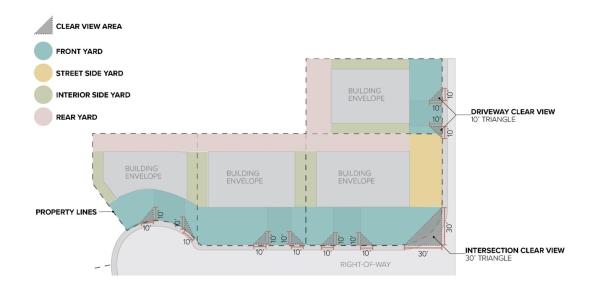
- Fences may be located within the front yard or street side yard setback area along a street right-of-way, as indicated in Figure 18.66.2 Yard Fence Locations, provided that:
- Interior Side Yard and Rear Yard Fences
- A fence not exceeding seven feet (7’) in height may be installed between abutting properties within side or rear yard area and/or along a rear or side property line without a building permit.
- Fences and/or walls in the rear or side yard area may extend up to a maximum of eight feet (8’) in height, however, according to applicable building codes, fences and/or walls may require a building permit.
- All rear and side yard fences shall comply with applicable clear view areas as set forth in MKZ 18.67, Clear View Areas.
Repealed & Reenacted by Ord. 25-12 on 4/28/2025
18.66.080 Fence Materials
- Permitted Fence Materials
- Fences and walls shall be made of high quality, durable materials that require minimal maintenance. The following materials and colors shall be used for all fences, except as otherwise provided in this section or by a more restrictive provision of this title or engineering standard:
- Decorative precast concrete or integrally colored and textured block, brick, stone, or other masonry wall materials;
- Vinyl, polyethylene materials with beige, white or other neutral color;
- Composite fence materials (Trex®, SimTek®, or similar);
- Weather-tolerant wood materials such as but not limited to cedar, redwood, cypress, bamboo;
- Decorative wrought iron or metal picket materials or solid metal panels with a thickness of at least 1/8”;
- Powder-coated chain-link may be allowed for public recreational uses or sport courts;
- Welded wire panel;
- Chain-link is allowed for temporary construction fences.
- Fences and walls shall be made of high quality, durable materials that require minimal maintenance. The following materials and colors shall be used for all fences, except as otherwise provided in this section or by a more restrictive provision of this title or engineering standard:
- Prohibited Fence Materials
- The following fencing materials shall be prohibited in all zones:
- Plastic materials other than vinyl and composite;
- Materials not typically used, designated, or manufactured for fencing, such as but not limited to roofing panels, corrugated or sheet metal, tarps, wood panel (plywood OSB sheeting), scrap lumber or metal, rubber, tires, containers;
- Chain-link, when located within a front or street side yard area.
- Barbed wire, concertina wire, razor ribbon, and similar fencing materials;
- Electric fences.
- The following fencing materials shall be prohibited in all zones:
- Fences on properties zoned as agricultural and large enough for livestock animals shall be constructed of sturdy fence materials, such as metal pipes, horse-grade vinyl, wood posts or similar materials the manufacturer recommends and as the Planning Director determines.
Repealed & Reenacted by Ord. 25-12 on 4/28/2025
Amended by Ord. 25-38 on 9/8/2025
18.66.090 Fence Height Measurement
- Fence height shall be measured from the existing grade to the highest point of the fence. Grade shall not be modified as part of a permit to increase fence height. The height of a berm, retaining wall, or other means to modify grade that existed prior to the construction of a fence is considered as contributing to the height of a fence.
- When a difference in grade exists on either side of a fence or wall, the height of the fence or wall shall be measured as follows:
- Height is measured at the property line from the lower property grade.
- The higher property grade may not exceed 12 feet of elevation gain at any point within four feet (4’) of the property line.
Repealed & Reenacted by Ord. 25-12 on 4/28/2025
Amended by Ord. 26-52 on 7/27/2026
18.66.100 Neighborhood Compatibility Modification (NCM) For Fence Height
The Neighborhood Compatibility Modification (NCM) allows for modified standards for the height of fences in A, R-1, R-2, R-4, RM, and FRE based upon the compatibility of the proposed residential development application with other lots and parcels in the proximate neighborhood. The Planning Director may approve an NCM request at time of site plan submittal provided the following conditions are met:
- Evidence. Compliance with the corresponding neighborhood conditions must be established by a survey of the proximate neighborhood. The survey must be completed by a surveyor licensed to practice in the State of Utah.
- Submittal. NCM requests shall be submitted on a separate land use application and shall include an additional review fee as set forth in the Millcreek Consolidated Fee Schedule.
- Permissible Modifications. The fence height shall be the average height of existing fences that are on all lots or parcels within the proximate neighborhood. Fence height modifications may be accommodated if the request does not exceed a fence height of twelve feet (12’).
- Like-for-Like Comparison Required. Fence height modifications approved through the NCM shall be based only on fences of the same type and location as the proposed fence. The average fence height used to establish an NCM shall be calculated using only fences within the proximate neighborhood that are located in the same yard as the proposed fence. Fences in different yards shall not be included in the analysis.
- Non-Permissible Modifications. Modification of fence heights in clear vision areas as set forth in MKZ 18.67, Clear View Areas, do not qualify under the NCM.
Repealed & Reenacted by Ord. 25-12 on 4/28/2025
Amended by Ord. 26-52 on 7/27/2026
18.66.110 Retaining Walls - General Requirements
- Walls requiring a building permit shall submit a Geotechnical Report for soil stability by a certified geotechnical engineer licensed to practice in the state of Utah.
- Wall systems that are four feet (4') or higher and that are made of organic material, such as treated lumber or railroad ties, are prohibited.
- Retaining walls located on properties subject to Sensitive Lands standards, shall comply with all applicable standards of MKZ 18.61, Sensitive Lands.
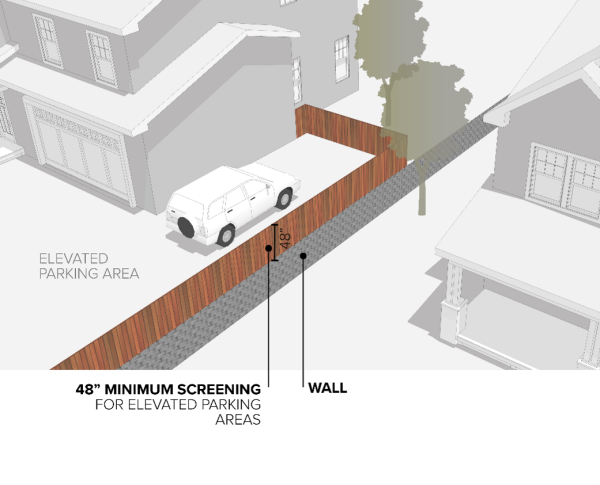
- A minimum 48-inch opaque screening fence, as depicted in Figure 18.66.3, shall be utilized for retaining walls used to extend driveways or to create additional surface parking or vehicular access when a fill is required to raise the elevation of the property from the original grade.
Figure 18.66.3 Retaining Wall Parking Screening
Repealed & Reenacted by Ord. 25-12 on 4/28/2025
18.66.120 Retaining Wall Submittal And Inspections
- A site plan and wall design plan stamped by a structural or geotechnical engineer licensed to practice in the State of Utah, must be submitted in order to obtain a building permit for a retaining wall.
- Site plans shall include the following:
- The boundary of the property, including any required setbacks, easements, and building envelopes;
- The existing and proposed surrounding surface grades and structures located in front of, behind, and to the side of the retaining wall at a distance equivalent to three times (3x) the height of the wall. If the wall is supporting a slope, the site plan shall include the entire slope plus surface grades and structures within a horizontal distance equivalent to the height of the slope;
- The location of the proposed retaining wall(s);
- The height and elevation of the bottom of the lowest point of the wall, the top of the wall and the finish elevation of the fill on both sides of the wall;
- The drainage plan for the surrounding area and how the walls drainage system will connect to the site drainage system;
- Wall Design plans shall:
- Reference any geological and geotechnical studies conducted on the site and incorporate the findings into the design.
- Include sections and details to be utilized in the construction of the retaining wall showing:
- A detailed cross-section showing each lift’s minimum rock or block size, or a cross-section showing concrete thickness and re-bar size and spacing.
- The maximum wall height.
- The backfill material and specification.
- Soil stabilization methods or reinforcement materials and the required frequency of installation.
- A retaining wall drainage detail.
- The slope of the adjacent ground, including the surrounding properties
- Minimum embedment into the existing soil
- The inward slope of a retaining wall’s outside face.
- Inspections and Final Report: The engineer of record shall monitor all phases of retaining wall construction to verify that the nature and quality of the materials being used are appropriate and that the construction is in accordance with the engineered design. The engineer shall verify and submit to the City in writing that the materials and construction of the retaining walls are as built in accordance with the engineered design after construction.
- Conflict:
- Millcreek retains a City Geologist to review, suggest modifications, and approve Geotechnical Reports. Millcreek reserves the right to commission the City Geologist to review or inspect all retaining walls, whether existing or proposed at the applicant’s expense.
- Millcreek may request an as-built survey of retaining walls to verify height and surrounding grades at the applicant's expense prior to approval.
- In cases of conflict between the provisions contained in this chapter, other adopted zoning regulations, the building code,, and the adopted standards for Sensitive Lands standards as set forth in MKZ 18.61, Sensitive Lands, or any other ordinance of Millcreek, the most restrictive provision shall apply.
Repealed & Reenacted by Ord. 25-12 on 4/28/2025
18.66.130 Retaining Wall Height And Terracing
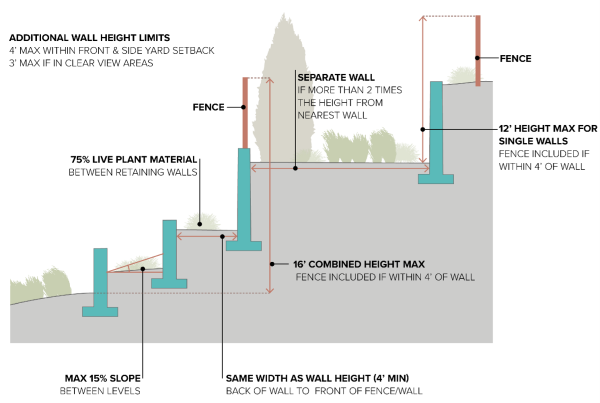
- Retaining wall height and terracing requirements are generally depicted In Figure 18.66.4.
- To calculate the height of a retaining wall for compliance with the standards of this code, height shall be measured from finished grade to the top of the retaining wall system.
- Retaining Walls shall not exceed three feet (3’) in height when located within a clear view area as established in MKZ 18.67, Clear View Areas.
- A single retaining wall shall not exceed 12 feet in height.
- For a Retaining Wall System that uses terracing and/or a combination of multiple retaining walls:
- The combined height of all retaining walls shall not exceed sixteen feet (16') in height.
- The height of any upper wall shall not exceed the height any lower wall.
- The engineer of record shall establish a minimum separation between the walls as measured from the back of the lower wall to the face of the upper wall. In no case shall the minimum separation be less than a one-to-one (1:1) ratio based on the height of the taller wall or be less than four feet (4’) in width.
- Terraces between retaining walls shall be permanently landscaped or revegetated with shrubs and other similar perennials with at least 75 percent live plant material.
- Any slopes in excess of 15 percent between terraces or tying into the original or proposed finished grade must be certified by the engineer of record and shall not exceed 50 percent slope.
- Retaining walls with a separation distance of at least two times (2x) the height of the tallest wall from the back of the lower wall to the face of the upper wall are considered separate walls.
- Fences on top of, or within four feet (4’) parallel to the top of a retaining wall are considered part of the overall wall height, excluding open-style guardrails and fences.
Figure 18.66.4 Retaining Wall Requirements
Repealed & Reenacted by Ord. 25-12 on 4/28/2025
18.66.140 Retaining Wall Setbacks
- The following shall apply to retaining walls within the front and street side yard setback areas:
- Each retaining wall shall not exceed four feet (4') in height.
- Fences shall not be installed on the top of, or within four (4’) feet parallel to the top of a retaining wall. Any retaining wall exceeding 30 inches in height and within 36 inches of a walking surface or a property line shall provide a minimum 42-inch high guardrail, or similar barrier on top of the retaining wall.
- At no point shall a retaining wall be located within four feet (4’) of the current or future public right-of-way as set forth in the adopted Millcreek Transportation Master Plan.
Repealed & Reenacted by Ord. 25-12 on 4/28/2025
18.66.150 Special Requirements For Rockery Walls
- Fill Compaction: Where the rockery walls are constructed in front of a fill, the fill shall be placed, compacted, and tested as directed in a geotechnical study. All fills shall consist of quality fill meeting APWA standards.
- Rock Selection. Rock shall be of a cubical, tabular, or rectangular shape. Rounded rocks shall not be used, and internal void spaces in the facing shall be kept to a minimum. The rock shall be preapproved by the engineer of record.
- Rock placement. The engineer of record shall recommend the placement of rocks. A keyway shall be constructed into unyielding soil, as the engineer of record recommends..
- Building permits for rockery walls shall include details specific to the site and not a generic standard design.
- Steepness of walls. The steepness of the rockery wall shall be noted in the drawings.
Repealed & Reenacted by Ord. 25-12 on 4/28/2025

