
Seattle City Zoning Code
CHAPTER 23
74 - STADIUM TRANSITION AREA OVERLAY DISTRICT
23.74.002 - Purpose, intent, and description of the Overlay District—Rezone requirement—Rezone criteria
A.
Purpose and intent. The purpose of this Chapter 23.74 is to implement the City's Comprehensive Plan, including the subarea plan for the Greater Duwamish Manufacturing and Industrial Center, by establishing a Stadium Transition Area Overlay District for the area shown on Map A for 23.74.004. The Stadium Transition Area centers on large sports facilities and allows uses complementary to them. It is intended to contribute to a safer pedestrian environment for those attending events and permits a mix of uses, supporting the pedestrian-oriented character of the area as well as the surrounding industrial zone, while minimizing conflicts with industrial uses. Within the Overlay District, use provisions and development standards are designed to: create a pedestrian connection with downtown; discourage encroachment on nearby industrial uses to the south; and create a pedestrian-friendly streetscape. Allowing a mix of uses, including office development, restaurants, lodging, and maker uses and arts, is intended to encourage redevelopment and to maintain the health and vibrancy of the area during times when the sports facilities are not in operation.
B.
Relationship to surrounding activity of areas located within the District. The District is an area where stadiums and similar major, regional attractions are located, in which transportation and other infrastructure can support additional development. It is an area surrounded by land with widely varying development patterns and land use characteristics including the mixed use urban development of south Downtown, Pioneer Square, the working waterfront, and the industrial area. The desired relationship of the Stadium Transition Area is with Pioneer Square and First Avenue, permitting strong pedestrian and transit links to the north. There should be well-defined edges between the pedestrian activity of the Stadium Transition Area and industrial activity surrounding it. The portion of Fourth Avenue South that is north of Royal Brougham and the main line railroad tracks create a strong edge to the east and should be the eastern boundary. South Holgate Street, the first major cross street to the south of the professional baseball stadium, should be the southern boundary. Boundaries should not be shifted farther into the industrial area.
C.
Rezones resulting in boundary changes to the Stadium Transition Overlay Area District. A rezone pursuant to Chapter 23.34 shall be required to change the established boundaries of the Stadium Transition Area Overlay District. A rezone shall be subject to the provisions of Chapter 23.76. Areas to be included within the District boundaries shall be compatible with the purpose and intent as stated in this Section 23.74.002, and shall either be areas developed as major spectator sports facilities, or areas that meet the criteria for Industrial Commercial or Urban Industrial zoning and are along preferred pedestrian routes that can provide safe and attractive passage for pedestrians between the stadiums and retail areas and transit service.
(Ord. 127375, § 103, 2025; Ord. 127191, § 1, 2025; Ord. 126862, § 15, 2023; Ord. 119972, § 10, 2000.)
23.74.004 - Stadium Transition Area Overlay District established
There is established pursuant to Chapter 23.59 of the Seattle Municipal Code, the Stadium Transition Area Overlay District as shown on Map A of 23.74.004.
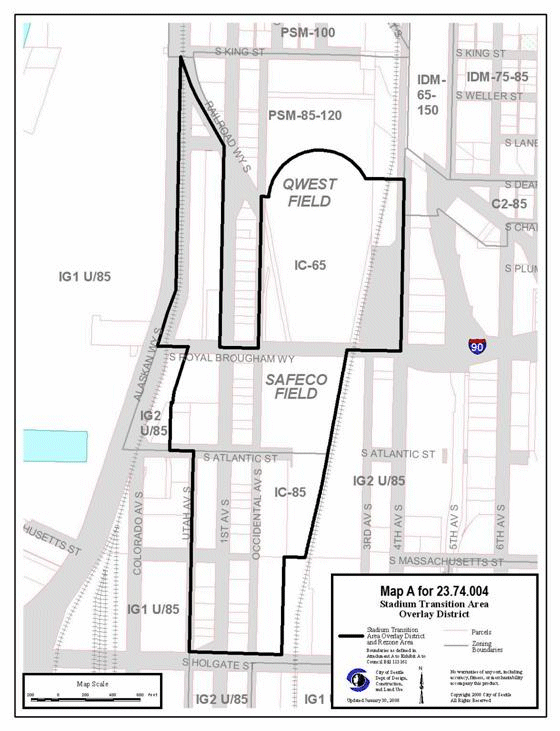
(Ord. 123046, § 54, 2009; Ord. 119972, § 10, 2000.)
23.74.006 - Application of regulations
Land located within the Stadium Transition Area Overlay District, as shown on Map A for 23.74.004, is subject to the regulations of the underlying zone except as otherwise expressly provided in this Chapter 23.74. In the event of a conflict between the provisions of this Chapter 23.74 and the underlying zone, the provisions of this Chapter 23.74 apply.
(Ord. 126862, § 16, 2023; Ord. 119972, § 10, 2000.)
23.74.008 - Uses.
Notwithstanding the use provisions of the underlying zone, the following use provisions apply:
A.
The following uses are permitted in buildings existing on June 1, 2023:
1.
Artist's studio/dwellings;
2.
Major institutions.
B.
The following uses are prohibited:
1.
Heavy manufacturing uses;
2.
High-impact uses;
3.
Solid waste management;
4.
Recycling uses;
5.
Animal shelters and kennels;
6.
Veterinary offices;
7.
Pet grooming;
8.
Airports, land and water based;
9.
Hospitals;
10
Elementary and secondary schools;
11.
Drive-in businesses, including gas stations;
12.
Bus bases;
13.
Flexible-use parking 1 ; and
14.
Residential uses, except for those allowed under subsection 23.74.008.C.
1 Parking required for a spectator sports facility or exhibition hall is allowed and shall be permitted to be used for flexible-use parking or shared with another such facility to meet its required parking. A spectator sports facility or exhibition hall within the Stadium Transition Overlay Area District may reserve non-required parking only outside the overlay district and only if:
(a) The parking is owned and operated by the owner of the spectator sports facility or exhibition hall; and
(b) The parking is reserved for events in the spectator sports facility or exhibition hall; and
(c) The reserved parking is south of South Royal Brougham Way, west of 6th Avenue South and north of South Atlantic Street. Parking that is provided to meet required parking will not be considered reserved parking.
C.
In areas zoned Urban Industrial, residential uses are permitted as a conditional use east of 1st Avenue S pursuant to the criteria contained in subsection 23.50A.062.C:
1.
Except that criterion 23.50A.062.C.3 does not apply within the Stadium Transition Area Overlay District (STAOD);
2.
Only where the following occur: the total number of residential units permitted in the Stadium Transition Area Overlay District may not exceed 990 units;
3.
Except that, if any site is determined to be a geologic hazard area by the Director, a covenant shall be required and recorded to run with the land in perpetuity;
4.
Except that criterion 23.50A.062.C.4 does not apply within the STAOD, and instead the following criteria must be met: All dwelling units shall have sound-insulating windows sufficient to maintain interior sound levels at 45 decibels or below in consideration of existing environmental noise levels at the site. The applicant shall submit an analysis of existing noise levels and documentation of the sound insulating capabilities of windows as part of the conditional use permit application;
5.
Only where the following occur: The building containing residential uses shall have at least three signs in conspicuous locations, such as in the residential lobby, the leasing office, and on the exterior of the building visible from the residential entry, that use clear language to convey the following information:
a.
That the project is located in an industrial area, and that residents, by choosing to live in the area, accept the industrial character of the neighborhood and agree that existing or permitted industrial uses do not constitute a nuisance or other inappropriate or unlawful use of land, and
b.
If the project has been determined to be in a liquefaction zone, that the building is in a liquefaction zone and that residents understand that there may be heightened risk during earthquakes; and
6.
Except that a Master Use Permit application for a development containing residential uses in the Stadium Transition Area Overlay District pursuant to the criteria contained in subsection 23.50A.062.C must contain an executed and recorded agreement stating that the development has not used City funding, will not use City funding and will not seek City funding for the construction of the project, maintenance of the project, or any environmental remediation of the site on which the development is located. The agreement shall be recorded on the title of the property on which that development is located.
Residential uses otherwise allowed as an administrative conditional use in the Urban Industrial zone pursuant to subsection 23.50A.062.C are prohibited west of 1st Avenue S.
(Ord. 127191, § 2, 2025; Ord. 126862, § 17, 2023; Ord. 125558, § 57, 2018; Ord. 122311, § 94, 2006; Ord. 119972 § 10 (part), 2000.)
Reviser's note—Ordinance 127191, when it was before the City Council as Council Bill 120933, was passed with several amendments to the new subsection 23.74.008.C that did not refer to each other. As much as possible, those amendments have been codified in the order they were considered and adopted. C.2 through C.6 were passed as Amendments A, C, D, F, and I, respectively. Amendment H's provisions are in the first clause of C and the sentence after C.6.
23.74.009 - Height
A.
Within the Stadium Transition Area Overlay District, maximum height limits of the underlying zone are not applicable to spectator sports facilities.
B.
Parking garages accessory to spectator sports facilities north of South Massachusetts Street may exceed the height limit if all the conditions in this subsection 23.74.009.B are satisfied.
1.
The total height of the parking garage does not exceed 130 feet.
2.
All floor area above the maximum height allowed by such MUP decision is used as parking required for the spectator sports facility, or for storage or meeting space accessory to the spectator sports facility or exhibition hall, except that the top floor or the rooftop may contain other permitted uses.
C.
The height limit for areas zoned UI-U/85 in the Stadium Transition Area Overlay District shall be 85 feet, except for land bounded by 1st Avenue South at the east, Colorado Avenue South at the west, South Atlantic Street at the south, and within 320 linear feet north of South Atlantic Street at the north, which shall have a height limit of 65 feet.
(Ord. 126862, § 18, 2023; Ord. 119972 § 10 (part), 2000.)
23.74.010 - Development standards
A.
Within the Stadium Transition Area Overlay District, the following development standards apply to all uses and structures except for spectator sports facilities:
1.
Accessory parking and outdoor storage
a.
Accessory parking or outdoor storage on any lot to the side of a structure on that lot shall not exceed 60 feet of street frontage along 1st Avenue South or along Occidental Avenue South, and may not be located within the first 40 feet from any intersection described in subsection 23.74.010.C. Parking shall be screened in accordance with screening standards for Class II Pedestrian Streets in downtown zones.
b.
The maximum parking ratio is one space per 650 square feet of gross floor area of all uses for which required parking is expressed in terms of square footage, except for institutions for which minimum parking requirements apply, and except for parking accessory to a spectator sports facility or exhibition hall. Nonrequired parking accessory to a spectator sports facility or exhibition hall is not permitted in the overlay district.
2.
Curb cuts. Curb cuts are limited to three per block front along north-south streets and Railroad Way South within the area described in subsection 23.74.010.C. No curb cuts are allowed within the first 40 feet from any intersection described in subsection 23.74.010.C. On east-west streets outside the area described in subsection 23.74.010.C, curb cuts are limited to two per block front. On east-west streets, additional curb cuts may be allowed if no other access is possible, including in the 40 feet from intersections described in subsection 23.74.010.C.
B.
For the areas marked on Map A for 23.74.010, the following development standards and provisions apply to all uses and structures except for spectator sports facilities:
1.
Floor area ratio (FAR) limits
a.
The maximum FAR for all uses is 4.5.
b.
In addition to the FAR exemptions in subsection 23.50A.100.B, the first 25,000 square feet of street-level general sales and service, medical services, eating and drinking establishments, or lodging uses on any lot are exempt from the maximum FAR limit.
2.
Maximum size of use limits
a.
If a development provides an amount of gross floor area that totals at least 0.4 times the lot area in qualifying industrial uses as indicated in Table A for 23.50A.040 and meeting the standards of subsection 23.50A.120.A.2, the development is exempt from all maximum size of use limits.
b.
Developments not exempt from the maximum size of use limits according subsection 23.74.010.A are subject to the maximum size of use limits shown in Table A for 23.74.010.
C.
Pedestrian environment. The following development standards apply to each use and structure, except spectator sports facilities, to the extent that the use or structure either is on a lot fronting on Railroad Way South, First Avenue South, South Holgate between First Avenue South and Occidental Avenue South, or Occidental Avenue South, or is within a 40-foot radius measured from any of the block corners of First Avenue South or Occidental Avenue South intersecting with the following streets: Railroad Way South, South Royal Brougham, South Atlantic, South Massachusetts, South Holgate, and any other streets intersecting with First Avenue or Occidental Avenue South that may be established between South Holgate Street and Railroad Way South, as depicted in Map A for 23.74.010. Railroad Way South, First Avenue South, South Holgate Street, and Occidental Avenue South within the Stadium Transition Area Overlay District, and all street areas within a 40-foot radius of any of those block corners described above, are referred to in this Section 23.74.010 as the "pedestrian environment," except that, in applying this Section 23.74.010 to a through lot abutting on Occidental Avenue South and on First Avenue South, Occidental Avenue South is not considered part of the pedestrian environment.
1.
Street-facing facade requirements. For street-facing facades or portions thereof facing streets or portions of streets in the pedestrian environment, the minimum facade height is 25 feet, but minimum facade heights do not apply if all portions of the structure are lower than the elevation of the required minimum facade height.
2.
Outdoor service areas. Service islands, electric vehicle charging stations, and vehicular queuing lanes, are not allowed between any structure and the pedestrian environment area described in this Section 23.74.010. Service islands, vehicular queuing lanes, and other service areas related to automobiles must be located behind or to the side of a principal use, as viewed from any street in such pedestrian environment and are not allowed between any structure on the same lot and the pedestrian environment area described in this Section 23.74.010.
3.
Screening and landscaping. In addition to the requirements of Sections 23.50A.180 through 23.50A.190, the screening and landscaping requirements for outdoor storage in subsection 23.47A.016.D.2 apply, with respect to street lot lines abutting the pedestrian environment, to the following uses, where a principal or accessory use is located outdoors: outdoor storage (except for outdoor storage associated with florists and horticultural uses), sales and rental of motorized vehicles, towing services, sales and rental of large boats, dry boat storage, heavy commercial sales (except for fuel sales), heavy commercial services, outdoor sports and recreation, wholesale showrooms, warehouse, transportation facilities (except for rail transit facilities), utilities (except for utility service uses), and light and general manufacturing.
4.
Blank facades and transparency requirements. The blank facade limits and transparency requirements of subsections 23.49.056.C and 23.49.056.D, and the screening of parking requirements of subsection 23.49.019.B apply to facades or portions thereof facing streets in the pedestrian environment, except that requirements for Class I Pedestrian Streets and designated green streets do not apply.
5.
Principal pedestrian entrances. A principal pedestrian entrance to a structure having a facade along Railroad Way South, First Avenue South, or Occidental Avenue South shall be located on Railroad Way South, First Avenue South, or Occidental Avenue South, respectively. If the structure has facades along both First Avenue South and Occidental Avenue South, a principal pedestrian entrance is required only on First Avenue South.
6.
Pedestrian walkway. Development shall provide a pedestrian walkway that is a minimum of 10 feet wide when fronting a street in the pedestrian environment. The walkway must be continuous for the length of the development site and may be designed to include sidewalk space in the public right of way and space on the site adjacent to the right of way.
Map A for 23.74.010
Stadium Transition Area Overlay District development standards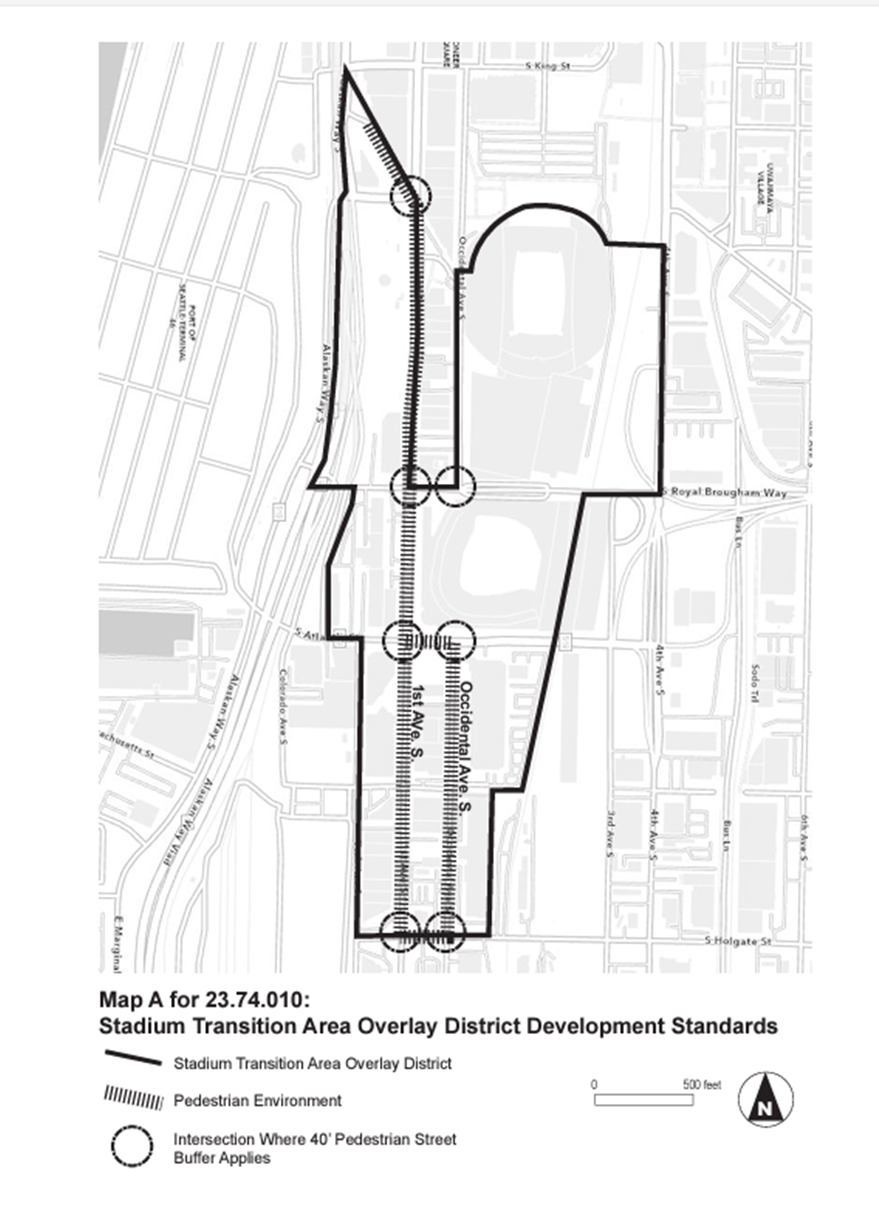
(Ord. 126864, § 20, 2023; Ord. 126862, § 19, 2023; Ord. 125791, § 106, 2019; Ord. 123589, § 96, 2011; Ord. 123266, § 2, 2010; Ord. 123046, § 55, 2009; Ord. 122935, § 17, 2009; Ord. 122311, § 95, 2006; Ord. 122054 § 78, 2006; Ord. 119972 § 10 (part), 2000.)

