
Seattle City Zoning Code
CHAPTER 23
58B - AFFORDABLE HOUSING IMPACT MITIGATION PROGRAM FOR COMMERCIAL DEVELOPMENT
23.58B.005 - Purpose
The purpose of this Chapter 23.58B is to mitigate certain adverse impacts of development of new commercial floor area on the need for affordable housing for the households of new workers having lower-wage jobs. Chapter 23.58B provides for voluntary agreements for mitigation of affordable housing impacts associated with new commercial floor area. The mitigation provided in this Chapter 23.58B is not intended to eliminate all affordable housing impacts of new commercial floor area.
(Ord. 124895, § 2, 2015)
23.58B.010 - Intent for implementation
Section 1 of Ordinance 125233 provides a statement of intent for implementation of this Chapter 23.58B that generally addresses the Council's intent as to an initial implementation phase of this Chapter 23.58B, the setting and changing of payment and performance amounts during that initial implementation phase, review of outcomes, the amendment of payment and performance amounts after the initial implementation phase, and the establishment of additional processes for modifying dimensional development standards and/or payment and performance amounts.
(Ord. 126855, § 46, 2023; Ord. 125233, § 3, 2016; Ord. 124895, § 2, 2015)
23.58B.015 - Scope of provisions
This Chapter 23.58B contains provisions that apply where the provisions of the zone refer to this Chapter 23.58B, or through the terms of a contract rezone according to Section 23.34.004.
(Ord. 125233, § 4, 2016; Ord. 124895, § 2, 2015)
23.58B.020 - Applicability and general requirements
A.
Voluntary agreement; impact mitigation options. If an applicant elects to seek approval of a permit for a development as described according to subsection 23.58B.020.B, the applicant shall:
1.
Enter into a voluntary agreement with the City to mitigate impacts on the need for affordable housing according to this Chapter 23.58B.
2.
The applicant shall mitigate impacts on the need for housing affordable to households of new lower wage workers either through the payment option according to Section 23.58B.040 or through the performance option according to Section 23.58B.050.
3.
In the absence of a signed voluntary agreement, acceptance of the permit by the applicant shall constitute a voluntary agreement for the purpose of this Chapter 23.58B.
B.
Applicability. Except as provided according to subsection 23.58B.020.C, this Chapter 23.58B shall apply to development that includes more than 4,000 square feet of gross floor area in commercial use through one of the following:
1.
Construction of a new structure;
2.
Construction of an addition; or
3.
Change of use from residential use to commercial use.
C.
Exemption. Low-income housing that includes floor area in commercial use is exempt from the requirements of this Chapter 23.58B.
D.
Relationship to incentive zoning. Where the provisions of the zone refer to this Chapter 23.58B and where bonus non-residential floor area or extra non-residential floor area may be achieved according to the provisions of the zone and/or Chapter 23.58A, the following provisions apply:
1.
All requirements to provide affordable housing to gain bonus non-residential floor area or extra non-residential floor area according to the provisions of the zone and/or Chapter 23.58A shall be satisfied solely by compliance with this Chapter 23.58B.
2.
Any non-housing requirements for achieving bonus non-residential floor area or extra non-residential floor area shall be satisfied according to the provisions of the zone and/or Chapter 23.58A.
(Ord. 126855, § 47, 2023; Ord. 125791, § 92, 2019; Ord. 125233, § 5, 2016; Ord. 124895, § 2, 2015)
23.58B.025 - Permit documentation
A.
General
1.
For any development to which this Chapter 23.58B applies, the Master Use Permit application and the first building permit application that includes the structural frame for the structure shall include the following:
a.
The amount of the cash contribution to be provided for affordable housing impact mitigation, if the applicant elects the payment option according to Section 23.58B.040.
b.
The total net unit area, measured according to subsection 23.86.007.B, of MHA-C units provided according to subsection 23.58B.050.A and a proposal for MHA-C units that satisfy requirements of subsections 23.58B.050.B and 23.58B.050.C, if the applicant elects the performance option according to Section 23.58B.050.
2.
Any requests for modifications according to Section 23.58B.030, including all supporting materials required for a decision on such requests, shall be included in the Master Use Permit application, or in the first building permit application that includes the structural frame for the structure if no Master Use Permit is required.
3.
The Director shall, as a Type I decision and in consultation with the Director of Housing, determine:
a.
The amount of the cash contribution according to subsection 23.58B.040.A, if the applicant elects the payment option according to Section 23.58B.040;
b.
The total net unit area, measured according to subsection 23.86.007.B, of MHA-C units according to subsection 23.58B.050.A and compliance of the proposal for MHA-C units with the requirements of subsections 23.58B.050.B and 23.58B.050.C, if the applicant elects the performance option according to Section 23.58B.050; and
c.
Any modification according to subsection 23.58B.030.B.
4.
The Director shall, as a special exception according to Chapter 23.76, in consultation with the Director of Housing, determine any modification according to subsection 23.58B.030.C or subsection 23.58B.030.D.
5.
Substitution of MHA-C units according to subsection 23.58B.050.B.15 shall require a separate review and approval by the Director in consultation with the Director of Housing.
6.
The applicant for a project subject to this Chapter 23.58B shall pay housing review fees according to Section 22.900G.015.
B.
Issuance of Master Use Permit. Prior to issuance of a Type II Master Use Permit, the applicant shall provide the following:
1.
The amount of the cash contribution required according to subsection 23.58B.040.A, if the applicant elects the payment option according to Section 23.58B.040;
2.
If the applicant elects the performance option according to Section 23.58B.050:
a.
The total square feet of housing required to be provided according to subsection 23.58B.050.A, measured as net unit area;
b.
A proposal for MHA-C units meeting the requirements of subsections 23.58B.050.B and 23.58B.050.C;
c.
A draft agreement according to subsection 23.58B.050.B.17; and
d.
A draft developer's agreement according to subsection 23.58B.050.C.3, if applicable.
C.
Issuance of building permit. Prior to issuance of the first building permit that includes the structural frame for the structure containing the commercial development to which this Chapter 23.58B applies, the applicant shall provide the following:
1.
If the applicant elects to comply with this Chapter 23.58B through the payment option according to Section 23.58B.040:
a.
Final plans that include the structural frame for the structure showing the calculation of the amount of the cash contribution required according to subsection 23.58B.040.A; and
b.
Documentation from the Director of Housing of receipt of payment of the cash contribution required according to subsection 23.58B.040.A.
2.
If the applicant elects to comply with this Chapter 23.58B through the performance option according to Section 23.58B.050:
a.
Final plans that include the structural frame for the structure that:
1)
Include the calculation of total square feet of housing required to be provided according to subsection 23.58B.050.A and actual square feet of MHA-C units to be provided, measured as net unit area; and
2)
Demonstrate compliance of the proposal for MHA-C units with the requirements of subsections 23.58B.050.B and 23.58B.050.C;
b.
The executed and recorded agreement required according to subsection 23.58B.050.B.17;
c.
Documentation of issuance of the first building permit that includes the structural frame for the structure that includes the MHA-C units, if the MHA-C units are located in a different structure than the structure containing the commercial development to which this Chapter 23.58B applies;
d.
The executed developer's agreement required according to subsection 23.58B.050.C.3, if applicable; and
e.
Documentation from the Director of Housing of receipt of the letter of credit required according to subsection 23.58B.050.C.4, if applicable.
3.
The applicant may change its election between performance and payment prior to issuance of the first building permit that includes the structural frame for the structure, provided the applicant changing its election shall obtain any necessary approvals affected by the change in election. Review and approval of a change in election between performance and payment is a Type I decision, unless the requested change affects a modification according to subsection 23.58B.030.C or subsection 23.58B.030.D.
(Ord. 126855, § 48, 2023; Ord. 125233, § 6, 2016; Ord. 124895, § 2, 2015)
23.58B.030 - Modification of payment/performance amounts
A.
General
1.
An applicant may request a modification, according to this Section 23.58B.030, of the amount of mitigation calculated according to subsection 23.58B.040.A or subsection 23.58B.050.A.
2.
An applicant requesting a modification according to subsection 23.58B.030.C or subsection 23.58B.030.D shall have requested a modification according to subsection 23.58B.030.B, if applicable, and an applicant requesting a modification according to subsection 23.58B.030.D shall have requested a modification according to subsection 23.58B.030.C, if applicable. The Director shall evaluate modification requests in the following order: subsection 23.58B.030.B, subsection 23.58B.030.C, and subsection 23.58B.030.D.
3.
The decision on any modification according to subsection 23.58B.030.B, subsection 23.58B.030.C, or subsection 23.58B.030.D shall specify a mitigation amount expressed as dollars per square foot according to subsection 23.58B.040.A for the payment option and/or percentage per square foot according to subsection 23.58B.050.A for the performance option that shall be applied based on the final plans for the development or, in the case of a modification according to subsection 23.58B.030.D, may be expressed as an absolute payment amount for the payment option or square footage amount for the performance option along with a limitation in the degree of change in the final plans that is permissible without a redetermination of the modification.
B.
Modification in zones with height limits exceeding 85 feet. The Director shall modify the amount of mitigation if the development is in a zone with a height limit greater than 85 feet and the Director finds that applicable development standards prohibit the development from exceeding a height of 85 feet. The reduced mitigation shall be the payment calculation amount or performance calculation amount according to subsection 23.58B.040.A or subsection 23.58B.050.A for the zone that has a height limit of 85 feet or less that is most comparable to the zone in which the development required to mitigate affordable housing impacts according to this Chapter 23.58B is located.
C.
Modification based on mitigation greater than impact. The Director shall, as a special exception according to Chapter 23.76, modify the amount of mitigation required according to subsection 23.58B.040.A or subsection 23.58B.050.A if the applicant demonstrates that the required amount of mitigation exceeds the amount that would be needed to mitigate the actual demand for affordable housing created by the development. A request for such a modification shall include information showing the affordable housing impacts created by the development, based on the actual characteristics of the development, including, for example, the unique characteristics and space utilization of the future workforce of the development and the demand of that workforce for housing expressed in terms of the number of employees in households with incomes at or below 60 percent of median income, and the number of employees in households with incomes higher than 60 percent of median income but not higher than 80 percent of median income, and such other factors the applicant believes justify a modification.
D.
Modification based on severe economic impact
1.
The purpose of this subsection 23.58B.030.D is to allow the Director, as a special exception according to Chapter 23.76, to modify the amount of payment according to subsection 23.58B.040.A or the amount of performance according to subsection 23.58B.050.A if the applicant can demonstrate facts supporting a determination of severe economic impact at such a level that a property owner's constitutional rights may be at risk.
2.
For purposes of this subsection 23.58B.030.D, the Director is not making a determination of the constitutional rights of a property owner, but instead is reviewing the credibility and strength of facts demonstrating severe economic impact.
3.
The Director may waive or reduce the amount of payment required according to subsection 23.58B.040.A or the amount of housing required to be provided according to subsection 23.58B.050.A if the applicant shows that application of the requirements according to this Chapter 23.58B would:
a.
Create severe economic impact by depriving a property owner of all economically beneficial use of the property; or
b.
Create severe economic impact, not reaching deprivation of all economically beneficial use, but reaching the level of an undue burden that should not be borne by the property owner.
4.
In determining whether there is a severe economic impact reaching the level of an undue burden that should not be borne by the property owner, the Director may weigh the following nonexclusive factors:
a.
The severity of the economic impact caused by the application of the requirements according to this Chapter 23.58B;
b.
The degree to which the requirements according to this Chapter 23.58B were or could have been anticipated;
c.
The extent to which alternative uses of the property or configurations of the proposed development would alleviate the need for the requested waiver or reduction;
d.
The extent to which any economic impact was due to decisions by the applicant and/or property owner; and
e.
Other factors relevant to whether the burden should be borne by the property owner.
5.
The waiver or reduction may be approved only to the extent necessary to grant relief from the severe economic impact.
6.
A request to the Director for a modification according to this subsection 23.58B.030.D shall include, at a minimum, all of the following:
a.
A description of the requested waiver or reduction, including the proposed payment and/or performance amount;
b.
Documentation showing that any relief available according to subsection 23.58B.030.B or subsection 23.58B.030.C would not eliminate the need for the requested waiver or reduction;
c.
The identity of the property owner and the date of the owner's acquisition of the property;
d.
Documentation showing the use of the property at the time of the request or, if the property is vacant at that time, the use of the property prior to commencement of vacancy;
e.
Documentation explaining and supporting the claim of economic impact; and
f.
Documentation showing that a different development configuration that satisfied the requirements according to this Chapter 23.58B would not alleviate the need for the requested waiver or reduction.
7.
The applicant shall provide any additional information as may be required by the Director to make a determination on the request. The applicant shall have the burden of proving by a preponderance of the evidence that a waiver or reduction authorized according to this subsection 23.58B.030.D is justified.
8.
None of the following, standing alone and without consideration of the full range of relevant factors including those according to subsection 23.58B.030.D.4, shall be a sufficient basis for the Director to grant a waiver or reduction authorized according to this subsection 23.58B.030.D:
a.
The fact of a decrease in property value;
b.
The fact that a property owner is unable to utilize the full amount of any increase in non-residential development capacity enacted in connection with implementation of this Chapter 23.58B in the zone in which the property is located; or
c.
The fact that any such increase in non-residential development capacity, combined with the requirements according to this Chapter 23.58B, did not leave the property owner in a better financial position than would have been the case with no increase in non-residential development capacity and no application of the requirements according to this Chapter 23.58B.
9.
In any appeal to the Hearing Examiner, the parties will have an additional opportunity to make a record on the factual issues consistent with due process.
(Ord. 125233, § 7, 2016; Ord. 124895, § 2, 2015)
23.58B.040 - Mitigation of impacts—Payment option
A.
Amount of cash contributions
1.
An applicant complying with this Chapter 23.58B through the payment option shall provide a cash contribution to the City, calculated by multiplying the payment calculation amount per square foot according to Table A or Table B for 23.58B.040 and Map A for 23.58B.050, as applicable, by the total square feet of chargeable floor area in commercial use, or gross floor area in commercial use that is not underground if there is no FAR limit in the underlying zone, as follows:
a.
Including chargeable floor area in commercial use in the following:
1)
A new structure;
2)
An addition to a structure;
3)
A change of use from residential use to commercial use; or
4)
Any combination of the above; and
b.
Excluding chargeable floor area in commercial use as follows:
1)
The first 4,000 gross square feet of street-level commercial uses; and
2)
Street-level commercial uses along a designated principal pedestrian street in a Pedestrian designated zone.
2.
Automatic adjustments to payment amounts. The amounts for payment calculations according to Table A and Table B for 23.58B.040 shall automatically adjust annually on March 1, starting in 2024, by an amount in proportion to the increase, if any, for January 1 through December 31 of the prior calendar year, in the Consumer Price Index, All Urban Consumers, Seattle-Tacoma-Bellevue, WA, Shelter (1982-84=100), as determined by the U.S. Department of Labor, Bureau of Labor Statistics, or successor index.
B.
Deposit and use of cash contributions
1.
Cash contributions shall be deposited by the Director of Housing in a special account established solely for preservation and production of housing affordable for renter households with incomes no higher than 60 percent of median income and for owner households with incomes no higher than 80 percent of median income. Earnings on balances in the special account shall accrue to that account.
2.
Use of cash contributions shall support the preservation and production of renter-occupied housing within Seattle, or the preservation and production of ownership housing within Seattle, as follows. Rental housing supported by the cash contributions shall be rent- and income-restricted to serve households with incomes no higher than 60 percent of median income for a minimum period of 50 years, with an expectation of ongoing affordability. At least five percent of total cash contributions on a yearly basis shall be dedicated to capital expenditures for development of ownership housing. Ownership housing supported by the cash contributions shall be priced to serve and sold to households with incomes no higher than 80 percent of median income, with resale restrictions for a minimum period of 50 years, with an expectation of ongoing affordability.
3.
For purposes of determining the location for use of cash contributions, the City shall consider the extent to which the housing advances the following factors:
a.
Affirmatively furthering fair housing choice;
b.
Locating within a regional center or an urban center;
c.
Locating in proximity to frequent bus service or current or planned light rail or streetcar stops;
d.
Furthering City policies to promote economic opportunity and community development and addressing the needs of communities vulnerable to displacement; and
e.
Locating near developments that generate cash contributions.
4.
Each cash contribution shall be expended within five years of collection. Any cash contribution not so expended shall be refunded with any interest required by law.
(Ord. 127375, § 95, 2025; Ord. 126862, § 13, 2023; Ord. 126855, § 49, 2023; Ord. 125792, § 8, 2019; Ord. 125791, § 93, 2019; Ord. 125371, § 16, 2017; Ord. 125291, § 37, 2017; Ord. 125267, § 29, 2017; Ord. 125233, § 9, 2016; Ord. 124895, § 2, 2015)
23.58B.050 - Mitigation of impacts—Performance option
A.
Performance option
1.
An applicant complying with this Chapter 23.58B through the performance option shall provide total net unit area, measured according to subsection 23.86.007.B, of MHA-C units meeting the standards of subsection 23.58B.050.B, equal to at least the percentage calculation amount per square foot according to Table A or Table B for 23.58B.050 and Map A for 23.58B.050, as applicable, multiplied by the total square feet of chargeable floor area in commercial use, or gross floor area in commercial use that is not underground if there is no FAR limit in the underlying zone, as follows:
a.
Including chargeable floor area in commercial use in the following:
1)
A new structure;
2)
An addition to a structure;
3)
A change of use from residential use to commercial use; or
4)
Any combination of the above; and
b.
Excluding chargeable floor area in commercial use as follows:
1)
The first 4,000 gross square feet of street-level commercial uses; and
2)
Street-level commercial uses along a designated principal pedestrian street in a Pedestrian designated zone.
2.
If the calculation according to subsection 23.58B.050.A.1 yields fewer than three MHA-C units using a conversion factor for unit size as determined by the Director, the applicant shall either round up to three units or provide a cash contribution using the payment option according to subsection 23.58B.040.A.
Map A for 23.58B.050
Payment and performance areas: high, medium, and low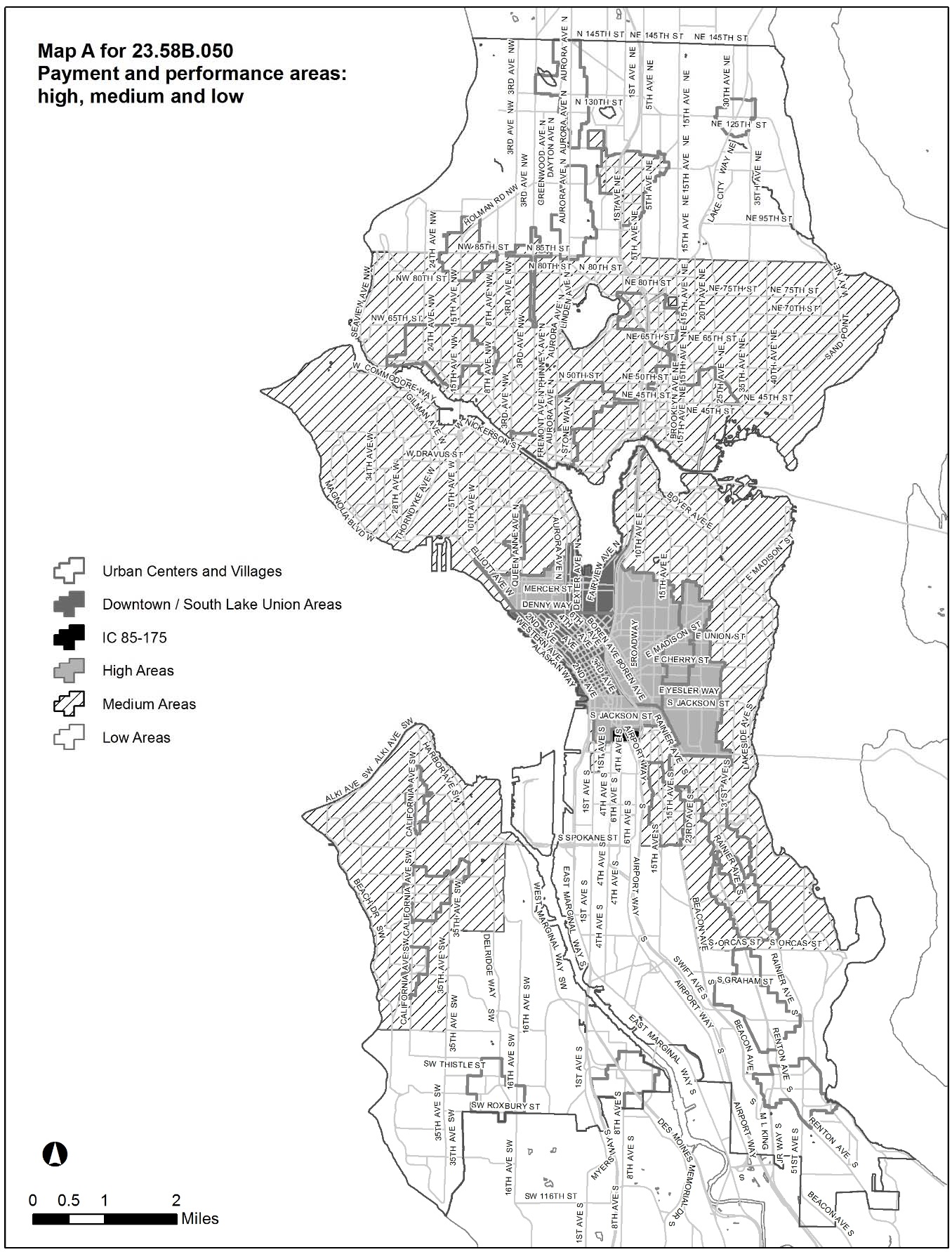
B.
General performance standards. All MHA-C units shall meet the following standards:
1.
Duration. The obligation to provide MHA-C units shall be for a minimum period of 75 years from the date of issuance of the certificate of occupancy, or if a certificate of occupancy is not required, from the date of the final building permit inspection, for the MHA-C units; provided that, in the case of demolition of a structure containing both MHA-C units provided according to this Section 23.58B.050 and units provided to comply with Chapter 23.58C through the performance option according to Section 23.58C.050, the obligation to provide MHA-C units shall last no longer than the time specified according to subsection 23.58C.050.B.1.b.1.
2.
Tenure. MHA-C units shall be rental housing for eligible households according to subsection 23.58B.050.B.6.
3.
Rent limits. Monthly rent for MHA-C units shall not exceed 30 percent of 60 percent of median income or, in the case of any unit with net unit area of 400 square feet or less, 30 percent of 40 percent of median income. For purposes of this subsection 23.58B.050.B.3, "monthly rent" includes a utility allowance for heat, gas, electricity, water, sewer, and refuse collection, to the extent such items are not paid for tenants by the owner, and also includes any recurring fees that are required as a condition of tenancy.
4.
Type. MHA-C units shall be dwelling units, except for accessory dwelling units or detached accessory dwelling units.
5.
Comparability. MHA-C units shall be comparable to the other dwelling units to be developed in terms of the following:
a.
Number and size of bedrooms and bathrooms;
b.
Net unit area measured as square feet;
c.
Access to amenity areas;
d.
Functionality; and
e.
Term of the lease.
6.
Eligible households. MHA-C units shall serve only:
a.
At initial occupancy by a household:
1)
For a unit with net unit area of 400 square feet or less, households with incomes no higher than 40 percent of median income; or
2)
For a unit with net unit area of greater than 400 square feet, households with incomes no higher than 60 percent of median income.
b.
At the time of annual certification according to subsection 23.58B.050.B.13:
1)
For a unit with net unit area of 400 square feet or less, households with incomes no greater than 60 percent of median income;
2)
For a unit with net unit area of greater than 400 square feet, households with incomes no greater than 80 percent of median income.
7.
Affordable housing; no other restrictions. MHA-C units and restricted units provided for any other reason, including a property tax exemption or loans and grants, must be different units.
8.
Time of completion. Except as provided according to subsection 23.58B.050.C.4, MHA-C units shall be completed and ready for occupancy at or before the time when a final certificate of occupancy is issued for the development mitigating impacts according to this Chapter 23.58B, and shall be a condition to any right of the applicant to such certificate of occupancy.
9.
Age of construction; distribution. MHA-C units shall be newly constructed and shall be generally distributed throughout the residential portion of the development.
10.
Affirmative marketing. MHA-C units shall be affirmatively marketed to attract eligible households from all racial, ethnic, and gender groups in the housing market area of the property, particularly to inform and solicit applications from households who are otherwise unlikely to apply for housing in the development. Proposed marketing efforts shall be submitted to the Office of Housing for review and approval. Records documenting affirmative marketing efforts shall be maintained and submitted to the Office of Housing upon request.
11.
Reporting. Periodically as may be required by the Director of Housing, but no less than annually, the owner of the MHA-C units shall submit to the Office of Housing a written report demonstrating compliance with and housing outcomes of this Chapter 23.58B. The report shall include required information and supporting documentation, verified upon the owner's oath or affirmation and in a form prescribed by the Office of Housing. The Director of Housing is authorized to assess a late fee of $50 per day, which shall accrue until the report is submitted, starting 14 days from the date of the Office of Housing's notice that the report is overdue.
12.
Limitation on charges. Fees charged to eligible households upon move-in or transfer within a development containing MHA-C units shall be limited to a reasonable level to be established by the Director of Housing by rule. No tenant of a rental unit may be charged fees for income verifications or reporting requirements related to this Chapter 23.58B.
13.
Annual certification, third party verification
a.
The owner of the structure(s) that includes the MHA-C units shall obtain from each tenant, no less than annually, a certification of household size and annual income in a form acceptable to the Director of Housing. The owner shall examine the income of each tenant household according to 24 CFR 5.609, with guidance from the HUD Occupancy Handbook 4350.3, Chapter 5. The owner also shall examine the income and household size of any tenant at any time when there is evidence that the tenant's written statement was not complete or accurate. If so requested by the City, the owner shall obtain such certifications and/or examine incomes and household sizes at any other times upon reasonable advance notice from the City. The owner shall maintain all certifications and documentation obtained according to this subsection 23.58B.050.B.13 on file for at least six years after they are obtained, and shall make them available to the City for inspection and copying promptly upon request.
b.
The owner of the structure that includes the MHA-C units shall attempt to obtain third party verification whenever possible to substantiate income at each certification, which shall include contacting the individual income source(s) supplied by the household. The verification documents shall be supplied directly to the independent source by the owner and returned directly to the owner from the independent source. In the event that the independent source does not respond to the owner's faxed, mailed, or emailed request for information, the owner may pursue oral third party verification. If written or oral third party documentation is not available, the owner may accept original documents (pay stubs, W-2, etc.) at the discretion of the Director of Housing and shall document why third party verification was not available. At the discretion of the Director of Housing, the owner may accept tenant self-certifications after the initial income verification and first annual recertification.
14.
Annual fee. The owner of the structure that includes the MHA-C units shall pay the Office of Housing an annual fee of $190 per MHA-C unit for the purpose of monitoring compliance with the requirements of to this Section 23.58B.050. The annual fee shall automatically adjust annually on March 1, starting in 2024, by an amount in proportion to the increase, if any, for January 1 through December 31 of the prior calendar year, in the Consumer Price Index, All Urban Consumers, Seattle-Tacoma-Bellevue, WA, All Items (1982-84=100), as determined by the U.S. Department of Labor, Bureau of Labor Statistics or successor index, unless the Director of Housing makes a determination that a lower fee covers the cost of monitoring compliance.
15.
Over-income households; unit substitution. If, based on any certification, a previously eligible household occupying an MHA-C unit is determined to be ineligible due to exceeding the income limits according to subsection 23.58B.050.B.6, the owner of the development containing the MHA-C units shall, through the process according to subsection 23.58B.025.A.5, designate a comparable substitute MHA-C unit within the development, as approved by the Director of Housing, as soon as such a unit becomes available, and upon such designation the requirements of this subsection 23.58B.050.B and subsection 23.58B.050.C shall transfer to the substitute unit. All of the rental units in the development that contains the MHA-C units shall be considered as potential substitute replacement units. Upon such determination that a previously eligible household is ineligible, the owner shall promptly give the ineligible household notice of such determination and notice that the requirements of this subsection 23.58B.050.B and subsection 23.58B.050.C shall transfer to a substitute MHA-C unit when such unit becomes available. Upon the transfer of the requirements, the owner shall give the ineligible household six months' notice prior to any rent increase.
16.
Maintenance, insurance. MHA-C units, and the development in which the MHA-C units are located, shall be maintained by the owner in decent and habitable condition, including the provision of adequate basic appliances. The owner shall keep the MHA-C units, and the development in which the MHA-C units are located, insured by an insurance company licensed to do business in the state of Washington and reasonably acceptable to the City, against loss by fire and other hazards included with broad form coverage, in the amount of 100 percent of the replacement value.
17.
Agreement. The City and the owner of the structure(s) that include the MHA-C units shall enter into an agreement specifying the requirements of this Section 23.58B.050. The agreement shall be recorded on the title of the property on which the MHA-C units are located. The requirements specified in the agreement shall be consistent with final plans for the MHA-C units. If the first building permit is issued for the structural frame for the structure that includes affordable housing according to this Chapter 23.58B and such structure is acquired to provide City-funded low-income housing, the agreement according to this subsection 23.58B.050.B.17 may be released at the sole discretion of the Director of Housing.
18.
Casualty
a.
If an MHA-C unit is destroyed or rendered unfit for occupancy by casualty, the owner of the MHA-C unit shall, through the process according to subsection 23.58B.025.A.5, designate a comparable substitute MHA-C unit within the development, as approved by the Director of Housing, as soon as such unit becomes available, which the tenant household of the MHA-C unit affected by casualty shall be allowed to move into, and upon such designation the requirements of subsection 23.58B.050.B shall transfer to the substitute unit.
b.
If any casualty loss results in the loss of one or more MHA-C units for a period of one year or more, the duration according to subsection 23.58B.050.B.1.a shall be automatically extended beyond the original term hereof for a period equal to the period of time for which the MHA-C units are not in service and no comparable MHA-C units have been provided and placed in service within the development.
C.
Additional performance standards. In addition to meeting the standards in subsection 23.58B.050.B, MHA-C units located on a site other than the same lot as the development required to mitigate affordable housing impacts according to this Chapter 23.58B shall meet the following additional standards:
1.
Equal or better mitigation. The applicant shall demonstrate to the satisfaction of the Director of Housing that affordable housing impact mitigation provided through the performance option on a site other than the same lot as the development required to mitigate affordable housing impacts according to this Chapter 23.58B is equal to or better than mitigation provided through performance on the same lot.
2.
Location. MHA-C units provided on a site other than the same lot as the development required to mitigate affordable housing impacts according to this Chapter 23.58B shall be located:
a.
Within the same regional center or urban center as the development required to mitigate affordable housing impacts according to this Chapter 23.58B; or
b.
Within one mile of the development required to mitigate affordable housing impacts according to this Chapter 23.58B if such development is located outside of a regional center or an urban center.
3.
Developer's agreement. If the owner of the development required to mitigate affordable housing impacts according to this Chapter 23.58B is not the owner of the MHA-C units, then in addition to the agreement required according to subsection 23.58B.050.B.17, the owner of the development required to mitigate affordable housing impacts according to this Chapter 23.58B and the owner of the MHA-C units shall execute a developer's agreement, acceptable to the Director of Housing, allowing the exclusive use of the MHA-C units to satisfy the requirements of this Chapter 23.58B in return for necessary and adequate financial support to the development of the MHA-C units.
4.
Letter of credit
a.
If the MHA-C units are located on a site other than the same lot as the development required to mitigate affordable housing impacts according to this Chapter 23.58B, the owner of the development required to mitigate affordable housing impacts according to this Chapter 23.58B shall provide to the Director of Housing an irrevocable bank letter of credit, approved by the Director of Housing, in the amount according to subsection 23.58B.040.A.
b.
The Director of Housing may draw on the letter of credit one year after the date of issuance of the certificate of occupancy, or, if a certificate of occupancy is not required, the final building permit inspection, for the development required to mitigate affordable housing impacts according to this Chapter 23.58B if the certificate of occupancy or final building permit inspection for the MHA-C units has not been issued on or before that date. The owner of the development required to mitigate affordable housing impacts according to this Chapter 23.58B shall also pay an amount equal to the interest on the cash contribution, at the rate equal to the prime rate quoted by Bank of America, or its successor, plus three percent per annum, from the date of issuance of the first building permit that includes the structural frame for the development required to mitigate affordable housing impacts according to this Chapter 23.58B.
c.
If and when the City becomes entitled to draw on any letter of credit, the Director of Housing may take appropriate steps to do so, and the amounts realized, net of any costs to the City, shall be used in the same manner as cash contributions according to subsection 23.58B.040.B.
(Ord. 127375, § 96, 2025; Ord. 126862, § 14, 2023; Ord. 126855, § 50, 2023; Ord. 126685, § 47, 2022; Ord. 125835, § 1, 2019; Ord. 125792, § 9, 2019; Ord. 125791, § 94, 2019; Ord. 125371, § 17, 2017; Ord. 125363, § 2, 2017; Ord. 125291, § 38, 2017; Ord. 125267, § 30, 2017; Ord. 125233, § 10, 2016; Ord. 124895, § 2, 2015)
23.58B.055 - Approved and vested projects - election to participate
An applicant who (1) has an unexpired Master Use Permit for a project issued prior to the effective date of the ordinance introduced as Council Bill 118940, or (2) has submitted an application for a Master Use Permit for a project that is under review by the Department, has completed the Design Review Board Recommendation phase pursuant to subsection 23.41.014.E, and is vested pursuant to Section 23.76.026 prior to the effective date of the ordinance introduced as Council Bill 118940, may elect to incorporate into the project some or all of the capacity added to the applicable zone through the ordinance introduced as Council Bill 118940 without additional review by the Design Review Board if the following conditions are met:
A.
The project is located in a Downtown or SM-SLU zone to which capacity was added through the ordinance introduced as Council Bill 118940; and
B.
The proposed changes to the project are limited to incorporating capacity added to the applicable zone through the ordinance introduced as Council Bill 118940; and
C.
The Director determines, as a Type I decision, that incorporating the additional capacity into the project is done in a manner consistent with the design recommended for approval by the Design Review Board pursuant to subsection 23.41.014.E; and
D.
Incorporating the additional capacity into the project does not require any new development standard departures pursuant to Section 23.41.012; and
E.
The project will comply with the requirements of Chapter 23.58B.
(Ord. 125291, § 39, 2017.)
23.58B.060 - Definitions
Definitions in this Chapter 23.58B supersede any definitions of the same terms in Chapter 23.84A and Section 23.58A.004 for the purposes of provisions of this Chapter 23.58B, unless otherwise specified in this Chapter 23.58B.
"Affordable housing" means dwelling units affordable to households with a range of incomes no higher than 80 percent of median income.
"MHA-C unit" means a dwelling unit provided to comply with Chapter 23.58B through the performance option according to Section 23.58B.050.
For purposes of this Chapter 23.58B, "dwelling unit" does not include an accessory dwelling unit.
(Ord. 126855, § 51, 2023; Ord. 125233, § 11, 2016; Ord. 124895, § 2, 2015)

