
Seattle City Zoning Code
CHAPTER 23
55 - SIGNS
23.55.001 - Intent.
The intent of the standards in this chapter is:
A.
To encourage the design of signs that attract and invite rather than demand the public's attention, and to curb the proliferation of signs;
B.
To encourage the use of signs that enhance the visual environment of the city;
C.
To promote the enhancement of business and residential properties and neighborhoods by fostering the erection of signs complementary to the buildings and uses to which they relate and which are harmonious with their surroundings;
D.
To protect the public interest and safety;
E.
To protect the right of business to identify its premises and advertise its products through the use of signs without undue hindrance or obstruction; and
F.
To provide opportunities for communicating information of community interest.
(Ord. 120388, § 3, 2001; Ord. 112830 § 10(part), 1986.)
23.55.002 - Scope of provisions
A.
The provisions of this Chapter 23.55 apply to signs in all zones, except those zones regulated by Chapter 23.66, Special Review Districts, and except as otherwise provided.
B.
Signs located in the Shoreline District shall meet the requirements of the Seattle Shoreline Master Program in addition to the provisions of this Chapter 23.55. In the event that there is a conflict between the provisions of this Chapter 23.55 and the regulations of the Shoreline Master Program, the provisions of the Shoreline Master Program apply.
C.
Signs are also regulated by the provisions of Chapter 31 of the Seattle Building Code, including the permit requirements of Title 22.
D.
Signs located completely within public rights-of-way are regulated by the Street Use Ordinance, Title 15 of the Seattle Municipal Code. Signs projecting from private property over public rights-of-way are also regulated by the Street Use Ordinance, as well as the provisions of this Chapter 23.55.
E.
Signs adjacent to certain public highways and designated scenic routes shall meet the provisions of Section 23.55.042. Signs adjacent to state highways may also be regulated by state law or regulations.
F.
Variances may be permitted from the provisions of this Chapter 23.55, except that variances are not permitted from subsection 23.55.014.A, and variances from Section 23.55.042 are limited by the provisions of subsection 23.55.042.E.
G.
Measurements provisions for signs are located in Chapter 23.86, Measurements.
(Ord. 126685, § 44, 2022 [cross-reference update]; Ord. 125869, § 1, 2019; Ord. 119239 § 31, 1998; Ord. 112830 § 10(part), 1986.)
23.55.003 - Signs prohibited in all zones
A.
The following signs are prohibited in all zones:
1.
Flashing signs;
2.
Signs that rotate or have a rotating or moving part or parts that revolve at a speed in excess of seven revolutions per minute;
3.
Signs attached to or located on stationary motor vehicles, equipment, trailers, and related devices, except for signs not exceeding five square feet in area and relating to the sale, lease, or rent of a motor vehicle to which the signs are attached;
4.
Portable signs other than readily detachable signs having a fixed base or mounting for the placement and intermittent use of such signs;
5.
Banners, streamers, strings of pennants, fabric signs, festoons of lights, clusters of flags, wind-animated objects, balloons, searchlights, and similar devices, except:
a.
Where the principal use or activity on the lot is outdoor retail sales in NC3, C1, C2 and downtown zones, or
b.
Where permitted as temporary signs under Section 23.55.012, or
c.
As permitted in Part 4 of Chapter 23.55.
6.
Signs that attempt, or appear to attempt, to direct the movement of traffic or that interfere with, imitate, or resemble any official traffic sign, signal, or device.
7.
Signs using a video display method, except as provided in Section 23.55.005 or in Part 4 of Chapter 23.55.
(Ord. 125869, § 2, 2019; Ord. 120466, § 1, 2001; Ord. 112830 § 10(part), 1986.)
23.55.004 - Signs projecting over public rights-of-way.
A.
Signs projecting into any public right-of-way, except alleys, shall have a minimum clearance of eight (8) feet over the adjacent sidewalk or other grade.
B.
Signs projecting into any public alley shall have a minimum clearance of sixteen (16) feet above grade, and shall not project more than twenty-four (24) inches beyond the property line.
C.
No permanent sign shall extend into any public right-of-way to within less than two (2) feet of the curbline, or more than six (6) feet beyond the property line, except that at street intersections, signs which project from intersecting street property lines may extend to the intersection of the six (6) foot projection margins on each street (Exhibit 23.55.004 A).
D.
No barberpole, including the brackets and fastenings for the barberpole, shall extend more than one (1) foot into any public right-of-way.
E.
No temporary sign made of rigid material shall extend more than four (4) inches into the public right-of-way.
F.
Marquee signs may be permitted in conjunction with any lawful marquee, provided that they shall not project more than twelve (12) inches beyond the front of the marquee, nor closer than two (2) feet to the curbline. Marquee signs may not exceed thirty (30) inches in height above the top of the marquee, and total vertical dimension may not exceed five (5) feet. Only one (1) sign may be placed on or attached to an end face of a marquee.
G.
Roof signs shall not project into any public right-of-way.
(Ord. 112830 § 10(part), 1986.)
Exhibit 23.55.004A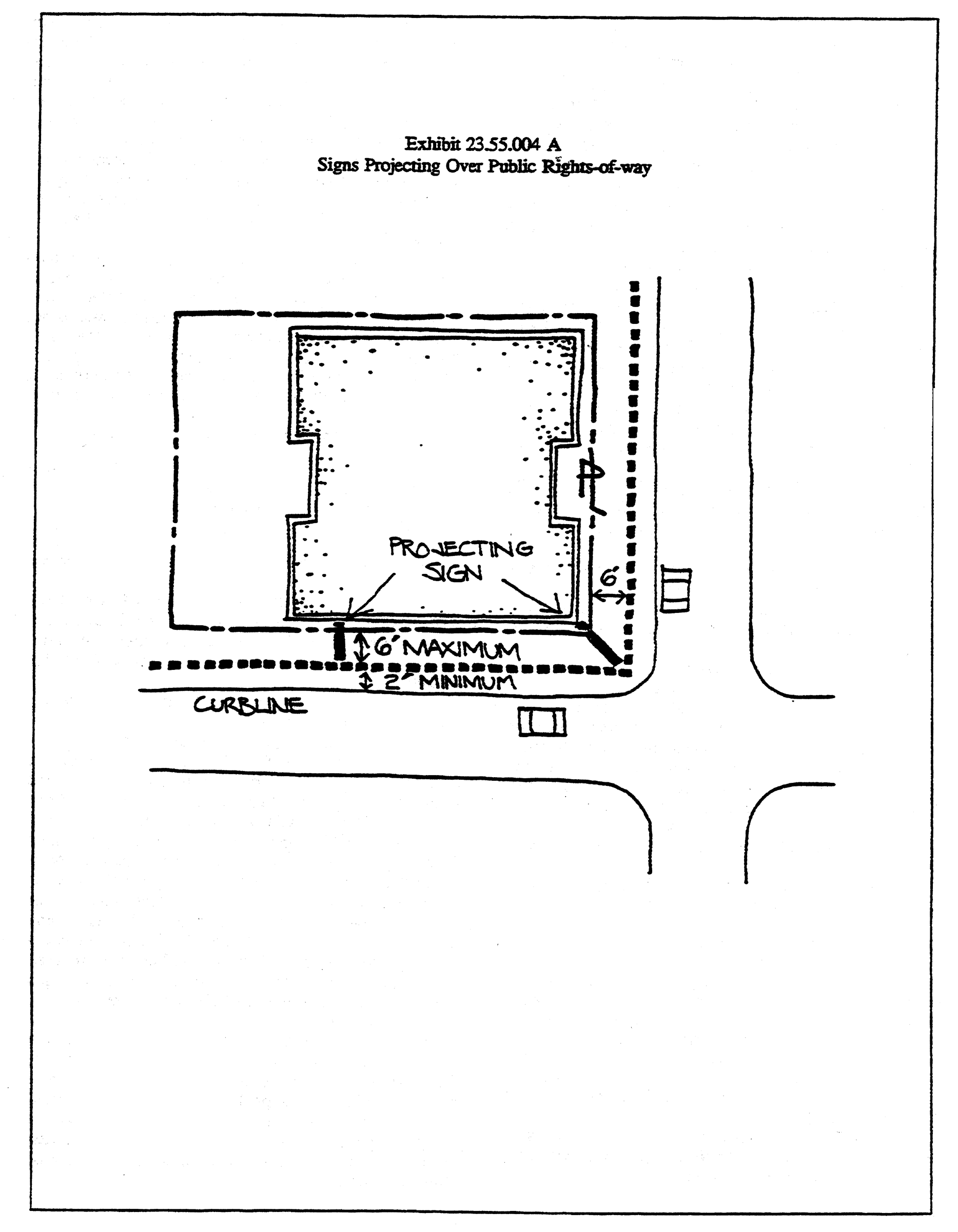
23.55.005 - Video display methods
A.
Development standards. Video display may be used on a sign when the sign meets all of the following development standards, except as allowed in Part 4 of Chapter 23.55:
1.
The sign is an on-premises sign;
2.
The sign is not located in a residential, NC1, or NC2 zone, Special Review District, Historical District, Preservation District, or shoreline environment;
3.
The sign meets one of the following criteria:
a.
The sign face is not visible from a street, driveway, surface parking area, or lot that is owned by a different person or entity, in which case the size of the sign is not limited by this subsection 23.55.005.A, and the standards for duration or pause periods and subsection 23.55.005.A.5 do not apply; or
b.
The sign area is less than or equal to 1,000 square inches and no single dimension of the sign exceeds three feet; or
c.
The sign meets the standards set out in subsection 23.55.005.B, in addition to meeting all other standards of this subsection 23.55.005.A.
4.
The maximum height for any sign using a video display method is 15 feet above existing grade. Pole signs using a video display method shall be at least 10 feet above the ground;
5.
The sign is at least 35 linear feet in any direction from any other sign that uses a video display method;
6.
When located within 50 feet of a lot in a residential zone, any part of the sign using a video display method is oriented so that no portion of the sign face is visible from an existing or permitted principal structure on that lot;
7.
Duration: Any portion of the message that uses a video display method shall have a minimum duration of two seconds and a maximum duration of five seconds. Calculation of the duration shall not include the number of frames per second used in a video display method. Calculation of the maximum duration shall include the time used for any other display methods incorporated within that portion of the message displayed using a video display method;
8.
Pause Between Video Portions of Message. There shall be 20 seconds of still image or blank screen following every message using a video display method;
9.
Audio speakers are prohibited in association with a sign using a video method of display;
10.
Between dusk and dawn the video display shall be limited in brightness to no more than 500 nits (candela per square meter) when measured from the sign's face at its maximum brightness; and
11.
Signs using a video display method may be used after dusk only until 11 p.m. or, if the advertising is an on-premises message about an event at the site where the sign is located, for up to one hour after said event.
B.
In lieu of complying with subsection 23.55.005.A.3, the Director of SDCI shall allow video display methods on a sign if the sign meets all of the following development standards:
1.
The sign is within the area shown on the map attached as Exhibit 23.55.005.A and not within a Special Review District, Historic District, Preservation District, residential zone, or shoreline environment;
2.
The sign is a minimum distance of 15 feet from the curb; and
3.
The maximum size of the sign is 20 square feet as independently applied to each sign face, including framework and border.
C.
Video Signs Previously Erected. On-premises signs using the video method of display, that have permits authorizing use of that method of display issued prior to August 1, 2001, may continue to use the video method of display authorized in the permit provided that they meet the standards of subsections 23.55.005.A.6 through 23.55.005.A.11 within 180 days from September 9, 2001. Previously erected and permitted signs that use a video method of display located within the area shown on the map attached as Exhibit A are not subject to the foregoing standards of this Section 23.55.005 except those in subsection 23.55.005.A.1. If the video method of display is terminated for 180 days or the sign is relocated or reconstructed, then the video method of display cannot be used except in conformance with the development standards of this Section 23.55.005.
(Ord. 125869, § 3, 2019; Ord. 124919, § 143, 2015; Ord. 121477 § 34, 2004; Ord. 120466, § 2, 2001.)
Exhibit A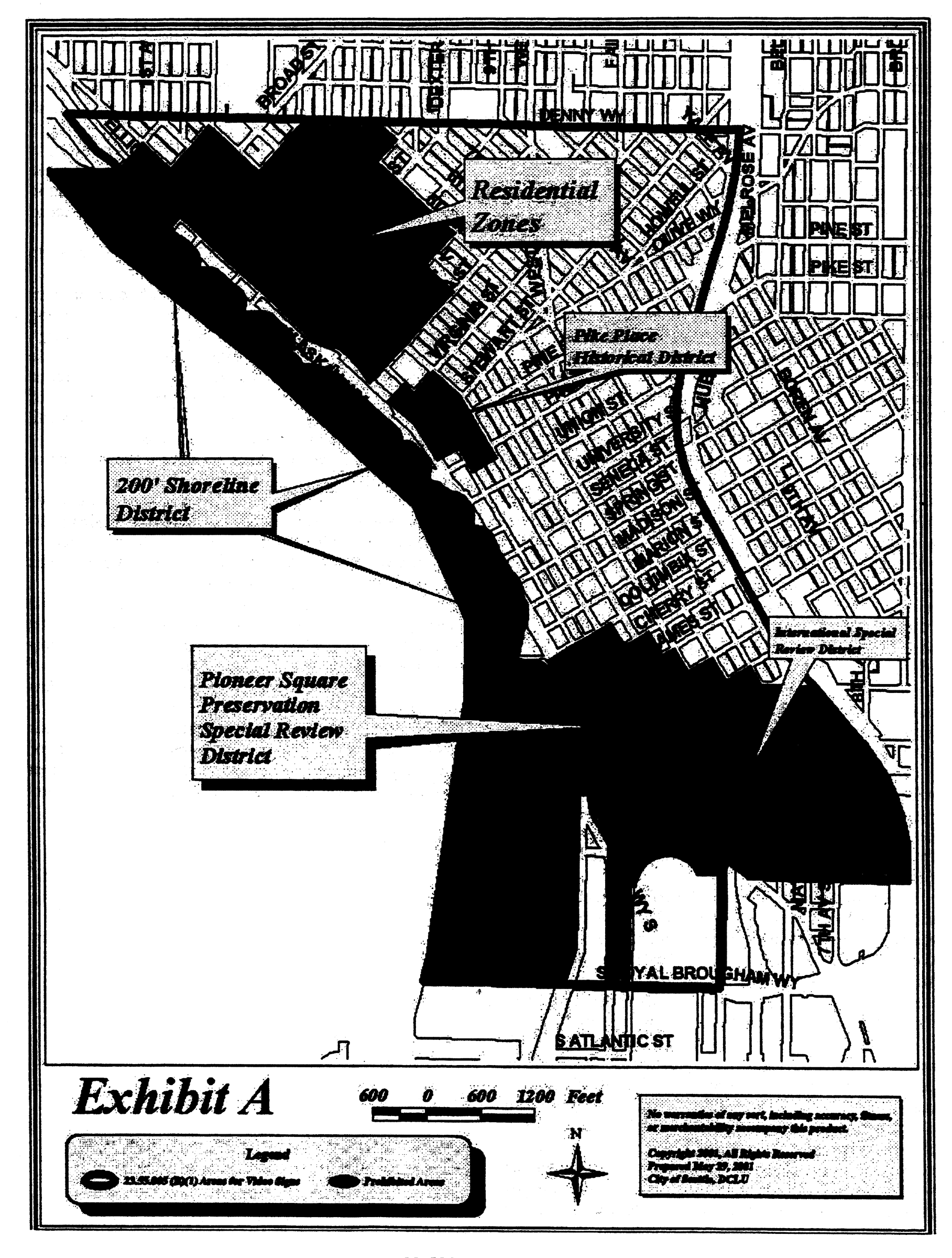
23.55.008 - Signs near intersections or driveways.
Signs which are ten (10) feet or less in height as measured from street or driveway grade and which obscure the vision of motorists shall be located at least twenty (20) feet from intersections and driveways.
(Ord. 112830 § 10(part), 1986.)
23.55.012 - Temporary signs permitted in all zones.
A.
Real estate "for sale," "for rent" and "open house" temporary signs, temporary signs identifying the architect, engineer or contractor for work currently under construction, and temporary noncommercial messages displayed on fabric signs, flags or rigid signs shall be permitted in all zones at all times, provided they are not painted with light-reflecting paint or illuminated. The total area for these types of temporary signs in the aggregate shall not exceed eight (8) square feet per building lot in neighborhood residential zones, and twenty-four (24) square feet per building lot in all other zones, except as follows: the total area allowed for noncommercial messages may increase to a maximum of eight (8) square feet per dwelling unit for use by the occupant of that dwelling unit; and in buildings where there are eight (8) dwelling units or more, a real estate banner not exceeding thirty-six (36) square feet may be permitted for one (1) nine (9) month period starting from the date of the issuance of the certificate of occupancy.
B.
In addition to the signs described in subsection A of this section above, commercial or noncommercial messages may be displayed for a total of four (4) fourteen (14) consecutive day periods a calendar year; these additional four (4) periods are the maximum, whether the message is the same message or a different message. These messages may be displayed on banners, streamers, strings of pennants, fabric signs, festoons of lights, flags, wind-animated objects, rigid signs, balloons, searchlights, portable signs attached to vehicles, or devices of a carnival nature, and shall be allowed as temporary signs in all zones. The total area for all temporary signs per fourteen (14) day period, when combined with those signs authorized under subsection A of this section, in the aggregate shall not exceed thirty-two (32) square feet per building lot for signs made of rigid material, with no dimension greater than eight (8) feet, and one hundred (100) square feet per building lot for temporary signs not made of rigid material; provided that the total area allowed for noncommercial messages may increase to a maximum of thirty-two (32) square feet per dwelling unit, with no dimension greater than eight (8) feet, for signs made of rigid material, and one hundred (100) square feet per dwelling unit for temporary signs not made of rigid material, all for use by the occupant of that dwelling unit. No individual sign made of nonrigid material may exceed thirty-six (36) square feet.
C.
All signs authorized by this section are subject to the following regulations:
1.
No sign may be placed on public property or on the planting strips that abut public property, including planting strips forming a median in a public street, except as provided in subsection C3 below and except for portable signs attached to vehicles that are using the public streets.
2.
All signs must be erected with the consent of the occupant of the property on which the sign is located, except as provided in subsection C3 below.
3.
Temporary Signs on Public Property or in Planting Strips.
a.
Temporary signs with commercial or noncommercial messages may be located on public rights-of-way or in planting strips in business districts, subject to the requirements of City of Seattle Public Works Rules Chapter 4.60 or its successor Rule.
b.
Temporary signs with noncommercial messages, other than in subsection C3a above, may be located in the planting strip in front of private property with the consent of the occupant of that property and may not exceed eight (8) square feet or be supported by stakes that are more than one (1) foot into the ground. Signs in the planting strip shall be no more than twenty-four (24) inches in height as measured from street or driveway grade when located within thirty (30) feet from the curbline of intersections. Signs shall be no more than thirty-six inches (36") in height as measured from street or driveway grade when located thirty feet (30') or more from the curbline of intersections.
c.
In addition to commercial signs in business districts allowed in subsection C3a above, only temporary commercial "open house" signs may be placed in planting strips. One (1) "open house" temporary sign per street frontage of a lot may be located with the consent of the occupant and provided the occupant or seller is on the premises. The "open house" signs may not exceed eight (8) square feet per lot or be supported by stakes that are more than one foot (1') into the ground. The "open house" signs shall be no more than twenty-four inches (24") in height as measured from street or driveway grade when located within thirty feet (30') from the curbline of intersections, and shall be no more than thirty-six inches (36") in height as measured from street or driveway grade when located thirty feet (30') or more from the curbline of intersections.
d.
No sign placed in a planting strip may be displayed on banners, streamers, strings of pennants, festoons of lights, flags, wind-animated objects or balloons.
e.
The requirements of this subsection C3 shall be enforced by the Director of Seattle Department of Transportation pursuant to the enforcement provisions of that Department.
4.
No sign shall obstruct or impair access to a public sidewalk, public or private street or driveway, traffic control sign, bus stop, fire hydrant, or any other type of street furniture, or otherwise create a hazard, including a tripping hazard.
5.
Signs shall be designed to be stable under all weather conditions, including high winds.
6.
A temporary sign shall conform to the standards for roof signs, flashing, changing image or message board signs, for moving signs, and for lighting and height regulations for the zone or special review district in which the temporary sign is located, provided that balloons may exceed height regulations.
7.
The entire visible surface of the sign, exclusive of support devices, shall be included in area calculations.
(Ord. 126509, § 78, 2022 [zone name change]; Ord. 121477 § 35, 2004; Ord. 118409, § 203, 1996; Ord. 117555, § 2, 1995; Ord. 112830, § 10, 1986.)
23.55.014 - Off-premises signs.
A.
Advertising Signs.
1.
No advertising sign shall be erected, or constructed, unless an existing advertising sign is relocated or reconstructed at a new location. An advertising sign may be relocated or reconstructed if:
a.
The existing advertising sign was lawfully erected and after the effective date of the ordinances codified in this section, [10] is registered to pursuant to subsection F of this section;
b.
The advertising sign is located on a site or in a zone where it is not permitted, except as provided in subsection A.1.c of this Section 23.55.014;
c.
In each calendar year one advertising sign which is located on a site or in a zone where it is permitted may be relocated or reconstructed if a citizen submits a written request for relocation to the Director;
d.
The reconstructed or relocated advertising sign will be a permitted use and will conform with all ordinances of the City at its new location;
e.
The construction permit for the relocated or reconstructed advertising sign is issued during the pendency of the demolition permit for the existing sign;
f.
The advertising sign face does not increase in size; and
g.
The advertising sign is relocated to an area with the same or more intensive zoning. Areas in which advertising signs are allowed are listed below from least intense to most intense zoning, and zones listed on the same line are considered of the same intensity. Zones which do not allow advertising signs shall be considered less intense zones for the purpose of relocation. This list is for purposes of this criterion only.
h.
The number of relocated advertising signs does not exceed 12 structure locations per year or 24 sign face locations per year, excluding relocations pursuant to subsection G of this Section 23.55.014.
2.
For purposes of relocation, sign owners maintain the right to relocation.
3.
Wall signs cannot be relocated.
4.
Maximum Sign Face Area. The maximum total area of any advertising sign in Commercial 1 and 2, Industrial and Downtown (except Downtown Mixed Residential/Commercial) zones shall be 672 square feet, with a maximum vertical dimension of 25 feet and a maximum horizontal dimension of 50 feet, provided that cutouts and extensions may add up to 20 percent of additional sign area. The maximum total area of any advertising sign in Downtown Mixed Residential/Commercial (DMR/C) zones shall be 300 square feet, except for visually blocked signs which may be a maximum of 672 square feet.
5.
All advertising signs shall be located at least 50 feet from any lot in a residential zone, and at least 500 feet from any public school grounds, public park, or public playground, or community center, except for off-premises signs allowed under Section 23.55.032.G. For purposes of this section, a public park or public playground means a park or playground at least one acre in size and a community center must be publicly owned.
6.
No variances shall be permitted from the provisions of this subsection A.
B.
Off-premises Directional Signs. The maximum area of any off-premises directional sign shall be 100 square feet, with a maximum vertical dimension of 10 feet and a maximum horizontal dimension of 20 feet, except for off-premises signs allowed under Section 23.55.032.G.
C.
The maximum area for each sign face for business district identification signs shall be that permitted for pole signs in the zone.
D.
The maximum area for each sign face for residential district identification signs shall be fifty (50) square feet.
E.
Development Standards Applicable to All Off-premises Signs.
1.
Dispersion Standard.
a.
Directional Sign Faces and Business District Identification Signs. Not more than a total of four (4) off-premises directional sign faces, plus two (2) identification signs for a business district, shall be permitted on both sides of a street within a space of six hundred sixty feet (660'). There shall be a minimum distance of one hundred feet (100') between sign structures.
b.
Advertising Signs.
(1)
Not more than a total of five (5) advertising sign structures shall be permitted when counting both sides of a street within a linear distance of two thousand six hundred forty feet (2640'), one-half (½) mile).
(2)
There shall be a minimum distance of three hundred linear feet (300') between advertising sign structures on the same side of the street; a maximum of two (2) advertising sign structures within three hundred linear feet (300') when counting both sides of the street; and, a minimum distance of one hundred radial (100') between advertising sign structures.
(3)
Visually blocked advertising signs shall count as one-half (½) a structure, and may be within any distance from each other on the same side of the street as long as they are oriented in opposite directions. Visually blocked advertising signs oriented in the same direction or on opposite sides of the street are subject to the spacing criteria under subsection E1b(2) of this section.
(4)
There shall be a maximum of two (2) sign faces per advertising sign structure and a maximum of one (1) sign face per side of the advertising sign structure.
2.
Off-premises signs shall not be roof signs.
3.
Lighting. No off-premises sign shall be incandescently illuminated by more than one and one-quarter (1¼) watts of electrical power per square foot of sign area, or be fluorescently or otherwise illuminated by more than one (1) watt of electrical power per square foot of sign area. Off-premises signs that include lights as part of the message or content of the sign (chasing and message board advertising signs) are prohibited.
4.
Sign Height. The maximum height limit for any portion of an off-premises sign (except in Industrial zones) is forty (40) feet or the height limit of the zone, whichever is less. The maximum height limit for any portion of an off-premises sign in an Industrial zone is sixty-five (65) feet or the height limit of the zone, whichever is less.
F.
Registration of advertising signs. Each owner of an off-premises advertising sign shall file a written report with the Director on or before July 1 of each year. The report shall be submitted on a form supplied by the Director. The owner shall identify the number and location of advertising signs maintained by the owner in the City at any time during the previous year and provide such other information as the Director deems necessary for the inspection of signs and for the administration and enforcement of this Section 23.55.014. The owner shall pay a fee to the Director at the time the written report is filed. The amount of the fee is established by Section 22.900E.010 for each sign face identified in the report. SDCI shall assign a registration number to each sign face, and the sign number shall be displayed on the face of the billboard frame in figures which are a minimum of 8 inches tall. It is unlawful to maintain a sign face that has not been registered as required by this Section 23.55.014. Notwithstanding any other provision of this code, any person who maintains an unregistered sign face is subject to an annual civil penalty of $5,000 for each unregistered sign face.
G.
Side-by-Side Advertising Signs. One (1) of the two (2) sign faces that comprise side-by-side advertising signs shall be removed within three (3) years of the effective date of the ordinance codified in this section. 1 The sign face may be relocated if the sign will meet the requirements of subsections A1e, A1f and A1g of this section, provided that in lieu of relocation the two (2) side-by-side advertising signs may be replaced by one (1) six hundred seventy-two (672) square foot advertising sign at the same location.
H.
The provisions of this section do not apply to sign kiosks, except subsection A5, prohibiting advertising signs within five hundred (500) feet from any public school grounds.
(Ord. 125272, § 51, 2017; Ord. 124919, § 144, 2015; Ord. 123543, § 1, 2011; Ord. 121477, § 36, 2004; Ord. 120388, § 4, 2001; Ord. 116780, § 1, 1993; Ord. 112830, § 10(part), 1986.)
Editor's note— Ordinance 116780 was passed by the City Council on July 19, 1993.
23.55.015 - Sign kiosks and community bulletin boards
A.
Sign Kiosks. Sign kiosks are permitted in all zones, except neighborhood residential zones and multifamily residential zones, provided that a sign kiosk may abut a park or playground at least one acre in size, or publicly owned community center in all zones. Sign kiosks are not permitted within fifty (50) feet of a neighborhood residential zone or multifamily residential zone.
B.
Sign Kiosks in the Public Right-of-way. Sign kiosks that are located in the public right-of-way must obtain a street use permit from Seattle Department of Transportation and are subject to the requirements, conditions and procedures set out in SMC Title 15. Seattle Department of Transportation shall review an application for a sign kiosk in the public right-of-way for compliance with the provisions of this chapter. The street use permit issued by Seattle Department of Transportation shall serve as the required sign permit.
C.
Development standards for sign kiosks
1.
Design and construction
a.
The design of any sign kiosk shall comply with the design principles for sign kiosks approved by the Seattle Design Commission, or shall be reviewed and recommended by the Commission.
b.
The design of any sign kiosk adjacent to a park, playground, or publicly owned community center shall also be reviewed and must be approved by the Seattle Department of Parks and Recreation for aesthetic compatibility with existing signs and the design of the park, playground, or community center.
c.
The design of any sign kiosk in a special review district established in Chapters 23.66, 25.16, 25.20, 25.22, and 25.24 shall also be reviewed and must be approved by the board for that district for compliance with the standards of that district.
d.
The sign kiosk shall be in sections with maximum dimensions of 7 feet high, 3 feet wide measuring from the centers of the supporting posts on either side of the sections, and 6 inches deep, with a maximum of four sections. No more than 2 feet of additional height will be allowed for artistic decoration on top of the kiosk, with additional width not to exceed the width of the kiosk structure. The Seattle Design Commission may approve a different style or different dimensions, which shall not exceed the maximum height dimension and the maximum overall size set out above.
e.
Lights, changing image signs, and message board signs shall not be placed on any part of a sign kiosk that is visible from the street. Flashing signs and chasing signs are prohibited on any part of a kiosk. Any lighting fixtures used within kiosks or used externally to illuminate kiosks shall be fully shielded. The maximum illumination level at the kiosk shall be 5 foot-candles (fc) maintained at ground level.
f.
Materials used in constructing sign kiosks shall minimize reflective glare from natural or artificial illumination.
g.
The design of any kiosk structure shall not be likely to be mistaken for any traffic control device and shall comply with Sections 11.50.500 through 11.50.560.
h.
All sign kiosks shall be designed, constructed, and maintained in accordance with Section 3107 of the Seattle Building Code.
2.
Location
a.
The location of any sign kiosk shall comply with the location standards set out in the rules of Seattle Department of Transportation, including without limitation rules for line of sight at intersections, compatibility with traffic control signs and other right-of-way uses, parking and pedestrian safety, and access to adjacent and abutting property.
b.
The location of any sign kiosk adjacent to a park, playground or publicly owned community center shall also be reviewed and must be approved by the Seattle Department of Parks and Recreation as not conflicting with or distracting from existing signs of the park, playground or community center.
c.
The location of any sign kiosk in a special review district established in SMC Chapters 23.66, 25.16, 25.20, 25.22, and 25.24 shall also be reviewed by and must be approved by the board for that district for compliance with the standards of that district.
d.
Sign kiosks shall be located in compliance with Section 23.55.042 and Chapter 23.60A.
e.
Sign kiosks that are not located in the public right-of-way shall be located so that they are accessible for posting and reading by the public at all times.
3.
Dispersion.
a.
Not more than a total of five (5) sign kiosks are permitted when counting both sides of street within a linear distance of two thousand six hundred forty (2640) feet (one-half (½) mile).
b.
There shall be a minimum distance of three hundred (300) linear feet between sign kiosks on the same side of the street; a maximum of two (2) sign kiosks within three hundred (300) linear feet when counting both sides of the street; and a minimum distance of one hundred (100) radial feet between sign kiosks.
D.
Standards for Posting Signs on Sign Kiosks.
1.
All members of the public may post signs on sign kiosks. Each person may post, or have posted on his/her behalf, two signs with noncommercial messages and one sign with a commercial message on each sign kiosk.
2.
Graffiti is prohibited on sign kiosks.
3.
All signs posted on sign kiosks shall comply with the following standards:
a.
The maximum size of any sign shall be eight and one-half (8½) inches by fourteen (14) inches.
b.
Signs shall not be posted in a manner that creates the appearance of a sign larger than eight and one-half (8½) inches by fourteen (14) inches.
c.
The design of any posting shall not be likely to be mistaken for any traffic control device and shall comply with SMC Sections 11.50.500 through 11.50.560.
4.
Signs shall show the date they are posted and shall be removed within thirty (30) days of posting or the day after the event announced, whichever is first. Signs with commercial messages must also include the name of the person posting the sign or causing the sign to be posted.
5.
The sign posting standards set out in subsections D1, 2, 3 and 4 shall be affixed to the kiosk. These standards are in addition to any standards set out in City ordinances or rules, in policies adopted by City departments and posted on the sign kiosk, and in contracts with The City of Seattle for sign kiosks.
6.
The sign kiosk permit holder shall clearly designate and maintain one quarter of the total posting area and may designate and maintain up to three-quarters of the total posting area of a sign kiosk for posting only noncommercial signs.
7.
The City of Seattle may post a map of the area and historical information on any kiosk in addition to the area reserved for noncommercial speech.
8.
No one may (1) sell, (2) rent, or (3) reserve or transfer for consideration posting space on a sign kiosk. Posting a sign on sign kiosk does not create a transferable right.
E.
Sign Kiosks Previously Erected. The Council finds that the sign kiosks erected or planned for before the effective date of Ordinance 120388[11] that are listed on Attachment 1 of the ordinance amending this section, which is filed with the City Clerk in C.F. 305387, are consistent with the policies for allowing sign kiosks and reasonably further the objectives of promoting traffic safety, aesthetics, and community communication. As a result, they are lawful signs. All postings on these sign kiosks shall comply with the requirements of this section. Any alteration of these sign kiosks or their location shall comply with the requirements of this section.
(Ord. 126685, § 45, 2022; Ord. 126509, § 79, 2022 [zone name change]; Ord. 125272, § 52, 2017; Ord. 124105, § 27, 2013; Ord. 121477 § 37, 2004; Ord. 120924, § 1, 2002; Ord. 120388, § 5, 2001.)
Editor's note— Ordinance 120388 was passed by the City Council on May 29, 2001.
23.55.016 - Light and glare from signs.
A.
The source of light for externally illuminated signs shall be shielded so that direct rays from the light are visible only on the lot where the sign is located.
B.
The light source for externally illuminated signs, except advertising signs, shall be no farther away from the sign than the height of the sign.
(Ord. 112830, § 10(part), 1986.)
23.55.020 - Signs in neighborhood residential zones
A.
Signs shall be stationary and shall not rotate.
B.
No flashing, changing-image or message board signs shall be permitted.
C.
No roof signs shall be permitted.
D.
The following signs are permitted in all neighborhood residential zones:
1.
Electric, externally illuminated or nonilluminated signs bearing the name of the occupant of a dwelling unit, not exceeding 64 square inches in area;
2.
Memorial signs or tablets, and the name of buildings and dates of building erection if cut into a masonry surface or constructed of bronze or other noncombustible materials;
3.
Signs for public facilities indicating danger and/or providing service or safety information;
4.
National, state, and institutional flags;
5.
For any nonresidential use allowed in the zone except for elementary or secondary schools, one electric or nonilluminated double-faced identifying wall or ground sign not to exceed 15 square feet of area per sign face on each street frontage;
6.
On-premises directional signs not exceeding 8 square feet in area. One such sign is permitted for each entrance or exit to a surface parking area or parking garage;
7.
For elementary or secondary schools, one electric or nonilluminated double-faced identifying sign, not to exceed 30 square feet of area per sign face on each street frontage, provided that the signs shall be located and landscaped so that light and glare impacts on surrounding properties are reduced, and so that any illumination is controlled by a timer set to turn off by 10 p.m.
8.
One nonilluminated sign bearing the name of a home occupation not exceeding 5 square feet in area.
E.
Existing business signs for nonconforming business establishments may be replaced, provided that:
1.
Maximum total area of sign faces shall be one hundred seventy (170) square feet, and the maximum area of the face of any single sign face shall be eighty-five (85) square feet.
2.
The replacement sign shall not be a roof sign.
3.
Replacement signs may be located in the same place as the original sign except that maximum height of any portion of the replacement sign shall be twenty-five (25) feet.
4.
Replacement signs may be electric or nonilluminated.
5.
The number of business signs shall not be increased.
F.
No sign shall be maintained in a surface parking area or on a parking garage which faces a residential lot other than one (1) designating an entrance, exit, or condition of use.
G.
Off-premises signs shall not be permitted, except that:
1.
When accessory parking is provided on a lot other than the lot where the principal use is located, off-premises directional signs five (5) square feet or less in area identifying the accessory parking shall be permitted;
2.
One (1) residential district identification wall or ground sign per entrance meeting the standards of Section 23.55.014 shall be permitted.
3.
Sign kiosks are not permitted, except when the sign kiosk abuts a park or playground at least one (1) acre in size, or publicly owned community center and complies with Section 23.55.015.
(Ord. 126845, § 2, 2023; Ord. 126509, § 80, 2022 [zone name change]; Ord. 125272, § 53, 2017; Ord. 123046, § 47, 2009; Ord. 121429, § 2, 2004; Ord. 120609, § 14, 2001; Ord. 120388, § 6, 2001; Ord. 112830, § 10, 1986.)
23.55.022 - Signs in multifamily zones
A.
Signs shall be stationary and shall not rotate.
B.
No flashing, changing-image or message board signs shall be permitted.
C.
No roof signs shall be permitted.
D.
The following signs are permitted in all multifamily zones:
1.
Electric, externally illuminated or nonilluminated signs bearing the name of the occupant of a dwelling unit, not exceeding 64 square inches in area;
2.
Memorial signs or tablets, and the names of buildings and dates of building erection if cut into a masonry surface or constructed of bronze or other noncombustible materials;
3.
Signs for public facilities indicating danger and/or providing service or safety information;
4.
National, state, and institutional flags;
5.
One electric, externally illuminated or nonilluminated sign bearing the name of a home occupation not exceeding 5 square feet in area;
6.
One nonilluminated wall or ground identification sign for multifamily structures on each street or alley frontage in addition to signs permitted by subsection 23.55.022.D.2. For structures of 16 units or less, the maximum area of each sign face is 16 square feet. One square foot of sign area is permitted for each additional unit over 16, to a maximum area of 50 square feet per sign face;
7.
For institutions other than elementary and secondary schools, one electric or nonilluminated double-faced identifying wall or ground sign on each street frontage, not to exceed 24 square feet of area per sign face;
8.
One electric, externally illuminated or nonilluminated sign bearing the name of a bed and breakfast, not exceeding 64 square inches in area;
9.
For elementary or secondary schools, one electric or nonilluminated double-faced identifying sign, not to exceed 30 square feet of area per sign face on each street frontage, provided that the signs shall be located and landscaped so that light and glare impacts on surrounding properties are reduced, and that any illumination is controlled by a timer set to turn off by 10 p.m.
E.
In Midrise and Highrise zones which are not designated Residential-Commercial, permitted ground-floor business establishments in multifamily structures may have one (1) electric or nonilluminated sign per street frontage. The sign may be a wall or projecting sign. The maximum area of each sign face shall be twenty-four (24) square feet. The maximum height of any portion of the sign shall be fifteen (15) feet.
F.
Existing business signs for nonconforming uses may be replaced, provided that:
1.
Maximum total area of sign faces shall be one hundred seventy (170) square feet, and the maximum area of any single sign face shall be eighty-five (85) square feet;
2.
The replacement sign shall not be a roof sign;
3.
Replacement signs may be located in the same place as the original signs, except that the maximum height of any portion of the replacement sign shall be thirty (30) feet;
4.
Replacement signs may be electric or nonilluminated;
5.
The number of business signs shall not be increased.
G.
On-premises directional signs shall be permitted. Maximum sign area shall be eight (8) square feet. One (1) such sign shall be permitted for each entrance or exit to a surface parking area or parking garage.
H.
No sign shall be maintained in a surface parking area or on a parking garage which faces a residential lot other than one (1) designating an entrance, exit, or condition of use.
I.
Off-premises signs shall not be permitted, except that:
1.
When accessory parking is provided on a lot other than the lot where the principal use is located, off-premises directional signs five (5) square feet or less in area identifying the accessory parking shall be permitted;
2.
One (1) residential district identification, wall or ground sign per entrance meeting the standards of Section 23.55.014 shall be permitted.
3.
Sign kiosks are not permitted, except when the sign kiosk abuts a park or playground at least one (1) acre in size, or publicly owned community center and complies with Section 23.55.015.
(Ord. 126845, § 3, 2023; Ord. 123046, § 48, 2009; Ord. 121429, § 3, 2004; Ord. 120388, § 7, 2001; Ord. 113464, § 3, 1987; Ord. 112830, § 10, 1986.)
23.55.024 - Signs in residential commercial (RC) zones.
A.
The standards of this section shall apply only to signs for business establishments permitted on the ground floor or below in RC zones. The standards for multi-family zones, Section 23.55.022, shall apply to all other signs in RC zones.
B.
Ground-floor business establishments may have one (1) electric or nonilluminated wall sign per street frontage, located on the commercial portion of the structure.
C.
Maximum total area of sign faces per business establishment shall be one hundred seventy (170) square feet, and the maximum area of any single sign face shall be eighty-five (85) square feet.
D.
The maximum height of any portion of a sign for a business establishment shall be fifteen (15) feet.
E.
Sign kiosks as provided in Section 23.55.015 are permitted.
(Ord. 120388, § 8, 2001: Ord. 112830 § 10(part), 1986.)
23.55.028 - Signs in NC1 and NC2 zones
A.
Signs shall be stationary and shall not rotate, except for barberpoles.
B.
Signs may be electric, externally illuminated, or non-illuminated.
C.
No flashing, changing-image or chasing signs are permitted, except that chasing signs for motion picture and performing arts theaters are permitted in NC2 zones.
D.
On-premises signs
1.
The following signs are permitted in addition to the signs permitted by subsections 23.55.028.D.2, 23.55.028.D.3, and 23.55.028.D.4:
a.
Electric, externally illuminated or nonilluminated signs bearing the name of the occupant of a dwelling unit, not exceeding 64 square inches in area;
b.
Memorial signs or tablets, and the names of buildings and dates of building erection if cut into a masonry surface or constructed of bronze or other noncombustible materials;
c.
Signs for public facilities indicating danger and/or providing service or safety information;
d.
National, state and institutional flags;
e.
One under-marquee sign that does not exceed 10 square feet in area;
f.
One electric, externally illuminated or non-illuminated sign bearing the name of a home occupation, not exceeding 5 square feet in area.
2.
Number and type of signs allowed for business establishments
a.
Each business establishment may have one ground, roof, projecting or combination sign (Type A sign) for each 300 lineal feet, or portion thereof, of frontage on public rights-of-way, except alleys.
b.
In addition to the signs permitted by subsection 23.55.028.D.2.a, each business establishment may have one wall, awning, canopy, marquee, or under-marquee sign (Type B sign) for each 30 lineal feet, or portion thereof, of frontage on public rights-of-way, except alleys.
c.
In addition to the signs permitted by subsections 23.55.028.D.2.a and D.2.b, each multiple business center and drive-in business may have one pole sign for each 300 lineal feet, or portion thereof, of frontage on public rights-of-way, except alleys. Such pole signs may be for a drive-in business or for an individual business establishment located in a multiple business center, or may identify a multiple business center.
d.
Individual businesses that are not drive-in businesses and that are not located in a multiple business center may have one pole sign in lieu of a Type A sign permitted by subsection 23.55.028.D.2.a for each 300 lineal feet, or portion thereof, of frontage on public rights-of-way, except alleys.
3.
Maximum area of signs for nonresidential uses and live-work units. The maximum area of all signs for each business establishment permitted in subsection 23.55.028.D.2 is 185 square feet, and the maximum area of any one Type A sign is 72 square feet, provided that the maximum area of pole signs for gas stations that identify the price of motor fuel being offered by numerals of equal size is 96 square feet.
4.
Identification signs for multifamily structures.
a.
One identification sign bearing the name of a multifamily structure is permitted on each street or alley frontage of a residential use in addition to the signs permitted by subsection 23.55.028.D.1.
b.
Identification signs may be wall, ground, awning, canopy, marquee, under-marquee, or projecting signs.
c.
For structures of 24 units or less, the maximum area of each sign face is 24 square feet. One square foot of sign area is permitted for each additional unit over 24, to a maximum of 50 square feet per sign face.
5.
Sign height
a.
The maximum height for any portion of a pole, projecting or combination sign is 25 feet.
b.
The maximum height for any portion of a wall or under-marquee sign is 20 feet or the height of the cornice of the structure to which the sign is attached, whichever is greater.
c.
Marquee signs may not exceed a height of 30 inches above the top of the marquee, and total vertical dimension shall not exceed 5 feet.
d.
No portion of a roof sign shall exceed a height of 25 feet above grade.
E.
Off-premises Signs. Off-premises signs shall not be permitted, except that:
1.
Each business district may have two (2) identifying ground, pole, wall or projecting signs which may list businesses located in the district. The identifying signs shall not be located in a residential zone, and shall meet the standards of Section 23.55.014, Off-premises signs.
2.
One (1) residential district identification wall or ground sign per entrance, meeting the standards of Section 23.55.014, shall be permitted.
3.
When accessory parking is provided on a lot other than the lot where the principal use is located, off-premises directional signs five (5) square feet or less in area identifying the accessory parking shall be permitted. Off-premises directional signs five (5) square feet or less in area shall not be counted in sign size or number limits.
4.
Sign kiosks as provided in Section 23.55.015 are permitted.
F.
Signs Near Residential Zones. When located within fifty (50) feet of an abutting lot in a residential zone, electric and externally illuminated signs shall be oriented so that no portion of the sign face is visible from an existing or permitted principal structure on the abutting lot.
(Ord. 126845, § 4, 2023; Ord. 123649, § 41, 2011; Ord. 123046, § 49, 2009; Ord. 121196 § 26, 2003; Ord. 120388, § 9, 2001; Ord. 113387 § 5, 1987; Ord. 112830 § 10(part), 1986.)
23.55.030 - Signs in NC3, C1, C2 and SM zones
A.
No sign shall have rotating or moving parts that revolve at a speed in excess of seven revolutions per minute.
B.
Signs may be electric, externally illuminated, non-illuminated or may use video display methods when the sign meets the development standards in Section 23.55.005, Video display methods.
C.
Flashing signs are prohibited.
D.
In the Pike/Pine Conservation Overlay District, internally-illuminated cabinet signs larger than 3 square feet in size and backlit awning signs are prohibited.
E.
On-premises signs
1.
The following signs are permitted in addition to the signs permitted by subsections 23.55.030.E.2 and 23.55.030.E.3:
a.
Electric, externally illuminated or non-illuminated signs bearing the name of the occupant of a dwelling unit, not exceeding 64 square inches in area;
b.
Memorial signs or tablets, and the names of buildings and dates of building erection if cut into a masonry surface or constructed of bronze or other noncombustible materials;
c.
Signs for public facilities indicating danger and/or providing service or safety information;
d.
National, state and institutional flags;
e.
One under-marquee sign that does not exceed 10 square feet in area;
f.
One electric, externally illuminated or non-illuminated sign bearing the name of a home occupation, not to exceed 5 square feet in area.
2.
Number and type of signs allowed for business establishments.
a.
Each business establishment may have one ground, roof, projecting or combination sign (Type A sign) for each 300 lineal feet, or portion thereof, of frontage on public rights-of-way, except alleys.
b.
In addition to the signs permitted by subsection 23.55.030.E.2.a, each business establishment may have one wall, awning, canopy, marquee or under- marquee sign (Type B sign) for each 30 lineal feet, or portion thereof, of frontage on public rights-of-way, except alleys.
c.
In addition to the signs permitted by subsections 23.55.030.E.2.a and 23.55.030.E.2.b, each multiple business center and drive-in business may have one pole sign for each 300 lineal feet, or portion thereof, of frontage on public rights-of-way, except alleys. Such pole signs may be for a drive-in business or for an individual business establishment located in a multiple business center, or may identify a multiple business center.
d.
Individual businesses that are not drive-in businesses and that are not located in multiple business centers may have one pole sign in lieu of a Type A sign permitted by subsection 23.55.030.E.2.a for each 300 lineal feet, or portion thereof, of frontage on public rights-of-way, except alleys.
e.
If the principal use or activity on the lot is outdoor retail sales, banners and strings of pennants maintained in good condition are permitted in addition to the signs permitted by subsections 23.55.030.E.2.a, 23.55.030.E.2.b and 23.55.030.E.2.c.
3.
Maximum area
a.
NC3 and SM zones
1)
The maximum area of each face of a pole, ground, roof, projecting or combination sign is 72 square feet plus 2 square feet for each foot of frontage over 36 feet on public rights-of-way, except alleys, to a maximum area of 300 square feet, provided that:
i.
The maximum area for signs for multiple business centers, and signs for business establishments located within 100 feet of a state route right-of-way that is not designated in Section 23.55.042 as a landscaped or scenic view section, is 600 square feet; and
ii.
The maximum area for pole signs for gas stations that identify the price of motor fuel being offered by numerals of equal size is 96 square feet.
2)
There is no maximum area limit for awning, canopy, marquee or under-marquee signs.
3)
The maximum area for each wall sign is 672 square feet.
b.
C1 and C2 Zones. There is no maximum area limit for on-premises signs for business establishments in C1 and C2 zones except the maximum area for each wall sign is 672 square feet.
4.
Identification signs for multifamily structures
a.
One identification sign is permitted on each street or alley frontage of a multifamily structure.
b.
Identification signs may be wall, ground, awning, canopy, marquee, under-marquee, or projecting signs.
c.
The maximum area of each sign is 72 square feet.
5.
Sign height
a.
The maximum height for any portion of a projecting or combination sign is 65 feet above existing grade, or the maximum height limit of the zone, whichever is less.
b.
The maximum height limit for any portion of a pole sign is 30 feet; except for pole signs for multiple business centers and for business establishments located within 100 feet of a state route right-of-way that is not designated in Section 23.55.042 as a landscaped or scenic view section, for which a maximum height of 40 feet is permitted.
c.
The maximum height for any portion of a wall, marquee, under-marquee or canopy sign is 20 feet or the height of the cornice of the structure to which the sign is attached, whichever is greater.
d.
No portion of a roof sign shall:
1)
Extend beyond the height limit of the zone;
2)
Exceed a height above the roof in excess of the height of the structure on which the sign is located; or
3)
Exceed a height of 30 feet above the roof, measured from a point on the roof line directly below the sign or from the nearest adjacent parapet.
F.
Off-Premises Signs.
1.
Identifying Signs for Business Districts. Each business district may have up to two identifying ground, pole, wall or projecting signs which may list businesses located in the district. The identifying signs shall not be located in a residential zone, and shall meet the standard of Section 23.55.014, Off-premises signs.
2.
One residential district identification wall or ground sign per entrance, meeting the standards of Section 23.55.014, is permitted.
3.
When accessory parking is provided on a lot other than the lot where the principal use is located, off-premises directional signs 5 square feet or less in area identifying the accessory parking are permitted.
4.
Off-premises directional signs and advertising signs, in addition to those permitted by subsections 23.55.030.F.1, 23.55.030.F.2 and 23.55.030.F.3, are permitted according to Section 23.55.014, Off-premises signs.
5.
Advertising signs are prohibited in Neighborhood Commercial 3 zones and in the Seattle Mixed (SM) zone.
6.
Sign kiosks as provided in Section 23.55.015 are permitted.
G.
Signs Near Residential Zones. When located within 50 feet of an abutting lot in a residential zone, electrical and externally illuminated signs shall be oriented so that no portion of the sign face is visible from an existing or permitted principal structure on the abutting lot.
(Ord. 126845, § 5, 2023; Ord. 124457, § 2, 2014; Ord. 123649, § 42, 2011; Ord. 123392, § 4, 2010; Ord. 123046, § 50, 2009; Ord. 123020, § 13, 2009; Ord. 121782 § 34, 2005; Ord. 120466, § 3, 2001; Ord. 120388, § 10, 2001; Ord. 118302 § 16, 1996; Ord. 116780, § 2, 1993; Ord. 113387 § 6, 1987; Ord. 112830 § 10(part), 1986.)
23.55.032 - Signs in the Sand Point Overlay District
A.
Sign regulations within this section apply to subareas B and C in the Sand Point Overlay District, as described in Section 23.72.004 and depicted on Map A for Section 23.72.004. Sign regulations in the underlying zones continue to apply to all uses in subarea A. The regulations in this Section 23.55.032 supersede the sign regulations for the underlying zone in subareas B and C, except when a residential use is allowed in subarea B the sign regulations for the underlying zone in that subarea shall apply.
B.
Signs in the Sand Point Historic District portion of the Sand Point Overlay District subareas B and C, as depicted in Map B for Section 23.72.004, are permitted when consistent with the provisions of this section and undertaken in a manner consistent with the Sand Point Historic Properties Reuse and Protection Plan, dated April 1998, or successor plans, as documented by a letter of approval from the Sand Point Historic Preservation Coordinator, or any successor agency decision maker, certifying that the erection of the proposed sign is consistent with the plan.
C.
Signs shall be stationary and shall not rotate.
D.
The following types of signs are prohibited:
1.
Flashing image signs;
2.
Signs with changing-images;
3.
Message board signs; or
4.
Off-premises signs, except as provided in subsection 23.55.032.G.
E.
Signs may be externally illuminated, or non-illuminated, except as provided in subsection 23.55.032.G. Electric signs that include individually cut letters, numbers, or figures are permitted when affixed to a building or structure, except as provided in subsection 23.55.032.G. For any use located on a lot in subarea B, when located within 50 feet of an abutting lot in subareas A or C, permitted electrical or externally illuminated signs are required to be oriented so that no portion of the sign face is visible from:
1.
an existing or permitted principal structure on the abutting lot in subarea A; or
2.
an existing or permitted principal structure on the abutting lot in subarea C, unless the use of the structure is a non-conforming use at the time of the effective date of this ordinance.
F.
On-premises signs
1.
The following on-premises signs are permitted in addition to the signs permitted by subsections 23.55.032.F.2 and F.3:
a.
Memorial signs or tablets, and the names of buildings and dates of building erection when cut into a masonry surface or constructed of bronze or other noncombustible materials, up to a maximum of 5 square feet;
b.
Signs for public facilities indicating danger and/or providing service or safety information;
c.
National, state, county, city, and institutional flags. In addition, flags are permitted for a non-profit organization not meeting the definition of an Institution in Section 23.84A.018.
2.
The number and type of on-premises signs allowed for business establishments in subarea B and subarea C of the Sand Point Overlay District are as follows:
a.
Each individual business establishment is permitted one projecting sign oriented to pedestrians on each building facade occupied by that business on public rights-of-way and publicly-owned roadways. The maximum area of this sign is 16 square feet.
b.
Each individual business establishment is permitted one of the following types of signs for each 300 linear feet, or portion thereof, of building facade occupied by that business establishment on public rights-of-way and publicly-owned roadways. These signs are:
1)
Wall;
2)
Ground;
3)
Projecting;
4)
Awning;
5)
Canopy;
6)
Marquee; or
7)
Under-marquee.
The maximum area for any of these signs is 48 square feet each. The sign shall be located on the portion of the structure that is on the public right-of-way or publicly owned roadway and occupied by the business establishment.
c.
A business establishment with more than 300 linear feet of a building facade on a public right-of-way or publicly owned roadway is permitted to have one additional sign of the type permitted under subsection 23.55.032.F.2.b. A business establishment that is permitted to have two signs under this subsection 23.55.032.F.2.c may combine the two signs into one of the type of signs permitted under subsection 23.55.032.F.2.b, up to a maximum total combined area of 96 square feet.
d.
Sign height
1)
The maximum height for any portion of a pedestrian oriented projecting sign permitted under subsection 23.55.032.F.2.a is 10 feet above existing grade.
2)
The maximum height for any portion of a projecting sign that is not a pedestrian oriented sign permitted under subsection 23.55.032.F.2.a is 50 feet above existing grade, or the height of the top of the wall, excluding any cornice, of the structure to which the sign is attached, whichever is less.
3)
The maximum height for any portion of a wall, awning, canopy, marquee, or under-marquee sign is 20 feet or the height of the top of the wall, excluding any cornice of the structure to which the sign is attached, whichever is greater.
3.
Multifamily structures in subarea C of the Sand Point Overlay District are allowed to have identification signs as follows:
a.
One identification sign is permitted on each facade of a building containing a multifamily use on public rights-of-way and publicly-owned roadways. Such signs may not be located within 50 feet of each other.
b.
Identification signs may be wall, ground, projecting, awning, canopy, marquee, or under-marquee.
c.
The maximum area of each identification sign is 24 square feet.
d.
The maximum height for any portion of a wall, projecting, awning, canopy, marquee, or under-marquee identification sign is 20 feet or the height of the top of the wall, excluding any cornice, whichever is greater.
G.
Off-Premises Signs. Two types of off-premises signs are allowed in the Sand Point Overlay District: "Off-premises directional signs", and "Sand Point District signs."
1.
"Off-premises directional signs" are allowed, subject to the provisions in subsection 23.55.032.G.3. The maximum area for each off-premises directional sign face is 24 square feet per sign face. Only Sand Point Overlay District property owners may install off-premises directional signs.
2.
"Sand Point District signs" are signs installed by Sand Point Overlay District property owners listing the names of buildings or subareas and the organizations and businesses located within those buildings or subareas. Sand Point District signs are allowed in lieu of business district identification signs, which are prohibited. The maximum area for each off-premises Sand Point District sign is 48 square feet per sign face. The maximum area for any portion of a Sand Point District sign that lists an individual business or other nonresidential use is 16 square feet per sign face.
3.
Off-premises directional signs and Sand Point District signs are allowed as follows:
a.
Signs permitted under this subsection 23.55.032.G shall be ground signs;
b.
The provisions of subsection 23.55.014.B do not apply; and
c.
If a Sand Point District sign lists more than one individual business or other nonresidential use, the overall area devoted to such messages shall be at least 8 square feet smaller than the part of the sign identifying the name of the building or the subarea;
d.
The signs shall comply with subsections 23.55.014 E.1.a, dispersion standards for directional sign faces and business district identification signs, 23.55.014 E.2, no roof signs, 23.55.014 E.3, lighting, and 23.55.014 E.4, height. Subsection 23.55.014 E.1.b does not apply.
I.
Sign kiosks are allowed as provided in subsections 23.55.015 B, C, D and E.
J.
Signs shall conform to Section 23.55.016, Light and glare from signs.
(Ord. 127099, § 48, 2024; Ord. 123543, § 2, 2011.)
23.55.034 - Signs in downtown zones
A.
The provisions of this Section 23.55.034 apply to all downtown zones except PSM, IDR and IDM zones, and portions of PMM zones located in a Historic District. Signs in the PSM, IDR and IDM zones are regulated by the provisions of Chapter 23.66, Special review districts.
B.
The following signs are permitted in all downtown zones regulated by this section:
1.
Electric, externally illuminated or nonilluminated signs bearing the name of the occupant of a dwelling unit, not exceeding 64 square inches in area;
2.
Memorial signs or tablets, and the names of buildings and dates of building erection if cut into a masonry surface or constructed of bronze or other noncombustible materials;
3.
Signs for public facilities indicating danger and/or providing service or safety information;
4.
National, state and institutional flags.
C.
General Standards for All Signs.
1.
Signs may be electrical, externally illuminated, nonilluminated or may use video display methods when the sign meets the development standards in Section 23.55.005, Video display methods.
2.
No sign shall have rotating or moving parts that revolve at a speed in excess of seven (7) revolutions per minute.
3.
No flashing signs shall be permitted.
4.
Roof signs shall not be permitted.
5.
No portion of any on-premises or off-premises sign shall be located more than sixty-five (65) feet above the elevation of the sidewalk at the street property line closest to the sign, other than for on-premises signs that only identify hotels and public buildings and where such a sign shall have no rotating or moving parts and shall meet the other requirements of this section.
D.
On-premises Signs.
1.
Number and Type of Permitted Signs.
a.
Each use may have one (1) pole, ground, projecting or combination sign for each three hundred (300) lineal feet, or portion thereof, of frontage on public rights-of-way, except alleys.
b.
In addition to the signs permitted by subsection D1a, each use may have one (1) wall, awning, canopy, marquee, or under-marquee sign for each thirty (30) lineal feet, or portion thereof, of frontage on public rights-of-way, except alleys.
c.
In addition to the signs permitted by subsections D1a and D1b, each multiple business center may have one (1) wall, marquee, under-marquee, projecting or combination sign for each three hundred (300) lineal feet, or portion thereof, of frontage on public rights-of-way, except alleys.
d.
Among the number and type of permitted signs in subsections D1a, D1b and D1c, a maximum of four (4) of these signs identifying hotels or public buildings may be located sixty-five (65) feet or more above the elevation of the sidewalk.
e.
Where the principal use or activity on the lot is outdoor retail sales, banner and strings of pennants maintained in good condition shall be allowed in addition to the signs permitted by subsections D1a, D1b and D1c.
2.
There is no maximum area limit for on-premises signs, except as follows:
a.
The maximum area for each wall sign is 672 square feet; and
b.
Signs identifying hotels and public buildings 65 feet or more above the elevation of the sidewalk shall not exceed 18 feet in length, height or any other direction.
E.
Off-premises Signs.
1.
When accessory parking is provided on a lot other than the lot where the principal use is located, off-premises directional signs five (5) square feet or less in area identifying the accessory parking shall be permitted.
2.
Off-premises directional signs and advertising signs, in addition to those permitted by subsection E1, shall be permitted according to Section 23.55.014.
3.
Advertising signs are prohibited in Downtown Mixed Residential/Residential (DMR/R) zones.
4.
Sign kiosks as provided in Section 23.55.015 are allowed in downtown zones.
(Ord. 124457, § 3, 2014; Ord. 124378, § 60, 2013; Ord. 123046, § 51, 2009; Ord. 120466, § 4, 2001; Ord. 120388, § 11, 2001; Ord. 119239 § 32, 1998; Ord. 118414 § 42, 1996; Ord. 116780, § 3, 1993; Ord. 112830 § 10(part), 1986.)
23.55.036 - Signs in IB, IC, IG1 and IG2 zones
A.
No sign shall have rotating or moving parts that revolve at a speed in excess of seven revolutions per minute.
B.
Signs may be electric, externally illuminated, or nonilluminated or may use video display methods when the sign meet the development standards in Section 23.55.005, Video display methods.
C.
Flashing signs are prohibited.
D.
On-premises signs
1.
The following signs are permitted in addition to the signs permitted by subsections 23.55.036.D.2, 23.55.036.D.3, and 23.55.036.D.4:
a.
Electric, externally illuminated or non-illuminated signs bearing the name of the occupant of a dwelling unit, not exceeding 64 square inches in area;
b.
Memorial signs or tablets, and the names of buildings and dates of building erection if cut into a masonry surface or constructed of bronze or other noncombustible materials;
c.
Signs for public facilities indicating danger and/or providing service or safety information;
d.
National, state and institutional flags;
e.
One under-marquee sign not exceeding 10 square feet in area;
f.
One electric, externally illuminated or non-illuminated sign bearing the name of a home occupation, not exceeding 5 square feet in area.
2.
Number and type of signs allowed for business establishments
a.
Except as further restricted in subsection 23.55.036.D.5, each business establishment may have one ground, roof, projecting, or combination sign (Type A sign) for each 300 lineal feet, or portion thereof, of frontage on public rights-of-way, except alleys.
b.
In addition to the signs allowed by subsection 23.55.036.D.2.a, each business establishment may have one wall, awning, canopy, marquee, or under-marquee sign (Type B sign) for each 30 lineal feet, or portion thereof, of frontage on public rights-of-way, except alleys.
c.
Multiple business centers may have one pole, ground, wall, marquee, under-marquee, projecting or combination sign for each 300 lineal feet, or portion thereof, of frontage on public rights-of-way, except alleys.
d.
Individual businesses that are not drive-in businesses and that are not located in multiple business centers may have one pole sign in lieu of a Type A sign permitted by subsection 23.55.036.D.2.a for each 300 lineal feet, or portion thereof, of frontage on public rights-of-way, except alleys.
e.
In addition to the signs allowed by subsections 23.55.036.d.2.a and 23.55.036.D.2.b, drive-in business establishments may have one pole sign for each 300 lineal feet, or portion thereof, of frontage on public rights-of-way, except alleys.
f.
Where the principal use or activity on the lot is outdoor retail sales, banners and strings of pennants maintained in good condition shall be permitted in addition to the signs permitted by subsections 23.55.036.D.2.a and 23.55.036.D.2.b.
3.
Maximum area. There is no maximum area limit for on-premises signs for business establishments, except as follows:
a.
As set forth in subsection 23.55.036.D.5; and
b.
The maximum area for each wall sign is 672 square feet except that the maximum area for each wall sign for spectator sports facilities with a seating capacity of 40,000 or greater shall be 3,000 square feet.
4.
Identification signs for multifamily structures.
a.
One identification sign shall be permitted on each street or alley frontage of a multifamily structure.
b.
Identification signs may be wall, ground, awning, canopy, marquee, under-marquee, or projecting signs.
c.
The maximum area of each sign shall be 72 square feet.
5.
Sign height
a.
The maximum height for any portion of a projecting or combination sign shall be 65 feet above existing grade, or the maximum height limit of the zone, whichever is less.
b.
The maximum height limit for any portion of a pole sign shall be 30 feet; except for pole signs for multiple business centers and for business establishments located within 100 feet of a state route right-of-way which is not designated in Section 23.55.042 as a landscaped or scenic view section, which shall have a maximum height of 40 feet.
c.
The maximum height for any portion of a wall, marquee, under-marquee, or canopy sign shall be 20 feet or the height of the cornice of the structure to which the sign is attached, whichever is greater.
d.
No portion of a roof sign shall:
(1)
Extend beyond the height limit of the zone for office uses, except that spectator sports facilities with a seating capacity of 40,000 or greater and more than one roof level may have up to two identification signs, with the vertical dimension of lettering or characters limited to 12 feet and a maximum total area for both signs limited to 3,000 square feet; provided, the sign height does not exceed the highest roof level. One additional identification sign may be applied to each surface of the highest roof level, provided it does not exceed the height of that roof level.
(2)
Exceed a height above the roof in excess of the height of the structure on which the sign is located; or
(3)
Exceed a height of 30 feet above the roof measured from a point on the roof line directly below the sign or from the nearest adjacent parapet.
E.
Off-premises Signs.
1.
Identifying Signs for Business Districts. Each business district may have up to two (2) identifying ground, pole, wall, or projecting signs which may list businesses located in the district. The identifying signs shall not be located in a residential zone, and shall meet the standard of Section 23.55.014, Off-premises signs.
2.
When accessory parking is provided on a lot other than the lot where the principal use is located, off-premises directional signs five (5) square feet or less in area identifying the accessory parking shall be permitted.
3.
Off-premises directional signs and advertising signs in addition to those permitted by subsections E1, E2, and E3 shall be permitted according to Section 23.55.014, Off-premises signs.
4.
Sign kiosks as provided in Section 23.55.015 are permitted.
F.
Signs Near Residential Zones. When located within fifty (50) feet of an abutting lot in a residential zone, electrical and externally illuminated signs shall be oriented so that no portion of the sign face is visible from an existing or permitted principal structure on the abutting lot.
(Ord. 126845, § 6, 2023; Ord. 124457, § 4, 2014; Ord. 123649, § 43, 2011; Ord. 120611, § 15, 2001; Ord. 120466, § 5, 2001; Ord. 120388, § 12, 2001; Ord. 119391 § 1, 1999; Ord. 113658 § 11, 1987.)
23.55.040 - Special exception for signs in commercial and downtown zones
The Director may authorize exceptions to the regulations for the size, number, type, height and depth of projection of on-premises signs in neighborhood commercial, commercial, downtown office core, downtown retail core, downtown mixed commercial, areas of Pike Market Mixed not located in a Historic District, and downtown harborfront zones as a special exception pursuant to Chapter 23.76, Procedures for Master Use Permit and Council Land Use Decisions, except that no special exception may be authorized for a sign using video display methods. When one or more of the conditions in subsection 23.55.040.A have been met, the characteristics described in subsection 23.55.040.B shall be used to evaluate the merits of the proposal. Proposals must also meet the intent of the Sign Code as specified in Section 23.55.001, Intent. An exception shall not be granted for roof signs or signs prohibited in Section 23.55.003. In downtown zones, the Director shall consult with the Seattle Design Commission before issuance of the special exception decision.
A.
Conditions. One (1) or more of the following conditions shall be met:
1.
The proposed sign plan shows an exceptional effort toward creating visual harmony among signs, desirable streetscape features, building facades and other architectural elements of the building structure through the use of a consistent design theme;
2.
The proposed sign plan will preserve a desirable existing design or siting pattern for signs in an area;
3.
The proposed sign plan will reduce views of historic landmarks designated by the Landmarks Preservation Board no more than would be permitted by a sign permitted outright without a special exception.
B.
Desired Characteristics. All the following desired characteristics shall be used to evaluate applications for a special exception, and at least one (1) must be met. The proposed sign(s):
1.
Unifies the project as a whole or contributes positively to a comprehensive building and tenant signage plan;
2.
Is compatible with the building facade and scale of building in terms of size, height and location;
3.
Adds interest to the street level environment, while also identifying upper level businesses;
4.
Helps orient pedestrians and motorists at street-level in the vicinity of the subject building;
5.
Integrates support fixtures, conduits, wiring, switches and other mounting apparatus into the building architecture to the extent feasible.
C.
Submittal Requirements. As part of any application for a special sign exception, the following information shall be submitted:
1.
A narrative describing how the proposal is consistent with the conditions and desired characteristics listed in subsection A and B of this section, and why the desired results cannot be achieved without a special exception;
2.
A colored rendering showing the proposed signs and how they relate to development in the area and on the subject property.
(Ord. 124378, § 61, 2013; Ord. 120466, § 6, 2001; Ord. 118888 § 2, 1998: Ord. 112830 § 10(part), 1986.)
23.55.042 - Off-premises and business signs adjacent to certain public highways.
A.
Intent. The purpose of this section is to implement the purpose and policy expressed by the Highway Advertising Control Act of the State of Washington in the regulation of outdoor off-premises signs adjacent to certain public highways, and this section is declared to be an exercise of the police power of the City to protect the public health, safety, convenience and the enjoyment of public travel, to attract visitors to the City and to conserve the beauty of the natural and built environment by regulating the size and location of certain signs adjacent to certain designated freeways, expressways, parkways and scenic routes within the City. This section shall be liberally construed for the accomplishment of these purposes and is intended to be additional and supplemental to other laws regulating the size and location of signs.
B.
Off-premises and Business Signs Prohibited Near Certain Areas. No off-premises sign or business sign shall be erected within six hundred sixty (660) feet outgoing from the nearest edge of the main traveled way of any landscaped and/or scenic view section of a freeway, expressway, parkway or scenic route designated by this subsection and shown on Exhibit 23.55.042 A (Type A sections), and no off-premises sign shall be erected within two hundred (200) feet in any direction from the main traveled way of the exit and entrance ramps thereto, if any part of the advertising matter or informative content of the sign is visible from any place on the traveled way of the landscaped and/or scenic view section or ramp, except as provided in subsections C and D:
1.
West Seattle Freeway from Harbor Avenue S.W. to 35th Avenue S.W.;
2.
The west side of the Alaskan Freeway from South Connecticut Street to the west portal of the Battery Street Tunnel. The east side of the Alaskan Freeway from South Connecticut Street to the west portal of the Battery Street Tunnel;
3.
Interstate Highway No. 5 from the north City limits to the south City limits;
4.
Interstate Highway No. 90 from the east City limits to Interstate Highway No. 5;
5.
State Route 520 (Evergreen Point Bridge) to Interstate Highway No. 5.
C.
Business Signs Permitted on Type A Landscaped and Scenic View Sections. The following business signs shall be permitted outright on Type I landscaped and scenic view sections:
1.
Stationary, nonflashing business signs on the face of a structure, the total area of which shall not exceed ten (10) percent of the face of the structure or two hundred fifty (250) square feet, whichever is less;
2.
Stationary, nonflashing freestanding business signs, of which the total area visible from any place on the traveled way of the landscaped and/or scenic view section does not exceed seventy-five (75) square feet, and not exceeding thirty (30) feet in height including structures and component parts as measured from the grade immediately below the sign;
3.
Real estate "for sale" or "for rent" signs, provided the total area of all such signs on any lot shall not exceed fifty (50) square feet;
4.
Stationary, nonflashing business signs for gas stations, the area of a single face of which shall not exceed one hundred fifty (150) square feet and the total combined area of which shall not exceed two hundred fifty (250) square feet, which may be apportioned among freestanding business signs not exceeding thirty (30) feet in height and business signs on the face of a structure.
D.
Discretionary Exceptions.
1.
Discretionary exceptions from the provisions of subsection B may be issued for the types of signs listed in subsection D2 as a Type I decision under Chapter 23.76, Master Use Permits and Council Land Use Decisions, when the Director finds that the following criteria are met:
a.
The exception will not make difficult the viewing and comprehending by motorists and pedestrians of official or conforming signs; and
b.
The exception will not increase the density of signs along a designated landscaped and/or scenic view section to an extent tending to constitute a hazard to traffic safety or a detriment to the appearance of the neighborhood; and
c.
The exception will not allow a sign to impinge upon a view of scenic interest.
2.
Discretionary exemptions may be permitted for the following types of signs:
a.
Business signs composed of letters, numbers or designs individually painted or mounted directly on a structure;
b.
Business signs on a structure which extend not more than twelve (12) feet in height above the face of the structure, provided that the maximum permitted area of such signs, except for gas station signs, shall be reduced by fifty (50) percent;
c.
Time, temperature and/or stock index recording devices as part of a business sign;
d.
Business signs on a structure face of five thousand (5,000) square feet or more, the area of which exceeds two hundred fifty (250) square feet but which in no case exceeds five (5) percent of the area of the face of the structure;
e.
Except signs for gas stations, freestanding business signs on the same premises with business signs on the face of a structure.
E.
Off-premises Signs Prohibited Near Certain Areas. No off-premises sign shall be erected within six hundred sixty (660) feet outgoing from the nearest edge of the main traveled way of any landscaped and/or scenic view section designated by this subsection (Type B section) and shown on Exhibit 23.55.042 A, and no off-premises signs shall be erected within two hundred (200) feet in any direction from the main traveled way of the exit or entrance ramps thereto, if any part of the advertising matter or informative content of the off-premises sign is visible from any place on the traveled way of the landscaped and/or scenic view section or ramp.
1.
The east side of Aurora Avenue North from the George Washington Memorial Bridge (Raye Street) to Prospect Street;
2.
The east side of Dexter Avenue North from Westlake Avenue North to Aloha Street;
3.
The east side of Westlake Avenue North from the Fremont Bridge to Valley Street;
4.
The west side of Fairview Avenue North and Fairview Avenue East from Valley Street to the Lake Union Ship Canal;
5.
The north side of Valley Street from Westlake Avenue North to Fairview Avenue North;
6.
The south side of North 34th Street from the Fremont Bridge to North Pacific Street;
7.
The south side of North Northlake Way and Northeast Northlake Way from the George Washington Memorial Bridge to Tenth Avenue Northeast;
8.
The east side of Harbor Avenue Southwest from Southwest Florida Street to Duwamish Head;
9.
The northwesterly side of Alki Avenue Southwest from Duwamish Head to Alki Point;
10.
Lake Washington Boulevard and Lake Washington Boulevard South from Interstate 90 to Denny Blaine Park;
11.
The perimeter streets of Green Lake, consisting of Aurora Avenue North from West Green Lake Way North to West Green Lake Drive North; West Green Lake Drive North; East Green Lake Way North; and West Green Lake Way North;
12.
Northwest 54th Street and Seaview Avenue Northwest from the Hiram Chittenden Locks to Golden Gardens Park;
13.
All streets forming the perimeter of Seattle Center, as follows:
Mercer Street from Warren Avenue North to Fifth Avenue North; Fifth Avenue North from Mercer Street to Broad Street; Broad Street from Fifth Avenue North to Denny Way; Denny Way from Broad Street to Second Avenue North; Second Avenue North from Denny Way to Thomas Street; Thomas Street from Second Avenue North to First Avenue North; First Avenue North from Thomas Street to Republican Street; Republican Street from First Avenue North to Warren Avenue; Warren Avenue from Republican Street to Mercer Street;
14.
The south side of North Pacific Street and Northeast Pacific Street from 34th Street North to Latona Avenue Northeast;
15.
Fourth Avenue South from Airport Way South to South Royal Brougham and South Royal Brougham Way from Fourth Avenue South to Occidental Avenue South.
(Ord. 119239 § 33, 1998; Ord. 116780, § 4, 1993; Ord. 112830, § 10(part), 1986.)
Exhibit 23.55.042A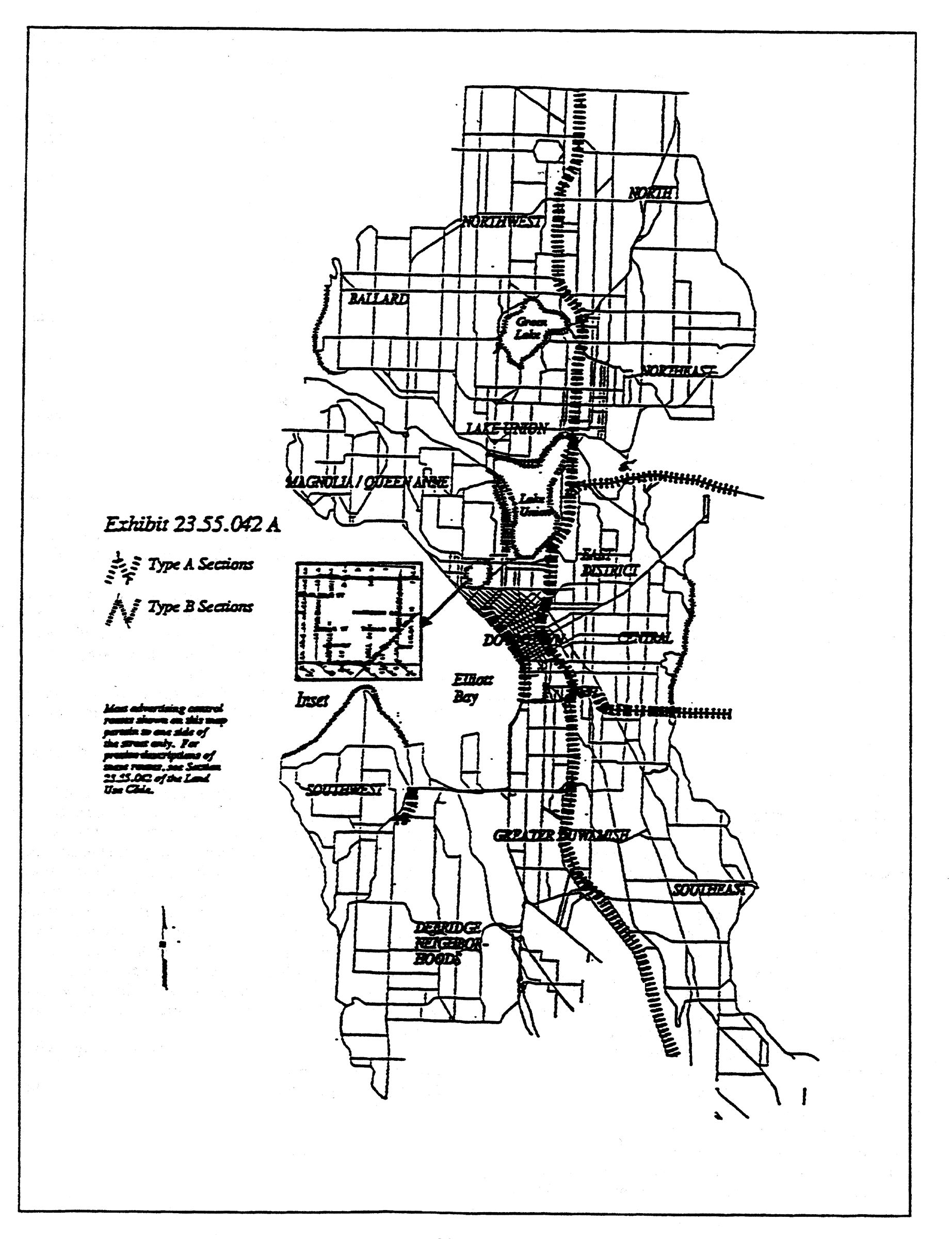
23.55.050 - Appeals to Municipal Court.
If a person asserts a noncommercial speech right protected by the First Amendment of the United States Constitution and/or Article I, Sections 3, 4, and 5 of the Washington Constitution, and is aggrieved by an action of the City in denying or enforcing a permit or in removing a sign, and time be of the essence, the person may petition the presiding judge of the Seattle Municipal Court for a prompt review thereof. The matter shall be granted priority as a case involving constitutional liberties and shall be heard in the manner provided by the Municipal Court by rule, and the decision of the Municipal Court shall be final subject only to judicial review.
(Ord. 120388, § 13, 2001.)
23.55.052 - Seattle Center sign overlay district purpose and intent
In addition to the regulatory purposes described in Section 23.55.001, the purpose of this overlay district is to regulate signage to promote the Seattle Center as a vibrant and valuable community resource for arts, entertainment, sports, and civic events, and to implement the goals and policies of the Seattle Comprehensive Plan. The City recognizes the unique nature of the Seattle Center as a large civic cultural center that includes numerous individual cultural and entertainment venues and hosts numerous community events year-round.
(Ord. 125869, § 4, 2019.)
23.55.054 - Seattle Center Sign Overlay District and Overlay District subareas established
There is established pursuant to Chapter 23.59 of the Seattle Municipal Code, the Seattle Center Sign Overlay District, as shown on the City's Official Land Use Map, Chapter 23.32, and Map A for 23.55.054. Three subareas are also established that together comprise the Seattle Center Sign Overlay District: the Arena Subarea located between Republican Street, Thomas Street, 1st Avenue N, and the alignment of 2nd Avenue N; the Bressi Block Subarea located between Thomas Street, John Street, Warren Avenue N, and 1st Avenue N; and the Center Campus Subarea that includes Seattle Center property that is not included in the other subareas. The District and subareas are shown on Map A for 23.55.054.
Map A for 23.55.054
Seattle Center Sign Overlay District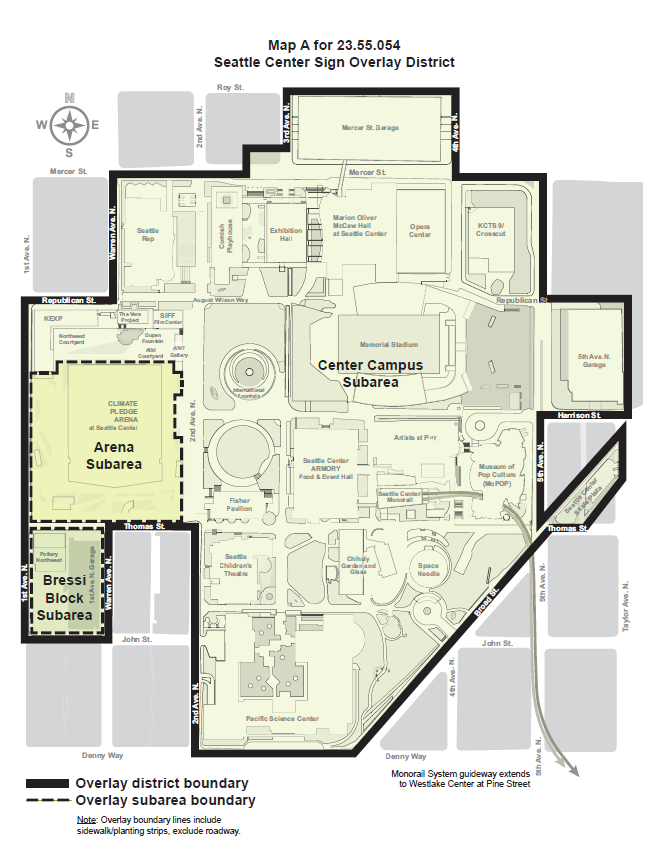
(Ord. 126365, § 1, 2021; Ord. 125869, § 4, 2019.)
23.55.056 - Application of regulations
Land located within the Seattle Center Sign Overlay District, as shown on Map A for 23.55.054, is subject to the sign regulations of Chapter 23.55, except as provided in this Part 4 of Chapter 23.55. In the event of a conflict between the provisions of this Part 4 of Chapter 23.55 and other provisions of Chapter 23.55, the provisions of this Part 4 of Chapter 23.55 apply. For a project that vested to Chapter 23.55 prior to August 25, 2019, the provisions of this Part 4 of Chapter 23.55 may be applied to the project at the election of the project applicant as provided by subsection 23.76.026.F.
(Ord. 127228, § 20, 2025; Ord. 126685, § 46, 2022 [cross-reference and style update]; Ord. 125869, § 4, 2019.)
23.55.057 - Sponsorship signs
Sponsorship signs are permitted on City-owned property located within the Seattle Center Sign Overlay District.
(Ord. 125869, § 4, 2019.)
23.55.058 - Arena Subarea—Overlay District sign standards
The standards of this Section 23.55.058 apply only within the Arena Subarea of the Seattle Center Sign Overlay District.
A.
On-premises and sponsorship signs. On-premises and sponsorship signs are permitted within the Arena Subarea. For purposes of this Part 4 of Chapter 23.55, all property located within the Seattle Center Sign Overlay District comprises the premises.
B.
Number and type of signs allowed.
1.
Each business establishment may have one Type A on-premises or sponsorship sign (ground, projecting, or combination) sign for each 65 lineal feet, or portion thereof, of lot frontage on public rights-of-way, except alleys.
2.
Each business establishment may have one Type B on-premises or sponsorship sign (wall, awning, canopy, marquee, or under-marquee) sign for each 65 lineal feet, or portion thereof, of lot frontage on public rights-of-way, except alleys.
3.
The Arena subarea may have up to 12 pole banner sponsorship signs, which may be double-faced.
4.
The Arena subarea may have up to 10 sponsorship signs using video display methods, 6 of which may be double-faced.
5.
The total number of sponsorship signs in the Arena subarea shall not exceed 32 signs, which may be double-faced except for sponsorship sign faces at the roof apex of the Seattle Center Arena.
6.
Up to 4 sponsorship signs located at the roof apex of the Seattle Center Arena that contains the name of building conferred as a naming right pursuant to authority granted by The City of Seattle. The name of the building may be displayed using text, fonts, or colors chosen by the entity having the naming right, and may be accompanied by display of a logo associated with the building name, if any. The height of the sign is regulated pursuant to subsection 23.55.058.D.4. An Arena may have one roof apex sign face per facade.
7.
Directional signs that direct pedestrian or vehicular traffic or identify entrances and exits to facilities shall not be sponsorship signs.
8.
The following signs are permitted in addition to the signs permitted by subsections 23.55.058.B.1 through 23.55.058.B.6:
a.
Memorial signs or tablets, or signs stating the name of a building or date of construction, if the sign is cut into a masonry surface or constructed of bronze or other noncombustible materials;
b.
Signs warning of danger or providing safety information; and
c.
National and state flags.
C.
Maximum area of signs
1.
The maximum area of each face of a ground, projecting, or combination sign is 72 square feet plus 2 square feet for each lineal foot of a parcel's public street frontage that exceeds 36 lineal feet, to a maximum sign face area of 600 square feet. For purposes of this standard, public street right-of-way does not include alleys.
2.
The maximum area of each wall sign is 672 square feet, except that signs larger than 672 square feet are permitted if they meet the following conditions:
a.
The sign face is displayed on or visible through a glass wall;
b.
The glass wall has a facade area greater than 5,000 square feet;
c.
The glass wall is not a landmarked feature under Chapter 25.12; and
d.
The sign does not exceed 30 percent of the area of glass wall.
3.
The maximum area of a roof sign face is 700 square feet.
4.
The maximum area of a pole banner sign face is 60 square feet.
5.
The maximum area for a vegetative wall sign is 1,500 square feet.
6.
There is no maximum area limit for awning, canopy, marquee, or under-marquee signs.
D.
Maximum height of signs
1.
The maximum height for any portion of a projecting or combination sign is 65 feet above grade, or the maximum height limit of the zone, whichever is less.
2.
The maximum height for any portion of a pole banner sign is 25 feet above grade.
3.
The maximum height for any portion of a wall, marquee, under-marquee, or canopy sign is the height of the perimeter roof edge at the top of the wall.
4.
Roof signs are subject to the height limit of the zone, except that if mechanical equipment is located on the roof of a structure that exceeds the height limit of the zone, then a mounted roof sign that provides screening for such mechanical equipment may exceed the height limit of the zone if it meets but does not exceed the height of such mechanical equipment. In the event mechanical equipment is replaced in a manner that increases its height, a roof sign's maximum height may be increased to provide comparable screening of the equipment, provided that the maximum sign area limit per sign face described in subsection 23.55.058.C.3 still applies.
5.
Notwithstanding the definition of ground sign in Section 23.84A.036, the maximum height for any portion of a ground sign in the Arena subarea is 12 feet above grade.
E.
Changing-image and changing-color signs are permitted.
F.
Temporary signage. In addition to temporary signs allowed by Section 23.55.012, temporary signs:
1.
May include wall signs or posters, banners, window signs, window graphics consisting of paint or decals applied directly to windows, signs consisting of LED lights, and signs consisting of light projections on building surfaces.
2.
May identify or promote an event, an activity, the sale of merchandise, or the sale of business services located within Seattle Center.
3.
Shall be maintained in a clean, orderly, and sightly condition;
4.
Shall be no larger than 32 square feet for rigid signs, and 200 square feet for non-rigid signs;
5.
If the temporary sign is for an event, the sign shall be displayed for no more than 14 days prior to an advertised event and no more than one day after the advertised event. Time limits for temporary signs not associated with an event are controlled by Section 23.55.012.
G.
Illumination
1.
The light source for externally illuminated signs shall be shielded and directed away from adjacent properties.
2.
Signs may be electric, externally illuminated, non-illuminated, or use any combination of these features. Signs may use illuminated video display methods if the sign meets the development standards in subsections 23.55.058.G and 23.55.058.H.
3.
Between dusk and dawn, video displays shall be limited in brightness to no more than 500 nits (candela per square meter), measured as described in subsection 23.55.005.A.10.
H.
Video displays. Except for video displays described in subsection 23.55.058.H.8, standards for video displays are:
1.
The total duration of multiple video display messages together may not constitute more than 20 seconds of every two minutes.
2.
Video displays are prohibited between 10 p.m. and 7 a.m. except that video displays are permitted within an hour after an Arena event ends.
3.
A video display message shall have a minimum duration of two seconds and a maximum duration of ten seconds. Calculation of the duration does not include the number of frames per second used in a video display.
4.
There shall be ten seconds of still image or blank display following every message using a video display method.
5.
The maximum height for any video display is 20 feet above existing grade, except the maximum height is 35 feet above grade for video displays on signs described in subsection 23.55.058.C.2.
6.
Video displays may not exceed 150 square feet, except that video displays may exceed 150 square feet on signs described in subsection 23.55.058.C.2.
7.
All video displays, except those described in subsection 23.55.058.H.8, shall be set back a minimum distance of 20 feet from the street curb of the nearest right-of-way.
8.
A video display using only scrolling alphanumeric characters is permitted and may be located adjacent to a right-of-way with no minimum setback, provided that such a sign may not exceed 42 feet in length and 18 inches in height. No more than 21 feet of any such sign face may be directed at the same right-of-way. Any such sign must be at least 8 feet above grade. "Scrolling" means, for purposes of this Part 4 of Chapter 23.55, the movement of alphanumeric characters within a sign display. A video display consistent with this subsection 23.55.058.H.8 is not subject to the standards in subsections 23.55.058.H.1 through 23.55.058.H.7.
I.
Signs projecting over a public right-of-way must comply with Section 23.55.004.
(Ord. 125869, § 4, 2019.)
23.55.060 - Bressi Block Subarea—Overlay District sign standards
The standards of this Section 23.55.060 apply only within the Bressi Block Subarea of the Seattle Center Sign Overlay District.
A.
On-premises and sponsorship signs. On-premises and sponsorship signs are permitted within the Bressi Block Subarea. For purposes of this Part 4 of Chapter 23.55, all property located within the Seattle Center Sign Overlay District comprises the premises.
B.
Number and type of signs allowed.
1.
Each business establishment may have one Type A on-premises or sponsorship sign (ground, projecting, or combination) sign for each 300 lineal feet, or portion thereof, of frontage on public rights-of-way, except alleys.
2.
Each business establishment may have one Type B on-premises or sponsorship sign (wall, awning, canopy, marquee, or under-marquee) sign for each 300 lineal feet, or portion thereof, of frontage on public rights-of-way, except alleys.
3.
No more than two sponsorship signs are permitted within the Bressi Block Subarea.
4.
The following signs are permitted in addition to the signs permitted by subsection 23.55.060.B.1 through 23.55.060.B.3:
a.
Memorial signs or tablets, or signs stating the name of a building or date of construction, if the sign is cut into a masonry surface or constructed of bronze or other noncombustible materials;
b.
Signs warning of danger or providing safety information; and
c.
National and state flags.
C.
Maximum area of signs. The maximum area of signs is as expressed in Part 1 and Part 2 of Chapter 23.55.
D.
Maximum height of signs. The maximum height of signs is as expressed in Part 1 and Part 2 of Chapter 23.55.
E.
Changing-image signs are permitted, as expressed in Part 1 and Part 2 of Chapter 23.55.
F.
Temporary signage. Temporary signage is permitted, as expressed in Part 1 and Part 2 of Chapter 23.55.
G.
Illumination
1.
The light source for externally illuminated signs shall be shielded and directed away from adjacent properties.
2.
Signs may be electric, externally illuminated, non-illuminated, or use any combination of these features.
H.
Video displays. Signs may use video display methods, subject to the provisions expressed in Part 1 and Part 2 of Chapter 23.55.
I.
Signs projecting over a public right-of-way must comply with Section 23.55.004.
(Ord. 125869, § 4, 2019.)
23.55.062 - Center Campus Subarea—Overlay District sign standards
A.
Except for technical code approval required by the Seattle Building Code, Seattle Electrical Code, or other applicable technical code, and except for landmark regulation under Chapter 25.12, the Seattle Center Director is authorized to install, operate, maintain, administer, manage, and control campus signs so long as the Seattle Center Director determines such signs are consistent with this Chapter 23.55, the Seattle Center Sign Guidelines as updated and approved by the Seattle Center Advisory Commission, and any applicable rules and regulations adopted pursuant to Section 17.04.040. The Seattle Center Director may directly perform the installation, operation, or maintenance of campus signs, or delegate such performance.
B.
For purposes of this Part 4 of Chapter 23.55, the following definitions apply:
"Campus signs" means signs owned or managed by the Seattle Center Department on City-owned or City-managed property within the Center Campus Subarea, as well as temporary event signs located within the Subarea.
"Scrolling" has the same meaning as the term is defined in subsection 23.55.058.H.8.
"Seattle Center Director" means the Director of the Seattle Center Department.
C.
Except for technical code approval and landmark regulation under Chapter 25.12 as provided in subsection 23.55.062.A, campus signs within the Center Campus Subarea are regulated only by the standards of this Section 23.55.062.
D.
On-premises and sponsorship signs are permitted on City-owned or City-managed property within the Center Campus Subarea. For purposes of this Part 4 of Chapter 23.55, all property located within the Seattle Center Sign Overlay District comprises the premises. Off-premises signs within the Center Campus Subarea owned or managed by the City on City-owned or City-managed property are prohibited.
E.
The number, type, maximum area, maximum height, illumination, display methods, and standards of campus signs within the Center Campus Subarea shall be determined by the Seattle Center Director, in accordance with the following standards, any applicable Seattle Center Guidelines as updated and approved by the Seattle Center Advisory Commission, and any applicable rules and regulations adopted pursuant to Section 17.04.040:
1.
Illumination and light and glare
a.
The light source for externally illuminated signs shall be shielded and directed away from adjacent properties.
b.
Signs may be electric, externally illuminated, or non-illuminated, or may use any combination of these features. Signs may use illuminated video display methods if the sign meets the development standards in this subsection 23.55.062.E.1 and subsection 23.55.062.E.4.
c.
Between dusk and dawn, video displays shall be limited in brightness to no more than 500 nits (candela per square meter), measured as described in subsection 23.55.005.A.10.
2.
The standards for temporary signage in subsection 23.55.058.F.1 through F.5 shall apply to the Center Campus Subarea. For purposes of this Section 23.55.062, temporary screens used primarily to show movies, live stream events, or other similar event purposes are not signs. Temporary signage within the Center Campus Subarea may also include video display.
3.
Non-rigid event-related banners of up to 180 square feet per banner may be hung or temporarily affixed on the Seattle Center skybridge over Mercer Street and the Director of the Seattle Department of Transportation authorizes the Seattle Center Director to permit such banners as authorized in subsection 15.04.015.E.
4.
Video displays
a.
The total duration of multiple video display messages together may not constitute more than 20 seconds of every two minutes.
b.
Video displays are prohibited between 10 p.m. and 7 a.m. except that video displays are permitted within an hour after an event in the Seattle Center Sign Overlay District ends.
c.
A video display message shall have a minimum duration of two seconds and a maximum duration of ten seconds. Calculation of the duration does not include the number of frames per second used in a video display.
d.
There shall be ten seconds of still image or blank display following every message using a video display method.
e.
All video displays, except those described in subsection 23.55.062.E.4.f, and except those regulated by subsection 23.55.062.E.5, shall be set back a minimum of 20 feet from the street curb of the nearest unvacated right-of-way.
f.
A video display using only scrolling alphanumeric characters is permitted and may be located adjacent to a right-of-way with no minimum setback, provided that such a sign may not exceed 42 feet in length and 18 inches in height. No more than 21 feet of any such sign face may be directed at the same right-of-way. Any such sign must be at least 8 feet above grade. A video display consistent with this subsection 23.55.062.E.4.f is not subject to the standards in subsections 23.55.062.E.4.a through 23.55.062.E.4.d.
5.
Signs that are within 20 feet from the street curb of the nearest unvacated roadway and oriented so as to be visible from such unvacated roadway, and signs within the Center Campus Subarea that are not campus signs, shall be regulated by the general sign standards in Part 1 of Chapter 23.55, subsection 23.55.062.D, and subsection 23.55.062.E.4.f.
6.
Campus signs may also include the following:
a.
Portable signs including readily detachable signs having a fixed base or mounting for the placement and intermittent use of such signs;
b.
Banners, streamers, strings of pennants, fabric signs, festoons of lights, clusters of flags, wind animated objects, balloons, searchlights, and similar devices;
c.
Signs attached to or located on event related or sponsored stationary motor vehicles, equipment, trailers, and similar devices;
d.
Changing-image and changing-color signs, including video display;
e.
Memorial signs or tablets, or signs stating the name of a building or date of construction;
f.
Signs warning of danger or providing safety information; and
g.
National, state, and other flags.
7.
Signs projecting over a public right-of-way must comply with Section 23.55.004.
8.
Signs within 20 feet from public right-of-way intersections or driveways must comply with Section 23.55.008.
9.
Sign kiosks are permitted on City-owned or City-managed property within the Center Campus Subarea.
10.
Permanent signs that are flashing or that rotate or have a rotating or moving part or parts that revolve at a speed in excess of seven revolutions per minute are prohibited within the Center Campus Subarea.
(Ord. 126365, § 2, 2021.)
23.55.070 - Standards for light rail transit facilities
A.
Unless specifically exempted or modified in this Section 23.55.070, signs in a light rail transit facility are subject to the applicable standards in Part 1, Part 3, and Part 4 of this Chapter 23.55. Signs in a light rail transit facility located in a special review district are subject to the applicable provisions in Chapter 23.66 and this Part 5.
B.
Signs in a light rail transit facility are exempt from subsections 23.55.004.C, 23.55.004.E, 23.55.014.B, and 23.55.014.E.
C.
Signs in a light rail transit facility are exempt from Part 2 of this Chapter 23.55.
D.
Light rail transit facilities may have an unlimited number of signs serving wayfinding, public service, safety, and identification purposes.
E.
There is no limit on the types of permissible signs except as described in Section 23.55.003 and Section 23.55.014.
F.
Signs within concourses and platforms that are not oriented to be visible from adjacent public right-of-way are exempt from the standards in this Chapter 23.55.
G.
Off-premises directional signs for light rail transit facilities shall not be advertising signs. Off-premises directional signs in the public right-of-way are subject to applicable requirements, conditions, and procedures set out in Title 15.
H.
Sign kiosks located on a light rail transit facility site are only subject to subsections 23.55.015.C.2.a and 23.55.015.C.2.c and are exempt from all other subsections of Section 23.55.015. Sign kiosks may be established on a light rail transit facility site in any zone.
(Ord. 127228, § 21, 2025.)

