41 - DESIGN REVIEW5
Editor's note— The title of Ch. 23.41 was amended by Ord. 124389, § 1, adopted December 16, 2013.
The purpose of Design Review is to:
A.
Encourage better design and site planning to help ensure that new development enhances the character of the city and sensitively fits into neighborhoods, while allowing for diversity and creativity; and
B.
Provide flexibility in the application of development standards to better meet the intent of the Land Use Code as established by City policy, to meet neighborhood objectives, and to provide for effective mitigation of a proposed project's impact and influence on a neighborhood;
C.
Promote and support communication and mutual understanding among applicants, neighborhoods, and the City early and throughout the development review process; and
D.
Promote the consideration of public safety in design as a way to reduce crime and improve quality of life.
(Ord. 127309, § 1, 2025; Ord. 125429, § 3, 2017; Ord. 124389, § 2, 2013; Ord. 116909, § 1, 1993.)
A.
Design review required
1.
Subject to the exemptions in subsection 23.41.004.B, design review is required in the following areas or zones when development is proposed that exceeds a threshold in Table A or Table B for 23.41.004:
a.
Multifamily;
b.
Commercial;
c.
Seattle Mixed; and
d.
Downtown.
2.
Subject to the exemptions in subsection 23.41.004.B, design review is required in the Industrial Commercial zone when commercial or institution development is proposed that exceeds a threshold in Table A or Table B for 23.41.004.
3.
The gross floor area of the following uses is not included in the total gross floor area of a development for purposes of determining if a threshold is exceeded:
a.
Religious facilities;
b.
Childcare centers, elementary, and secondary schools;
c.
Uses associated with a Major Institution Master Plan (MIMP); or
d.
Development of a major institution use within a Major Institution Overlay (MIO) district.
4.
Any development proposal participating in the Living Building or 2030 Challenge High Performance Existing Building Pilot Program according to Sections 23.40.060 and 23.40.070, including a development proposal for an existing structure, regardless of size or site characteristics, is subject to full design review according to Section 23.41.014.
5.
Any development proposal that is located in a Master Planned Community zone and that includes a request for departures, regardless of size or site characteristics, is subject to full design review according to Section 23.41.014. If a development proposal in a Master Planned Community zone does not include a request for departures, the applicable design review procedures are in Section 23.41.020. A development proposal in a Master Planned Community zone, which includes a request for departures and provides affordable housing per subsection 23.41.004.A.5, shall be subject to administrative design review according to Section 23.41.016.
6.
Subject to the exemptions in subsection 23.41.004.B, design review is required for additions to existing structures when the size of the proposed addition or expansion exceeds a threshold in Table A or Table B for 23.41.004. Administrative design review, as described in Section 23.41.016, is required for certain other additions to existing structures according to rules promulgated by the Director.
B.
Exemptions. The following are exempt from design review:
1.
Development located in special review districts established by Chapter 23.66;
2.
Development in Landmark districts established by Title 25;
3.
Development within the historic character area of the Downtown Harborfront 1 zone;
4.
Development that is subject to shoreline design review pursuant to Chapter 23.60A;
5.
New light rail transit facilities that are subject to review by the Seattle Design Commission;
6.
City facilities that are subject to review by the Seattle Design Commission;
7.
Development within neighborhood residential or residential small lot zones; and
8.
Low-income housing.
C.
Optional design review
1.
Design review. Development proposals that are not subject to design review may elect to be reviewed pursuant to the full, administrative, or streamlined design review process if:
a.
The development proposal is in any zone or area identified in subsection 23.41.004.A.1 or 23.41.004.A.2 or in the Stadium Transition Area Overlay District, except development that is within a Master Planned Community zone is not eligible for optional design review; and
b.
The development proposal does not include the uses listed in subsection 23.41.004.A.3.
2.
Administrative design review. According to the applicable process described in Section 23.41.016, administrative design review is optional for a development proposal that is not otherwise subject to this Chapter 23.41 and is on a site that contains a Tier 1 and/or Tier 2 tree, as defined in Section 25.11.130, when the ability to depart from development standards may result in protection of the tree as provided in Section 25.11.070.
D.
Exemptions; applicability. Low-income housing that vests according to Section 23.76.026 prior to the effective date of this ordinance may also use the design review exemption authorized according to subsection 23.41.004.B.8.
E.
Temporary provisions
1.
Developments with units provided on-site to comply with Chapter 23.58C through the performance option
a.
A development proposal subject to design review under subsection 23.41.004.A that is complying with Chapter 23.58C solely through the performance option by providing affordable units on-site according to Section 23.58C.050.C shall be exempt from design review if the applicant files a valid and complete building permit application electing the exemption while this ordinance is in effect.
b.
A development proposal subject to design review under subsection 23.41.004.A that is complying with Chapter 23.58C solely through the performance option by providing affordable units on-site according to Section 23.58C.050.C that is vested according to Section 23.76.026 prior to August 14, 2023 may elect to be processed as allowed by Section 23.41.004.E.
c.
The design review exemption under subsection 23.41.004.E.1 shall be rescinded for a development proposal that changes from the performance option to the payment option at any time prior to issuance of a building permit.
d.
Requests for departures. If a project subject to design review under subsection 23.41.004.A is exempt from design review according to subsection 23.41.004.E.1, the Director may consider requests for departures from any development standard in this Title 23, except as otherwise limited in subsection 23.41.012.B.
e.
Departures decision. Requests for departures according to subsection 23.41.004.E.1.d shall be evaluated and may be granted by the Director as a Type I decision if the departure would result in additional housing units being constructed.
2.
Low-income housing
a.
Notwithstanding any contrary provision of this Title 23, the Director may consider requests for departures from any development standard in this Title 23, except as otherwise limited in subsection 23.41.012.B, for low-income housing.
b.
Departures decision. Requests for departures shall be evaluated by the Director, in consultation with the Office of Housing, in light of the particular population designed to be served by the project, and may be granted by the Director as a Type I decision if the departure would result in additional housing units being constructed.
3.
Downtown Activation Plan
a.
A development proposal that is subject to design review according to this Section 23.41.004 shall be exempt from this Chapter 23.41, unless ineligible for exemption due to other code provisions, if:
1)
The proposal includes residential use comprising at least 50 percent of its chargeable floor area, except if at least 50 percent of the chargeable floor area in nonresidential use is lodging then no residential use is required; or includes a research and development laboratory use; and
2)
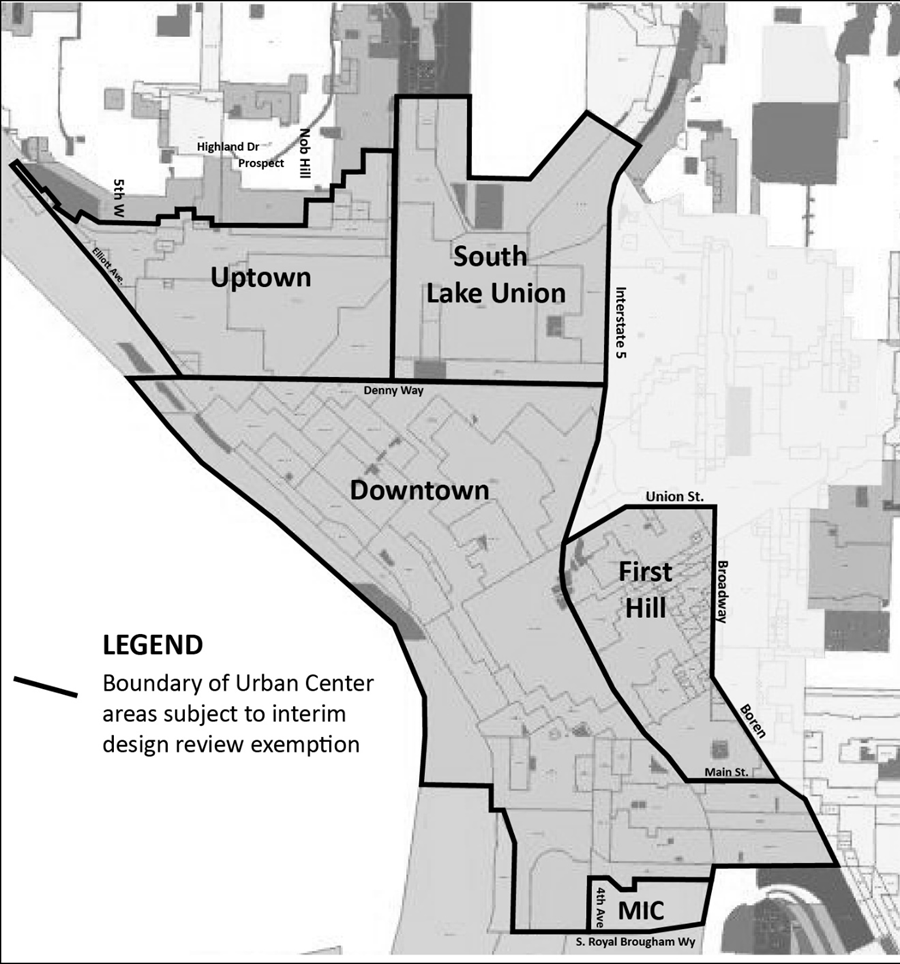
The proposal is located on a property within the Downtown Urban Center, Uptown Urban Center, South Lake Union Urban Center, First Hill Urban Center, or an area within the Greater Duwamish Manufacturing and Industrial Center, as shown on Map A for 23.41.004; or within an area included in an adopted expansion area of an urban center or manufacturing and industrial center shown on Map A for 23.41.004; and
3)
The applicant files a letter of eligibility for exemption pursuant to subsection 23.76.010.G, provided that permit application materials are subsequently filed per subsection 23.76.026.A.4; and
4)
The proposal does not involve a Type IV or Type V Council land use decision.
b.
Waiver or modification of development standard. If a project is exempt from design review according to this subsection 23.41.004.E.3, the Director may consider requests for waivers or modifications of the following development standards in Title 23:
1)
Upper-level setbacks, modulation, articulation, facade opening requirements, and structure width;
2)
Street level setbacks and facade setbacks: dimensional and area limits;
3)
Floor-to-floor height requirements at street level, except as otherwise limited in subsection 23.41.012.B;
4)
Rooftop screening and coverage limits in relation to mechanical equipment, energy-related features, elevator equipment, and related enclosures;
5)
Street-level use type, minimum depth, and percent presence on street-level street-facing facade requirements;
6)
Facade transparency and blank facade requirements;
7)
Overhead weather protection requirements;
8)
Requirements for the size and design of common recreational areas, amenity areas, community rooms, and similar indoor amenities, but not including required outdoor open space requirements;
9)
Open space and open areas: dimensional, area, distribution of types, and amount of overhead coverage requirements, except standards for open space amenities provided to meet requirements of Chapter 23.58A;
10)
Landscaping: dimensional, area, and location requirements;
11)
Minimum dimensions and slope of vehicle access;
12)
Parking space size requirements in subsections 23.54.030.A and 23.54.030.B;
13)
Bicycle parking minimum quantity requirements in Table D for 23.54.015; and
14)
Provisions of the MPC-YT zone, except: affordable housing production requirements in Section 23.75.085; limits on floor area for uses in Sections 23.75.040, 23.75.085, or 23.75.090; and limits on the number of highrise structures, distribution of highrise structures, and gross floor area per story for highrise structures in Section 23.75.040 or Section 23.75.120.
c.
Decision on waiver or modification of development standards. Requests for waiver or modification of development standards according to subsection 23.41.004.E.3.b shall be evaluated by the Director and may be granted by the Director as a Type I decision if a waiver or modification of development standards would result in an increased number of dwelling units, lodging rooms, or increased floor area of a research and development laboratory use, being constructed.
Map A for 23.41.004
Areas subject to interim design review exemption
F.
Temporary provisions made by Ordinance 127309 for design review
1.
Developments with units provided on-site to comply with Chapter 23.58C through the performance option
a.
A development proposal subject to design review under subsection 23.41.004.A that is complying with Chapter 23.58C solely through the performance option by providing affordable units on-site according to subsection 23.58C.050.C shall be exempt from design review if the applicant files a valid and complete building permit application electing the exemption while Ordinance 127309 is in effect.
b.
A development proposal subject to design review under subsection 23.41.004.A that is complying with Chapter 23.58C solely through the performance option by providing affordable units on-site according to subsection 23.58C.050.C that is vested according to Section 23.76.026 prior to October 27, 2025 may elect to be processed as allowed by this subsection 23.41.004.F.
c.
The design review exemption under this subsection 23.41.004.F.1 shall be rescinded for a development proposal that changes from the performance option to the payment option at any time prior to issuance of a building permit.
d.
Requests for departures. If a project subject to design review under subsection 23.41.004.A is exempt from design review according to this subsection 23.41.004.F.1, the Director may consider requests for departures from any development standard in this Title 23, except as otherwise limited in subsection 23.41.012.B.
e.
Departures decision. Requests for departures according to subsection 23.41.004.F.1.d shall be evaluated and may be granted by the Director as a Type I decision if the departure would result in additional housing units being constructed.
f.
The provisions of this subsection 23.41.004.F.1 shall be in effect for six months from October 27, 2025.
2.
Low-income housing
a.
Notwithstanding any contrary provision of this Title 23, the Director may consider requests for departures from any development standard in this Title 23, except as otherwise limited in subsection 23.41.012.B, for low-income housing.
b.
Departures decision. Requests for departures shall be evaluated by the Director, in consultation with the Office of Housing, in light of the particular population designed to be served by the project, and may be granted by the Director as a Type I decision if the departure would result in additional housing units being constructed.
c.
The provisions of this subsection 23.41.004.F.2 shall be in effect for six months from October 27, 2025.
G.
Interim suspension of required design review for all proposed development
1.
Notwithstanding any contrary provision of this Title 23 and Title 25, including but not limited to Chapters 23.40, 23.41, 23.42, 23.45, 23.47A, 23.48, 23.49, 23.57, 23.58B, 23.58C, 23.60A, 23.61, 23.73, 23.76, 25.05, 25.11, 25.16. 25.20, and 25.22, required design review is temporarily suspended for all proposed development.
2.
Applicants of proposed development that is being reviewed pursuant to the full, administrative, or streamlined design review process as of October 27, 2025 may elect to continue review under the design review process or withdraw the proposed development from the design review process. Applicants of all other proposed development may elect, at any time during the effective period of Ordinance 127309, their proposed development be reviewed pursuant to the full, administrative, or streamlined design review process. Applicants with projects meeting the thresholds for full design review pursuant to subsection 23.41.004.A that elect to continue review, or elect review, under the design review process may choose administrative design review.
3.
The provisions of this subsection 23.41.004.G shall be in effect for six months from October 27, 2025.
(Ord. 127309, § 1, 2025; Ord. 127100, § 1, 2024; Ord. 127099, § 8, 2024; Ord. 126862, § 6, 2023; Ord. 126855, § 4, 2023; Ord. 126854, § 1, 2023; Ord. 126821, § 7, 2023; Ord. 126741, § 2, 2022; Ord. 126685, § 4, 2022; Ord. 126509, § 25, 2022 [zone name change]; Ord. 126287, § 1, 2021; Ord. 126188, § 2, 2020; Ord. 126157, § 9, 2020; Ord. 126072, § 2, 2020; Ord. 125603, § 7, 2018; Ord. 125429, § 5, 2017)
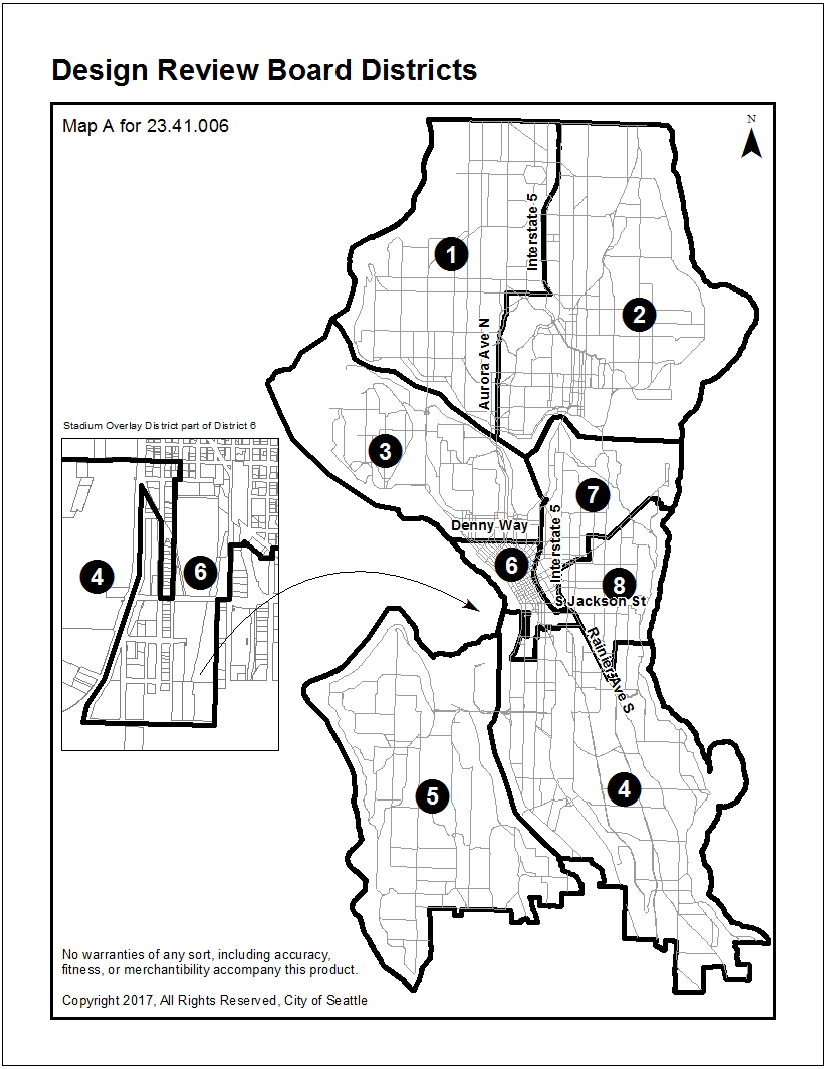
For the purposes of design review, the City is divided into eight districts, as depicted on the Design Review Districts Map, Map A for 23.41.006.
Map A for 23.41.006
Design Review Board Districts
(Ord. 125562, § 1, 2018; Ord. 125371, § 21, 2017; Ord. 123046, §§ 7, 8, 2009; Ord. 119972, §§ 2, 3, 2000; Ord. 118980, § 2, 1998; Ord. 118012, § 14, 1996; Ord. 116909, § 1, 1993.)
A.
Role of the Design Review Board. The Design Review Board shall be convened to review development proposals that are subject to full design review, or Master Planned Community-highrise design review pursuant to this Chapter 23.41. To accomplish this purpose, the Design Review Board shall perform the following, as applicable:
1.
For developments subject to full design review or Master Planned Community-highrise design review, synthesize community input on design concerns, identify guideline priorities, and provide early design guidance to the applicant;
2.
Determine whether a proposed design submitted by an applicant does or does not comply with the guideline priorities;
3.
For development subject to full design review, recommend to the Director whether to approve, condition, or deny any requested departures from development standards;
4.
Recommend to the Director specific conditions of approval that are consistent with the guideline priorities; and
5.
Ensure fair and consistent application of Citywide or neighborhood-specific design guidelines.
B.
Design Review Board membership criteria
1.
Members shall reside in Seattle;
2.
Members should possess experience in neighborhood land use issues and demonstrate, by their experience, sensitivity in understanding the effect of design decisions on neighborhoods and the development process;
3.
Members should possess a familiarity with land use processes and standards as applied in Seattle; and
4.
Consistent with Section 4.16.070, no member of the Design Review Board shall have a financial or other private interest, direct or indirect, personally or through a person in the member's immediate family, in a project under review by the Design Review Board on which that member sits.
C.
Design Review Board composition
1.
The Design Review Board shall be composed as follows:
2.
Term. Members of the Design Review Board shall be appointed to two-year terms. A member may be re-appointed to subsequent terms pursuant to the selection and confirmation process in subsection 23.41.008.C.1. The Director may extend the existing term of a serving member by up to one year in order to avoid more than two vacancies at any time. This subsection 23.41.008.C.2 does not apply to Get Engaged members, whose terms are governed by Chapter 3.51.
3.
Members may be removed by the Director for cause, including but not limited to:
a.
Failing to attend the Design Review orientation session offered by SDCI and an onboarding session offered by the City; and
b.
Failing to attend at least 90 percent of all regularly scheduled meetings that have occurred in the term.
4.
Any vacancy in an unexpired term shall be filled in the same manner as the original appointment. A member whose term is ending may continue on an interim basis as a member with voting rights until such time as a successor for that position has been appointed by the City Council or confirmed by the City Council.
D.
Design Review Board assignment
1.
Each design review district shall be assigned a Design Review Board consisting of members as follows:
a.
One member representing development-related interests;
b.
One member representing the design professions;
c.
Two members representing local residential/community interests;
d.
One member representing general business interests or landscape professions; and
e.
No more than one young adult member from the Get Engaged program.
2.
Three Design Review Board members shall be a quorum of each District Design Review Board.
3.
The Design Review Board members assigned to each project as described in subsection 23.41.008.D.1 shall be known collectively as the District Design Review Board. All members of the District Design Review Board shall be voting members.
4.
Substitutions
a.
In the event that more projects are undergoing simultaneous design review than a District Design Review Board can review in a timely manner, the Director may assign such projects to a geographically unassigned Substitute Design Review Board, whose five members the Director may select from the Substitute Design Review Board membership described in subsection 23.41.008.D.5, so long as the five members represent each of the five interests required by subsection 23.41.008.D.1.
b.
If an individual District Design Review Board member is unable to serve, the Director may either appoint an individual from another District Design Review Board or may appoint a Substitute Design Review Board member from the Substitute Design Review Board membership described in subsection 23.41.008.D.5 to serve in the member's absence.
c.
The Director may assign a Design Review Board to review a project outside of its designated district in order to expedite review, provided that the local residential/community representatives shall review development only within their district. In such a case, the Director shall appoint the local residential/community representatives from the District Board from which the project originated, or the local residential/community representative from the Substitute Design Review Board provided in subsection 23.41.008.D.5, or any combination thereof, to review the project, so long as the local residential/community representatives appointed are from the same geographic district as the project to be reviewed.
5.
Substitute Design Review Board membership
a.
Membership criteria:
1)
A person must have been a member of the Design Review Board whose term has expired;
2)
A person must indicate a willingness to continue participation on the Board; and
3)
A person must have, in the opinion of the Director, demonstrated a commitment to Design Review through exemplary attendance and Board participation.
b.
The term of service for Substitute Design Review Board members is indefinite.
E.
Meetings of the Design Review Board
1.
Notice of Design Review Board meetings shall be given as described in subsection 23.76.015.C.
2.
All meetings of the Design Review Board shall be held virtually, in-person, or a combination of both as follows:
a.
A physical meeting venue option shall be provided for attendance of virtual meetings;
b.
Virtual meetings may be offered to supplement in-person meetings;
c.
If an emergency makes in-person meetings impracticable as declared by the Mayor, meetings shall be held virtually;
d.
In-person meetings shall be accessible; and
e.
All in-person or virtual meetings shall be open to the general public.
The actions of the Board are not quasi-judicial in nature.
3.
Design Review Board meetings are limited to the maximum number described in Table B for 23.41.008.
4.
The Director may require additional Design Review Board meetings above the maximum established in subsection 23.41.008.E.3 if the Director determines the Design Review Board needs additional time for deliberation and evaluation of a project due to the size and complexity of the site or proposed development, the amount and content of public comment, an applicant's insufficient response to previous Board direction, or at the applicant's request. If the Design Review Board cannot complete a recommendation, it shall identify reasons why another recommendation meeting is necessary.
F.
Design Review Board recommendation
1.
The Design Review Board shall determine whether the proposed design submitted by the applicant complies with the guideline priorities. The Board shall recommend to the Director whether to approve or conditionally approve the proposed project based on compliance with the guideline priorities, and whether to approve, condition, or deny any requested departures from development standards.
2.
The Director shall consider the recommendations of the Design Review Board when deciding whether to approve an application for a Master Use Permit.
3.
If four or more members of the Design Review Board agree in their recommendation to the Director, and if the Director otherwise approves a Master Use Permit application, the Director shall make compliance with the recommendation of the Design Review Board a condition of permit approval, unless the Director concludes that the recommendation of the Design Review Board:
a.
Reflects inconsistent application of the design review guidelines;
b.
Exceeds the authority of the Design Review Board;
c.
Conflicts with SEPA conditions or other regulatory requirements applicable to the project; or
d.
Conflicts with requirements of local, state, or federal law.
G.
Revisions to an issued and unexpired MUP
1.
Minor revisions to an issued and unexpired MUP that was subject to design review may be approved by the Director as a Type I decision. A minor revision is defined as any proposed change to an issued and unexpired MUP that has little or no effect on the overall appearance of the design or environmental impact of the issued MUP.
2.
Major revisions to an issued and unexpired MUP that was subject to design review may be approved by the Director as a Type II decision. A Major Revision is defined as any proposed change to an issued MUP that is not a Minor Revision that is consistent with the building massing, site plan, and guidance received at Early Design Guidance (EDG), where the current context of the project (e.g. adjacent structures or uses) is comparable to the context at the time of the EDG. In instances when citywide or neighborhood guidelines have been adopted, amended, or updated since the EDG, the Board or SDCI staff may identify additional guideline priorities as part of the major revision process.
3.
The Director shall establish, by rule, what constitutes a major and minor revision and the review process for major and minor revisions.
(Ord. 126684, § 2, 2022; Ord. 126509, § 26, 2022 [zone name change]; Ord. 126188, § 3, 2020; Ord. 126072, § 3, 2020; Ord. 125562, §§ 2, 3, 2018; Ord. 125429, §§ 6, 7, 2017; Ord. 124843, § 10, 2015; Ord. 124389, § 3, 2013; Ord. 121475, § 1, 2004; Ord. 120914, § 5, 2002; Ord. 118980, § 3, 1998; Ord. 118672, § 1, 1997; Ord. 118012, § 15, 1996; Ord. 117075, § 1, 1994; Ord. 116909, § 1, 1993.)
A.
The "Seattle Design Guidelines, 2013" and the "Guidelines for Downtown Development, 1999" are approved. The "Seattle Design Guidelines, 2013", the neighborhood design guidelines identified in subsection 23.41.010.B, and Master Planned Community design guidelines identified in subsection 23.41.010.C provide the basis for Design Review Board recommendations and City design review decisions, except in Downtown zones, where the "Guidelines for Downtown Development, 1999" apply. Neighborhood design guidelines and Master Planned Community design guidelines are intended to augment and make more specific the "Seattle Design Guidelines, 2013" and the "Guidelines for Downtown Development, 1999." To the extent there are conflicts between neighborhood design guidelines or Master Planned Community design guidelines and the "Seattle Design Guidelines, 2013" or "Guidelines for Downtown Development, 1999," the neighborhood design guidelines or Master Planned Community design guidelines supersede.
B.
The following neighborhood design guidelines are approved. These neighborhood design guidelines apply in the areas shown on the map included in the guidelines.
1.
"Admiral Design Guidelines, 2013";
2.
"Ballard Neighborhood Design Guidelines, 2019";
3.
"Belltown Urban Center Village Design Guidelines, 2004";
4.
"Capitol Hill Neighborhood Design Guidelines, 2019";
5.
"Central Area Design Guidelines, 2018";
6.
"Crown Hill Neighborhood Design Guidelines, 2022";
7.
"Green Lake Design Guidelines, 2013";
8.
"Greenwood/Phinney Design Guidelines, 2013";
9.
"Morgan Junction Design Guidelines, 2013";
10.
"Mount Baker Town Center Design Guidelines, 2017";
11.
"North Beacon Hill Design Guidelines, 2013";
12.
"North District/Lake City Design Guidelines, 2013";
13.
"Northgate Design Guidelines, 2013";
14.
"Othello Design Guidelines, 2013";
15.
"Pike/Pine Design Guidelines, 2017";
16.
"Roosevelt Design Guidelines, 2013";
17.
"South Lake Union Design Guidelines, 2018";
18.
"University District Design Guidelines, 2019";
19.
"Upper Queen Anne Design Guidelines, 2013";
20.
"Uptown Design Guidelines, 2019";
21.
"Wallingford Design Guidelines, 2013"; and
22.
"West Seattle Junction Design Guidelines, 2013."
C.
The following Master Planned Community design guidelines are approved:
1.
Yesler Terrace Master Planned Community Design Guidelines, 2012, Exhibit B to Ordinance 123963.
(Ordinances that updated adopted guidelines in B, with no other substantive changes
Ord. No. 125844, § 1, 2019; Ord. No. 125843, § 1, 2019; Ord. 125776, § 1, 2019; Ord. 125775, § 1, 2019; Ord. No. 125680, § 1, 2018; Ord. 124869, § 1, 2015; Ord. 124242, § 3, 2013; Ord. 123392, § 1, 2010; Ord. 123335, § 1, 2010;
Ord. 121781, § 1, 2005.
All other ordinances
2020s
Ord. 126683, § 1, 2022.
2010s
Ord. 125562, § 4, 2018; Ord. 125429, § 8, 2017; Ord. 125362, § 1, 2017; Ord. 124843, § 11, 2015 [style update]; Ord. 124389, § 4, 2013; Ord. 123963, § 16, 2012.
2000s
Ord. 122994, § 1, 2009; Ord. 122443, § 1, 2007; Ord. 122334, § 1, 2007; Ord. 122311, § 108, 2006; Ord. 122152, § 1, 2006; Ord. 122033, § 1, 2006; Ord. 121891, § 1, 2005;
Ord. 121759, § 1, 2005; Ord. 121534, § 1, 2004; Ord. 121476, § 4, 2004 [readopted
Ord. 121303's amendments]; Ord. 121305, § 1, 2003; Ord. 121303, § 1, 2003; Ord. 120785,
§ 1, 2002; Ord. 120447, § 1, 2001; Ord. 120209, § 1, 2000; Ord. 120081, § 1, 2000.
1990s
Ord. 119399, § 2, 1999; Ord. 118012, § 16, 1996; Ord. 116909, § 1, 1993.)
A.
The Director may waive or modify application of a development standard to a development proposal if the Director decides that waiver or modification would result in a development that better meets the intent of adopted design guidelines.
B.
Departures may be granted from any Land Use Code standard or requirement, except for the following:
1.
Procedures;
2.
Definitions;
3.
Measurements;
4.
Provisions of the Shoreline District, Chapter 23.60A;
5.
Lot configuration standards in subsections 23.22.100.C.3, 23.24.040.A.9, and 23.28.030.A.3;
6.
Permitted, prohibited, or conditional use provisions, except that departures may be granted from development standards for required street-level uses, subject to the limitations of subsection 23.41.012.B.34;
7.
Maximum size of use;
8.
Residential density limits;
9.
Noise and odor standards;
10.
Floor area ratios (FAR), except that:
a.
In the Pike/Pine Conservation Overlay District shown on Map A for 23.73.004, departures from the development standards for floor area exemptions from FAR calculations in subsection 23.73.009.C and for retention of a character structure on a lot in Section 23.73.015 are allowed;
b.
Departures of up to an additional 0.5 FAR may be granted if the applicant demonstrates that:
1)
The departure is needed to protect a tree that is located on the lot that is either a Tier 1 or Tier 2 tree, as defined in Section 25.11.130; and
2)
Avoiding development in the tree protection area will reduce the total development capacity of the site;
11.
Structure height, except that:
a.
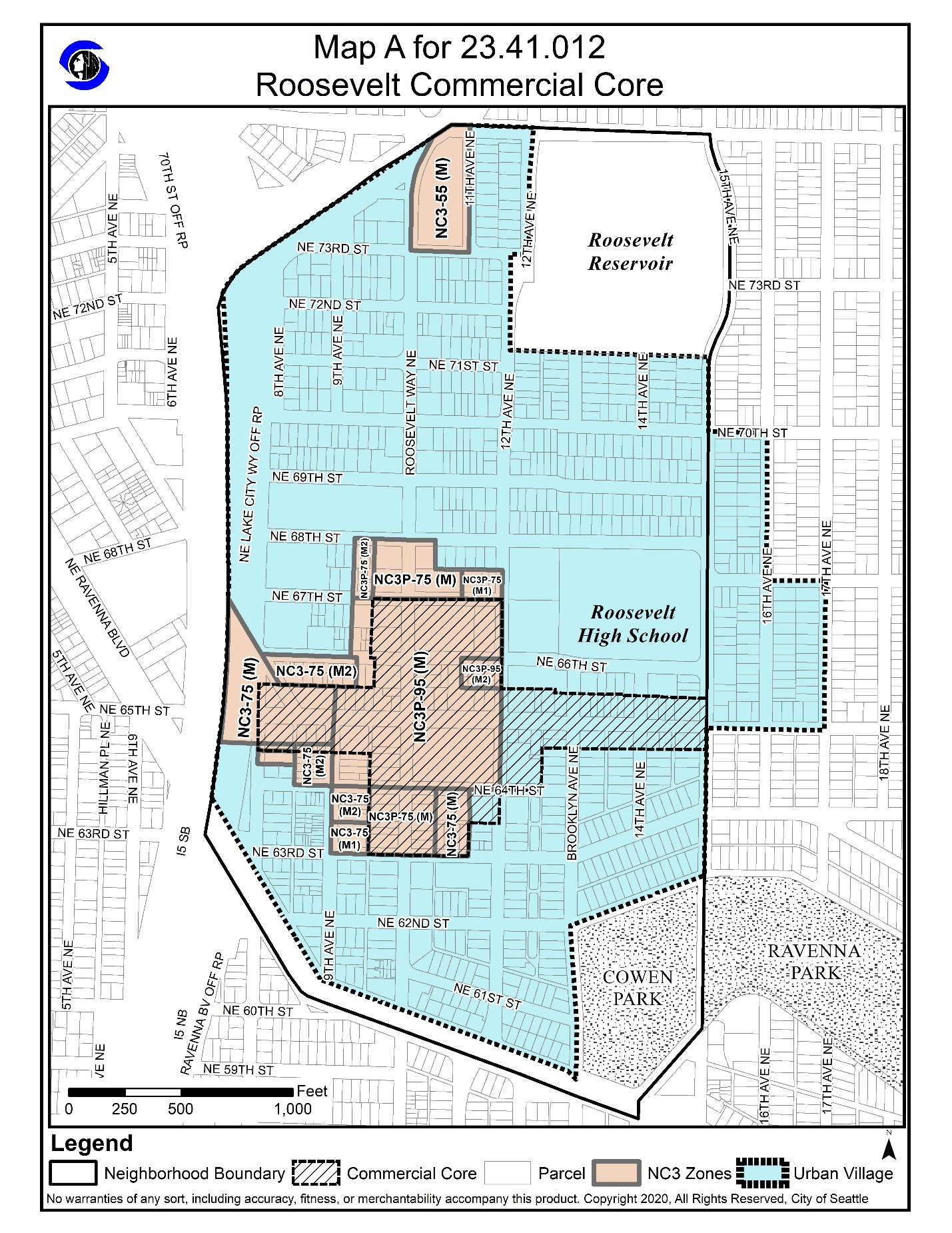
Within the Roosevelt Commercial Core building height departures up to an additional 3 feet may be granted for properties zoned NC3-75 (Map A for 23.41.012, Roosevelt Commercial Core);
b.
Within the Uptown Urban Center building height departures up to 3 feet of additional height may be granted if the top floor of the structure is set back at least 6 feet from all lot lines abutting streets;
c.
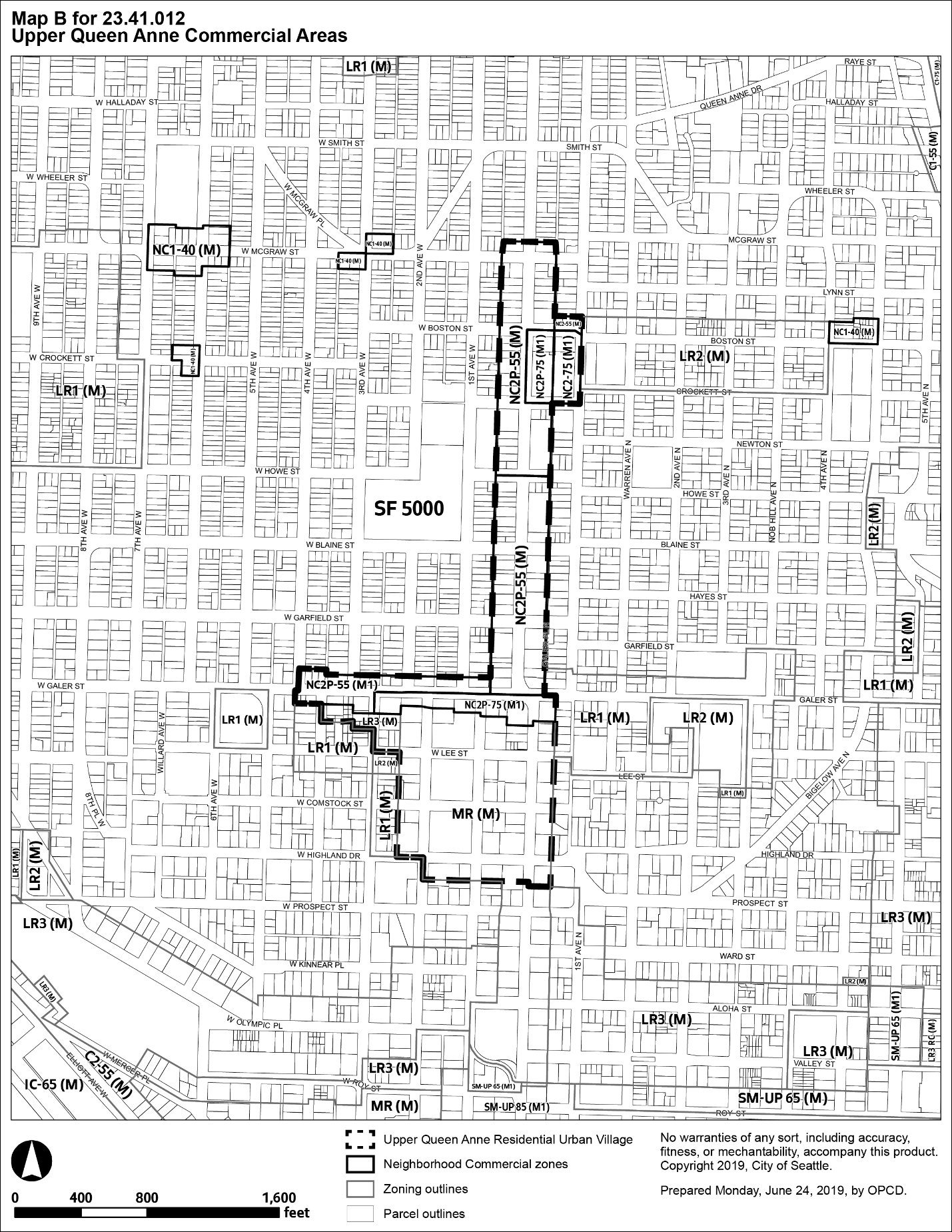
Within the Queen Anne Residential Urban Village and Neighborhood Commercial zones as shown on Map B for 23.41.012, Upper Queen Anne Commercial Areas, building height departures up to 3 feet of additional height may be granted if the top floor of the structure is set back at least 6 feet from all lot lines abutting streets;
d.
Within the PSM 85-120 zone in the area shown on Map A for 23.49.180, departures may be granted from development standards that apply as conditions to additional height, except for floor area ratios and provisions for adding bonus floor area above the base FAR;
e.
Within the Pike/Pine Conservation Overlay District shown on Map A for 23.73.004, departures may be granted from:
1)
Development standards that apply as conditions to additional height in subsections 23.73.014.A and 23.73.014.B; and
2)
The provision for receiving sites for transfer of development potential in subsection 23.73.024.B.5;
f.
Departures of up to 10 feet of additional height may be granted if the applicant demonstrates that:
1)
The departure is needed to protect a tree that is located on the lot that is either a Tier 1 or Tier 2 tree, as defined in Section 25.11.130; and
2)
Avoiding development in the tree protection area will reduce the total development capacity of the site;
g.
In Midrise and Highrise zones, Seattle Mixed, and in all commercial and Downtown zones, departures for rooftop features may be granted from rooftop coverage limits and setback standards from the roof edge, but not from the height limits for rooftop features.
12.
Provisions of Chapter 23.52;
13.
Provisions of Chapter 23.53, except that departures may be granted from the access easement standards in Section 23.53.025;
14.
Quantity of parking required, minimum and maximum parking limits, and minimum and maximum number of drive-in lanes;
15.
Standards for solid-waste and recyclable materials storage and access in Section 23.54.040;
16.
Provisions of Chapter 23.58A, except that departures may be granted from the requirements of subsections 23.48.021.C.1.b.2, 23.48.021.C.1.b.3.a, 23.48.021.C.1.b.4, and 23.48.021.C.1.b.5;
17.
Provisions of Chapter 23.58B and Chapter 23.58C;
18.
In SM-SLU zones, floor area limits for all uses provided in subsections 23.48.245.A, 23.48.245.B.1, 23.48.245.B.2, and 23.48.245.B.3, except that departures of up to a five percent increase in floor area limit for each story may be granted for structures with non-residential uses meeting the requirements of subsections 23.48.245.B.1.d.1 and 23.48.245.B.1.d.2;
19.
In SM-SLU zones, provisions in Section 23.48.245 for upper-level setbacks;
20.
In SM-SLU zones, provisions in Section 23.48.245 limiting the number of towers permitted per block, except that departures may be granted from the condition contained in subsection 23.48.245.F.5.b that requires a minimum tower separation, up to the minimum amount of separation necessary to achieve the maximum floor area allowed by subsection 23.48.245.B.1.d and only if the development proposal includes a site or improvement that is subject to Landmark controls and incentives imposed pursuant to Chapter 25.12;
21.
In Downtown zones, provisions in Chapter 23.49 for exceeding the base FAR or achieving bonus development;
22.
In Downtown zones, provisions in Section 23.49.036 for the minimum size for planned community developments;
23.
In Downtown zones, the average floor area limit for stories in residential use in Table B for 23.49.058;
24.
In Downtown zones, provisions in Section 23.49.041 for combined lot developments;
25.
In the Downtown Mixed Commercial 170 zone, minimum floor-to-floor height for street-level uses required as a condition of the additional height allowed by subsection 23.49.008.E;
26.
In Downtown zones, downtown view corridor requirements, except that departures may be granted to allow open railings on upper-level roof decks or on rooftop open space to project into the required view corridor, if the railings are determined to have a minimal impact on views;
27.
In Downtown zones, the quantity of open space required for major office projects as provided in subsection 23.49.016.B;
28.
In Downtown zones, standards for the location of access to parking;
29.
In Downtown Mixed Commercial zones, tower spacing requirements contained in subsection 23.49.058.D;
30.
Within the Pike/Pine Conservation Overlay District shown on Map A for 23.73.004, the requirement that all character structures on a lot be retained in order to qualify as a transferable development potential (TDP) receiving site in subsection 23.73.024.B, the exception allowing additional FAR for non-residential uses in subsection 23.73.009.B, the FAR exemption for residential uses in subsection 23.73.009.C.3, the exception to floor area limits in subsections 23.73.010.B.1 and 23.73.010.B.2, the exception for width and depth measurements in subsection 23.73.012.B, or the exception for an additional 10 feet in height in subsection 23.73.014.B.
a.
However, departures from the development standards identified above may be granted under the following conditions:
1)
The character structure is neither a designated Seattle Landmark nor identified in a rule promulgated by the Director according to Section 23.73.005; and
2)
The proposed development entails the demolition of a wood-frame character structure originally built as a single-family residence or single-family accessory structure; or
3)
The proposed development entails the demolition of a character structure that is determined to have insufficient value to warrant retention when the following applies:
a)
The structure lacks a high degree of architectural integrity as evidenced by extensive irreversible exterior remodeling; or
b)
The structure does not represent the Pike/Pine neighborhood's building typology that is characterized by the use of exterior materials and design elements such as masonry, brick, and timber; multi-use loft spaces; very high and fully glazed ground-floor storefront windows; and decorative details including cornices, emblems, and embossed building names; or
c)
Demolishing the character structure would allow for more substantial retention of other, more significant character structures on the lot, such as a structure listed in a rule promulgated by the Director according to Section 23.73.005; or would allow for other key neighborhood development objectives to be achieved, such as improving pedestrian circulation by providing through-block connections, developing arts and cultural facilities, or siting publicly accessible open space at key neighborhood locations.
b.
In addition to the provisions of subsection 23.41.012.B.30.a, the following provisions apply:
1)
At least one character structure shall be retained on the lot if any of the following are to be used by the development proposal:
a)
Subsection 23.73.009.C.3 regarding the FAR exemption for residential uses;
b)
Subsection 23.73.010.B.2 regarding increases in the floor area limits;
c)
Subsection 23.73.012.B regarding the exception from width and depth measurements; or
d)
Subsection 23.73.014.B regarding the exception allowing for an additional 10 feet in height.
2)
A departure may allow removal of character structures if the requirement for retaining structures is limited to the following:
a)
Subsection 23.73.009.B regarding the exception to allow additional FAR for non-residential uses;
b)
Subsection 23.73.010.B.1 regarding increases in the floor area limits; or
c)
Section 23.73.024 for the use of TDP on a lot that is an eligible TDP receiving site under the provisions of subsection 23.73.024.B;
31.
In the MPC-YT zone, affordable housing production requirements in Section 23.75.085;
32.
In the MPC-YT zone, limits on floor area for uses in Sections 23.75.040, 23.75.085, or 23.75.090;
33.
In the MPC-YT zone, limits on the number of highrise structures, distribution of highrise structures, and gross floor area per story for highrise structures in Section 23.75.040 or Section 23.75.120;
34.
In pedestrian-designated zones, provisions for residential uses at street level, as provided in subsection 23.47A.005.C.1, except that a departure may be granted to allow residential uses at street level to occupy, in the aggregate, no more than 50 percent of the street-level, street-facing facade;
35.
In pedestrian-designated zones, provisions for transparency requirements, as provided in subsection 23.47A.008.B, except that departures may be granted to reduce the required transparency from 60 percent to no less than 40 percent of the street-facing facade;
36.
In pedestrian-designated zones, provisions for height requirements for floor-to-floor height, as provided in subsection 23.47A.008.B, except that departures to allow a mezzanine with less than the minimum floor-to-floor height may be granted provided that the outer edge of the mezzanine floor is at least 15 feet from the exterior wall facing a principal pedestrian street;
37.
Area-specific development standards for Lake City, identified in subsection 23.47A.009.E, except departures may be requested if the development provides at least one of the following features:
a.
A usable open space that:
1)
Abuts the street;
2)
Is no more than 4 feet above or 4 feet below the adjacent sidewalk grade;
3)
Has a minimum width equal to 30 percent of the width of the street-facing facade or 20 feet, whichever is greater; and
4)
Has a minimum depth of 20 feet measured from the abutting street lot line.
b.
An east-west, through-block pedestrian passageway that:
1)
Has a minimum width of 20 feet and provides direct and continuous passage between the north/south rights-of-way abutting the lot; and
2)
Is designed to provide safe pedestrian use, including signage identifying the passageway; and
38.
For lots 40,000 square feet or greater in size, area-specific development standards for Ballard identified in subsections 23.47A.009.F.2, 23.47A.009.F.3, and 23.47A.009.F.4.b, except that departures may be requested if the development provides at least one of the following features:
a.
A usable open space that:
1)
Abuts the street;
2)
Is no more than 4 feet above or 4 feet below the adjacent sidewalk grade;
3)
Has a minimum width equal to 30 percent of the width of the street-facing facade or 20 feet, whichever is greater; and
4)
Has a minimum depth of 20 feet measured from all street lot lines.
b.
A separation between structures that:
1)
Has a minimum east-west dimension width of 20 feet;
2)
Is no more than 4 feet above or below the adjacent sidewalk grades; and
3)
Is either developed as:
a)
A north-south through block pedestrian passageway;
b)
A woonerf;
c)
An amenity area that is available for public use and not counting towards the minimum requirement of Section 23.47A.024; or
d)
A combination thereof.
C.
Departures authorized by this Section 23.41.012 do not limit the approval of waivers or modifications of development standards permitted by other provisions of this Title 23 or other titles of the Seattle Municipal Code.
D.
Departures for the Living Building and 2030 Challenge High Performance Existing Building Pilot Programs
1.
Criteria for departures. Departures from Land Use Code requirements for projects qualifying for the Living Building and 2030 Challenge High Performance Existing Building Pilot Programs pursuant to Sections 23.40.060 and 23.40.070 may be allowed if an applicant demonstrates that the departure would result in a development that better meets the intent of adopted design guidelines or that the departure would result in a development that better meets the goals of the Living Building Pilot Program or the 2030 Challenge High Performance Existing Building Pilot Program and would not conflict with adopted design guidelines.
2.
Scope of departures. In addition to the departures allowed under subsection 23.41.012.B, departures for projects qualifying for the Living Building and 2030 Challenge High Performance Existing Building Pilot Programs established under Sections 23.40.060 and 23.40.070 may also be granted for the following:
a.
Permitted, prohibited, or conditional use provisions, but only for accessory uses that would directly address the standards contained in subsection 23.40.060.B and subsection 23.40.070.B, including but not limited to uses that could re-use existing waste streams or reduce the transportation impacts of people or goods;
b.
Residential density limits;
c.
Maximum size of use;
d.
Quantity of parking required, minimum and maximum parking limits, and minimum and maximum number of drive-in lanes;
e.
Standards for storage of solid-waste containers;
f.
The quantity of open space required for major office projects in Downtown zones in subsection 23.49.016.B;
g.
Standards for the location of access to parking in Downtown zones; and
h.
Standards for structural building overhangs and minor architectural encroachments in Section 23.53.035.
Map A for 23.41.012
Roosevelt Commercial Core
Map B for 23.41.012 Upper Queen Anne Commercial Areas
(2020s
Ord. 127099, § 9, 2024; Ord. 126821, § 7, 2023; Ord. 126157, § 10, 2020.
2010s
Ord. 125927, § 1, 2019; Ord. 125843, § 2, 2019; Ord. 125612, § 4, 2018; Ord. 125603, § 8, 2018; Ord. 125429, § 9, 2017; Ord. 125291, § 3, 2017; Ord. 125272, § 9, 2017; Ord. 125233, § 2, 2016; Ord. 125163, § 3, 2016; Ord. 124883, § 7, 2015; Ord. 124869, § 2, 2015; Ord. 124843, § 12, 2015; Ord. 124770, § 3, 2015; Ord. 124680, § 1, 2015; Ord. 124535, § 2, 2014; Ord. 124503, § 1, 2014; Ord. 124378, § 11, 2013; Ord. 124172, § 3, 2013; Ord. 124105, § 12, 2013 [cross-reference update]; Ord. 123963, § 17, 2012; Ord. 123942, § 2,
2012; Ord. 123809, § 5, 2012; Ord. 123776, § 3, 2011 [cross-reference update]; Ord.
123392, § 2, 2010.
2000s
Ord. 123206, § 5, 2009; Ord. 123046, § 65, 2009 [amended "chart" to "table"]; Ord.
123034, § 2, 2009; Ord. 122994, § 2, 2009; Ord. 122935, § 1, 2009; Ord. 122311, § 20, 2006; Ord. 122235, § 1, 2006; Ord. 122054, § 6, 2006.)
A.
A preapplication conference is required for all projects subject to or for which an applicant has elected full design review.
B.
Community outreach
1.
Applicants shall prepare a community outreach plan. The outreach plan shall include, at minimum, the following outreach methods: printed, electronic or digital, and in-person.
2.
Applicants shall document compliance with the community outreach plan and submit documentation demonstrating compliance to the Director prior to the scheduling of the early design guidance meeting. The Director shall make the documentation available to the public. The documentation shall include:
a.
A summary of the outreach completed to comply with the outreach plan, including a list and description of the outreach methods used, dates associated with each method, and a summary of what the applicant heard from the community when conducting the outreach; and
b.
Materials to demonstrate that each outreach method was conducted.
3.
The purpose of the community outreach plan is to identify the outreach methods an applicant will use to establish a dialogue with nearby communities early in the development process in order to share information about the project, better understand the local context, and hear community interests and concerns related to the project.
4.
The Director may establish, by rule, what constitutes the community outreach plan, and how compliance with the community outreach plan must be documented.
C.
Early design guidance public meeting
1.
Following a preapplication conference, an applicant may apply to begin the early design guidance process and a public meeting with the Design Review Board shall be held.
2.
The purpose of the early design guidance public meeting is to identify concerns about the site and the proposed project, receive comments from the public, review the design guidelines applicable to the site, identify guideline priorities, and explore conceptual design or siting alternatives.
3.
The Director may establish, by rule, the information that the applicant shall present at the early design guidance public meeting.
D.
Guideline priorities
1.
The Board shall identify the applicable guidelines of highest priority to the Board, referred to as the "guideline priorities". The Board shall summarize and consider any community consensus regarding design resulting from community outreach, or as expressed at the meeting or in written comments received.
2.
The Director shall make the guideline priorities available to all those who attended the early design guidance public meeting, to those who sent in comments or otherwise requested notification, and to the applicant.
3.
The applicant is encouraged to meet with the Board and the public for early resolution of design issues, and may hold additional optional meetings with the public or the Board. The Director may require the applicant to meet with the Board, in accordance with subsection 23.41.008.E.4, if the Director believes that such a meeting may help to resolve design issues.
E.
Application for Master Use Permit
1.
Once the guideline priorities are made available by the Director, the applicant may apply for a Master Use Permit (MUP).
2.
In addition to submitting information required in a standard MUP application, as prescribed in Chapter 23.76, the applicant shall include in the MUP application such additional information related to design review as the Director may require.
F.
Design Review Board recommendation
1.
During a regularly scheduled evening meeting of the Design Review Board, the Board shall review the summary of public comments on the project's design, the project's consistency with the guideline priorities, and the Director's review of the project's design and consistency with the guideline priorities, and make a recommendation pursuant to subsection 23.41.008.F.1.
2.
The Director shall make the recommendation available to all those who attended Design Review Board public meetings, to those who sent in comments or otherwise requested notification, and to the applicant.
G.
Director's decision
1.
A decision on an application for a permit subject to design review shall be made by the Director. The Director may condition a proposed project to achieve compliance with design guidelines and to achieve the purpose and intent of this Chapter 23.41. For applications accepted into the Living Building and 2030 Challenge High Performance Existing Building Pilot Programs established under Sections 23.40.060 and 23.40.070, the Director may also condition a proposed project to achieve the purpose and intent of the applicable Pilot Program.
2.
The Director's design review decision shall be made as part of the overall MUP decision for the project. The Director's decision shall consider the recommendation of the Design Review Board, pursuant to subsection 23.41.008.F.
H.
Notice of Decision. Notice of the Director's decision shall be as provided in Chapter 23.76.
I.
Appeals. Appeal procedures for design review decisions are as described in Chapter 23.76.
(Ord. 126188, § 4, 2020; Ord. 126072, § 4, 2020; Ord. 125612, § 5, 2018; Ord. 125429, § 10, 2017; Ord. 125272, § 10, 2017; Ord. 123392, § 3, 2010; Ord. 123206, § 6, 2009; Ord. 119791, § 5, 1999; Ord. 119399, § 4, 1999; Ord. 118980, § 4, 1998; Ord. 116909, § 1, 1993.)
A.
A preapplication conference is required for all projects subject to or for which an applicant has elected administrative design review.
B.
Community outreach
1.
Applicants shall prepare a community outreach. The outreach plan shall include, at minimum, the following outreach methods: printed, electronic or digital, and in-person.
2.
Applicants shall document compliance with the community outreach plan and submit documentation demonstrating compliance to the Director prior to the early design guidance review. The Director shall make the documentation available to the public. The documentation shall include:
a.
A summary of the outreach completed to comply with the outreach plan, including a list and description of the outreach methods used, dates associated with each method, and a summary of what the applicant heard from the community when conducting the outreach; and
b.
Materials to demonstrate that each outreach method was conducted.
3.
The purpose of the community outreach plan is to identify the outreach methods an applicant will use to establish a dialogue with nearby communities early in the development process in order to share information about the project, better understand the local context, and hear community interests and concerns related to the project.
4.
The Director may establish, by rule, what constitutes the community outreach plan, and how compliance with the community outreach plan must be documented.
C.
Early design guidance process
1.
Following a preapplication conference, an applicant may apply to begin the early design guidance process.
2.
The purpose of the early design guidance process is to identify concerns about the site and proposed development, receive written comments from the public, review the design guidelines applicable to the site, identify guideline priorities, and explore conceptual design or siting alternatives.
3.
The Director may establish, by rule, the information that the applicant shall provide with the early design guidance application.
D.
Guideline priorities
1.
The Director shall identify the guidelines of highest priority, referred to as the "guideline priorities". The Director shall summarize and consider any community consensus regarding design resulting from community outreach, or resulting from community outreach, or as expressed in written comments received.
2.
The Director shall make the guideline priorities available to those who sent in comments or otherwise requested notification, and to the applicant.
E.
Application for Master Use Permit
1.
Once the guideline priorities are made available by the Director, the applicant may apply for a Master Use Permit (MUP).
2.
In addition to submitting information required in a standard MUP application, as prescribed in Chapter 23.76, the applicant shall include in the MUP application such additional information related to design review as the Director may require.
F.
Design review recommendation phase
1.
The Director shall review the summary of public comments on the project's design, the project's consistency with the guideline priorities, and make a recommendation pursuant to subsection 23.41.008.F.1.
2.
The Director shall make the recommendation available to those who sent in comments or otherwise requested notification, and to the applicant.
G.
Director's decision
1.
A decision on an application for a permit subject to administrative design review shall be made by the Director.
2.
The Director's design review decision shall be made as part of the overall Master Use Permit decision for the project. The Director's decision shall be based on the extent to which the proposed project meets the guideline priorities and in consideration of public comments on the proposed project.
H.
Notice of decision. Notice of the Director's decision shall be as provided in Chapter 23.76, Procedures for Master Use Permits and Council Land Use Decisions.
I.
Appeals. Appeal procedures for design review decisions are described in Chapter 23.76, Procedures for Master Use Permits and Council Land Use Decisions.
(Ord. 126685, § 5, 2022; Ord. 126188, § 5, 2020; Ord. 126072, § 5, 2020; Ord. 125429, § 11, 2017; Ord. 120410, § 4, 2001; Ord. 118980, § 5, 1998.)
A.
A preapplication conference is required for all projects subject to or for which an applicant has elected this Section 23.41.018.
B.
Community Outreach
1.
Applicants shall prepare a community outreach. The outreach plan shall include, at minimum, the following outreach methods: printed, electronic or digital, and in-person.
2.
Applicants shall document compliance with the community outreach plan and submit documentation demonstrating compliance to the Director prior to the early design guidance review. The Director shall make the documentation available to the public. The documentation shall include:
a.
A summary of the outreach completed to comply with the outreach plan, including a list and description of the outreach methods used, dates associated with each method, and a summary of what the applicant heard from the community when conducting the outreach; and
b.
Materials to demonstrate that each outreach method was conducted.
3.
The purpose of the community outreach plan is to identify the outreach methods an applicant will use to establish a dialogue with nearby communities early in the development process in order to share information about the project, better understand the local context, and hear community interests and concerns related to the project.
4.
The Director may establish, by rule, what constitutes the community outreach plan, and how compliance with the community outreach plan must be documented.
C.
Early design guidance process
1.
Following a preapplication conference, an applicant may apply to begin the early design guidance process.
2.
The purpose of the early design guidance process is to receive written comments from the public, identify concerns about the site and proposed development, review the design guidelines applicable to the site, identify guideline priorities, explore conceptual design or siting alternatives, and identify and document proposed development standard adjustments, which may be approved as a Type I decision pursuant to subsection 23.41.018.D, or departures, which may be approved as a Type II decision pursuant to Section 23.41.016.
3.
The Director may establish, by rule, the information that the applicant shall provide with the early design guidance application.
D.
SDR Guidance report
1.
The Director shall identify the guidelines of highest priority, referred to as the "guideline priorities". The Director shall summarize and consider any community consensus regarding design resulting from community outreach, or as expressed in written comments received.
2.
The Director shall prepare a report that identifies guideline priorities, documents any design changes needed to achieve consistency with the design guidelines, and identifies any requested or required development standard adjustments and/or departures.
3.
If the criteria listed in subsection 23.41.018.F.3 are met, the Director may consider adjustments to the following development standards to the extent listed for each standard:
a.
Setbacks and separation requirements may be reduced by a maximum of 50 percent;
b.
Amenity areas may be reduced by a maximum of ten percent;
c.
Landscaping and screening may be reduced by a maximum of 25 percent; and
d.
Structure width, structure depth, and facade length may be increased by a maximum of ten percent.
4.
The Director shall make the Guidance report available to those who sent in comments or otherwise requested notification, and to the applicant.
E.
Application for Building Permit
1.
Once the SDR Guidance report is made available by the Director, the applicant may apply for a Building Permit.
2.
In addition to submitting information required in a standard Building Permit application, the applicant shall include in the Building Permit application such additional information related to design review as the Director may require.
3.
Adjustments to development standards listed in subsection 23.41.018.D.3 may be approved as a Type I decision. If requested development standard departures, authorized under Section 23.41.012 exceed the adjustments allowed under subsection 23.41.018.D.3, the applicant may either revise the application to eliminate the need for departures and proceed under this Section 23.41.018, or else apply for a Type II Master Use Permit for administrative design review pursuant to Section 23.41.016.
F.
Director's Type I decision
1.
A decision on an application for a permit subject to streamline design review shall be made by the Director.
2.
The Director's design review decision shall be made as part of the overall Building Permit decision for the project. The Director's decision shall be based on the extent to which the proposed project meets guideline priorities and responds to the SDR Guidance report, and in consideration of public comments on the proposed project.
3.
The Director may approve the adjustments listed in subsection 23.41.018.D.3, if the adjustments are consistent with the SDR Guidance report and the adjustments would result in a development that:
a.
Better meets the intent of the adopted design guidelines and/or
b.
Provides a better response to environmental and/or site conditions, including but not limited to topography, the location of trees, or adjacent uses and structures.
E.
Limitations on adjustments through the SDR process established in this Section 23.41.018 do not limit modifications to standards expressly permitted by other provisions of the Seattle Municipal Code.
(Ord. 126685, § 6, 2022; Ord. 126188, § 6, 2020; Ord. 126072, § 6, 2020; Ord. 125429, § 12, 2017; Ord. 124952, § 2, 2015; Ord. 123564, § 4, 2011; Ord. 123495, § 13, 2011.)
A.
Scope. This Section 23.41.020 applies only to development proposals in Master Planned Community zones that do not include a request for departures. If an application in a Master Planned Community zone includes a request for departures, then the applicable design review procedures are in Section 23.41.014, except if the temporary provisions in subsection 23.41.004.E.3 apply. For purposes of this Section 23.41.020, "highrise structure" and "non-highrise structure" are as defined in Section 23.75.020.
B.
A preapplication conference is required for any application subject to this Section 23.41.020.
C.
Early design guidance
1.
An early design guidance process is required only if a proposal includes a highrise structure.
2.
Following a pre-application conference and site visits by Design Review Board members assigned to review a proposed project, an early design guidance public meeting with the Design Review Board shall be held for each proposal that includes a highrise structure.
3.
The purpose of the early design guidance public meeting is to identify concerns about the site and the proposed project, receive comments from the public, review the design guidelines applicable to the site, identify guideline priorities, and explore conceptual design or siting alternatives.
4.
The Director may establish, by rule, the information that the applicant shall present at the early design guidance public meeting.
5.
Guideline priorities. The Board shall identify those guidelines of highest priority to the Board, referred to as "guideline priorities". The Board shall make preliminary design recommendations, summarizing and considering any community consensus regarding design expressed at the meeting.
6.
The Director shall make available a summary of the public comments and the Board's preliminary design recommendations from the early design guidance meeting to the applicant and to all persons who provided an address for notice at the meeting, submitted written comments, or made a written request for notice.
D.
Application for Master Use Permit
1.
Timing
a.
If a proposal does not include a highrise structure, then following the pre-application conference, the applicant may apply for a Master Use Permit.
b.
If a proposal includes a highrise structure, then following the early design guidance public meeting, distribution of the meeting summary, and any additional optional meetings that the applicant chooses to hold with the public and the Design Review Board, the applicant may apply for a Master Use Permit.
2.
In addition to submitting information required in a standard MUP application, as prescribed in Chapter 23.76, the applicant shall include in the MUP application such additional information related to design review as the Director may require.
E.
Design review process and decision
1.
Director's decision for non-highrise proposals. For a development proposal that does not include a highrise structure, the Director shall make a Type I design review decision. The Director's decision shall be based on the extent to which the proposed project meets applicable design guidelines, with consideration of public comments on the proposed project. The Director may condition a proposed project to achieve greater consistency with design guidelines and to achieve the purpose and intent of this Chapter 23.41.
2.
Design Review Board recommendation for highrise development proposals
a.
If the proposal includes a highrise structure, then during a recommendation meeting, the Board shall review the summary of public comments on the project's design, the project's consistency with the guideline priorities, and the Director's review of the project's design and its consistency with the guideline priorities.
b.
At a recommendation meeting for a development proposal that includes a highrise structure, the Design Review Board shall determine whether the proposed design submitted by the applicant is consistent with the guideline priorities. The Board may recommend to the Director whether to approve or conditionally approve the proposed project based on the guideline priorities. The Design Review Board shall hold no more than two recommendation meetings on the proposed project, following the required early design guidance meeting and any optional meetings that the applicant may hold with the public or the Design Review Board. If the Design Review Board does not issue a recommendation that a proposed project be approved, conditionally approved, or denied by the end of the second recommendation meeting, the remaining design review process shall proceed through design review pursuant to subsection 23.41.020.E.1.
c.
For a development proposal including a highrise structure, the Director shall make a Type I design review decision. The Director may condition approval of a development proposal to achieve greater consistency with design guidelines and to achieve the purpose and intent of this Chapter 23.41.
d.
The Director shall consider public comments on the proposed project and the recommendations of the Design Review Board, pursuant to subsection 23.41.008.F.
(Ord. 127100, § 2, 2024; Ord. 126188, § 7, 2020; Ord. 126072, § 7, 2020; Ord. 125429, § 13, 2017; Ord. 123963, § 18, 2012.)
A.
Full design review. The following requirements apply to projects that seek the vacation of a public right-of-way pursuant to Chapter 15.62 and are subject to or for which an applicant has elected full design review pursuant to Section 23.41.004:
1.
Early design guidance. Before submitting any application materials to begin the early design guidance process, an applicant shall consult with the Seattle Design Commission. The purpose of the consultation is to have the Seattle Design Commission provide recommendations to the Design Review Board before the board holds any early design guidance meetings under Section 23.41.014. The Seattle Design Commission recommendations may include any initial concerns about the proposed project and any conceptual design or siting alternatives, including any no-vacation alternatives prepared.
2.
Design Review Board recommendation. The Design Review Board shall not hold a final recommendation meeting until the Seattle Design Commission makes a recommendation on the Public Trust Analysis phase of a street vacation review as described in the Street Vacation Policies.
B.
Administrative design review. The following requirements apply to projects that seek the vacation of a public right-of-way pursuant to Seattle Municipal Code Chapter 15.62 and are subject to or for which an applicant has elected administrative design review pursuant to Section 23.41.004.
1.
Early design guidance. Before the Director makes guideline priorities available, an applicant shall consult with the Seattle Design Commission. The purpose of the consultation is to have the Seattle Design Commission provide recommendations to the Director, prior to the Director identifying priorities pursuant to Section 23.41.016. The Seattle Design Commission recommendations may include any initial concerns about the proposed project and any conceptual design or siting alternatives, including any no-vacation alternatives prepared.
2.
Design Review Board recommendation. The Director shall not make a recommendation pursuant to Section 23.41.016 until the Seattle Design Commission makes a recommendation on the Public Trust Analysis phase of a street vacation review.
(Ord. 125587, § 1, 2018.)

41 - DESIGN REVIEW5
Editor's note— The title of Ch. 23.41 was amended by Ord. 124389, § 1, adopted December 16, 2013.
The purpose of Design Review is to:
A.
Encourage better design and site planning to help ensure that new development enhances the character of the city and sensitively fits into neighborhoods, while allowing for diversity and creativity; and
B.
Provide flexibility in the application of development standards to better meet the intent of the Land Use Code as established by City policy, to meet neighborhood objectives, and to provide for effective mitigation of a proposed project's impact and influence on a neighborhood;
C.
Promote and support communication and mutual understanding among applicants, neighborhoods, and the City early and throughout the development review process; and
D.
Promote the consideration of public safety in design as a way to reduce crime and improve quality of life.
(Ord. 127309, § 1, 2025; Ord. 125429, § 3, 2017; Ord. 124389, § 2, 2013; Ord. 116909, § 1, 1993.)
A.
Design review required
1.
Subject to the exemptions in subsection 23.41.004.B, design review is required in the following areas or zones when development is proposed that exceeds a threshold in Table A or Table B for 23.41.004:
a.
Multifamily;
b.
Commercial;
c.
Seattle Mixed; and
d.
Downtown.
2.
Subject to the exemptions in subsection 23.41.004.B, design review is required in the Industrial Commercial zone when commercial or institution development is proposed that exceeds a threshold in Table A or Table B for 23.41.004.
3.
The gross floor area of the following uses is not included in the total gross floor area of a development for purposes of determining if a threshold is exceeded:
a.
Religious facilities;
b.
Childcare centers, elementary, and secondary schools;
c.
Uses associated with a Major Institution Master Plan (MIMP); or
d.
Development of a major institution use within a Major Institution Overlay (MIO) district.
4.
Any development proposal participating in the Living Building or 2030 Challenge High Performance Existing Building Pilot Program according to Sections 23.40.060 and 23.40.070, including a development proposal for an existing structure, regardless of size or site characteristics, is subject to full design review according to Section 23.41.014.
5.
Any development proposal that is located in a Master Planned Community zone and that includes a request for departures, regardless of size or site characteristics, is subject to full design review according to Section 23.41.014. If a development proposal in a Master Planned Community zone does not include a request for departures, the applicable design review procedures are in Section 23.41.020. A development proposal in a Master Planned Community zone, which includes a request for departures and provides affordable housing per subsection 23.41.004.A.5, shall be subject to administrative design review according to Section 23.41.016.
6.
Subject to the exemptions in subsection 23.41.004.B, design review is required for additions to existing structures when the size of the proposed addition or expansion exceeds a threshold in Table A or Table B for 23.41.004. Administrative design review, as described in Section 23.41.016, is required for certain other additions to existing structures according to rules promulgated by the Director.
B.
Exemptions. The following are exempt from design review:
1.
Development located in special review districts established by Chapter 23.66;
2.
Development in Landmark districts established by Title 25;
3.
Development within the historic character area of the Downtown Harborfront 1 zone;
4.
Development that is subject to shoreline design review pursuant to Chapter 23.60A;
5.
New light rail transit facilities that are subject to review by the Seattle Design Commission;
6.
City facilities that are subject to review by the Seattle Design Commission;
7.
Development within neighborhood residential or residential small lot zones; and
8.
Low-income housing.
C.
Optional design review
1.
Design review. Development proposals that are not subject to design review may elect to be reviewed pursuant to the full, administrative, or streamlined design review process if:
a.
The development proposal is in any zone or area identified in subsection 23.41.004.A.1 or 23.41.004.A.2 or in the Stadium Transition Area Overlay District, except development that is within a Master Planned Community zone is not eligible for optional design review; and
b.
The development proposal does not include the uses listed in subsection 23.41.004.A.3.
2.
Administrative design review. According to the applicable process described in Section 23.41.016, administrative design review is optional for a development proposal that is not otherwise subject to this Chapter 23.41 and is on a site that contains a Tier 1 and/or Tier 2 tree, as defined in Section 25.11.130, when the ability to depart from development standards may result in protection of the tree as provided in Section 25.11.070.
D.
Exemptions; applicability. Low-income housing that vests according to Section 23.76.026 prior to the effective date of this ordinance may also use the design review exemption authorized according to subsection 23.41.004.B.8.
E.
Temporary provisions
1.
Developments with units provided on-site to comply with Chapter 23.58C through the performance option
a.
A development proposal subject to design review under subsection 23.41.004.A that is complying with Chapter 23.58C solely through the performance option by providing affordable units on-site according to Section 23.58C.050.C shall be exempt from design review if the applicant files a valid and complete building permit application electing the exemption while this ordinance is in effect.
b.
A development proposal subject to design review under subsection 23.41.004.A that is complying with Chapter 23.58C solely through the performance option by providing affordable units on-site according to Section 23.58C.050.C that is vested according to Section 23.76.026 prior to August 14, 2023 may elect to be processed as allowed by Section 23.41.004.E.
c.
The design review exemption under subsection 23.41.004.E.1 shall be rescinded for a development proposal that changes from the performance option to the payment option at any time prior to issuance of a building permit.
d.
Requests for departures. If a project subject to design review under subsection 23.41.004.A is exempt from design review according to subsection 23.41.004.E.1, the Director may consider requests for departures from any development standard in this Title 23, except as otherwise limited in subsection 23.41.012.B.
e.
Departures decision. Requests for departures according to subsection 23.41.004.E.1.d shall be evaluated and may be granted by the Director as a Type I decision if the departure would result in additional housing units being constructed.
2.
Low-income housing
a.
Notwithstanding any contrary provision of this Title 23, the Director may consider requests for departures from any development standard in this Title 23, except as otherwise limited in subsection 23.41.012.B, for low-income housing.
b.
Departures decision. Requests for departures shall be evaluated by the Director, in consultation with the Office of Housing, in light of the particular population designed to be served by the project, and may be granted by the Director as a Type I decision if the departure would result in additional housing units being constructed.
3.
Downtown Activation Plan
a.
A development proposal that is subject to design review according to this Section 23.41.004 shall be exempt from this Chapter 23.41, unless ineligible for exemption due to other code provisions, if:
1)
The proposal includes residential use comprising at least 50 percent of its chargeable floor area, except if at least 50 percent of the chargeable floor area in nonresidential use is lodging then no residential use is required; or includes a research and development laboratory use; and
2)
The proposal is located on a property within the Downtown Urban Center, Uptown Urban Center, South Lake Union Urban Center, First Hill Urban Center, or an area within the Greater Duwamish Manufacturing and Industrial Center, as shown on Map A for 23.41.004; or within an area included in an adopted expansion area of an urban center or manufacturing and industrial center shown on Map A for 23.41.004; and
3)
The applicant files a letter of eligibility for exemption pursuant to subsection 23.76.010.G, provided that permit application materials are subsequently filed per subsection 23.76.026.A.4; and
4)
The proposal does not involve a Type IV or Type V Council land use decision.
b.
Waiver or modification of development standard. If a project is exempt from design review according to this subsection 23.41.004.E.3, the Director may consider requests for waivers or modifications of the following development standards in Title 23:
1)
Upper-level setbacks, modulation, articulation, facade opening requirements, and structure width;
2)
Street level setbacks and facade setbacks: dimensional and area limits;
3)
Floor-to-floor height requirements at street level, except as otherwise limited in subsection 23.41.012.B;
4)
Rooftop screening and coverage limits in relation to mechanical equipment, energy-related features, elevator equipment, and related enclosures;
5)
Street-level use type, minimum depth, and percent presence on street-level street-facing facade requirements;
6)
Facade transparency and blank facade requirements;
7)
Overhead weather protection requirements;
8)
Requirements for the size and design of common recreational areas, amenity areas, community rooms, and similar indoor amenities, but not including required outdoor open space requirements;
9)
Open space and open areas: dimensional, area, distribution of types, and amount of overhead coverage requirements, except standards for open space amenities provided to meet requirements of Chapter 23.58A;
10)
Landscaping: dimensional, area, and location requirements;
11)
Minimum dimensions and slope of vehicle access;
12)
Parking space size requirements in subsections 23.54.030.A and 23.54.030.B;
13)
Bicycle parking minimum quantity requirements in Table D for 23.54.015; and
14)
Provisions of the MPC-YT zone, except: affordable housing production requirements in Section 23.75.085; limits on floor area for uses in Sections 23.75.040, 23.75.085, or 23.75.090; and limits on the number of highrise structures, distribution of highrise structures, and gross floor area per story for highrise structures in Section 23.75.040 or Section 23.75.120.
c.
Decision on waiver or modification of development standards. Requests for waiver or modification of development standards according to subsection 23.41.004.E.3.b shall be evaluated by the Director and may be granted by the Director as a Type I decision if a waiver or modification of development standards would result in an increased number of dwelling units, lodging rooms, or increased floor area of a research and development laboratory use, being constructed.
Map A for 23.41.004
Areas subject to interim design review exemption
F.
Temporary provisions made by Ordinance 127309 for design review
1.
Developments with units provided on-site to comply with Chapter 23.58C through the performance option
a.
A development proposal subject to design review under subsection 23.41.004.A that is complying with Chapter 23.58C solely through the performance option by providing affordable units on-site according to subsection 23.58C.050.C shall be exempt from design review if the applicant files a valid and complete building permit application electing the exemption while Ordinance 127309 is in effect.
b.
A development proposal subject to design review under subsection 23.41.004.A that is complying with Chapter 23.58C solely through the performance option by providing affordable units on-site according to subsection 23.58C.050.C that is vested according to Section 23.76.026 prior to October 27, 2025 may elect to be processed as allowed by this subsection 23.41.004.F.
c.
The design review exemption under this subsection 23.41.004.F.1 shall be rescinded for a development proposal that changes from the performance option to the payment option at any time prior to issuance of a building permit.
d.
Requests for departures. If a project subject to design review under subsection 23.41.004.A is exempt from design review according to this subsection 23.41.004.F.1, the Director may consider requests for departures from any development standard in this Title 23, except as otherwise limited in subsection 23.41.012.B.
e.
Departures decision. Requests for departures according to subsection 23.41.004.F.1.d shall be evaluated and may be granted by the Director as a Type I decision if the departure would result in additional housing units being constructed.
f.
The provisions of this subsection 23.41.004.F.1 shall be in effect for six months from October 27, 2025.
2.
Low-income housing
a.
Notwithstanding any contrary provision of this Title 23, the Director may consider requests for departures from any development standard in this Title 23, except as otherwise limited in subsection 23.41.012.B, for low-income housing.
b.
Departures decision. Requests for departures shall be evaluated by the Director, in consultation with the Office of Housing, in light of the particular population designed to be served by the project, and may be granted by the Director as a Type I decision if the departure would result in additional housing units being constructed.
c.
The provisions of this subsection 23.41.004.F.2 shall be in effect for six months from October 27, 2025.
G.
Interim suspension of required design review for all proposed development
1.
Notwithstanding any contrary provision of this Title 23 and Title 25, including but not limited to Chapters 23.40, 23.41, 23.42, 23.45, 23.47A, 23.48, 23.49, 23.57, 23.58B, 23.58C, 23.60A, 23.61, 23.73, 23.76, 25.05, 25.11, 25.16. 25.20, and 25.22, required design review is temporarily suspended for all proposed development.
2.
Applicants of proposed development that is being reviewed pursuant to the full, administrative, or streamlined design review process as of October 27, 2025 may elect to continue review under the design review process or withdraw the proposed development from the design review process. Applicants of all other proposed development may elect, at any time during the effective period of Ordinance 127309, their proposed development be reviewed pursuant to the full, administrative, or streamlined design review process. Applicants with projects meeting the thresholds for full design review pursuant to subsection 23.41.004.A that elect to continue review, or elect review, under the design review process may choose administrative design review.
3.
The provisions of this subsection 23.41.004.G shall be in effect for six months from October 27, 2025.
(Ord. 127309, § 1, 2025; Ord. 127100, § 1, 2024; Ord. 127099, § 8, 2024; Ord. 126862, § 6, 2023; Ord. 126855, § 4, 2023; Ord. 126854, § 1, 2023; Ord. 126821, § 7, 2023; Ord. 126741, § 2, 2022; Ord. 126685, § 4, 2022; Ord. 126509, § 25, 2022 [zone name change]; Ord. 126287, § 1, 2021; Ord. 126188, § 2, 2020; Ord. 126157, § 9, 2020; Ord. 126072, § 2, 2020; Ord. 125603, § 7, 2018; Ord. 125429, § 5, 2017)
For the purposes of design review, the City is divided into eight districts, as depicted on the Design Review Districts Map, Map A for 23.41.006.
Map A for 23.41.006
Design Review Board Districts
(Ord. 125562, § 1, 2018; Ord. 125371, § 21, 2017; Ord. 123046, §§ 7, 8, 2009; Ord. 119972, §§ 2, 3, 2000; Ord. 118980, § 2, 1998; Ord. 118012, § 14, 1996; Ord. 116909, § 1, 1993.)
A.
Role of the Design Review Board. The Design Review Board shall be convened to review development proposals that are subject to full design review, or Master Planned Community-highrise design review pursuant to this Chapter 23.41. To accomplish this purpose, the Design Review Board shall perform the following, as applicable:
1.
For developments subject to full design review or Master Planned Community-highrise design review, synthesize community input on design concerns, identify guideline priorities, and provide early design guidance to the applicant;
2.
Determine whether a proposed design submitted by an applicant does or does not comply with the guideline priorities;
3.
For development subject to full design review, recommend to the Director whether to approve, condition, or deny any requested departures from development standards;
4.
Recommend to the Director specific conditions of approval that are consistent with the guideline priorities; and
5.
Ensure fair and consistent application of Citywide or neighborhood-specific design guidelines.
B.
Design Review Board membership criteria
1.
Members shall reside in Seattle;
2.
Members should possess experience in neighborhood land use issues and demonstrate, by their experience, sensitivity in understanding the effect of design decisions on neighborhoods and the development process;
3.
Members should possess a familiarity with land use processes and standards as applied in Seattle; and
4.
Consistent with Section 4.16.070, no member of the Design Review Board shall have a financial or other private interest, direct or indirect, personally or through a person in the member's immediate family, in a project under review by the Design Review Board on which that member sits.
C.
Design Review Board composition
1.
The Design Review Board shall be composed as follows:
2.
Term. Members of the Design Review Board shall be appointed to two-year terms. A member may be re-appointed to subsequent terms pursuant to the selection and confirmation process in subsection 23.41.008.C.1. The Director may extend the existing term of a serving member by up to one year in order to avoid more than two vacancies at any time. This subsection 23.41.008.C.2 does not apply to Get Engaged members, whose terms are governed by Chapter 3.51.
3.
Members may be removed by the Director for cause, including but not limited to:
a.
Failing to attend the Design Review orientation session offered by SDCI and an onboarding session offered by the City; and
b.
Failing to attend at least 90 percent of all regularly scheduled meetings that have occurred in the term.
4.
Any vacancy in an unexpired term shall be filled in the same manner as the original appointment. A member whose term is ending may continue on an interim basis as a member with voting rights until such time as a successor for that position has been appointed by the City Council or confirmed by the City Council.
D.
Design Review Board assignment
1.
Each design review district shall be assigned a Design Review Board consisting of members as follows:
a.
One member representing development-related interests;
b.
One member representing the design professions;
c.
Two members representing local residential/community interests;
d.
One member representing general business interests or landscape professions; and
e.
No more than one young adult member from the Get Engaged program.
2.
Three Design Review Board members shall be a quorum of each District Design Review Board.
3.
The Design Review Board members assigned to each project as described in subsection 23.41.008.D.1 shall be known collectively as the District Design Review Board. All members of the District Design Review Board shall be voting members.
4.
Substitutions
a.
In the event that more projects are undergoing simultaneous design review than a District Design Review Board can review in a timely manner, the Director may assign such projects to a geographically unassigned Substitute Design Review Board, whose five members the Director may select from the Substitute Design Review Board membership described in subsection 23.41.008.D.5, so long as the five members represent each of the five interests required by subsection 23.41.008.D.1.
b.
If an individual District Design Review Board member is unable to serve, the Director may either appoint an individual from another District Design Review Board or may appoint a Substitute Design Review Board member from the Substitute Design Review Board membership described in subsection 23.41.008.D.5 to serve in the member's absence.
c.
The Director may assign a Design Review Board to review a project outside of its designated district in order to expedite review, provided that the local residential/community representatives shall review development only within their district. In such a case, the Director shall appoint the local residential/community representatives from the District Board from which the project originated, or the local residential/community representative from the Substitute Design Review Board provided in subsection 23.41.008.D.5, or any combination thereof, to review the project, so long as the local residential/community representatives appointed are from the same geographic district as the project to be reviewed.
5.
Substitute Design Review Board membership
a.
Membership criteria:
1)
A person must have been a member of the Design Review Board whose term has expired;
2)
A person must indicate a willingness to continue participation on the Board; and
3)
A person must have, in the opinion of the Director, demonstrated a commitment to Design Review through exemplary attendance and Board participation.
b.
The term of service for Substitute Design Review Board members is indefinite.
E.
Meetings of the Design Review Board
1.
Notice of Design Review Board meetings shall be given as described in subsection 23.76.015.C.
2.
All meetings of the Design Review Board shall be held virtually, in-person, or a combination of both as follows:
a.
A physical meeting venue option shall be provided for attendance of virtual meetings;
b.
Virtual meetings may be offered to supplement in-person meetings;
c.
If an emergency makes in-person meetings impracticable as declared by the Mayor, meetings shall be held virtually;
d.
In-person meetings shall be accessible; and
e.
All in-person or virtual meetings shall be open to the general public.
The actions of the Board are not quasi-judicial in nature.
3.
Design Review Board meetings are limited to the maximum number described in Table B for 23.41.008.
4.
The Director may require additional Design Review Board meetings above the maximum established in subsection 23.41.008.E.3 if the Director determines the Design Review Board needs additional time for deliberation and evaluation of a project due to the size and complexity of the site or proposed development, the amount and content of public comment, an applicant's insufficient response to previous Board direction, or at the applicant's request. If the Design Review Board cannot complete a recommendation, it shall identify reasons why another recommendation meeting is necessary.
F.
Design Review Board recommendation
1.
The Design Review Board shall determine whether the proposed design submitted by the applicant complies with the guideline priorities. The Board shall recommend to the Director whether to approve or conditionally approve the proposed project based on compliance with the guideline priorities, and whether to approve, condition, or deny any requested departures from development standards.
2.
The Director shall consider the recommendations of the Design Review Board when deciding whether to approve an application for a Master Use Permit.
3.
If four or more members of the Design Review Board agree in their recommendation to the Director, and if the Director otherwise approves a Master Use Permit application, the Director shall make compliance with the recommendation of the Design Review Board a condition of permit approval, unless the Director concludes that the recommendation of the Design Review Board:
a.
Reflects inconsistent application of the design review guidelines;
b.
Exceeds the authority of the Design Review Board;
c.
Conflicts with SEPA conditions or other regulatory requirements applicable to the project; or
d.
Conflicts with requirements of local, state, or federal law.
G.
Revisions to an issued and unexpired MUP
1.
Minor revisions to an issued and unexpired MUP that was subject to design review may be approved by the Director as a Type I decision. A minor revision is defined as any proposed change to an issued and unexpired MUP that has little or no effect on the overall appearance of the design or environmental impact of the issued MUP.
2.
Major revisions to an issued and unexpired MUP that was subject to design review may be approved by the Director as a Type II decision. A Major Revision is defined as any proposed change to an issued MUP that is not a Minor Revision that is consistent with the building massing, site plan, and guidance received at Early Design Guidance (EDG), where the current context of the project (e.g. adjacent structures or uses) is comparable to the context at the time of the EDG. In instances when citywide or neighborhood guidelines have been adopted, amended, or updated since the EDG, the Board or SDCI staff may identify additional guideline priorities as part of the major revision process.
3.
The Director shall establish, by rule, what constitutes a major and minor revision and the review process for major and minor revisions.
(Ord. 126684, § 2, 2022; Ord. 126509, § 26, 2022 [zone name change]; Ord. 126188, § 3, 2020; Ord. 126072, § 3, 2020; Ord. 125562, §§ 2, 3, 2018; Ord. 125429, §§ 6, 7, 2017; Ord. 124843, § 10, 2015; Ord. 124389, § 3, 2013; Ord. 121475, § 1, 2004; Ord. 120914, § 5, 2002; Ord. 118980, § 3, 1998; Ord. 118672, § 1, 1997; Ord. 118012, § 15, 1996; Ord. 117075, § 1, 1994; Ord. 116909, § 1, 1993.)
A.
The "Seattle Design Guidelines, 2013" and the "Guidelines for Downtown Development, 1999" are approved. The "Seattle Design Guidelines, 2013", the neighborhood design guidelines identified in subsection 23.41.010.B, and Master Planned Community design guidelines identified in subsection 23.41.010.C provide the basis for Design Review Board recommendations and City design review decisions, except in Downtown zones, where the "Guidelines for Downtown Development, 1999" apply. Neighborhood design guidelines and Master Planned Community design guidelines are intended to augment and make more specific the "Seattle Design Guidelines, 2013" and the "Guidelines for Downtown Development, 1999." To the extent there are conflicts between neighborhood design guidelines or Master Planned Community design guidelines and the "Seattle Design Guidelines, 2013" or "Guidelines for Downtown Development, 1999," the neighborhood design guidelines or Master Planned Community design guidelines supersede.
B.
The following neighborhood design guidelines are approved. These neighborhood design guidelines apply in the areas shown on the map included in the guidelines.
1.
"Admiral Design Guidelines, 2013";
2.
"Ballard Neighborhood Design Guidelines, 2019";
3.
"Belltown Urban Center Village Design Guidelines, 2004";
4.
"Capitol Hill Neighborhood Design Guidelines, 2019";
5.
"Central Area Design Guidelines, 2018";
6.
"Crown Hill Neighborhood Design Guidelines, 2022";
7.
"Green Lake Design Guidelines, 2013";
8.
"Greenwood/Phinney Design Guidelines, 2013";
9.
"Morgan Junction Design Guidelines, 2013";
10.
"Mount Baker Town Center Design Guidelines, 2017";
11.
"North Beacon Hill Design Guidelines, 2013";
12.
"North District/Lake City Design Guidelines, 2013";
13.
"Northgate Design Guidelines, 2013";
14.
"Othello Design Guidelines, 2013";
15.
"Pike/Pine Design Guidelines, 2017";
16.
"Roosevelt Design Guidelines, 2013";
17.
"South Lake Union Design Guidelines, 2018";
18.
"University District Design Guidelines, 2019";
19.
"Upper Queen Anne Design Guidelines, 2013";
20.
"Uptown Design Guidelines, 2019";
21.
"Wallingford Design Guidelines, 2013"; and
22.
"West Seattle Junction Design Guidelines, 2013."
C.
The following Master Planned Community design guidelines are approved:
1.
Yesler Terrace Master Planned Community Design Guidelines, 2012, Exhibit B to Ordinance 123963.
(Ordinances that updated adopted guidelines in B, with no other substantive changes
Ord. No. 125844, § 1, 2019; Ord. No. 125843, § 1, 2019; Ord. 125776, § 1, 2019; Ord. 125775, § 1, 2019; Ord. No. 125680, § 1, 2018; Ord. 124869, § 1, 2015; Ord. 124242, § 3, 2013; Ord. 123392, § 1, 2010; Ord. 123335, § 1, 2010;
Ord. 121781, § 1, 2005.
All other ordinances
2020s
Ord. 126683, § 1, 2022.
2010s
Ord. 125562, § 4, 2018; Ord. 125429, § 8, 2017; Ord. 125362, § 1, 2017; Ord. 124843, § 11, 2015 [style update]; Ord. 124389, § 4, 2013; Ord. 123963, § 16, 2012.
2000s
Ord. 122994, § 1, 2009; Ord. 122443, § 1, 2007; Ord. 122334, § 1, 2007; Ord. 122311, § 108, 2006; Ord. 122152, § 1, 2006; Ord. 122033, § 1, 2006; Ord. 121891, § 1, 2005;
Ord. 121759, § 1, 2005; Ord. 121534, § 1, 2004; Ord. 121476, § 4, 2004 [readopted
Ord. 121303's amendments]; Ord. 121305, § 1, 2003; Ord. 121303, § 1, 2003; Ord. 120785,
§ 1, 2002; Ord. 120447, § 1, 2001; Ord. 120209, § 1, 2000; Ord. 120081, § 1, 2000.
1990s
Ord. 119399, § 2, 1999; Ord. 118012, § 16, 1996; Ord. 116909, § 1, 1993.)
A.
The Director may waive or modify application of a development standard to a development proposal if the Director decides that waiver or modification would result in a development that better meets the intent of adopted design guidelines.
B.
Departures may be granted from any Land Use Code standard or requirement, except for the following:
1.
Procedures;
2.
Definitions;
3.
Measurements;
4.
Provisions of the Shoreline District, Chapter 23.60A;
5.
Lot configuration standards in subsections 23.22.100.C.3, 23.24.040.A.9, and 23.28.030.A.3;
6.
Permitted, prohibited, or conditional use provisions, except that departures may be granted from development standards for required street-level uses, subject to the limitations of subsection 23.41.012.B.34;
7.
Maximum size of use;
8.
Residential density limits;
9.
Noise and odor standards;
10.
Floor area ratios (FAR), except that:
a.
In the Pike/Pine Conservation Overlay District shown on Map A for 23.73.004, departures from the development standards for floor area exemptions from FAR calculations in subsection 23.73.009.C and for retention of a character structure on a lot in Section 23.73.015 are allowed;
b.
Departures of up to an additional 0.5 FAR may be granted if the applicant demonstrates that:
1)
The departure is needed to protect a tree that is located on the lot that is either a Tier 1 or Tier 2 tree, as defined in Section 25.11.130; and
2)
Avoiding development in the tree protection area will reduce the total development capacity of the site;
11.
Structure height, except that:
a.
Within the Roosevelt Commercial Core building height departures up to an additional 3 feet may be granted for properties zoned NC3-75 (Map A for 23.41.012, Roosevelt Commercial Core);
b.
Within the Uptown Urban Center building height departures up to 3 feet of additional height may be granted if the top floor of the structure is set back at least 6 feet from all lot lines abutting streets;
c.
Within the Queen Anne Residential Urban Village and Neighborhood Commercial zones as shown on Map B for 23.41.012, Upper Queen Anne Commercial Areas, building height departures up to 3 feet of additional height may be granted if the top floor of the structure is set back at least 6 feet from all lot lines abutting streets;
d.
Within the PSM 85-120 zone in the area shown on Map A for 23.49.180, departures may be granted from development standards that apply as conditions to additional height, except for floor area ratios and provisions for adding bonus floor area above the base FAR;
e.
Within the Pike/Pine Conservation Overlay District shown on Map A for 23.73.004, departures may be granted from:
1)
Development standards that apply as conditions to additional height in subsections 23.73.014.A and 23.73.014.B; and
2)
The provision for receiving sites for transfer of development potential in subsection 23.73.024.B.5;
f.
Departures of up to 10 feet of additional height may be granted if the applicant demonstrates that:
1)
The departure is needed to protect a tree that is located on the lot that is either a Tier 1 or Tier 2 tree, as defined in Section 25.11.130; and
2)
Avoiding development in the tree protection area will reduce the total development capacity of the site;
g.
In Midrise and Highrise zones, Seattle Mixed, and in all commercial and Downtown zones, departures for rooftop features may be granted from rooftop coverage limits and setback standards from the roof edge, but not from the height limits for rooftop features.
12.
Provisions of Chapter 23.52;
13.
Provisions of Chapter 23.53, except that departures may be granted from the access easement standards in Section 23.53.025;
14.
Quantity of parking required, minimum and maximum parking limits, and minimum and maximum number of drive-in lanes;
15.
Standards for solid-waste and recyclable materials storage and access in Section 23.54.040;
16.
Provisions of Chapter 23.58A, except that departures may be granted from the requirements of subsections 23.48.021.C.1.b.2, 23.48.021.C.1.b.3.a, 23.48.021.C.1.b.4, and 23.48.021.C.1.b.5;
17.
Provisions of Chapter 23.58B and Chapter 23.58C;
18.
In SM-SLU zones, floor area limits for all uses provided in subsections 23.48.245.A, 23.48.245.B.1, 23.48.245.B.2, and 23.48.245.B.3, except that departures of up to a five percent increase in floor area limit for each story may be granted for structures with non-residential uses meeting the requirements of subsections 23.48.245.B.1.d.1 and 23.48.245.B.1.d.2;
19.
In SM-SLU zones, provisions in Section 23.48.245 for upper-level setbacks;
20.
In SM-SLU zones, provisions in Section 23.48.245 limiting the number of towers permitted per block, except that departures may be granted from the condition contained in subsection 23.48.245.F.5.b that requires a minimum tower separation, up to the minimum amount of separation necessary to achieve the maximum floor area allowed by subsection 23.48.245.B.1.d and only if the development proposal includes a site or improvement that is subject to Landmark controls and incentives imposed pursuant to Chapter 25.12;
21.
In Downtown zones, provisions in Chapter 23.49 for exceeding the base FAR or achieving bonus development;
22.
In Downtown zones, provisions in Section 23.49.036 for the minimum size for planned community developments;
23.
In Downtown zones, the average floor area limit for stories in residential use in Table B for 23.49.058;
24.
In Downtown zones, provisions in Section 23.49.041 for combined lot developments;
25.
In the Downtown Mixed Commercial 170 zone, minimum floor-to-floor height for street-level uses required as a condition of the additional height allowed by subsection 23.49.008.E;
26.
In Downtown zones, downtown view corridor requirements, except that departures may be granted to allow open railings on upper-level roof decks or on rooftop open space to project into the required view corridor, if the railings are determined to have a minimal impact on views;
27.
In Downtown zones, the quantity of open space required for major office projects as provided in subsection 23.49.016.B;
28.
In Downtown zones, standards for the location of access to parking;
29.
In Downtown Mixed Commercial zones, tower spacing requirements contained in subsection 23.49.058.D;
30.
Within the Pike/Pine Conservation Overlay District shown on Map A for 23.73.004, the requirement that all character structures on a lot be retained in order to qualify as a transferable development potential (TDP) receiving site in subsection 23.73.024.B, the exception allowing additional FAR for non-residential uses in subsection 23.73.009.B, the FAR exemption for residential uses in subsection 23.73.009.C.3, the exception to floor area limits in subsections 23.73.010.B.1 and 23.73.010.B.2, the exception for width and depth measurements in subsection 23.73.012.B, or the exception for an additional 10 feet in height in subsection 23.73.014.B.
a.
However, departures from the development standards identified above may be granted under the following conditions:
1)
The character structure is neither a designated Seattle Landmark nor identified in a rule promulgated by the Director according to Section 23.73.005; and
2)
The proposed development entails the demolition of a wood-frame character structure originally built as a single-family residence or single-family accessory structure; or
3)
The proposed development entails the demolition of a character structure that is determined to have insufficient value to warrant retention when the following applies:
a)
The structure lacks a high degree of architectural integrity as evidenced by extensive irreversible exterior remodeling; or
b)
The structure does not represent the Pike/Pine neighborhood's building typology that is characterized by the use of exterior materials and design elements such as masonry, brick, and timber; multi-use loft spaces; very high and fully glazed ground-floor storefront windows; and decorative details including cornices, emblems, and embossed building names; or
c)
Demolishing the character structure would allow for more substantial retention of other, more significant character structures on the lot, such as a structure listed in a rule promulgated by the Director according to Section 23.73.005; or would allow for other key neighborhood development objectives to be achieved, such as improving pedestrian circulation by providing through-block connections, developing arts and cultural facilities, or siting publicly accessible open space at key neighborhood locations.
b.
In addition to the provisions of subsection 23.41.012.B.30.a, the following provisions apply:
1)
At least one character structure shall be retained on the lot if any of the following are to be used by the development proposal:
a)
Subsection 23.73.009.C.3 regarding the FAR exemption for residential uses;
b)
Subsection 23.73.010.B.2 regarding increases in the floor area limits;
c)
Subsection 23.73.012.B regarding the exception from width and depth measurements; or
d)
Subsection 23.73.014.B regarding the exception allowing for an additional 10 feet in height.
2)
A departure may allow removal of character structures if the requirement for retaining structures is limited to the following:
a)
Subsection 23.73.009.B regarding the exception to allow additional FAR for non-residential uses;
b)
Subsection 23.73.010.B.1 regarding increases in the floor area limits; or
c)
Section 23.73.024 for the use of TDP on a lot that is an eligible TDP receiving site under the provisions of subsection 23.73.024.B;
31.
In the MPC-YT zone, affordable housing production requirements in Section 23.75.085;
32.
In the MPC-YT zone, limits on floor area for uses in Sections 23.75.040, 23.75.085, or 23.75.090;
33.
In the MPC-YT zone, limits on the number of highrise structures, distribution of highrise structures, and gross floor area per story for highrise structures in Section 23.75.040 or Section 23.75.120;
34.
In pedestrian-designated zones, provisions for residential uses at street level, as provided in subsection 23.47A.005.C.1, except that a departure may be granted to allow residential uses at street level to occupy, in the aggregate, no more than 50 percent of the street-level, street-facing facade;
35.
In pedestrian-designated zones, provisions for transparency requirements, as provided in subsection 23.47A.008.B, except that departures may be granted to reduce the required transparency from 60 percent to no less than 40 percent of the street-facing facade;
36.
In pedestrian-designated zones, provisions for height requirements for floor-to-floor height, as provided in subsection 23.47A.008.B, except that departures to allow a mezzanine with less than the minimum floor-to-floor height may be granted provided that the outer edge of the mezzanine floor is at least 15 feet from the exterior wall facing a principal pedestrian street;
37.
Area-specific development standards for Lake City, identified in subsection 23.47A.009.E, except departures may be requested if the development provides at least one of the following features:
a.
A usable open space that:
1)
Abuts the street;
2)
Is no more than 4 feet above or 4 feet below the adjacent sidewalk grade;
3)
Has a minimum width equal to 30 percent of the width of the street-facing facade or 20 feet, whichever is greater; and
4)
Has a minimum depth of 20 feet measured from the abutting street lot line.
b.
An east-west, through-block pedestrian passageway that:
1)
Has a minimum width of 20 feet and provides direct and continuous passage between the north/south rights-of-way abutting the lot; and
2)
Is designed to provide safe pedestrian use, including signage identifying the passageway; and
38.
For lots 40,000 square feet or greater in size, area-specific development standards for Ballard identified in subsections 23.47A.009.F.2, 23.47A.009.F.3, and 23.47A.009.F.4.b, except that departures may be requested if the development provides at least one of the following features:
a.
A usable open space that:
1)
Abuts the street;
2)
Is no more than 4 feet above or 4 feet below the adjacent sidewalk grade;
3)
Has a minimum width equal to 30 percent of the width of the street-facing facade or 20 feet, whichever is greater; and
4)
Has a minimum depth of 20 feet measured from all street lot lines.
b.
A separation between structures that:
1)
Has a minimum east-west dimension width of 20 feet;
2)
Is no more than 4 feet above or below the adjacent sidewalk grades; and
3)
Is either developed as:
a)
A north-south through block pedestrian passageway;
b)
A woonerf;
c)
An amenity area that is available for public use and not counting towards the minimum requirement of Section 23.47A.024; or
d)
A combination thereof.
C.
Departures authorized by this Section 23.41.012 do not limit the approval of waivers or modifications of development standards permitted by other provisions of this Title 23 or other titles of the Seattle Municipal Code.
D.
Departures for the Living Building and 2030 Challenge High Performance Existing Building Pilot Programs
1.
Criteria for departures. Departures from Land Use Code requirements for projects qualifying for the Living Building and 2030 Challenge High Performance Existing Building Pilot Programs pursuant to Sections 23.40.060 and 23.40.070 may be allowed if an applicant demonstrates that the departure would result in a development that better meets the intent of adopted design guidelines or that the departure would result in a development that better meets the goals of the Living Building Pilot Program or the 2030 Challenge High Performance Existing Building Pilot Program and would not conflict with adopted design guidelines.
2.
Scope of departures. In addition to the departures allowed under subsection 23.41.012.B, departures for projects qualifying for the Living Building and 2030 Challenge High Performance Existing Building Pilot Programs established under Sections 23.40.060 and 23.40.070 may also be granted for the following:
a.
Permitted, prohibited, or conditional use provisions, but only for accessory uses that would directly address the standards contained in subsection 23.40.060.B and subsection 23.40.070.B, including but not limited to uses that could re-use existing waste streams or reduce the transportation impacts of people or goods;
b.
Residential density limits;
c.
Maximum size of use;
d.
Quantity of parking required, minimum and maximum parking limits, and minimum and maximum number of drive-in lanes;
e.
Standards for storage of solid-waste containers;
f.
The quantity of open space required for major office projects in Downtown zones in subsection 23.49.016.B;
g.
Standards for the location of access to parking in Downtown zones; and
h.
Standards for structural building overhangs and minor architectural encroachments in Section 23.53.035.
Map A for 23.41.012
Roosevelt Commercial Core
Map B for 23.41.012 Upper Queen Anne Commercial Areas
(2020s
Ord. 127099, § 9, 2024; Ord. 126821, § 7, 2023; Ord. 126157, § 10, 2020.
2010s
Ord. 125927, § 1, 2019; Ord. 125843, § 2, 2019; Ord. 125612, § 4, 2018; Ord. 125603, § 8, 2018; Ord. 125429, § 9, 2017; Ord. 125291, § 3, 2017; Ord. 125272, § 9, 2017; Ord. 125233, § 2, 2016; Ord. 125163, § 3, 2016; Ord. 124883, § 7, 2015; Ord. 124869, § 2, 2015; Ord. 124843, § 12, 2015; Ord. 124770, § 3, 2015; Ord. 124680, § 1, 2015; Ord. 124535, § 2, 2014; Ord. 124503, § 1, 2014; Ord. 124378, § 11, 2013; Ord. 124172, § 3, 2013; Ord. 124105, § 12, 2013 [cross-reference update]; Ord. 123963, § 17, 2012; Ord. 123942, § 2,
2012; Ord. 123809, § 5, 2012; Ord. 123776, § 3, 2011 [cross-reference update]; Ord.
123392, § 2, 2010.
2000s
Ord. 123206, § 5, 2009; Ord. 123046, § 65, 2009 [amended "chart" to "table"]; Ord.
123034, § 2, 2009; Ord. 122994, § 2, 2009; Ord. 122935, § 1, 2009; Ord. 122311, § 20, 2006; Ord. 122235, § 1, 2006; Ord. 122054, § 6, 2006.)
A.
A preapplication conference is required for all projects subject to or for which an applicant has elected full design review.
B.
Community outreach
1.
Applicants shall prepare a community outreach plan. The outreach plan shall include, at minimum, the following outreach methods: printed, electronic or digital, and in-person.
2.
Applicants shall document compliance with the community outreach plan and submit documentation demonstrating compliance to the Director prior to the scheduling of the early design guidance meeting. The Director shall make the documentation available to the public. The documentation shall include:
a.
A summary of the outreach completed to comply with the outreach plan, including a list and description of the outreach methods used, dates associated with each method, and a summary of what the applicant heard from the community when conducting the outreach; and
b.
Materials to demonstrate that each outreach method was conducted.
3.
The purpose of the community outreach plan is to identify the outreach methods an applicant will use to establish a dialogue with nearby communities early in the development process in order to share information about the project, better understand the local context, and hear community interests and concerns related to the project.
4.
The Director may establish, by rule, what constitutes the community outreach plan, and how compliance with the community outreach plan must be documented.
C.
Early design guidance public meeting
1.
Following a preapplication conference, an applicant may apply to begin the early design guidance process and a public meeting with the Design Review Board shall be held.
2.
The purpose of the early design guidance public meeting is to identify concerns about the site and the proposed project, receive comments from the public, review the design guidelines applicable to the site, identify guideline priorities, and explore conceptual design or siting alternatives.
3.
The Director may establish, by rule, the information that the applicant shall present at the early design guidance public meeting.
D.
Guideline priorities
1.
The Board shall identify the applicable guidelines of highest priority to the Board, referred to as the "guideline priorities". The Board shall summarize and consider any community consensus regarding design resulting from community outreach, or as expressed at the meeting or in written comments received.
2.
The Director shall make the guideline priorities available to all those who attended the early design guidance public meeting, to those who sent in comments or otherwise requested notification, and to the applicant.
3.
The applicant is encouraged to meet with the Board and the public for early resolution of design issues, and may hold additional optional meetings with the public or the Board. The Director may require the applicant to meet with the Board, in accordance with subsection 23.41.008.E.4, if the Director believes that such a meeting may help to resolve design issues.
E.
Application for Master Use Permit
1.
Once the guideline priorities are made available by the Director, the applicant may apply for a Master Use Permit (MUP).
2.
In addition to submitting information required in a standard MUP application, as prescribed in Chapter 23.76, the applicant shall include in the MUP application such additional information related to design review as the Director may require.
F.
Design Review Board recommendation
1.
During a regularly scheduled evening meeting of the Design Review Board, the Board shall review the summary of public comments on the project's design, the project's consistency with the guideline priorities, and the Director's review of the project's design and consistency with the guideline priorities, and make a recommendation pursuant to subsection 23.41.008.F.1.
2.
The Director shall make the recommendation available to all those who attended Design Review Board public meetings, to those who sent in comments or otherwise requested notification, and to the applicant.
G.
Director's decision
1.
A decision on an application for a permit subject to design review shall be made by the Director. The Director may condition a proposed project to achieve compliance with design guidelines and to achieve the purpose and intent of this Chapter 23.41. For applications accepted into the Living Building and 2030 Challenge High Performance Existing Building Pilot Programs established under Sections 23.40.060 and 23.40.070, the Director may also condition a proposed project to achieve the purpose and intent of the applicable Pilot Program.
2.
The Director's design review decision shall be made as part of the overall MUP decision for the project. The Director's decision shall consider the recommendation of the Design Review Board, pursuant to subsection 23.41.008.F.
H.
Notice of Decision. Notice of the Director's decision shall be as provided in Chapter 23.76.
I.
Appeals. Appeal procedures for design review decisions are as described in Chapter 23.76.
(Ord. 126188, § 4, 2020; Ord. 126072, § 4, 2020; Ord. 125612, § 5, 2018; Ord. 125429, § 10, 2017; Ord. 125272, § 10, 2017; Ord. 123392, § 3, 2010; Ord. 123206, § 6, 2009; Ord. 119791, § 5, 1999; Ord. 119399, § 4, 1999; Ord. 118980, § 4, 1998; Ord. 116909, § 1, 1993.)
A.
A preapplication conference is required for all projects subject to or for which an applicant has elected administrative design review.
B.
Community outreach
1.
Applicants shall prepare a community outreach. The outreach plan shall include, at minimum, the following outreach methods: printed, electronic or digital, and in-person.
2.
Applicants shall document compliance with the community outreach plan and submit documentation demonstrating compliance to the Director prior to the early design guidance review. The Director shall make the documentation available to the public. The documentation shall include:
a.
A summary of the outreach completed to comply with the outreach plan, including a list and description of the outreach methods used, dates associated with each method, and a summary of what the applicant heard from the community when conducting the outreach; and
b.
Materials to demonstrate that each outreach method was conducted.
3.
The purpose of the community outreach plan is to identify the outreach methods an applicant will use to establish a dialogue with nearby communities early in the development process in order to share information about the project, better understand the local context, and hear community interests and concerns related to the project.
4.
The Director may establish, by rule, what constitutes the community outreach plan, and how compliance with the community outreach plan must be documented.
C.
Early design guidance process
1.
Following a preapplication conference, an applicant may apply to begin the early design guidance process.
2.
The purpose of the early design guidance process is to identify concerns about the site and proposed development, receive written comments from the public, review the design guidelines applicable to the site, identify guideline priorities, and explore conceptual design or siting alternatives.
3.
The Director may establish, by rule, the information that the applicant shall provide with the early design guidance application.
D.
Guideline priorities
1.
The Director shall identify the guidelines of highest priority, referred to as the "guideline priorities". The Director shall summarize and consider any community consensus regarding design resulting from community outreach, or resulting from community outreach, or as expressed in written comments received.
2.
The Director shall make the guideline priorities available to those who sent in comments or otherwise requested notification, and to the applicant.
E.
Application for Master Use Permit
1.
Once the guideline priorities are made available by the Director, the applicant may apply for a Master Use Permit (MUP).
2.
In addition to submitting information required in a standard MUP application, as prescribed in Chapter 23.76, the applicant shall include in the MUP application such additional information related to design review as the Director may require.
F.
Design review recommendation phase
1.
The Director shall review the summary of public comments on the project's design, the project's consistency with the guideline priorities, and make a recommendation pursuant to subsection 23.41.008.F.1.
2.
The Director shall make the recommendation available to those who sent in comments or otherwise requested notification, and to the applicant.
G.
Director's decision
1.
A decision on an application for a permit subject to administrative design review shall be made by the Director.
2.
The Director's design review decision shall be made as part of the overall Master Use Permit decision for the project. The Director's decision shall be based on the extent to which the proposed project meets the guideline priorities and in consideration of public comments on the proposed project.
H.
Notice of decision. Notice of the Director's decision shall be as provided in Chapter 23.76, Procedures for Master Use Permits and Council Land Use Decisions.
I.
Appeals. Appeal procedures for design review decisions are described in Chapter 23.76, Procedures for Master Use Permits and Council Land Use Decisions.
(Ord. 126685, § 5, 2022; Ord. 126188, § 5, 2020; Ord. 126072, § 5, 2020; Ord. 125429, § 11, 2017; Ord. 120410, § 4, 2001; Ord. 118980, § 5, 1998.)
A.
A preapplication conference is required for all projects subject to or for which an applicant has elected this Section 23.41.018.
B.
Community Outreach
1.
Applicants shall prepare a community outreach. The outreach plan shall include, at minimum, the following outreach methods: printed, electronic or digital, and in-person.
2.
Applicants shall document compliance with the community outreach plan and submit documentation demonstrating compliance to the Director prior to the early design guidance review. The Director shall make the documentation available to the public. The documentation shall include:
a.
A summary of the outreach completed to comply with the outreach plan, including a list and description of the outreach methods used, dates associated with each method, and a summary of what the applicant heard from the community when conducting the outreach; and
b.
Materials to demonstrate that each outreach method was conducted.
3.
The purpose of the community outreach plan is to identify the outreach methods an applicant will use to establish a dialogue with nearby communities early in the development process in order to share information about the project, better understand the local context, and hear community interests and concerns related to the project.
4.
The Director may establish, by rule, what constitutes the community outreach plan, and how compliance with the community outreach plan must be documented.
C.
Early design guidance process
1.
Following a preapplication conference, an applicant may apply to begin the early design guidance process.
2.
The purpose of the early design guidance process is to receive written comments from the public, identify concerns about the site and proposed development, review the design guidelines applicable to the site, identify guideline priorities, explore conceptual design or siting alternatives, and identify and document proposed development standard adjustments, which may be approved as a Type I decision pursuant to subsection 23.41.018.D, or departures, which may be approved as a Type II decision pursuant to Section 23.41.016.
3.
The Director may establish, by rule, the information that the applicant shall provide with the early design guidance application.
D.
SDR Guidance report
1.
The Director shall identify the guidelines of highest priority, referred to as the "guideline priorities". The Director shall summarize and consider any community consensus regarding design resulting from community outreach, or as expressed in written comments received.
2.
The Director shall prepare a report that identifies guideline priorities, documents any design changes needed to achieve consistency with the design guidelines, and identifies any requested or required development standard adjustments and/or departures.
3.
If the criteria listed in subsection 23.41.018.F.3 are met, the Director may consider adjustments to the following development standards to the extent listed for each standard:
a.
Setbacks and separation requirements may be reduced by a maximum of 50 percent;
b.
Amenity areas may be reduced by a maximum of ten percent;
c.
Landscaping and screening may be reduced by a maximum of 25 percent; and
d.
Structure width, structure depth, and facade length may be increased by a maximum of ten percent.
4.
The Director shall make the Guidance report available to those who sent in comments or otherwise requested notification, and to the applicant.
E.
Application for Building Permit
1.
Once the SDR Guidance report is made available by the Director, the applicant may apply for a Building Permit.
2.
In addition to submitting information required in a standard Building Permit application, the applicant shall include in the Building Permit application such additional information related to design review as the Director may require.
3.
Adjustments to development standards listed in subsection 23.41.018.D.3 may be approved as a Type I decision. If requested development standard departures, authorized under Section 23.41.012 exceed the adjustments allowed under subsection 23.41.018.D.3, the applicant may either revise the application to eliminate the need for departures and proceed under this Section 23.41.018, or else apply for a Type II Master Use Permit for administrative design review pursuant to Section 23.41.016.
F.
Director's Type I decision
1.
A decision on an application for a permit subject to streamline design review shall be made by the Director.
2.
The Director's design review decision shall be made as part of the overall Building Permit decision for the project. The Director's decision shall be based on the extent to which the proposed project meets guideline priorities and responds to the SDR Guidance report, and in consideration of public comments on the proposed project.
3.
The Director may approve the adjustments listed in subsection 23.41.018.D.3, if the adjustments are consistent with the SDR Guidance report and the adjustments would result in a development that:
a.
Better meets the intent of the adopted design guidelines and/or
b.
Provides a better response to environmental and/or site conditions, including but not limited to topography, the location of trees, or adjacent uses and structures.
E.
Limitations on adjustments through the SDR process established in this Section 23.41.018 do not limit modifications to standards expressly permitted by other provisions of the Seattle Municipal Code.
(Ord. 126685, § 6, 2022; Ord. 126188, § 6, 2020; Ord. 126072, § 6, 2020; Ord. 125429, § 12, 2017; Ord. 124952, § 2, 2015; Ord. 123564, § 4, 2011; Ord. 123495, § 13, 2011.)
A.
Scope. This Section 23.41.020 applies only to development proposals in Master Planned Community zones that do not include a request for departures. If an application in a Master Planned Community zone includes a request for departures, then the applicable design review procedures are in Section 23.41.014, except if the temporary provisions in subsection 23.41.004.E.3 apply. For purposes of this Section 23.41.020, "highrise structure" and "non-highrise structure" are as defined in Section 23.75.020.
B.
A preapplication conference is required for any application subject to this Section 23.41.020.
C.
Early design guidance
1.
An early design guidance process is required only if a proposal includes a highrise structure.
2.
Following a pre-application conference and site visits by Design Review Board members assigned to review a proposed project, an early design guidance public meeting with the Design Review Board shall be held for each proposal that includes a highrise structure.
3.
The purpose of the early design guidance public meeting is to identify concerns about the site and the proposed project, receive comments from the public, review the design guidelines applicable to the site, identify guideline priorities, and explore conceptual design or siting alternatives.
4.
The Director may establish, by rule, the information that the applicant shall present at the early design guidance public meeting.
5.
Guideline priorities. The Board shall identify those guidelines of highest priority to the Board, referred to as "guideline priorities". The Board shall make preliminary design recommendations, summarizing and considering any community consensus regarding design expressed at the meeting.
6.
The Director shall make available a summary of the public comments and the Board's preliminary design recommendations from the early design guidance meeting to the applicant and to all persons who provided an address for notice at the meeting, submitted written comments, or made a written request for notice.
D.
Application for Master Use Permit
1.
Timing
a.
If a proposal does not include a highrise structure, then following the pre-application conference, the applicant may apply for a Master Use Permit.
b.
If a proposal includes a highrise structure, then following the early design guidance public meeting, distribution of the meeting summary, and any additional optional meetings that the applicant chooses to hold with the public and the Design Review Board, the applicant may apply for a Master Use Permit.
2.
In addition to submitting information required in a standard MUP application, as prescribed in Chapter 23.76, the applicant shall include in the MUP application such additional information related to design review as the Director may require.
E.
Design review process and decision
1.
Director's decision for non-highrise proposals. For a development proposal that does not include a highrise structure, the Director shall make a Type I design review decision. The Director's decision shall be based on the extent to which the proposed project meets applicable design guidelines, with consideration of public comments on the proposed project. The Director may condition a proposed project to achieve greater consistency with design guidelines and to achieve the purpose and intent of this Chapter 23.41.
2.
Design Review Board recommendation for highrise development proposals
a.
If the proposal includes a highrise structure, then during a recommendation meeting, the Board shall review the summary of public comments on the project's design, the project's consistency with the guideline priorities, and the Director's review of the project's design and its consistency with the guideline priorities.
b.
At a recommendation meeting for a development proposal that includes a highrise structure, the Design Review Board shall determine whether the proposed design submitted by the applicant is consistent with the guideline priorities. The Board may recommend to the Director whether to approve or conditionally approve the proposed project based on the guideline priorities. The Design Review Board shall hold no more than two recommendation meetings on the proposed project, following the required early design guidance meeting and any optional meetings that the applicant may hold with the public or the Design Review Board. If the Design Review Board does not issue a recommendation that a proposed project be approved, conditionally approved, or denied by the end of the second recommendation meeting, the remaining design review process shall proceed through design review pursuant to subsection 23.41.020.E.1.
c.
For a development proposal including a highrise structure, the Director shall make a Type I design review decision. The Director may condition approval of a development proposal to achieve greater consistency with design guidelines and to achieve the purpose and intent of this Chapter 23.41.
d.
The Director shall consider public comments on the proposed project and the recommendations of the Design Review Board, pursuant to subsection 23.41.008.F.
(Ord. 127100, § 2, 2024; Ord. 126188, § 7, 2020; Ord. 126072, § 7, 2020; Ord. 125429, § 13, 2017; Ord. 123963, § 18, 2012.)
A.
Full design review. The following requirements apply to projects that seek the vacation of a public right-of-way pursuant to Chapter 15.62 and are subject to or for which an applicant has elected full design review pursuant to Section 23.41.004:
1.
Early design guidance. Before submitting any application materials to begin the early design guidance process, an applicant shall consult with the Seattle Design Commission. The purpose of the consultation is to have the Seattle Design Commission provide recommendations to the Design Review Board before the board holds any early design guidance meetings under Section 23.41.014. The Seattle Design Commission recommendations may include any initial concerns about the proposed project and any conceptual design or siting alternatives, including any no-vacation alternatives prepared.
2.
Design Review Board recommendation. The Design Review Board shall not hold a final recommendation meeting until the Seattle Design Commission makes a recommendation on the Public Trust Analysis phase of a street vacation review as described in the Street Vacation Policies.
B.
Administrative design review. The following requirements apply to projects that seek the vacation of a public right-of-way pursuant to Seattle Municipal Code Chapter 15.62 and are subject to or for which an applicant has elected administrative design review pursuant to Section 23.41.004.
1.
Early design guidance. Before the Director makes guideline priorities available, an applicant shall consult with the Seattle Design Commission. The purpose of the consultation is to have the Seattle Design Commission provide recommendations to the Director, prior to the Director identifying priorities pursuant to Section 23.41.016. The Seattle Design Commission recommendations may include any initial concerns about the proposed project and any conceptual design or siting alternatives, including any no-vacation alternatives prepared.
2.
Design Review Board recommendation. The Director shall not make a recommendation pursuant to Section 23.41.016 until the Seattle Design Commission makes a recommendation on the Public Trust Analysis phase of a street vacation review.
(Ord. 125587, § 1, 2018.)
