Seattle City Zoning Code
CHAPTER 23
57 - COMMUNICATIONS REGULATIONS
23.57.001 - Intent and objectives.
This chapter provides regulations and development standards for major and minor communication utilities and accessory communication devices. The regulations and development standards contained in this chapter are imposed to minimize the health, safety and visual impact of telecommunication utilities on nearby areas. Development of communication utilities and accessory devices may also be subject to other regulations, including but not limited to Chapter 25.05, SEPA Policies and Procedures and Chapter 25.10, Radiofrequency Radiation, in addition to the Land Use Code.
(Ord. 120928 § 24, 2002: Ord. 118414 § 44, 1996: Ord. 116295, § 25, 1992.)
23.57.002 - Scope and applicability of provisions
A.
The provisions of this chapter apply to communication utilities and accessory communication devices in all zones where permitted.
1.
Direct broadcast satellite service, video programming service, or fixed wireless service antennas, as defined in applicable federal regulations, that measure 1 meter (3.28 feet) or less in diameter or diagonal measurement are exempt from the provisions of this chapter, except in special review, historic and landmark districts and on buildings designated by the Seattle Landmarks Preservation Board.
2.
Special Rule for Satellite Dish Antennas. Satellite dish antennas are exempt from the provisions of this chapter when:
a.
The antenna measures 1 meter (3.28 feet) or less in diameter in residential zones; or
b.
The antenna measures 2 meters (6.56 feet) or less in diameter in non-residential zones.
B.
The provisions of this chapter do not apply to Citizen Band radios, equipment designed and marketed as consumer products such as computers (including internet linkage), telephones, microwave ovens and remote control toys, and to television broadcast and radio receive-only antennas except satellite dishes not exempted in subsection 23.57.002.A.
C.
Lots located in the Shoreline District shall meet the requirements of Chapter 23.60A, Shoreline District, in addition to the provisions of this Chapter 23.57. If there is a conflict between the regulations of the Shoreline District and this Chapter 23.57, the provisions of Chapter 23.60A apply.
D.
Communication Utilities and Accessory Communication Devices Located in the Major Institution Overlay District. Communication Utilities located in the Major Institution Overlay District (Chapter 23.69) are subject to the use provisions and development standards of Chapter 23.57. Communication devices accessory to major institution uses located in the Major Institution Overlay District are subject to the use provisions and development standards of Chapter 23.57 unless such devices are addressed in a master plan adopted pursuant to Subchapter VI of Chapter 23.69. Accessory Communication Devices associated with the University of Washington are subject to Section 23.69.006.B.
(Ord. 124105, § 28, 2013; Ord. 123649, § 44, 2011; Ord. 120928 § 25, 2002: Ord. 116295, § 25, 1992.)
23.57.003 - Nonconforming uses and structures.
A.
Existing communication utilities and accessory communication devices which are nonconforming uses may remain in use subject to the provisions of this chapter.
B.
The following activities shall be permitted outright for existing major and minor communication utilities and accessory communication devices which are nonconforming structures: structural alteration to meet safety requirements, replacement on-site, maintenance, renovation or repair. The addition of new telecommunication devices to an existing major communication utility transmission tower shall be permitted outright, except as follows: No more than a total of fifteen (15) horn and dish antennas which are over four (4) feet in any dimension may be located on an existing tower, unless the applicant submits copies of Federal Communications Commission licenses, as provided in Section 23.57.008 G, showing that all of the existing fifteen (15) horn and dish antennas over four (4) feet in any dimension, plus any proposed additional such horn or dish antenna, are accessory to the communication utility. Physical expansion shall be prohibited, except as may be permitted by the provisions in each zone.
(Ord. 120928 § 26, 2002; Ord. 116295, § 25, 1992.)
23.57.004 - Removal of unused facilities.
There shall be a rebuttable presumption that any major or minor communication utility or accessory communication device that is regulated by this chapter and that is not operated for a period of twelve (12) months shall be considered abandoned. This presumption may be rebutted by a showing that such utility or device is an auxiliary, back-up, or emergency utility or device not subject to regular use or that the facility is otherwise not abandoned. For those utilities deemed abandoned, all equipment, including but not limited to antennas, poles, towers, and equipment shelters associated with the utility or accessory communication device shall be removed within twelve (12) months of the cessation of operation. Irrespective of any agreement among them to the contrary, the owner or operator of such unused facility, or the owner of a building or land upon which the utility is located, shall be jointly and severally responsible for the removal of abandoned utilities or devices (Ord. 120928 § 27, 2002.)
23.57.005 - Permitted and prohibited locations
A.
Neighborhood Residential, Lowrise, Midrise, Highrise, Neighborhood Commercial 1, 2 and 3, and Seattle Mixed zones
1.
New major communication utilities are prohibited.
2.
Physical expansion of existing major communication utilities may be permitted by Council Conditional Use under the criteria listed in Section 23.57.006 and according to development standards in Section 23.57.008.
3.
The following activities are permitted outright for existing communication utilities and accessory communication devices: structural alteration to meet safety requirements, replacement on-site, maintenance, renovation, or repair. The addition of new accessory communication devices or new minor communication utilities to an existing tower is permitted outright, except as follows: No more than a total of 15 horn and dish antennas that are over 4 feet in any dimension may be located on an existing tower, unless the applicant submits copies of Federal Communications Commission licenses, as provided in subsection 23.57.008.G, showing that all of the existing 15 horn and dish antennas over 4 feet in any dimension, plus any proposed additional such horn or dish antennas, are accessory to the communication utility.
B.
Commercial 1 and 2 zones
1.
New major communication utilities
a.
Single-occupant major communication utilities may be permitted by Council Conditional Use under the criteria listed in Section 23.57.006 and according to the development standards in Section 23.57.008.
b.
Shared-use major communication utilities may be permitted by Administrative Conditional Use under the criteria listed in Section 23.57.007 and according to development standards in Section 23.57.008.
2.
Physical expansion of existing major communication utilities may be permitted by Council Conditional Use under the criteria listed in Section 23.57.006 and according to development standards in Section 23.57.008.
3.
The following activities are permitted outright for existing communication utilities and accessory communication devices: structural alteration to meet safety requirements, replacement on-site, maintenance, renovation, or repair. The addition of new accessory communication devices or new minor communication utilities to an existing tower is permitted outright, except as follows: No more than a total of 15 horn and dish antennas that are over 4 feet in any dimension may be located on an existing tower, unless the applicant submits copies of Federal Communications Commission licenses, as provided in subsection 23.57.008.G, showing that all of the existing 15 horn and dish antennas over 4 feet in any dimension, plus any proposed additional such horn or dish antennas, are accessory to the communication utility.
C.
Downtown zones
1.
In Pioneer Square Mixed, International District Mixed, International District Residential and Pike Market Mixed Zones, new major communication utilities are prohibited.
2.
In all other downtown zones, establishment or physical expansion of major communication utilities may be permitted, whether single-occupant or shared, by Administrative Conditional Use under the evaluation criteria listed in Section 23.57.007 and according to development standards in Section 23.57.008.
3.
The following activities are permitted outright for existing communication utilities and accessory communication devices: structural alteration to meet safety requirements, replacement on-site, maintenance, renovation, or repair. The addition of new accessory communication devices or new minor communication utilities to an existing tower is permitted outright, except as follows: No more than a total of 15 horn and dish antennas that are over 4 feet in any dimension may be located on an existing tower, unless the applicant submits copies of Federal Communications Commission licenses, as provided in subsection 23.57.008.G, showing that all of the existing 15 horn and dish antennas over 4 feet in any dimension, plus any proposed additional such horn or dish antennas, are accessory to the communication utility.
D.
Industrial zones
Establishment or physical expansion of major communication utilities, whether single-occupant or shared, may be permitted by Administrative Conditional Use under the criteria listed in Section 23.57.007 and the development standards in Section 23.57.008. The following activities are permitted outright for existing communication utilities and accessory communication devices: structural alteration to meet safety requirements, replacement on-site, maintenance, renovation, or repair. The addition of new accessory communication devices or new minor communication utilities to an existing tower is permitted outright, except as follows: No more than a total of 15 horn and dish antennas that are over 4 feet in any dimension may be located on an existing tower, unless the applicant submits copies of Federal Communications Commission licenses, as provided in subsection 23.57.008.G, showing that all of the existing 15 horn and dish antennas over 4 feet in any dimension, plus any proposed additional such horn or dish antennas, are accessory to the communication utility.
(Ord. 126509, § 81, 2022 [zone name change]; Ord. 124172, § 45, 2013; Ord. 120928, § 28, 2002; Ord. 116295, § 25, 1992.)
23.57.006 - Council conditional use criteria.
When evaluating an application for a new or expanded major communication utility, the Council shall weigh the potential benefits to the general public of improved broadcast communications against potential negative impacts. The following criteria shall be weighed and balanced to make this determination:
A.
Whether the proposed major communication utility will be substantially detrimental to the pedestrian or retail character of the surrounding commercial area or the residential character of nearby residentially zoned areas. Detriment may include diminished street-level activity. The impacts considered shall include, but not be limited to, visual, noise, land use, safety and traffic impacts;
B.
Whether the location provides topographic conditions which maximize the opportunity for the use and operation of the major communication utility;
C.
If a single-occupant major communication utility is proposed, whether reasonable efforts have been made and the applicant has demonstrated that it is not practical to locate the proposed antenna(s) on an existing communication utility, determined in part by the ability to achieve equivalent broadcast performance, and that locations other than in Residential, Neighborhood Commercial or Commercial zones have been considered in good faith;
D.
Whether the proposed new, expanded or replaced communication utility provides the opportunity for sharing of facilities, so that the demand for major communication utilities elsewhere is minimized;
E.
The Federal Aviation Administration advises the City that the proposed major communication utility does not create a hazard to aviation.
(Ord. 116295, § 25, 1992.)
23.57.007 - Administrative conditional use criteria.
When evaluating an application for the establishment of a proposed major communication utility or its physical expansion, the Director shall consider the following criteria:
A.
Whether the public benefit is outweighed by the adverse impacts, which cannot otherwise be mitigated;
B.
Whether the project will have substantial adverse impacts on residential development in the vicinity, including demolition of housing.
(Ord. 116295, § 25, 1992.)
23.57.008 - Development standards
A.
In Neighborhood Residential, Lowrise, Midrise, Highrise, Neighborhood Commercial, and Seattle Mixed zones, physical expansion of a major communication utility may be permitted only when:
1.
The expanded facility will be a shared-use utility, and another broadcaster has contracted to relocate its transmitter to the expanded facility; and
2.
A different existing tower of similar size in the immediate vicinity will be removed within six months of issuance of the certificate of occupancy.
B.
Access to sites containing major communication utilities is restricted to authorized personnel by fencing or other means of security. This fencing or other barrier shall be incorporated into the landscaping and/or screening to reduce visual impact of the facility.
C.
Setbacks and landscaping
1.
Major communication utility structures, including accessory structures, shall be set back at least 20 feet from all lot lines.
2.
The required setback shall be landscaped as follows:
a.
A 5-foot-deep setback measured perpendicular to the lot lines shall be planted with ground cover.
b.
The area between 5 feet and 10 feet in from all lot lines shall be planted with continuous vegetation consisting of bushes.
c.
The area between 10 feet and 20 feet in from all lot lines shall be planted with view-obscuring vegetation consisting of evergreen hedges and evergreen trees a minimum of 10 feet tall at the time of planting and expected to reach at least 30 feet at maturity.
d.
All landscaping shall conform to the Director's Rule on Landscape Standards.
e.
Bioretention facilities are allowed as part of the landscaping requirement if the resulting screening and mitigation of visual impacts is the same as would otherwise result from the provision of the requirements of this subsection 23.57.008.C.2.
3.
Exceptions to landscaping and setback requirements
a.
The setback requirement of subsection 23.57.008.C.1 may be reduced for any particular frontage of the utility site which is adjacent to, or across a street or alley from, a commercially zoned lot and the Director finds that an alternate plan for screening and landscaping would result in the same screening and mitigation of visual impacts as would result from the provision of the requirements of subsections 23.57.008.C.1 and 23.57.008.C.2, and would result in an appearance compatible with the commercial area. Alternative screening devices could include decorative walls, fences, or murals. The screening may be provided by a structure if the appearance is compatible with the commercial area and if it results in the screening of the base of the transmission tower from adjacent uses.
b.
The setback and landscaping requirements of subsection 23.57.008.C shall not apply when the lot is adjacent to, or across a street or alley from, an industrially zoned lot.
c.
Landscaping requirements of subsection 23.57.008.C.2 may be waived or reduced if the distance from the lot line to the structure is far enough to substantially diminish the impact of the height of the structure or if the topography or existing vegetation provides a visual barrier comparable to the requirements of subsection 23.57.008.C.2.
D.
The maximum height limit for all major communication utilities is 1,100 feet above mean sea level. These structures are also subject to Chapter 23.64, Airport Height District. Accessory structures are subject to the height limits of the zone.
E.
The applicant shall use material, shape, color and lighting to minimize to the greatest extent practicable the visual impact, as long as these measures are not inconsistent with the requirements of the Federal Aviation Administration.
F.
The applicant shall submit and follow a construction and maintenance plan to control or eliminate off-site impacts from construction or maintenance debris and icefall. This plan shall include a requirement to notify residents and business owners on properties immediately adjacent to or across a street or alley from the site when maintenance work such as sandblasting or painting is to occur.
G.
When a horn or dish antenna over 4 feet in any dimension is proposed to be added to an existing tower that already contains 15 such antennas, per Section 23.57.003 or Section 23.57.005, the applicant shall submit copies of Federal Communications Commission licenses for auxiliary broadcast service, showing that all of the existing 15 horn and dish antennas that are over 4 feet in any dimension, plus any proposed additional such horn or dish antenna, are accessory to the communication utility.
H.
Equipment shelters and other accessory structures shall comply with the development standards of this Section 23.57.008 whether or not physical expansion, as defined in Section 23.84A.006, is proposed.
(Ord. 126509, § 82, 2022 [zone name change]; Ord. 124952, § 22, 2015; Ord. 124172, § 46, 2013; Ord. 122311, § 72, 2006; Ord. 120928, § 29, 2002; Ord. 116295, § 25, 1992.)
23.57.009 - Permitted and prohibited locations for all minor communication utilities, and development standards for minor communication utilities with freestanding transmission towers in all zones.
A.
Permitted and Prohibited Locations for All Minor Communication Utilities. New minor communication utilities and accessory communication devices shall be regulated as provided in Sections 23.57.010, 23.57.011, 23.57.012, 23.57.013, 23.57.014, and 23.57.015. However, minor communication utilities shall be permitted at any location if the applicant can demonstrate by technical studies that 1) the facility is for commercial mobile service, unlicensed wireless services, fixed wireless service, or common carrier wireless exchange access service as defined by applicable federal statutes or regulations; and 2) a facility at the site proposed is necessary to close an existing significant gap or gaps in the availability of a wireless carrier's communication service or to provide additional call capacity and that, absent the proposed facility, remote users of a wireless carrier's service are unable to connect with the land-based national telephone network, or to maintain a connection capable of supporting a reasonably uninterrupted communication; and 3) that the facility and the location proposed is the least intrusive facility at the least intrusive location consistent with effectively closing the service gap. In considering the degree of intrusiveness, the impacts considered shall include but not be limited to visual, noise, compatibility with uses allowed in the zone, traffic and the displacement of residential dwelling units in a residential zone.
B.
Interior Locations. Minor communication utilities located entirely within the interior of a structure shall be permitted outright on lots developed with non-single family principal uses in neighborhood residential zones, and on all lots in all other zones. The installation of the utility shall not result in the removal of a dwelling unit in a residential zone.
C.
Minor communication utilities with freestanding transmission towers shall be subject to the access, setback, screening and landscaping requirements for major communication utilities in subsections B, C, E and H of Section 23.57.008 in addition to the standards of each zone as described in this chapter.
(Ord. 126509, § 83, 2022 [zone name change]; Ord. 120928 § 30, 2002: Ord. 116295, § 25, 1992.)
23.57.010 - Neighborhood Residential zones
A.
Uses Permitted Outright.
1.
Amateur radio devices accessory to a residential use that meet the development standards of subsection 23.57.010.E are permitted outright.
2.
Minor communication utilities are permitted outright on existing freestanding major or minor telecommunication utility towers. Minor communication utilities locating on major communication utility towers are subject to the limitations of Sections 23.57.003 and 23.57.005.
B.
Accessory Communication Devices.
1.
Communication devices, regulated by this chapter pursuant to Section 23.57.002, that are accessory to residential uses and meet the development standards of subsection 23.57.010.E are permitted outright;
2.
Communication devices on the same lot as and accessory to institutions, public facilities, public utilities, major institutions and nonconforming residential uses, that meet the development standards of subsection 23.57.010.E are permitted outright.
C.
Uses Permitted by Administrative Conditional Use.
1.
The following may be permitted by Administrative Conditional Use, pursuant to criteria listed in subsection 23.57.010.C.2, as applicable:
a.
The establishment or expansion of a minor communication utility, unless the minor communication utility is permitted outright on an existing freestanding major or minor communication tower, except on lots zoned neighborhood residential and containing a single family dwelling or no use.
b.
Mechanical equipment associated with minor communication utilities whose antennas are located on another site or in the right-of-way, where the equipment is completely enclosed within a structure that meets the development standards of the zone. The equipment shall not emit radiofrequency radiation, and shall not result in the loss of a dwelling unit. Antennas attached to City-owned poles in the right-of-way shall follow the terms and conditions contained in Section 15.32.300.
2.
Administrative Conditional Use Criteria.
a.
The proposal shall not be significantly detrimental to the residential character of the surrounding residentially zoned area, and the facility and the location proposed shall be the least intrusive facility at the least intrusive location consistent with effectively providing service. In considering detrimental impacts and the degree of intrusiveness, the impacts considered shall include but not be limited to visual, noise, compatibility with uses allowed in the zone, traffic, and the displacement of residential dwelling units.
b.
The visual impacts that are addressed in Section 23.57.016 shall be mitigated to the greatest extent practicable.
c.
Within a Major Institution Overlay District, a Major Institution may locate a minor communication utility or an accessory communication device, either of which may be larger than permitted by the underlying zone, when:
1)
The antenna is at least 100 feet from a Major Institution Overlay District boundary, and
2)
The antenna is substantially screened from the surrounding neighborhood's view.
d.
If the proposed minor communication utility is proposed to exceed the permitted height of the zone, the applicant shall demonstrate the following:
1)
The requested height is the minimum necessary for the effective functioning of the minor communication utility, and
2)
Construction of a network of minor communication utilities that consists of a greater number of smaller less obtrusive utilities is not technically feasible.
e.
If the proposed minor communication utility is proposed to be a new freestanding transmission tower, the applicant shall demonstrate that it is not technically feasible for the proposed facility to be on another existing transmission tower or on an existing building in a manner that meets the applicable development standards. The location of a facility on a building on an alternative site or sites, including construction of a network that consists of a greater number of smaller less obtrusive utilities, shall be considered.
f.
If the proposed minor communication utility is for a personal wireless facility and it would be the third separate utility, or any subsequent separate utility after the third utility, on the same lot, the applicant shall demonstrate that it meets the criteria contained in subsection 23.57.009.A, except for minor communication utilities located on a freestanding water tower or similar facility.
D.
Uses Permitted by Council Conditional Use. The establishment or expansion of a minor communication utility other than as described in subsection 23.57.010.C, may be permitted as a Council Conditional Use, pursuant to the following criteria, as applicable:
1.
The proposal is for a personal wireless facility that meets the criteria contained in subsection 23.57.009.A;
2.
If located on a lot developed with a single family dwelling, the proposed minor communication utility is clearly incidental to the use of the property as a dwelling;
3.
If the proposed minor communication utility is proposed to exceed the permitted height of the zone, the applicant shall demonstrate that the requested height is the minimum necessary for the effective functioning of the minor communication utility.
E.
Development Standards.
1.
Location. Minor communication utilities and accessory communication devices regulated pursuant to Section 23.57.002 and amateur radio towers:
a.
Are prohibited in the required front yard, and amateur radio towers are additionally prohibited in side yards.
b.
When ground-mounted, shall be included in lot coverage and rear yard coverage calculations. For dish antennas, lot coverage shall be calculated with the dish in a horizontal position.
c.
May be located on rooftops of non-residential buildings, but shall not be located on rooftops of principal or accessory structures containing residential uses, except as provided in subsection 23.57.010.E.5.
2.
Height and Size.
a.
The height limit of the zone applies to minor communication utilities and accessory communication devices. Exceptions to the height limit may be authorized through the approval of an Administrative Conditional Use pursuant to subsection 23.57.010.C or a Council Conditional Use pursuant to subsection 23.57.010.D.
b.
The maximum diameter of dish antennas is 6 feet, except for major institutions within a Major Institution Overlay District, when regulated as an administrative conditional use pursuant to subsection 23.57.010.C.
c.
The maximum height of an accessory amateur radio tower is no more than 50 feet above existing grade. Cages and antennas may extend to a maximum additional 15 feet. The base of the tower shall be setback from any lot line a distance at least equivalent to one-half the height of the total structure, including tower or other support, cage and antennas.
3.
Visual Impacts. All minor communication utilities and accessory communication devices, except for facilities located on buildings designated by the Seattle Landmarks Preservation Board, facilities governed by Section 23.57.014, and amateur radio towers, shall meet the standards set forth in Section 23.57.016.
4.
Access and Signage. Access to transmitting accessory communication devices and to minor communication utilities shall be restricted to authorized personnel by fencing or other means of security. If located on a residential structure or on a public utility, warning signs at every point of access to the transmitting antenna shall be posted with information on the existence of radiofrequency radiation.
5.
Reception Window Obstruction. If, in the case of an accessory communications device or minor communications utility that would otherwise comply with this Section 23.57.010, the strict adherence to all development standards would result in reception window obstruction in all permissible locations on the subject lot, the Director may grant a waiver from development standards of subsection 23.57.010.E.1.c and the screening requirements of Section 23.57.016. The first waiver to be considered will be reduction, then waiver from screening. Only if these waived regulations would still result in obstruction shall rooftop location be considered. Approval of a waiver is subject to the following criteria:
a.
The applicant shall demonstrate that the obstruction is a result of factors beyond the property owner's control, taking into consideration potential permitted development on adjacent and neighboring lots with regard to future reception-window obstruction.
b.
The applicant is required to use material, shape and color to minimize visual impact.
c.
If a waiver is sought per this subsection 23.57.005.E.5.c to permit a rooftop location, the maximum permitted height of the device is 4 feet above the existing roofline or 4 feet above the zone height limit, whichever is higher.
(Ord. 126509, § 84, 2022 [zone name change]; Ord. 123649, § 45, 2011; Ord. 120928 § 31, 2002: Ord. 116295, § 25, 1992.)
23.57.011 - Multifamily zones and Master Planned Community zones
A.
Uses Permitted Outright.
1.
Amateur radio devices accessory to a residential use that meet the development standards of subsection 23.57.011.C are permitted outright.
2.
Communication devices accessory to residential, public facility, public utility, major institution or institutional use are permitted outright when they meet the development standards of subsection 23.57.011.C.
3.
Mechanical equipment, associated with minor communication utilities whose antennas are located on another site or in the right-of-way, is permitted outright where the equipment is completely enclosed within a structure that meets the development standards of the zone. The equipment shall not emit radiofrequency radiation, and shall not result in the loss of a dwelling unit. Antennas attached to City-owned poles in the right-of-way shall follow the terms and conditions contained in Section 15.32.300.
4.
Minor communication utilities are permitted outright on existing freestanding major or minor telecommunication utility towers. Minor communication utilities locating on major communication utility towers are subject to the limitations of Sections 23.57.003 and 23.57.005.
B.
Uses Permitted by Administrative Conditional Use. The establishment or expansion of a minor communication utility regulated pursuant to Section 23.57.002, may be permitted as an Administrative Conditional Use when they meet the development standards of subsection 23.57.011.C and the following criteria, as applicable:
1.
The project shall not be substantially detrimental to the residential character of nearby residentially zoned areas, and the facility and the location proposed shall be the least intrusive facility at the least intrusive location consistent with effectively providing service. In considering detrimental impacts and the degree of intrusiveness, the impacts considered shall include but not be limited to visual, noise, compatibility with uses allowed in the zone, traffic, and the displacement of residential dwelling units.
2.
The visual impacts that are addressed in Section 23.57.016 shall be mitigated to the greatest extent practicable.
3.
Within a Major Institution Overlay District, a Major Institution may locate a minor communication utility or an accessory communication device, either of which may be larger than permitted by the underlying zone, when:
a.
The antenna is at least 100 feet from a MIO boundary, and
b.
The antenna is substantially screened from the surrounding neighborhood's view.
4.
If the minor communication utility is proposed to exceed the zone height limit, the applicant shall demonstrate that the requested height is the minimum necessary for the effective functioning of the minor communication utility.
5.
If the proposed minor communication utility is proposed to be a new freestanding transmission tower, the applicant shall demonstrate that it is not technically feasible for the proposed facility to be on another existing transmission tower or on an existing building in a manner that meets the applicable development standards. The location of a facility on a building on an alternative site or sites, including construction of a network that consists of a greater number of smaller less obtrusive utilities, shall be considered.
C.
Development standards.
1.
Location. Minor communication utilities and accessory communication devices regulated pursuant to Section 23.57.002 and amateur radio towers:
a.
Are prohibited in a required front or side setback.
b.
May be located in a required rear setback, except for transmission towers.
c.
May be located on rooftops of buildings, including sides of parapets and penthouses above the roofline. Rooftop space within the following parameters does not count toward open space or amenity area requirements: the area 8 feet from and in front of a directional antenna and at least 2 feet from the back of a directional antenna, or, for an omnidirectional antenna, 8 feet away from the antenna in all directions. Public Health—Seattle & King County may require a greater distance for paging facilities after review of the Non-Ionizing Electromagnetic Radiation (NIER) report.
2.
Height and Size.
a.
The height limit of the zone shall apply to minor communication utilities and accessory communication devices, except as may be permitted in this subsection 23.57.011.C.
b.
The maximum diameter of dish antennas shall be 6 feet, except for major institutions within the Major Institution Overlay District, regulated through an administrative conditional use in subsection 23.57.011.B above.
c.
The maximum height of an amateur radio tower shall be no more than 50 feet above existing grade. Cages and antennas may extend to a maximum additional 15 feet. The base of the tower shall be setback from any lot line a distance at least equivalent to one-half the height of the total structure, including tower or other support, cage and antennas.
3.
Visual Impacts. All minor communication utilities and accessory communication devices, except for facilities located on buildings designated by the Seattle Landmarks Preservation Board, facilities governed by Section 23.57.014, and amateur radio towers, shall meet the standards set forth in Section 23.57.016.
4.
Access and Signage. Access to transmitting minor communication utilities and to accessory communication devices shall be restricted to authorized personnel by fencing or other means of security. Warning signs at every point of access to the rooftop or common area shall be posted with information on the existence of radio frequency radiation.
5.
Reception Window Obstruction. When, in the case of an accessory communications device or minor communications utility that would otherwise comply with this Section 23.57.011, the strict adherence to all development standards would result in reception window obstruction in all permissible locations on the subject lot, the Director may grant a waiver from the screening requirements of Section 23.57.016. Approval of a waiver shall be subject to the following criteria:
a.
The applicant shall demonstrate that the obstruction is due to factors beyond the control of the property owner, taking into consideration potential permitted development on adjacent and neighboring lots with regard to future reception-window obstruction.
b.
The applicant shall use material, shape and color to minimize visual impact.
(Ord. 123963, § 24, 2012; Ord. 123668, § 1, 2011; Ord. 123495, § 70, 2011; Ord. No. 123209, § 57, 2009; Ord. 120928 § 32, 2002: Ord. 116295, § 25, 1992.)
23.57.012 - Commercial zones
A.
Uses permitted outright
1.
In Neighborhood Commercial, Commercial, and Seattle Mixed zones, minor communication utilities other than freestanding transmission towers and accessory communication devices are permitted outright when meeting the height limit of the zone as modified by subsection 23.57.012.C.
2.
Minor communication utilities that do not meet the height limit of the zone are permitted outright on existing freestanding major or minor telecommunication utility towers. Minor communication utilities locating on major communication utility towers are subject to the limitations of Sections 23.57.003 and 23.57.005.
B.
Uses permitted by administrative conditional use. In Neighborhood Commercial, Commercial, and Seattle Mixed zones, an administrative conditional use shall be required for the establishment or expansion of a free standing transmission tower, regardless of height, and for minor communication utilities and accessory communication devices that exceed the height limit of the underlying zone as modified by subsection 23.57.012.C. Approval shall be pursuant to the following criteria, as applicable:
1.
The proposal does not result in a significant change in the pedestrian or retail character of the commercial area.
2.
If the minor communication utility is proposed to exceed the zone height limit as modified by subsection 23.57.012.C, the applicant shall demonstrate that the requested height is the minimum necessary for the effective functioning of the minor communication utility.
3.
If the proposed minor communication utility is proposed to be a new freestanding transmission tower, the applicant shall demonstrate that it is not technically feasible for the proposed facility to be on another existing transmission tower or on an existing building in a manner that meets the applicable development standards. The location of a facility on a building on an alternative site or sites, including construction of a network that consists of a greater number of smaller, less obtrusive utilities, shall be considered.
C.
Development standards
1.
Location and height. Facilities in special review, historic, and landmark districts are subject to the standards of Section 23.57.014. On sites that are not in special review, historic, or landmark districts, antennas may be located on the rooftops of buildings, including sides of parapets and equipment penthouses above the roofline, subject to the height limits in subsections 23.57.012.C.1.a and 23.57.012.C.1.b, as limited by subsection 23.57.012.C.1.c below:
a.
Utilities and devices located on a rooftop of a building nonconforming as to height may extend up to 15 feet above the height of the building legally existing as of the effective date of September 23, 2002.
b.
Utilities and devices located on a rooftop of a building that conforms to the height limit may extend up to 15 feet above the zone height limit or above the highest portion of a building, whichever is less.
c.
Any height above the underlying zone height limit permitted under subsections 23.57.012.C.1.a and 23.57.012.C.1.b, shall be allowed only if the combined total coverage by communication utilities and accessory communication devices, in addition to the roof area occupied by rooftop features listed in subsection 23.47A.012.C.4, does not exceed 20 percent of the total rooftop area, or 25 percent of the rooftop area if mechanical equipment is screened.
d.
The following rooftop areas shall not be counted towards amenity area requirements:
1)
The area 8 feet from and in front of a directional antenna and the area 2 feet from and in back of a directional antenna.
2)
The area within 8 feet in any direction from an omnidirectional antenna.
3)
Such other areas in the vicinity of paging facilities as determined by the Seattle-King County Health Department after review of the Non-Ionizing Electromagnetic Radiation (NIER) report.
2.
Access and signage. Access to minor communication utilities and transmitting accessory communication devices is restricted to authorized personnel by fencing or other means of security. Warning signs at every point of access to the rooftop or common area shall be posted with information on the existence of radiofrequency radiation.
3.
Height of amateur radio tower. The maximum height of an amateur radio tower is 50 feet above grade in zones with a maximum height limit of 50 feet or less. Cages and antennas may extend to a maximum additional 15 feet. In zones with a maximum permitted height over 50 feet, the height above grade of the amateur radio tower shall not exceed the maximum height limit of the zone.
4.
Visual impacts. All minor communication utilities and accessory communication devices, except for facilities located on buildings designated by the Seattle Landmarks Preservation Board, facilities governed by Section 23.57.014, and amateur radio towers, shall meet the standards set forth in Section 23.57.016.
5.
Reception window obstruction. When, in the case of an accessory communications device or minor communications utility that would otherwise comply with this Section 23.57.012, the strict adherence to all development standards would result in reception window obstruction in all permissible locations on the subject lot, the Director may grant a waiver from the development standards of this Section 23.57.012 and Section 23.57.016, subject to the following criteria:
a.
The applicant shall demonstrate that obstruction of the reception window is due to factors beyond the control of the property owner, taking into account potential permitted development on adjacent and neighboring lots with regard to reception window obstruction.
b.
The applicant shall use material, shape and color to minimize visual impact.
(Ord. 124172, § 47, 2013; Ord. 123564, § 9, 2011; Ord. 123495, § 71, 2011; Ord. 122311, § 73, 2006; Ord. 120928 § 33, 2002: Ord. 116295, § 25, 1992.)
23.57.013 - Downtown zones
A.
Permitted uses. Minor communication utilities and accessory communication devices are permitted outright when meeting development standards of the zone in which the site is located, except for height limits, and subsection 23.57.013.B.
B.
Development standards
1.
Access to transmitting minor communication utilities and accessory communication devices shall be restricted to authorized personnel when located on rooftops or other common areas. Warning signs at every point of access to the rooftop or common area shall be posted with information on the existence of radiofrequency radiation.
2.
Height
a.
Except for special review, historic, and landmark districts (see Section 23.57.014), minor communication utilities and accessory communication devices may be located on rooftops of buildings, including sides of parapets and equipment penthouses above the roofline, as follows:
1)
Those utilities and devices located on a rooftop of a building nonconforming as to height may extend up to 15 feet above the height of the building existing as of November 1, 2002;
2)
Those utilities and devices located on a rooftop may extend up to 15 feet above the applicable height limit or above the highest portion of the building, whichever is less.
The additional height permitted in subsections 23.57.013.B.2.a.1 and 23.57.013.B.2.a.2 is permitted if the combined total of communication utilities and accessory communication devices in addition to the roof area occupied by rooftop features listed in subsection 23.49.008.D.2, does not exceed 35 percent of the total rooftop area.
b.
The height of minor communications utilities and accompanying screening may be further increased as a Type I decision, not to exceed 10 percent of the applicable height limit for the structure.
3.
Visual Impacts. All minor communication utilities and accessory communication devices, except for facilities located on buildings designated by the Seattle Landmarks Preservation Board, facilities governed by Section 23.57.014, and amateur radio towers, shall meet the standards set forth in Section 23.57.016.
4.
Antennas may be located on rooftops of buildings, including sides of parapets above the roofline. Rooftop space within the following parameters do not count toward meeting open space requirements: the area 8 feet away from and in front of a directional antenna and at least 2 feet from the back of a directional antenna, or, for an omnidirectional antenna, 8 feet away from the antenna in all directions. Public Health—Seattle & King County may require a greater distance for paging facilities after review of the Non-Ionizing Electromagnetic Radiation (NIER) report.
C.
Reception Window Obstruction. When, in the case of an accessory communications device or minor communications utility that would otherwise comply with this section, the strict adherence to all development standards would result in reception window obstruction in all permissible locations on the subject lot, the Director may grant a waiver from the development standards of this section and Section 23.57.016, subject to the following criteria:
1.
The applicant shall demonstrate that the obstruction is due to factors beyond the control of the property owner, taking into account potential permitted development on adjacent and neighboring lots with regard to future reception-window obstruction.
2.
The applicant shall use material, shape and color to minimize visual impact.
(Ord. 125429, § 14, 2017; Ord. 123668, § 1, 2011; Ord. 123649, § 46, 2011; Ord. 122054, § 79, 2006; Ord. 120928, § 34, 2002; Ord. 116295, § 25, 1992.)
23.57.014 - Special review, historic and landmark districts.
Communication utilities and accessory communication devices for which a Certificate of Approval may be required in IDR, PSM, IDM, PMM (see SMC Chapter 25.24) zones, the International Special Review District, the Pioneer Square Preservation District, and the Ballard Avenue (SMC Chapter 25.16), Columbia City (SMC Chapter 25.20) and Harvard-Belmont (SMC Chapter 25.22) Landmark Districts shall be sited in a manner that minimizes visibility from public streets and parks and may be permitted as follows:
A.
Minor communication utilities and accessory communication devices may be permitted subject to the use provisions and development standards of the underlying zone and this chapter, with the following additional height allowance: communication utilities and devices may extend up to four (4) feet above a roof of the structure, regardless of zone height limit.
B.
An Administrative Conditional Use approval shall be required for communication utilities and accessory devices regulated per Section 23.57.002, and which do not meet the requirements of subsection A above. Any action under this section shall be subject to the Pioneer Square Preservation District and the International Special Review District review and approval and the Department of Neighborhoods Director; in the Ballard Avenue Landmark District by the Ballard Avenue Landmark District Board and the Department of Neighborhoods Director; in the Pike Place Market Historical District by the Pike Place Market Historical Commission, and in the Columbia City Landmark District and the Harvard-Belmont Landmark District by the Landmarks Preservation Board, according to the following criteria:
1.
Location on rooftops is preferred, set back toward the center of the roof as far as possible. If a rooftop location is not feasible, communication utilities and accessory communication devices may be mounted on secondary building facades. Siting on primary building facades may be permitted only if the applicant shows it is impossible to site the devices on the roof or secondary facade. Determination of primary and secondary building facades will be made by the appropriate board or commission.
2.
Communication utilities and accessory communication devices shall be installed in a manner that does not hide, damage or obscure architectural elements of the building or structure.
3.
Visibility shall be further minimized by painting, screening, or other appropriate means, whichever is less obtrusive. Creation of false architectural features to obscure the device is discouraged.
(Ord. 120928 § 35, 2002: Ord. 116295, § 25, 1992.)
23.57.015 - Industrial zones.
A.
Permitted Uses. Minor communication utilities and accessory communication devices shall be permitted outright when meeting the standards of the zone in which the site is located, except for height limits, and subsection B of this section.
B.
Development Standards.
1.
Height limits of the zone shall not apply to antennas or their support structures.
2.
Access to transmitting minor communication utilities and accessory communication devices shall be restricted to authorized personnel when located on rooftops or other common areas. Warning signs at every point of access to the rooftop or common area shall be posted with information on the existence of radiofrequency radiation.
3.
Visual Impacts. All minor communication utilities and accessory communication devices, except for facilities located on buildings designated by the Seattle Landmarks Preservation Board, facilities governed by Section 23.57.014, and amateur radio towers, shall meet the standards set forth in Section 23.57.016.
C.
Reception Window Obstruction. When, in the case of an accessory communications device or minor communications utility that would otherwise comply with this section, the strict adherence to all development standards would result in reception-window obstruction in all permissible locations on the subject lot, the Director may grant a waiver from the development standards of this section and Section 23.57.016, subject to the following criteria:
1.
The applicant shall demonstrate that the obstruction is due to factors beyond the control of the property owner, taking into account potential permitted development on adjacent and neighboring lots with regard to future reception-window obstruction.
2.
The applicant shall use material, shape and color to minimize visual impact.
(Ord. 120928 § 36, 2002: Ord. 116295, § 25, 1992.)
23.57.016 - Visual impacts and design standards.
A.
Telecommunication facilities shall be integrated with the design of the building to provide an appearance as compatible as possible with the structure. Telecommunication facilities, or methods to screen or conceal facilities, shall result in a cohesive relationship with the key architectural elements of the building.
B.
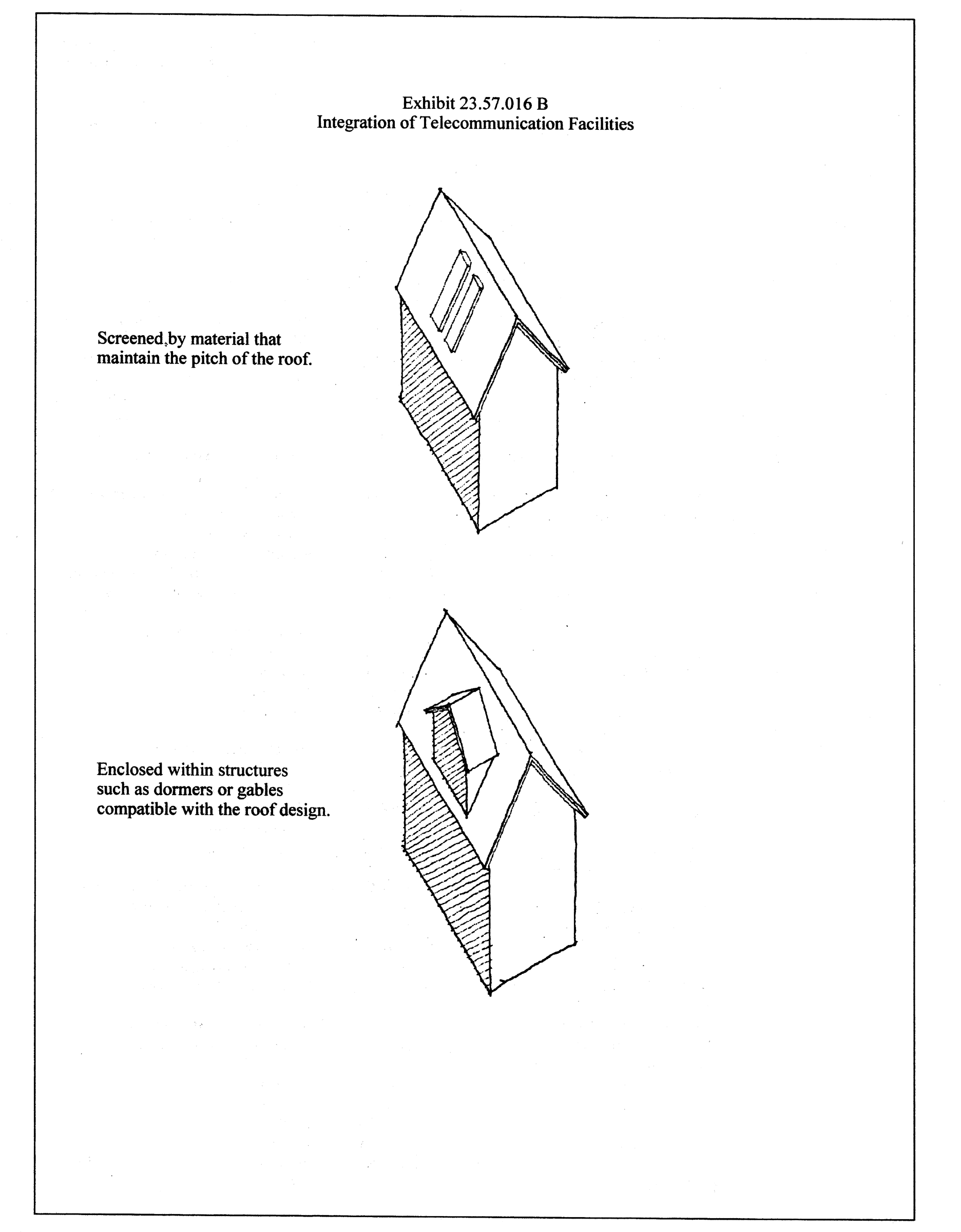
If mounted on a pitched roof, facilities shall be screened by materials that maintain the pitch of the roof, matching color and texture as closely as possible, or integrated with and enclosed within structures such as dormers or gables compatible with the roof design. See exhibit 23.57.016 B.
C.
If mounted on a flat roof, screening shall extend to the top of communication facilities except that whip antennas may extend above the screen as long as mounting structures are screened. Screening for satellite dishes is addressed in subsection E, below. Said screening shall be integrated with architectural design, material, shape and color. Facilities in a separate screened enclosure shall be located near the center of the roof, if technically feasible. Facilities not in a separate screened enclosure shall be mounted fiat against existing stair and elevator penthouses or mechanical equipment enclosures and shall be no taller than such structures.
D.
Facilities that are side-mounted on buildings shall be integrated with architectural elements such as window design or building decorative features, or screened by siding or other materials matching the building exterior, or otherwise be integrated with design, material, shape, and color so as to not be visibly distinctive. In general, antennas shall be as unobtrusive as practicable, including the use of non-reflective materials. Installations on the primary building facade shall be allowed only if roof, ground-mounted, or secondary facade mounted installation is technically unfeasible.
E.
Satellite dishes that are not located on freestanding transmission towers shall be screened to the top of the dish on at last three (3) sides and shall be enclosed in the direction of the signal to the elevation allowed by the azimuth of the antenna. If screening on the remaining side is not to the top of the antenna, the antenna and the inside and outside of the screen shall be painted the same color to minimize visibility and mask the contrasting shape of the dish with building or landscape elements.
F.
New antennas shall be consolidated with existing antennas and mechanical equipment unless the new antennas can be better obscured or integrated with the design of other parts of the building.
G.
Antennas mounted on a permitted accessory structure, such as a free standing sign, shall be integrated with design, material, shape and color and shall not be visibly distinctive from the structure.
H.
A screen for a ground-mounted dish antenna shall be a minimum six (6) feet tall and shall extend to the top of the dish. The screen may be in the form of a view-obscuring fence, wall or hedge that shall be maintained in good condition. Chain link, plastic or vinyl fencing/screening is prohibited.
I.
Antennas attached to a public facility, such as a water tank, shall be integrated with the design, material, shape and color of, and shall not be visibly distinctive from, the public facility. Antennas attached to City-owned poles shall follow the terms and conditions contained in Section 15.32.300.
J.
Freestanding transmission towers shall minimize external projections from the support structure to reduce visual impacts and to the extent feasible shall integrate antennas in a screening structure with the same dimensions as external dimensions of the support structure, or shall mount antennas with as little projection from the structure as feasible. External conduits, climbing structures, fittings, and other projections from the external face of the support structure shall be minimized to the extent feasible.
K.
The standards set forth in this Section 23.57.016 may be varied as follows:
1.
For new buildings these standards may be varied through the design review process provided for in Section 23.41.014.
2.
For existing buildings that have previously gone through the design review process these standards may be varied by the Director if the Director determines that the new minor communication facilities would be consistent with the Director's design review decision on the original building; otherwise, these standards may be varied through the administrative design review process provided for in Section 23.41.016.
3.
For existing buildings that have not previously gone through the design review process these standards may be varied through the administrative design review process provided for in Section 23.41.016.
(Ord. 120928 § 37, 2002.)