71 - NORTHGATE OVERLAY DISTRICT
Part 1 Northgate Overlay District Development Standards
The purpose of this Chapter 23.71 is to implement the Northgate Area Comprehensive Plan by regulating land use and development within the Northgate Overlay District in order to:
A.
Create an environment in the Northgate Area that is more amenable to pedestrians and supportive of commercial development; and
B.
To protect the residential character of residential neighborhoods; and
C.
Support the use of Northgate as a regional high-capacity transportation center.
(Ord. 116795, § 2, 1993.)
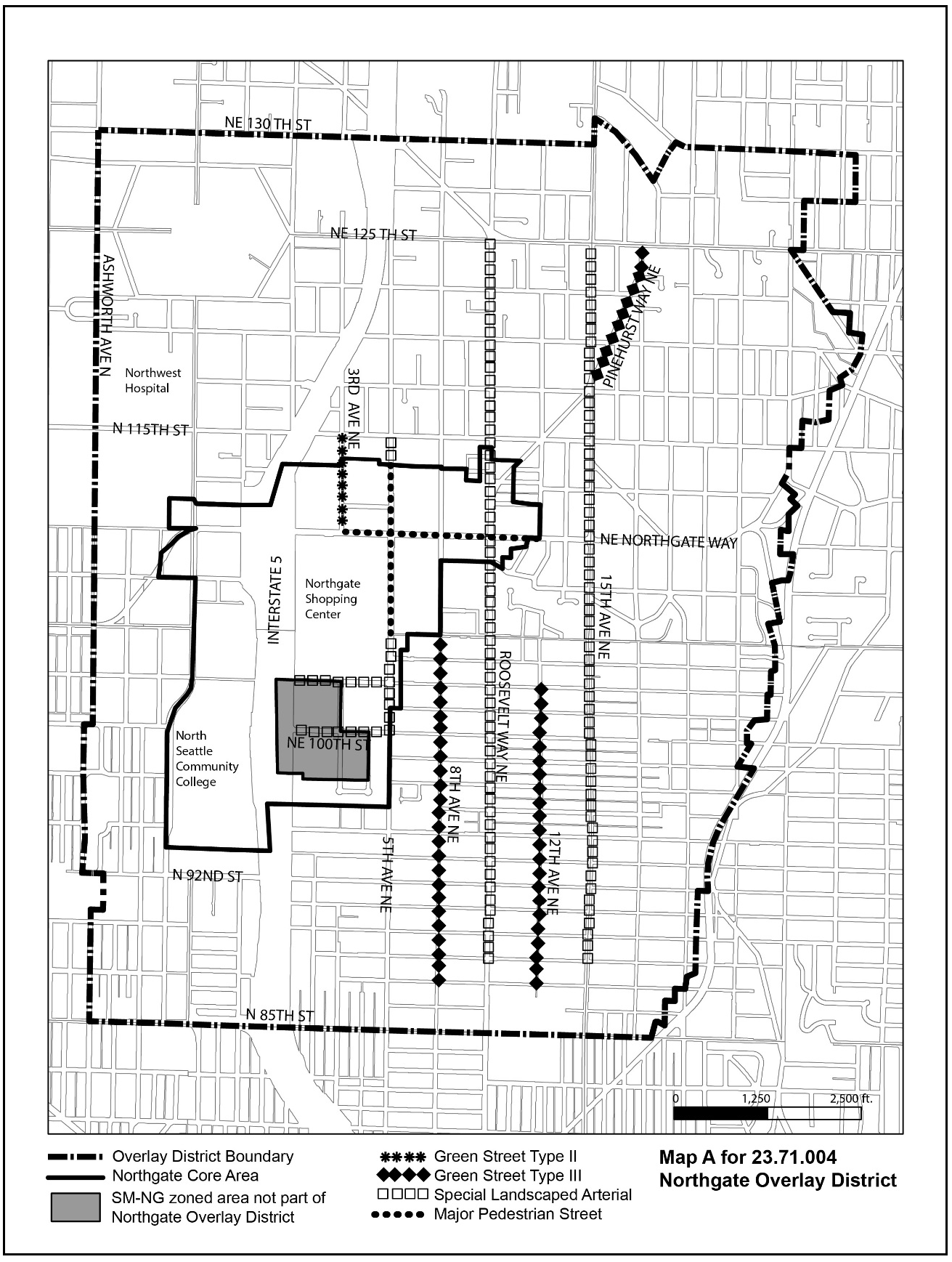
There is hereby established, pursuant to Chapter 23.59, the Northgate Overlay District, as shown on the City's Official Land Use Map, Chapter 23.32, and Map A for 23.71.004.
Map A for 23.71.004
Northgate Overlay District
(Ord. 125792, § 12, 2019; Ord. 121362, § 1, 2003; Ord. 120117, § 51, 2000; Ord. 118414, § 52, 1996 [cross-reference update]; Ord. 116795, § 2, 1993.)
All land located within the Northgate Overlay District is subject to regulations of the underlying zone unless specifically modified by the provisions of this Chapter 23.71. Where the boundaries of the Northgate Overlay District overlap with the boundaries of the Major Institution Overlay District, the zoning underlying a major institution shall be as modified by the Northgate Overlay District. In the event of irreconcilable differences between the provisions of the Northgate Overlay District and the underlying zone, the provisions of this Chapter 23.71 apply, except that where a conflict exists between the provisions of this Chapter 23.71 and Chapter 23.69, Major Institution Overlay District, the provisions of Chapter 23.69 take precedence.
For the purposes of this Chapter 23.71, "substantial development" means any new development, or expansion or addition to existing development, when the new development, expansion or addition exceeds 4,000 square feet in gross floor area, excluding accessory parking area.
(Ord. 116795, § 2, 1993.)
A.
Northeast Northgate Way (from Third Avenue Northeast to 11th Avenue Northeast) and Fifth Avenue Northeast (from Northeast 113th Street to Northeast 105th Street) are designated as Major Pedestrian Streets as shown on Map A for 23.71.004. Proposed use and development of property zoned commercial and abutting these streets shall meet the standards of this Section 23.71.008.
B.
Standards for required street-level uses
1.
A minimum of 60 percent of a commercially zoned lot's frontage on a major pedestrian street shall be occupied by one or more of the following uses, referred to in this Section 23.71.008 as "required street-level uses," provided that drive-in businesses and outdoor storage are prohibited:
a.
General sales and services;
b.
Major durables retail sales;
c.
Eating and drinking establishments;
d.
Entertainment uses;
e.
Lodging uses;
f.
Public libraries;
g.
Parks and open spaces.
If a portion of the major pedestrian street frontage is required for access to on-site parking due to limited lot dimension, the Director may permit less than 60 percent of the frontage to be occupied by such uses.
2.
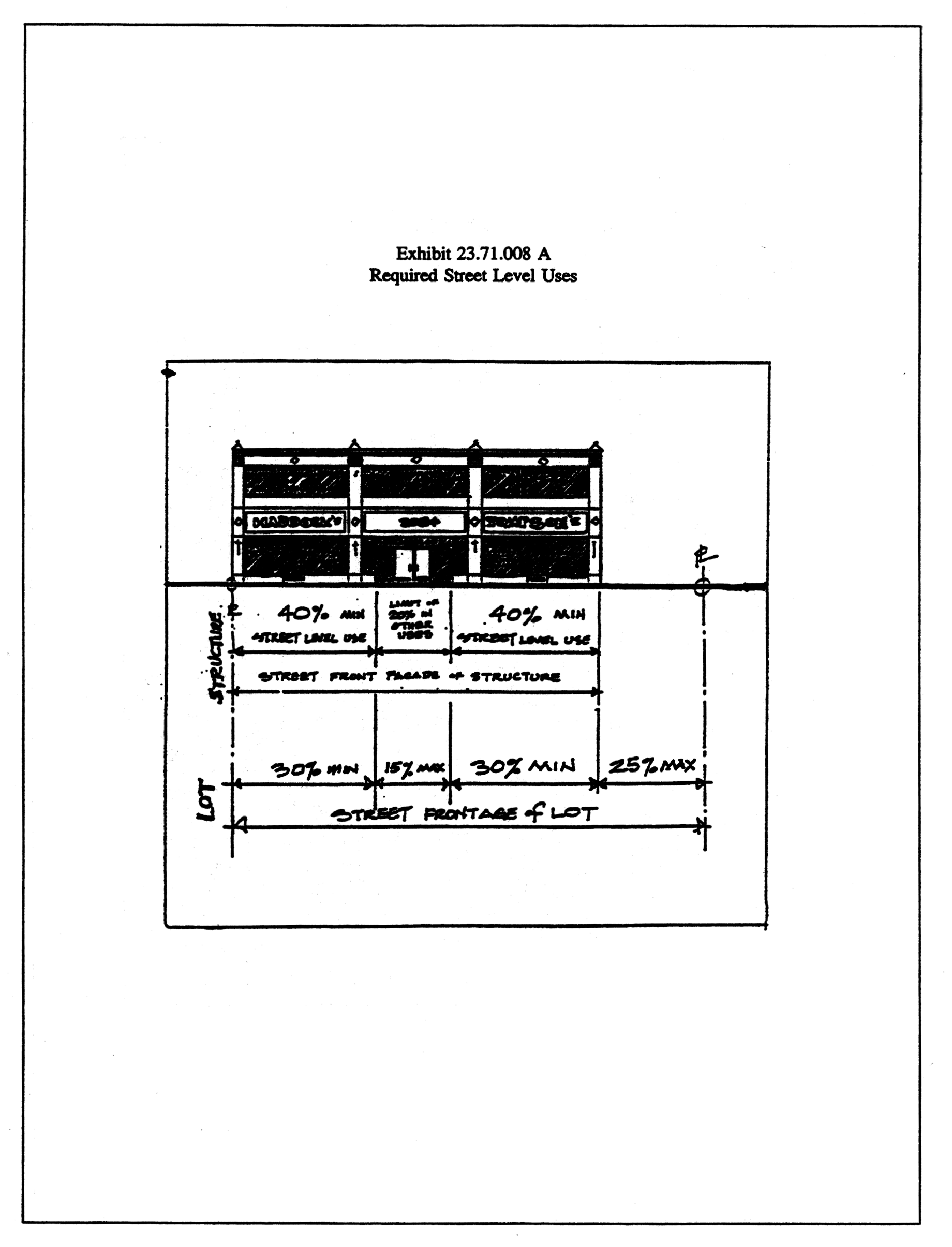
A minimum of 80 percent of each structure fronting on a major pedestrian street must be occupied at street level by required street-level uses or a building lobby permitting access to uses above or behind street-front uses. In no case may pedestrian access to uses above or behind required street-front uses exceed 20 percent of the structure's major pedestrian street front. The remaining 20 percent of the structure's street frontage may contain other permitted uses or pedestrian entrances (Exhibit 23.71.008 A).
3.
Street-level uses must occupy a minimum of the first 10 feet above sidewalk grade.
4.
All required street-level uses along major pedestrian streets may be set back no more than 10 feet from the street lot line, except as necessary to provide open space as defined in subsection 23.71.014.C or for bedrooms in a lodging structure, which may be set back a maximum of 15 feet. The owner shall design the area subject to this setback to include special pavers, as an extension of the sidewalk or with landscaping.
5.
The principal entrances to required street-level uses on major pedestrian streets shall have direct access to the sidewalk and be within 3 feet of the sidewalk grade elevation.
6.
General sales and service uses or major durables retail sales uses, in each case greater than thirty thousand (30,000) square feet, may locate a principal pedestrian entrance on a facade oriented to a parking area or the major pedestrian street. Where a principal pedestrian entrance is oriented to a parking area, an additional pedestrian entrance shall be located along the major pedestrian street. In lieu of the additional entrance, the owner may provide a 10 foot wide, landscaped pedestrian walkway from the major pedestrian street to the principal pedestrian entrance, provided that the walkway does not go through other businesses or parking areas.
C.
Parking location and screening. The following standards apply along major pedestrian streets:
1.
Parking, or access to parking, shall not exceed 40 percent of a lot's frontage on a major pedestrian street.
2.
Parking shall be located to the rear or side of a structure, within or under the structure, or within 800 feet of the lot to which it is accessory.
3.
Where parking within a structure occupies any portion of the major pedestrian street level of the structure, the parking shall be screened from public view from the major pedestrian street(s) by a street-level facade. The street-level facade shall be enhanced by architectural detailing, artwork, landscaping, or similar treatment that will add visual interest to the facade.
4.
The perimeter of each floor of parking that is 8 feet or more above sidewalk grade shall have an opaque screen at least 3½ feet high at its perimeter.
5.
Surface parking areas shall be set back a minimum of 15 feet from the major pedestrian street lot line. The setback area, excluding driveways, shall be provided as landscaped or usable open space, as defined in Section 23.71.014.
6.
Any nonconformity with respect to location, screening and landscaping of an existing parking area shall be eliminated at the time of a substantial development, if the area of the nonconformity is between the substantial development and the major pedestrian street. This requirement shall apply regardless of whether the substantial development increases lot coverage.
D.
Parking access and curb cuts
1.
When a lot abuts an alley which meets the standards of subsection 23.53.030.C, access to parking shall be from the alley.
2.
When a lot does not abut an improved alley, and the lot fronts on more than one street, at least one of which is not a major pedestrian street, access to parking shall be from a street which is not a major pedestrian street.
3.
If the lot does not abut an improved alley, and only abuts a major pedestrian street(s), access from the major pedestrian streets shall be limited to one two-way curb cut within any 300 foot segment of that lot. For purposes of this subsection 23.71.008.D.3, a segment of a lot shall be measured as a lot's continuous streetside lot line unbroken by streets, alleys, or property owned by another. A segment may front on two or more streets around corners.
E.
Sidewalks.
1.
The owner shall construct a sidewalk no less than 12 feet in width.
2.
The owner shall plant street trees adjacent to the major pedestrian street. The trees shall meet criteria prescribed by the Director of Transportation.
3.
Planting strips are prohibited along major pedestrian streets.
4.
The owner shall install street furniture and planting boxes adjacent to the major pedestrian street. The installation shall conform to the Right-of-Way Improvements Manual.
F.
Street facade standards
1.
Transparency requirements. Sixty percent of the width of the facade of a structure along the major pedestrian street shall be transparent. Clear or lightly tinted glass, with comparable visibility into the structure as clear glass, in windows, doors, and display windows, which must be a minimum of 4 feet deep, shall be considered transparent. Transparent areas shall allow unobstructed views into the structure or into display windows, which must be a minimum of 4 feet deep, from the outside.
2.
Blank facades
a.
Any portion of a facade that is not transparent shall be considered to be a blank facade.
b.
Blank facade segments shall not exceed 30 feet along the major pedestrian street front.
c.
Blank facade segments which are separated by transparent areas of at least 2 feet in width shall be considered separate facade segments for the purposes of this Section 23.71.008.
3.
Transparent and blank facade standards apply to the area of a facade between 2 feet and 8 feet above the sidewalk.
G.
Overhead weather protection
1.
Continuous overhead weather protection (i.e., canopies, awnings, marquees, and arcades) is required along at least 60 percent of the street frontage of a commercial structure on a major pedestrian street.
2.
The overhead weather protection must be provided over the sidewalk, or over a walking area within 10 feet immediately adjacent to the sidewalk. When provided adjacent to the sidewalk, the covered walking area must be at the same grade or within 18 inches of sidewalk grade and meet Washington state requirements for barrier-free access.
3.
The covered area shall have a minimum width of 6 feet, unless there is a conflict with street trees or utility poles, in which case the width may be adjusted to accommodate such features.
4.
The lower edge of the overhead weather protection shall be a minimum of 8 feet and a maximum of 12 feet above the sidewalk for projections extending a maximum of 6 feet. For projections extending more than 6 feet from the structure, the lower edge of the weather protection shall be a minimum of 10 feet and a maximum of 15 feet above the sidewalk.
(Ord. 122311, § 87, 2006 [cross-reference update]; Ord. 122205, § 12, 2006; Ord. 121362, § 2, 2003; Ord. 121244, § 1, 2003; Ord. 118414, § 53, 1996; Ord. 118409, § 210, 1996 [department name change]; Ord. 116795, § 2, 1993.)
A.
Green streets are identified on Map A for 23.71.004.
B.
Where an owner proposes substantial development adjacent to a street classified as a green street, the owner shall construct street and pedestrian improvements that meet standards promulgated by the Director and the Director of Transportation.
(Ord. 118409, § 211, 1996 [department name change]; Ord. 116795, § 2, 1993.)
A.
Special landscaped arterials are those arterials identified on Map A for 23.71.004.
B.
If an owner proposes substantial development on lots abutting special landscaped arterials, the owner shall provide the following:
1.
Street trees meeting standards established by the Director of the Seattle Department of Transportation.
2.
A 6 foot planting strip and 6 foot sidewalk if the lot is zoned NR, LR1, or LR2.
3.
A 6 foot planting strip and a 6 foot sidewalk, or, at the owner's option, a 12 foot sidewalk without a planting strip, if the lot is zoned NC2, NC3, RC, LR3, or MR.
4.
Pedestrian improvements, as determined by the Director of the Seattle Department of Transportation, such as, but not limited to special pavers, lighting, benches and planting boxes.
(Ord. 126509, § 87, 2022 [zone name change]; Ord. 123495, § 72, 2011; Ord. 121477, § 44, 2004 [department name change]; Ord. 118409, § 212, 1996 [department name change]; Ord. 116795, § 2, 1993.)
A.
Quantity of open space
1.
In all Commercial zones with a permitted height limit of 40 feet or less, a minimum of ten percent of lot area or, at the applicant's option, proposed gross floor area, shall be provided as landscaped or usable open space for all commercial and mixed use substantial development. A minimum of half of the required open space shall be landscaped open space and a minimum of one-third of the required open space shall be usable open space. The remainder shall be either landscaped or usable open space or may be provided in accordance with subsection 23.71.014.A.8.
2.
In all Commercial zones with a permitted height limit greater than 40 feet, a minimum of 15 percent of lot area or, at the applicant's option, proposed gross floor area, shall be provided as landscaped or usable open space for all commercial and mixed use substantial development. A minimum of one-third of the required open space shall be landscaped open space and a minimum of one-fifth of the required open space shall be usable open space. The remainder shall be either landscaped or usable open space or may be provided in accordance with subsection 23.71.014.A.8.
3.
Open space may be provided as interior or exterior open space according to the standards provided in subsections 23.71.014.B and 23.71.014.C. Interior open space may be used to satisfy up to 20 percent of the open space requirement.
4.
Reductions to required open space. Required open space may be reduced if any of the following open space alternatives are provided:
a.
Interior public meeting space or space accommodating a public library, either of which shall be free to the public and credited at two times their actual area;
b.
An on-site town square, urban plaza, active park, or passive park that meets the minimum size requirements prescribed in Table A for 23.71.014 and that is consistent with the standards for such features contained in subsection 23.71.014.C. Such space shall be credited towards the open space requirement at 1.5 times the actual lot area occupied by such space.
5.
Above-ground open space in the form of a publicly accessible terrace may satisfy up to 30 percent of total required open space. Due to the more limited public access to such areas, such above-ground open space shall be credited at 75 percent of actual area provided. Above-ground open space in combination with interior open space shall not exceed 50 percent of the total area required for open space.
6.
In no case shall required landscaped open space be reduced to less than the minimum percentages for landscaped open space required in subsections 23.71.014.A.1 and 23.71.014.A.2. Required landscaping of surface parking areas, which may include perimeter screening, may count towards the landscaped open space requirement up to the minimum percentages required in subsections 23.71.014.A.1 and 23.71.014.A.2.
7.
When an owner proposes substantial development on lots 40,000 square feet or less and adjacent to a major pedestrian street as designated in Section 23.71.008, the Director may reduce the total amount of required open space if the owner provides open space on the portion of the site abutting the major pedestrian street. The reduction does not apply to open space consisting of landscaping required for surface parking areas, screening, or to improvements provided within the street right-of-way.
8.
Northgate Open Space Fund
a.
In lieu of providing the remainder of open space, as defined in subsections 23.71.014.A.1 and 23.71.014.A.2, an owner may make a payment to the Northgate Area Open Space fund, if such a fund is established by the City Council.
b.
An in-lieu payment shall equal the assessed value of the land and improvements that would otherwise have been provided as open space.
c.
Funds received from properties within the Northgate Core sub-area, as shown on Map A for 23.71.004, shall be applied to open space acquisition or improvements in the Northgate Core sub-area. Funds received from properties outside of the Northgate Core sub-area shall be applied to open space acquisition or improvements within one-half mile of contributing sites.
B.
Open space development standards
1.
Landscaped open space
a.
Landscaped open space shall be provided outdoors in the ground or in permanently installed beds, planters, or in large containers that cannot be readily removed.
b.
Landscaped open space shall have a minimum horizontal dimension of 6 feet, except on lots that are 10,000 square feet or less in area, where a minimum horizontal dimension of 5 feet is allowed. Where screening and landscaping of a surface parking area is counted towards meeting the landscaped open space requirement it shall meet the minimum dimensions as required by the underlying zone.
2.
Usable open space - General
a.
Usable open space shall be open to the public. The minimum size of usable open space is prescribed in Table A for 23.71.014. The Director may modify the requirements of subsection 23.71.014.C, if the owner demonstrates that meeting the requirements is infeasible or the Director determines that the owner's proposal will better achieve the purpose of usable open space than the requirements prescribed herein.
b.
Usable open space shall be located within 3 feet of the elevation of abutting sidewalks, provide access of at least 10 feet in width, and provide barrier-free access according to the Washington State Rules and Regulations for Barrier-Free Design.
c.
Where proposed, skybridges shall provide a direct connection to the nearest usable open space at ground level. This connection shall be visible from the skybridge and shall be identified by signage at both entrances to the skybridge.
3.
Usable open space - Exterior
a.
Usable open space may be provided as on-site exterior open space consisting of an active or passive park, courtyard, public meeting space, terrace, town square, urban garden, urban plaza, landscaped interior block pedestrian connection, or urban trail.
b.
Exterior usable open space shall meet the minimum standards contained in subsection 23.71.014.C.
c.
Exterior usable open space shall be screened from streets and parking areas by landscaping, a fence or a wall, except along a major pedestrian street, in which case usable open space shall be accessible to or integrated into the adjoining sidewalk for at least 50 percent of its frontage.
4.
Usable open space - Interior
a.
Usable open space may be provided as on-site interior open space consisting of an atrium/greenhouse, galleria, or public meeting space.
b.
Interior usable open space shall provide direct pedestrian connections, with a clear path at least 10 feet wide, to exterior usable open space or public right-of-way. Such pedestrian connections shall not count toward interior usable open space requirements.
c.
Interior usable open space shall meet the applicable standards contained in subsection 23.71.014.C.
C.
Minimum standards for usable open space
1.
Active park. An active park shall be essentially level, accessible from a public right-of-way and shall include areas for active recreation such as, but not limited to, ball fields, courts, and children's play area(s). Public seating shall be provided.
2.
Atrium/greenhouse or galleria. An atrium/greenhouse or galleria shall provide a large, enclosed, weather-protected space, generally covered by transparent and/or translucent material and meeting the following minimum standards and guidelines:
a.
Location and access. The location of an atrium/greenhouse or galleria shall be highly visible from the street and easily accessible to pedestrians. Pedestrian access should be designed to improve overall pedestrian circulation on the block.
b.
Minimum standards
1)
The minimum height shall be 30 feet.
2)
A minimum of 15 percent of an atrium/greenhouse or galleria shall be landscaped.
3)
A minimum of 15 percent of an atrium/greenhouse or galleria shall be reserved for public seating at a rate of one lineal foot for every 30 square feet of floor area or one lineal foot of public seating area for every 30 square feet of floor area.
4)
A minimum of 35 percent of the perimeter of an atrium/greenhouse or galleria shall be occupied by retail sales and service uses and 60 percent of every retail frontage on the atrium/greenhouse or galleria shall be transparent.
5)
Perimeter walls of an atrium/greenhouse or galleria, excluding the wall of the structure, shall be no more than 15 percent blank. All nontransparent perimeter walls shall include measures to reduce the effect of the blank wall including, but not limited to, architectural detailing, landscaping, modulation, or art.
3.
Courtyard. A courtyard shall meet the following minimum standards and guidelines:
a.
Location and access. A courtyard shall be adjacent to or attached to a structure or public sidewalk and shall be highly visible from adjacent sidewalks and public areas and have direct access to the streets on which it fronts. A courtyard shall be easily accessible and inviting to pedestrians and provide enclosure through use of design elements such as pedestrian walkways, structures containing retail uses, low planters or benches, and seating.
b.
Fifty percent of the courtyard area, outside of areas of major pedestrian traffic, shall be level.
c.
Courtyards shall include unit paving; landscaping, which encourages privacy and quiet; and pedestrian-scaled lighting and seating. Public seating shall be provided at a rate of one lineal foot of seating for every 50 square feet of courtyard area.
4.
Passive park. Passive parks shall provide landscaped space for unstructured recreational activity such as walking or picnicking.
5.
Public meeting space. Public meeting spaces shall be enclosed rooms available for use by the public free of charge, designed for the purposes of accommodating meetings, gatherings, or performances with seating capacity for at least 50 people. Public meeting spaces shall be available to the public between the hours of 10 a.m. and 10 p.m. Monday through Friday and shall not count towards minimum parking requirements.
6.
Terrace. A terrace is intended to provide additional opportunity for open space in areas of concentrated development.
a.
Location and access
1)
A terrace is a wind-sheltered area above street-level uses in a structure.
2)
A terrace should be easily accessible from the street and access should be plainly identified.
3)
Direct access by stairs, ramps or mechanical assist shall be provided from a public right-of-way or public open space to the terrace.
4)
The path of access must have a minimum width of 10 feet.
b.
A minimum of 80 percent of the terrace shall receive solar exposure from 11 a.m. until 2 p.m. PDT between the spring and autumn equinox.
c.
Public seating shall be provided in an amount equal to one seat for each 30 square feet of terrace area or one lineal foot of public seating for each 30 square feet of terrace area.
d.
Terraces shall be landscaped in a manner which provides for the comfort and enjoyment of people in the space and creates a visual amenity for pedestrians and occupants of surrounding buildings.
e.
A terrace shall be open to the public from at least 7 a.m. until one hour after sunset seven days a week.
7.
Town square. A town square shall meet the criteria for an urban plaza and, in addition, shall meet the following:
a.
Location and access. A town square shall be located adjacent to a Major Pedestrian Street.
b.
A large, essentially level, unobstructed area should characterize the center of a town square and be available for public events.
8.
Urban garden. Urban gardens are intended to provide color and visual interest to pedestrians and motorists and are characterized by such amenities as specialized landscaping, paving materials, and public seating.
a.
Location and access. Urban gardens shall be located at or near sidewalk grade and adjacent to a public right-of-way or building lobby.
b.
One public seating space for each 20 square feet of garden area or one lineal foot of public seating for every 20 square feet of garden area shall be provided.
c.
Urban gardens shall be developed with unit paving and plant materials in a garden-like setting. Landscaping shall include a mix of seasonal and permanent plantings, including trees and shrubs. A water feature is encouraged.
d.
A minimum of 75 percent of the garden area shall receive solar exposure from 11 a.m. until 2 p.m. PDT, between the spring and autumn equinox.
e.
The garden shall be open to the public at least five days a week from 8 a.m. until 7 p.m.
9.
Urban plaza. An urban plaza shall serve as a link between a building and the pedestrian network and/or as a focal point between two or more buildings.
a.
Location and access
1)
An urban plaza shall be one contiguous space, with at least one edge abutting a street at a transit stop or anywhere along a Major Pedestrian Street.
2)
The area within 10 feet of the sidewalk, along a minimum of 50 percent of each street frontage, shall be within 3 feet elevation of the adjoining public sidewalk.
b.
There shall be no physical obstruction between an urban plaza and the sidewalk. The plaza should be distinguished from the public right-of-way by landscaping and/or a change in paving materials.
c.
The aggregate area of retail kiosks and carts in an urban plaza should not exceed 150 square feet or one percent of the total area of the plaza, whichever is greater.
d.
Urban plazas shall have retail sales and service uses on frontage equivalent to at least 50 percent of the perimeter of the plaza. The retail sales and service uses shall have direct access onto the plaza.
e.
Urban plazas shall be landscaped and paved in such a way as to provide continuous access to the public right-of-way. A minimum of 20 percent and a maximum of 30 percent of the plaza shall be landscaped.
f.
A minimum ratio of one tree per 700 square feet of plaza area is required. Trees should be arranged in such a manner as to define the perimeter of the space and to maximize solar exposure to the principal space.
g.
A minimum of 85 percent of the plaza shall be uncovered and open to the sky, excluding deciduous tree canopies.
h.
There shall be one lineal foot of public seating area or one public seat for every 35 square feet of plaza area. Up to 50 percent of the seating may be moveable.
i.
An urban plaza shall be open to the public during normal business hours, seven days a week.
10.
For surface parking areas exceeding 250 parking spaces, a 10-foot-wide landscaped pedestrian walkway separating each of the parking areas and connecting to the building shall be provided, or separation of parking areas exceeding 250 spaces shall be provided by principal-use or accessory-use structures on-site. Landscaped pedestrian walkways may be counted towards open space requirements as provided for in this Section 23.71.014.
(Ord. 125558, § 55, 2018; Ord. 124378, § 68, 2013 [cross-reference update and style update]; Ord. 121362, § 3, 2003; Ord. 116795, § 2, 1993.)
A.
When substantial development is proposed that is expected to generate 25 or more employee or student vehicle trips in any one p.m. hour, the owner of the site upon which the substantial development is proposed shall prepare and implement a Transportation Management Program (TMP) consistent with requirements for TMPs in Director's Rule 10-2012 or its successor.
1.
For purposes of measuring attainment of single-occupant vehicle (SOV) goals contained in the TMP, the proportion of SOV trips shall be calculated for the p.m. hour in which an applicant expects the largest number of vehicle trips to be made by employees and students at the site (the p.m. peak hour of the generator). The proportion of SOV trips shall be calculated by dividing the total number of employees and students using an SOV to make a trip during the expected peak hour by the total number of employee and student person trips during the expected peak hour.
2.
Compliance with this Section 23.71.018 does not supplant the responsibility of any employer to comply with Chapter 25.02.
B.
The owner of any site who proposes multifamily substantial development which is expected to generate 50 or more vehicle trips in any one p.m. hour shall prepare and implement a TMP. The TMP shall be consistent with requirements for TMPs in Director's Rule 10-2012 or its successor. For purposes of measuring attainment of the SOV goal, the proportion of SOV trips shall be calculated for the p.m. hour in which an applicant expects the largest number of vehicle trips to be made by residents of the site (the p.m. peak hour of the generator). The proportion of SOV trips shall be calculated by dividing the total number of residential trips made by SOV during the expected peak hour by the total number of residential person trips.
C.
Each owner subject to the requirements of this Section 23.71.018 shall prepare a TMP as described in rules promulgated by the Director, as part of the requirements for obtaining a master use permit.
D.
The TMP shall be approved by the Director if, after consulting with Seattle Department of Transportation, the Director determines that the TMP measures are likely to achieve the SOV goals.
E.
The owner of each property subject to this implementation guideline shall submit an annual progress report to the Director of Transportation, who will advise the Director of the Seattle Department of Construction and Inspections on compliance. The progress report shall contain:
1.
The number of full and part-time employees, students and/or residents at a site during the peak hour;
2.
A summary of the total p.m. peak hour vehicle trips generated by the site, including employees, students, and residents;
3.
A description of any programs, incentives, or activities or other measures targeted to reduce vehicle trips, in which employees, students, or residents at the site participate;
4.
The number of people participating in the TMP measures;
5.
The peak hour proportion of SOV trips of the employees, students, and/or residents.
F.
The Seattle Department of Transportation shall monitor compliance with the requirements of this Section 23.71.018. If monitoring shows that the owner has not implemented the TMP measures or has not made sufficient progress toward achieving the TMP goals, the Director of Transportation may recommend that the Director:
1.
Require modifications to the TMP program measures; and/or
2.
Pursue enforcement action pursuant to the Land Use Code.
G.
After approval of a TMP and issuance of a master use permit as prescribed in subsections 23.71.018.C and 23.71.018.D, if the owner applies for a master use permit for additional development, before approving the new master use permit, the Director, after consulting with the Director of Transportation, shall review the implementation of the TMP. If substantial progress has not been made in achieving the goal for the proportion of SOV trips, the Director may:
1.
Require the applicant to revise the TMP to include additional measures in order to achieve compliance with the TMP goal before the issuance of a permit; and/or
2.
Require measures in addition to those in the TMP that encourage alternative means of transportation for the proposed new development; and/or
3.
Deny the permit if the Director determines that the owner has failed to make a good-faith effort to implement the TMP; or
4.
Determine that a revised or new program is not needed, and that the permit can be issued without changes to the existing TMP.
H.
Compliance. To comply with this Section 23.71.018, the owner of a site subject to the requirement for a TMP, must demonstrate that he or she has an approved TMP, has submitted the required annual reports, and has succeeded in accomplishing one of the two following objectives:
1.
That the owner has implemented the measures contained in the TMP for the development project; and/or
2.
That the owner has met the goal for SOV trips specified in subsection A of this section. Failure to comply with the provisions of this Section 23.71.018 is a violation of the Land Use Code. The penalty for each violation is $250 per day.
I.
A fund shall be established in the City's General Fund to receive revenue from fines for violations of this Section 23.71.018. Revenue from fines shall be allocated to activities or incentives to reduce vehicle trips in the Northgate area. The Director of Transportation shall recommend to the Mayor and City Council how these funds should be allocated.
J.
The Seattle Department of Transportation and the Seattle Department of Construction and Inspections shall prepare a Director's Rule explaining how each department shall implement this Section 23.71.018.
(Ord. 124919, § 161, 2015 [department name change and style update]; Ord. 124378, § 69, 2013 [cross-reference and style update]; Ord. 122244, § 3, 2006; Ord. 121477, § 45, 2004 [department name change]; Ord. 121276, § 37, 2003 [department/department head name change]; Ord. 118409, § 213, 1996 [department/department head name change]; Ord. 117432, § 42, 1994; Ord. 116795, § 2, 1993.)
Development Agreements may be proposed for development within the Northgate Overlay District pursuant to chapter 36.70B RCW. In determining whether to approve a Development Agreement, the City Council shall consider the extent to which the proposed development or redevelopment:
A.
Contributes toward meeting the Northgate Urban Center housing targets;
B.
Coordinates approaches to transportation planning and traffic analysis with surrounding properties and the City, with the goal of reducing use of single-occupant vehicles and reducing or minimizing pedestrian and vehicular conflicts and other potential negative traffic impacts on neighborhoods;
C.
Proposes improvements to the street level environment and circulation for pedestrians, including coordination with area-wide pedestrian circulation and open space plans such as the 5th Avenue Streetscape Design Plan;
D.
Includes natural drainage strategies such as those described in the Thornton Creek Five-Year Action Agenda and "Refining Our Choices" for Northgate; and
E.
Incorporates sustainable design and green building practices in the proposed development.
(Ord. 121362, § 4, 2003 [replaced entire text]; Ord. 116795, § 2, 1993.)
A.
To promote compatibility between different types and intensities of development located within and along the boundary of the Northgate Overlay District, a transition shall be provided between zones where different intensities of development may occur.
B.
The requirements of this Section 23.71.030 apply to development on lots in the more intensive zones under the following conditions:
1.
Where a lot zoned Midrise (MR) or Highrise (HR) abuts or is across an alley from a lot zoned neighborhood residential, Lowrise 1 (LR1), or Lowrise 2 (LR2); and
2.
Where a lot zoned Neighborhood Commercial 2 or 3 (NC2, NC3) with a height limit of 40 feet or greater abuts or is across an alley from a lot zoned neighborhood residential, Lowrise 1 (LR1), or Lowrise 2 (LR2).
C.
Side setbacks abutting or across an alley
1.
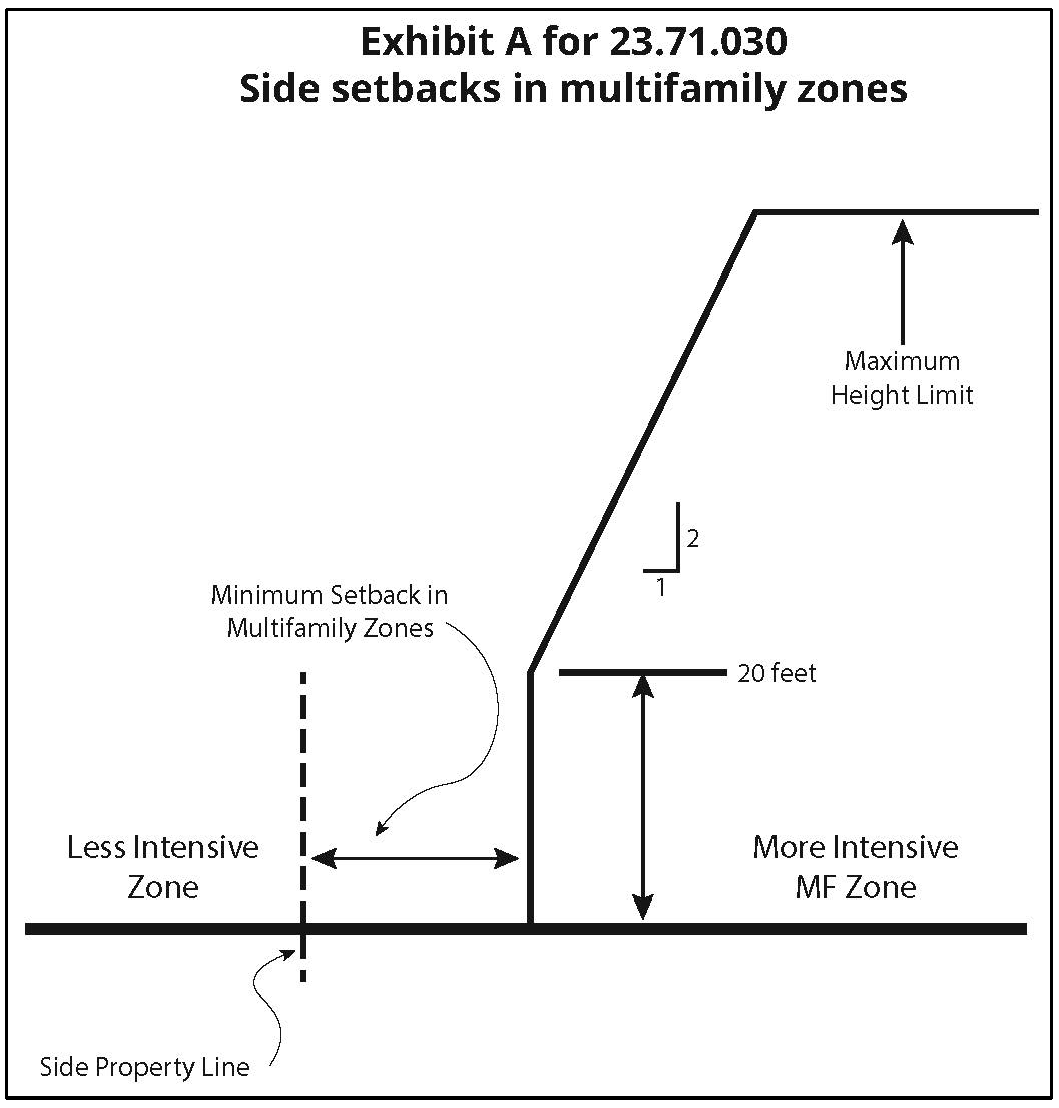
For structures in multifamily zones, an additional side setback of 1 foot for each 2 feet of a structure height above 20 feet is required (Exhibit A for 23.71.030).
Exhibit A for 23.71.030
Side setbacks in multifamily zones
2.
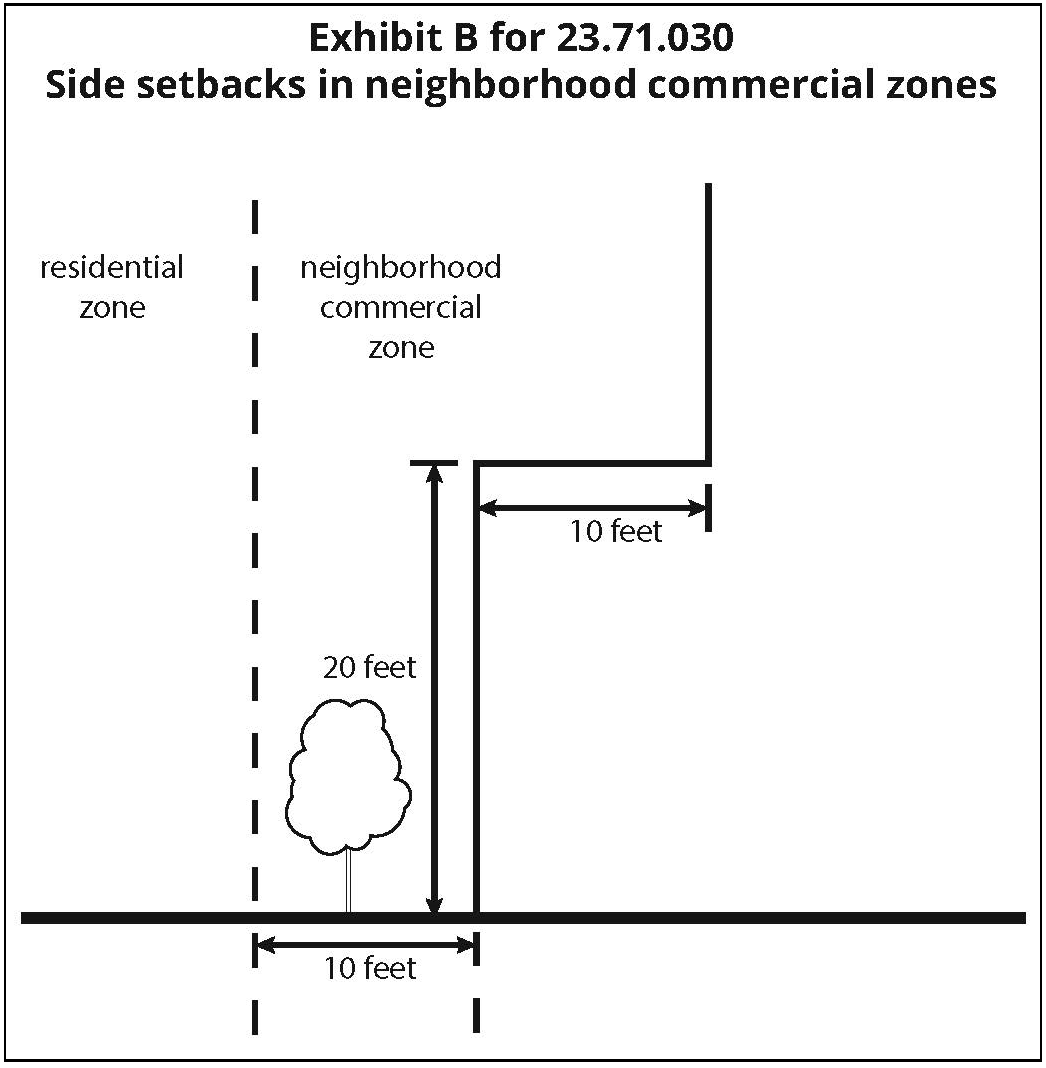
For structures in C or NC zones, a side setback of 10 feet is required for all portions of the structure 20 feet or less in height (and an additional side setback of 10 feet is required for all portions of the structure exceeding 20 feet (Exhibit B for 23.71.030).
Exhibit B for 23.71.030
Side setbacks in neighborhood commercial zones
3.
Side setbacks shall be landscaped within 5 feet of the abutting property line, unless the setback is used for parking, in which case the parking area shall be screened as otherwise required by this Title 23.
D.
Rear setbacks abutting or across an alley
1.
For structures in multifamily zones, a rear setback of 20 feet is required or the minimum required by the standards of the underlying zone, whichever is greater.
2.
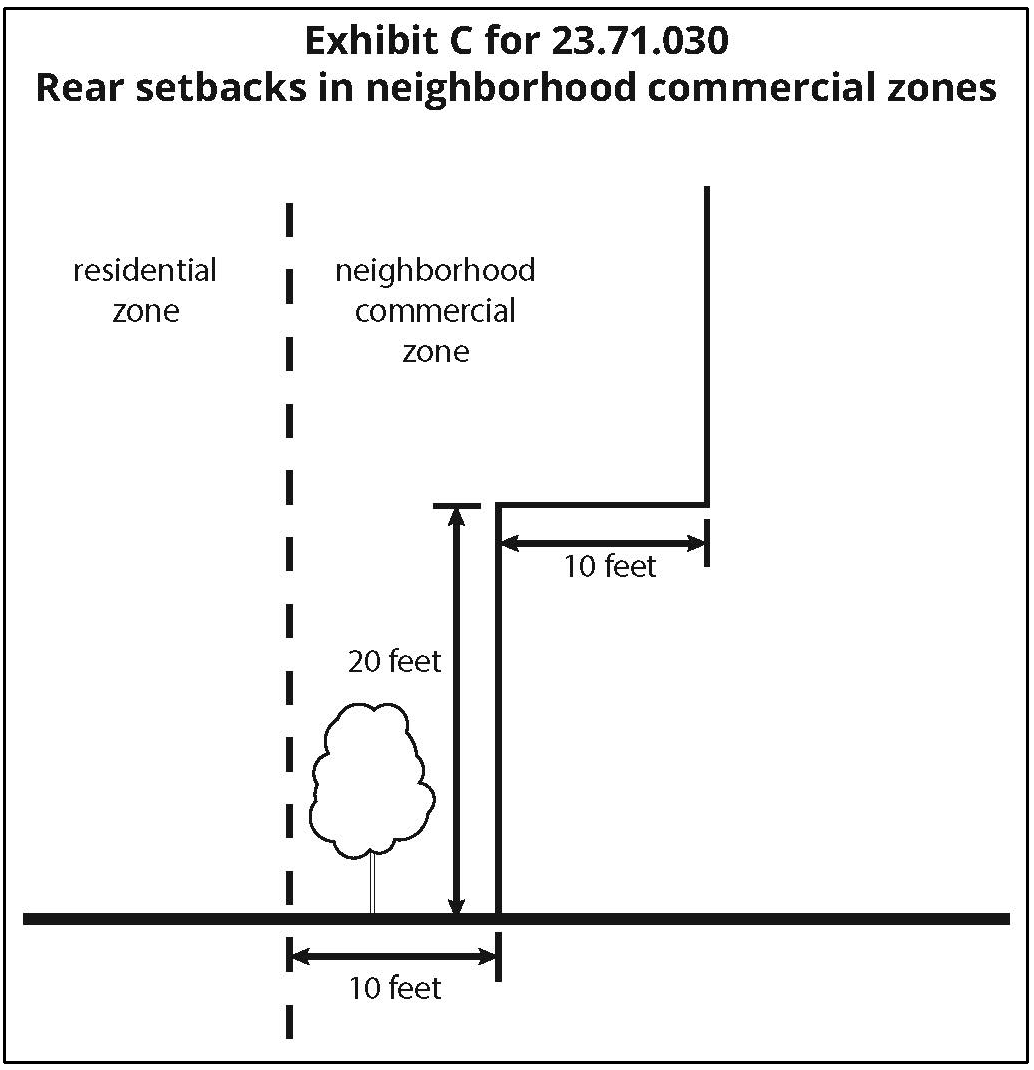
For structures in C or NC zones, a rear setback of 10 feet is required for all portions of the structure 20 feet or less in height and an additional rear setback of 10 feet is required for all portions of the structure exceeding 20 feet (Exhibit C for 23.71.030).
Exhibit C for 23.71.030
Rear setbacks in neighborhood commercial zones
3.
Rear setbacks shall be landscaped unless used for parking, in which case the parking area shall be screened and landscaped as otherwise required by this Title 23.
(Ord. 126509, § 88, 2022 [zone name change]; Ord. 125791, § 100, 2019; Ord. 123495, § 73, 2011; Ord. 116795, § 2, 1993.)
The maximum width and depth requirements of this Section 23.71.036 shall apply only to portions of a structure within 50 feet of a lot line abutting, or directly across a street right-of-way that is less than 80 feet in width, from a less intensive residential zone as provided in Table A for 23.71.036.
Table A for 23.71.036: Structure Width and Depth Standards for Transition Areas
(Ord. 126509, § 89, 2022 [zone name change]; Ord. 123495, § 74, 2011; Ord. 116795, § 2, 1993.)
"Mixed use development," for the purposes of this Chapter 23.71, means development in a commercial zone containing both residential and nonresidential uses and that meets the requirements of subsection 23.47A.008.B.
(Ord. 122311, § 89, 2006; Ord. 121828, § 12, 2005 [reenactment to incorporate Ord. 121362's and Ord. 121196's amendments]; Ord. 121362, § 9, 2003; Ord. 121196, § 27, 2003; Ord. 118414, § 54, 1996; Ord. 116795, § 2, 1993.)
A.
Commercial uses permitted in a mixed use structure in Residential/Commercial (RC) zones as provided in Section 23.46.012 are permitted outright in single-purpose commercial structures within the Northgate Overlay District.
B.
Single-purpose commercial structures shall not exceed a size limit of .75 FAR or 5,000 square feet, whichever is less.
C.
Single-purpose commercial structures in Residential/Commercial (RC) zones are subject to the development standards of subsections 23.71.008.B.4 and 23.71.008.F.
(Ord. 116795, § 2, 1993.)
A.
In C and NC zones with height limits less than 85 feet, residential uses, in aggregate, may exceed 20 percent of the street-level street-facing facade only as a special exception under the following conditions or criteria:
1.
Either:
a.
Due to location or parcel size, the proposed site is not suited for commercial development; or
b.
There is substantial excess supply of land available for commercial use near the lot, as evidenced by conditions such as lack of commercial activity in existing commercial structures for a sustained period, commercial structures in disrepair, or vacant or underused commercially zoned land; and
2.
The residential structure would not interrupt an established commercial street front. As used in this subsection 23.71.044.A.2, the phrase "established commercial street front" may include a street front intersected by streets or alleys, and some lots with no current commercial use.
B.
When permitted, structures with residential uses exceeding 20 percent of the street-level street-facing facade are subject to the following development standards:
1.
In all C and NC zones with a height limit of 40 feet or less, the development standards for residential structures in Lowrise 3 zones, except that no front setback is required.
2.
In all C and NC zones with a height limit of 55 feet up to 65 feet, the development standards for residential structures in Midrise zones, except that no front setback is required.
C.
In C and NC zones with a height limit of 85 feet or greater, residential uses may occupy, in aggregate, more than 20 percent of the street-level street-facing facade.
(Ord. 126685, § 52, 2022; Ord. 125272, § 56, 2017; Ord. 122311, § 90, 2006; Ord. 121362, § 10, 2003; Ord. 116795, § 2, 1993.)

71 - NORTHGATE OVERLAY DISTRICT
Part 1 Northgate Overlay District Development Standards
The purpose of this Chapter 23.71 is to implement the Northgate Area Comprehensive Plan by regulating land use and development within the Northgate Overlay District in order to:
A.
Create an environment in the Northgate Area that is more amenable to pedestrians and supportive of commercial development; and
B.
To protect the residential character of residential neighborhoods; and
C.
Support the use of Northgate as a regional high-capacity transportation center.
(Ord. 116795, § 2, 1993.)
There is hereby established, pursuant to Chapter 23.59, the Northgate Overlay District, as shown on the City's Official Land Use Map, Chapter 23.32, and Map A for 23.71.004.
Map A for 23.71.004
Northgate Overlay District
(Ord. 125792, § 12, 2019; Ord. 121362, § 1, 2003; Ord. 120117, § 51, 2000; Ord. 118414, § 52, 1996 [cross-reference update]; Ord. 116795, § 2, 1993.)
All land located within the Northgate Overlay District is subject to regulations of the underlying zone unless specifically modified by the provisions of this Chapter 23.71. Where the boundaries of the Northgate Overlay District overlap with the boundaries of the Major Institution Overlay District, the zoning underlying a major institution shall be as modified by the Northgate Overlay District. In the event of irreconcilable differences between the provisions of the Northgate Overlay District and the underlying zone, the provisions of this Chapter 23.71 apply, except that where a conflict exists between the provisions of this Chapter 23.71 and Chapter 23.69, Major Institution Overlay District, the provisions of Chapter 23.69 take precedence.
For the purposes of this Chapter 23.71, "substantial development" means any new development, or expansion or addition to existing development, when the new development, expansion or addition exceeds 4,000 square feet in gross floor area, excluding accessory parking area.
(Ord. 116795, § 2, 1993.)
A.
Northeast Northgate Way (from Third Avenue Northeast to 11th Avenue Northeast) and Fifth Avenue Northeast (from Northeast 113th Street to Northeast 105th Street) are designated as Major Pedestrian Streets as shown on Map A for 23.71.004. Proposed use and development of property zoned commercial and abutting these streets shall meet the standards of this Section 23.71.008.
B.
Standards for required street-level uses
1.
A minimum of 60 percent of a commercially zoned lot's frontage on a major pedestrian street shall be occupied by one or more of the following uses, referred to in this Section 23.71.008 as "required street-level uses," provided that drive-in businesses and outdoor storage are prohibited:
a.
General sales and services;
b.
Major durables retail sales;
c.
Eating and drinking establishments;
d.
Entertainment uses;
e.
Lodging uses;
f.
Public libraries;
g.
Parks and open spaces.
If a portion of the major pedestrian street frontage is required for access to on-site parking due to limited lot dimension, the Director may permit less than 60 percent of the frontage to be occupied by such uses.
2.
A minimum of 80 percent of each structure fronting on a major pedestrian street must be occupied at street level by required street-level uses or a building lobby permitting access to uses above or behind street-front uses. In no case may pedestrian access to uses above or behind required street-front uses exceed 20 percent of the structure's major pedestrian street front. The remaining 20 percent of the structure's street frontage may contain other permitted uses or pedestrian entrances (Exhibit 23.71.008 A).
3.
Street-level uses must occupy a minimum of the first 10 feet above sidewalk grade.
4.
All required street-level uses along major pedestrian streets may be set back no more than 10 feet from the street lot line, except as necessary to provide open space as defined in subsection 23.71.014.C or for bedrooms in a lodging structure, which may be set back a maximum of 15 feet. The owner shall design the area subject to this setback to include special pavers, as an extension of the sidewalk or with landscaping.
5.
The principal entrances to required street-level uses on major pedestrian streets shall have direct access to the sidewalk and be within 3 feet of the sidewalk grade elevation.
6.
General sales and service uses or major durables retail sales uses, in each case greater than thirty thousand (30,000) square feet, may locate a principal pedestrian entrance on a facade oriented to a parking area or the major pedestrian street. Where a principal pedestrian entrance is oriented to a parking area, an additional pedestrian entrance shall be located along the major pedestrian street. In lieu of the additional entrance, the owner may provide a 10 foot wide, landscaped pedestrian walkway from the major pedestrian street to the principal pedestrian entrance, provided that the walkway does not go through other businesses or parking areas.
C.
Parking location and screening. The following standards apply along major pedestrian streets:
1.
Parking, or access to parking, shall not exceed 40 percent of a lot's frontage on a major pedestrian street.
2.
Parking shall be located to the rear or side of a structure, within or under the structure, or within 800 feet of the lot to which it is accessory.
3.
Where parking within a structure occupies any portion of the major pedestrian street level of the structure, the parking shall be screened from public view from the major pedestrian street(s) by a street-level facade. The street-level facade shall be enhanced by architectural detailing, artwork, landscaping, or similar treatment that will add visual interest to the facade.
4.
The perimeter of each floor of parking that is 8 feet or more above sidewalk grade shall have an opaque screen at least 3½ feet high at its perimeter.
5.
Surface parking areas shall be set back a minimum of 15 feet from the major pedestrian street lot line. The setback area, excluding driveways, shall be provided as landscaped or usable open space, as defined in Section 23.71.014.
6.
Any nonconformity with respect to location, screening and landscaping of an existing parking area shall be eliminated at the time of a substantial development, if the area of the nonconformity is between the substantial development and the major pedestrian street. This requirement shall apply regardless of whether the substantial development increases lot coverage.
D.
Parking access and curb cuts
1.
When a lot abuts an alley which meets the standards of subsection 23.53.030.C, access to parking shall be from the alley.
2.
When a lot does not abut an improved alley, and the lot fronts on more than one street, at least one of which is not a major pedestrian street, access to parking shall be from a street which is not a major pedestrian street.
3.
If the lot does not abut an improved alley, and only abuts a major pedestrian street(s), access from the major pedestrian streets shall be limited to one two-way curb cut within any 300 foot segment of that lot. For purposes of this subsection 23.71.008.D.3, a segment of a lot shall be measured as a lot's continuous streetside lot line unbroken by streets, alleys, or property owned by another. A segment may front on two or more streets around corners.
E.
Sidewalks.
1.
The owner shall construct a sidewalk no less than 12 feet in width.
2.
The owner shall plant street trees adjacent to the major pedestrian street. The trees shall meet criteria prescribed by the Director of Transportation.
3.
Planting strips are prohibited along major pedestrian streets.
4.
The owner shall install street furniture and planting boxes adjacent to the major pedestrian street. The installation shall conform to the Right-of-Way Improvements Manual.
F.
Street facade standards
1.
Transparency requirements. Sixty percent of the width of the facade of a structure along the major pedestrian street shall be transparent. Clear or lightly tinted glass, with comparable visibility into the structure as clear glass, in windows, doors, and display windows, which must be a minimum of 4 feet deep, shall be considered transparent. Transparent areas shall allow unobstructed views into the structure or into display windows, which must be a minimum of 4 feet deep, from the outside.
2.
Blank facades
a.
Any portion of a facade that is not transparent shall be considered to be a blank facade.
b.
Blank facade segments shall not exceed 30 feet along the major pedestrian street front.
c.
Blank facade segments which are separated by transparent areas of at least 2 feet in width shall be considered separate facade segments for the purposes of this Section 23.71.008.
3.
Transparent and blank facade standards apply to the area of a facade between 2 feet and 8 feet above the sidewalk.
G.
Overhead weather protection
1.
Continuous overhead weather protection (i.e., canopies, awnings, marquees, and arcades) is required along at least 60 percent of the street frontage of a commercial structure on a major pedestrian street.
2.
The overhead weather protection must be provided over the sidewalk, or over a walking area within 10 feet immediately adjacent to the sidewalk. When provided adjacent to the sidewalk, the covered walking area must be at the same grade or within 18 inches of sidewalk grade and meet Washington state requirements for barrier-free access.
3.
The covered area shall have a minimum width of 6 feet, unless there is a conflict with street trees or utility poles, in which case the width may be adjusted to accommodate such features.
4.
The lower edge of the overhead weather protection shall be a minimum of 8 feet and a maximum of 12 feet above the sidewalk for projections extending a maximum of 6 feet. For projections extending more than 6 feet from the structure, the lower edge of the weather protection shall be a minimum of 10 feet and a maximum of 15 feet above the sidewalk.
(Ord. 122311, § 87, 2006 [cross-reference update]; Ord. 122205, § 12, 2006; Ord. 121362, § 2, 2003; Ord. 121244, § 1, 2003; Ord. 118414, § 53, 1996; Ord. 118409, § 210, 1996 [department name change]; Ord. 116795, § 2, 1993.)
A.
Green streets are identified on Map A for 23.71.004.
B.
Where an owner proposes substantial development adjacent to a street classified as a green street, the owner shall construct street and pedestrian improvements that meet standards promulgated by the Director and the Director of Transportation.
(Ord. 118409, § 211, 1996 [department name change]; Ord. 116795, § 2, 1993.)
A.
Special landscaped arterials are those arterials identified on Map A for 23.71.004.
B.
If an owner proposes substantial development on lots abutting special landscaped arterials, the owner shall provide the following:
1.
Street trees meeting standards established by the Director of the Seattle Department of Transportation.
2.
A 6 foot planting strip and 6 foot sidewalk if the lot is zoned NR, LR1, or LR2.
3.
A 6 foot planting strip and a 6 foot sidewalk, or, at the owner's option, a 12 foot sidewalk without a planting strip, if the lot is zoned NC2, NC3, RC, LR3, or MR.
4.
Pedestrian improvements, as determined by the Director of the Seattle Department of Transportation, such as, but not limited to special pavers, lighting, benches and planting boxes.
(Ord. 126509, § 87, 2022 [zone name change]; Ord. 123495, § 72, 2011; Ord. 121477, § 44, 2004 [department name change]; Ord. 118409, § 212, 1996 [department name change]; Ord. 116795, § 2, 1993.)
A.
Quantity of open space
1.
In all Commercial zones with a permitted height limit of 40 feet or less, a minimum of ten percent of lot area or, at the applicant's option, proposed gross floor area, shall be provided as landscaped or usable open space for all commercial and mixed use substantial development. A minimum of half of the required open space shall be landscaped open space and a minimum of one-third of the required open space shall be usable open space. The remainder shall be either landscaped or usable open space or may be provided in accordance with subsection 23.71.014.A.8.
2.
In all Commercial zones with a permitted height limit greater than 40 feet, a minimum of 15 percent of lot area or, at the applicant's option, proposed gross floor area, shall be provided as landscaped or usable open space for all commercial and mixed use substantial development. A minimum of one-third of the required open space shall be landscaped open space and a minimum of one-fifth of the required open space shall be usable open space. The remainder shall be either landscaped or usable open space or may be provided in accordance with subsection 23.71.014.A.8.
3.
Open space may be provided as interior or exterior open space according to the standards provided in subsections 23.71.014.B and 23.71.014.C. Interior open space may be used to satisfy up to 20 percent of the open space requirement.
4.
Reductions to required open space. Required open space may be reduced if any of the following open space alternatives are provided:
a.
Interior public meeting space or space accommodating a public library, either of which shall be free to the public and credited at two times their actual area;
b.
An on-site town square, urban plaza, active park, or passive park that meets the minimum size requirements prescribed in Table A for 23.71.014 and that is consistent with the standards for such features contained in subsection 23.71.014.C. Such space shall be credited towards the open space requirement at 1.5 times the actual lot area occupied by such space.
5.
Above-ground open space in the form of a publicly accessible terrace may satisfy up to 30 percent of total required open space. Due to the more limited public access to such areas, such above-ground open space shall be credited at 75 percent of actual area provided. Above-ground open space in combination with interior open space shall not exceed 50 percent of the total area required for open space.
6.
In no case shall required landscaped open space be reduced to less than the minimum percentages for landscaped open space required in subsections 23.71.014.A.1 and 23.71.014.A.2. Required landscaping of surface parking areas, which may include perimeter screening, may count towards the landscaped open space requirement up to the minimum percentages required in subsections 23.71.014.A.1 and 23.71.014.A.2.
7.
When an owner proposes substantial development on lots 40,000 square feet or less and adjacent to a major pedestrian street as designated in Section 23.71.008, the Director may reduce the total amount of required open space if the owner provides open space on the portion of the site abutting the major pedestrian street. The reduction does not apply to open space consisting of landscaping required for surface parking areas, screening, or to improvements provided within the street right-of-way.
8.
Northgate Open Space Fund
a.
In lieu of providing the remainder of open space, as defined in subsections 23.71.014.A.1 and 23.71.014.A.2, an owner may make a payment to the Northgate Area Open Space fund, if such a fund is established by the City Council.
b.
An in-lieu payment shall equal the assessed value of the land and improvements that would otherwise have been provided as open space.
c.
Funds received from properties within the Northgate Core sub-area, as shown on Map A for 23.71.004, shall be applied to open space acquisition or improvements in the Northgate Core sub-area. Funds received from properties outside of the Northgate Core sub-area shall be applied to open space acquisition or improvements within one-half mile of contributing sites.
B.
Open space development standards
1.
Landscaped open space
a.
Landscaped open space shall be provided outdoors in the ground or in permanently installed beds, planters, or in large containers that cannot be readily removed.
b.
Landscaped open space shall have a minimum horizontal dimension of 6 feet, except on lots that are 10,000 square feet or less in area, where a minimum horizontal dimension of 5 feet is allowed. Where screening and landscaping of a surface parking area is counted towards meeting the landscaped open space requirement it shall meet the minimum dimensions as required by the underlying zone.
2.
Usable open space - General
a.
Usable open space shall be open to the public. The minimum size of usable open space is prescribed in Table A for 23.71.014. The Director may modify the requirements of subsection 23.71.014.C, if the owner demonstrates that meeting the requirements is infeasible or the Director determines that the owner's proposal will better achieve the purpose of usable open space than the requirements prescribed herein.
b.
Usable open space shall be located within 3 feet of the elevation of abutting sidewalks, provide access of at least 10 feet in width, and provide barrier-free access according to the Washington State Rules and Regulations for Barrier-Free Design.
c.
Where proposed, skybridges shall provide a direct connection to the nearest usable open space at ground level. This connection shall be visible from the skybridge and shall be identified by signage at both entrances to the skybridge.
3.
Usable open space - Exterior
a.
Usable open space may be provided as on-site exterior open space consisting of an active or passive park, courtyard, public meeting space, terrace, town square, urban garden, urban plaza, landscaped interior block pedestrian connection, or urban trail.
b.
Exterior usable open space shall meet the minimum standards contained in subsection 23.71.014.C.
c.
Exterior usable open space shall be screened from streets and parking areas by landscaping, a fence or a wall, except along a major pedestrian street, in which case usable open space shall be accessible to or integrated into the adjoining sidewalk for at least 50 percent of its frontage.
4.
Usable open space - Interior
a.
Usable open space may be provided as on-site interior open space consisting of an atrium/greenhouse, galleria, or public meeting space.
b.
Interior usable open space shall provide direct pedestrian connections, with a clear path at least 10 feet wide, to exterior usable open space or public right-of-way. Such pedestrian connections shall not count toward interior usable open space requirements.
c.
Interior usable open space shall meet the applicable standards contained in subsection 23.71.014.C.
C.
Minimum standards for usable open space
1.
Active park. An active park shall be essentially level, accessible from a public right-of-way and shall include areas for active recreation such as, but not limited to, ball fields, courts, and children's play area(s). Public seating shall be provided.
2.
Atrium/greenhouse or galleria. An atrium/greenhouse or galleria shall provide a large, enclosed, weather-protected space, generally covered by transparent and/or translucent material and meeting the following minimum standards and guidelines:
a.
Location and access. The location of an atrium/greenhouse or galleria shall be highly visible from the street and easily accessible to pedestrians. Pedestrian access should be designed to improve overall pedestrian circulation on the block.
b.
Minimum standards
1)
The minimum height shall be 30 feet.
2)
A minimum of 15 percent of an atrium/greenhouse or galleria shall be landscaped.
3)
A minimum of 15 percent of an atrium/greenhouse or galleria shall be reserved for public seating at a rate of one lineal foot for every 30 square feet of floor area or one lineal foot of public seating area for every 30 square feet of floor area.
4)
A minimum of 35 percent of the perimeter of an atrium/greenhouse or galleria shall be occupied by retail sales and service uses and 60 percent of every retail frontage on the atrium/greenhouse or galleria shall be transparent.
5)
Perimeter walls of an atrium/greenhouse or galleria, excluding the wall of the structure, shall be no more than 15 percent blank. All nontransparent perimeter walls shall include measures to reduce the effect of the blank wall including, but not limited to, architectural detailing, landscaping, modulation, or art.
3.
Courtyard. A courtyard shall meet the following minimum standards and guidelines:
a.
Location and access. A courtyard shall be adjacent to or attached to a structure or public sidewalk and shall be highly visible from adjacent sidewalks and public areas and have direct access to the streets on which it fronts. A courtyard shall be easily accessible and inviting to pedestrians and provide enclosure through use of design elements such as pedestrian walkways, structures containing retail uses, low planters or benches, and seating.
b.
Fifty percent of the courtyard area, outside of areas of major pedestrian traffic, shall be level.
c.
Courtyards shall include unit paving; landscaping, which encourages privacy and quiet; and pedestrian-scaled lighting and seating. Public seating shall be provided at a rate of one lineal foot of seating for every 50 square feet of courtyard area.
4.
Passive park. Passive parks shall provide landscaped space for unstructured recreational activity such as walking or picnicking.
5.
Public meeting space. Public meeting spaces shall be enclosed rooms available for use by the public free of charge, designed for the purposes of accommodating meetings, gatherings, or performances with seating capacity for at least 50 people. Public meeting spaces shall be available to the public between the hours of 10 a.m. and 10 p.m. Monday through Friday and shall not count towards minimum parking requirements.
6.
Terrace. A terrace is intended to provide additional opportunity for open space in areas of concentrated development.
a.
Location and access
1)
A terrace is a wind-sheltered area above street-level uses in a structure.
2)
A terrace should be easily accessible from the street and access should be plainly identified.
3)
Direct access by stairs, ramps or mechanical assist shall be provided from a public right-of-way or public open space to the terrace.
4)
The path of access must have a minimum width of 10 feet.
b.
A minimum of 80 percent of the terrace shall receive solar exposure from 11 a.m. until 2 p.m. PDT between the spring and autumn equinox.
c.
Public seating shall be provided in an amount equal to one seat for each 30 square feet of terrace area or one lineal foot of public seating for each 30 square feet of terrace area.
d.
Terraces shall be landscaped in a manner which provides for the comfort and enjoyment of people in the space and creates a visual amenity for pedestrians and occupants of surrounding buildings.
e.
A terrace shall be open to the public from at least 7 a.m. until one hour after sunset seven days a week.
7.
Town square. A town square shall meet the criteria for an urban plaza and, in addition, shall meet the following:
a.
Location and access. A town square shall be located adjacent to a Major Pedestrian Street.
b.
A large, essentially level, unobstructed area should characterize the center of a town square and be available for public events.
8.
Urban garden. Urban gardens are intended to provide color and visual interest to pedestrians and motorists and are characterized by such amenities as specialized landscaping, paving materials, and public seating.
a.
Location and access. Urban gardens shall be located at or near sidewalk grade and adjacent to a public right-of-way or building lobby.
b.
One public seating space for each 20 square feet of garden area or one lineal foot of public seating for every 20 square feet of garden area shall be provided.
c.
Urban gardens shall be developed with unit paving and plant materials in a garden-like setting. Landscaping shall include a mix of seasonal and permanent plantings, including trees and shrubs. A water feature is encouraged.
d.
A minimum of 75 percent of the garden area shall receive solar exposure from 11 a.m. until 2 p.m. PDT, between the spring and autumn equinox.
e.
The garden shall be open to the public at least five days a week from 8 a.m. until 7 p.m.
9.
Urban plaza. An urban plaza shall serve as a link between a building and the pedestrian network and/or as a focal point between two or more buildings.
a.
Location and access
1)
An urban plaza shall be one contiguous space, with at least one edge abutting a street at a transit stop or anywhere along a Major Pedestrian Street.
2)
The area within 10 feet of the sidewalk, along a minimum of 50 percent of each street frontage, shall be within 3 feet elevation of the adjoining public sidewalk.
b.
There shall be no physical obstruction between an urban plaza and the sidewalk. The plaza should be distinguished from the public right-of-way by landscaping and/or a change in paving materials.
c.
The aggregate area of retail kiosks and carts in an urban plaza should not exceed 150 square feet or one percent of the total area of the plaza, whichever is greater.
d.
Urban plazas shall have retail sales and service uses on frontage equivalent to at least 50 percent of the perimeter of the plaza. The retail sales and service uses shall have direct access onto the plaza.
e.
Urban plazas shall be landscaped and paved in such a way as to provide continuous access to the public right-of-way. A minimum of 20 percent and a maximum of 30 percent of the plaza shall be landscaped.
f.
A minimum ratio of one tree per 700 square feet of plaza area is required. Trees should be arranged in such a manner as to define the perimeter of the space and to maximize solar exposure to the principal space.
g.
A minimum of 85 percent of the plaza shall be uncovered and open to the sky, excluding deciduous tree canopies.
h.
There shall be one lineal foot of public seating area or one public seat for every 35 square feet of plaza area. Up to 50 percent of the seating may be moveable.
i.
An urban plaza shall be open to the public during normal business hours, seven days a week.
10.
For surface parking areas exceeding 250 parking spaces, a 10-foot-wide landscaped pedestrian walkway separating each of the parking areas and connecting to the building shall be provided, or separation of parking areas exceeding 250 spaces shall be provided by principal-use or accessory-use structures on-site. Landscaped pedestrian walkways may be counted towards open space requirements as provided for in this Section 23.71.014.
(Ord. 125558, § 55, 2018; Ord. 124378, § 68, 2013 [cross-reference update and style update]; Ord. 121362, § 3, 2003; Ord. 116795, § 2, 1993.)
A.
When substantial development is proposed that is expected to generate 25 or more employee or student vehicle trips in any one p.m. hour, the owner of the site upon which the substantial development is proposed shall prepare and implement a Transportation Management Program (TMP) consistent with requirements for TMPs in Director's Rule 10-2012 or its successor.
1.
For purposes of measuring attainment of single-occupant vehicle (SOV) goals contained in the TMP, the proportion of SOV trips shall be calculated for the p.m. hour in which an applicant expects the largest number of vehicle trips to be made by employees and students at the site (the p.m. peak hour of the generator). The proportion of SOV trips shall be calculated by dividing the total number of employees and students using an SOV to make a trip during the expected peak hour by the total number of employee and student person trips during the expected peak hour.
2.
Compliance with this Section 23.71.018 does not supplant the responsibility of any employer to comply with Chapter 25.02.
B.
The owner of any site who proposes multifamily substantial development which is expected to generate 50 or more vehicle trips in any one p.m. hour shall prepare and implement a TMP. The TMP shall be consistent with requirements for TMPs in Director's Rule 10-2012 or its successor. For purposes of measuring attainment of the SOV goal, the proportion of SOV trips shall be calculated for the p.m. hour in which an applicant expects the largest number of vehicle trips to be made by residents of the site (the p.m. peak hour of the generator). The proportion of SOV trips shall be calculated by dividing the total number of residential trips made by SOV during the expected peak hour by the total number of residential person trips.
C.
Each owner subject to the requirements of this Section 23.71.018 shall prepare a TMP as described in rules promulgated by the Director, as part of the requirements for obtaining a master use permit.
D.
The TMP shall be approved by the Director if, after consulting with Seattle Department of Transportation, the Director determines that the TMP measures are likely to achieve the SOV goals.
E.
The owner of each property subject to this implementation guideline shall submit an annual progress report to the Director of Transportation, who will advise the Director of the Seattle Department of Construction and Inspections on compliance. The progress report shall contain:
1.
The number of full and part-time employees, students and/or residents at a site during the peak hour;
2.
A summary of the total p.m. peak hour vehicle trips generated by the site, including employees, students, and residents;
3.
A description of any programs, incentives, or activities or other measures targeted to reduce vehicle trips, in which employees, students, or residents at the site participate;
4.
The number of people participating in the TMP measures;
5.
The peak hour proportion of SOV trips of the employees, students, and/or residents.
F.
The Seattle Department of Transportation shall monitor compliance with the requirements of this Section 23.71.018. If monitoring shows that the owner has not implemented the TMP measures or has not made sufficient progress toward achieving the TMP goals, the Director of Transportation may recommend that the Director:
1.
Require modifications to the TMP program measures; and/or
2.
Pursue enforcement action pursuant to the Land Use Code.
G.
After approval of a TMP and issuance of a master use permit as prescribed in subsections 23.71.018.C and 23.71.018.D, if the owner applies for a master use permit for additional development, before approving the new master use permit, the Director, after consulting with the Director of Transportation, shall review the implementation of the TMP. If substantial progress has not been made in achieving the goal for the proportion of SOV trips, the Director may:
1.
Require the applicant to revise the TMP to include additional measures in order to achieve compliance with the TMP goal before the issuance of a permit; and/or
2.
Require measures in addition to those in the TMP that encourage alternative means of transportation for the proposed new development; and/or
3.
Deny the permit if the Director determines that the owner has failed to make a good-faith effort to implement the TMP; or
4.
Determine that a revised or new program is not needed, and that the permit can be issued without changes to the existing TMP.
H.
Compliance. To comply with this Section 23.71.018, the owner of a site subject to the requirement for a TMP, must demonstrate that he or she has an approved TMP, has submitted the required annual reports, and has succeeded in accomplishing one of the two following objectives:
1.
That the owner has implemented the measures contained in the TMP for the development project; and/or
2.
That the owner has met the goal for SOV trips specified in subsection A of this section. Failure to comply with the provisions of this Section 23.71.018 is a violation of the Land Use Code. The penalty for each violation is $250 per day.
I.
A fund shall be established in the City's General Fund to receive revenue from fines for violations of this Section 23.71.018. Revenue from fines shall be allocated to activities or incentives to reduce vehicle trips in the Northgate area. The Director of Transportation shall recommend to the Mayor and City Council how these funds should be allocated.
J.
The Seattle Department of Transportation and the Seattle Department of Construction and Inspections shall prepare a Director's Rule explaining how each department shall implement this Section 23.71.018.
(Ord. 124919, § 161, 2015 [department name change and style update]; Ord. 124378, § 69, 2013 [cross-reference and style update]; Ord. 122244, § 3, 2006; Ord. 121477, § 45, 2004 [department name change]; Ord. 121276, § 37, 2003 [department/department head name change]; Ord. 118409, § 213, 1996 [department/department head name change]; Ord. 117432, § 42, 1994; Ord. 116795, § 2, 1993.)
Development Agreements may be proposed for development within the Northgate Overlay District pursuant to chapter 36.70B RCW. In determining whether to approve a Development Agreement, the City Council shall consider the extent to which the proposed development or redevelopment:
A.
Contributes toward meeting the Northgate Urban Center housing targets;
B.
Coordinates approaches to transportation planning and traffic analysis with surrounding properties and the City, with the goal of reducing use of single-occupant vehicles and reducing or minimizing pedestrian and vehicular conflicts and other potential negative traffic impacts on neighborhoods;
C.
Proposes improvements to the street level environment and circulation for pedestrians, including coordination with area-wide pedestrian circulation and open space plans such as the 5th Avenue Streetscape Design Plan;
D.
Includes natural drainage strategies such as those described in the Thornton Creek Five-Year Action Agenda and "Refining Our Choices" for Northgate; and
E.
Incorporates sustainable design and green building practices in the proposed development.
(Ord. 121362, § 4, 2003 [replaced entire text]; Ord. 116795, § 2, 1993.)
A.
To promote compatibility between different types and intensities of development located within and along the boundary of the Northgate Overlay District, a transition shall be provided between zones where different intensities of development may occur.
B.
The requirements of this Section 23.71.030 apply to development on lots in the more intensive zones under the following conditions:
1.
Where a lot zoned Midrise (MR) or Highrise (HR) abuts or is across an alley from a lot zoned neighborhood residential, Lowrise 1 (LR1), or Lowrise 2 (LR2); and
2.
Where a lot zoned Neighborhood Commercial 2 or 3 (NC2, NC3) with a height limit of 40 feet or greater abuts or is across an alley from a lot zoned neighborhood residential, Lowrise 1 (LR1), or Lowrise 2 (LR2).
C.
Side setbacks abutting or across an alley
1.
For structures in multifamily zones, an additional side setback of 1 foot for each 2 feet of a structure height above 20 feet is required (Exhibit A for 23.71.030).
Exhibit A for 23.71.030
Side setbacks in multifamily zones
2.
For structures in C or NC zones, a side setback of 10 feet is required for all portions of the structure 20 feet or less in height (and an additional side setback of 10 feet is required for all portions of the structure exceeding 20 feet (Exhibit B for 23.71.030).
Exhibit B for 23.71.030
Side setbacks in neighborhood commercial zones
3.
Side setbacks shall be landscaped within 5 feet of the abutting property line, unless the setback is used for parking, in which case the parking area shall be screened as otherwise required by this Title 23.
D.
Rear setbacks abutting or across an alley
1.
For structures in multifamily zones, a rear setback of 20 feet is required or the minimum required by the standards of the underlying zone, whichever is greater.
2.
For structures in C or NC zones, a rear setback of 10 feet is required for all portions of the structure 20 feet or less in height and an additional rear setback of 10 feet is required for all portions of the structure exceeding 20 feet (Exhibit C for 23.71.030).
Exhibit C for 23.71.030
Rear setbacks in neighborhood commercial zones
3.
Rear setbacks shall be landscaped unless used for parking, in which case the parking area shall be screened and landscaped as otherwise required by this Title 23.
(Ord. 126509, § 88, 2022 [zone name change]; Ord. 125791, § 100, 2019; Ord. 123495, § 73, 2011; Ord. 116795, § 2, 1993.)
The maximum width and depth requirements of this Section 23.71.036 shall apply only to portions of a structure within 50 feet of a lot line abutting, or directly across a street right-of-way that is less than 80 feet in width, from a less intensive residential zone as provided in Table A for 23.71.036.
Table A for 23.71.036: Structure Width and Depth Standards for Transition Areas
(Ord. 126509, § 89, 2022 [zone name change]; Ord. 123495, § 74, 2011; Ord. 116795, § 2, 1993.)
"Mixed use development," for the purposes of this Chapter 23.71, means development in a commercial zone containing both residential and nonresidential uses and that meets the requirements of subsection 23.47A.008.B.
(Ord. 122311, § 89, 2006; Ord. 121828, § 12, 2005 [reenactment to incorporate Ord. 121362's and Ord. 121196's amendments]; Ord. 121362, § 9, 2003; Ord. 121196, § 27, 2003; Ord. 118414, § 54, 1996; Ord. 116795, § 2, 1993.)
A.
Commercial uses permitted in a mixed use structure in Residential/Commercial (RC) zones as provided in Section 23.46.012 are permitted outright in single-purpose commercial structures within the Northgate Overlay District.
B.
Single-purpose commercial structures shall not exceed a size limit of .75 FAR or 5,000 square feet, whichever is less.
C.
Single-purpose commercial structures in Residential/Commercial (RC) zones are subject to the development standards of subsections 23.71.008.B.4 and 23.71.008.F.
(Ord. 116795, § 2, 1993.)
A.
In C and NC zones with height limits less than 85 feet, residential uses, in aggregate, may exceed 20 percent of the street-level street-facing facade only as a special exception under the following conditions or criteria:
1.
Either:
a.
Due to location or parcel size, the proposed site is not suited for commercial development; or
b.
There is substantial excess supply of land available for commercial use near the lot, as evidenced by conditions such as lack of commercial activity in existing commercial structures for a sustained period, commercial structures in disrepair, or vacant or underused commercially zoned land; and
2.
The residential structure would not interrupt an established commercial street front. As used in this subsection 23.71.044.A.2, the phrase "established commercial street front" may include a street front intersected by streets or alleys, and some lots with no current commercial use.
B.
When permitted, structures with residential uses exceeding 20 percent of the street-level street-facing facade are subject to the following development standards:
1.
In all C and NC zones with a height limit of 40 feet or less, the development standards for residential structures in Lowrise 3 zones, except that no front setback is required.
2.
In all C and NC zones with a height limit of 55 feet up to 65 feet, the development standards for residential structures in Midrise zones, except that no front setback is required.
C.
In C and NC zones with a height limit of 85 feet or greater, residential uses may occupy, in aggregate, more than 20 percent of the street-level street-facing facade.
(Ord. 126685, § 52, 2022; Ord. 125272, § 56, 2017; Ord. 122311, § 90, 2006; Ord. 121362, § 10, 2003; Ord. 116795, § 2, 1993.)
