
Seattle City Zoning Code
CHAPTER 23
46 - RESIDENTIAL—COMMERCIAL
23.46.002 - Scope of provisions
A.
This Chapter 23.46 details those authorized commercial uses which are or may be permitted in Residential-Commercial (RC) zones.
B.
All RC zones are assigned a residential zone classification on the Official Land Use Map. Developments that do not include commercial uses permitted according to this Chapter 23.46 are regulated according to the standards for the applicable residential zone. Structures containing floor area in commercial use permitted according to this Chapter 23.46 are subject to the development standards of this Chapter 23.46 and the designated residential zone, except that parking quantity is required as provided in Chapter 23.54 and as permitted by Section 23.45.504 and Section 23.45.506.
C.
Methods for measurements are provided in Chapter 23.86. Standards for parking quantity access and design are provided in Chapter 23.54. Sign standards are provided in Chapter 23.55.
D.
In addition to the provisions of this Chapter 23.46, certain residential-commercial areas may be regulated by Overlay Districts, Chapter 23.59.
(Ord. 125603, § 25, 2018; Ord. 125558, § 11, 2018; Ord. 124843, § 28, 2015; Ord. 123495, § 46, 2011; Ord. 118414 § 29, 1996; Ord. 116795, § 7, 1993: Ord. 112777 § 24(part), 1986.)
Part 1 Use Provisions
23.46.004 - Uses
A.
All uses, except commercial uses, live-work units, flexible-use parking, and park and ride facilities, which are permitted outright or by conditional use in the applicable residential zone shall be regulated by the residential zone provisions, including provisions relating to accessory uses.
B.
The following uses are permitted outright:
1.
Sales and services, general;
2.
Medical services;
3.
Restaurants;
4.
Business support services;
5.
Offices;
6.
Food processing and craft work;
7.
Retail sales, major durables;
8.
Live-work units;
9.
Flexible-use parking; and
10.
Park and ride facilities in garages, if located in LR3/RC zones.
C.
Permitted commercial uses shall be allowed as either a principal use or as an accessory use.
D.
Permitted commercial uses are allowed only in structures containing at least one dwelling unit or live-work unit, according to the development standards of Section 23.46.012.
E.
Drive-in businesses shall be prohibited, either as principal or accessory uses.
F.
Outdoor sales, outdoor display of rental equipment, and outdoor storage shall be prohibited, except for accessory recycling collection stations, and the accessory outdoor sales of fruits, vegetables and plants.
(Ord. 125558, § 12, 2018; Ord. 123046, § 27, 2009; Ord. 122311, § 42, 2006; Ord. 121828 § 1, 2005; Ord. 121196 § 2, 2003; Ord. 121145 § 2, 2003; Ord. 112777 § 24(part), 1986.)
23.46.006 - Conditional uses.
A.
Conditional use provisions of the applicable residential zone shall apply to all noncommercial conditional uses.
B.
All conditional uses not regulated by subsection A shall meet the following criteria:
1.
The use shall be determined not to be materially detrimental to the public welfare or injurious to property in the zone or vicinity in which the property is located.
2.
In authorizing a conditional use, adverse impacts may be mitigated by imposing requirements or conditions deemed necessary for the protection of other properties in the zone or vicinity, and the public interest. The Director shall deny the conditional use if it is determined that adverse impacts cannot be satisfactorily mitigated.
C.
Parking at or below grade accessory to nonresidential uses or live-work units in adjacent commercial zones may be permitted as a conditional use.
1.
The Director may authorize such parking if:
a.
The proposed parking is necessary to meet parking requirements, or the proposed parking will be used as a shared parking facility;
b.
The proposed parking is necessary to avoid increased parking congestion in the adjacent commercial area;
c.
The proposed parking is necessary to avoid creation or worsening of excessive spillover parking in adjacent residential areas;
d.
Other parking options such as shared parking have been considered and found to be unavailable in the adjacent commercial zone; and
e.
The proposed parking does not encourage substantial traffic to pass through adjacent residential areas.
2.
If the Director authorizes a surface parking area, the following standards shall be met:
a.
A minimum of fifteen (15) percent of the surface parking area shall be landscaped. Specific landscaped areas required in this subsection shall count toward the fifteen (15) percent.
b.
A landscaped setback of at least ten (10) feet shall be provided along the front property line. A landscaped setback of at least five (5) feet in depth shall be provided along all other street property lines.
c.
When abutting a property in a residential zone (including RC zones), six (6) foot high screening and a five (5) foot deep landscaped area inside the screening shall be provided.
d.
When across the street from a residential zone (including RC zones), three (3) foot high screening shall be provided between the parking area and the landscaped setback along all street property lines.
e.
Whenever possible, access to parking shall be from the commercial area.
(Ord. 121196 § 3, 2003; Ord. 112777 § 24(part), 1986.)
Part 2 Development Standards for
Commercial Uses
23.46.012 - Location of commercial uses
A.
Commercial uses are permitted only on or below the ground floor of a structure that contains at least one dwelling unit or live-work unit, except as provided in the Northgate Overlay District, Chapter 23.71, and except that if there is an existing established commercial use in a structure that does not contain a dwelling unit or live-work unit, the existing established commercial use may be converted to another permitted commercial use without providing a dwelling unit or live-work unit in the structure and without obtaining an administrative conditional use.
B.
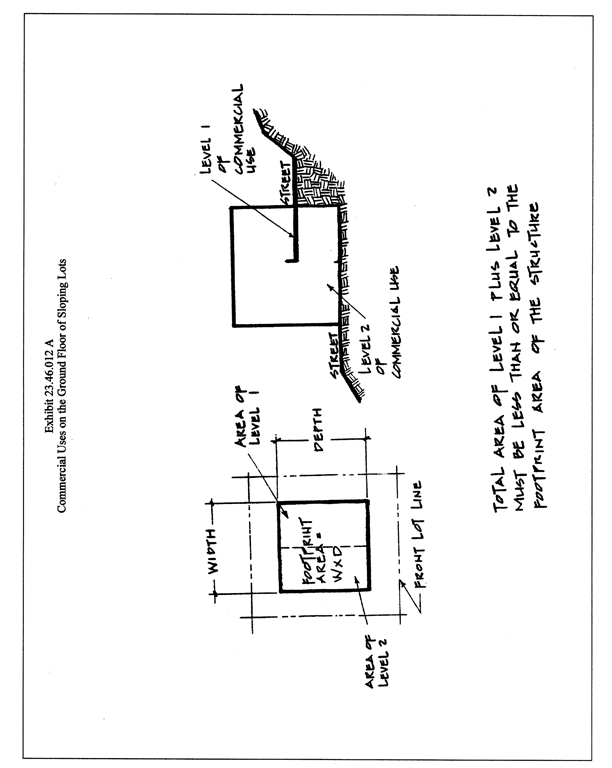
On sloping lots the commercial use may be located at more than one (1) level within the structure where the total commercial area does not exceed the area of the structure's footprint (Exhibit 23.46.012 A)
(Ord. 123046, § 28, 2009; Ord. 121196 § 4, 2003; Ord. 116795, § 8, 1993; Ord. 112777 § 24(part), 1986.)
23.46.014 - Maximum size of commercial uses.
A.
The maximum size limit for individual business establishments shall be four thousand (4,000) square feet, except that in MR/RC and HR/RC zones, multi-purpose convenience stores shall be permitted up to a maximum size of ten thousand (10,000) square feet.
B.
Maximum size shall be calculated by taking the gross floor area of a structure(s) or portion of a structure(s) occupied by a single business establishment.
C.
Any area used for permitted outdoor sales shall be limited to one thousand (1,000) square feet, and shall be included in determining the maximum size of a business establishment.
D.
Maximum Size of Combined Uses Within a Business Establishment. Business establishments which include more than one (1) type of use shall be permitted, provided each use is permitted, and:
1.
The size of each use shall not exceed the size limit for the individual use; and
2.
The total size of the business establishment does not exceed the maximum size allowed for the type of use with the largest size limit.
E.
Split Zoned Lots.
1.
The total size of a business establishment occupying portions of a lot in more than one (1) zone shall not exceed the maximum size allowed in the zone with the larger size limit.
2.
The total size of that portion of a business establishment in each zone shall not exceed the maximum size allowed for that business establishment in that zone.
F.
Accessory exterior recycling collection stations maintained in good condition shall be permitted in surface parking areas up to a maximum size of five hundred (500) square feet or five (5) percent of the parking area, whichever is less.
(Ord. 112777 § 24(part), 1986.)
23.46.016 - Noise standards.
A.
All fabricating uses, repairing, and refuse compacting activities shall be conducted wholly within an enclosed structure.
B.
Major Noise Generators.
1.
Exterior heat exchangers and other similar devices shall be considered major noise generators.
2.
When a major noise generator is proposed, a report from an acoustical consultant shall be required to describe the measures to be taken by the applicant in order to meet noise standards for the area. Such measures may include, for example, the provision of buffers, reduction in hours of operation, relocation of mechanical equipment, increased setbacks, and use of specified construction techniques or building materials.
Measures to be used shall be specified on the plans. After a permit has been issued, any measures which were required by the permit to limit noise shall be maintained.
(Ord. 112777 § 24(part), 1986.)
23.46.018 - Odor standards.
A.
The venting of odors, fumes, vapors, smoke, cinders, dust and gas shall be at least ten (10) feet above finished sidewalk grade and directed away as much as possible from residential uses within fifty (50) feet of the vent.
B.
Major Odor Sources. Uses which employ the following odor-emitting processes or activities shall be considered major odor sources except when the entire activity is provided on a retail or on-site customer-service basis:
1.
Cooking of grains;
2.
Smoking of food or food products;
3.
Fish or fish meal processing;
4.
Coffee or nut roasting;
5.
Deep fat frying;
6.
Dry cleaning; and
7.
Other similar processes or activities.
C.
When an application is made for a use which is determined to be a major odor source, the Director, in consultation with the Puget Sound Clean Air Agency (PSCAA), shall determine the appropriate measures to be taken by the applicant in order to significantly reduce potential odor emissions and airborne pollutants. The measures to be taken shall be indicated on plans submitted to the Director, and may be required as conditions for the issuance of any permit. After a permit has been issued, any measures which were required by the permit shall be maintained.
(Ord. 121477 § 10, 2004; Ord. 112777 § 24(part), 1986.)
23.46.020 - Light and glare standards.
A.
Exterior lighting shall be shielded and directed away from adjacent uses.
B.
Interior lighting in parking garages shall be shielded, to minimize nighttime glare affecting nearby uses.
C.
Exterior lighting on poles shall be permitted up to a maximum height of thirty (30) feet from finished grade. In MR/RC and HR/RC zones, exterior lighting on poles shall be permitted up to a height of forty (40) feet from finished grade, provided that ratio of watts to area is at least twenty (20) percent below the maximum exterior lighting level permitted by the Energy Code.
(Ord. 112777 § 24(part), 1986.)
23.46.022 - Parking requirements
A.
Parking Quantity. Each permitted commercial use shall provide a minimum number of off-street parking spaces according to the requirements of Section 23.54.015.
B.
Location of Parking. Required parking for commercial uses may be located:
1.
On the same lot, according to the locational requirements of the designated residential zone; or
2.
Within 800 feet of the lot on which the commercial use is located, when either:
a.
The parking is located in a commercial zone; or
b.
The parking is part of the joint use of existing parking in an RC zone.
3.
If required parking is provided on a lot other than the lot of the use to which it is accessory, the provisions of Section 23.54.025 shall apply.
(Ord. 125558, § 13, 2018; Ord. 112777 § 24(part), 1986.)
23.46.024 - Transportation concurrency level-of-service standards.
Proposed uses in residential-commercial zones shall meet the transportation concurrency level-of-service standards prescribed in Chapter 23.52.
(Ord. 117383, § 5, 1994.)

