
Seattle City Zoning Code
CHAPTER 23
72 - SAND POINT OVERLAY DISTRICT
23.72.002 - Purpose and intent
The purpose of this Chapter 23.72 is to implement the Sand Point amendments to the Comprehensive Plan by regulating land use and development within the Sand Point Overlay District in order to integrate the property into the city of Seattle as a multi-purpose regional center that provides:
A.
Expanded opportunity for recreation, education, arts, cultural, and community activities;
B.
Increased public access to the shoreline and enhanced open space and natural areas;
C.
Opportunities for low-income housing and community and social services with a special priority for addressing the needs of homeless families; and
D.
Expanded opportunity for low-impact economic development uses which could provide employment and services for residents of the property and for the broader community.
(Ord. 126855, § 61, 2023; Ord. 118624 § 3(part), 1997.)
23.72.004 - Sand Point Overlay District established
A.
There is hereby established pursuant to Chapter 23.59 the Sand Point Overlay District, including three subareas: A, B, and C. Subarea A includes one area zoned Neighborhood Residential 2 (NR2), Subarea B includes one area zoned NR2, and Subarea C includes three areas zoned LR3, as shown on the City's Official Land Use Map, Chapter 23.32, and Map A for 23.72.004. The Sand Point Overlay District includes the Naval Air Station Puget Sound Sand Point National Register Historic District, shown on Map B for 23.72.004.
B.
Additional regulations, including Certificate of Approval reviews, as applicable to the Sand Point Overlay District are found in Chapter 25.30. In any case where the provisions of the overlay district conflict with the provisions of the Sand Point Naval Air Station Landmark District, the Landmark district provisions shall apply.
Map A for 23.72.004—Sand Point Overlay District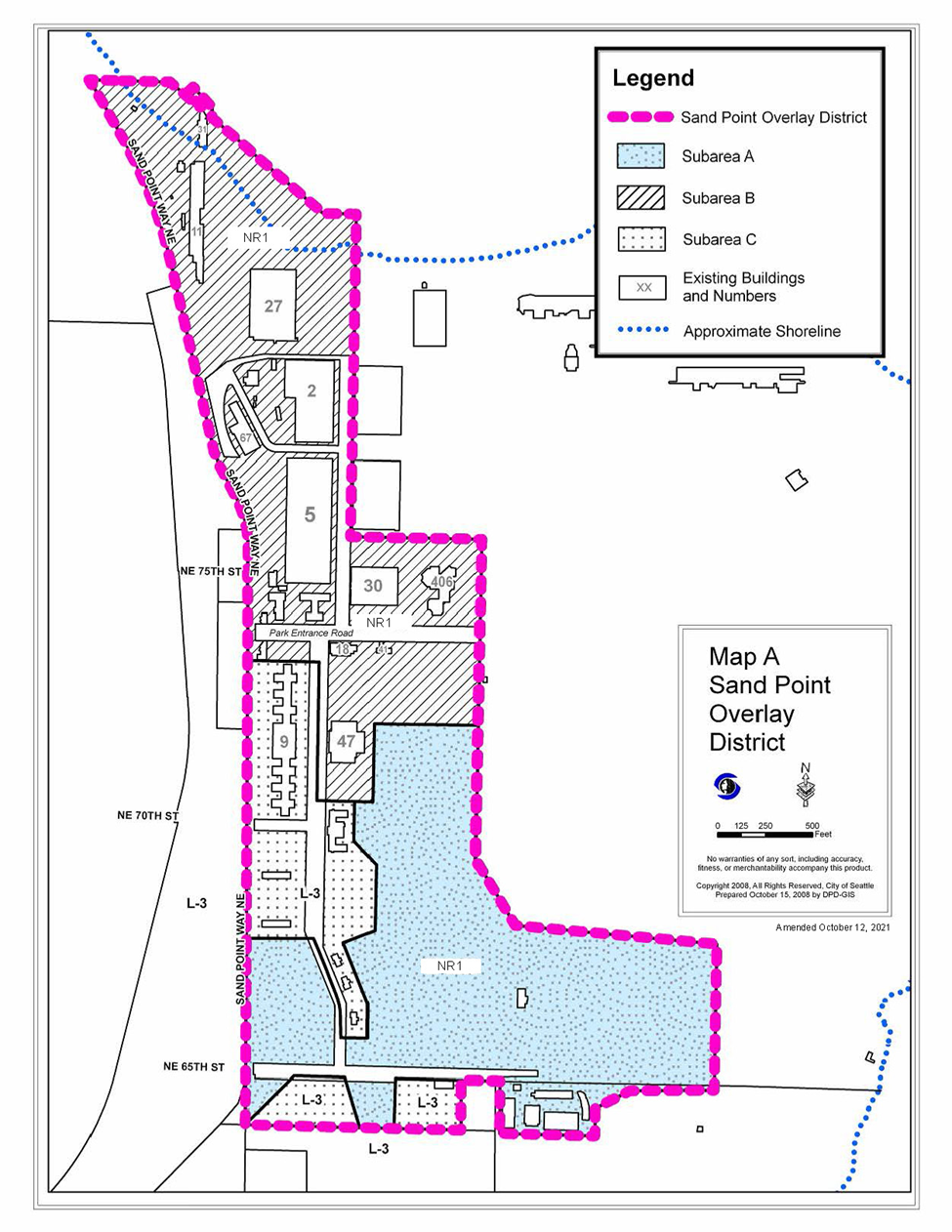
Map B for 23.72.004—Naval Air Station Puget Sound Sand Point
National Register Historic District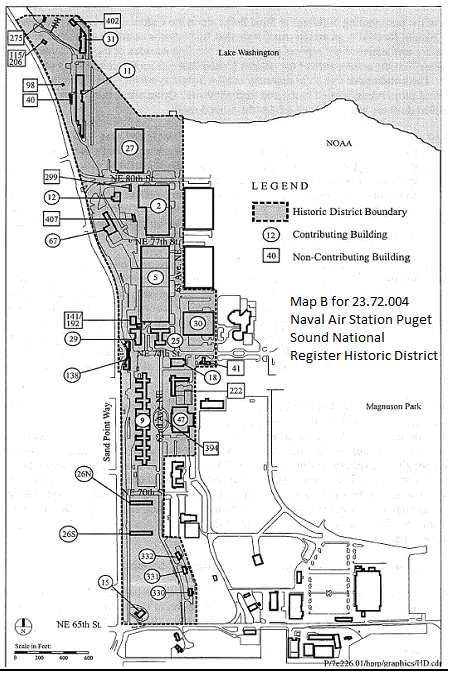
(Ord. 126685, § 53, 2022; Ord. 126509, § 90, 2022 [zone name change]; Ord. 125603, § 65, 2018; Ord. No. 123543, § 3, 2011; Ord. 122829, §§ 2, 3, 2008; Ord. 118794, § 44, 1997; Ord. 118624, § 3(part), 1997.)
23.72.006 - Application of regulations
All land located within the Sand Point Overlay District is subject to the regulations of the underlying zone unless specifically modified by the provisions of this Chapter 23.72. In the event of irreconcilable differences between the provisions of the Sand Point Overlay District and the underlying zone, the provisions of this Chapter 23.72 shall apply. Portions of the Sand Point Overlay District that lie within the Shoreline District, Chapter 23.60A, shall be governed by the provisions of the Shoreline District in addition to this Chapter 23.72. In the event of a conflict, the provisions of Chapter 23.60A shall prevail.
(Ord. 124750, § 79, 2015; Ord. 124105, § 29, 2013; Ord. 118624 § 3(part), 1997.)
23.72.008 - Uses permitted in specified areas within the Sand Point Overlay District
B.
Uses permitted within portions of Subarea B depicted on Map A for 23.72.008
1.
Principal uses permitted outright. In addition to the principal uses permitted by the provisions of Section 23.44.020, the following principal uses are permitted outright in Subarea B as depicted on Map A for 23.72.004, subject to subsection 23.72.008.B.4:
a.
Custom and craft work;
b.
Dry boat storage, limited to storage of non-motorized, hand-launchable boats such as kayaks, canoes, and sail boats;
c.
Indoor and outdoor sports and recreation;
d.
Institutions, except hospitals;
e.
Lecture and meeting halls;
f.
Motion picture theater not to exceed 500 seats within Building 47;
g.
Offices, limited to a total of 86,000 gross square feet in the entire subarea;
h.
Performing arts theaters;
i.
Research and development laboratories;
j.
Restaurants without drive-in lanes, limited to no more than 2,500 square feet per business establishment;
k.
Storage of fleet vehicles including accessory service and repair;
l.
Warehouses; and
m.
General retail sales and service, up to 6,000 square feet per business establishment.
2.
Accessory uses. Accessory uses that meet the following standards and that are customarily incidental to the principal uses permitted outright, are permitted outright:
a.
The area devoted to the accessory use is limited no more than 20 percent of the gross floor area of the principal use it serves;
b.
Only principal uses permitted by this Section 23.72.008 and by the applicable provisions of Chapter 23.60A are allowed as accessory uses.
3.
When not in use as a motion picture studio, a structure with an established use as a motion picture studio as of July 18, 1997, may be used for indoor and outdoor sports and recreation.
4.
Any area not occupied by structures in existence as of July 18, 1997, paved parking areas in existence as of July 18, 1997, or rights-of-way in existence as of July 18, 1997, is limited to open space, dry boat storage or recreation uses.
C.
Uses permitted within Subarea C depicted on Map A for 23.72.004. In addition to the uses permitted outright in Section 23.45.504 and Table A for 23.45.504, the following principal uses are permitted outright in Subarea C as depicted on Map A for 23.72.004:
1.
Food processing;
2.
Horticulture;
3.
Institutions, except hospitals;
4.
Lecture and meeting halls;
5.
Medical service uses, excluding animal health services, mortuary and funeral services; and
6.
Offices, in structures in existence as of July 18, 1997.
(Ord. 127376, § 68, 2025; Ord. 124378, § 70, 2013; Ord. 124105, § 30, 2013; Ord. 122829, § 4, 2008; Ord. 122311, § 90, 2006; Ord. 121145 § 16, 2003; Ord. 118794 § 45, 1997: Ord. 118624 § 3(part), 1997.)
23.72.010 - Development standards
A.
Within areas zoned neighborhood residential, changes of use within existing structures that are subject to SEPA requirements in Seattle Municipal Code Chapter 25.05 and new structures shall conform to the development standards for neighborhood residential development in Chapter 23.44, Neighborhood Residential, except as modified in subsections D—H of this section and except as provided in section 23.72.012.
B.
Within areas zoned Lowrise 3, changes of use within existing structures that are subject to SEPA requirements in Seattle Municipal Code Chapter 25.05 and new structures shall conform to the development standards of Chapter 23.45 applicable to Lowrise 3 development, except as modified in subsections D—H of this section and except as provided in Section 23.72.012.
C.
Density. A maximum of 200 dwelling units may be established within the boundaries of the Sand Point Overlay District. Residential uses provided by the University of Washington, and dwelling units established by Master Use Permit after December 1, 2012 in the LR3 zone, located within Subarea C of Map A of Section 23.72.004 and within a structure identified on Map B for 23.72.004 as a contributing building in the Naval Station Puget Sound Sand Point Historic District, do not count toward the maximum site density established in this subsection 23.72.010.C.
D.
New structures. Demolition of existing structures and construction of new structures in the Sand Point Overlay District are permitted if in compliance with the following provisions and if consistent with the Sand Point Historic Properties Reuse and Protection Plan, dated April 1998, as documented by a letter from the State Historic Preservation Officer certifying that the proposal is consistent with the Plan:
1.
Any new structure shall be located on and limited to the footprint of a structure that existed on the site as of July 18, 1997, except for:
a.
An indoor and outdoor tennis center to be located within Subarea B as depicted on Map A for 23.72.004;
b.
Low-income housing to be located within LR3 zoned portions of the overlay district; and
c.
Dry boat storage.
2.
In determining the footprint of structures existing on July 18, 1997, interior courtyards enclosed by three or more building walls at least 10 feet in height may be included as part of the footprint.
3.
Except for a proposed new tennis center in Subarea B, for which the height limit is 45 feet, and except for any new structure used for nonmotorized dry boat storage, for which the height limit is 15 feet, the height limit of a new structure is the greater of the height limit of the underlying zone or the height of the structure that existed on the same site as the new structure as of July 18, 1997.
E.
Rooftop features on existing non-residential structures. Stair penthouses, elevator penthouses and mechanical equipment on non-residential structures in existence as of July 18, 1997 may extend up to the higher of 15 feet above the maximum height limit or 15 feet above the roof elevation existing as of July 18, 1997, so long as the combined total coverage of all rooftop features above the roof elevation does not exceed (1) 25 percent of the roof area, if the rooftop features do not include screened mechanical equipment, or (2) 30 percent of the roof area, if the combined features include screened mechanical equipment. The addition of rooftop features is permitted only if also consistent with the Sand Point Historic Properties Reuse and Protection Plan, dated April 1998, and the U.S. Secretary of the Interior's Standards for Rehabilitation, as evidenced by a letter of approval from the State Historic Preservation Officer.
F.
Lighting. Changes of use within existing structures that are subject to SEPA requirements in Seattle Municipal Code Chapter 25.05 and all new structures shall comply with the following lighting standards:
1.
Exterior lighting shall be shielded and directed away from adjacent uses.
2.
Exterior lighting shall not exceed the height of the structure on which it is located or the height limit of the underlying zone in which it is located, whichever is less.
3.
All exterior lighting features shall be consistent with the Sand Point Historic Properties Reuse and Protection Plan, dated April 1998, and the U.S. Secretary of the Interior's Standards for Rehabilitation, as evidenced by a letter of approval from the State Historic Preservation Officer.
G.
Solid waste and recycling storage space. Changes of use within existing structures that are subject to SEPA requirements in Chapter 25.05 and all new structures shall provide storage space for solid waste containers in accordance with the requirements of Section 23.54.040. All solid waste and recyclable storage features shall be consistent with the Sand Point Historic Properties Reuse and Protection Plan, dated April 1998, and the U.S. Secretary of the Interior's Standards for Rehabilitation, as evidenced by a letter of approval from the State Historic Preservation Officer.
H.
Landscaping. Changes of use within existing structures that are subject to SEPA requirements in Seattle Municipal Code Chapter 25.05 and all new structures shall comply with the following landscape standards:
1.
Street trees along dedicated rights of way shall be provided pursuant to the requirements and exceptions in the underlying zone.
2.
Landscaping of surface parking areas.
a.
Surface parking areas shall be landscaped as follows:
b.
Each landscaped area shall be no smaller than 100 square feet and shall be enclosed by permanent curbs or structural barriers.
c.
No part of a landscaped area shall be less than 4 feet in any dimension except those parts created by turning radii or angles of parking spaces.
d.
No parking space shall be more than 60 feet from a required landscaped area.
e.
Landscaping that meets the dimension standards in this subsection may be provided in above-ground containers or similar planting areas.
3.
Surface parking areas shall be screened from direct street view by a minimum of 3-foot high landscaped areas.
4.
To provide pedestrian and vehicular access, breaks not to exceed the width of any required curbcuts or sight triangles are permitted in required landscaping.
5.
All landscaping features shall be consistent with the Sand Point Historic Properties Reuse and Protection Plan, dated April 1998, and the U.S. Secretary of the Interior's Standards for Rehabilitation, as evidenced by a letter of approval from the State Historic Preservation Officer.
(Ord. 126855, § 62, 2023; Ord. 126509, § 91, 2022 [zone name change]; Ord. 124378, § 71, 2013; Ord. 124060, § 1, 2012; Ord. 122829, § 5, 2008; Ord. 118794, § 46, 1997; Ord. 118624, § 3, 1997.)
23.72.012 - Parking location.
Required parking may be provided anywhere within the Sand Point Overlay District, including public rights-of-way.
(Ord. 118624 § 3(part), 1997.)
23.72.014 - Nonconformity.
The provisions of Chapter 23.42 pertaining to nonconformity apply except that further subdivision of property may be permitted by the Director even if nonconformity would be created with respect to a structure's relationship to lot lines or lot area. This provision shall only apply to structures in existence on the effective date of this chapter.
(Ord. 120293, § 10, 2001: Ord. 118624 § 3(part), 1997.)

