
Seattle City Zoning Code
CHAPTER 23
58A - INCENTIVE PROVISIONS
Subchapter IV - Extra Floor Area in Zones with an Incentive Zoning Suffix[12]
Editor's note— Ord. 125791, § 90, changed the title of Subchapter IV.
23.58A.002 - Scope of chapter; general rules
A.
Consistent with subsections 23.58B.020.D and 23.58C.025.D, this Chapter 23.58A provides rules for incentives in areas for which the provisions of the zone specifically refer to this Chapter 23.58A, and in zones with an incentive zoning suffix. The provisions in this Chapter 23.58A specify conditions under which extra floor area may be allowed, as exceptions to the otherwise applicable floor area or base height limit, or both, subject to the maximum limits stated in the provisions of the zone and to all other applicable requirements and approvals. Nothing in this Chapter 23.58A authorizes allowance of extra floor area, or the construction or use of any structure, contrary to any other provisions of this Title 23 or Title 25.
B.
The provisions of this Subchapter I apply generally to projects using any of the incentive provisions in this Chapter 23.58A, unless otherwise expressly provided in the applicable subchapter of this Chapter 23.58A or in the provisions of the zone.
C.
Nothing in this Chapter 23.58A shall be construed to confer on any owner or developer any development rights or property interests. The availability and terms of any allowance of extra floor area depend on the regulations in effect on the relevant date for consideration of a permit application for the project proposing to use such extra floor area, pursuant to Section 23.76.026, notwithstanding any prior approvals, interpretations or agreements by the Director, Director of Housing, or other official regarding the eligibility of any actual or proposed facility or feature to satisfy conditions for extra floor area.
D.
In zones to which this Chapter 23.58A applies, low-income housing may achieve bonus floor area according to provisions of the zone without meeting the requirements of this Chapter 23.58A.
(Ord. 126855, § 40, 2023; Ord. 125791, § 88, 2019; Ord. 124172, § 48, 2013; Ord. 123770, § 8, 2011; Ord. 123589, § 68, 2011; Ord. 122882, § 1, 2008.)
23.58A.003 - Affordable housing incentives: purpose and findings
A.
Purpose. The provisions of this Chapter 23.58A that relate to affordable housing are intended to implement affordable housing incentives authorized by RCW 36.70A.540, as amended.
B.
State law controlling. In case of any irreconcilable conflict with the terms of this Chapter 23.58A related to an affordable housing incentive, the provisions of RCW 36.70A.540, as amended, shall supersede and control.
C.
Findings
1.
Pursuant to the authority of RCW 36.70A.540, the City finds that higher income levels consistent with Section 23.58A.004's definition of "income-eligible households," rather than the income levels stated for rental housing units and owner occupancy housing units in RCW 36.70A.540, are needed to address local housing market conditions.
2.
The "general area of the development for which a bonus or incentive is provided" under RCW 36.70A.540 is deemed to be the Seattle city limits for all development within the Seattle city limits.
(Ord. 126855, § 41, 2023; Ord. 124172, § 49, 2013.)
23.58A.004 - Definitions
A.
Scope and applicability
1.
General rule. The terms set forth in quotations in this Section 23.58A.004, when used in this Chapter 23.58A, have the meanings set forth in this Section 23.58A.004 unless the context otherwise requires.
2.
Definitions in Chapter 23.84A. Definitions in this Chapter 23.58A or in the applicable provisions of the zone supersede any definitions of the same terms in Chapter 23.84A for purposes of the provisions of this Chapter 23.58A, unless specified otherwise in this Chapter 23.58A.
B.
Defined terms - General
"Affordable housing" means restricted units provided as a condition to bonus floor area that are affordable to and reserved solely for "income-eligible households."
"Base FAR" means base floor area ratio, which is the non-residential floor area that may be allowed under the provisions of the zone limiting floor area, expressed as a multiple of the lot area, without use of any bonuses, transfer of development capacity, other incentive provisions, or any departures, waivers, variances or special exceptions.
"Base residential floor area" means:
1.
For a lot in South Downtown in a PSM, IDM, IDR, DMR or DMC zone from which TDP is transferred, six times the lot area; and
2.
For all other lots, the amount of residential floor area allowable on the lot under the provisions of the zone that expressly limit floor area, excluding any floor area exempted from the limits, without use of any bonuses, transfer of development capacity, other incentive provisions, or any departures, waivers, variances or special exceptions, and before giving effect to any transfer of residential development potential to another lot.
"Base height limit" means the height limit that would apply under the provisions of the zone based upon the proposed uses in a structure, if the applicant did not qualify for any additional height dependent on the provisions of this Chapter 23.58A, after giving effect to any additional height that is actually allowed for the pitched roof of a structure and any additional height that is or would be allowed under the provisions of the zone because of the slope of the lot, but before giving effect to any allowance for rooftop features or any departure, waiver, variance or special exception.
"Bonus floor area" means bonus residential floor area or bonus non-residential floor area.
"Bonus non-residential floor area" means extra non-residential floor area allowed pursuant to the bonus provisions in subchapters III and V of this Chapter 23.58A. It does not include extra floor area gained through TDR.
"Bonus residential floor area" means extra residential floor area allowed pursuant to the bonus provisions in subchapters II and V of this Chapter 23.58A. It does not include extra floor area gained through TDP.
"Certificate of occupancy" means the first certificate of occupancy issued by the City for a project, whether temporary or permanent, unless otherwise specified.
"Extra floor area" means extra residential floor area or extra non-residential floor area.
"Extra residential floor area" means the gross floor area of all residential development allowed in addition to a base height limit or base residential floor area limit, or both, under the provisions of this Chapter 23.58A or under any other provisions of this Title 23 referring to this Chapter 23.58A that allow a bonus or a transfer of development rights or development capacity. It includes, without limitation, gross floor area in residential use in all stories wholly or in part above the base height limit, and all bonus residential floor area. In the IDM 75/85-150 zone, hotel use in a mixed-use project may be counted as extra residential floor area subject to subsection 23.49.023.A and subsection 23.49.208.E.
"Extra non-residential floor area" means the non-residential floor area of all non-residential development allowed in addition to base FAR or to a base height limit for non-residential use, or both, under the provisions of this Chapter 23.58A or under any other provisions of this Title 23 referring to this Chapter 23.58A that allow a bonus or a transfer of development rights or development capacity. It includes, without limitation, gross floor area in non-residential use in all stories wholly or in part above the base height limit for non-residential use, and all bonus non-residential floor area.
"Housing bonus residential floor area" means extra residential floor area allowed on condition that affordable housing be provided, or that a payment in lieu thereof be made, under Subchapter II of this Chapter 23.58A.
"Housing and child care bonus non-residential floor area" means extra non-residential floor area allowed under Subchapter III of this Chapter 23.58A on condition that affordable housing be provided or a payment in lieu of affordable housing be made and that a child care facility be provided or a payment in lieu of a child care facility be made.
"Income-eligible households" means:
1.
For rental affordable housing units, except affordable housing units with net unit area equal to or less than 400 square feet and sleeping rooms in a congregate residence, households with annual incomes no higher than the lower of:
a.
80 percent of median income; or
b.
The maximum level permitted for rental housing units by RCW 36.70A.540 in effect when the agreement for the affordable housing is executed.
2.
In the case of ownership affordable housing units, households with incomes no higher than the lesser of:
a.
100 percent of median income, or
b.
The maximum level permitted for owner occupancy housing units by RCW 36.70A.540 in effect when the agreement for the affordable housing is executed.
3.
For affordable housing units with net unit area equal to or less than 400 square feet and sleeping rooms in a congregate residence, households with annual incomes no higher than 40 percent of median income. For this purpose, the resident(s) of each sleeping room in a congregate residence is one household.
"Payment option" means making a payment to the City in lieu of providing affordable housing, child care, or any amenity or feature, to qualify for bonus floor area.
"Performance option" means providing or committing to provide a physical facility, or a portion or feature of a project, such as affordable housing, to qualify for bonus floor area.
"Provisions of the zone" means one or more provisions of another chapter of this Title 23 relating to allowable floor area or height, or to the allowance of extra floor area or additional height, or to the transfer of development capacity, for the area in which the lot on which extra floor area is used or proposed is located or the location from which TDR or TDP may be transferred.
(Ord. 126855, § 42, 2023; Ord. 124608, § 12, 2014; Ord. 124172, § 50, 2013; Ord. 123589, § 69, 2011; Ord. No. 123209, § 58, 2009; Ord. 122882, § 1, 2008.)
23.58A.006 - Permitting conditions—Incentive Plans.
A.
Master Use Permit. The Master Use Permit application to establish any extra floor area under this chapter shall include a calculation of the total amount of extra floor area sought and shall identify the manner in which the conditions to such extra floor area shall be satisfied. If the applicant seeks bonus floor area under any provisions allowing the option of performance or a payment in lieu thereof, the applicant shall indicate whether it intends to pursue the payment option or the performance option, or what combination of the two options. If any performance option is to be used, the application shall include the proposed location of the affordable housing or other facilities, including the proposed location or distribution within the proposed building(s), and if not to be provided on the same lot as the development using the extra floor area, the address, legal description, dimensions and ownership of the other lot(s). The Director shall, at the time of issuance of any Master Use Permit decision approving any such extra floor area, issue a Type I decision as to the amount of extra floor area to be allowed and the conditions to such extra floor area, which decision may include alternative means to achieve extra floor area, at the applicant's option, if each alternative would be consistent with the provisions of this chapter, the applicable provisions of the zone, and any other conditions of the permit, including Design Review conditions if applicable.
B.
First Building Permit. Prior to issuance, and as a condition to issuance, of the first building permit for a project, and in any event before any permit for any construction activity other than excavation and shoring is issued, the applicant shall execute and record a declaration in a form acceptable to the Director that shall commit the applicant to satisfy the conditions to establishing extra floor area as approved by the Director at the time of the Master Use Permit decision.
(Ord. 122882, § 1, 2008.)
23.58A.008 - Limits on use of incentives
No extra floor area under this Chapter 23.58A shall be granted to any proposed development that would result in significant alteration to any designated feature of a Landmark structure or significant alteration to a contributing structure, as defined in Section 23.66.032, unless a Certificate of Approval for the alteration is granted by the Landmarks Preservation Board in the case of a Landmark structure, or by the Director of Neighborhoods in the case of a contributing structure.
(Ord. 123589, § 70, 2011; Ord. 122882, § 1, 2008.)
23.58A.010 - Scope of subchapter.
This subchapter II includes provisions under which applicants may gain extra residential floor area in development for which the applicable provisions of the zone expressly refer to this chapter.
(Ord. 122882, § 1, 2008.)
23.58A.012 - Methods to achieve extra residential floor area
The method to achieve extra residential floor area shall be as provided in the provisions of the underlying zone. If the underlying zone does not provide methods to achieve extra residential floor area, the methods shall be:
A.
If the maximum height limit for residential use is 85 feet or less, all extra residential floor area shall be housing bonus residential floor area pursuant to Section 23.58A.014.
B.
If the maximum height limit for residential use is higher than 85 feet, the applicant shall use housing bonus residential floor area pursuant to Section 23.58A.014 to achieve at least 60 percent of the total extra residential floor area on the lot, and, to the extent permitted under the provisions of the zone or this Chapter 23.58A, may use bonus residential floor area for amenities pursuant to Section 23.58A.040 or transfer of transferable development potential pursuant to Section 23.58A.042, or both, for the balance of the extra residential floor area.
(Ord. 124172, § 51, 2013; Ord. 123589, § 71, 2011; Ord. 122882, § 1, 2008.)
23.58A.014 - Bonus residential floor area for affordable housing
A.
Scope; general rule. This Section 23.58A.014 applies to bonus residential floor area for affordable housing allowed on lots for which applicable sections of this Title 23 expressly refer to this Chapter 23.58A. To obtain bonus residential floor area for affordable housing, the applicant may use the performance option, the payment option, or a combination of these options, in accordance with this Section 23.58A.014 and subject to the provisions of the zone. However, where the maximum allowable height under the applicable provisions of the zone is 85 feet or less, the applicant may only use the performance option.
B.
Performance option
1.
Amount of affordable housing. An applicant using the performance option shall provide affordable housing units with total net unit area measured according to subsection 23.86.007.B at least equal to the greatest of:
a.
14 percent of the gross bonus residential floor area achieved according to this subsection 23.58A.014.B; or
b.
300 square feet; or
c.
Any minimum floor area specified in the provisions of the zone.
The percentage of gross bonus residential floor area obtained through the performance option to be provided as affordable housing may be reduced by the Council below 14 percent of the gross bonus residential floor area to no less than 12 percent of the gross bonus residential floor area as a Type V decision on an official land use map amendment or text amendment when the Council determines that the reduction is needed to accomplish Comprehensive Plan goals and policies or to reflect economic conditions of the area. Applicants may provide affordable housing as part of the development that includes extra floor area, or by providing or contributing to affordable housing at another location, subject to requirements in subsection 23.58A.014.B.8 and approval in writing by the Director of Housing prior to issuance of any permit after the first building permit for the development that includes the bonus residential floor area and before any permit for any construction activity other than excavation and shoring for the development that includes the bonus residential floor area is issued.
2.
Agreement. The City and the affordable housing owner shall enter into an agreement specifying the affordable housing requirements under this subsection 23.58A.014.B. This agreement shall be executed and recorded prior to issuance and as a condition to issuance of any permit after the first building permit for the development that includes the bonus residential floor area and before any permit for any construction activity other than excavation and shoring for the development that includes the bonus residential floor area is issued. If the first building permit is issued for the structural frame for the structure that includes affordable housing according to this Section 23.58A.014 and such structure is acquired to provide City-funded low-income housing, the agreement(s) according to this subsection 23.58A.014.B.2 and subsection 23.58A.014.B.6.b may be released at the sole discretion of the Director of Housing.
3.
Duration. Affordable housing shall serve only income-eligible households for a minimum period of 50 years from the date when a certificate of occupancy is issued for the structure that includes the affordable housing.
4.
Unit size and distribution. Affordable housing shall be provided in a range of sizes comparable to those units that are available to other residents. To the extent practicable, the affordable housing units must be in the same proportion as total units in the development in terms of size and configuration. The affordable housing units shall generally be distributed throughout the development and have substantially the same functionality as the other units in the development.
5.
Additional standards for rental housing
a.
Monthly rent, including basic utilities, shall not exceed 30 percent of the applicable income limit for the affordable housing unit, all as determined by the Director of Housing.
b.
Periodically as may be required by the Director of Housing, but no less than annually, the owner of the affordable housing shall submit to the Office of Housing a written report demonstrating compliance with and housing outcomes of this Section 23.58A.014. The report shall include required information and supporting documentation, verified upon the owner's oath or affirmation and in a form prescribed by the Office of Housing. The Director of Housing is authorized to assess a late fee of $50 per day, which shall accrue until the report is submitted, starting 14 days from the date of the Office of Housing's notice that the report is overdue.
c.
The owner of the affordable housing shall pay the Office of Housing an annual fee of $190 per affordable housing unit for the purpose of monitoring compliance according to this Section 23.58A.014. The fee shall automatically adjust annually on March 1, starting in 2024, by an amount in proportion to the increase, if any, for January 1 through December 31 of the prior calendar year, in the Consumer Price Index, All Urban Consumers, Seattle-Tacoma-Bellevue, WA, All Items (1982-1984=100), as determined by the U.S. Department of Labor, Bureau of Labor Statistics, or successor index, unless the Director of Housing determines that a lower fee covers the cost of monitoring compliance.
6.
Additional standards for ownership housing
a.
Initial and resale prices for the affordable housing unit shall be restricted to an amount determined by the Director of Housing to be affordable to an income-eligible household. The Office of Housing will establish by rule the formula for calculating maximum affordable prices for initial sales and resales to allow modest growth in homeowner equity while maintaining long-term affordability for income-eligible buyers.
b.
The affordable housing unit shall be subject to recorded instruments satisfactory to the Director of Housing providing for limits on sale and resale prices according to Section 23.58A.004 for a minimum period of 50 years.
c.
Periodically as may be required by the Director of Housing, but no less than annually, the applicant or third-party stewardship entity, as applicable, shall submit to the Office of Housing a written report demonstrating compliance with and housing outcomes of this Section 23.58A.014. The report shall include required information and supporting documentation, verified upon the owner's oath or affirmation and in a form prescribed by the Office of Housing. The Director of Housing is authorized to assess a late fee of $50 per day, which shall accrue until the report is submitted, starting 14 days from the date of the Office of Housing's notice that the report is overdue.
d.
The owner of each ownership affordable housing unit shall pay to the Office of Housing or third-party stewardship entity, as applicable, an annual fee payable in 12 equal payments for the purpose of monitoring compliance with this Section 23.58A.014. The fee shall be established by the Director of Housing by rule.
7.
Additional standards for on-site performance. If the affordable housing is provided within the development that includes the bonus residential floor area, the affordable housing shall be completed and ready for occupancy at or before the time when a certificate of occupancy is issued for any other units in the development that includes the bonus residential floor area, and as a condition to any right of the applicant to such a certificate of occupancy.
8.
Additional standards for off-site performance. If the affordable housing is not provided within the development that includes the bonus residential floor area, it may be provided off-site according to the following standards:
a.
Off-site affordable housing must be provided within the South Lake Union Regional Center if the development that includes bonus residential floor area is within the South Lake Union Regional Center. If the development that includes bonus residential floor area is outside the South Lake Union Regional Center, the off-site affordable housing must be in Seattle city limits, in priority order, (1) within the same regional center or urban center as the development, (2) within one mile of the development, (3) within 0.5 mile of a light rail or bus rapid transit station, or (4) within 0.25 mile of a bus or streetcar stop.
b.
The applicant shall provide to the City an irrevocable letter of credit, or other sufficient security approved by the Director of Housing, prior to issuance and as a condition of issuance of any permit after the first building permit for the development that includes the bonus residential floor area and before any permit for any construction activity other than for excavation and shoring for the development is issued, unless completion of the affordable housing has been documented to the satisfaction of the Director of Housing and the affordable housing is subject to recorded restrictions satisfactory to the Director of Housing. The letter of credit or other security shall be in an amount equal to the payment option amount calculated according to provisions in subsection 23.58A.014.C, plus an amount equal to interest on such payment. The Director of Housing is authorized to adopt, by rule, terms and conditions of such security including the amount of security and rate of annual interest, conditions on which the City shall have a right to draw on the letter of credit or other security, and terms should the City become entitled to realize on any such security.
c.
Any failure of the affordable housing to satisfy the requirements of this subsection 23.58A.014.B shall not affect the right to maintain or occupy the bonus residential floor area if the Director of Housing certifies to the Director that either:
1)
The applicant has provided the City with a letter of credit or other sufficient security pursuant to subsection 23.58A.014.B.8.b; or
2)
There have been recorded one or more agreements or instruments satisfactory to the Director of Housing providing for occupancy and affordability restrictions on affordable housing with the minimum floor area determined under this Section 23.58A.014, all affordable housing has been completed, and the affordable housing is on a different lot from the bonus residential floor area or is in one or more condominium units separate from the bonus residential floor area under condominium documents acceptable to the Director of Housing.
d.
Unless and until the Director of Housing shall certify as set forth in subsection 23.58A.014.B.8.c, it shall be a continuing permit condition, whether or not expressly stated, for each development obtaining bonus residential floor area based on the provision of housing to which this Section 23.58A.014 applies, that the affordable housing shall be maintained in compliance with the terms of this Section 23.58A.014 and any applicable provisions of the zone, as documented to the satisfaction of the Director of Housing.
9.
Affordable housing; no other restrictions. Affordable housing units provided according to this Section 23.58A.014 and restricted units provided for any other reason, including but not limited to a property tax exemption or loans and grants, must be different units.
10.
The applicant for a project that includes bonus floor area according to this Section 23.58A.014 shall pay housing review fees according to Section 22.900G.015.
C.
Payment option. The payment option is available only where the maximum height for residential use under the provisions of the zone is more than 85 feet and only if the Director determines that the payment achieves a result equal to or better than providing the affordable housing on-site and the payment does not exceed the approximate cost of developing the same number and quality of housing units that would otherwise be developed. The amount of the in-lieu payment made at the time specified in subsection 23.58A.014.C.2 shall be based on the payment amount in effect on the vesting date for the Master Use Permit under Section 23.76.026 or, if a Master Use Permit is not required, on the filing date for the valid and fully complete permit application.
1.
Amount of payments
a.
In lieu of all or part of the performance option, an applicant may pay to the City $29.15 per square foot of gross bonus residential floor area. Cash payment amounts shall automatically adjust according to subsection 23.58A.014.C.1.b.
b.
The in-lieu payment amount in subsection 23.58A.014.C.1.a shall automatically adjust annually on March 1, starting in 2024, by an amount in proportion to the increase, if any, for January 1 through December 31 of the prior calendar year, in the Consumer Price Index, All Urban Consumers, Seattle-Tacoma-Bellevue, WA, All Items (1982-84=100), as determined by the U.S. Department of Labor, Bureau of Labor Statistics, or successor index.
2.
Timing of payments. Cash payments shall be made prior to issuance and as a condition to issuance of any permit after the first building permit for a development and before any permit for any construction activity other than excavation and shoring is issued, unless the applicant elects in writing to defer payment. If the applicant elects to defer payment, then the issuance of any certificate of occupancy for the development shall be conditioned upon payment of the full amount of the cash payment determined under this Section 23.58A.014, plus an inflation adjustment equal to that amount multiplied by the increase, if any, in the Consumer Price Index, All Urban Consumers, Seattle-Tacoma-Bellevue, WA, All Items (1982-84=100), from the most recent month for which data are available on or before the vesting date for the Master Use Permit under Section 23.76.206 or, if a Master Use Permit is not required, the filing date for the valid and fully complete permit application, to the most recent month for which data are available at the time of payment. If the index specified in this subsection 23.58A.014.C.2 is not available for any reason, the Director shall select a substitute cost of living index. In no case shall the inflation adjustment be less than zero.
3.
Deposit and use of payments. Cash payments in lieu of affordable housing shall be deposited in a special account established solely to support the development of housing for income-eligible households as defined in this Chapter 23.58A. Earnings on balances in the special account shall accrue to that account. The Director of Housing shall use cash payments and any earnings thereon to support the development of housing for income-eligible households in any manner now or hereafter permitted by RCW 36.70A.540. Uses of funds may include the City's costs to administer housing for income-eligible households, not to exceed ten percent of the payments into the special account. Housing for income-eligible households funded wholly or in part with cash payments shall be located within the Seattle city limits.
D.
If a Master Use Permit application includes establishment of bonus residential floor area and the proposed development entails demolition of a building containing four or more dwelling units occupied as rental housing within 18 months prior to that Master Use Permit application, then the amount of affordable housing to be provided under subsection 23.58A.014.B.1 is increased by the number of units within the building or buildings to be demolished that were rented to tenants who received or are eligible to receive a tenant relocation assistance payment under Chapter 22.210. The additional affordable housing is subject to the following requirements:
1.
For the first 50 years of operation, the affordable housing shall be affordable to households with incomes at or below 50 percent of median income as defined by Section 23.84A.025.
2.
A cash payment in lieu of the additional affordable housing is not permitted.
3.
If the additional affordable housing is not being provided in the development using the bonus residential floor area, the additional affordable housing units shall be completed, including issuance of a certificate of occupancy, within three years from the time when a certificate of occupancy is issued for any units in the development seeking bonus residential floor area, except that the Director may extend the time for completion if the Director finds that:
a.
The failure to complete the affordable housing is due to circumstances beyond the applicant's control;
b.
The applicant has been acting and may reasonably be expected to continue to act in good faith and with due diligence; and
c.
The affordable housing will be completed within a reasonable time.
E.
The Director and the Director of Housing are authorized jointly to adopt rules to interpret and implement the provisions of this Section 23.58A.014.
(Ord. 127375, § 91, 2025; Ord. 126855, § 43, 2023; Ord. 125791, § 89, 2019; Ord. 124919, § 145, 2015; Ord. 124172, § 53, 2013; Ord. 123770, § 9, 2011; Ord. No. 123209, § 60, 2009; Ord. 122882, § 1, 2008.)
23.58A.020 - Scope of subchapter
This subchapter III includes provisions under which applicants may gain extra nonresidential floor area in development for which the applicable provisions of the zone expressly refer to this Chapter 23.58A.
(Ord. 123589, § 74, 2011.)
23.58A.022 - Methods to achieve extra nonresidential floor area
The method to achieve extra nonresidential floor area shall be as provided in the provisions of the underlying zone. If the underlying zone does not provide methods to achieve extra nonresidential floor area, the methods shall be:
A.
If the maximum height limit for nonresidential use is 85 feet or less, all extra nonresidential floor area shall be housing and child care bonus nonresidential floor area pursuant to Section 23.58A.024, or housing TDR pursuant to Section 23.58A.042, or both.
B.
If the maximum height limit for nonresidential use is greater than 85 feet, the applicant shall use housing and child care bonus nonresidential floor area pursuant to Section 23.58A.024, or housing TDR pursuant to Section 23.58A.042, or both, to achieve 75 percent of total extra nonresidential floor area on the lot, and, to the extent permitted under the provisions of the zone and this Chapter 23.58A, shall use bonus nonresidential floor area for amenities pursuant to Section 23.58A.040, or TDR pursuant to Section 23.58A.042, or both, for the balance of the extra nonresidential floor area.
(Ord. 124172, § 56, 2013; Ord. 123589, § 74, 2011.)
23.58A.024 - Bonus nonresidential floor area for affordable housing and child care
A.
Scope; general rule. This Section 23.58A.024 applies to bonus non-residential floor area for affordable housing and child care allowed on lots for which applicable sections of this Title 23 expressly refer to this Chapter 23.58A. To obtain bonus non-residential floor area for affordable housing and child care, the applicant may use the performance option, the payment option, or a combination of these options, in accordance with this Section 23.58A.024 and subject to the provisions of the zone.
B.
Performance option for housing
1.
Amount of affordable housing. An applicant using the housing performance option shall provide affordable housing units with total net unit area, measured according to subsection 23.86.007.B, at least equal to 15.6 percent of gross bonus non-residential floor area achieved according to this subsection 23.58A.024.B.
2.
Agreement. The City and the affordable housing owner shall enter into an agreement specifying the affordable housing requirements under this subsection 23.58A.024.B. This agreement shall be executed and recorded prior to issuance and as a condition to issuance of any permit after the first building permit for the development that includes the bonus non-residential floor area and before any permit for any construction activity other than excavation and shoring for the development is issued. If the first building permit is issued for the structural frame for the structure that includes affordable housing according to this Section 23.58A.024 and such structure is acquired to provide City-funded low-income housing, the agreement(s) according to this subsection 23.58A.024.B.2 and subsection 23.58A.024.B.6.b may be released at the sole discretion of the Director of Housing.
3.
Duration. Affordable housing shall serve only income-eligible households for a minimum period of 50 years from the date when a certificate of occupancy is issued, or if no certificate of occupancy is required the date of the final building permit inspection, for the affordable housing.
4.
Unit size and distribution. Affordable housing shall be provided in a range of sizes comparable to those units that are available to other residents. To the extent practicable, the affordable housing units must be in the same proportion as total units in the development in terms of size and configuration. The affordable units shall generally be distributed throughout the development and have substantially the same functionality as the other units in the development.
5.
Additional standards for rental housing
a.
Monthly rent, including basic utilities, shall not exceed 30 percent of the applicable income limit for the affordable housing unit, all as determined by the Director of Housing, for a minimum period of 50 years.
b.
Periodically as may be required by the Director of Housing, but no less than annually, the owner of the affordable housing shall submit to the Office of Housing a written report demonstrating compliance with and housing outcomes of this Section 23.58A.024. The report shall include required information and supporting documentation, verified upon the owner's oath or affirmation and in a form prescribed by the Office of Housing. The Director of Housing is authorized to assess a late fee of $50 per day, which shall accrue until the report is submitted, starting 14 days from the date of the Office of Housing's notice that the report is overdue.
c.
The owner of the affordable housing shall pay the Office of Housing an annual fee of $190 per affordable housing unit for the purpose of monitoring compliance according to this Section 23.58A.024. The fee shall automatically adjust annually on March 1, starting in 2024, by an amount in proportion to the increase, if any, for January 1 through December 31 of the prior calendar year, in the Consumer Price Index, All Urban Consumers, Seattle-Tacoma-Bellevue, WA, All Items (1982-1984=100), as determined by the U.S. Department of Labor, Bureau of Labor Statistics, or successor index.
6.
Additional standards for ownership housing
a.
Initial and resale prices for the affordable housing unit shall be restricted to an amount determined by the Director of Housing to be affordable to an income-eligible household. The Office of Housing will establish by rule the formula for calculating maximum affordable prices for initial sales and resales to allow modest growth in homeowner equity while maintaining long-term affordability for income-eligible buyers.
b.
The affordable housing unit shall be subject to recorded instruments satisfactory to the Director of Housing providing for limits on sale and resale prices according to Section 23.58A.004 for a minimum period of 50 years.
c.
Periodically as may be required by the Director of Housing, but no less than annually, the applicant or third-party stewardship entity, as applicable, shall submit to the Office of Housing a written report demonstrating compliance with and housing outcomes of this Section 23.58A.024. The report shall include required information and supporting documentation, verified upon the owner's oath or affirmation and in a form prescribed by the Office of Housing. The Director of Housing is authorized to assess a late fee of $50 per day, which shall accrue until the report is submitted, starting 14 days from the date of the Office of Housing's notice that the report is overdue.
d.
The owner of each ownership affordable housing unit shall pay to the Office of Housing or third-party stewardship entity, as applicable, an annual fee payable in 12 equal payments for the purpose of monitoring compliance with this Section 23.58A.024. The fee shall be established by the Director of Housing by rule.
7.
Additional standards for on-site performance. If the affordable housing is provided within the development that includes the bonus non-residential floor area, the affordable housing shall be completed and ready for occupancy at or before the time when a certificate of occupancy is issued for any chargeable floor area in the development that includes the bonus non-residential floor area, and as a condition to any right of the applicant to such a certificate of occupancy.
8.
Additional standards for off-site performance. If the affordable housing is not provided within the development that includes the bonus nonresidential floor area, it may be provided off-site according to the following standards:
a.
If the development that includes bonus nonresidential floor area is within the South Lake Union Regional Center, the off-site affordable housing must be located within the South Lake Union Regional Center or within one mile of the development that includes the bonus nonresidential floor area and no more than 0.25 mile from the South Lake Union Regional Center boundary. If the development that includes bonus nonresidential floor area is outside of the South Lake Union Regional Center, the off-site affordable housing must be in Seattle city limits, in priority order, (1) within the same regional center or urban center as the development, (2) within one mile of the development, (3) within 0.5 mile of a light rail or bus rapid transit station, or (4) within 0.25 mile of a bus or streetcar stop.
b.
The applicant shall provide to the City an irrevocable letter of credit, or other sufficient security approved by the Director of Housing, prior to and as a condition of issuance of any permit after the first building permit for the development that includes bonus nonresidential floor area and before any permit for construction activity other than excavation and shoring is issued, unless completion of the affordable housing has been documented to the satisfaction of the Director of Housing and the affordable housing is subject to recorded restrictions satisfactory to the Director of Housing. The letter of credit or other security shall be in an amount equal to the payment option amount calculated according to provisions in subsection 23.58A.024.D, plus an amount equal to interest on such payment. The Director of Housing is authorized to adopt, by rule, terms and conditions of such security including the amount of security and rate of annual interest, conditions on which the City shall have a right to draw on the letter of credit or other security, and terms should the City become entitled to realize on any such security.
c.
Any failure of the affordable housing to satisfy the requirements of this subsection 23.58A.024.B shall not affect the right to maintain or occupy the bonus nonresidential floor area if the Director of Housing certifies to the Director that either:
1)
The applicant has provided the City with a letter of credit or other sufficient security pursuant to subsection 23.58A.024.B.8.b; or
2)
There have been recorded one or more agreements or instruments satisfactory to the Director of Housing providing for occupancy and affordability restrictions on affordable housing with the minimum floor area determined under this Section 23.58A.024, all affordable housing has been completed, and the affordable housing is on a different lot from the bonus nonresidential floor area or is in one or more condominium units separate from the bonus nonresidential floor area under condominium documents acceptable to the Director of Housing.
d.
Unless and until the Director of Housing certifies as set forth in subsection 23.58A.024.B.8.c, it shall be a continuing permit condition, whether or not expressly stated, for each development obtaining bonus nonresidential floor area based on the provision of housing to which this Section 23.58A.024 applies, that the affordable housing shall be maintained in compliance with the terms of this Section 23.58A.024 and any applicable provisions of the zone, as documented to the satisfaction of the Director of Housing.
9.
Affordable housing; no other restrictions. Affordable housing units provided according to this Section 23.58A.024 and restricted units provided for any other reason, including but not limited to a property tax exemption or loans and grants, must be different units.
10.
The applicant for a project that includes bonus floor area according to this Section 23.58A.024 shall pay housing review fees according to Section 22.900G.015.
C.
Performance option for child care
1.
For each square foot of nonresidential bonus floor area allowed under this Section 23.58A.024, in addition to providing housing pursuant to subsection 23.58A.024.B or an alternative cash contribution pursuant to subsection 23.58A.024.D, an applicant using the child care performance option shall provide fully improved child care facility space sufficient for 0.000127 of a child care slot. The minimum interior space in the child care facility for each child care slot shall comply with all applicable state and local regulations governing the operation of licensed childcare providers. Child care facility space shall be deemed provided only if the applicant causes the space to be newly constructed or newly placed in child care use after the submission of a permit application for the development intended to use the bonus floor area, except as provided in subsection 23.58A.024.C.3.f. If any contribution or subsidy in any form is made by any public entity to the acquisition, development, financing or improvement of any child care facility, then any portion of the space in such facility determined by the Human Services Director to be attributable to such contribution or subsidy shall not be considered as provided by any applicant other than that public entity.
2.
Child care space shall be provided on the same lot as the development using the bonus nonresidential floor area, or on another lot within a distance of 0.25 mile of the development using the bonus nonresidential floor area.
3.
Child care space shall be contained in a child care facility satisfying the following standards:
a.
The child care facility and accessory exterior space shall be approved for licensing by the State of Washington Department of Early Learning and any other applicable state or local governmental agencies responsible for the regulation of licensed child care providers.
b.
At least 20 percent of the number of child care slots for which space is provided as a condition of bonus nonresidential floor area shall be reserved for, and affordable to, families with annual incomes at or below the U.S. Department of Housing and Urban Development Low Income Standard for Section 8 Housing based on family size or, if such standard shall no longer be published, a standard established by the Human Services Director based generally on 80 percent of the median family income of the Metropolitan Statistical Area, or division thereof, that includes Seattle, adjusted for family size. Child care slots shall be deemed to meet these conditions if they serve, and are limited to,
1)
children receiving child care subsidy from the City of Seattle, King County or State Department of Early Learning, or
2)
children whose families have annual incomes no higher than the above standard who are charged according to a sliding fee scale such that the fees paid by any family do not exceed the amount it would be charged, exclusive of subsidy, if the family were enrolled in the City of Seattle Child Care Assistance Program.
c.
Child care space provided to satisfy bonus conditions shall be dedicated to child care use, consistent with the terms of this Section 23.58A.024, for 20 years. The dedication shall be established by a recorded covenant, running with the land, and enforceable by the City, signed by the owner of the lot where the child care facility is located, or the long-term lessee of the child care space under terms acceptable to the Human Services Director, and by the owner of the lot where the bonus floor area is used, if different from the lot of the child care facility. The child care facility shall be maintained in operation, with adequate staffing, at least 11 hours per day, five days per week, and 50 weeks per year.
d.
Space for which a bonus is or has been allowed under any other section of this Title 23 or under former Title 24 shall not be eligible to satisfy the conditions of this Section 23.58A.024.
e.
Unless the applicant is the owner of the child care space and is a duly licensed and experienced child care provider approved by the Human Services Director, the applicant shall provide to the Human Services Director a signed agreement, acceptable to the Human Services Director, with a duly licensed child care provider, under which the child care provider agrees to operate the child care facility consistent with the terms of this Section 23.58A.024 and of the recorded covenant, and to provide reports and documentation to the City to demonstrate such compliance.
f.
One child care facility may fulfill the conditions for a bonus for more than one development if it includes sufficient space, and provides sufficient slots affordable to limited income families, to satisfy the conditions for each such development without any space or child care slot being counted toward the conditions for more than one development. If the child care facility is located on the same lot as one of the developments using the bonus, then the owner of that lot shall be responsible for maintaining compliance with all the requirements applicable to the child care facility; otherwise responsibility for such requirements shall be allocated by agreement in such manner as the Human Services Director may approve. If a child care facility developed to qualify for bonus floor area by one applicant includes space exceeding the amount necessary for the bonus floor area used by that applicant, then to the extent that the voluntary agreement accepted by the Human Services Director from that applicant so provides, such excess space may be deemed provided by the applicant for a later development pursuant to a new voluntary agreement signed by both such applicants and by any other owner of the child care facility, and a modification of the recorded covenant, each in form and substance acceptable to the Human Services Director.
4.
The Human Services Director shall review the design and proposed management plan for any child care facility proposed to qualify for bonus floor area to determine whether it will comply with the terms of this Section 23.58A.024. The allowance of bonus floor area is conditioned upon approval of the design and proposed management plan by the Human Services Director. The child care facility shall be constructed consistent with the design approved by the Human Services Director and shall be operated for the minimum 20 year term consistent with the management plan approved by the Human Services Director, in each case with only such modifications as shall be approved by the Human Services Director. If the proposed management plan includes provisions for payment of rent or occupancy costs by the provider, the management plan shall include a detailed operating budget, staffing ratios, and other information requested by the Human Services Director to assess whether the child care facility may be economically feasible and able to deliver quality services.
5.
The Human Services Director is authorized to accept a voluntary agreement for the provision of a child care facility to satisfy bonus conditions and related agreements and instruments consistent with this Section 23.58A.024. The voluntary agreement may provide, in case a child care facility is not maintained in continuous operation consistent with this subsection 23.58A.024.C at any time within the minimum 20 year period, for the City's right to receive payment of a prorated amount of the alternative cash contribution that then would be applicable to a new development seeking bonus nonresidential floor area, with any adjustments for changes in costs that the Human Services Director may deem appropriate. The Human Services Director may require security or evidence of adequate financial responsibility, or both, as a condition to acceptance of an agreement under this subsection 23.58A.024.C. Review and approval of any proposed facilities, plans or other matters by the Human Services Director is in the interest of the City and the general public and not for the particular benefit of any persons or class, and shall not constitute any assurance to any person that any facility or its operations will satisfy any health, safety or other standards or criteria.
D.
Payment option
1.
Amount of payments. The amount of the in lieu payment made at the time specified in subsection 23.58A.024.D.2 shall be based on the payment amount in effect on the vesting date for the Master Use Permit under Section 23.76.026 or, if no Master Use Permit is required, on the filing date for the valid and fully complete permit application.
a.
In lieu of all or part of the performance option for affordable housing, an applicant may provide a cash contribution to the City of $33.31 per square foot of gross bonus nonresidential floor area, if the Director of Housing determines that the payment achieves a result equal to or better than providing the low-income housing on-site and the payment does not exceed the approximate cost of developing the same number and quality of housing units that would otherwise be developed. In lieu of all or part of the performance option for child care, the applicant may provide a cash contribution to the City of $5.76 per square foot of gross bonus nonresidential floor area to be used for child care facilities, to be administered by the Human Services Department. Cash payment amounts shall automatically adjust according to subsection 23.58A.024.D.1.b.
b.
The in lieu cash contribution amounts for affordable housing and child care shall automatically adjust annually on March 1, starting in 2024, by an amount in proportion to the increase, if any, for January 1 through December 31 of the prior calendar year, in the Consumer Price Index, All Urban Consumers, Seattle-Tacoma-Bellevue, WA, All Items (1982-1984=100), as determined by the U.S. Department of Labor, Bureau of Labor Statistics, or successor index.
2.
Timing of payments. Cash payments shall be made prior to issuance and as a condition to issuance of any permit after the first building permit for a development that includes bonus nonresidential floor area and before any permit for any construction activity other than excavation and shoring is issued.
3.
Deposit and use of payments. Cash payments in lieu of affordable housing and child care facilities shall be deposited in special accounts established solely to support the development of housing for income-eligible households and child care facilities. Earnings on balances in the special accounts shall accrue to those accounts.
a.
The Director of Housing shall use cash payments in lieu of affordable housing and any earnings thereon to support the development of housing for income-eligible households in any manner now or hereafter permitted by RCW 36.70A.540. Uses of funds may include the City's costs to administer the housing for income-eligible households, not to exceed ten percent of the payments into the special accounts. Housing for income-eligible households funded wholly or in part with cash payments shall be located within the Seattle city limits.
b.
The Director of Human Services shall use cash payments in lieu of child care and any earnings thereon to support the development or expansion of child care facilities within 0.5 mile of the development using the bonus nonresidential floor area, or in another location, consistent with an applicable voluntary agreement, where the child care facility addresses the additional need created by that development. Child care facilities supported with cash payments may be publicly or privately owned, and if privately owned shall be committed to long-term use as child care under such agreements or instruments as the Director of Human Services deems appropriate. The Director of Human Services shall require that child care facilities supported with cash payments and their operators satisfy applicable licensing requirements, and may require compliance with other provisions applicable to child care facilities provided under the performance option, with such modifications as the Director of Human Services deems appropriate.
E.
The Director and the Director of Housing are authorized jointly to adopt rules to interpret and implement the provisions of this Section 23.58A.024.
(Ord. 127375, § 92, 2025; Ord. 126855, § 44, 2023; Ord. 124919, § 146, 2015; Ord. 124378, § 62, 2013; Ord. 124172, § 58, 2013; Ord. 123589, § 74, 2011.)
23.58A.025 - Scope of subchapter
This subchapter IV includes provisions under which applicants may gain extra floor area for development in zones with an incentive zoning suffix.
(Ord. 123770, § 10, 2011)
23.58A.026 - Application of floor area limits in zones with an incentive zoning suffix
In zones with an incentive zoning suffix, extra floor area may be allowed in addition to the maximum gross floor area allowed by the FAR limit indicated by the incentive zoning suffix. All extra floor area shall be considered extra residential floor area regardless of the use. Extra floor area may be gained up to the maximum non-exempt gross floor area allowed by the FAR limit of the applicable Commercial or Multifamily zone. For single purpose commercial structures in zones with an incentive zoning suffix, extra floor area may be allowed when the applicant qualifies by using the performance option or the payment option in accordance with Section 23.58A.014, or a combination of these options. The provisions of this Chapter 23.58A under which applicants may gain extra residential floor area shall apply.
(Ord. 124172, § 59, 2013; Ord. 123770, § 10, 2011)
23.58A.040 - Bonus floor area for open space amenities
A.
Findings. The City Council finds that:
1.
Amenities, including public open space, are an important aspect of livability in areas targeted in the Comprehensive Plan for concentrated housing and employment growth.
2.
Developments that add density will increase demand for public open space. If additional public open space is voluntarily provided to offset additional demand, the impacts on available open space resources will be mitigated.
3.
Within Highrise zones, the average amount of public open space, including breathing room open space, needed to accommodate residential development is at least 0.14 square feet of open space per gross square foot of residential floor area in a development.
B.
Voluntary agreements for amenities. Where expressly permitted by the provisions of the zone, an applicant may achieve bonus floor area in part through a voluntary agreement for provision of amenities to mitigate impacts of the development, subject to the limits in this Chapter 23.58A.
1.
Except where limited in the provisions of the zone, amenities that may be provided for bonus floor area include:
a.
Neighborhood open space;
b.
Green street setbacks on lots abutting designated green streets;
c.
Green street improvements;
d.
Mid-block corridor; and
e.
Hillside terrace.
2.
The amenities listed in subsection 23.58A.040.B.1 are referred to as "open space amenities" in this Section 23.58A.040. Mitigation of impacts identified in subsection 23.58A.040.A may be achieved by providing the amenity on the same lot as the development using the bonus floor area or, for green street improvements, in the right-of-way 1/4 mile of the development using the bonus floor area (the performance option), by a payment-in-lieu of providing the amenity on- or off-site (payment option), or both.
3.
Amenities provided as part of street vacations may not be counted as amenities for the purpose of achieving extra floor area.
C.
Performance option
1.
General provisions
a.
An applicant electing to use the performance option shall provide the amenity on the same lot as the development using the bonus floor area, except as follows:
1)
The amenity is located on a lot that is included in a combined lot development or a lot that is specified according to a Council approved development agreement that is expressly permitted by the provisions of the zone;
2)
The amenity is a green street improvement that is provided on a designated green street within 1/4 mile of the lot; or
3)
The amenity is a neighborhood open space in an SM-U zone that is provided to satisfy the open space requirement for a large lot development under Section 23.48.650 on a site other than the project site in accordance with subsection 23.48.650.B.11. The off-site open space provided to meet the open space requirement on the project site shall not be used to meet the open space requirement or to provide a bonus for extra floor area for any other lot other than the project site.
b.
The maximum area of any amenity or combination of amenities provided on a lot eligible for a bonus is established in this subsection 23.58A.040.C and may be further limited by Sections 23.58A.012, 23.58A.022, or the provisions of the zone. Open space amenities shall meet the standards of this subsection 23.58A.040.C in order to qualify for bonus floor area, except as may be authorized by the Director under subsection 23.58A.040.C.5. An open space amenity may also qualify as a required residential amenity or other open space requirement to the extent permitted by the provisions of the zone.
2.
Amenities in Downtown zones in South Downtown:
a.
In Downtown zones in South Downtown, in order to qualify for bonus residential floor area, amenity features shall satisfy the eligibility conditions of the Downtown Amenity Standards, except as provided in subsection 23.58A.040.C.2.b, and shall be consistent with the guidelines of the Downtown Amenity Standards.
b.
The Director may allow modifications from the eligibility conditions of the Downtown Amenity Standards, as a Type I decision, if the applicant demonstrates that the amenity better achieves the intent of the Downtown Amenity Standards for that amenity feature, and that the departure is consistent with any applicable criteria for allowing the particular type of departure in the Downtown Amenity Standards.
c.
The Director may condition the approval of an amenity as provided in the Downtown Amenity Standards.
3.
Bonus ratio. Unless otherwise specified in the provisions of the zone, amenities may be used to gain bonus floor area according to the following ratios and subject to the limits of this Section 23.58A.040:
a.
For a neighborhood open space, 7 square feet of bonus floor area per 1 square foot of qualifying neighborhood open space area (7:1).
b.
For a green street setback, 5 square feet of bonus floor area per 1 square foot of qualifying green street setback area (5:1).
c.
For a green street improvement, 5 square feet of bonus floor area per 1 square foot of qualifying green street improvement area (5:1).
d.
For a mid-block corridor, 7 square feet of bonus floor area per 1 square foot of qualifying mid-block corridor area (7:1).
e.
For a residential or non-residential hillside terrace, 5 square feet of bonus floor area per 1 square foot of qualifying hillside terrace area (5:1).
4.
Maximum open space amenity in Highrise zone. In the Highrise zone, the amount of open space amenity for which bonus floor area may be allowed shall not exceed the lesser of the amount required to mitigate the impact created by the total bonus residential floor area in the development, or 15,000 square feet. For purposes of this Section 23.58A.040, the amount of open space required to mitigate that impact in the Highrise zone is 0.14 square feet of open space amenity per square foot of bonus residential floor area, unless the Director determines, as a Type I decision, that a different ratio applies based on consideration of one or both of the following:
a.
The overall number or density of people anticipated to use or occupy the structure in which bonus floor area will be located, in relation to the total floor area of the structure, is different from the density level of approximately 1.32 persons per 1,000 residential gross square feet, which was used to establish the ratio in subsection 23.58A.040.C, such that a different amount of open space is needed to mitigate the impacts of development;
b.
Characteristics or features of the development mitigate the impacts that the anticipated population using or occupying the structure in which bonus floor area will be located would otherwise have on open space needs.
5.
Standards for open space amenities. The following standards apply to open space amenities, except as otherwise specifically stated in the provisions of the zone.
a.
Public access
1)
Public access for open space amenities in downtown zones is regulated pursuant to subsection 23.58A.040.C.2.
2)
Except for green street improvements, open space amenities not in downtown zones shall be open to the public, without charge, each day of the year for a minimum of ten hours each day for a neighborhood open space and for a mid-block corridor in SM-U zones in the University District Regional Center, and 24 hours each day of the year for a green street setback. The hours of public access identified above shall be during daylight hours, unless there are insufficient daylight hours, in which case the open space shall also be open during nighttime hours for the balance of the hours the open space is to remain open. Public access may be limited temporarily during hours that are otherwise required to be open to the public for necessary maintenance or for reasons of public safety.
3)
Within the open space, property owners, tenants, and their agents shall allow members of the public to engage in activities allowed in the public sidewalk environment, except that those activities that would require a street use permit if conducted on the sidewalk may be excluded or restricted. Free speech activities such as hand billing, signature gathering, and holding signs, all without obstructing access to the space, any building, or other adjacent features, and without unreasonably interfering with the enjoyment of the space by others, shall be allowed. While engaged in allowed activities, members of the public may not be asked to leave for any reason other than conduct that unreasonably interferes with the enjoyment of the space by others unless the space is being closed to the general public consistent with this subsection 23.58A.040.C. No parking, storage, or other use may be established on or above the surface of the open space except as provided in subsection 23.58A.040.C.5.b.2.f. Use by motor vehicles of open space for which bonus floor area is granted is not permitted. The open space shall be identified clearly with the City's public open space logo on a plaque placed at a visible location at each street entrance providing access to the amenity. The plaque shall indicate, in letters legible to passersby, the nature of the bonus amenity, its availability for general public access, and additional directional information as needed.
b.
Standards for neighborhood open space
1)
Neighborhood open space in downtown zones in South Downtown is regulated pursuant to subsection 23.58A.040.C.2.
2)
Neighborhood open space not in downtown zones used to qualify for bonus floor area shall meet the conditions in this subsection 23.58A.040.C.5.b.2, unless a modification is allowed by the Director as a Type I decision, based on the Director's determination that, relative to the strict application of the standards, the exception will result in improved public access and use of the space or a better integration of the space with surrounding development.
a)
The open space shall comply with the applicable provisions of this Section 23.58A.040. The open space shall consist of one continuous area with a minimum of 3,000 square feet and a minimum horizontal dimension of 10 feet.
b)
A minimum of 35 percent of the open space shall be landscaped with grass, ground cover, bushes, and/or trees.
c)
Either permanent or movable seating in an amount equivalent to 1 lineal foot for every 200 square feet of open space shall be available for public use during hours of public access.
d)
The open space shall be located and configured to maximize solar exposure to the space, allow easy access from streets or other abutting public spaces, including access for persons with disabilities, and allow convenient pedestrian circulation through all portions of the open space. The open space shall have a minimum frontage of 30 feet at grade abutting a sidewalk, and be visible from sidewalks on at least one street.
e)
The open space shall be provided at ground level, except that in order to provide level open spaces on steep lots, some separation of multiple levels may be allowed, provided they are physically and visually connected and accessible to persons with disabilities.
f)
Up to 20 percent of the open space may be covered by elements accessory to public use of the open space, including: permanent, freestanding structures, such as retail kiosks, pavilions, or pedestrian shelters; structural overhangs; overhead arcades or other forms of overhead weather protection; and any other features approved by the Director that contribute to pedestrian comfort and active use of the space. The following elements within the open space area may count as open space and are not subject to the percentage coverage limit: temporary kiosks and pavilions, public art, permanent seating that is not reserved for any commercial use, exterior stairs and mechanical assists that provide access to public areas and are available for public use, and any similar features approved by the Director. Seating or tables, or both, may be provided and reserved for customers of restaurants or other uses abutting the open space, but the area reserved for customer seating shall not exceed 15 percent of the open space area or 500 square feet, whichever is less.
c.
Standards for green street setbacks
1)
Green street setbacks in downtown zones in South Downtown are regulated pursuant to subsection 23.58A.040.C.2.
2)
Green street setbacks in downtown zones outside South Downtown are regulated pursuant to Section 23.49.013.
3)
Green street setbacks not in downtown zones shall meet the following standards:
a)
Where permitted by the provisions of the zone, bonus floor area may be gained for green street setbacks by development on lots abutting those street segments that are listed or shown as green streets in the provisions of the zone.
b)
A green street setback shall be provided as a setback from a lot line abutting a designated green street. The setback shall be continuous for the length of the frontage of the lot abutting the green street, and a minimum of 50 percent of the setback area shall be landscaped. The area of any driveways in the setback area is not included in the bonusable area. For area eligible for a bonus, the average setback from the abutting green street lot line shall not exceed 10 feet, with a maximum setback of 15 feet. The design of the setback area shall allow for public access, such as access to street-level uses in abutting structures or access to areas for seating. The Director may approve a modification to the standards in this subsection 23.58A.040.C.5.c.3.b as a Type I decision, based on the Director's determination that the modification is consistent with a green street concept plan, if one exists, established in accordance with Director's Rule 11-2007, or a successor rule.
d.
Standards for green street improvement. Green street improvements used to qualify for bonus floor area shall be located on a designated green street and shall meet the standards of a city-approved streetscape concept plan or other design document approved by the Director.
e.
Standards for mid-block corridor
1)
Mid-block corridors used to qualify for bonus floor area in downtown zones in South Downtown are regulated pursuant to subsection 23.58A.040.C.2.
2)
Mid-block corridors used to qualify for bonus floor area in the Mount Baker Station Area must meet the requirements in the Downtown Amenity Standards.
3)
Mid-block corridors used to qualify for bonus floor area in the SM-U zones within the University District Regional Center shall meet the applicable requirements of this subsection 23.58A.040.C and the requirements of subsection 23.48.640.E.
f.
Standards for hillside terraces. A hillside terrace used to qualify for bonus floor area in South Lake Union Regional Center or in downtown zones in South Downtown is regulated pursuant to subsection 23.58A.040.C.2.
g.
Declaration. If open space is to be provided for purposes of obtaining bonus floor area, the owners of the lot using the bonus floor area, and of the lot where the open space is provided, if different, shall execute and record a declaration and voluntary agreement in a form acceptable to the Director identifying the bonus amenities; acknowledging that the right to develop and occupy a portion of the gross floor area on the lot using the bonus floor area is based upon the long-term provision and maintenance of the open space and that development is restricted in the open space; and committing to provide and maintain the open space.
h.
Identification
1)
Open space amenities in downtown zones in South Downtown shall meet the identification conditions of the Downtown Amenity Standards.
2)
Open space amenities not in downtown zones shall be identified clearly with the City's public open space logo on a plaque placed at a visible location at each street entrance providing access to the amenity. The plaque shall indicate, in letters legible to passersby, the nature of the bonus amenity, its availability for general public access, and additional directional information as needed.
i.
Duration; alteration. Except as provided for in this subsection 23.58A.040.C.5.i, the owners of the lot using the bonus floor area and of the lot where the open space amenity is located, if different, including all successors, shall provide and maintain the open space amenities for which bonus floor area is granted, in accordance with the applicable provisions of this Section 23.58A.040, for as long as the bonus floor area gained by the open space amenities exists. An open space amenity for which bonus floor area has been granted may be altered or removed only to the extent that either or both of the following occur, and alteration or removal may be further restricted by the provisions of the zone and by conditions of any applicable permit:
1)
The bonus floor area permitted in return for the specific open space amenity is removed or converted to a use for which bonus floor area is not required under the provisions of the zone; or
2)
An amount of bonus floor area equal to that allowed for the open space amenity that is to be altered or removed is provided through alternative means consistent with the provisions of the zone and provisions for allowing bonus floor area in this Chapter 23.58A.
D.
Payment option
1.
There is no payment-in-lieu option for open space amenities other than neighborhood open space.
2.
Payment-in-lieu of providing neighborhood open space
a.
In lieu of all or part of the performance option for neighborhood open space, an applicant may pay to the City an amount determined pursuant to this subsection 23.58A.040.D if the Director determines that the payment will contribute to public open space improvements abutting the lot or in the vicinity; that the improvements will meet the additional need for open space caused by the development and are feasible within a reasonable time; and that the applicant agrees to the specific improvements or to the general nature and location of the improvements.
b.
The amount of the payment is determined by multiplying the number of square feet of land that would be provided as neighborhood open space, by the sum of an estimated land value per square foot based on recent transactions in the area and an average square foot cost for open space improvements. The dollar amount per square foot shall be determined by the Director based on any relevant information submitted by the applicant, and any other data related to land values and costs that the Director considers reliable.
c.
Cash payments shall be made prior to issuance and as a condition to issuance of any permit after the first building permit for a development and before any permit for any construction activity other than excavation and shoring is issued.
d.
Any payment-in-lieu of providing neighborhood open space shall be deposited in a dedicated fund or account solely to support acquisition or development of public open space within 1/4 mile of the lot using the bonus floor area, or within another area prescribed by the provisions of the zone, or at another location where the applicant and the Director agree that it will mitigate the direct impacts of the development, and the payment shall be expended within five years of receipt for such purposes.
(Ord. 127375, § 93, 2025; Ord. 125267, § 27, 2017; Ord. 125173, § 9, 2016; Ord. 124513, § 9, 2014; Ord. 124172, § 60, 2013.)
23.58A.042 - Transferable development potential (TDP) and rights (TDR)
A.
Scope and applicability
1.
This Section 23.58A.042 contains rules for TDP and TDR when their transfer or use is authorized by other provisions of this Title 23 that specifically refer to provisions of this Chapter 23.58A.
2.
Whether a lot may be eligible as a TDP or TDR sending site is determined by the provisions of the zone in which the lot is located. To be eligible as a sending lot for a specific category of TDP or TDR defined in this Chapter 23.58A, the lot shall satisfy the applicable conditions of this Section 23.58A.042 and definitions in Chapter 23.84A except to the extent otherwise expressly stated in the provisions of the zone. Whether a lot is eligible as a TDP or TDR receiving lot, whether the lot may receive TDP or TDR from another lot, and what categories of TDP or TDR the lot may receive are determined by the provisions of the zone. The transfer and use of TDP or TDR on any receiving lot are subject to the limits and conditions in this Chapter 23.58A, the provisions of the zone, and all other applicable provisions of this Title 23.
B.
General standards for sending lots
1.
TDP calculation. The maximum amount of TDP floor area that may be transferred from a sending lot is the amount by which the residential floor area allowed under the base FAR, or floor area that could be allowed under the base residential height as determined by the Director if no base residential floor area exists, exceeds the sum of:
a.
Any nonexempt floor area existing on the sending lot; plus
b.
Any TDP or TDR previously transferred from the sending lot.
2.
TDR calculation. The maximum amount of TDR floor area that may be transferred from a sending lot is the amount by which the non-residential floor area allowed under the base FAR of the sending lot exceeds the sum of:
a.
Any nonexempt floor area existing on the sending lot; plus
b.
Any TDP or TDR previously transferred from the sending lot.
3.
Floor area limit after transfer. After TDP or TDR is transferred from a sending lot, the total amount of residential and non-residential floor area that may then be established on the sending lot, other than floor area exempt from limits on floor area under the provisions of the zone, shall be as follows:
a.
The amount of residential floor area that may be established shall be the base residential floor area, or floor area that could be allowed under the base residential height as determined by the Director if no base residential floor area exists, plus any net amount of TDP previously transferred to that lot, minus the total of the existing nonexempt floor area on the lot and the amount of TDP or TDR transferred from the lot; and
b.
The amount of non-residential floor area that may be established shall be the base non-residential floor area, plus any net amount of TDR previously transferred to that lot, minus the total of the existing nonexempt floor area on the lot and the amount of TDP or TDR transferred from the lot.
C.
Standards for Landmark TDP or TDR sending lots. Landmark structures on sending lots from which Landmark TDP or TDR is transferred shall be rehabilitated and maintained as required by the Landmarks Preservation Board.
D.
Standards for open space TDP or TDR sending sites. The following standards apply unless provisions of the zone state otherwise:
1.
General conditions. Open space TDP or TDR sites shall meet the following conditions, unless an exception is granted by the Director through subsection 23.58A.042.D.2:
a.
Each portion of the open space shall be accessible from each other portion of the open space without leaving the open space.
b.
The open space shall have a minimum area of 5,000 square feet.
c.
The open space shall be directly accessible from the sidewalk or another public open space, including access for persons with disabilities.
d.
The open space shall be at ground level, except that in order to provide level open spaces on steep lots, some separation of multiple levels may be allowed, provided they are physically and visually connected.
e.
No more than 20 percent of the open space may be occupied by any above grade structures.
f.
A minimum of 35 percent of the open space shall be landscaped with grass, ground cover, bushes, and/or trees.
g.
Either permanent or movable seating in an amount equivalent to 1 lineal foot for every 200 square feet of open space shall be available for public use during hours of public access.
h.
The open space shall be located and configured to maximize solar exposure to the space, allow easy access from streets or other abutting public spaces, including access for persons with disabilities, and allow convenient pedestrian circulation through all portions of the open space.
i.
The lot shall be located a minimum of 1/4 mile from the closest lot approved by the Director as a separate open space TDP or TDR site, unless the lot is abutting another TDP or TDR site and is designed to be integrated with the other TDP or TDR site.
j.
The open space shall be open to the public, without charge, each day of the year for a minimum of ten hours each day during daylight hours, unless there are insufficient daylight hours, in which case the open space shall also be open during nighttime hours for the balance of the hours the open space is to remain open. Public access may be limited temporarily during hours that are otherwise required to be open to the public for necessary maintenance or for reasons of public safety.
k.
Within the open space, property owners, tenants, and their agents shall allow members of the public to engage in activities allowed in the public sidewalk environment, except that those activities that would require a street use permit if conducted on the sidewalk may be excluded or restricted. Free speech activities such as hand billing, signature gathering, and holding signs, all without obstructing access to the space, any building, or other adjacent features, and without unreasonably interfering with the enjoyment of the space by others, shall be allowed. While engaged in allowed activities, members of the public may not be asked to leave for any reason other than conduct that unreasonably interferes with the enjoyment of the space by others unless the space is being closed to the general public consistent with subsection 23.58A.042.D.1.j.
l.
The open space shall be identified clearly with the City's public open space logo on a plaque placed at a visible location at each street entrance providing access to the amenity. The plaque shall indicate, in letters legible to passersby, the nature of the bonus amenity, its availability for general public access, and additional directional information as needed.
m.
Unless the open space will be in public ownership, the applicant shall make adequate provision to ensure the permanent maintenance of the open space.
2.
Special exception for open space TDP or TDR sites. The Director may grant, or grant with conditions, an exception to the standards for open space TDP or TDR sites in this subsection 23.58A.042.D and any applicable Director's rules, as a special exception pursuant to Chapter 23.76, Procedures for Master Use Permit and Council Land Use Decisions. In determining whether to grant, grant with conditions, or deny a request for special exception under this subsection 23.58A.042.D.2, the Director shall consider:
a.
The extent to which the exception would result in an open space TDP or TDR site that better meets the intent of the provisions of this subsection 23.58A.042.D; and
b.
The extent to which the exception would allow the design of the open space to take advantage of unusual site characteristics or conditions in the surrounding area, such as views and relationship to surroundings.
3.
After any TDP or TDR is transferred from an open space TDP or TDR site, lot coverage by structures shall be permanently limited to 20 percent, or any greater amount that was allowed as a special exception prior to the transfer, and no development shall be permitted that would be inconsistent with the standards under which it was approved as an open space TDP or TDR sending site.
E.
Standards for housing TDR sending lots
1.
Housing on lots from which housing TDR is transferred shall be rehabilitated to the extent required to provide decent, sanitary, and habitable conditions, in compliance with applicable codes, and so as to have an estimated minimum useful life of at least 50 years from the time of the TDR transfer, as approved by the Director of Housing. If housing TDR is proposed to be transferred prior to the completion of work necessary to satisfy this subsection 23.58A.042.E, the Director of Housing may require, as a condition to such transfer, that security be deposited with the City to ensure the completion of such work.
2.
Restricted units provided as a condition to transfer of development rights shall be generally comparable in their average size and quality of construction to other units in the same structure, in the judgment of the Director of Housing, after completion of any rehabilitation or construction undertaken in order to qualify as a TDR sending lot.
3.
For transfers of housing TDR, the owner of the sending lot shall execute and record an agreement, with the written consent of all holders of encumbrances on the sending lot, unless such consent is waived by the Director of Housing for good cause, to provide for the maintenance of the required housing on the sending lot for a minimum of 50 years. Such agreement shall commit to limits on rent and occupancy consistent with the definition of housing TDR site and acceptable to the Director of Housing.
F.
Standards for vulnerable masonry structure TDR or TDP sending lots. Within the portion of the University District Regional Center west of 15th Avenue NE or within the Uptown Regional Center, TDR and TDP may be transferred from lots that comply with the following conditions:
1.
The sending lot is located in the University District Regional Center west of 15th Avenue NE and is in an SM-U, NC3, or NC3P zone with a mapped height limit of 55 feet or greater, or is located in the Uptown Regional Center and is in an SM-UP, MR, LR3, or C2 zone;
2.
The lot includes a structure that contributes to the historic architectural context of the neighborhood and is identified as such in the Department of Neighborhoods' (DON) Historic Resource Survey, and is also identified on a list of structures meeting specific criteria in a rule promulgated by the Director according to Section 23.48.627; and
3.
The qualifying structure on the sending lot shall be retained as follows for a minimum of 50 years:
a.
The structure is rehabilitated and maintained to comply with all codes applicable to seismic retrofitting of vulnerable masonry structures;
b.
All exterior facades shall be retained; except that portions of a new structure may abut facades that are not street-facing facades or that set back a minimum of 30 feet from a street lot line that is generally parallel to the facade, and connections between the new structure and the facades of the retained structure are allowed; and
c.
Additions or alterations to the structure that extend the useful physical life or economic viability of the structure are permitted, provided that:
1)
The additions do not significantly alter the original structural system or result in significant alterations to any historic or architectural characteristics of the exterior appearance of the structure as documented in the DON Historic Resource Survey, except as may be required to comply with applicable codes; and
2)
The total floor area of any additions to the original structure, excluding floor area added to reclaim floor area that may have been removed from the original structure over time, does not exceed one story in height and the equivalent of 0.5 FAR, as calculated on the lot on which the structure was originally permitted.
4.
If development rights from a lot certified by the Director of the Seattle Department of Construction and Inspections as a vulnerable masonry structure sending site have not been sold within three years of certification, the lot must be recertified by the Director to determine if the structure continues to qualify as an eligible sending site; and
5.
For transfers of vulnerable masonry structure TDR and TDP, the owner of the sending lot shall execute and record an agreement with the City, with the written consent of all holders of encumbrances on the sending lot, unless such consent is waived by the Director for good cause, that provides for the maintenance of the required structure on the sending lot for a minimum of 50 years. Such agreement shall commit to limits on additions and modifications to the structure consistent with the provisions of this subsection 23.58A.042.F and that are approved by the Director.
G.
Standards for TDP sending lots in South Downtown. This subsection 23.58A.042.G applies to TDP sending lots in South Downtown, in addition to the general provisions in this Section 23.58A.042.
1.
Limit on open space TDP. The maximum amount of open space TDP that may be transferred from a sending lot is the amount by which three times the lot area exceeds the total gross floor area of all uses on the lot.
2.
South Downtown Historic TDP
a.
Only lots in the Pioneer Square Preservation District or the International Special Review District may qualify as sending lots for South Downtown Historic TDP.
b.
In order to be eligible to send South Downtown Historic TDP, a lot shall contain a structure that includes at least 5,000 gross square feet in above-grade floor area and has been finally determined to be a contributing structure under Section 23.66.032 within no more than three years prior to the recording of the deed conveying the TDP from the sending lot.
c.
Contributing structures on a sending lot from which South Downtown Historic TDP is transferred shall be rehabilitated and maintained in accordance with an agreement pursuant to subsection 23.58A.042.K.3.
d.
South Downtown Historic TDP shall not be transferred from a lot from which South Downtown Historic TDR has been transferred or from a lot on which any bonus floor area has been established based on the presence of a contributing structure.
3.
Limit on combined TDR and TDP. A cumulative combination of TDR and TDP exceeding a total of six times the lot area may not be transferred from any lot.
H.
TDP or TDR required before construction. No permit after the first building permit, no permit for any construction activity other than excavation and shoring, and no permit for occupancy of existing floor area by any use based upon TDP or TDR will be issued for development that includes TDP or TDR until the applicant's possession of TDP or TDR is demonstrated to the satisfaction of the Director.
I.
Time of determination of TDP or TDR eligible for transfer. The eligibility of a sending lot to transfer TDP or TDR, and the amount transferable from a sending lot, shall be determined as of the date of transfer from the sending lot and shall not be affected by the date of any application, permit decision, or other action for any development seeking to use the TDP or TDR.
J.
Reservation in deed. Any TDP or TDR eligible for transfer may be reserved in the conveyance of title to an eligible sending lot, by the express terms of the deed or other instrument of conveyance reserving a specified amount of TDP or TDR, provided that an instrument acceptable to the Director is recorded binding the lot to the terms and conditions for eligibility to send TDP or TDR under this Section 23.58A.042. Any TDP or TDR so reserved shall be considered transferred from that lot and later may be conveyed by deed without participation of the owner of the lot.
K.
TDP or TDR deeds and agreements
1.
The fee owners of the sending lot shall execute a deed and shall obtain the release of the TDP or TDR from all liens of record and the written consent of all holders of encumbrances on the sending lot other than easements and restrictions, unless the requirement for a release or consent is waived by the Director for good cause. The deed shall be recorded in the King County real property records. If TDP or TDR is conveyed to the owner of a receiving lot described in the deed, the TDP or TDR shall pass with the receiving lot, whether or not a structure using the TDP or TDR shall have been permitted or built prior to any conveyance of the receiving lot, unless otherwise expressly stated in the deed or any subsequent instrument conveying the lot or the TDP or TDR. Any subsequent conveyance of TDP or TDR previously conveyed to a receiving lot shall require the written consent of all parties holding any interest in or lien on the receiving lot from which the conveyance is made. If the TDP or TDR is transferred other than directly from the sending lot to the receiving lot using the TDP or TDR, then after the initial transfer, all subsequent transfers also shall be by deed, duly executed, acknowledged and recorded, each referring by King County recording number to the prior deed.
2.
Any person may purchase any TDP or TDR that is eligible for transfer by complying with the applicable provisions of this Section 23.58A.042, whether or not the purchaser is then an applicant for a permit to develop real property or is the owner of any potential receiving lot. Any purchaser of the TDP or TDR (including any successor or assignee) may use the TDP or TDR to obtain floor area above the applicable base height limit or base floor area limit on a receiving lot to the extent that use of TDP or TDR is permitted under the Land Use Code provisions applicable with respect to the issuance of permits for development of the development intended to use the TDP or TDR. The Director may require, as a condition of processing any permit application using TDP or TDR or for the release of any security posted in lieu of a deed for TDP or TDR to the receiving lot, that the owner of the receiving lot demonstrate that the TDP or TDR has been validly transferred of record to the receiving lot, and that the owner has recorded in the real estate records a notice of the filing of such permit application, stating that the TDP or TDR is not available for retransfer.
3.
As a condition to the effective transfer of Landmark TDP or TDR or South Downtown Historic TDP, except from a City-owned sending lot, the fee owner of the sending lot shall execute and record an agreement running with the land, in form and content acceptable to, and accepted in writing by, the Director of the Department of Neighborhoods, providing for the rehabilitation and maintenance of the historically significant or other relevant features of the structure or structures on the lot and acknowledging the restrictions on future development resulting from the transfer. The Director may require evidence that each holder of a lien has effectively subordinated the lien to the terms of the agreement, and that any holders of interests in the property have agreed to its terms. To the extent that a Landmark structure on the sending lot, or a contributing structure on a sending lot in a special review district requires restoration or rehabilitation for the long-term preservation of the structure or its historically or architecturally significant features, the Director of the Department of Neighborhoods may require, as a condition to acceptance of the necessary agreement, that the owner of the sending site apply for and obtain a certificate of approval from the Landmarks Preservation Board, or from the Director of the Department of Neighborhoods after review by the Pioneer Square Preservation Board or International Special Review District Board, as applicable, for the necessary work, or post security satisfactory to the Director of the Department of Neighborhoods for the completion of the restoration or rehabilitation, or both.
(Ord. 127375, § 94, 2025; Ord. 126855, § 45, 2023; Ord. 125432, § 15, 2017; Ord. 125267, § 28, 2017; Ord. 124172, § 61, 2013.)
23.58A.044 - Regional Development Credits Program
A.
Scope and applicability. This Section 23.58A.044 contains standards for acquiring regional development credits when use of the credits is authorized by other Title 23 provisions.
B.
Process. To achieve extra floor area by acquiring regional development credits, applicants shall acquire and extinguish certified regional development credits that originate from property located in King, Pierce, or Snohomish counties according to the standards of this Section 23.58A.044.
C.
Initial Ratios. Except as provided in subsection 23.58A.044.C, applicants shall receive either an amount of extra residential floor area listed in Table A for 23.58A.044 or an amount of extra nonresidential floor area listed in Table B for 23.58A.044 for each regional development credit acquired and extinguished.
D.
Exchange Ratios after first 200 credits extinguished. When the first 200 regional development credits have been extinguished to the satisfaction of the Director as provided in subsection 23.58A.044.G, Table A and Table B for 23.58A.044 shall no longer have effect and applicants shall, for each regional development credit acquired and extinguished, receive an amount of extra residential floor area listed in Table C for 23.58A.044 or an amount of extra nonresidential floor area listed in Table D for 23.58A.044.
E.
Certification. Regional development credits shall be certified by King, Pierce, or Snohomish County as being eligible for transfer under the regional development credit program adopted by the county that is certifying the credits.
F.
Prerequisite for issuing development permits. A building permit shall not be issued for a development that includes bonus floor area obtained through regional development credits until the applicant demonstrates to the satisfaction of the Director that the owner of the property being developed owns the regional development credits used to obtain the bonus floor area according to documentation issued by the county where the credits originated from.
G.
Prerequisite for issuing a certificate of occupancy. A certificate of occupancy shall not be issued for a development that includes bonus floor area obtained through regional development credits until the applicant demonstrates to the satisfaction of the Director that the regional development credits have been extinguished according to documentation issued by the county where the credits originated from.
H.
Proceeds from sale
1.
In order to demonstrate the entire proceeds from the sale of credits will be used to purchase new agricultural credits under subsection 23.58A.044.C or 23.58A.044.D, the applicant shall demonstrate that the Forest or Rural credits were purchased from a county or non-profit entity that provides documentation to the Director that the entire proceeds from the sale of the Forest or Rural credits have been:
a.
Expended for the purchase of new Agricultural credits that meet the requirement of subsection 23.58A.044.E and that were purchased from property owners owning agricultural property located in the same county where the Forest or Rural credits originated from; or
b.
Placed in a segregated account subject to the restriction that the funds in the account shall only be used for purchasing new Agricultural credits from property owners owning agricultural property located in the same county where the Forest or Rural credits originated from.
2.
In the case of subsection 23.58A.044.H.1.b, the account holder shall annually provide, within 30 days after the end of each calendar year, a report to the Director demonstrating:
a.
The sources and uses of funds in the account; and
b.
The funds in the account have only been used for directly purchasing new Agricultural credits from property owners owning agricultural property located in the same county where the Forest or Rural credits originated from.
This reporting obligation shall end when the entity holding the funds demonstrates to the Director that all funds held by the entity for acquiring credits have been expended.
I.
The Local Infrastructure Project Area for Downtown and South Lake Union is as shown on Map A for 23.58A.044.
J.
In order to implement this program cooperatively with Snohomish and Pierce Counties, The City of Seattle adopts by reference the TDR terms and conditions in chapter 365-198 WAC to facilitate the transfer of development rights from these counties to Seattle.
Map A for 23.58A.044
Local Infrastructure Project Area boundary for Downtown and South Lake Union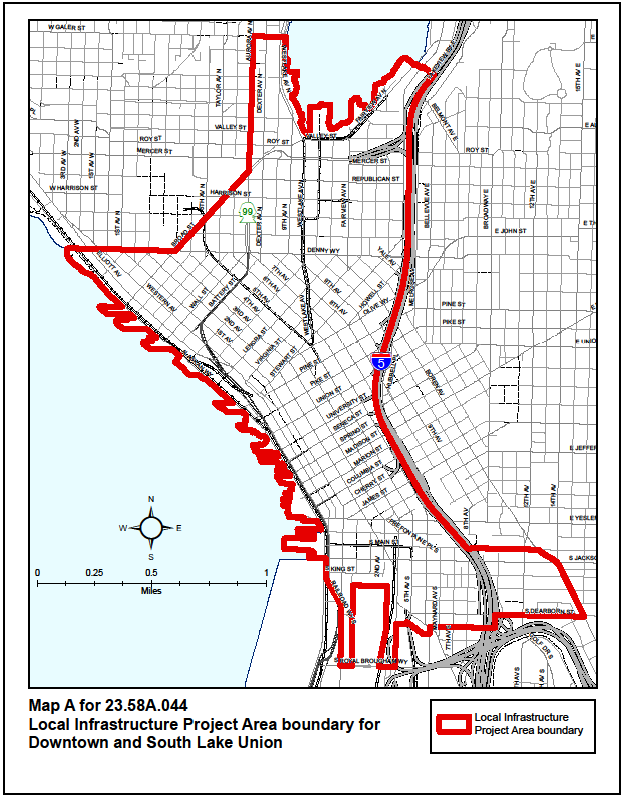
(Ord. 126455, § 1, 2021; Ord. 124843, § 51, 2015; Ord. 124287, § 7, 2013; Ord. 124172, § 62, 2013.)

