
Seattle City Zoning Code
CHAPTER 23
53 - REQUIREMENTS FOR STREETS, ALLEYS, AND EASEMENTS
23.53.002 - Scope of provisions
In addition to the provisions of this Chapter 23.53, other regulations including but not limited to the Seattle Fire Code (Chapter 22.600) may apply to development proposals.
(Ord. 126682, § 5, 2022.)
23.53.003 - Accessory dwelling units exempt from public street improvements
Notwithstanding any conflicting requirements in this Chapter 23.53, no public street improvements, other than public street improvements required by state or federal law, shall be required as a condition of permitting accessory dwelling units for construction, conversion, expansion, change of use, or other development method. This does not preclude requiring the repair or replacement of existing improvements as needed due to development of an accessory dwelling unit. For purposes of calculating required street improvements in this Chapter 23.53, accessory dwelling units shall be excluded from dwelling unit counts.
(Ord. 127211, § 15, 2025.)
23.53.004 - Requirements and design criteria
Where, because of specific site conditions, the requirements of this Chapter 23.53 do not protect public health, safety, and welfare, the Director of Transportation and the Director of the Seattle Department of Construction and Inspections together may impose different or additional right-of-way improvement requirements consistent with the Right-of-Way Improvements Manual.
(Ord. 124919, § 141, 2015; Ord. 122205, § 6, 2006.)
23.53.005 - Access to lots
A.
Street or private easement abutment required
1.
For residential uses, at least 10 feet of a lot line shall abut a street or a private permanent vehicle access easement meeting the standards of Section 23.53.025, or the provisions of subsection 23.53.025.F for pedestrian access easements shall be met.
2.
For non-residential uses that do not provide parking, at least 5 feet of a lot line shall abut a street or a private permanent vehicle access easement meeting the standards of Section 23.53.025, or the provisions of subsection 23.53.025.F for pedestrian access easements to residential uses shall be met.
3.
For non-residential uses and live-work units that provide parking, an amount of lot line sufficient to provide the required driveway width shall abut a street, or an alley improved to the standards of Section 23.53.030; or a private permanent vehicle access easement to a street meeting the standards of Section 23.53.025. If no vehicular access is required or provided, then pedestrian access meeting the provisions of subsection 23.53.025.F for pedestrian access easements to residential uses shall be met.
B.
New Easements. When a new private easement is proposed for vehicular access to a lot, the Director may instead require access by a street when one (1) or more of the following conditions exist:
1.
Where access by easement would compromise the goals of the Land Use Code to provide for adequate light, air and usable open space between structures;
2.
If the improvement of a dedicated street is necessary or desirable to facilitate adequate water supply for domestic water purposes or for fire protection, or to facilitate adequate storm drainage;
3.
If improvement of a dedicated street is necessary or desirable in order to provide on-street parking for overflow conditions;
4.
Where it is demonstrated that potential safety hazards would result from multiple access points between existing and future developments onto a roadway without curbs and with limited sight lines;
5.
If the dedication and improvement of a street would provide better and/or more identifiable access for the public or for emergency vehicles; or
6.
Where a potential exists for extending the street system.
(Ord. 124378, § 54, 2013; Ord. 123649, § 33, 2011; Ord. 121196 § 19, 2003; Ord. 115568, § 4, 1991; Ord. 115326 § 26(part), 1990.)
23.53.006 - Pedestrian access and circulation
A.
General requirements. Pedestrian access and circulation are required on all streets in all zones as set forth in this Section 23.53.006.
1.
Pedestrian access and circulation improvements shall meet the standards in the Right-of-Way Improvements Manual for sidewalks, pedestrian walkways, curbs, curb ramps, and accessible crossings.
2.
Curb ramps are required when: the proposed development is on or creates a corner lot; or when the Director as a Type I decision and in consultation with the Director of Transportation finds a potential for a pedestrian connection exists due to unique lot conditions, including but not limited to a "T" intersection. Curb ramps shall meet Americans with Disabilities Act (ADA) standards.
3.
The regulations in this Section 23.53.006 are not intended to preclude the use of Chapter 25.05 to mitigate adverse environmental impacts.
B.
Dedication of new streets. Sidewalks, curbs, and curb ramps are required when new streets are dedicated.
C.
Within regional, urban, and neighborhood centers, sidewalks, curbs, and curb ramps are required when new lots, other than unit lots, are created through the full or short subdivision platting process or when development is proposed on a lot that abuts any existing street in any zone, except as specified in subsection 23.53.006.F. If the existing street includes sidewalks, curbs, curb ramps, and accessible crossings that do not comply with the Streets Illustrated Right-of-Way Improvements Manual or successor rule, they shall be brought into compliance.
D.
Outside regional, urban, and neighborhood centers, sidewalks, curbs, and curb ramps are required on an existing street in any of the following circumstances, except as provided in subsection 23.53.006.F.
1.
In any zone with a pedestrian designation, sidewalks, curbs, and curb ramps are required when new lots, other than unit lots, are created through the full or short subdivision platting process or when development is proposed.
2.
In industrial zones, on streets designated on Map A for 23.50A.190, sidewalks, curbs, and curb ramps are required when new lots are created through the full or short subdivision platting process or when development is proposed. Sidewalks, curbs, and curb ramps are required only for the portion of the lot that abuts the designated street.
3.
On arterials, except in the MML zone, sidewalks, curbs, and curb ramps are required when new lots, other than unit lots, are created through the full or short subdivision platting process or when development is proposed. Sidewalks, curbs, and curb ramps are required only for the portion of the lot that abuts the arterial.
4.
In neighborhood residential zones, sidewalks, curbs, and curb ramps are required when ten or more lots are created through the full subdivision platting process or when ten or more dwelling units are developed.
5.
Except in neighborhood residential zones and the MML zone, sidewalks, curbs, and curb ramps are required when six or more lots, other than unit lots, are created through the full or short subdivision platting process or when six or more dwelling units are developed.
6.
In all zones, except the MML zone, sidewalks, curbs, and curb ramps are required when the following nonresidential uses are developed:
a.
Seven hundred and fifty square feet or more of gross floor area of major and minor vehicle repair uses and multi-purpose retail sales; or
b.
Four thousand square feet or more of nonresidential uses not listed in subsection 23.53.006.D.6.a.
E.
Requirements for pedestrian walkways in the MML zone. In the MML zone, when development is proposed on existing streets that do not have curbs, and when sidewalks are not otherwise required by subsection 23.53.006.D, a pedestrian walkway with accessible crossings is required, except as provided in subsection 23.53.006.F.
F.
Exceptions. The following exceptions to pedestrian access and circulation requirements and standards apply:
1.
Projects exempt from requirements. Pedestrian access and circulation improvements are not required for the following types of projects:
a.
Change of use;
b.
Alterations to existing structures;
c.
Additions to existing structures that are exempt from environmental review;
d.
Construction of a detached structure that does not contain a dwelling unit and is accessory to an existing dwelling unit in any zone, if the property owner enters into a no-protest agreement, as authorized by chapter 35.43 RCW, to future pedestrian access and circulation improvements and that agreement is recorded with the King County Recorder's Office;
e.
Construction of one dwelling unit on a lot in any zone, if the property owner enters into a no-protest agreement, as authorized by chapter 35.43 RCW, to future pedestrian access and circulation improvements and that agreement is recorded with the King County Recorder's Office, and if at least one of the following conditions is met:
1)
The lot is on a block front where there are no existing pedestrian access and circulation improvements within 100 feet of the lot; or
2)
Construction of pedestrian access and circulation improvements is not necessary because, for example, the existing right-of-way has suitable width and surface treatment for pedestrian use; or the existing right-of-way has a limited amount of existing and potential vehicular traffic; or the Director anticipates limited, if any, additional development near the lot because the development near the lot is at or near zoned capacity under current zoning designations;
f.
Construction of accessory dwelling units;
g.
Expansions of surface parking, outdoor storage, outdoor sales and outdoor display of rental equipment of less than 20 percent of the parking, storage, sales or display area, or number of parking spaces;
h.
In the MML zone, the addition of:
1)
Fewer than ten artist's studio dwellings;
2)
Less than 750 square feet of gross floor area of major and minor vehicle repair uses and multipurpose retail sales; or
3)
Less than 4,000 square feet of gross floor area of nonresidential uses not listed in subsection 23.53.006.F.1.h.2; and
i.
Construction of a new nonresidential structure of up to 4,000 square feet of gross floor area if the structure is at least 50 feet from any lot line abutting an existing street that does not have pedestrian access and circulation improvements.
2.
Waiver or modification of pedestrian access and circulation requirements. The Director, in consultation with the Director of Transportation, may waive or modify pedestrian access and circulation requirements when one or more of the following conditions are met. The waiver or modification shall provide the minimum relief necessary to accommodate site conditions while maximizing pedestrian access and circulation.
a.
Location in an environmentally critical area or buffer makes installation of a sidewalk, curb, and/or curb ramp structurally impracticable or technically infeasible;
b.
The existence of a bridge, viaduct, or structure such as a substantial retaining wall in proximity to the project site makes installation of a sidewalk, curb, and/or curb ramp structurally impracticable or technically infeasible;
c.
Sidewalk, curb, and/or curb ramp construction would result in undesirable disruption of existing drainage patterns, or disturbance to or removal of natural features such as significant trees or other valuable and character-defining mature vegetation; or
d.
Sidewalk, curb, and/or curb ramp construction would preclude vehicular access to the lot, for example on project sites where topography would render driveway access in excess of the maximum 15 percent slope.
3.
Notwithstanding any provision of Section 23.76.026, the applicant for a Master Use Permit or a building permit to which Title 23 in effect prior to October 30, 2009, applies may, by written election, use the exemptions in subsections 23.53.006.F.1 and 23.53.006.F.2.
(Ord. 127376, § 57, 2025; Ord. 127375, § 86, 2025; Ord. 127219, § 24, 2025; Ord. 127099, § 43, 2024; Ord. 126862, § 9, 2023; Ord. 126685, § 40, 2022; Ord. 126509, § 72, 2022 [zone name change]; Ord. 125791, § 84, 2019; Ord. 125681, § 2, 2018; Ord. 125272, § 45, 2017; Ord. 124843, § 46, 2015; Ord. 124378, § 55, 2013; Ord. 123589, § 66, 2011; Ord. 123495, § 59, 2011; Ord. 123104, § 1, 2009; Ord. 122615, § 7, 2007.)
23.53.010 - Improvement requirements for new streets in all zones
A.
General requirements. New streets created through the platting process or otherwise dedicated shall meet the requirements of this Chapter 23.53 and the Streets Illustrated Right-of-Way Improvements Manual or successor.
B.
Required right-of-way widths for new streets
1.
Arterial and downtown streets. New streets located in downtown zones, and new arterials, shall be designed according to the Streets Illustrated Right-of-Way Improvements Manual or successor.
2.
Nonarterials not in downtown zones
a.
The required right-of-way widths for new nonarterial streets not located in downtown zones shall be as shown on Table A for 23.53.010:
b.
If a block is split into more than one zone, the required right-of-way width is determined based on the requirement in Table A for 23.53.010 for the zone category with the most frontage. If the zone categories have equal frontage, the one with the wider requirement shall be used to determine the minimum right-of-way width.
3.
Exceptions to required right-of-way widths. The Director, after consulting with the Director of Transportation, may reduce the required right-of-way width for a new street if its location in an environmentally critical area or buffer, disruption of existing drainage patterns, or the presence of natural features such as significant trees makes the required right-of-way width impractical or undesirable.
(Ord. 126862, § 10, 2023; Ord. 126685, § 41, 2022 [zone name and style correction]; Ord. 126509, § 73, 2022 [zone name change]; Ord. 123495, § 60, 2011; Ord. 123046, § 65, 2009; Ord. 122205, § 7, 2006; Ord. 122050, § 11, 2006; Ord. 121782, § 26, 2005; Ord. 118409, § 195, 1996; Ord. 118302, § 10, 1996; Ord. 116262, § 14, 1992; Ord. 115326, § 26, 1990.)
23.53.015 - Improvement requirements for existing streets in residential and commercial zones
A.
General requirements
1.
If new lots are proposed to be created, or if any type of development is proposed in residential or commercial zones, existing streets abutting the lot(s) are required to be improved in accordance with this Section 23.53.015 and Section 23.53.006. A setback from the lot line, or dedication of right-of-way, may be required to accommodate the improvements. One or more of the following types of improvements may be required under this Section 23.53.015:
a.
Pavement;
b.
Drainage;
c.
Grading to future right-of-way grade;
d.
Design of structures to accommodate future right-of-way grade;
e.
No-protest agreements; and
f.
Planting of street trees and other landscaping.
2.
Subsections 23.53.015.D, 23.53.015.E, and 23.53.015.F contain exceptions from the standard requirements for street improvements, including exceptions for streets that already have curbs, projects that are smaller than a certain size, and for special circumstances, such as location in an environmentally critical area or buffer.
3.
Off-site improvements, such as provision of drainage systems or fire access roads, shall be required pursuant to the authority of this Code or other ordinances to mitigate the impacts of development.
4.
Detailed requirements for street improvements are in the Right-of-Way Improvements Manual.
5.
The regulations in this Section 23.53.015 are not intended to preclude the use of Chapter 25.05 to mitigate adverse environmental impacts.
6.
Minimum right-of-way widths
a.
Arterials. The minimum right-of-way widths for arterials as designated by the Seattle Department of Transportation are as specified in the Right-of-Way Improvements Manual.
b.
Nonarterial streets
1)
The minimum right-of-way width for an existing street that is not an arterial designated on the Arterial street map, Section 11.18.010, is as shown on Table A for 23.53.015.
2)
If a block is split into more than one zone, the required right-of-way width shall be determined based on the requirements in Table A for 23.53.015 for the zone category with the most frontage. If the zone categories have equal frontage, the minimum right-of-way width is 52 feet.
B.
Improvements to arterial streets. Except as provided in subsections 23.53.015.D, 23.53.015.E, and 23.53.015.F, arterials shall be improved according to the following requirements:
1.
If a street is designated as an arterial by the Seattle Department of Transportation, a paved roadway and pedestrian access and circulation as required by Section 23.53.006, drainage facilities, and any landscaping required by the zone in which the lot is located shall be provided in the portion of the street right-of-way abutting the lot, as specified in the Right-of-Way Improvements Manual.
2.
If necessary to accommodate the right-of-way and roadway widths specified in the Right-of-Way Improvements Manual, dedication of right-of-way is required. If an existing arterial street has less than the minimum right-of-way width established in subsection 23.53.015.A.6, dedication of additional right-of-way equal to half the difference between the current right-of-way width and the minimum right-of-way width established in subsection 23.53.015.A.6 is required.
C.
Improvements to non-arterial streets. Except as provided in subsections 23.53.015.D, 23.53.015.E, and 23.53.015.F, non-arterial streets shall be improved according to the following requirements:
1.
Non-arterial streets with right-of-way greater than or equal to the minimum right-of-way width
a.
Improvement requirements. When an existing non-arterial street right-of-way is greater than or equal to the minimum right-of-way width established in subsection 23.53.015.A.6, a paved roadway with pedestrian access and circulation as required by Section 23.53.006, drainage facilities, and any landscaping required by the zone in which the lot is located shall be provided, as specified in the Right-of-Way Improvements Manual.
b.
Fire apparatus access. If the lot does not have vehicular access from a street or private easement that meets the regulations for fire apparatus access roads in Chapter 22.600, such access shall be provided. When an existing street does not meet these regulations, the Chief of the Fire Department may approve an alternative that provides adequate emergency vehicle access.
c.
Dead-end streets. Streets that form a dead end at the property to be developed shall be improved with a cul-de-sac or other vehicular turnaround in accordance with the Right-of-Way Improvements Manual. The Director, in consultation with the Director of Seattle Department of Transportation, shall determine whether the street has the potential for being extended or whether it forms a dead end because of topography and/or the layout of the street system.
2.
Non-arterial streets with less than the minimum right-of-way width
a.
Dedication requirement. When an existing non-arterial street has less than the minimum right-of-way width established in subsection 23.53.015.A.6, dedication of additional right-of-way equal to half the difference between the current right-of-way width and the minimum right-of-way width established in subsection 23.53.015.A.6 is required; provided, however, that if right-of-way has been dedicated since 1982, other lots on the block shall not be required to dedicate more than that amount of right-of-way.
b.
Improvement requirement. A paved roadway with pedestrian access and circulation as required by Section 23.53.006, drainage facilities, and any landscaping required by the zone in which the lot is located shall be provided in the portion of the street right-of-way abutting the lot, as specified in the Right-of-Way Improvements Manual.
c.
Fire apparatus access. If the lot does not have vehicular access from a street or private easement that meets the regulations for fire apparatus access roads in Chapter 22.600, such access shall be provided. When an existing street does not meet these regulations, the Chief of the Fire Department may approve an alternative that provides adequate emergency vehicle access.
d.
Dead-end streets. Streets that form a dead end at the property to be developed shall be improved with a cul-de-sac or other vehicular turnaround as specified in the Right-of-Way Improvements Manual. The Director, in consultation with the Director of the Seattle Department of Transportation, shall determine whether the street has the potential for being extended or whether it forms a dead end because of topography and/or the layout of the street system.
D.
Exceptions for streets with existing curbs
1.
Streets with right-of-way greater than or equal to the minimum right-of-way width. If a street with existing curbs abuts a lot and the existing right-of-way is greater than or equal to the minimum width established in subsection 23.53.015.A.6, but the roadway width is less than the minimum established in the Right-of-Way Improvements Manual, the following requirements shall be met:
a.
All structures on the lot shall be designed and built to accommodate the grade of the future street improvements.
b.
A no-protest agreement to future street improvements is required, as authorized by chapter 35.43 RCW. The agreement shall be recorded with the King County Recorder.
c.
Pedestrian access and circulation are required as specified in Section 23.53.006.
2.
Streets with less than the minimum right-of-way width. If a street with existing curbs abuts a lot and the existing right-of-way is less than the minimum width established in subsection 23.53.015.A.6, the following requirements shall be met:
a.
Setback requirement. A setback equal to half the difference between the current right-of-way width and the minimum right-of-way width established in subsection 23.53.015.A.6 is required; provided, however, that if a setback has been provided under this provision, other lots on the block shall provide the same setback. The area of the setback may be used to meet any development standard, except that required parking may not be in the setback. Underground structures that would not prevent the future widening and improvement of the right-of-way may be permitted in the required setback by the Director after consulting with the Director of Transportation. Encroachments into this setback shall not be considered structural building overhangs, but the encroachment is limited to the standards set forth in Section 23.53.035. In all residential zones except Highrise zones, an additional 3-foot setback is also required.
b.
Grading requirement. If a setback is required, all structures on the lot shall be designed and built to accommodate the grade of the future street, as specified in the Right-of-Way Improvements Manual.
c.
No-protest agreement requirement. A no-protest agreement to future street improvements is required, as authorized by chapter 35.43 RCW. The agreement shall be recorded with the King County Recorder.
d.
Pedestrian access and circulation are required as specified in Section 23.53.006.
E.
Exceptions for projects with reduced improvement requirements
1.
One or two dwelling units. If no more than two new dwelling units are proposed to be constructed, or no more than two new neighborhood residential zoned lots are proposed to be created, the following requirements shall be met:
a.
If there is no existing hard-surfaced roadway, a crushed-rock roadway at least 16 feet in width is required, as specified in the Right-of-Way Improvements Manual.
b.
All structures on the lot(s) shall be designed and built to accommodate the grade of the future street improvements.
c.
A no-protest agreement to future street improvements is required, as authorized by chapter 35.43 RCW. The agreement shall be recorded with the King County Recorder.
d.
Pedestrian access and circulation are required as specified in Section 23.53.006.
2.
Other projects with reduced requirements. The types of projects listed in this subsection 23.53.015.E.2 are exempt from right-of-way dedication requirements and are subject to the street improvement requirements of this subsection 23.53.015.E.2, except as waived or modified pursuant to subsection 23.53.015.F. The requirements of subsection 23.53.015.D.2 shall also be met.
a.
Types of projects
1)
Proposed developments that contain more than two but fewer than ten units in NR, RSL, and LR1 zones, or fewer than six residential units in all other zones, or proposed short plats in which no more than two additional lots are proposed to be created, except as provided in subsection 23.53.015.E.1;
2)
The following uses if they are smaller than 750 square feet of gross floor area: major and minor vehicle repair uses, and multipurpose retail sales uses;
3)
Non-residential structures that have less than 4,000 square feet of gross floor area and that do not contain uses listed in subsection 23.53.015.E.2.a.2 that are larger than 750 square feet;
4)
Structures containing a mix of residential uses and either nonresidential uses or live-work units, if there are fewer than ten units in NR, RSL, and LR1 zones, or fewer than six residential units in all other zones, and the square footage of nonresidential use is less than specified in subsections 23.53.015.E.2.a.2 and 23.53.015.E.2.a.3;
5)
Remodeling and use changes within existing structures;
6)
Additions to existing structures that are exempt from environmental review; and
7)
Expansions of surface parking, outdoor storage, outdoor sales or outdoor display of rental equipment of less than 20 percent of the parking, storage, sales or display area or number of parking spaces.
b.
Paving requirement. For the types of projects listed in subsection 23.53.015.E.2.a, the streets abutting the lot shall have a hard-surfaced roadway at least 18 feet wide. If there is not an 18-foot wide hard-surfaced roadway, the roadway shall be paved to a width of at least 20 feet from the lot to the nearest hard-surfaced street meeting this requirement, or 100 feet, whichever is less. Streets that form a dead end at the property to be developed shall be improved with a cul-de-sac or other vehicular turnaround as specified in the Right-of-Way Improvements Manual. As a Type 1 decision, the Director, after consulting with the Director of Transportation, shall determine whether the street has the potential for being extended or whether it forms a dead end because of topography or the layout of the street system.
F.
Exceptions from required street improvements. As a Type 1 decision, the Director, in consultation with the Director of Transportation, may waive or modify the requirements for paving and drainage, dedication, setbacks, grading, no-protest agreements, and landscaping if one or more of the following conditions are met. The waiver or modification shall provide the minimum relief necessary to accommodate site conditions while maximizing access and circulation.
1.
Location in an environmentally critical area or buffer, disruption of existing drainage patterns, or removal of natural features such as significant trees or other valuable and character-defining mature vegetation makes widening or improving the right-of-way impractical or undesirable.
2.
The existence of a bridge, viaduct, or structure such as a substantial retaining wall in proximity to the project site makes widening or improving the right-of-way impractical or undesirable.
3.
Widening the right-of-way or improving the street would adversely affect the character of the street, as it is defined in an adopted neighborhood plan or adopted City plan for green streets, boulevards, or other special rights-of-way, or would otherwise conflict with the stated goals of such a plan.
4.
Widening or improving the right-of-way would preclude vehicular access to an existing lot.
5.
Widening or improving the right-of-way would make building on a lot infeasible by reducing it to dimensions where development standards cannot reasonably be met.
6.
One or more substantial principal structures on the same side of the block as the proposed project are in the area needed for future expansion of the right-of-way and the structure(s)' condition and size make future widening of the remainder of the right-of-way unlikely.
7.
Widening or improving the right-of-way is impractical because topography would preclude the use of the street for vehicular access to the lot, for example due to an inability to meet the required 15 percent maximum driveway slope.
8.
Widening or improving the right-of-way is not necessary because it is adequate for current and potential vehicular traffic, for example, due to the limited number of lots served by the development or because the development on the street is at zoned capacity.
(Ord. 127099, § 44, 2024; Ord. 126682, § 6, 2022; Ord. 126509, § 74, 2022 [zone name change]; Ord. No. 125681, § 3, 2018; Ord. 125603, § 58, 2018; Ord. 125272, § 46, 2017; Ord. 124843, § 47, 2015; Ord. 123649, § 34, 2011; Ord. 123495, § 62, 2011; Ord. 123046, § 44, 2009; Ord. 122615, § 8, 2007; Ord. 122311, § 66, 2006; Ord. 122205, § 8, 2006; Ord. 122050, § 12, 2006; Ord. 121828, § 8, 2005; Ord. 121782, § 27, 2005; Ord. 121276, § 37, 2003; Ord. 121196, § 20, 2003; Ord. 121145, § 11, 2003; Ord. 119239, § 28, 1998; Ord. 118414, § 37, 1996; Ord. 118409, § 196, 1996: Ord. 118302, § 11, 1996; Ord. 117432, § 36, 1994; Ord. 116262, § 15, 1992; Ord. 115568, § 5, 1991; Ord. 115326, § 26, 1990.)
23.53.020 - Improvement requirements for existing streets in industrial zones
A.
General requirements
1.
If new lots are created or any type of development is proposed in an industrial zone, existing streets abutting the lot(s) are required to be improved in accordance with this Section 23.53.020 and Section 23.53.006. One or more of the following types of improvements may be required by this Section 23.53.020:
a.
Pavement;
b.
Drainage;
c.
Grading to future right-of-way grade;
d.
Design of structures to accommodate future right-of-way grade;
e.
No-protest agreements; and
f.
Planting of street trees and other landscaping.
A setback from the property line, or dedication of right-of-way, may be required to accommodate the improvements.
2.
Subsection 23.53.020.E contains exceptions from the standard requirements for street improvements, including exceptions for streets that already have curbs, projects that are smaller than a certain size, and for special circumstances, such as location in an environmentally critical area.
3.
Off-site improvements such as provision of drainage systems or fire access roads shall be required pursuant to the authority of this Code or other ordinances to mitigate the impacts of development.
4.
Detailed requirements for street improvements are in the Streets Illustrated Right-of-Way Improvements Manual or successor.
5.
The regulations in this Section 23.53.020 are not intended to preclude the use of Chapter 25.05 to mitigate adverse environmental impacts.
6.
Minimum right-of-way widths
a.
Arterials. The minimum right-of-way widths for arterials designated on the Arterial street map, Section 11.18.010, are as specified in the Streets Illustrated Right-of-Way Improvements Manual or successor.
b.
Non-arterials
1)
The minimum right-of-way width for an existing street that is not an arterial designated on the Arterial street map, Section 11.18.010, is as shown on Table A for 23.53.020.
2)
If a block is split into more than one zone, the zone category with the most frontage shall determine the minimum width on Table A for 23.53.020. If the zone categories have equal frontage, the one with the wider requirement shall be used to determine the minimum right-of-way width.
B.
Improvements on designated streets in all industrial zones. In all industrial zones, except as provided in subsection 23.53.020.E, if a lot abuts a street designated on Map A for 23.50A.190, the following on-site improvements shall be provided:
1.
Dedication requirement. If the street right-of-way is less than the minimum width established in subsection 23.53.020.A.6, dedication of additional right-of-way equal to half the difference between the current right-of-way and the minimum right-of-way width established in subsection 23.53.020.A.6 is required; provided, however, that if right-of-way has been dedicated since 1982, other lots on the block are not required to dedicate more than that amount of right-of-way.
2.
Improvement requirements. A paved roadway with pedestrian access and circulation as required by Section 23.53.006 and drainage facilities shall be provided in the portion of the street right-of-way abutting the lot, as specified in the Streets Illustrated Right-of-Way Improvements Manual or successor.
3.
Street trees. Street trees shall be provided along designated street frontages pursuant to Sections 23.50A.180 through 23.50A.190.
C.
General Industrial 1 and General Industrial 2 (IG1 and IG2 zones) and Maritime, Manufacturing, and Logistics (MML) zone. Except as provided in subsection 23.53.020.E, the following improvements shall be required in IG1, IG2, and the MML zones, in addition to the pedestrian access and circulation requirements of Section 23.53.006. Further improvements may be required on streets designated in subsection 23.53.020.B.
1.
Setback requirement. When the right-of-way abutting a lot has less than the minimum width established in subsection 23.53.020.A.6, a setback equal to half the difference between the current right-of-way width and the minimum right-of-way width established in subsection 23.53.020.A.6 is required; provided, however, that if a setback has been provided under this subsection 23.53.020.C.1, other lots on the block shall provide the same setback. The area of the setback may be used to meet any development standard, except that required parking may not be in the setback. Underground structures that would not prevent the future widening and improvement of the right-of-way may be permitted in the required setback by the Director after consulting with the Director of Seattle Department of Transportation.
2.
Grading requirement. When an existing street abutting a lot is less than the width established in subsection 23.53.020.A.6, all structures shall be designed and built to accommodate the grade of the future street improvements.
3.
Fire apparatus access. If the lot does not have vehicular access from a street or private easement that meets the regulations for fire apparatus access roads in Chapter 22.600, such access shall be provided. When an existing street does not meet these regulations, the Chief of the Fire Department may approve an alternative that provides adequate emergency vehicle access.
4.
Dead-end streets. Streets that form a dead end at the property to be developed shall be improved with a cul-de-sac or other vehicular turnaround as specified in the Streets Illustrated Right-of-Way Improvements Manual or successor. The Director, after consulting with the Director of the Seattle Department of Transportation, shall determine whether the street has the potential for being extended or whether it forms a dead end because of topography and/or the layout of the street system.
5.
No-protest agreement requirement. When a setback is required by subsection 23.53.020.C.1, or a pedestrian walkway is required as specified in Section 23.53.006, a no-protest agreement to future street improvements shall be required, as authorized by chapter 35.43 RCW. The agreement shall be recorded with the King County Recorder.
D.
Industrial Buffer (IB) , Urban Industrial (UI), Industry and Innovation (II), and Industrial Commercial (IC) zones. Except as provided in subsection 23.53.020.E, the following improvements are required in UI, II, and IC zones, in addition to the pedestrian access and circulation requirements of Section 23.53.006. Further improvements may be required on streets designated in subsection 23.53.020.B. The requirements of this subsection 23.53.020.D shall apply when development projects are proposed on lots in all UI, II, and IC zones:
1.
Improvements to arterials
a.
When a street is designated as an arterial on the Arterial street map, Section 11.18.010, a paved roadway with pedestrian access and circulation as required by Section 23.53.006, drainage facilities, and any landscaping required by the zone in which the lot is located shall be provided in the portion of the street right-of-way abutting the lot, as specified in the Streets Illustrated Right-of-Way Improvements Manual or successor.
b.
If necessary to accommodate the right-of-way widths specified in the Streets Illustrated Right-of-Way Improvements Manual or successor, dedication of right-of-way shall be required.
2.
Improvements to non-arterial streets
a.
Non-arterial streets with right-of-way greater than or equal to the minimum right-of-way width
1)
Improvement requirements. When an existing non-arterial street right-of-way is greater than or equal to the minimum right-of-way width established in subsection 23.53.020.A.6, a paved roadway with pedestrian access and circulation as required by Section 23.53.006, drainage facilities, and any landscaping required by the zone in which the lot is located shall be provided in the portion of the street right-of-way abutting the lot, as specified in the Streets Illustrated Right-of-Way Improvements Manual or successor. Development in the Industry and Innovation zone abutting the SODO Trail shall contribute to pedestrian access and circulation on the trail for the portion of the development fronting the trail.
2)
Fire apparatus access. If the lot does not have vehicular access from a street or private easement that meets the regulations for fire apparatus access roads in Chapter 22.600, such access shall be provided. When an existing street does not meet these regulations, the Chief of the Fire Department may approve an alternative that provides adequate emergency vehicle access.
3)
Dead-end streets. Streets that form a dead end at the property to be developed shall be improved with a cul-de-sac or other vehicular turnaround as specified in the Streets Illustrated Right-of-Way Improvements Manual or successor. The Director, after consulting with the Director of the Seattle Department of Transportation, shall determine whether the street has the potential for being extended or whether it forms a dead end because of topography or the layout of the street system.
b.
Non-arterial streets with less than the minimum right-of-way width
1)
Dedication requirement. When an existing non-arterial street has less than the minimum right-of-way established in subsection 23.53.020.A.6, dedication of additional right-of-way equal to half the difference between the current right-of-way width and the minimum right-of-way width established in subsection 23.53.020.A.6 is required; provided, however, that if right-of-way has been dedicated since 1982, other lots on the block shall not be required to dedicate more than that amount of right-of-way.
2)
Improvement requirement. A paved roadway with pedestrian access and circulation as required by Section 23.53.006, drainage facilities, and any landscaping required by the zone in which the lot is located shall be provided in the portion of the street right-of-way abutting the lot, as specified in the Streets Illustrated Right-of-Way Improvements Manual or successor.
3)
Fire apparatus access. If the lot does not have vehicular access from a street or private easement that meets the regulations for fire apparatus access roads in Chapter 22.600, such access shall be provided. When an existing street does not meet these regulations, the Chief of the Fire Department may approve an alternative that provides adequate emergency vehicle access.
4)
Dead-end streets. Streets that form a dead end at the property to be developed shall be improved with a cul-de-sac or other vehicular turnaround as specified in the Streets Illustrated Right-of-Way Improvements Manual or successor. The Director, after consulting with the Director of Seattle Department of Transportation, shall determine whether the street has the potential for being extended or whether it forms a dead end because of topography or the layout of the street system.
E.
Exceptions
1.
Streets with existing curbs
a.
Streets with right-of-way greater than or equal to the minimum right-of-way width. When a street with existing curbs abuts a lot, and improvements would be required by subsections 23.53.020.B or 23.53.020.D, and the existing right-of-way is greater than or equal to the minimum width established in subsection 23.53.020.A.6, but the roadway width is less than the minimum established in the Streets Illustrated Right-of-Way Improvements Manual or successor, the following requirements shall be met:
1)
All structures on the lot shall be designed and built to accommodate the grade of the future street improvements.
2)
A no-protest agreement to future street improvements is required, as authorized by chapter 35.43 RCW. The agreement shall be recorded with the title to the property with the King County Recorder.
3)
Pedestrian access and circulation are required as specified in Section 23.53.006.
b.
Streets with less than the minimum right-of-way width. When a street with existing curbs abuts a lot and the existing right-of-way is less than the minimum width established in subsection 23.53.020.A.6, the following requirements shall be met:
1)
Setback requirement. A setback equal to half the difference between the current right-of-way width and the minimum right-of-way width established in subsection 23.53.020.A.6 is required; provided, however, that if a setback has been provided under this subsection 23.53.020.E.1.b.1, other lots on the block shall provide the same setback. The area of the setback may be used to meet any development standard, except that required parking may not be in the setback. Underground structures that would not prevent the future widening and improvements of the right-of-way may be permitted in the required setback by the Director after consulting with the Director of Transportation.
2)
Grading requirement. When a setback is required, all structures on the lot shall be designed and built to accommodate the grade of the future street, as specified in the Streets Illustrated Right-of-Way Improvements Manual or successor.
3)
A no-protest agreement to future street improvements is required, as authorized by chapter 35.43 RCW. The agreement shall be recorded with the title to the property with the King County Recorder.
4)
If there is no sidewalk, a sidewalk shall be constructed except when an exception set forth in Section 23.53.006 is applicable.
2.
Projects with reduced improvement requirements. The following types of projects are exempt from all dedication and improvement requirements of subsections 23.53.020.B, 23.53.020.C, and 23.53.020.D, but shall meet the pedestrian access and circulation requirements specified in Section 23.53.006 and the requirements of subsection 23.53.020.E.1.b if the street right-of-way abutting the lot has less than the minimum right-of-way width established in subsection 23.53.020.A or does not meet the grade of future street improvements.
a.
Structures with fewer than ten artist's studio dwellings;
b.
The following uses when they are smaller than 750 square feet of gross floor area: major and minor vehicle repair uses, and multipurpose retail sales uses;
c.
Nonresidential structures that have less than 4,000 square feet of gross floor area and that do not contain uses listed in subsection 23.53.020.E.2.b that are larger than 750 square feet;
d.
Structures containing a mix of artist's studio dwellings and nonresidential uses, if there are fewer than ten artist's studio dwellings, and the square footage of nonresidential use is less than specified in subsections 23.53.020.E.2.b and 23.53.020.E.2.c;
e.
Remodeling and use changes within existing structures;
f.
Additions to existing structures that are exempt from environmental review; and
g.
Expansions of surface parking, outdoor storage, outdoor sales or outdoor display of rental equipment of less than 20 percent of the parking, storage, sales or display area, or number of parking spaces.
3.
Exceptions from street improvement requirements. The Director, in consultation with the Director of Transportation, may waive or modify the requirements for paving, dedication, setbacks, grading, no-protest agreements, and landscaping when it is determined that one or more of the following conditions are met. The waiver or modification shall provide the minimum relief necessary to accommodate site conditions while maximizing access and circulation.
a.
Location in an environmentally critical area or buffer, disruption of existing drainage patterns, or removal of natural features such as significant trees or other valuable and character-defining mature vegetation makes widening or improving the right-of-way impractical or undesirable.
b.
The existence of a bridge, viaduct, or structure such as a substantial retaining wall in proximity to the project site makes widening or improving the right-of-way impractical or undesirable.
c.
Widening the right-of-way or improving the street would adversely affect the character of the street, as it is defined in an adopted neighborhood plan, street designations in the Streets Illustrated Right-of-Way Improvements Manual or successor, or adopted City plan for Green Streets, boulevards, or other special right-of-way, or would otherwise conflict with the stated goals of such a plan.
d.
Widening or improving the right-of-way would make building on a lot infeasible by reducing it to dimensions where development standards cannot reasonably be met.
e.
Widening or improving the right-of-way would preclude vehicular access to an existing lot.
f.
One or more substantial principal structures on the same side of the block as the proposed project are in the area needed for future expansion of the right-of-way and the structure(s)' condition and size make future widening of the remainder of the right-of-way unlikely.
g.
Widening or improving the right-of-way is impractical because topography would preclude the use of the street for vehicular access to the lot, for example due to an inability to meet the required 15 percent maximum driveway slope.
h.
Widening or improving the right-of-way is not necessary because it is adequate for current and potential vehicular traffic, for example, due to the limited number of lots served by the development or because the development on the street is at zoned capacity.
(Ord. 126862, § 11, 2023; Ord. 126682, § 7, 2022; Ord. 125681, § 4, 2018; Ord. 123649, § 35, 2011; Ord. 123589, § 67, 2011; Ord. 123046, § 45, 2009; Ord. 122615, § 9, 2007; Ord. 122205, § 9, 2006; Ord. 122050, § 13, 2006; Ord. 121477, § 28, 2004; Ord. 121145, § 12, 2003; Ord. 120611, § 14, 2001; Ord. 120117, § 41, 2000; Ord. 119096, § 3, 1998; Ord. 118409, § 197, 1996; Ord. 117432, § 37, 1994; Ord. 116744, § 26, 1993; Ord. 116262, § 16, 1992; Ord. 115568, §§ 6, 7, 1991; Ord. 115326, § 26, 1990.)
23.53.025 - Access easement standards
If access by easement has been approved by the Director, the easement shall meet the following standards. Surfacing of easements, pedestrian walkways required within easements, and turnaround dimensions shall meet the requirements of the Right-of-Way Improvements Manual.
A.
Vehicle access easements serving one or two dwelling units shall meet the following standards:
1.
Easement width shall be a minimum of 10 feet.
2.
No maximum easement length shall be set. If easement length is more than 150 feet, a vehicle turnaround shall be provided.
3.
Curb cut width from the easement to the street shall be the minimum necessary for safety and access.
B.
Vehicle access easements serving at least three but fewer than ten dwelling units shall meet the following standards:
1.
Easement width shall be a minimum of 10 feet.
2.
The easement shall provide a hard-surfaced roadway at least 10 feet wide.
3.
No maximum easement length shall be set. If the easement is over 600 feet long, a fire hydrant may be required by the Director.
4.
A turnaround shall be provided unless the easement extends from street to street.
5.
Curb cut width from the easement to the street shall be the minimum necessary for safety and access.
C.
Vehicle access easements serving ten or more dwelling units shall meet the following standards:
1.
Easement width shall be a minimum of 32 feet.
2.
The easement shall provide a surfaced roadway at least 24 feet wide, except in the MPC-YT zone, where the minimum surfaced roadway width is 20 feet.
3.
No maximum length shall be set. If the easement is over 600 feet long, a fire hydrant may be required by the Director.
4.
A turnaround shall be provided unless the easement extends from street to street.
5.
Curb cut width from the easement to the street shall be the minimum necessary for safety access.
6.
No detached dwelling unit shall be located closer than 5 feet to an easement, except that architectural features such as cornices, eaves, gutters, roofs, fireplaces, chimneys, and other similar features shall not be located closer than 3 feet to a required easement.
7.
One pedestrian walkway shall be provided, extending the length of the easement.
D.
For nonresidential or live-work uses providing fewer than ten parking spaces, the easement shall meet the requirements of subsection 23.53.025.B.
E.
For nonresidential or live-work uses providing ten or more parking spaces, the easement shall meet the requirements of subsection 23.53.025.C.
F.
Pedestrian access easements. Where a lot proposed for a residential use abuts an alley but does not abut a street and the provisions of the zone require access by vehicles from the alley, or where the alley access is an exercised option, an easement providing pedestrian access to a street from the lot shall be provided meeting the following standards:
1.
Easement width shall be a minimum of 5 feet;
2.
Easements serving one or two dwelling units shall provide a paved pedestrian walkway at least 3 feet wide;
3.
Easements serving three or more dwelling units shall provide a paved pedestrian walkway at least 5 feet wide;
4.
Easements over 100 feet in length shall provide lighting at intervals not to exceed 50 feet. Lighting placement shall not exceed 15 feet in height;
5.
Pedestrian access easements shall not exceed 200 feet in length.
G.
Vertical clearance above easements. When an easement serves fewer than ten residential units and crosses a residentially zoned lot, portions of structures may be built over the easement provided that a minimum vertical clearance of 16.5 feet is maintained above the surface of the easement roadway and a minimum turning path radius in accordance with subsection 23.54.030.D is maintained. (Exhibit A for 23.53.025.)
H.
Exceptions from access easement standards. The Director, in consultation with the Fire Chief, may modify the requirements for easement width and surfacing for properties located in environmentally critical areas or their buffers when it is determined that:
1.
Such modification(s) would reduce adverse effects to identified environmentally critical areas or buffers; and
2.
Adequate access and provisions for fire protection can be provided for structures served by the easement.
Exhibit A for 23.53.025
Residential structures permitted to be constructed over vehicle access easement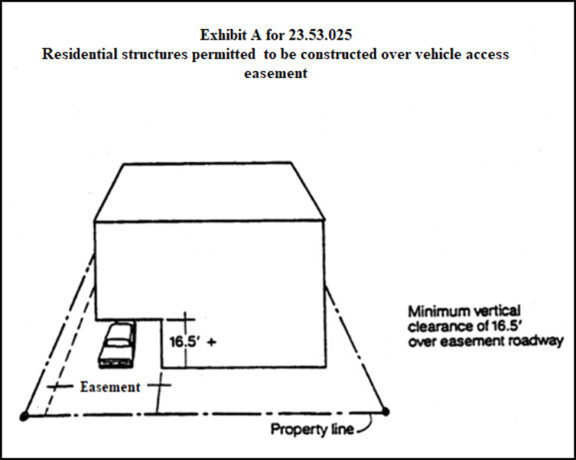
(Ord. 127376, § 58, 2025; Ord. 127219, § 25, 2025; Ord. 126682, § 8, 2022; Ord. 125791, § 85, 2019; Ord. 123963, § 19, 2012; Ord. 123649, § 36, 2011; Ord. 123495, § 62, 2011; Ord. 122205, § 10, 2006; Ord. 122050, § 14, 2006; Ord. 121196, § 21, 2003; Ord. 118414, § 38, 1996; Ord. 117263, § 49, 1994; Ord. 115568, § 8, 1991; Ord. 115326, § 26, 1990.)
23.53.030 - Alley improvements in all zones
A.
General requirements
1.
The regulations in this Section 23.53.030 are not intended to preclude the use of Chapter 25.05 to mitigate adverse environmental impacts.
2.
Detailed requirements for alley improvements are located in the Right-of-Way Improvements Manual, which is adopted by joint rule of the Director and the Director of Transportation.
B.
New alleys
1.
New alleys created through the platting process shall meet the requirements of Subtitle II of this Title 23.
2.
The required right-of-way widths for new alleys shall be as shown on Table A for Section 23.53.030.
3.
If an alley abuts lots in more than one zone category, the minimum alley width shall be determined based on the requirements in Table A for Section 23.53.030 for the zone category with the most frontage excluding Zone Category 1. If the zone categories have equal frontage, the one with the wider requirement shall be used to determine the minimum alley width.
C.
Definition of improved alley. In certain zones, alley access is required if the alley is improved. For the purpose of determining if access is required, the alley will be considered improved if it meets the standards of this subsection 23.53.030.C.
1.
Right-of-way width
a.
The minimum width for an alley to be considered to be improved shall be as shown on Table B for Section 23.53.030.
b.
If an alley abuts lots in more than one zone category, the minimum alley width shall be determined based on the requirements in Table B for the zone category with the most frontage excluding Zone Category 1. If Zone Categories 2 and 3 have equal frontage, the minimum alley width shall be 16 feet.
2.
Paving. To be considered improved, the alley shall be paved.
D.
Minimum widths established.
1.
The minimum required width for an existing alley right-of-way shall be as shown on Table C for Section 23.53.030.
2.
If an alley abuts lots in more than one zone category, the minimum alley width shall be determined based on the requirements in Table C for Section 23.53.030 for the zone category with the most frontage excluding Zone Category 1. If the zone categories have equal frontage, the one with the wider requirement shall be used to determine the minimum alley width.
E.
Existing alleys that meet minimum width. Except as provided in subsection 23.53.030.G and except for one and two dwelling unit developments that abut an alley that is not improved but is in common usage, if an existing alley meets the minimum right-of-way width established in subsection 23.53.030.D, the following requirements shall be met:
1.
If the alley is used for access to parking spaces, open storage, or loading berths on a lot, the following improvements shall be provided:
a.
For the following types of projects, the entire width of the portion of the alley abutting the lot, and the portion of the alley between the lot and a connecting street, shall be improved to at least the equivalent of a crushed rock surface, according to the Right-of-Way Improvements Manual or successor. The applicant may choose the street to which the improvements will be installed. If the alley does not extend from street to street, and the connecting street is an arterial designated on the Arterial street map, Section 11.18.010, either the remainder of the alley shall be improved so that it is passable to a passenger vehicle, or a turnaround shall be provided. The turnaround may be provided by easement.
1)
Residential structures with fewer than ten units;
2)
The following uses if they are smaller than 750 square feet of gross floor area: major and minor vehicle repair uses, and multipurpose retail sales;
3)
Nonresidential structures or structures with one or more live-work units that: (a) have less than 4,000 square feet of gross floor area; and (b) do not contain uses listed in subsection 23.53.030.E.1.a.2 that are larger than 750 square feet;
4)
Structures containing a mix of residential and either nonresidential uses or live-work units, if the residential use is less than ten units, and the total square footage of nonresidential uses and live-work units is less than specified in subsections 23.53.030.E.1.a.2 and E.1.a.3;
5)
Remodeling and use changes within existing structures, if remodeling and use changes require increases to parking spaces, open storage, or loading berths on a lot;
6)
Additions to existing structures that are exempt from environmental review; and
7)
Expansions of a surface parking area or open storage area of less than 20 percent of the parking area, storage area or number of parking spaces.
b.
For projects not listed in subsection 23.53.030.E.1.a, the entire width of the portion of the alley abutting the lot, and the portion of the alley between the lot and a connecting street, shall be paved. The applicant may choose the street to which the pavement will be installed. If the alley does not extend from street to street, and the connecting street is an arterial designated on the Arterial street map, Section 11.18.010, either the remainder of the alley shall be improved so that it is passable to a passenger vehicle, or a turnaround shall be provided. The turnaround may be provided by easement.
2.
If the alley is not used for access, or if the alley is not fully improved, all structures shall be designed to accommodate the grade of the future alley improvements, and a no-protest agreement to future alley improvements is required, as authorized by chapter 35.43 RCW. The agreement shall be recorded with the King County Recorder.
F.
Existing alleys that do not meet minimum width
1.
When an existing alley is used for access to parking spaces, open storage, or loading berths on a lot, and the alley does not meet the minimum width established in subsection 23.53.030.D, except as provided in subsection 23.53.030.G, a dedication equal to half the difference between the current alley right-of-way width and minimum right-of-way width established in subsection 23.53.030.D shall be required; provided, however, that if right-of-way has been dedicated since 1982, other lots on the block shall not be required to dedicate more than that amount of right-of-way. Underground and overhead portions of structures that would not interfere with the functioning of the alley may be allowed by the Director of the Seattle Department of Construction and Inspections after consulting with the Director of Transportation. When existing structures are located in the portion of the lot to be dedicated, that portion of the lot shall be exempt from dedication requirements. The improvements required under subsection 23.53.030.E.1 shall then be installed, depending on the type of project.
2.
When an existing alley is not used for access to parking spaces or loading berths on an abutting lot, but the alley does not meet the minimum width established in subsection 23.53.030.D, except as provided in subsection 23.53.030.G, the following requirements shall be met:
a.
A setback equal to half the distance between the current alley right-of-way width and the minimum right-of-way width established in subsection 23.53.030.D shall be required; provided, however, that if a setback has been provided under this provision, other lots on the block shall provide the same setback. The area of the setback may be used to meet any development standards, except that required parking and loading berths may not be located in the setback. Underground and overhead structures which would not prevent the future widening and improvement of the right-of-way may be permitted in the required setback by the Director of the Seattle Department of Construction and Inspections after consulting with the Director of Transportation.
b.
All structures shall be designed to accommodate the grade of the future alley right-of-way.
c.
A no-protest agreement to future street improvements shall be required, as authorized by chapter 35.43 RCW. The agreement shall be recorded with the title to the property with the King County Recorder's Office.
G.
Exceptions. The Director, after consulting with the Director of the Department of Transportation, may modify or waive the requirements for dedication, paving and drainage, setbacks, grading and no-protest agreements, if it is determined that one (1) or more of the following conditions are met. The Director may require access to be from a street if alley improvements are also waived.
1.
Location in an environmentally critical area or buffer, disruption of existing drainage patterns, or removal of natural features such as significant trees makes widening and/or improving the right-of-way impractical or undesirable;
2.
Widening and/or improving the right-of-way would make a building on a lot infeasible by reducing it to dimensions where development standards cannot reasonably be met;
3.
Widening and/or improving the right-of-way would eliminate alley access to an existing lot;
4.
Widening and/or improving the right-of-way is impractical because topography precludes the use of the alley for vehicular access to the lot;
5.
The alley is in a historic district or special review district, and the Department of Neighborhoods Director finds, after review and recommendation by the appropriate review board, that the widening and/or improvement would be detrimental to the character and goals of the district;
6.
The existence of a bridge, viaduct or structure such as a substantial retaining wall makes widening the right-of-way impractical or undesirable;
7.
Widening the right-of-way would adversely affect the character of the street, as it is defined in an adopted neighborhood plan or adopted City plan for green streets, boulevard, or other special right-of-way, or would otherwise conflict with the stated goals of such a plan;
8.
One (1) or more substantial principal structures on the same side of the block as the proposed project are located in the area needed for future expansion of the right-of-way and the structure(s)' condition and size make future widening of the remainder of the right-of-way unlikely;
9.
Widening and/or improving the right-of-way is not necessary because it is adequate for current and potential pedestrian and vehicular traffic, for example, due to the limited number of lots served by the development or because the development on the right-of-way is at zoned capacity.
(Ord. 127099, § 45, 2024; Ord. 126509, § 75, 2022 [zone name change]; Ord. 125603, § 59, 2018; Ord. 125272, § 47, 2017; Ord. 124919, § 142, 2015; Ord. 123649, § 37, 2011; Ord. 123495, § 63, 2011; Ord. 123046, §§ 46, 65, 2009; Ord. 122311, § 67, 2006; Ord. 122205, § 11, 2006; Ord. 122050, § 15, 2006; Ord. 121828, § 9, 2005; Ord. 121782, § 28, 2005; Ord. 121276, § 37, 2003; Ord. 121196, § 22, 2003; Ord. 121145, § 13, 2003; Ord. 118414, § 39, 1996; Ord. 118409, § 198, 1996; Ord. 118302, § 12, 1996; Ord. 117570, § 18, 1995; Ord. 117432, § 38, 1994; Ord. 117263 50, 1994; Ord. 116262, § 17, 1992; Ord. 115568, § 8, 1991; Ord. 115326, § 26, 1990.)
23.53.035 - Structural building overhangs and minor architectural encroachments
Structural building overhangs and minor architectural encroachments shall meet the following standards:
A.
Minor architectural encroachments. Minor architectural encroachments include overhead horizontal extensions of a purely architectural or decorative character such as cornices, eaves, sills, and belt courses that do not create any interior volume or floor area.
1.
Minor architectural encroachments shall not increase the floor area or the volume of space enclosed by the building.
2.
The maximum vertical dimension of a minor architectural encroachment is 2 feet 6 inches.
3.
The maximum horizontal dimension of a minor architectural encroachment is:
a.
One foot below roof level;
b.
Three feet at roof level; or
c.
if the roof level is 100 feet or higher above the street elevation, more than 3 feet at roof level if the minor architectural encroachment is:
1)
architecturally consistent with the structure;
2)
does not preclude use of the right-of-way for transportation or access purposes as determined in consultation with the Seattle Department of Transportation;
3)
poses no threat to public health and safety.
Exhibit A for 23.53.035
Minor architectural encroachments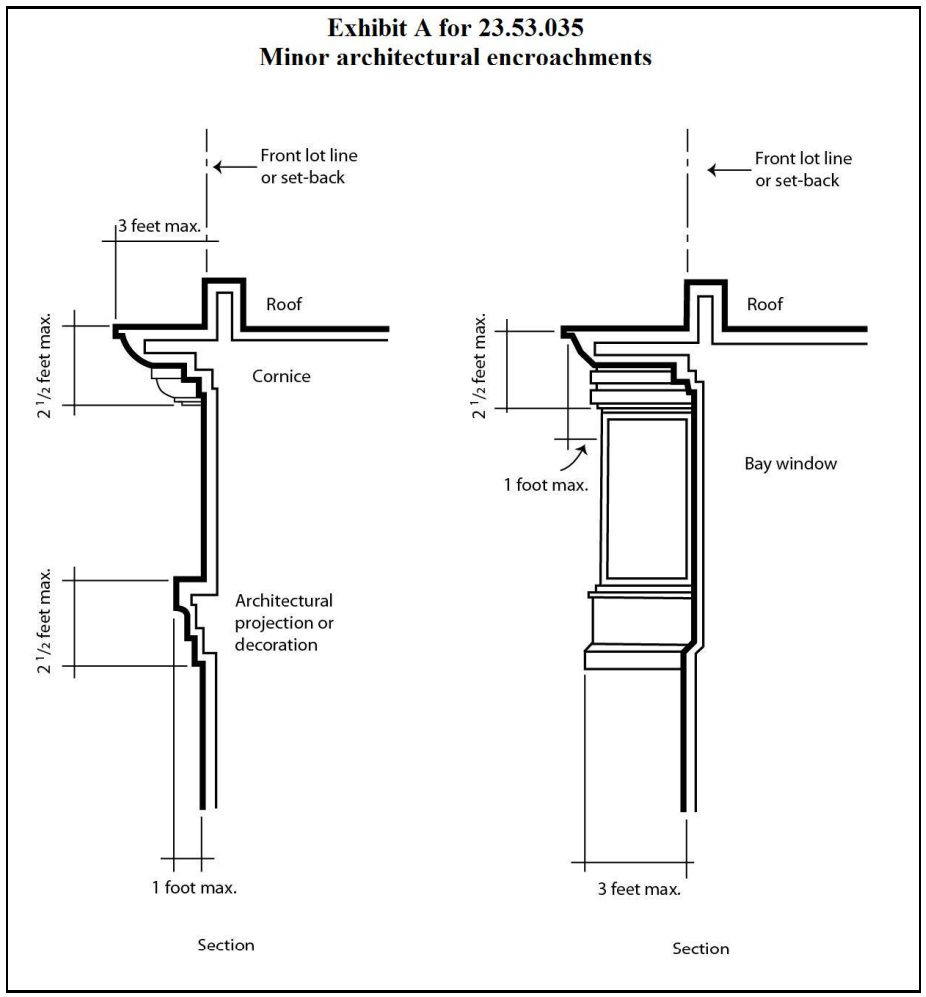
4.
Vertical clearance. Clearance to any minor architectural encroachment shall be a minimum of 8 feet above all sidewalk elevations, or 16 feet above all elevations of an alley, or greater when required by other regulations.
B.
Structural building overhangs. Structural building overhangs include bay windows, balconies, and other projections into and over public places as defined under Title 15 that exceed the limits of minor architectural encroachments as set forth in subsection 23.53.035.A and that increase either the floor area of the building or the volume of space enclosed by the building above grade.
1.
An annual permit from the Seattle Department of Transportation is required for structural building overhangs.
2.
Structural building overhangs shall be removable per Title 15.
3.
Structural building overhangs shall not be part of the essential building structure and shall not contain building systems, such as plumbing.
4.
Vertical clearance: Clearance to any structural building overhang shall be a minimum of 8 feet above all sidewalk elevations, or 26 feet above all elevations of an alley, or greater if required by other regulations.
5.
Depth: The maximum horizontal projection for a structural building overhang, measured to the furthest exterior element, shall be 3 feet, and the projection shall in no case be closer than 8 feet to the centerline of any alley (see Exhibit B for 23.53.035).
Exhibit B for 23.53.035
Depth of structural building overhangs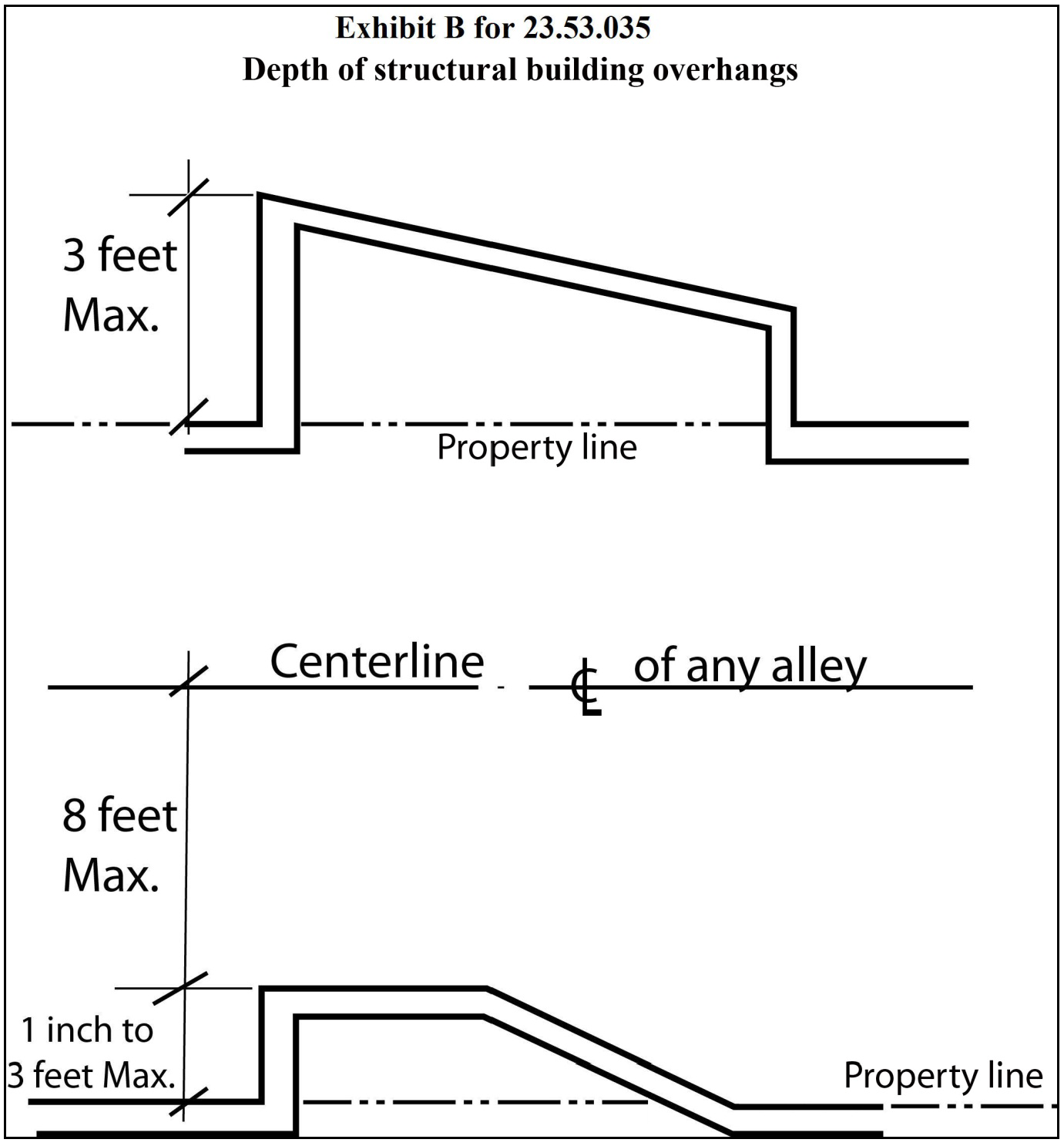
6.
Transparency: The glass areas of each bay window shall be a minimum of 50 percent of the sum of the areas of all the vertical surfaces of the bay window. At least 60 percent of such required glass area for each bay window shall be on the vertical surface most parallel to the property line (see Exhibit C for 23.53.035).
Exhibit C for 23.53.035
Transparency requirements for structural building overhangs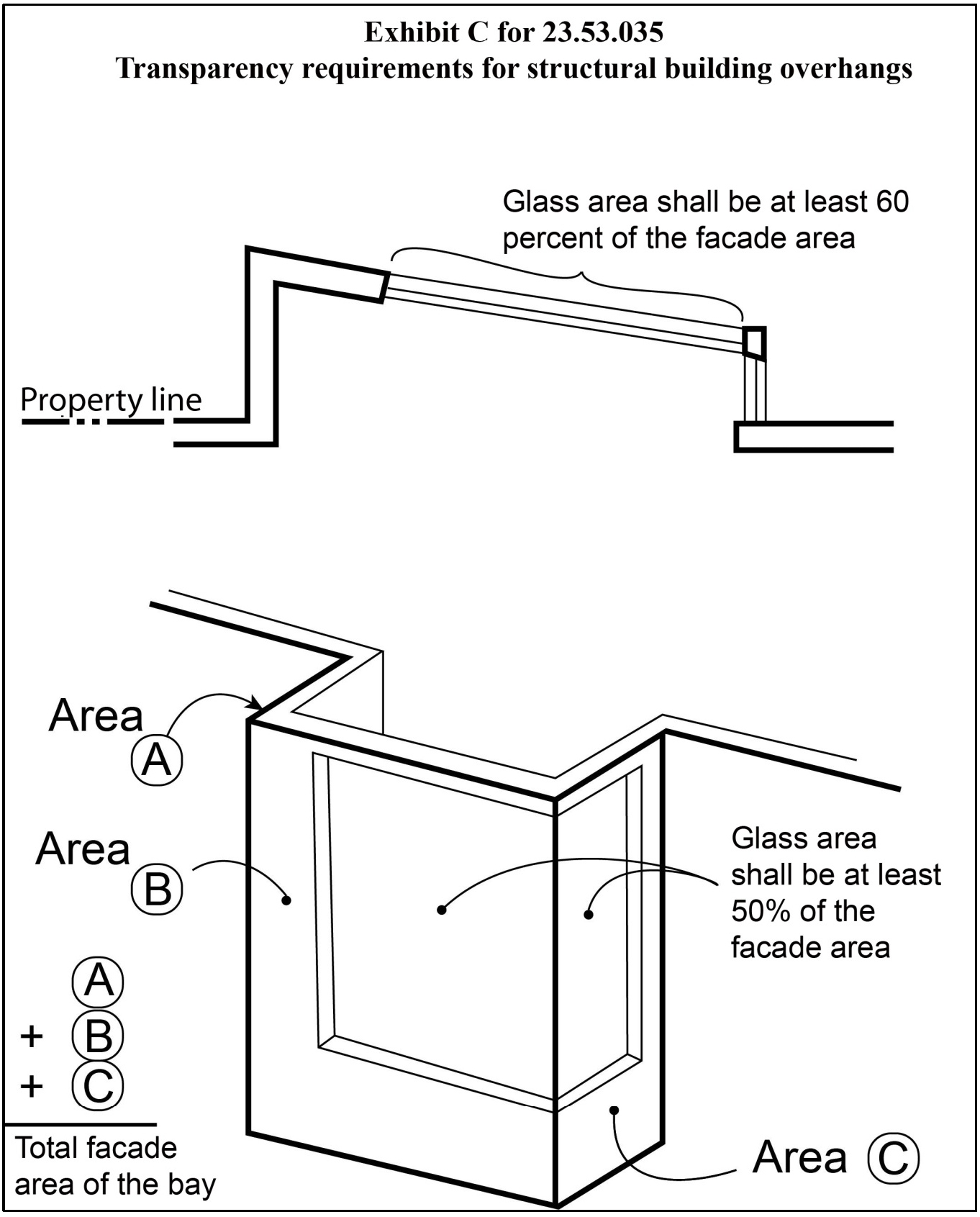
7.
Length: The maximum length of each structural building overhang shall be 15 feet measured at any location that is beyond the property line. The bay or other projection may be shaped in any way that remains within the 3 foot by 15 foot envelope beyond the property lines (see Exhibit D1 for 23.53.035).
Exhibit D1 for 23.53.035
Maximum length of structural building overhangs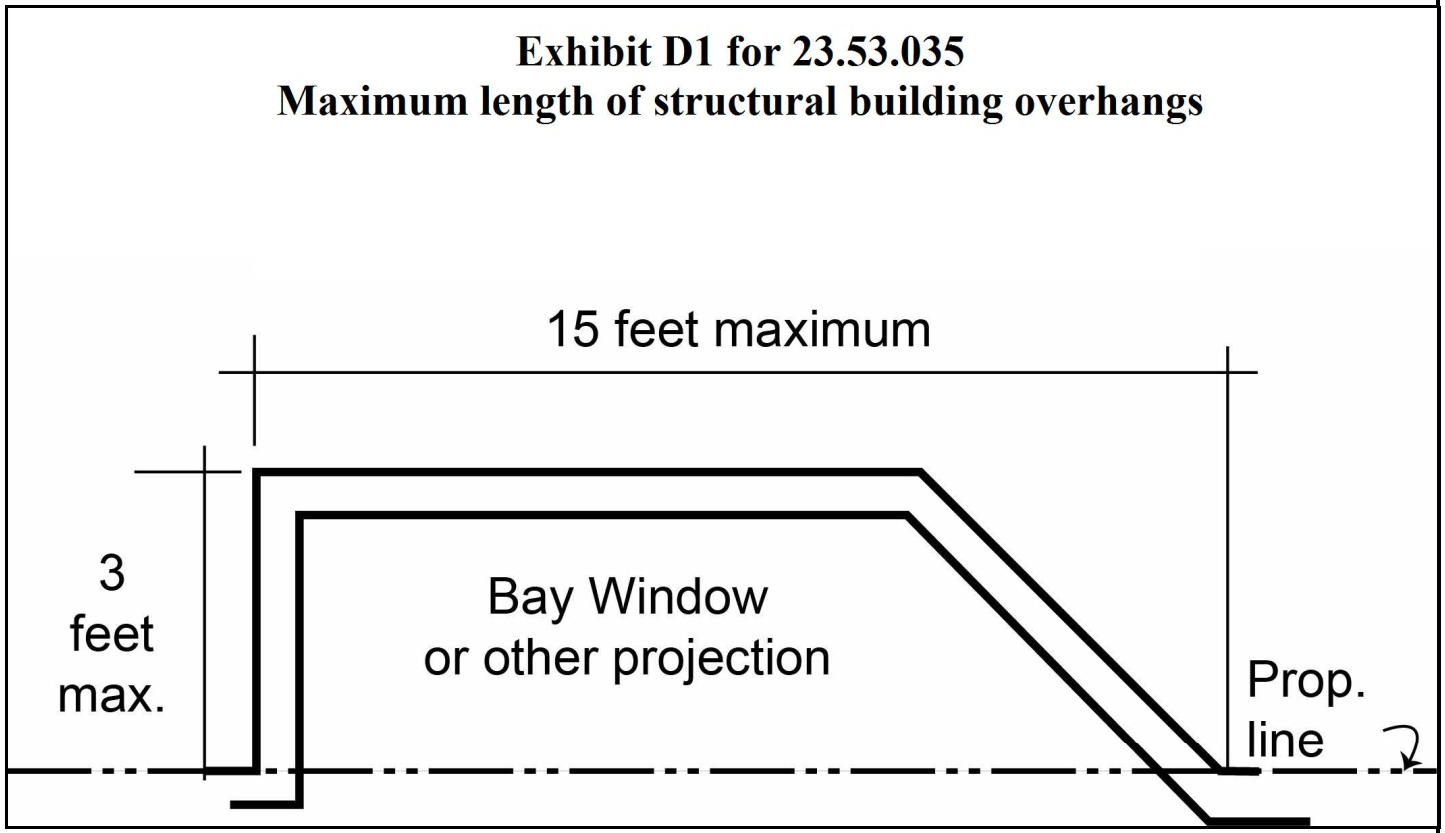
8.
Bay window and balcony combinations: If a bay window and a balcony are located immediately adjacent to one another, and the floor of such balcony has a minimum horizontal dimension of 6 feet parallel to the property line, the maximum length of the bay window and balcony together shall be 18 feet (see Exhibit D2 for 23.53.035).
Exhibit D2 for 23.53.035
Maximum length of bay window and balcony combinations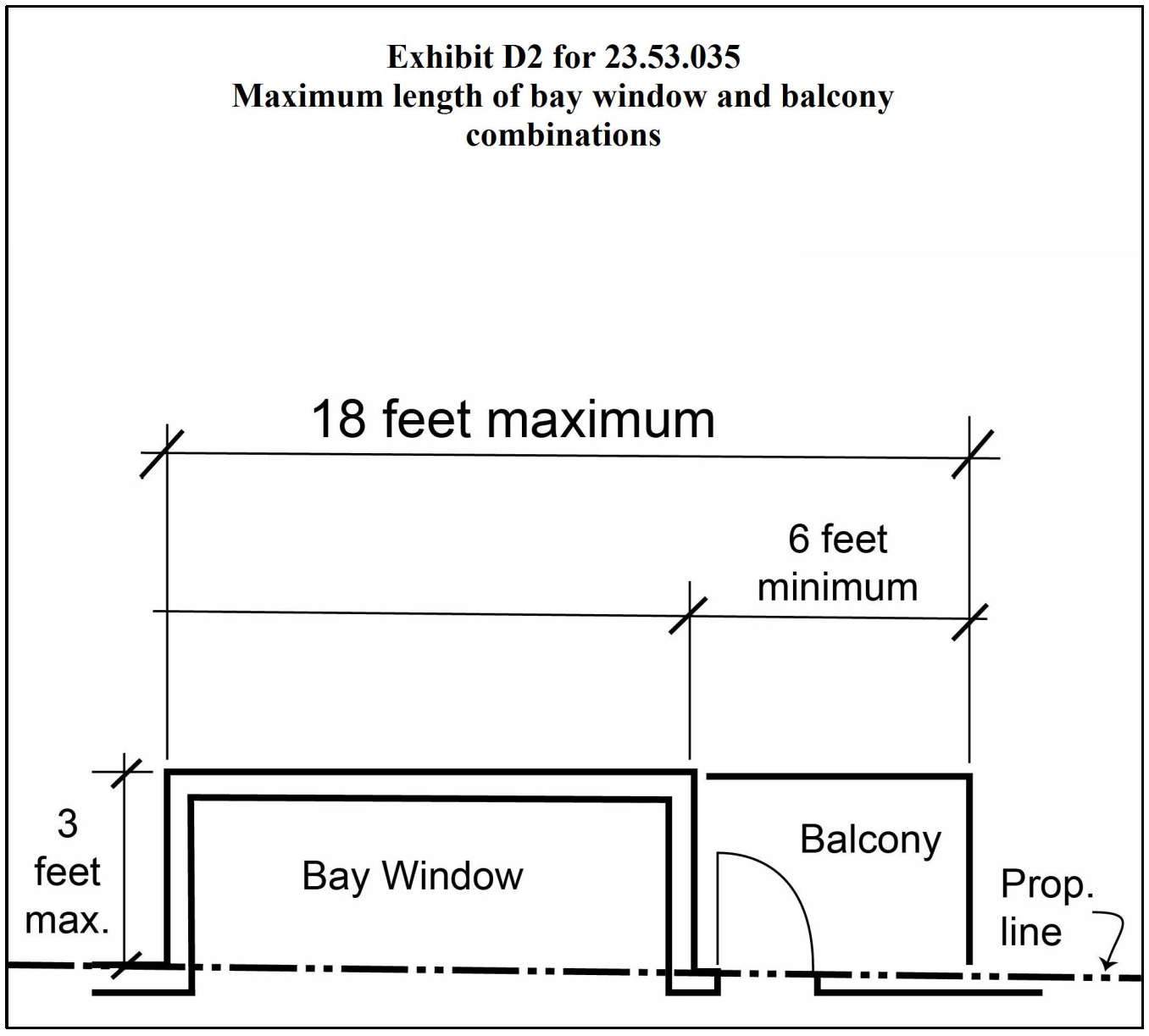
9.
Separation: The minimum horizontal separation between bay windows, between balconies, and between bay window and balcony combinations, shall be 8 feet (see Exhibit E for 23.53.035).
Exhibit E for 23.53.035
Separation between structural building overhangs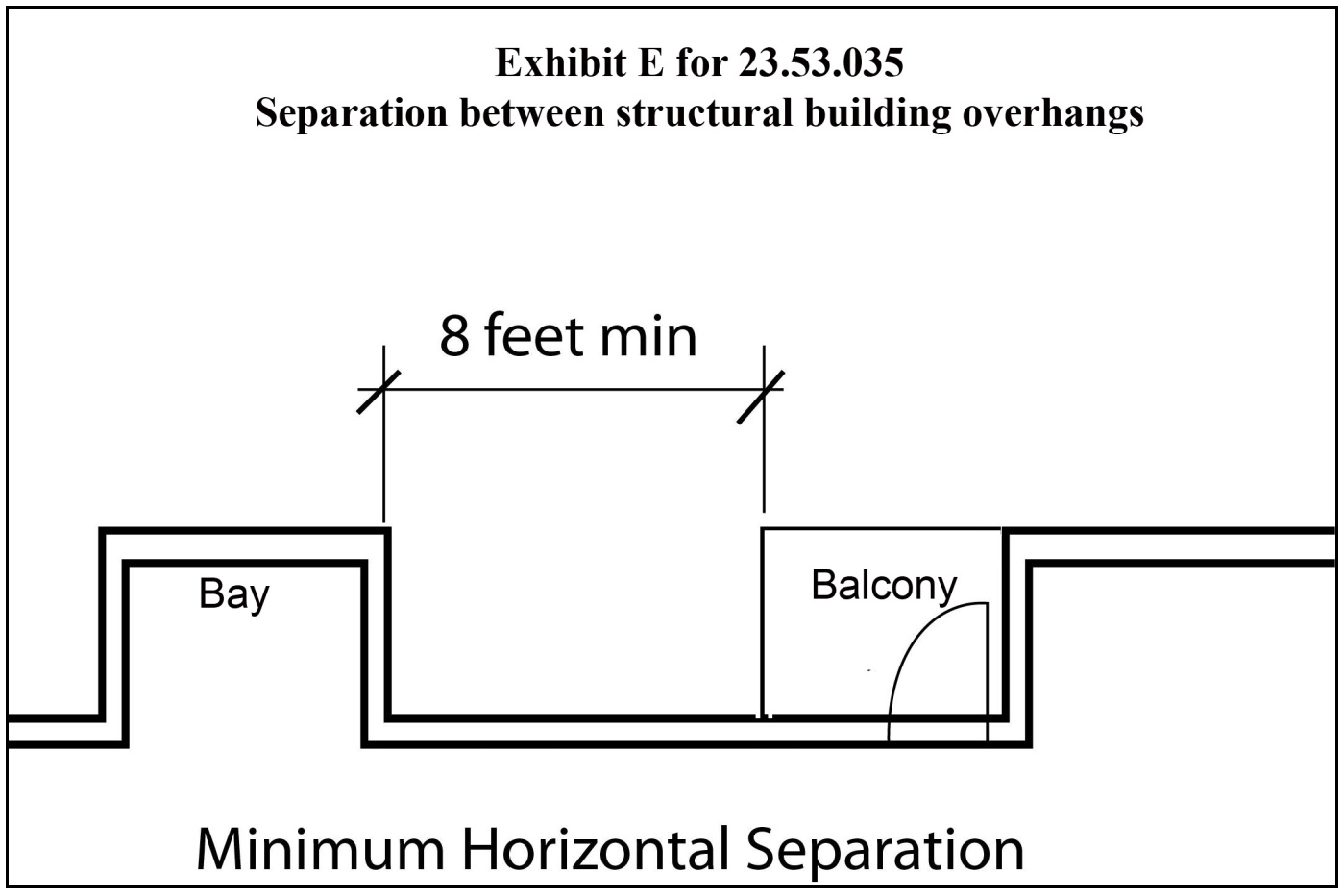
10.
Interior lot lines: Each bay window or balcony or other projection over a street or alley shall also be horizontally separated from interior lot lines by a minimum of 1 foot (except where the wall of a building on the adjoining lot is flush to the interior lot line immediately adjacent to the projecting portions of such bay window or balcony, then the bay window, balcony or projection may be placed at the interior lot line) (see Exhibit F for 23.53.035).
Exhibit F for 23.53.035
Minimum distance from interior lot lines for structural building overhangs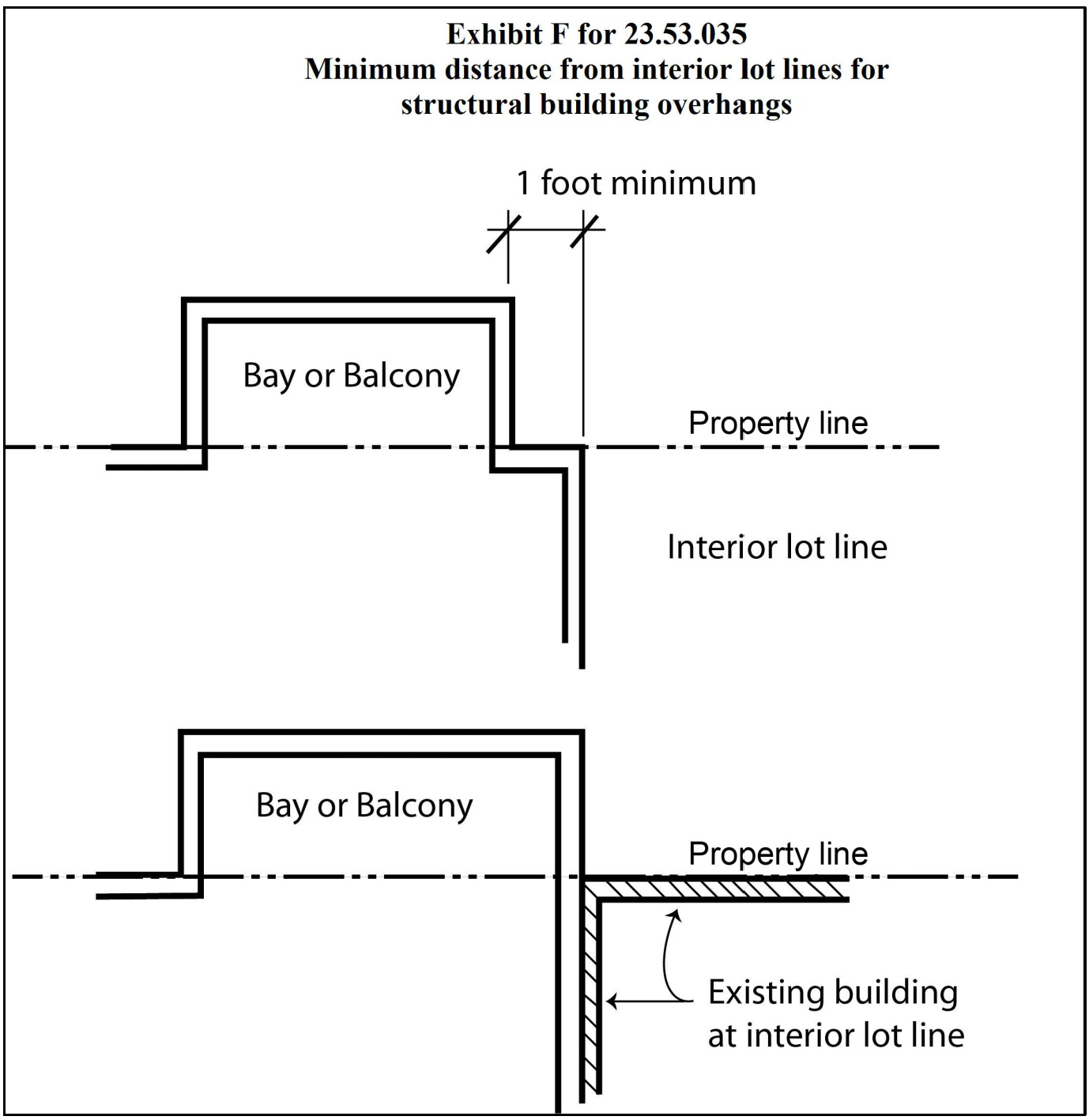
11.
Corners: Bay windows, balconies, and other projections may be located at a property corner but are limited to a maximum width of 15 feet along each facade of the corner, and a maximum total horizontal area of 81 square feet per floor. If there is no bay at the corner, then the minimum distance from the property corner to the nearest projecting bay is 15 feet (see Exhibit G for 23.53.035).
Exhibit G for 23.53.035
Structural building overhangs at property corners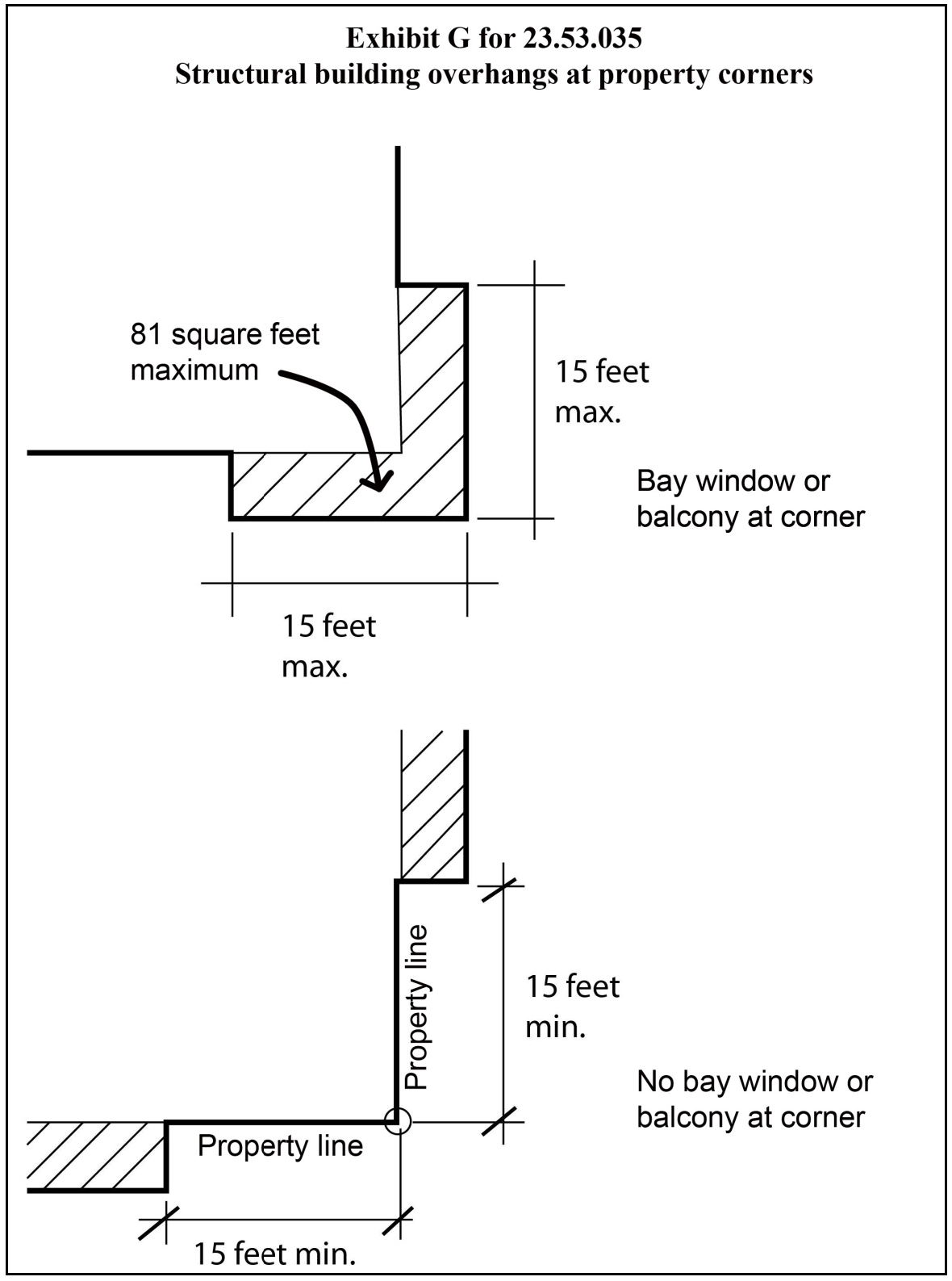
12.
Total facade area: The total vertical surface area of bay windows, balconies and other projections, measured at the maximum horizontal dimension into the public property, shall not exceed 30 percent of the total vertical surface area of the respective street-facing or alley facade. The vertical surface area of all solid balcony railings that project beyond the property line is included in this calculation; open railings are not (see Exhibit H for 23.53.035).
Exhibit H for 23.53.035
Structural building overhangs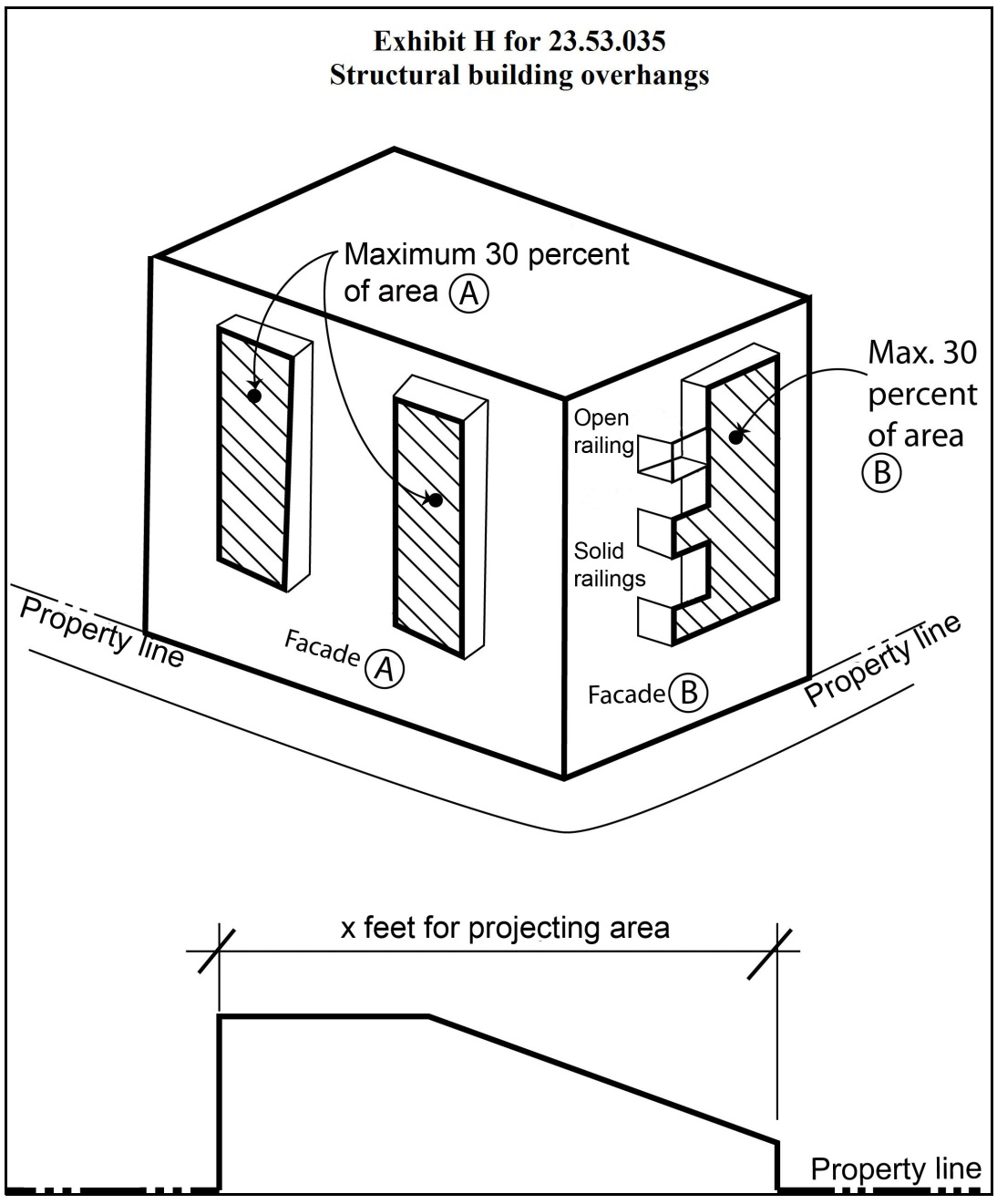
C.
Canopies. Canopies shall be no closer than 6 feet to the curb.
D.
Street trees. If the Seattle Department of Transportation landscape architect indicates that retention of street trees would be unfeasible, planting of new street trees of at least 4 inch caliper shall be required.
E.
Certain exceptions. Exceptions to the requirements in this Section 23.53.035 may be authorized for landmark structures, if they:
1.
Are compatible with the character-defining architectural features of the landmark structure, as determined in consultation with the Department of Neighborhoods;
2.
Do not preclude use of the right-of-way for transportation or access purposes as determined in consultation with the Seattle Department of Transportation; and
3.
Pose no threat to public health and safety.
(Ord. 124378, § 56, 2013; Ord. 121477 § 29, 2004; Ord. 119618 § 6, 1999.)

