
Seattle City Zoning Code
CHAPTER 23
44 - NEIGHBORHOOD RESIDENTIAL
23.44.010 - Scope of provisions
A.
This Chapter 23.44 establishes regulations for the Neighborhood Residential (NR) zone.
B.
Some land in these zones may be regulated by Subtitle III, Division 3, Overlay Districts, of this Title 23 in addition to the standards of this Chapter 23.44.
C.
Other regulations may apply to development proposals, including but not limited to general use provisions (Chapter 23.42); transportation concurrency and transportation impact mitigation (Chapter 23.52); requirements for streets, alleys, and easements (Chapter 23.53); standards for access, off-street parking, and solid waste storage (Chapter 23.54); sign regulations (Chapter 23.55); communication regulations (Chapter 23.57); shoreline regulations (Chapter 23.60A); and environmental protection and historic preservation (Title 25).
D.
Congregate residences are subject to additional requirements as specified in Section 23.42.049.
(Ord. 127376, § 31, 2025.)
23.44.020 - Permitted and prohibited uses
A.
All uses are permitted outright, prohibited, or permitted as a conditional use according to Table A for 23.44.020 and this Section 23.44.020. Uses not referred to in Table A for 23.44.020 are prohibited, unless otherwise indicated in this Chapter 23.44 or Chapters 23.51A, 23.51B, or 23.57. Communication utilities and accessory communication devices, except as exempted in Section 23.57.002, are subject to this Chapter 23.44 and Chapter 23.57. Public facilities are subject to Section 23.51A.004.
B.
All permitted uses are allowed as a principal use or as an accessory use, unless otherwise indicated in this Chapter 23.44.
C.
Accessory uses
1.
Except as otherwise provided in this subsection 23.44.020.C, accessory uses customarily incidental to principal uses permitted outright are permitted outright.
2.
All accessory uses and structures, except for urban farms and structures in urban farm use, must be located on the same lot as the principal use or structure unless otherwise specifically provided.
3.
Urban farms with planting area not more than 4,000 square feet are permitted outright as an accessory use. Urban farms with more than 4,000 square feet of planting area may be permitted as an administrative conditional use accessory to any principal use permitted outright or as a conditional use, pursuant to Section 23.42.051.
4.
Piers and floats are permitted, provided they comply with Chapter 23.60A.
5.
Bed and breakfast uses are permitted outright if:
a.
The bed and breakfast use has a valid business license tax certificate issued by the Department of Finance and Administrative Services;
b.
The bed and breakfast use is operated by the primary resident of the dwelling unit where the bed and breakfast is located or the resident operator;
c.
There is no evidence of the bed and breakfast use visible from the exterior of the dwelling unit except for a sign permitted by subsection 23.55.020.D.1; and
d.
The bed and breakfast use has no more than five guest rooms, provided that this limitation does not apply to bed and breakfast uses that were established on or before April 1, 1987.
6.
Accessory dwelling units are permitted, provided they comply with Section 23.42.022.
7.
Human service uses accessory to institutional uses are permitted outright.
D.
Existing cemeteries are permitted and are prohibited from expanding. New cemeteries are prohibited. For purposes of this Section 23.44.020, a change in a cemetery boundary is not considered an expansion in size and is permitted provided that:
1.
The change does not increase the net land area occupied by the cemetery;
2.
The land being added to the cemetery is contiguous to the existing cemetery and is not separated from the existing cemetery by a public street or alley whether or not improved; and
3.
The use of the land being added to the cemetery will not result in the loss of housing.
E.
All ground-floor commercial uses permitted pursuant to this Section 23.44.020 shall meet the following conditions:
1.
The commercial use is limited to the following:
a.
Food processing and craft work;
b.
General sales and services; and
c.
Restaurants;
2.
The gross floor area of commercial uses does not occupy more than 2,500 square feet of gross floor area;
3.
The commercial use is located only on or below the ground floor of a structure;
4.
Vents for venting of odors, vapors, smoke, gas and fumes, and exterior heat exchangers and other similar devices (e.g., related to ventilation, air conditioning, refrigeration) shall be at least 10 feet above finished sidewalk grade and directed away to the extent possible from residential uses within 50 feet of the vent;
5.
Drive-in businesses are prohibited as a principal or accessory use;
6.
Outdoor sales of food or beverages must be located at least 50 feet from adjacent lots;
7.
Outdoor service of food or beverages must be located at least 50 feet from adjacent lots; and
8.
Businesses may not be open between the hours of 10 p.m. and 6 a.m.
(Ord. 127376, § 31, 2025.)
23.44.030 - Administrative conditional uses
A.
Uses permitted as administrative conditional uses in Section 23.44.020 may be permitted by the Director when the provisions of Section 23.42.042 and this Section 23.44.030 are met.
B.
Unless otherwise specified in this Chapter 23.44, conditional uses shall meet the development standards for uses permitted outright. If an existing structure is nonconforming to development standards, no conditional use is required for any alterations that do not increase the nonconformity.
C.
Institutions other than public schools that do not meet the development standards of this Chapter 23.44, including Major Institution uses as provided in Chapter 23.69, and the expansion of existing private clubs may be permitted subject to the following:
1.
Bulk and siting. In order to accommodate the special needs of the proposed institution, and to better site the facility with respect to its surroundings, the Director may modify the applicable development standards. In determining whether to allow such modifications, the Director shall balance the needs of the institution against the compatibility of the proposed institution with the residential scale and character of the surrounding area.
2.
Noise, Light and Glare. The Director may condition the permit in order to mitigate potential noise, light and glare impacts. Measures the Director may require for this purpose include, but are not limited to the following: visual screening, landscaping, sound barriers, fences, berms, adjustments to setbacks or the location of refuse storage areas, location of parking areas and access, structural design modifications, limiting exterior lighting fixture type, location and height to mitigate light trespass, and regulating hours of use.
3.
Transportation plan. A transportation plan is required for proposed new institutions and for those institutions proposing to expand larger than 4,000 square feet of gross floor area and/or to provide 20 or more new parking spaces. The Director may condition a permit to mitigate potential traffic and parking impacts pursuant to a Transportation Management Plan or Program as described in Director's rules governing such plans or programs. The Director will determine the level of detail to be disclosed in the transportation plan based on the probable impacts and/or scale of the proposed institution.
D.
A use not otherwise permitted in a Neighborhood Residential zone within a structure designated as a Seattle Landmark that is subject to controls and incentives imposed by a designating ordinance, when the owner of the Landmark has executed and recorded an agreement acceptable in form and content to the Landmarks Preservation Board providing for the restoration and maintenance of the historically significant features of the structure, may be permitted subject to the following:
1.
The use is compatible with the existing design and/or construction of the structure without significant alteration;
2.
Uses permitted by the zone are impractical because of structure design and/or that no permitted use can provide adequate financial support necessary to sustain the structure in reasonably good physical condition; and
3.
The use shall not be detrimental to other properties in the zone or vicinity or to the public interest.
E.
Uses in structures unsuited to uses permitted outright
1.
A use not otherwise permitted in a Neighborhood Residential zone may be permitted as an administrative conditional use in structures unsuited to uses permitted outright in Neighborhood Residential zones. The determination that a use may be permitted shall be based on the following factors:
a.
The design of the structure is not suitable for conversion to a use permitted outright in a Neighborhood Residential zone;
b.
The structure contains more than 4,000 square feet; and
c.
The proposed use will provide a public benefit.
2.
Parking requirements for uses permitted under this subsection 23.44.030.E shall be determined by the Director.
3.
The Director may require measures to mitigate impacts such as noise, odor, parking, or traffic impacts. Mitigating measures may include but are not limited to landscaping, sound barriers, fences, mounding or berming, adjustments to development standards, design modifications, or setting hours of operation.
4.
In the case of an existing or former public school, permissible uses other than those permitted outright in the zone and their development standards including parking requirements shall be established only pursuant to procedures for establishing criteria for joint use or reuse of public schools in Chapter 23.78.
F.
A park and ride facility under the management of a public agency responsible for commuter pooling efforts may be permitted if the Director determines that:
1.
It is to be located on an existing parking lot;
2.
That parking proposed for the park and ride facility is not needed by the principal use or its accessory uses during the hours proposed for park and ride use; and
3.
The park and ride use shall not interfere or conflict with the peak-hour activities associated with the principal use and its accessory uses. The Director may control the number and location of parking spaces to be used.
G.
Any use that was previously authorized by a conditional use permit but which has been discontinued shall not be re-established or re-commenced except pursuant to a new conditional use permit, provided that such permit is required for the use at the time re-establishment or re-commencement is proposed. Vacant property, except for dead storage of materials or equipment of the conditional use, shall not be considered as being devoted to the authorized conditional use. The expiration of licenses necessary for the conditional use shall be evidence that the property is not being devoted to the conditional use. A conditional use in a residential structure or a multitenant commercial structure shall not be considered as discontinued unless all units are either vacant or devoted to another use. The following shall constitute conclusive evidence that the conditional use has been discontinued:
1.
A permit to change the use of the property has been issued and the new use has been established; or
2.
The property has not been devoted to the authorized conditional use for more than 24 consecutive months.
H.
Minor structural work that does not increase usable gross floor area or seating capacity and that does not exceed the development standards applicable to the use shall not be considered an expansion and does not require approval as a conditional use unless the work would exceed the height limit of the zone for uses permitted outright. Such work includes but is not limited to roof repair or replacement and construction of uncovered decks and porches, facilities for barrier-free access, bay windows, dormers, and eaves.
(Ord. 127376, § 31, 2025.)
23.44.040 - General provisions
A.
An exception from one specific standard does not relieve the applicant from compliance with any other standard.
B.
Any structure occupied by a permitted principal use other than residential use may be converted to residential use even if the structure does not conform to the development standards for residential uses in the Neighborhood Residential zone.
C.
Assisted living facilities, congregate residences, and structures containing ground floor commercial uses shall meet the development standards for stacked dwelling units unless otherwise specified.
D.
If more than one category of residential use is located on a lot, and if different development standards apply to the different categories of use, then each category's percentage of the total limit imposed by the development standard shall be calculated based on each category's percentage of total structure footprint area as follows:
1.
Calculate the footprint, in square feet, for each category of residential use. For purposes of this calculation, "footprint" is defined as the horizontal area enclosed by the exterior walls of the structure.
2.
Calculate the total square feet of the footprint of all categories of residential uses on the lot.
3.
Divide the square footage of the footprint for each category of residential structure in subsection 23.44.040.D.1 by the total square feet of the footprint of all residential uses in subsection 23.44.040.D.2.
4.
Multiply the percentage calculated in subsection 23.44.040.D.3 for each housing category by the area of the lot. The result is the area of the lot devoted to each housing category.
5.
The total limit for each category of residential use is the applicable limit for that use multiplied by the percentage calculated in subsection 23.44.040.D.4.
E.
As a Type I decision, the Director may waive or modify the standards of Sections 23.44.110 and 23.44.130, and subsections 23.44.160.A and 23.44.160.B for the conversion of a residential structure within a development from one dwelling unit to two or more dwelling units. For the purposes of this subsection 23.44.040.E, conversion means keeping an existing residential structure intact without the addition of interior floor area.
(Ord. 127376, § 31, 2025.)
23.44.050 - Floor area
A.
Gross floor area. In Neighborhood Residential zones, gross floor area includes exterior corridors, breezeways, and stairways that provide building circulation and access to dwelling units or sleeping rooms. Balconies, patios, and decks that are associated with a single dwelling unit or sleeping room and that are not used for common circulation are not considered gross floor area.
B.
Floor area ratio (FAR) limits. The FAR limit in Neighborhood Residential zones for lots with residential uses is as shown in Table A for 23.44.050, except that structures on lots with less than 5,000 square feet of lot area can include up to 2,500 square feet of total chargeable floor area or the amount of total chargeable floor area allowed by the FAR limit shown in Table A for 23.44.050, whichever is greater. The FAR limit in Neighborhood Residential zones for lots without residential uses is 1.2. The applicable FAR limit applies to the total chargeable floor area of all structures on the lot.
C.
The following floor area is exempt from FAR limits:
1.
All stories, or portions of stories, that are underground.
2.
All portions of a story that extend no more than 4 feet above existing or finished grade, whichever is lower, excluding access.
3.
Common walls separating individual attached dwelling units.
4.
Square footage of dwelling units that are Type A units as defined in the Seattle Building Code.
D.
The FAR limit for lots with stacked dwelling units that meet the following requirements is as shown in Table A for 23.44.050:
1.
The lot is within one quarter mile of an elementary or secondary school;
2.
At least 25 percent of the stacked dwelling units have a minimum of three bedrooms and a minimum floor area of 1,050 square feet.
E.
The FAR limit for lots with stacked dwelling units with a density of 1 unit per 1,600 square feet of lot size or denser that meet one of the following criteria is 2.0:
1.
Retain a Tier 1 tree, as defined in Section 25.11.130;
2.
Retain two Tier 2 trees, as defined in Section 25.11.130; or
3.
Meet a Green Factor score of 0.6, as measured in Section 23.86.019.
(Ord. 127376, § 31, 2025.)
23.44.060 - Maximum density and minimum lot size
A.
Except as provided in subsection 23.44.060.C, the maximum density is:
1.
For stacked dwelling units, one dwelling unit per 600 square feet of lot area;
2.
For stacked dwelling units that meet one of the following criteria, one dwelling unit per 500 square feet of lot area:
a.
Retain a Tier 1 tree, as defined in Section 25.11.130;
b.
Retain two Tier 2 trees, as defined in Section 25.11.130; or
c.
Meet a Green Factor score of 0.6, as measured in Section 23.86.019;
3.
Within a frequent transit service area, for development consisting entirely of dwelling units in structures that are less than three stories and that are arranged on up to three sides of a common ground-level amenity area equal to at least 20 percent of the lot area that includes usable, contiguous community green space and trees, one dwelling unit per 650 square feet of lot area;
4.
For all other dwelling units, one dwelling unit per 1,250 square feet of lot area.
B.
The minimum lot size for lots created after the effective date of this ordinance is 5,000 square feet.
C.
Maximum density exceptions
1.
A lot that is less than 5,000 square feet may be developed with up to four dwelling units provided that the lot does not contain any riparian corridors; wetlands and their buffers; submerged lands and areas within the shoreline setback; or designated non-disturbance area in steep slopes.
2.
A lot that is less than 7,500 square feet and within one-quarter mile walking distance of a stop on a major transit service may be developed with up to six dwelling units if the lot does not contain any riparian corridors; wetlands and their buffers; submerged lands and areas within the shoreline setback; or designated non-disturbance area in steep slopes.
3.
A lot that is less than 7,500 square feet and located more than one-quarter mile walking distance from a stop on a major transit service may be developed with up to six dwelling units if the lot meets the following criteria:
a.
The lot does not contain any riparian corridors; wetlands and their buffers; submerged lands and areas within the shoreline setback; or designated non-disturbance area in steep slopes;
b.
At least two principal dwelling units are low-income units subject to a regulatory agreement, covenant, or other legal instrument enforceable by The City of Seattle;
c.
The low-income units are generally distributed throughout the development and have substantially the same functionality as unrestricted units in the development;
d.
To the extent practicable, the low-income units are comparable to unrestricted units in terms of square footage and number of bedrooms and bathrooms;
e.
The tenure (i.e., rental or ownership) of low-income units and unrestricted units is the same;
f.
The regulatory agreement, covenant, or other legal instrument contains criteria and policies to maintain public benefit if the property is demolished or converted to a non-residential use;
g.
For ownership housing, the low-income units are stewarded by a qualified non-profit organization, which for purposes of this subsection 23.44.060.C.3 means a non-profit organization that the Office of Housing determines as experienced in the development and stewardship of permanently affordable homes, including:
1)
Pre-purchase verification of income and other requirements for eligible households, affordable sale price calculations for approval by the Office of Housing, and execution of legal restrictions on the property; and
2)
Post-purchase support for homeowners by facilitating resales, monitoring compliance with financial, owner occupancy, and other legal requirements, and clear communication of program guidelines and restrictions; and
h.
At such times as may be required by the Director of Housing but no less than annually, the property owner (for rental housing) or the qualified non-profit organization (for ownership housing) agrees to file property reports with the Office of Housing, verified upon oath or affirmation, which shall contain such information as the Office of Housing may deem necessary to determine compliance with this subsection 23.44.060.C.3 and the regulatory agreement, covenant, or other legal instrument.
4.
For lots that contain any riparian corridors, wetlands and their buffers, submerged lands and areas within the shoreline setback, or designated non-disturbance area in steep slopes, applicants may choose to develop the lot with the number of dwelling units provided in the density limits in subsection 23.44.060.A or with the number of dwelling units calculated as follows:
a.
Determine the number of units that would be allowed under subsections 23.44.060.C.1 through 23.44.060.C.3 if no environmentally critical areas were located on the lot;
b.
Determine the percentage of the lot that is not covered by riparian corridors, wetlands and their buffers, submerged lands and areas within the shoreline setback, or designated non-disturbance area in steep slopes; and
c.
Calculate the number of dwelling units by multiplying the number of units determined in subsection 23.44.060.C.4.a by the percentage of the lot calculated in subsection 23.44.060.C.4.b. At least one dwelling unit is allowed on all lots in existence as of the effective date of this ordinance.
5.
Square footage of dwelling units that are Type A units, as defined in the Seattle Building Code, do not count toward maximum density.
D.
Measurement of minimum lot size and maximum density
1.
When calculation of the number of dwelling units allowed results in a fraction of a unit, any fraction over 0.85 constitutes one additional unit.
2.
Congregate residence sleeping rooms shall be treated as one-fourth of a dwelling unit for purposes of calculating density.
3.
In the case of a development within a unit lot subdivision, the density limit shall be applied to the parent lot as a whole.
4.
If dedication of right-of-way is required, permitted density shall be calculated before the dedication is made.
5.
When calculating density, the number of dwelling units shall include both accessory dwelling units and principal dwelling units.
6.
Areas not counted in calculating the lot size. The following areas shall not be counted in calculating the area of lots for the purpose of calculating the maximum density and the minimum lot size:
a.
Riparian corridors;
b.
Wetlands and their buffers;
c.
Submerged lands and areas within the shoreline setback; and
d.
Designated non-disturbance area in steep slopes.
E.
For the purpose of this Section 23.44.060, designated non-disturbance area in steep slopes shall include all portions of steep slope hazard areas except the following:
1.
Areas that are granted relief from the prohibition of development according to Section 25.09.090;
2.
Areas where development is allowed under a small project waiver according to Section 25.09.090; and
3.
Areas where intrusion into the steep slope erosion hazard area and buffer is allowed by steep slope erosion hazard area variance according to Section 25.09.290.
(Ord. 127376, § 31, 2025.)
23.44.070 - Structure height
A.
Maximum height established
1.
Subject to the exceptions allowed in this Section 23.44.070, the height limit is 32 feet for any structure not listed in subsections 23.44.070.A.2 or 23.44.070.A.3;
2.
The height limit is 42 for the following types of development:
a.
Any development with three or more principal dwelling units and a front setback of at least 20 feet;
b.
Stacked dwelling units that meet the requirements in subsection 23.44.050.D;
c.
Stacked dwelling units on lots that meet a Green Factor score of 0.6 or higher as measured in Section 23.86.019; or
d.
Structures on lots that:
1)
Retain a Tier 1 or a Tier 2 tree, as defined in Section 25.11.130; or
2)
Achieve a tree point score under Section 23.44.120, through planting or preserving medium/large or large trees that would result in at least ten percent canopy coverage for the site at tree maturity.
3.
The height limit for accessory structures that are located in required setbacks is 12 feet, except as follows:
a.
The ridge of a pitched roof may extend up to 3 feet above the 12-foot height limit provided that all parts of the roof above the height limit shall be pitched at a rate of not less than 4:12. No portion of a shed roof is permitted to extend beyond the 12-foot height limit.
b.
Freestanding flagpoles and religious symbols for religious institutions are exempt from height controls except as regulated in Chapter 23.64, provided they are no closer to any lot line than 50 percent of their height above existing grade.
B.
Standards for pitched roofs
1.
The ridge of a pitched roof that is not a shed or butterfly roof may extend up to 5 feet above the maximum height limit, as determined under subsection 23.44.070.A. All parts of the roof above the height limit must be pitched at a rate of not less than 4:12 (see Exhibit A for 23.44.070).
Exhibit A for 23.44.070
Height exception for pitched roofs that are not shed or butterfly roofs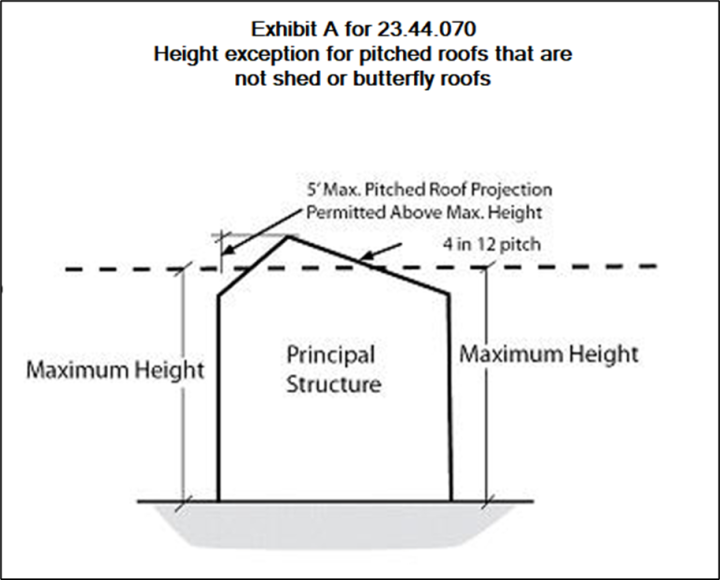
2.
The high side(s) of a shed or butterfly roof may extend 3 feet above the maximum height limit, as determined under subsection 23.44.070.A, provided that the low side(s) of the shed or butterfly roof are no higher than the height limit (see Exhibit B for 23.44.070). The roof line of a shed or butterfly roof may be extended in order to accommodate eaves, provided that the highest point of the roof extension is no more than 4 feet above the height limit.
Exhibit B for 23.44.070
Height exception for shed and butterfly roofs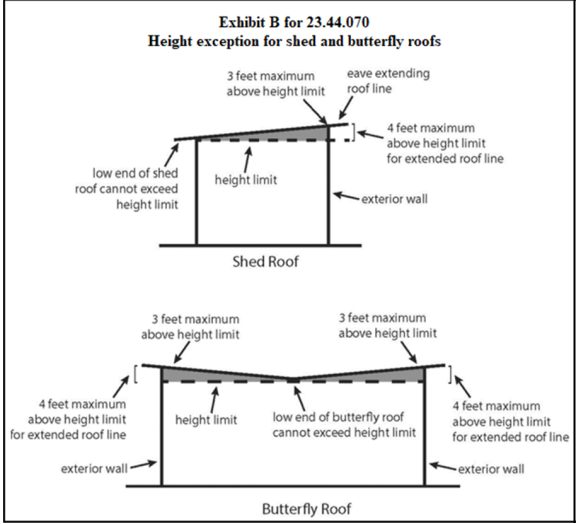
C.
Height limit exceptions
1.
Except in the Airport Height Overlay District, flagpoles are exempt from height limits, provided that they are no closer to any adjoining lot line than 50 percent of their height above existing grade, or, if attached only to a roof, no closer than 50 percent of their height above the roof portion where attached.
2.
Open railings, planters, greenhouses not dedicated to food production, parapets, and firewalls may extend 4 feet above the height limit in subsection 23.44.070.A. Planters on flat roofs shall not be located within 4 feet of more than 25 percent of the perimeter of the roof.
3.
Green roofs may extend 2 feet above the height limit in subsection 23.44.070.A or above a pitched roof allowed in subsection 23.44.070.B.
Exhibit C for 23.44.070
Green roof height allowance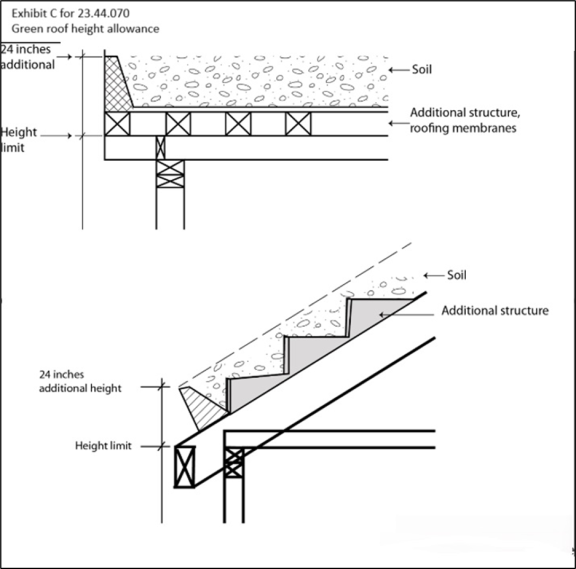
4.
Solar collectors may extend 4 feet above the height limit in subsection 23.44.070.A or above a pitched roof allowed in subsection 23.44.070.B.
5.
For nonresidential principal uses, the following rooftop features may extend up to 10 feet above the height limit in subsection 23.44.070.A, as long as the combined total coverage of all features listed in this subsection 23.44.070.C.5 does not exceed 15 percent of the roof area or 20 percent of the roof area if the total includes screened or enclosed mechanical equipment:
a.
Stair and elevator penthouses;
b.
Mechanical equipment;
c.
Wind-driven power generators; or
d.
Chimneys.
6.
Devices for generating wind power may extend up to 10 feet above the height limit in subsection 23.44.070.A, provided that the combined total coverage of all features does not exceed 15 percent of the roof area.
7.
For height limits and exceptions for communication utilities and accessory communication devices, see Section 23.57.010.
8.
Buildings existing prior to the effective date of this ordinance are permitted to extend up to 8 inches above the height limit in subsection 23.44.070.A or a pitched roof allowed in subsection 23.44.070.B solely for the purpose of adding insulation to an existing roof.
9.
Roofs enclosed by a parapet. Roof surfaces that are completely surrounded by a parapet may exceed the applicable height limit to allow for a slope, provided that the height of the highest elevation of the roof surface does not exceed 75 percent of the parapet height, and provided that the lowest elevation of the roof surface is no higher than the applicable height limit. See Exhibit C for 23.44.070.
Exhibit C for 23.44.070
Height allowance for sloped roofs concealed by a parapet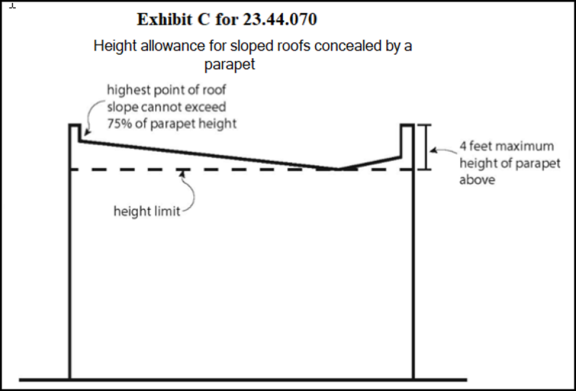
(Ord. 127376, § 31, 2025.)
23.44.080 - Lot coverage
A.
Except as otherwise provided in this Section 23.44.080, the maximum lot coverage allowed for structures is 50 percent.
B.
The following areas shall not be counted in calculating the lot size for the purpose of calculating lot coverage in this Section 23.44.080:
1.
Riparian corridors;
2.
Wetlands and their buffers;
3.
Submerged lands and areas within the shoreline setback; and
4.
Designated non-disturbance area in steep slopes.
C.
Structures not counted. The following structures and portions of structures are not counted in lot coverage calculations:
1.
Underground structures;
2.
The first 36 inches of architectural features such as cornices, eaves, gutters, roofs, fireplaces, chimneys, and other similar features that project from principal and accessory structures;
3.
Decks or parts of a deck that are 36 inches or less above existing grade;
4.
Unenclosed porches or steps no higher than 4 feet above existing grade, or the grade at the street lot line closest to the porch, whichever is lower; and
5.
Unenclosed structures that meet the standards of subsection 23.44.090.H.
6.
Square footage of all Type A dwelling units, as defined in the Seattle Building Code, on any floor of a structure with up to ten stacked dwelling units. Any dwelling units above or below a Type A unit are not required to be Type A units to utilize this exception.
D.
The lot coverage allowed on lots containing areas listed in subsection 23.44.080.B shall not be less than 625 square feet or an amount of lot coverage approved by the Director through an environmentally critical area reduction, waiver, or modification pursuant to Chapter 25.09, whichever is greater.
E.
For the purpose of this Section 23.44.080, designated non-disturbance area in steep slopes shall include all portions of steep slope hazard areas except the following:
1.
Areas that are granted relief from the prohibition of development according to Section 25.09.090;
2.
Areas where development is allowed under a small project waiver according to Section 25.09.090; and
3.
Areas where intrusion into the steep slope erosion hazard area and buffer is allowed by steep slope erosion hazard area variance according to Section 25.09.290.
F.
Within a frequent transit service area, for development consisting entirely of dwelling units in structures that are less than three stories and that are arranged on up to three sides of a common ground-level amenity area equal to at least 20 percent of the lot area, that includes usable, contiguous community green space and trees, the maximum lot coverage allowed for structures is 60 percent.
G.
The maximum lot coverage allowed on lots with stacked dwelling units is 60 percent.
(Ord. 127376, § 31, 2025.)
23.44.090 - Setbacks
A.
Required setbacks for the NR zones are shown in Table A for 23.44.090.
B.
Through lots. In the case of a through lot, each setback abutting a street, shall be a front setback.
C.
Other setback requirements. Additional structure setbacks may be required in order to meet the provisions of Chapter 23.53.
D.
Underground structures. Underground structures, measured from existing or finished grade, whichever is lower, may be located within setbacks.
E.
Projections from an enclosed structure allowed in required setbacks
1.
Architectural features such as cornices, eaves, gutters, roofs, fireplaces, chimneys, and other similar features may project into required setbacks a maximum of 2 feet if they are no closer than 3 feet to any lot line.
2.
Garden windows and other similar features that do not provide floor area may project a maximum of 18 inches into required setbacks if they:
a.
Are a minimum of 30 inches above the finished floor;
b.
Are no more than 6 feet in height and 8 feet wide; and
c.
Combined with bay windows and other similar features that provide floor area, make up no more than 30 percent of the area of the facade.
3.
Bay windows and other similar features that provide floor area may project a maximum of 2 feet into required front and rear setbacks if they:
a.
Are no closer than 5 feet to any lot line;
b.
Are no more than 10 feet in width; and
c.
Combined with garden windows and other projections included in subsection 23.44.090.E.2, make up no more than 30 percent of the area of the facade.
4.
Unenclosed porches and steps
a.
Unenclosed porches or steps no higher than 4 feet above existing grade, or the grade at the street lot line closest to the porch, whichever is lower, may extend to within 5 feet of a street lot line and 3 feet of a side lot line.
b.
Porches or steps may be covered, provided that:
1)
No portions of the cover-structure, including any supports, are closer than 5 feet to any lot line;
2)
The height of the roof over unenclosed porch or steps shall not exceed 15 feet above existing or finished grade, whichever is lower;
3)
The roof over such porches or steps shall not be used as a deck; and
4)
The total area of porches attached to any individual dwelling unit and located in the setback is not more than 60 square feet.
F.
Structures with ground-floor commercial uses. The ground floor of a structure containing a ground-floor commercial use may extend into one front setback provided it is not located closer than 2 feet from a front lot line.
G.
Garages and carports
1.
Garages and carports may be located in a setback where parking is allowed in a setback as provided in subsections 23.44.160.D.4 and 23.44.160.D.5.
2.
Garages and carports may be located in a required side setback that abuts the rear or side setback of another lot if:
a.
The garage or carport is a detached structure and extends only into that portion of a side setback that is either within 40 feet of the centerline of an alley or within 25 feet of any rear lot line that is not an alley lot line; or
b.
An agreement between the owners of record of the abutting properties, authorizing the garage or carport in that location, is executed and recorded with the King County Recorder's Office.
3.
Garages and carports may be located in the rear setback provided they are not located within 5 feet of the rear property line.
4.
Garages and carports allowed in required setbacks shall comply with all of the following standards:
a.
The area of a garage or carport in front setbacks, is limited to 300 square feet with 14-foot maximum width if one space is provided, and 600 square feet with 24-foot maximum width if two spaces are provided.
b.
Roof eaves and gutters that project up to 2 feet are excluded from the maximum coverage and size limits.
c.
The roof shall not be used as a balcony or deck in rear or side setbacks.
H.
Other unenclosed structures allowed in setbacks
1.
All unenclosed structures not more than 18 inches above existing or finished grade, whichever is lower, are allowed in any required setback including but not limited to decks, swimming pools, and hot tubs.
2.
Barrier-free access. Access facilities for the disabled and elderly, are allowed in any required setback.
3.
Freestanding signs, bike racks, play structures, and similar unenclosed structures that are 6 feet or less in height above existing or finished grade, whichever is lower, are allowed in any required setback, provided that:
a.
Signs meet the provisions of Chapter 23.55;
b.
Structures located in a side setback allow a 2.5-foot-wide pathway through the side setback; and
c.
Structures located within 5 feet of a front lot line are not more than 4 feet in height.
4.
Fences
a.
Fences no greater than 6 feet in height are allowed in any required setback, except that fences in the required front setback extended to side lot lines or in street side setbacks extended to the front and rear lot lines may not exceed 4 feet in height. Fences located on top of a bulkhead or retaining wall are also limited to 4 feet. If a fence is placed on top of a new bulkhead or retaining wall used to raise grade, the maximum combined height is limited to 9.5 feet.
b.
Except for fences in the required front setback extended to side lot lines or in street side setbacks extended to the front and rear lot lines, up to 2 feet of additional height for architectural features such as arbors or trellises on the top of a fence is allowed if the architectural features are predominately open.
c.
Fence height may be averaged along sloping grades for each 6-foot-long segment of the fence, but in no case may any portion of the fence exceed 8 feet in height when the height allowed by subsection 23.44.090.H.4.a is 6 feet, or 6 feet in height when the height allowed by subsection 23.44.090.H.4.a is 4 feet.
5.
Bulkheads and retaining walls
a.
Bulkheads and retaining walls used to raise grade are allowed in any required setback if they are limited to 6 feet in height, measured above existing grade.
b.
Bulkheads and retaining walls used to protect a cut into existing grade may not exceed the minimum height necessary to support the cut or 6 feet measured from the finished grade on the low side, whichever is greater. Any fence shall be set back a minimum of 3 feet from such a bulkhead or retaining wall.
6.
Mechanical equipment. Heat pumps, charging devices for electric vehicles, and similar mechanical equipment, not including incinerators, are allowed in required setbacks if they are not located within 3 feet of any lot line.
7.
Access bridges. Uncovered, unenclosed access bridges are allowed as follows:
a.
Pedestrian bridges 5 feet or less in width, and of any height necessary for access, are permitted in required setbacks, except that in side setbacks an access bridge must be at least 3 feet from any side lot line.
b.
A driveway access bridge is permitted in the required setback abutting the street if necessary for access to parking. The vehicular access bridge shall be no wider than 12 feet for access to one parking space or 22 feet for access to two or more parking spaces and of any height necessary for access. The driveway access bridge may not be located closer than 5 feet to any side lot line.
8.
Unenclosed structures are allowed in the rear setback provided that the structure is:
a.
Not located within 5 feet of a rear lot line that is not an alley lot line;
b.
Not more than 12 feet in height; and
c.
Separated from a dwelling unit by at least 3 feet, eave to eave.
9.
Above-grade stormwater management features, such as bioretention planters and cisterns, are allowed in setbacks if:
a.
No feature, excluding piping, is more than:
1)
Twelve feet tall if located in a portion of the rear setback that is not also a side setback; or
2)
Six and a half feet tall, if located in other setbacks.
b.
No feature greater than 4.5 feet tall is located within 10 feet of the front lot line, excluding piping, unless it is integrated into a bulkhead or retaining wall that is allowed in subsection 23.44.090.H.5;
c.
No feature greater than 6 inches tall is located within 2.5 feet of the side lot line; and
d.
The total storage capacity of all above-grade cisterns located in setbacks is no greater than 1,250 gallons.
10.
Guardrails or handrails no more than 42 inches are allowed on unenclosed stairs, decks, access bridges, bulkheads, and retaining walls.
I.
Other enclosed structures allowed in setbacks
1.
Any accessory structure that is not a dwelling unit may be constructed in a side or rear setback that abuts the rear or side setback of another lot upon recording with the King County Recorder's Office an agreement to this effect between the owners of record of the abutting properties.
2.
Enclosed structures that are not dwelling units are allowed in the rear setback provided that:
a.
They are not located within 5 feet of a rear lot line that is not an alley lot line;
b.
They are not more than 12 feet in height; and
c.
They are separated from a dwelling unit by at least 3 feet, eave to eave.
J.
Certain additions. An addition to an existing dwelling unit may extend into a required side setback if:
1.
The existing dwelling unit is already nonconforming with respect to that setback;
2.
The portion of the dwelling unit that is presently nonconforming is at least 60 percent of the total width of the respective facade of the structure prior to the addition;
3.
The addition would not be located within 3 feet of a side lot line; and
4.
The addition would not be located any closer to the side lot line than the closest part of the existing structure.
Exhibit A for 23.44.090
Additions into side setbacks for existing dwelling units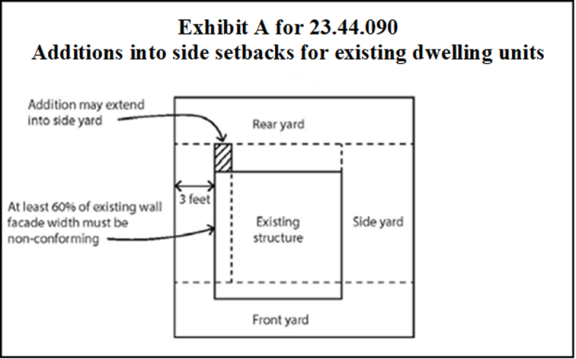
K.
A structure may be permitted to extend into front and rear setbacks as necessary to protect trees pursuant to Section 25.11.070.
(Ord. 127376, § 31, 2025.)
23.44.100 - Separations between structures
A.
The minimum required separation between structures containing floor area is 5 feet except that if the structures are separated by a driveway or parking aisle, the minimum required separation between the structures is 2 feet greater than the required width of the driveway or parking aisle or 24 feet, whichever is less.
B.
If structures containing floor area are separated by a driveway or parking aisle, projections that enclose floor area may extend a maximum of 3 feet into the required separation if they are at least 8 feet above finished grade.
C.
Architectural features such as cornices, eaves, gutters, roofs, fireplaces, chimneys, and other forms of weather protection may project into required separations a maximum of 2 feet. Garden windows, bay windows, covered porches and patios, balconies, and enclosed structures are not allowed in the required separation. Detached structures that are up to 10 feet in height and used exclusively for bike parking are allowed in required separations.
(Ord. 127376, § 31, 2025.)
23.44.110 - Amenity area
A.
The amount of required amenity area for stacked dwelling units is equal to 25 percent of the lot area, unless every unit above the ground level has a balcony, in which case it is 20 percent of the lot area. The amount of required amenity area for attached and detached units is 20 percent of the lot area.
B.
All dwelling units shall have access to either a common or private amenity area.
C.
For attached and detached dwelling units, required ground-level amenity areas may be provided as either private or common space. For stacked dwelling units, at least 30 percent of the amenity area shall be provided as common space.
D.
Amenity area shall not be enclosed within a structure.
E.
Each amenity area shall be at least 120 square feet in area and have a minimum width and depth of 8 feet, except for balconies, which shall be at least 30 square feet in area and have a minimum width and depth of 4 feet.
F.
Features in amenity areas
1.
The following features are not allowed in amenity areas:
a.
Vehicular parking areas, vehicular access easements, and driveways;
b.
Required bike parking;
c.
Solid waste and recyclable material storage area; and
d.
Enclosed structures.
2.
Pathways serving multiple dwelling units are not allowed in private amenity areas.
3.
Decks, porches, and steps; swimming pools, spas, and hot tubs; stormwater management features, including but not limited to bioretention planters and cisterns; play equipment; and similar features are allowed in amenity areas.
4.
Amenity areas may be covered by weather protection.
5.
Projections that do not provide floor area may extend into an amenity area if they meet the standards for projections into setbacks in subsection 23.44.090.E and if garden windows and other similar features are at least 8 feet above finished grade.
6.
Rooftop areas located within 8 feet of minor communication utilities and accessory communication devices do not qualify as amenity areas.
G.
Areas in environmentally critical areas and their buffers, including but not limited to steep slopes, may count toward amenity areas.
H.
No amenity area is required for:
1.
One new dwelling unit added to a dwelling unit existing as of January 1, 1982, or for one new dwelling unit added to a multifamily residential use existing as of October 10, 2001; or
2.
Development that retains a Tier 2 tree, as defined in Section 25.11.130, or achieves a tree point score under Section 23.44.120, through planting or preserving medium and large trees that would result in a ten percent canopy coverage for the site at tree maturity.
(Ord. 127376, § 31, 2025.)
23.44.120 - Tree requirements
A.
Development containing one or more new dwelling units must plant or retain trees to either achieve the number of tree points listed in Table A for 23.44.120 or provide at least one new tree for every 2,500 square feet of lot area, whichever results in the greater number of trees.
B.
Individual trees preserved during construction or planted as part of construction, excluding street trees, count toward the tree score according to Table B for 23.44.120. Trees required under Section 25.11.090 shall count toward this standard. All required trees shall meet standards promulgated by the Director to provide for the long-term health and viability of plantings. These standards may include but are not limited to tree selection, invasive species, planting specification, soil and mulch amendment, and protection practices during construction.
C.
Tree protection areas shall be designated in accordance with Section 25.11.060 for all trees that are proposed to be preserved to receive points under subsection 23.44.120.B, regardless of tree tier.
D.
The owner of the subject lot is required to ensure that the trees planted remain healthy for at least five years after inspection by the City, and the owner of the subject lot shall be responsible for replacing any trees that do not remain healthy after inspection by the City.
E.
Tree measurements
1.
New trees planted to meet this requirement shall meet the following size standards:
a.
Deciduous trees with one trunk must be at least 1.5 inches in diameter, measured 6 inches above the ground.
b.
Multi-stemmed deciduous trees must have at least three stems and be at least 6 feet tall.
c.
Evergreen trees must be at least 4 feet tall.
2.
Existing trees shall be measured 4.5 feet above the ground.
F.
Tree location. New trees planted to meet this requirement shall not be planted:
1.
For small species trees, within 2 feet of a dwelling unit;
2.
For small/medium species trees, within 4 feet of a dwelling unit;
3.
For medium/large species trees, within 6 feet of a dwelling unit;
4.
For large species trees, within 8 feet of a dwelling unit; and
5.
For all trees, within 2 feet of a sidewalk located in the right-of-way.
G.
Street tree requirements
1.
Street trees are required for development that would add one or more principal dwelling units on a lot, except as provided in subsection 23.44.120.G.2 and Section 23.53.015. Existing street trees shall be retained unless the Director of the Seattle Department of Transportation approves their removal. The Director, in consultation with the Director of the Seattle Department of Transportation, shall determine the number, type, and placement of additional street trees to be provided in order to:
a.
Improve public safety;
b.
Promote compatibility with existing street trees;
c.
Match trees to the available space in the planting strip;
d.
Maintain and expand the urban forest canopy;
e.
Encourage healthy growth through appropriate spacing;
f.
Protect utilities; and
g.
Allow access to the street, buildings, and lot.
2.
Exceptions to street tree requirements
a.
If a lot borders an unopened right-of-way, the Director may reduce or waive the street tree requirement along that right-of-way as a Type I decision if, after consultation with the Director of the Seattle Department of Transportation, the Director determines that the right-of-way is unlikely to be opened or improved.
b.
If it is not feasible to plant street trees in a right-of-way planting strip, a 5-foot setback shall be planted with trees along the street lot line that abuts the required front setback, or landscaping other than trees shall be provided in the planting strip, subject to approval by the Director of the Seattle Department of Transportation. If a 5-foot setback or landscaped planting strip is not feasible, the Director may reduce or waive this requirement as a Type I decision.
(Ord. 127376, § 31, 2025.)
23.44.130 - Structure width limits
Structure width for each building containing residential uses in Neighborhood Residential zones may not exceed 90 feet. Measurement of structure width is provided in Section 23.86.014.
(Ord. 127376, § 31, 2025.)
23.44.140 - Design standards
A.
Application of provisions.
1.
The provisions of this Section 23.44.140 apply to development that includes the construction of new dwelling units, except for new dwelling units added within existing structures.
2.
For the purposes of this Section 23.44.140, requirements for street-facing facades shall only apply to structures located within 40 feet of a street lot line or a vehicle access easement serving ten or more residential units. For structures located within 40 feet of a vehicle access easement serving ten or more residential units but not within 40 feet of a street lot line, the facade that faces the vehicle access easement shall be considered a street-facing facade for the purpose of this Section 23.44.140. If multiple facades face vehicle access easements, the applicant may decide which facade facing a vehicle access easement is considered the street-facing facade.
B.
Measurement of street-facing facades. For the purposes of this Section 23.44.140, a street-facing facade includes all vertical surfaces enclosing interior space, including gables and dormers, as shown in Exhibit A for 23.44.140.
Exhibit A for 23.44.140
Measurement of facades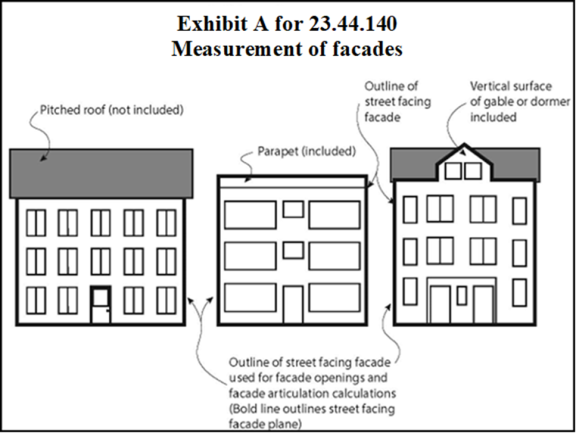
C.
Pedestrian access. Each dwelling unit shall have pedestrian access at least 3 feet in width to the sidewalk or, if no sidewalk exists, the front lot line. This pedestrian access may be shared or private. This pedestrian access may cross any required setbacks or interior separation. This pedestrian access may be part of a driveway.
D.
Entrances. Each structure with a street-facing facade shall have a pedestrian entry on that street-facing facade meeting the requirements of subsections 23.44.140.D.1 through 23.44.140.D.4. For attached and detached dwelling units, the pedestrian entry may be located on a wall perpendicular to the street-facing facade provided that the pedestrian entry abuts a covered porch or recessed entry that also abuts the street-facing facade.
1.
For stacked dwelling units, at least one pedestrian entry shall be required for the structure as a whole.
2.
For attached and detached dwelling units, each individual dwelling unit with a street-facing facade within 40 feet of the street lot line shall have at least one pedestrian entry on the street-facing facade.
3.
For structures or dwelling units with multiple street-facing facades, a pedestrian entry is required on only one of the street-facing facades.
4.
Required pedestrian entry on street-facing facades shall have weather protection, such as a covered porch, canopy, recessed entry, or similar feature, measuring at least 3 feet by 3 feet in width and depth for attached and detached dwelling units and at least 6 feet in width and 4 feet in depth for stacked dwelling units.
E.
Windows and doors. At least 20 percent of the area of each street-facing facade shall consist of windows and/or doors. If front and side facades are street-facing, the two facades shall be combined for the purpose of this calculation. Windows count toward the requirement for facade openings in this subsection 23.44.140.E only if they are transparent. Windows composed of garage doors and doors to utility and service areas do not count.
(Ord. 127376, § 31, 2025.)
23.44.150 - Light and glare standards
A.
Exterior lighting shall be shielded and directed away from adjacent properties.
B.
To prevent vehicle lights from affecting adjacent properties, driveways and parking areas for more than two vehicles shall be screened from abutting properties by a fence or wall between 5 feet and 6 feet in height, or a solid evergreen hedge or landscaped berm at least 5 feet in height. If the elevation of the lot line is different from the finished elevation of the driveway or parking surface, the difference in elevation may be measured as a portion of the required height of the screen so long as the screen itself is a minimum of 3 feet in height. The Director may waive the requirement for the screening if it is not needed due to changes in topography, agreements to maintain an existing fence, or the nature and location of adjacent uses.
(Ord. 127376, § 31, 2025.)
23.44.160 - Parking location and access
A.
Parking quantity. Off-street parking is required pursuant to Section 23.54.015.
B.
Parking on same lot. Any required parking shall be located on the same lot as the principal use, except that parking accessory to a floating home, floating on-water residence, house barge, or vessel with a dwelling unit may be located on another lot if within 600 feet of the lot on which the floating home, floating on-water residence, house barge, or vessel with a dwelling unit is located.
C.
Access to parking
1.
Vehicular access to parking from an improved street, alley, or easement is required if parking is provided.
2.
Access to parking is permitted from a street only if the Director determines that one of the following conditions exists:
a.
There is no alley improved to the standards of subsection 23.53.030.B, and there is no unimproved alley in common usage that currently provides access to parking on the lot or to parking on adjacent lots in the same block;
b.
Existing topography does not permit alley access;
c.
At least 50 percent of alley frontage abuts property in a nonresidential zone;
d.
Due to the relationship of the alley to the street system, use of the alley for parking access would create a significant safety hazard;
e.
Parking access must be from the street in order to provide access to a parking space that complies with Chapter 11 of the Seattle Building Code; or
f.
Providing alley access would require removal of a tree on private property that is a Tier 1 or Tier 2 tree and all other applicable criteria for tree protection in Chapter 25.11 are met.
D.
Location of parking. Except as provided below, parking is not allowed within 20 feet of a front lot line or within 5 feet of a side street lot line:
1.
If access to required parking passes through a required setback, automobiles, motorcycles, and similar vehicles may be parked on the open access located in a required setback.
2.
If access is taken directly from an alley, surface parking may be located within 20 feet of a street lot line if it is located within 28 feet of an alley lot line and is no closer than 7 feet to any street lot line.
3.
For lots at least 40 feet in width, up to two surface parking spaces are allowed within 20 feet of a street lot line provided:
a.
Access to parking is allowed through the required setback abutting the street by subsection 23.44.160.C;
b.
The parking spaces are located perpendicular to the street lot line from which they are accessed;
c.
On corner lots, the parking spaces are not located within 20 feet of the street lot line parallel to the parking spaces;
d.
No other parking spaces or driveways are located on the lot;
e.
The parking spaces are not located within 10 feet of a street lot line; and
f.
The combined width of the parking spaces shall not exceed 20 feet.
4.
Lots with uphill setbacks abutting streets. Parking may be located in a required setback abutting a street provided:
a.
Access to parking is allowed through the required setback abutting the street by subsection 23.44.160.C;
b.
The existing grade of the lot slopes upward from the street lot line an average of at least 6 feet above sidewalk grade at a line that is 10 feet from the street lot line;
c.
The parking area shall be at least an average of 6 feet below the existing grade prior to excavation and/or construction at a line that is 10 feet from the street lot line;
d.
No other parking spaces or driveways are located on the lot;
e.
If no garage is provided, the combined width of the parking spaces shall not exceed 20 feet. If a garage is provided, the width of a garage structure shall not exceed 24 feet; and
f.
The total width of parking spaces and garages is not more than 60 percent of the width of the lot.
5.
Lots with downhill setbacks abutting streets. Parking may be located in a required setback abutting a street if the following conditions are met:
a.
Access to parking is allowed through the required setback abutting the street by subsection 23.44.160.C;
b.
The existing grade slopes downward from the street lot line that the parking faces;
c.
For parking located in a front setback, the lot has a vertical drop of at least 6 feet in the first 10 feet, measured along a line from the midpoint of the front lot line to the midpoint of the rear lot line;
d.
Parking is not located in required side setbacks abutting a street;
e.
No other parking spaces or driveways are located on the lot;
f.
If no garage is provided, the combined width of the parking spaces shall not exceed 20 feet. If a garage is provided, the width of a garage structure shall not exceed 24 feet; and
g.
The total width of parking spaces and garages is not more than 60 percent of the width of the lot.
E.
No more than three vehicles may be parked outdoors per dwelling unit on a lot.
F.
Trailers, boats, recreational vehicles, and similar equipment shall not be parked in required setbacks, unless fully enclosed in a structure otherwise allowed in a required setback by subsection 23.44.160.D.
G.
The total combined horizontal width of all garage entrances that are located on front facades may not be more than 50 percent of the horizontal width of the street-level front facades or 10 feet, whichever is greater. No dwelling unit may have a garage entrance on both a front facade and a side facade.
H.
Except as provided in subsections 23.44.160.D.4 and 23.44.160.D.5, garage entrances facing the street shall be set back at least 20 feet from the street lot line.
(Ord. 127376, § 31, 2025.)
23.44.170 - Alternative standards for development of low-income housing and social housing
A.
Development of low-income housing or social housing that meets all of the following criteria may meet the alternative development standards in subsection 23.44.170.B:
1.
The restricted units are generally distributed throughout the development and have substantially the same functionality as unrestricted units, if any, in the development;
2.
To the extent practicable, the restricted units are comparable to unrestricted units, if any, in terms of square footage and number of bedrooms and bathrooms;
3.
The tenure (i.e., rental or ownership) of restricted units and unrestricted units, if any, is the same;
4.
For ownership housing, the restricted units are stewarded by a qualified non-profit organization, which for purposes of this subsection 23.44.170.A means a non-profit organization that the Office of Housing determines as experienced in the development and stewardship of permanently affordable homes, including:
a.
Pre-purchase verification of income and other requirements for eligible households, affordable sale price calculations for approval by the Office of Housing, and execution of legal restrictions on the property; and
b.
Post-purchase support for homeowners by facilitating resales, monitoring compliance with financial, owner occupancy, and other legal requirements, and clear communication of program guidelines and restrictions; and
5.
At such times as may be required by the Director of Housing but no less than annually, the property owner (for rental housing) or the qualified non-profit organization (for ownership housing) agree to file property reports with the Office of Housing, verified upon oath or affirmation, which shall contain such information as the Office of Housing may deem necessary to determine compliance with this subsection 23.44.170.A and the regulatory agreement, covenant, or other legal instrument.
B.
Proposed development on a lot meeting the criteria in subsection 23.44.170.A may elect to meet the following development standards in lieu of the standards in subsections 23.44.050.B (floor area), 23.44.060.A (density), and 23.44.070.A (structure height), and Sections 23.44.080 (lot coverage) and 23.54.015 (parking):
1.
The maximum floor area ratio (FAR) limit is 2.0. The applicable FAR limit applies to the total chargeable floor area of all structures on the lot.
2.
The maximum density limit is one unit per 400 square feet.
3.
The maximum height limit is 42 feet.
4.
The maximum lot coverage is 60 percent.
5.
No minimum required parking.
(Ord. 127376, § 31, 2025.)
23.44.180 - Institutions
A.
Institutions located in a Neighborhood Residential zone shall meet the development standards of this Section 23.44.180 and other sections of Chapter 23.44 except as provided in Section 23.44.030, Chapter 23.51B, Chapter 23.69, or Chapter 23.79. In the event of conflict between the standards in this Section 23.44.180 and other sections of Chapter 23.44, the standards in this Section 23.44.180 shall control.
B.
Height limits
1.
The height limit for institutions shall be 32 feet, except as provided in subsection 23.44.180.B.2.
2.
For gymnasiums, auditoriums, and wood shops that are accessory to an institution, the maximum permitted height is 35 feet if all portions of the structure above the height limit of the zone are set back at least 20 feet from all lot lines. Pitched roofs on the auditorium, gymnasium, or wood shop with a slope of not less than 4:12 may extend 10 feet above the 35-foot height limit. No portion of a shed roof on a gymnasium, auditorium, or wood shop is permitted to extend beyond 35 feet.
C.
Landscaping
1.
Landscaping that achieves a Green Factor score of 0.3 or greater, pursuant to Section 23.86.019, is required for any lot with:
a.
Development, either a new structure or an addition to an existing structure, containing more than 4,000 new square feet of non-residential uses; or
b.
Any parking lot containing more than 20 new parking spaces for automobiles.
2.
All required trees shall meet standards promulgated by the Director to provide for the long-term health, viability, and coverage of plantings. These standards may include, but are not limited to, the type and size of plants, spacing of plants, depth, and quality of soil, access to light and air, and protection practices during construction.
D.
Parking
1.
Location of parking. Parking areas and facilities may be located anywhere on the lot except in the required front setback or side street setback.
2.
Screening of surface parking areas. Surface parking areas for more than five vehicles shall be screened in accordance with the following requirements:
a.
Screening shall be provided on each side of the parking area that abuts, or faces across a street, alley, or access easement, a lot in a residential zone.
b.
Screening shall consist of a fence, solid evergreen hedge, or wall at least 3 feet in height.
E.
Odors. The venting of odors, vapors, smoke, cinders, dust, gas, and fumes shall be at least 10 feet above finished sidewalk grade and directed away to the extent possible from residential uses within 50 feet of the vent.
F.
Light and glare
1.
Exterior lighting for institutions shall be shielded or directed away from residential structures on adjacent lots.
2.
Poles for freestanding exterior lighting are permitted up to a maximum height of 32 feet. Light poles for illumination of athletic fields on new and existing public school sites will be allowed to exceed 30 feet pursuant to Chapter 23.51B.
G.
The Director may allow, as a Type I decision, higher fencing in a required setback when necessary for sports fields.
(Ord. 127376, § 31, 2025.)
23.44.190 - Parks and open space
A.
The following accessory uses shall be permitted in public parks when within a structure or on a terrace abutting the structure, provided that when the use is within 100 feet of another lot in a residential zone the use is completely enclosed:
1.
The sale and consumption of beer and wine during daylight hours;
2.
The sale and consumption of alcoholic beverages under a Class H liquor license at municipal golf courses during established hours of operation.
B.
The sale and consumption of beer and wine with meals served in a restaurant facility within the boundaries of Woodland Park shall be permitted. The use shall be permitted in only one facility located no closer than 100 feet from any lot in a residential zone and separated from other public activity areas and zoo buildings by at least 50 feet.
C.
Storage structures and areas and other structures and activities customarily associated with parks and playgrounds are subject to the following development standards in addition to the general development standards for accessory uses:
1.
Any active play area shall be located 30 feet or more from any lot in a Neighborhood Residential zone;
2.
Garages and service or storage areas shall be located 100 feet or more from any other lot in a residential zone and obscured from view from each such lot.
(Ord. 127376, § 31, 2025.)

