
Seattle City Zoning Code
CHAPTER 23
50A - INDUSTRIAL AND MARITIME
23.50A.020 - Scope
A.
This Chapter 23.50A establishes regulations for the following industrial zones:
1.
Maritime, Manufacturing, and Logistics (MML);
2.
Industry and Innovation (II);
3.
Urban Industrial (UI); and
4.
Industrial Commercial (IC).
B.
In addition to the regulations in this Chapter 23.50A, certain industrial areas may be regulated by other chapters or titles, including but not limited to Chapter 23.60A, Chapter 23.66, and Chapter 25.12.
C.
Communication utilities and accessory communication devices except as exempted in Section 23.57.002 are subject to the regulations in this Chapter 23.50A and additional regulations in Chapter 23.57.
D.
For the purposes of this Chapter 23.50A, the terms "existing structures or uses" mean those structures or uses which were established under permit, or for which a permit has been granted and has not expired, before June, 1, 2023.
E.
Major marijuana activity is subject to the regulations in this Chapter 23.50A and additional regulations in Section 23.42.058.
([Renumbered from 23.50A.002]; Ord. 126862, § 8, 2023.)
23.50A.040 - Permitted and prohibited uses
A.
All uses are permitted outright, prohibited, or permitted as a conditional use, according to Table A for 23.50A.040 and this Section 23.50A.040.
B.
All permitted uses are allowed as either a principal use or an accessory use, unless otherwise indicated in Table A for 23.50A.040.
C.
Uses that qualify as an Industrial Use for purposes of achieving extra floor area in II zones pursuant to Section 23.50A.120 through 23.50A.128 are indicated in Table A for 23.50A.040.
D.
Public facilities
1.
Similar uses permitted. Except as provided in subsections 23.50A.040.D.2 and 23.50A.040.D.3 and in Section 23.50A.100, uses in public facilities that are most similar to uses permitted outright or permitted by conditional use in this Chapter 23.50A are also permitted outright or by conditional use, subject to the same use regulations, development standards, and administrative conditional use criteria that govern the similar uses.
2.
Waivers or modification by the Council for similar uses. The Council may waive or modify applicable development standards or conditional use criteria for those uses in public facilities that are similar to uses permitted outright or permitted by conditional use according to Chapter 23.76, Subchapter III, with public projects considered as Type IV quasi-judicial decisions and City facilities considered as Type V legislative decisions.
3.
Other uses permitted in public facilities. Unless specifically prohibited, uses in public facilities that are not similar to uses permitted outright or permitted by a conditional use or special exception under this Chapter 23.50A may be permitted by the Council. The Council may waive or modify development standards or conditional use criteria according to Chapter 23.76, Subchapter III, with public projects considered as Type IV quasi-judicial decisions and City facilities considered as Type V legislative decisions.
4.
Uses in public facilities not meeting development standards. In all industrial zones, uses in public facilities not meeting development standards may be permitted by the Council if the following criteria are satisfied:
a.
The project provides unique services that are not provided to the community by the private sector, such as police and fire stations; and
b.
The proposed location is required to meet specific public service delivery needs; and
c.
The waiver or modification to the development standards is necessary to meet specific public service delivery needs; and
d.
The relationship of the project to the surrounding area has been considered in the design, siting, landscaping, and screening of the facility.
5.
Expansion of uses in public facilities
a.
Major expansion. Major expansions may be permitted to uses in public facilities allowed pursuant to subsections 23.50A.040.D.1, 23.50A.040.D.2, and 23.50A.040.D.3 according to the same provisions and procedural requirements as described in these subsections. A major expansion of a public facility use is one that would not meet development standards, or one that would exceed the greater of 750 square feet or ten percent of its existing area, including gross floor area and areas devoted to active outdoor uses other than parking.
b.
Minor expansion. An expansion that is not a major expansion is a minor expansion. Minor expansions may be permitted to uses in public facilities allowed pursuant to subsections 23.50A.040.D.1, 23.50A.040.D.2, and 23.50A.040.D.3 according to Chapter 23.76 for a Type I Master Use Permit if the development standards of the zone in which the public facility is located are met.
6.
Essential public facilities. Permitted essential public facilities, except for light rail transit facilities, shall also be reviewed according to Chapter 23.80. Light rail transit facilities are exempt from the development standards in this Chapter 23.50A and shall be reviewed according to the provisions of Chapter 23.80.
E.
Rooftop recreational space in the MML zone. Recreational space may be located on the rooftop of a building (including the rooftop of an attached parking structure) constructed as of June 1, 2023. Rooftop recreational space shall be used only for the purposes of active recreational uses and/or passive open spaces accessory to office uses of at least 100,000 square feet that are located in the same building or within an attached structure(s) and that are constructed on or before June 1, 2023. If any portion of the rooftop recreational space is covered by a structure, the following standards apply:
1.
The height of the structure shall not exceed 30 feet as measured from the existing rooftop elevation and be limited to only one story;
2.
The height shall not exceed the height of the highest portion or feature of the building or attached structure(s);
3.
The footprint of the structure shall not exceed 30 percent of the total roof area on which the structure is located; and
4.
The structure shall be designed to include a minimum of 30 percent transparent and/or translucent exterior building materials.
5.
The rooftop recreational space permitted under this subsection 23.50A.040.E shall be used only for active recreational uses and/or passive open spaces accessory to office uses and cannot be used for or converted to other uses. This subsection 23.50A.040.E does not preclude the use of rooftop decks for passive open space use if the deck is on a structure otherwise permitted, including a structure constructed after December 31, 1998, or if the deck is associated with an otherwise permitted use.
F.
Adult cabarets
1.
Any lot line of property containing any proposed new or expanding adult cabaret must be 800 feet or more from any lot line of property on which any of the following uses has been established by permit or otherwise recognized as legally established: community center; child care center; school, elementary or secondary; or public parks and open space use.
2.
Any lot line of property containing any proposed new or expanding adult cabaret must be 600 feet or more from any lot line of property for which a permit has been issued for any other adult cabaret.
3.
The analysis required by subsections 23.50A.040.F.1 and 23.50A.040.F.2 shall be based on the facts that exist on the earlier of:
a.
The date a complete application is made for a building permit for an adult cabaret for the property proposed to contain the new or expanding adult cabaret; or
b.
The date of publication of notice of the Director's decision on the Master Use Permit application to establish or expand an adult cabaret use, if the decision can be appealed to the Hearing Examiner, or the date of the Director's decision if no Hearing Examiner appeal is available.
G.
Ancillary uses in the Urban Industrial zone. A principal industrial use listed in Table A for 23.50A.040 may have an ancillary use within it. In the Urban Industrial zone, the ancillary use may occupy up to 80 percent of the floor area of the use while maintaining the classification as the principal industrial use. An ancillary use within a principal industrial use is exempt from the maximum size of use limits in Section 23.58A.008.
([Renumbered from 23.50A.004]; Ord. 127375, § 80, 2025; Ord. 127228, § 15, 2025; Ord. 126862, § 8, 2023.)
23.50A.060 - Criteria for all conditional uses
All conditional uses are subject to the procedures set forth in Chapter 23.76 and shall meet the following criteria:
A.
The use shall be determined not to be materially detrimental to the public welfare or injurious to property in the zone or vicinity in which the property is located.
B.
The benefits to the public that would be provided by the use shall outweigh the negative impacts of the use.
C.
Landscaping and screening, vehicular access controls, and other measures shall insure the compatibility of the use with the surrounding area and mitigate adverse impacts.
D.
The conditional use shall be denied if it is determined that the negative impacts cannot be mitigated satisfactorily. However, adverse negative impacts may be mitigated by imposing requirements or conditions deemed necessary for the protection of other properties in the zone or vicinity and the public interest.
([Renumbered from 23.50A.006.A]; Ord. 126862, § 8, 2023.)
23.50A.062 - Administrative conditional uses
The following uses, identified as administrative conditional uses in Table A for 23.50A.040, may be permitted by the Director if the provisions of this Section 23.50A.062 and Section 23.50A.060 are met.
A.
Artist's studio/dwellings in an existing structure may be permitted as a conditional use in MML, II, and IC zones, except as provided in Chapter 23.60A, upon showing that the occupant is a working artist who can demonstrate that their artworks or performances are provided for sale or compensation or are displayed or performed in venues accessible to a general public audience, and subject to the following criteria:
1.
Artist's studio/dwellings shall generally be discouraged along arterials such as freeways, state routes, and freight lines;
2.
Artist's studio/dwellings shall not be allowed in areas where existing industrial uses may cause environmental or safety problems;
3.
Artist's studio/dwellings shall not be located where they may restrict or disrupt industrial activity;
4.
The nature of the artist's work shall be such that there is a genuine need for the space; and
5.
The owner(s) of a building seeking a conditional use for artist's studio/dwellings must sign and record a covenant and equitable servitude, on a form acceptable to the Director, that acknowledges that the owner(s) and occupants of the building accept the industrial character of the neighborhood and agree that existing or permitted industrial uses do not constitute a nuisance or other inappropriate or unlawful use of land. Such covenant and equitable servitude must state that it is binding on the owner(s)' successors, heirs, and assigns, including any lessees of the artist's studio/dwellings.
B.
Residential use in landmark structures. A residential use not otherwise permitted in the zone may be permitted as a conditional use in MML, II, and IC zones within a structure designated as a Landmark pursuant to Chapter 25.12, or within a structure in a Landmark District pursuant to Chapter 25.16 or Chapter 25.28, subject to the following criteria:
1.
The use shall be compatible with the historic or landmark character of the structure. The Director shall request a determination regarding compatibility by the respective Board having jurisdiction over the structure or lot;
2.
The residential use shall not restrict or disrupt industrial activity in the zone, and
3.
The surrounding uses would not be detrimental to occupants of the Landmark structure.
C.
Residential use in UI zones. Residential uses are permitted as an administrative conditional use in UI zones if all of the following criteria are met. The residential use may be part of a Major Phased Development.
1.
The residential use shall not exceed a density limit of 50 dwelling units per acre; and
2.
The residential use shall not be located within 200 feet of a shoreline; and
3.
The residential use shall not be within 200 feet of a designated major truck street; and
4.
All dwelling units shall have sound-insulating windows sufficient to maintain interior sound levels at 60 decibels or below in consideration of existing environmental noise levels at the site. The applicant shall submit an analysis of existing noise levels and documentation of the sound insulating capabilities of windows as part of the conditional use permit application; and
5.
All dwelling units shall have a permanently installed air cooling system and a balanced ventilation system, which may be combined. The ventilation system shall filter any outdoor air supply through filters rated MERV 13 or higher as determined by the American Society of Heating, Refrigerating, and Air Conditioning Engineers (ASHRAE). The air cooling and ventilation systems shall be indicated on the plan; and
6.
The residential use shall be located, designed, and configured in a manner to reduce potential conflict with adjacent existing industrial business operations; and
7.
The owner(s) of a building seeking a conditional use for the residential use must sign and record a covenant and equitable servitude, on a form acceptable to the Director, that acknowledges that the owner(s) and occupants of the building accept the industrial character of the neighborhood and agree that existing or permitted industrial uses do not constitute a nuisance or other inappropriate or unlawful use of land. Such covenant and equitable servitude must state that it is binding on the owner(s)' successors, heirs, and assigns, including any lessees of the residential use; and
8.
The residential use shall be a part of a mixed-use development that includes non-residential uses permitted in UI zones, and the residential use component shall not exceed 50 percent of the total floor area of the mixed use development; and
9.
Occupancies of dwelling units are voluntarily limited by the building owner to support the availability of housing that is affordable to area workers, such that the residential use consists of either:
a.
All dwelling units are live-work units in which the commercial activity qualifies as industrial, or are caretakers' quarters associated with a business on the same site provided no single business shall have more than three associated caretakers' quarters; or
b.
A minimum of 50 percent of the dwelling units are moderate-income units.
D.
High-impact uses may be permitted as a conditional use in the MML zone, according to the following criteria:
1.
The lot is located so that large concentrations of people, particularly in residential and commercial areas, are not exposed to unreasonable adverse impacts; and
2.
A management plan may be required. The Director may determine the level of detail to be disclosed in the plan based on the probable impacts and/or the scale of the effects. Discussion of materials handling and storage, odor control, transportation, and other factors may be required.
E.
A new railroad switchyard with a mechanized hump, or the expansion of such a use beyond the lot occupied as of October 7, 1987, may be permitted as a conditional use in the MML zone, according to the following criteria:
1.
The lot is located so that large concentrations of people, particularly in residential and commercial areas, are not exposed to unreasonable adverse impacts;
2.
Measures to minimize the impacts of noise, light, and glare, and other measures to ensure the compatibility of the use with the surrounding area and to mitigate adverse impacts shall be incorporated into the design and operation of the facility.
F.
Solid waste transfer stations may be permitted as a conditional use in the MML, UI, and IC zones according to the following criteria:
1.
Measures to minimize potential odor emissions and airborne pollutants shall be determined in consultation with the Puget Sound Clean Air Agency. These measures shall be incorporated into the design and operation of the facility;
2.
Measures to maximize control of rodents, birds and other vectors shall be determined in consultation with Public Health—Seattle & King County. These measures shall be incorporated into the design and operation of the facility;
3.
The Director may require a transportation plan. The Director shall determine the level of detail to be disclosed in the plan such as estimated trip generation, access routes, and surrounding area traffic counts, based on the probable impacts and/or scale of the proposed facility; and
4.
Measures to minimize other impacts are incorporated into the design and operation of the facility;
5.
For any portion of the principal structure containing the solid waste management use that is located in a UI zone, the following standards apply:
a.
The maximum floor area of the principal structure is limited to 7,000 square feet.
b.
A setback of at least 65 feet is required between any facade of the principal structure and any lot line that abuts or is across a street from a residentially zoned lot.
6.
Accessory structures including scales, scale houses, entrance/exit kiosks, walls, screening, and other minor incidental improvements, including canopies over scales houses and drive lanes, are permitted. The total area of all scale houses in IC or UI zones shall not exceed 1,000 square feet.
7.
A landscaped area at least 20 feet deep is required between any structure or any parking located in an IC or UI zone and the nearest street lot line.
8.
Parking and driveways accessory to a solid waste transfer station. Parking and driveways on property in an IC or UI zone may be permitted as a conditional use accessory to a solid waste transfer station if:
a.
The parking is on property that is part of the same development site as the solid waste transfer station use.
b.
The parking meets the criteria of Section 23.50A.060.
c.
The parking is subject to analysis in any transportation plan required by the Director pursuant to subsection 23.50A.062.F.3.
d.
Driveways providing access to parking or access to the solid waste transfer station are on the same development site as the solid waste transfer station use.
9.
Rooftop features on the principal structure shall not exceed the maximum height limit of the zone.
10.
All transfer, handling, and compacting of materials processed by the solid waste management use shall be conducted within an enclosed structure.
11.
Outdoor storage is prohibited.
G.
Heavy manufacturing uses may be permitted in UI, II, and IC zones, and in portions of MML zones that are located within 1,500 linear feet of land that is residentially zoned and developed with housing, or neighborhood commercial zoned land except where separated by Interstate 5, as a conditional use, only when meeting all of the following criteria:
1.
The use shall be located within an enclosed building except for shipbuilding;
2.
A condition is identified in permit documents limiting the hours of operation for all processes creating any adverse impacts on residentially or commercially zoned land to specific hour ranges as appropriate to minimize the adverse impact on receiving populations;
3.
Truck and service traffic associated with the heavy manufacturing use shall be directed away from streets serving lots in nonindustrial zones;
4.
The infrastructure of the area shall be capable of accommodating the traffic generated by the proposed use; and
5.
The use shall not produce sustained or recurrent vibrations exceeding 0.002g acceleration as measured on lots in nonindustrial zones.
H.
The high-impact uses listed in subsection 23.50A.062.H.1 may be permitted as conditional uses in the IC and II zones according to the criteria contained in subsection 23.50A.062.H.2.
1.
Uses
a.
The manufacture of Group A hazardous materials, except Class A or B explosives; and
b.
The manufacture of Group B hazardous materials, when the hazardous materials are present in quantities greater than 2,500 pounds of solids, 275 gallons of liquids, or 1,000 cubic feet of gas at any time.
2.
Criteria
a.
The lot is located so that large concentrations of people, particularly in residential and commercial areas, are not exposed to unreasonable adverse impacts;
b.
A management plan may be required. The Director may determine the level of detail to be disclosed in the plan based on the probable impacts and/or the scale of the effects. Discussion of materials handling and storage, odor control, transportation, and other factors may be required;
c.
The finished product as packaged for sale or distribution shall be in such a form that product handling and shipment does not constitute a significant public health risk; and
d.
The nature of the materials produced and/or the scale of manufacturing operations may be limited to minimize the degree and severity of risks to public health and safety.
I.
Bus bases may be permitted as a conditional use in the MML, II, UI, and IC zones according to the following criteria:
1.
The amount of industrial land occupied by the facility shall be minimized. To avoid disruption of the industrial function of the area, the presence of the facility shall not obstruct the operation or likely expansion of existing industrial uses;
2.
The location of the facility shall not result in significant displacement of viable industrial uses or support activities.
3.
The amount of land occupied by the facility that has access to industrial shorelines or major rail facilities shall be minimized; and
4.
A transportation plan may be required to prevent conflicts with nearby industrial uses. The Director shall determine the level of detail to be disclosed in the plan based on the probable impacts and/or scale of the proposed facility.
J.
Power plants may be permitted as a conditional use according to the following criteria:
1.
The lot is located so that large concentrations of people, particularly in residential and commercial areas, are not exposed to unreasonable adverse impacts;
2.
A facility management and transportation plan may be required. The level and kind of detail to be disclosed in the plan shall be based on the probable impacts and/or scale of the proposed facility, and may include discussion of transportation, noise control, and hours of operation;
3.
Measures to minimize potential odor emission and airborne pollution shall meet standards of and be consistent with the Puget Sound Clean Air Agency, and shall be incorporated into the design and operation of the facility; and
4.
Landscaping and screening, separation from less-intensive zones, noise, light and glare controls, and other measures to ensure the compatibility of the use with the surrounding area and to mitigate adverse impacts shall be incorporated into the design and operation of the facility.
K.
Lodging may be permitted as a conditional use in the IC zone according to the following criteria:
1.
The use is designed primarily to serve users in the industrial area; and
2.
The use is designed and located to minimize conflicts with industrial uses in the area.
([Renumbered from 23.50A.006.B]; Ord. 127316, § 4, 2025; Ord. 126862, § 8, 2023.)
23.50A.064 - Council conditional uses
The following uses are identified as Council conditional uses on Table A for 23.50A.040 and may be permitted by the Council when provisions of this Section 23.50A.064 and Section 23.50A.060 are met:
A.
Sewage treatment plants may be permitted as a Council conditional use in the MML and IC zones according to the following criteria:
1.
The plant shall be located so that adverse impacts would not affect large concentrations of people, particularly in residential and commercial areas;
2.
The negative impacts of the use can be satisfactorily mitigated by imposing conditions to protect other property in the zone or vicinity and to protect the environment. Appropriate mitigation measures shall include but are not limited to:
a.
A facility management and transportation plan shall be required. The level and kind of detail to be disclosed in the plan shall be based on the probable impacts and/or scale of the proposed facility, and shall at a minimum include discussion of sludge transportation, noise control, and hours of operation, and shall be incorporated into the design and operation of the facility;
b.
Measures to minimize potential odor emission and airborne pollutants including methane shall meet standards of and be consistent with best available technology as determined in consultation with the Puget Sound Clean Air Agency, and shall be incorporated into the design and operation of the facility;
c.
Methods of storing and transporting chlorine and other hazardous and potentially hazardous chemicals shall be determined in consultation with the Seattle Fire Department and incorporated into the design and operation of the facility;
d.
Vehicular access suitable for trucks shall be available or provided from the plant to a designated arterial improved to City standards; and
e.
Landscaping and screening, separation from less-intensive zones, noise, light and glare controls, and other measures to ensure the compatibility of the use with the surrounding area and to mitigate adverse impacts shall be incorporated into the design and operation of the facility.
B.
Heliports may be permitted as a Council conditional use in MML, II, and IC zones according to the following criteria:
1.
The heliport is to be used for the takeoff and landing and servicing of helicopters which serve a public safety, news gathering or emergency medical care function; is part of a City and regional transportation plan approved by the City Council and is a public facility; or is part of a City and regional transportation plan approved by the City Council and is not within 2,000 feet of a residential zone;
2.
A need shall be determined for the facility at the proposed location;
3.
The heliport is located to minimize impacts, such as noise and dust impacts, on lots in the surrounding area;
4.
The lot is of sufficient size that the operations of the heliport and the flight paths of helicopters are buffered from the surrounding area;
5.
Open areas and landing pads are hard-surfaced; and
6.
The heliport meets all federal requirements including those for safety, glide angles, and approach lanes.
C.
Airports may be permitted as a Council conditional use in the MML and IC zones according to the following criteria:
1.
A need shall be determined for the facility at the proposed location;
2.
The impacts of the proposal shall be evaluated so that the negative impacts can be satisfactorily mitigated by imposing conditions to protect other property in the zone or vicinity and to protect the environment. Appropriate mitigation measures shall include, but are not limited to:
a.
The site shall be located so that adverse impacts associated with landing and takeoff activities, including noise levels and safety conditions, will not affect large numbers of people in the immediate vicinity as well as in the general landing path of the flight pattern;
b.
A facility management and transportation plan shall be required. At a minimum, the facility management and transportation plan shall demonstrate noise control, vehicle and service access, and hours of operation, and shall be incorporated into the design and operation of the facility; and
c.
Landscaping and screening, separation from less-intensive zones, noise, light and glare controls, and other measures to ensure the compatibility of the use with the surrounding area and to mitigate adverse impacts shall be incorporated into the design and operation of the facility.
D.
Solid waste incineration facilities may be permitted as a Council conditional use in MML zones according to the following criteria:
1.
The lot is located so that large concentrations of people, particularly in residential and commercial areas, are not exposed to unreasonable adverse impacts;
2.
Measures to minimize odor emission and airborne pollutants shall be determined in consultation with the Puget Sound Clean Air Agency. These measures shall be incorporated into the design and operation of the facility;
3.
A transportation plan may be required. The Director shall determine the level of detail to be disclosed in the plan based on the probable impacts and/or scale of the proposed facility.
E.
Helistops may be permitted as a Council conditional use in MML, II, UI, and IC zones according to the following criteria:
1.
The helistop is not within 1,200 feet of a residential zone;
2.
The helistop is located to minimize impacts, such as noise and dust impacts, on lots in residential zones;
3.
The lot is of sufficient size that the operations of the helistop and the flight paths of the helicopter are buffered from the surrounding area;
4.
Open areas and landing pads are hard-surfaced; and
5.
The helistop meets all federal requirements, including those for safety, glide angles and approach lanes.
([Renumbered from 23.50A.006.C]; Ord. 126862, § 8, 2023.)
23.50A.080 - Maximum size of nonindustrial use
A.
Applicability
1.
Except as otherwise provided in this Section 23.50A.080, the maximum size of use limits on gross floor area specified in Table A for 23.50A.080 apply to principal uses on a lot, and apply separately to the categories of uses.
2.
In MML zones the total gross floor area occupied by uses not qualifying as industrial as shown in Table A for 23.50A.040, shall not exceed 0.4 times the area of the lot or the maximum size of use limit, whichever is less.
3.
The combined square footage of any one business establishment located on more than one lot is subject to the size limitations on nonindustrial uses specified in Table A for 23.50A.080.
4.
In the Industry and Innovation zone, the maximum size of use limits in Table A for 23.50A.008 do not apply to development projects gaining any amount of extra floor area under the provision of Sections 23.50A.120 through 23.50A.128.
5.
Medical services uses in the Duwamish MIC east of Airport Way South established on or before July 18, 2023, and office uses associated with the same medical services use or provider are exempt from the provisions of this Section 23.50A.080 and may redevelop and/or expand on-site and on adjacent sites.
B.
Exceptions to the size limitations in Table A for 23.50A.080 are allowed for a structure existing as of June 1, 2023, in the following:
1.
A use legally established no later than June 1, 2023, that already exceeds the size limitations listed in Table A for 23.50A.080 may continue.
2.
The gross floor area of a use listed in Table A for 23.50A.080 and legally established as of June 1, 2023, may be converted to another category of use listed in Table A for 23.50A.080 provided that the combined gross floor area devoted to uses listed in Table A for 23.50A.080 does not exceed the total gross floor area of such uses legally established as of June 1, 2023.
3.
If 50 percent or more of the gross floor area of the structure has been legally established as of June 1, 2023, with a use or uses listed in Table A for 23.50A.080, those categories of uses may exceed the size of use limits as follows:
a.
Uses listed in Table A for 23.50A.080 may expand within and occupy the entire structure; or
b.
An existing use that occupies all of a structure may be expanded by up to 20 percent of the existing structure's gross floor area or 20,000 square feet, whichever is less.
C.
Covered rooftop recreational space of a building existing as of June 1, 2023, if complying with subsection 23.50A.040.E, is not subject to the limits on maximum size of nonindustrial uses contained in subsection 23.50A.080.A.
D.
Rooftop recreational space accessory to office use and meeting the standards of subsection 23.50A.040.E is not subject to the limits on maximum size of nonindustrial uses.
(Ord. 126980, § 1, 2023; [Renumbered from 23.50A.008]; Ord. 126862, § 8, 2023.)
23.50A.100 - Floor area
A.
Floor Area Ratio (FAR) limits apply in all Industrial zones as shown in Table A for 23.50A.100. The applicable FAR limit applies to the total chargeable floor area of all structures on the lot. Extra floor area above the FAR limits of Table A for 23.50A.100 may be achieved through the provisions of Sections 23.50A.120 through 23.50A.128.
B.
Exemptions from FAR calculations
1.
The following areas are exempt from FAR calculations in all industrial zones:
a.
All stories, or portions of stories, that are underground;
b.
All gross floor area used for accessory parking, except as provided in subsection 23.50A.100.C;
c.
All gross floor area located on the rooftop of a structure and used for any of the following: mechanical equipment, stair and elevator penthouses, and communication equipment and antennas;
d.
All gross floor area used for covered rooftop recreational space of a building existing as of June 1, 2023, in an MML zone, if complying with subsection 23.50A.040.E; and
e.
Bicycle commuter shower facilities.
2.
In addition to areas exempt from FAR calculations in subsection 23.50A.100.B.1, within an II 85-240 zone, the following exemptions from FAR calculations apply:
a.
As an allowance for mechanical equipment, 3.5 percent of the total chargeable gross floor area that is not otherwise exempt under this subsection 23.50A.100.B.
b.
All gross floor area for solar collectors and wind-driven power generators.
c.
The gross floor area of the following uses located at street level:
1)
General sales and service uses;
2)
Eating and drinking establishments;
3)
Entertainment use;
4)
Public libraries;
5)
Child care centers;
6)
Religious facilities; and
7)
Automotive sales and service.
3.
In addition to areas exempt from FAR calculations in subsection 23.50A.100.B.1, within MML zones, the gross floor area of rooftop recreational space accessory to office use meeting the standards of subsection 23.50A.040.E is exempt from FAR calculations.
4.
In addition to areas exempt from FAR calculations in subsection 23.50A.100.B.1, within the II 125 and II 160 zones space occupied by a vocational, educational, or training institution for activities related to industrial uses is exempt from FAR calculations.
C.
Within II 85-240, II 125, and II 160 zones, gross floor area used for accessory parking within stories that are completely above finished grade is not exempt, except that in an II 85-240 zone, if the Director finds, as a Type I decision, that locating all parking below grade is infeasible due to physical site conditions such as a high water table, contaminated soils conditions, or proximity to a tunnel, and that the applicant has placed or will place the maximum feasible amount of parking below or partially below grade, the Director may exempt all or a portion of accessory parking that is above finished grade. If any exemption is allowed under this subsection 23.50A.100.C, all parking provided above grade shall be subject to the screening requirements of subsection 23.50A.190.B.4.
([Renumbered from 23.50A.010]; Ord. 126862, § 8, 2023.)
23.50A.120 - Extra floor area in the II 125 and II 160 zones
In the II 125 and II 160 zones extra floor area may be added above the FAR limit shown in Table A for 23.50A.100 up to the limits shown in Table A for 23.50A.120.
A.
Projects adding extra floor area pursuant to this Section 23.50A.120 through Section 23.50A.128 must provide a minimum amount of gross floor area in industrial use as shown in the Minimum Industrial Use FAR column of Table A for 23.50A.120 and the industrial use floor area must meet the following standards:
1.
Allowable use of industrial use floor area is limited to the industrial uses indicated in Table A for 23.50A.040.
2.
Portions of a building qualifying as industrial use floor area must meet the following development standards for construction as bona fide industrial space. For spaces proposed to qualify as industrial use floor area, the applicant shall provide notes on the plans submitted for a land use permit how the floor area meets all the criteria.
a.
Load bearing floors with 250 pounds per square foot minimum capacity for ground level floors on grade, and load bearing floors with 125 pounds per square foot minimum capacity for floors above grade.
b.
Floor-to ceiling heights of at least 16 feet.
c.
Constructed to comply with a Seattle Building Code Group F, S, or B occupancy classification, except for ancillary support spaces that are secondary to the industrial use and occupy less than 25 percent of the industrial use floor area.
d.
Serviced directly by a loading dock or a freight elevator with a minimum capacity of 8,000 pounds.
B.
Tier I. Extra floor area may be achieved up to the Maximum FAR with Tier I column shown in Table A for 23.50A.120 as follows:
1.
Five square feet of extra floor area is achieved for every 1 square foot of industrial floor area provided that meets the standards of subsection 23.50A.120.A, except that for industrial use floor area occupied by ICT use the ratio shall be 4 square feet of extra floor area for every 1 square foot of floor area in ICT use.
2.
Minimum Industrial Use Space floor area is eligible to generate extra floor area in Tier I.
C.
Tier II. Extra floor area beyond that achieved through Tier I may be added up to the Maximum FAR with Tier II as shown in Table A for 23.50A.120 provided one of the two following conditions are met, and after the amount of extra floor area available in Tier I is exhausted.
1.
Mass timber construction. At least 50 percent of the gross floor area in the total development other than parking structures is constructed using mass timber construction methods consisting of Seattle Building Code construction types IV-A, IV-B, IV-C, or IV-HT. The applicant shall provide notes on the plans submitted for a land use permit the spaces to be constructed using mass timber construction.
2.
Transfer of development rights (TDR). The use of vulnerable masonry structure TDR to the maximum FAR with Tier II.
a.
Sending sites. Only sites within the same Manufacturing Industrial Center as the receiving site are eligible sending sites. These sites must meet the definition of vulnerable masonry structure TDR sending site in Chapter 23.84A and must comply with all applicable standards in Section 23.58A.042.
b.
Receiving sites. Only sites in the Industry Innovation zone located in the same Manufacturing Industrial Center as the sending site are eligible receiving sites.
([Renumbered from 23.50A.012.A]; Ord. 126862, § 8, 2023.)
23.50A.122 - Extra floor area in the II 85 zone
In the II 85 zone extra non-residential floor area may be added above the base FAR limit shown in Table A for 23.50A.100 up to the maximum FAR With Tier I as shown on Table A for 23.50A.122. Five square feet of extra floor area is achieved for every 1 square foot of industrial floor area provided that meets the standards of subsection 23.50A.120.A, except that for industrial use floor area occupied by ICT the ratio shall be 4 square feet of extra floor area for every 1 square foot of floor area in ICT use.
([Renumbered from 23.50A.012.B]; Ord. 126862, § 8, 2023.)
23.50A.124 - Extra floor area in the II 85-240 zone
A.
Conditions for extra floor area in the II 85-240 zone
1.
Projects in an II 85-240 zone may add chargeable floor area above the base FAR up to the applicable maximum FAR in Table A for 23.50A.124, if Sections 23.58A.022 and 23.58A.024 for extra non-residential floor area and all the applicable conditions of this Chapter 23.50A are satisfied. The provisions of Sections 23.50A.120 through 23.50A.128 apply to lots in an IC 85-240 zone, and only to development exceeding the base FAR.
2.
The applicant shall make a commitment that the proposed development will meet the green building standard, and shall demonstrate compliance with that commitment, all in accordance with Chapter 23.58D.
B.
Tier I. Extra floor area up to the Maximum FAR with Tier I may be gained as follows. Twenty-five percent of Tier I extra floor area shall be gained through the transfer of TDR pursuant to Sections 23.50A.120 through 23.50A.128 and 23.58A.042. Seventy-five percent shall be gained as bonus floor area pursuant to Section 23.58A.024, or through the transfer of housing TDR under Sections 23.50A.120 through 23.50A.128, or both.
1.
In an II 85-240 zone, in addition to satisfying the conditions of subsection 23.50A.100.B.1, for development to exceed the base FAR on a lot that has an area of 50,000 square feet or more, the Director shall make an individual determination of project impacts on the need for pedestrian facilities and complete a voluntary agreement between the property owner and the City to mitigate identified impacts, if any. The Director may consider the following as impact mitigation:
a.
Pedestrian walkways on a lot, including through-block connections on through lots, where appropriate, to facilitate pedestrian circulation by connecting structures to each other and abutting streets;
b.
Sidewalk improvements, including sidewalk widening, to accommodate increased pedestrian volumes and streetscape improvements that will enhance pedestrian comfort and safety; and
c.
Measures that will contribute to the improvement of pedestrian facilities, such as the following improvements applicable to the vicinity north of South Royal Brougham Way and south of South Charles Street east of 4th Avenue South:
1)
Improvements to 6th Avenue South as the primary pedestrian and bicycle corridor connecting new development to the surrounding area and transit facilities;
2)
Improvements to facilitate pedestrian wayfinding to and from the existing or future Light Rail stations;
d.
Improvements to enhance the pedestrian environment, such as providing overhead weather protection, landscaping, and other streetscape improvements; and
e.
Improved pedestrian and bicycle crossing of Airport Way South at 6th Avenue South.
2.
In an II 85-240 zone, in addition to satisfying the conditions of subsections 23.50A.100.B.1 and 23.50A.100.B.2, if applicable, for development to exceed the base FAR up to the Tier I maximum and include 85,000 or more square feet of gross office floor area, the Director shall make an individual determination of project impacts on the need for open space resources. The Director may limit floor area or allow floor area subject to conditions, which may include a voluntary agreement between the property owner and the City to mitigate identified impacts, if any. The Director shall take into account the findings of subsection 23.49.016.A in assessing the demand for open space generated by a typical office project in an area permitting high employment densities.
a.
The Director may consider the following as mitigation for open space impacts:
1)
Open space provided on-site or off-site, consistent with the provisions in subsection 23.49.016.C, or provided through payment-in-lieu, consistent with subsection 23.49.016.D, except that in all cases the open space shall be located on a lot in an II 85-240 zone that is accessible to the project occupants, and
2)
Additional pedestrian space through on-site improvements or streetscape improvements provided as mitigation for project impacts on pedestrian facilities pursuant to this subsection 23.50A.124.B.2.
b.
The Director may determine that open space meeting standards differing from those contained or referred to in subsection 23.49.016.C will mitigate project impacts, based on consideration of relevant factors, including the following:
1)
The density or other characteristics of the workers anticipated to occupy the project compared to the presumed office employment population providing the basis for the open space standards applicable under Section 23.49.016; and/or
2)
Characteristics or features of the project that mitigate the anticipated open space impacts of workers or others using or occupying the project.
C.
Tier II. In an II 85-240 zone, extra floor area beyond that achieved through Tier I may be added up to the Maximum FAR with Tier II as shown in Table A for 23.50A.124, after the amount of extra floor area available in Tier I is exhausted. Five square feet of extra floor area is achieved for every 1 square foot of industrial floor area provided that it meets the standards of Section 23.50A.120, except that for industrial use floor area occupied by ICT the ratio shall be 4 square feet of extra floor area for every 1 square foot of floor area in ICT use.
([Renumbered from 23.50A.012.C]; Ord. 126862, § 8, 2023.)
23.50A.126 - Extra floor area in II zones—Offsite performance
Industrial use floor area used to qualify a project for extra floor area allowed through Sections 23.50A.120 through 23.50A.128 may be located offsite if the offsite industrial floor area is located in a new structure that meets the requirements of subsection 23.50A.120.A and is located within the same Manufacturing and Industrial Center as the proposed development gaining extra floor area. The following conditions for offsite performance shall be met.
A.
The offsite industrial floor area must be built concurrent with the proposed development or completed within 18 months prior to a complete application for the proposed development gaining extra floor area.
B.
The fee owners of the offsite performance site shall execute a deed, and shall obtain the written consent of all holders of encumbrances on the offsite performance site other than easements and restrictions, unless such release or consent is waived by the Director for good cause. The deed shall be recorded in the King County real property records. The deed shall declare the amount of industrial use floor area that is used to qualify for extra floor area, identify and describe the structure in which the offsite industrial use floor area is contained, and identify the address of the development in which the extra floor area will be gained. The industrial use floor area shall be maintained in compliance with applicable codes, so as to have an estimated minimum useful life of at least 25 years from the time of completion of the development in which extra floor area was gained, as approved by the Director.
([Renumbered from 23.50A.012.D]; Ord. 126862, § 8, 2023.)
23.50A.128 - Extra floor area in II zones—Extra floor area from existing industrial structures
Extra floor area from existing industrial structures. Industrial use floor area that is used to qualify a project for extra floor area allowed through Section 23.50A.120 through this Section 23.50A.128 may be in an existing structure on the same site as the proposed development if the floor area in the existing structure meets or is renovated to meet the standards of Section 23.50A.120. An existing industrial structure offsite may not be used to generate extra floor area.
([Renumbered from 23.50A.012.E]; Ord. 126862, § 8, 2023.)
23.50A.140 - Structure height
Maximum structure height for structures that include industrial and/or non-industrial uses shall be limited as follows:
A.
There shall be no maximum height limit for structures containing only principal use industrial uses in the MML, II, and UI zones except as provided in subsection 23.50A.140.C or regulated in the Airport Height Overlay District regulations in Chapter 23.64.
B.
Except as otherwise stated in the provisions of this Section 23.50A.140 the maximum structure height for any portion of a structure that contains non-industrial uses other than spectator sports facilities whether they are principal or accessory or ancillary, is 45 feet, 65 feet, 75 feet, 85 feet, 125 feet, or 160 feet as designated on the Official Land Use Map, Chapter 23.32.
C.
In the MML, II, and UI zones the maximum height of any portion of a structure within 20 feet of an abutting lot with a residential zone shall be 30 feet.
D.
Except as may be otherwise provided in this Title 23, the maximum structure height in IC zones for all uses is as designated on the Official Land Use Map, Chapter 23.32. Maximum structure height may be increased or reduced as provided in this subsection 23.50A.140.D or Section 23.50A.160.
1.
An overlay district may increase or reduce the maximum structure height.
2.
Water-dependent uses within the Shoreline District are subject to only the height limits of the applicable shoreline environment in Chapter 23.60A.
E.
Within an II 85-240 zone, the first figure shown in the zone designation is the base height limit, which is the height limit for all uses, except for a structure that complies with the conditions to extra floor area specified in Sections 23.50A.120 through 23.50A.128 on a lot that includes extra floor area. Extra floor area means non-residential chargeable floor area allowed in addition to the base FAR under Chapter 23.58A. The second figure is the applicable height limit for all uses, on a lot that includes extra floor area, for a structure that complies with the conditions to extra floor area specified in Sections 23.50A.120 through 23.50A.128.
([Renumbered from 23.50A.014]; Ord. 126862, § 8, 2023.)
Reviser's note—The original subsection 23.50A.014.D, codified as 23.50A.140.D, contained a reference to "this Section 23.50A.024.E." Since there never was a 23.50A.024.E, and since the topic of the cross-reference is only in D, the reference has been codified as "this subsection 23.50A.140.D."
23.50A.160 - Structure height exceptions and additional restrictions
A.
Rooftop features. Where a height limit applies to a structure, the provisions in this subsection 23.50A.160.A apply to rooftop features:
1.
In all industrial zones, vent stacks, flagpoles, and religious symbols for religious institutions are exempt from height limits, except as regulated in the Airport Height Overlay District regulations at Chapter 23.64, provided they are a minimum of 10 feet from any side or rear lot line.
2.
In all industrial zones, open railings, planters, skylights, clerestories, parapets, and firewalls may extend 4 feet above the applicable height limit with unlimited rooftop coverage. Insulation material, rooftop decks and other similar features, or soil for landscaping and green roofs located above the structural roof surface, may exceed the maximum height limit by up to 2 feet if enclosed by parapets or walls that comply with this subsection 23.50A.160.A.2.
3.
In all industrial zones, wind-driven power generators may extend up to 15 feet above the applicable height limit, with unlimited rooftop coverage.
4.
Additional height is permitted for specified rooftop features according to this subsection 23.50A.160.A.4.
a.
The following rooftop features may extend up to 30 feet above the applicable height limit in all industrial zones, subject to the limits of subsection 23.50A.160.A.4.b:
1)
Solar collectors;
2)
Stair and elevator penthouses;
3)
Greenhouses and solariums;
4)
Mechanical equipment; and
5)
Minor communication utilities and accessory communication devices, except that height is regulated according to Section 23.57.015.
b.
The combined total coverage of all features listed in subsection 23.50A.160.A.4.a is limited to 35 percent of the roof area, or 60 percent of the roof area if the total includes greenhouses.
5.
Rooftop screening. In all industrial zones rooftop equipment is subject to the following screening requirements.
a.
Heating, ventilating, air conditioning or other wall or rooftop mechanical equipment shall be located and directed away from adjacent residential property.
b.
Screening shall be provided and shall be of a design and material which is compatible with the structure and shall be as high as the equipment to be screened and shall completely surround the equipment.
B.
Structures existing prior to June 1, 2023, that exceed the height limit of the zone may add the rooftop features listed as conditioned in subsection 23.50A.160.A. The existing roof elevation of the structure is considered the applicable height limit for the purpose of adding rooftop features.
C.
Covered rooftop recreational space of a building existing as of December 31, 1998, when complying with the provisions of subsection 23.50A.040.E, shall not be subject to the limits on maximum structure heights contained in subsection 23.50A.160.A.2.
([Renumbered from 23.50A.016]; Ord. 126862, § 8, 2023.)
23.50A.180 - Landscaping, screening, and Green Factor requirements
A.
Standards. All landscaping provided to meet requirements under this Section 23.50A.180 through Section 23.50A.190 must meet standards promulgated by the Director to provide for the long-term health, viability, and coverage of plantings. The standards may include, but are not limited to, the type and size of plants, number of plants, concentration of plants, depths of soil, use of low water use plants, and access to light and air for plants.
B.
The following types of screening and landscaping may be required according to the provisions of this Section 23.50A.180 through Section 23.50A.190:
1.
Three-foot-high screening. Three-foot-high screening may be either:
a.
A fence or wall at least 3 feet in height; or
b.
A landscaped area with vegetation at least 3 feet in height. Landscaped areas may include bioretention facilities or landscaped berms, provided that the top of the vegetation is at least 3 feet above the grade abutting the facility or berm.
2.
View-obscuring screening. View-obscuring screening may be either:
a.
A fence or wall 6 feet in height; or
b.
A landscaped area with vegetation at least 5 feet in height. Landscaped areas may include bioretention facilities or landscaped berms, provided that the top of the vegetation will be at least 5 feet above the grade abutting the facility or berm.
3.
Landscaped areas. Each area required to be landscaped shall be planted with trees, shrubs and grass, or evergreen ground cover, in a manner that the total required setback, excluding driveways, will be covered in three years. Features such as walkways, decorative paving, sculptures, or fountains may cover a maximum of 30 percent of each required landscaped area.
4.
Street trees. When required, street trees shall be provided in the planting strip according to Seattle Department of Transportation tree planting standards promulgated pursuant to Section 15.43.010. If it is not feasible to plant street trees in the planting strip according to City standards, they shall be planted in a 5-foot-deep landscaped setback area along the street property line. Trees planted in this setback area shall be at least 2 feet from the street lot line. The Director, in consultation with the Director of Transportation, will determine the number, type, and placement of street trees to be provided to:
a.
Improve public safety;
b.
Match trees to the available space in the planting strip;
c.
Maintain and expand the urban forest canopy;
d.
Encourage healthy growth through appropriate spacing; and
e.
Protect utilities; and to allow access to the street, buildings, and lot by vehicles including trucks and industrial equipment.
5.
Combinations of screening and landscaping requirements
a.
When there is more than one type of use which requires screening or landscaping, the requirement which results in the greater amount of screening and landscaping shall be followed.
b.
Different types of screening or landscaping may be combined on one lot.
6.
Landscaping that meets Seattle Green Factor standards, pursuant to Section 23.86.019.
([Renumbered from 23.50.018.A-B]; Ord. 126862, § 8, 2023.)
23.50A.182 - General landscaping requirements in the UI zones
A.
Street trees
1.
Street trees are required as follows.
a.
Development of either a new structure or an addition to an existing structure, containing more than 4,000 new gross square feet of floor area shall provide street trees.
b.
If it is not feasible to plant street trees in a right of way planting strip, then they shall be provided in a landscaped area along the street property line that is a minimum of 5 feet in width.
2.
Green Factor. Landscaping that achieves a Green Factor score of 0.3 or greater pursuant to Section 23.86.019 is required for any lot with:
a.
Development, either a new structure or an addition to an existing structure, containing more than 4,000 new square feet of gross floor area; or
b.
Any parking lot containing more than 20 new parking spaces for automobiles.
B.
Screening and landscaping requirements for uses abutting or across a street or an alley from a lot in a residential zone
1.
Surface parking areas, off-street loading areas, parking structures, drive-in businesses, gas stations, outdoor sales or storage and outdoor activities, shall provide screening and landscaping as provided in subsection 23.50A.180.B.6.
2.
Uses that abut or are across a street or alley from a lot in a residential zone shall provide view-obscuring screening along the abutting lot, street, or alley lot line, except as modified by subsection 23.50A.182.B.3.
3.
When the structure facade is located 5 feet or less from the lot line, landscaping may be provided in the area between the facade and the lot line as an alternative to view-obscuring screening. This landscaping shall be either:
a.
Vegetated walls attached to the facade up to a minimum height of 10 feet; or
b.
A landscaped area meeting the provisions of subsection 23.50A.180.B.3.
4.
When there is no structure or the structure facade is located more than 5 feet from the street or alley lot line, a 3-foot-tall vegetated wall, or landscape area, shall be provided.
C.
Some specific uses are required to provide additional screening, landscaping, and setbacks as regulated in Section 23.50A.188.
([Renumbered from 23.50A.018.C]; Ord. 126862, § 8, 2023.)
Reviser's note—Subsection B.1 as enacted contained a reference to subsection 23.50A.038.B.6. Since there never was a 23.50A.038.B.6, the reference is assumed to be a typographical error for 23.50A.018.B.6, which has been codified as 23.50A.180.B.6.
23.50A.184 - Landscaping and screening standards in the II and IC zones
A.
Screening and landscaping requirements for all uses
1.
Landscaping that achieves a Green Factor score of 0.30 or greater, pursuant to Section 23.86.019, is required for any lot zoned II or IC.
2.
All uses shall provide street trees unless it is determined by the Director to be infeasible. If it is not feasible to plant street trees in the planting strip, then they shall be provided in the required 5-foot-deep landscaped area along street lot lines.
B.
Treatment of blank facades for nonindustrial uses
1.
Blank facade limits apply to the area of the facade between 2 and 8 feet above the sidewalk for nonindustrial uses. Blank facade limits do not apply to industrial uses pursuant to Section 23.50A.040.
2.
Any portion of a structure's facade occupied by nonindustrial uses pursuant to Section 23.50A.040 that is not transparent shall be considered a blank facade. Clear or lightly tinted glass in windows, doors and display windows shall be considered transparent. Transparent areas shall allow views into the structure or into display windows from the outside.
3.
Portions of a structure's facade that are separated by transparent areas of at least 2 feet in width shall be considered separate facade segments for the purposes of this Section 23.50A.184.
4.
Except as provided for in subsection 23.50A.188.F, blank segments of facades that are 60 feet wide and greater, and within 20 feet of the street lot line shall be screened by one of the following:
a.
A hedge that will achieve a height of at least 5 feet within 3 years of planting and a height of at least 10 feet at full maturity; or
b.
Vegetated walls attached to the wall up to a minimum height of 10 feet; or
c.
A landscaped area meeting the provisions of subsection 23.50A.180.B.3.
5.
The following limits on blank facade segments apply to lots in an II 85-240 zone:
a.
For street-level street-facing facades, if the street level is occupied by uses other than parking, blank facade segments are limited to a width of 30 feet, except that:
1)
The width of a blank facade segment that includes a garage door may exceed 30 feet but is limited to the width of the driveway plus 5 feet; and
2)
The width of a blank facade segment may be increased to up to 60 feet if the Director determines, as a Type I decision, that the facade is sufficiently enhanced by architectural detailing, artwork, landscaping, or similar features that have visual interest.
b.
If a street-facing facade is occupied by parking, Section 23.50A.190 applies.
([Renumbered from 23.50A.018.D]; Ord. 126862, § 8, 2023.)
23.50A.186 - Landscaping and screening standards in the MML zone
A.
Screening and landscaping requirements for all uses. All uses shall provide street trees unless it is determined by the Director to be infeasible. If it is not feasible to plant street trees in the planting strip, then they shall be provided in the required 5-foot-deep landscaped area along street lot lines.
B.
Solid waste transfer stations
1.
All solid waste transfer stations shall provide landscaping meeting a minimum Green Factor score of 0.40, pursuant to Section 23.86.019. If the transfer station is part of a development located on separate parcels within 200 feet of each other, Green Factor scoring may be calculated for the multiple parcels considered as a whole. If the parcels are in zones having different Green Factor minimum scores, the development considered as a whole shall meet the highest applicable minimum Green Factor score.
2.
When a solid waste transfer station is abutting or across the street from a lot in a commercial or residential zone, screening is required pursuant to subsection 23.50A.180.B.2.
C.
Fences or free-standing walls associated with utility services uses may obstruct or allow views to the interior of a site. Where site dimensions and site conditions allow, applicants are encouraged to provide both a landscaped setback between the fence or wall and the right-of-way, and a fence or wall that provides visual interest facing the street lot line, through the height, design, or construction of the fence or wall, including the use of materials, architectural detailing, artwork, vegetated walls, decorative fencing, or similar features. If abutting or across the street from a lot in a residential, commercial, or downtown zone, fences or free-standing walls for a utility services use must provide either:
1.
A 5-foot-deep landscaped area between the wall or fence and the street lot line; or
2.
Architectural detailing, artwork, vegetated walls, decorative fencing, or similar features to provide visual interest facing the street lot line, as approved by the Director.
([Renumbered from 23.50A.018.E]; Ord. 126862, § 8, 2023.)
23.50A.188 - Additional screening standards and landscaping requirements for specific uses in the UI, II, and IC zones
A.
Surface parking areas for more than five vehicles
1.
If a surface parking area abuts a lot in an NC1, NC2, NC3, or C1 zone, view-obscuring screening along the abutting lot lines shall be provided.
2.
If a surface parking area is across an alley from a lot in a residential zone, view obscuring screening shall be required. A 5-foot-deep landscaped area shall be required inside the screening. The Director may reduce or waive the screening and landscaping requirement for all or a part of the lot abutting the alley, or may waive only the landscaping requirement, if required parking can only be provided at the rear lot line and the alley is necessary to provide aisle space. In making the determination to waive or reduce the landscaping and screening requirements, the Director shall consider the following criteria:
a.
Whether the lot width and depth permit a workable plan for the building and parking which would preserve the screening and landscaping; and
b.
Whether the character of use across the alley, such as multi-family parking structures or single-family garages, make the screening and landscaping less necessary; and
c.
Whether a topographic break between the alley and the residential zone makes screening less necessary.
3.
If a surface parking area or off-street loading area is directly across a street 80 feet or less in width from a lot in a residential zone, a 5-foot-deep landscaped setback area from the street lot line, including street trees, shall be provided. Three-foot high screening along the edge of the setback, with the landscaping on the street side of the screening, shall be provided.
4.
If a surface parking area or off-street loading area abuts a lot in a residential zone, view-obscuring screening and a 5-foot-deep landscaped setback area on the inside of the screening shall be provided.
5.
Surface parking areas for ten or fewer cars shall be screened by 3-foot-high screening along the street lot line.
6.
Surface parking areas for more than ten cars shall be screened by 3-foot-high screening and street trees along the street lot lines.
7.
Surface parking areas for more than 50 cars shall provide 3-foot-high screening and street trees along the street lot lines, as well as interior landscaping.
B.
Parking structures
1.
If a parking structure is directly across a street 80 feet or less in width from a lot in a residential zone, a 5-foot-deep landscaped setback area from the street lot line, including street trees, shall be provided. The street-facing facade of each floor of parking shall have an opaque screen at least 3.5 feet high.
2.
If a parking structure abuts a lot in a residential zone, a 5-foot-deep landscaped setback area from the lot line shall be provided unless the parking structure is completely enclosed except for driveway areas. In addition to the landscaped setback, view-obscuring screening shall be provided along abutting lot line(s). If the parking structure is enclosed by a solid wall, any setback area provided within 5 feet of the abutting lot lines shall be landscaped. The abutting facade of each floor of parking not enclosed by a solid wall shall have an opaque screen at least 3.5 feet high.
3.
If a parking structure is across an alley from a lot in a residential zone, a 5-foot-deep landscaped setback area from the alley lot line shall be provided, unless the parking structure is completely enclosed, except for driveway areas. Three-foot-high screening along the facade facing the alley with the landscaping on the alley side of the screening shall be provided. If the parking structure is enclosed by a solid wall, any setback area provided within 5 feet of the alley lot line shall be landscaped. The abutting or alley facade of each floor of parking shall have an opaque screen at least 3.5 feet high.
4.
If a parking structure is directly across a street wider than 80 feet from a lot in a residential zone, street trees shall be provided.
5.
If a parking structure is directly across a street 80 feet or less in width from a lot in a commercial zone, street trees shall be provided.
C.
Outdoor sales and outdoor display of rental equipment
1.
If an outdoor sales area or outdoor display of rental equipment is across an alley from a lot in a residential zone or abutting a lot in a residential or commercial zone, view-obscuring screening such as landscaping, a vegetated wall, or treatment other than a than a vegetated wall, shall be provided along the abutting or alley lot lines up to a height of 6 feet.
2.
If an outdoor sales area or outdoor display of rental equipment is directly across the street from a lot in a residential or commercial zone, street trees and 3-foot-high screening along the street front shall be provided.
D.
Drive-in businesses
1.
Drive-in businesses across an alley from a lot in a residential zone shall provide view-obscuring screening along the alley lot lines.
2.
Drive-in businesses in which the drive-in portion of the business is directly across a street 80 feet or less in width from a lot in a residential zone shall provide 3-foot-high screening for the drive-in portion and also provide street trees.
3.
If a drive-in business is directly across a street wider than 80 feet from a lot in a residential zone, street trees shall be provided.
4.
Drive-in businesses abutting a lot in a residential zone shall provide view-obscuring screening and a 5-foot-deep landscaped setback area inside the screening.
E.
Outdoor storage and outdoor loading berths
1.
Outdoor storage and outdoor loading berths directly across a street 80 feet or less in width from a lot in an NC1, NC2, NC3, or C1 zone shall provide view-obscuring screening along the street lot lines and street trees.
2.
If the outdoor storage or outdoor loading berth is directly across a street 80 feet or less in width from a lot in a residential zone, view-obscuring screening shall be provided. A 5-foot-deep landscaped area including street trees shall be provided between the lot line and the view-obscuring screening.
3.
If outdoor storage or an outdoor loading berth is directly across a street wider than 80 feet from a lot in a residential zone, view-obscuring screening and street trees shall be provided.
4.
If outdoor storage or an outdoor loading berth is across an alley from a lot in a residential zone, view-obscuring screening shall be provided. A 5-foot-deep landscaped area shall be provided between the lot line and the view-obscuring screening, unless the industrial lot is at least 15 feet above the elevation of the residential lot or the screen is a solid wall.
5.
If the outdoor storage or outdoor loading berth abuts a lot in a residential zone, view-obscuring screening and a 15-foot-deep landscaped area inside the screening shall be provided along the abutting lot line.
F.
Solid waste transfer stations
1.
Solid waste transfer stations greater than 60,000 square feet in lot area shall provide landscaping meeting a minimum Green Factor score of 0.40, pursuant to Section 23.86.019. If the transfer station is part of a development located on separate parcels within 200 feet of each other, Green Factor scoring may be calculated for the multiple parcels considered as a whole. If the parcels are in zones having different Green Factor minimum scores, the development considered as a whole shall meet the highest applicable, minimum Green Factor score.
2.
Solid waste transfer stations abutting or across the street from a lot in a commercial or residential zone, shall provide screening pursuant to subsection 23.50A.180.B.2.
G.
Fences or free-standing walls associated with utility services uses may obstruct or allow views to the interior of a site. Where site dimensions and site conditions allow, applicants are encouraged to provide both a landscaped setback between the fence or wall and the right-of-way, and a fence or wall that provides visual interest facing the street lot line, through the height, design, or construction of the fence or wall, including the use of materials, architectural detailing, artwork, vegetated walls, decorative fencing, or similar features. If abutting or across the street from a lot in a residential, commercial, or downtown zone, fences or free-standing walls for a utility services use must provide either:
1.
A 5-foot-deep landscaped area between the wall or fence and the street lot line; or
2.
Architectural detailing, artwork, vegetated walls, decorative fencing, or similar features to provide visual interest facing the street lot line, as approved by the Director.
([Renumbered from 23.50A.018.F]; Ord. 126862, § 8, 2023.)
23.50A.190 - Screening and location of parking in an II 85-240 zone
Those developments that gain extra floor area above the base FAR in an II 85-240 zone are subject to the following, in addition to any other applicable parking screening requirements in this Section 23.50A.190.
A.
All parking permitted on the lot shall be provided below grade or enclosed within a structure.
B.
Parking at street level
1.
Parking is not permitted at street level within a structure along a lot line abutting a street bounding the Downtown Regional Center or a street shown on Map A for 23.50A.190, unless separated from the street by other uses, except that garage and loading doors and access to parking need not be separated.
2.
Parking is permitted at street level within a structure along a street lot line abutting a street not specified in subsection 23.50A.190.B.1 subject to the following requirements:
a.
Any parking not separated from the street lot line by another use is screened from view at the street level, except that garage and loading doors and access to parking need not be screened.
b.
The facade facing the street lot line is enhanced by architectural detailing, artwork, landscaping, or similar visual interest features.
3.
Parking above street level. Parking is not permitted above street level unless it is separated from abutting street lot lines by another use, except that for structures located on a lot that is less than 150 feet in depth, as measured from the lot line with the greatest street frontage, parking is permitted above the first story under the following conditions:
a.
One story of parking shall be permitted above the first story of a structure for each story of parking provided below grade that is of at least equivalent capacity, up to a maximum of two stories of parking above the first story.
b.
Above the first story of a structure, parking is permitted up to a maximum of 70 percent of the length of each street-facing facade. Any additional parking must be separated from the street by another use. For structures located on corner lots, separation by another use shall be provided at the corner portion(s) of the structure for a minimum of 15 percent of the length of each street-facing facade.
4.
For all parking located on stories above street level that is not separated from the street by another use, the parking shall be screened from view at street level, and, through the use of materials, fenestration, or other architectural treatment, the screening shall be designed to provide visual interest and to integrate the screened portions of the building facade with the overall design of the structure's street-facing facades.
5.
The Director may permit, as a Type I decision, exceptions to subsection 23.50A.190.B.2.a to permit more parking above street level than otherwise allowed, if the Director finds that locating permitted parking below grade is infeasible due to physical site conditions such as a high-water table, contaminated soil conditions, or proximity to a tunnel. In such cases, the Director shall determine the maximum feasible amount of parking that can be provided below grade, if any, and the amount of additional parking to be permitted above street level.
Map A for 23.50A.190 Designated Industrial Streets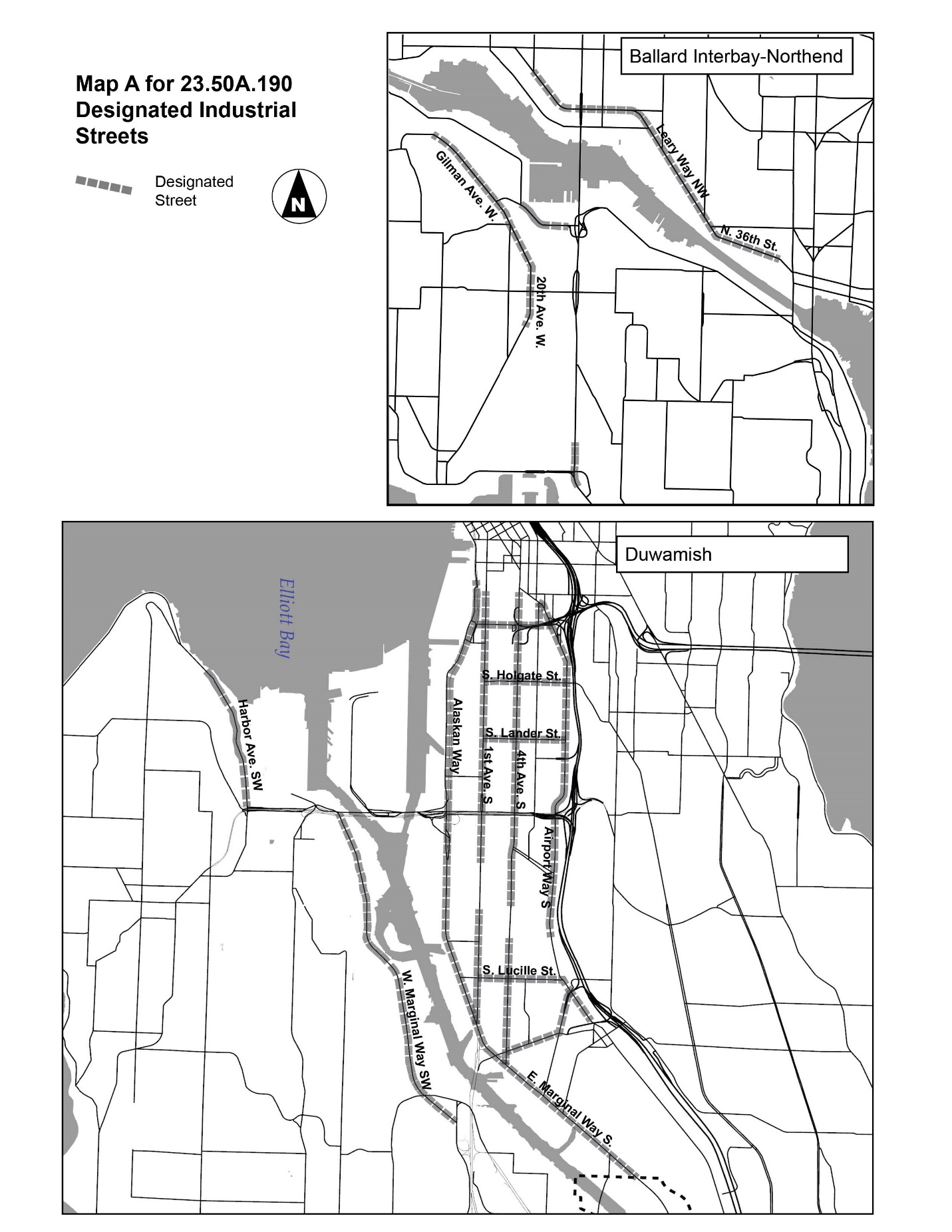
(Ord. 127375, § 81, 2025; [Renumbered from 23.50A.018.G]; Ord. 126862, § 8, 2023.)
23.50A.200 - View corridors
A.
On lots which are partially within the Shoreline District, a view corridor shall be required for the non-shoreline portion, if the portion of the lot in the Shoreline District is required to provide a view corridor under the Seattle Shoreline Master Program.
B.
The required width of the view corridor or corridors shall be not more than one-half of the required width of the view corridor required in the adjacent Shoreline District.
C.
Measurement, modification, or waiving of the view corridor requirement shall be according to the Shoreline District measurement regulations in Chapter 23.60A.
([Renumbered from 23.50A.020]; Ord. 126862, § 8, 2023.]
23.50A.220 - Venting standards
The venting of odors, vapors, smoke, cinders, dust, gas, and fumes shall be at least 10 feet above finished grade and directed away from residential uses within 200 feet of the vent.
([Renumbered from 23.50A.022]; Ord. 126862, § 8, 2023.]
23.50A.240 - Odor sources standards
A.
Major odor sources in UI, II, and IC zones
1.
Uses that involve the following odor-emitting processes or activities are major odor sources:
a.
Lithographic, rotogravure, or flexographic printing;
b.
Film burning;
c.
Fiberglassing;
d.
Selling of gasoline and/or storage of gasoline in tanks larger than 260 gallons;
e.
Handling of heated tars and asphalts;
f.
Incinerating (commercial);
g.
Metal plating;
h.
Tire buffing;
i.
Vapor degreasing;
j.
Wire reclamation;
k.
Use of boilers (greater than 106 British thermal units per hour, 10,000 pounds steam per hour, or 30 boiler horsepower);
l.
The production or processing of marijuana products by a major marijuana activity; and
m.
Other uses creating similar odor impacts.
2.
Uses that employ the following processes shall be considered major odor sources, unless the entire activity is conducted as part of a commercial use other than food processing or heavy commercial services:
a.
Cooking of grains;
b.
Smoking of food or food products;
c.
Fish or fishmeal processing;
d.
Coffee or nut roasting;
e.
Deep-fat frying;
f.
Dry cleaning;
g.
Animal food processing; and
h.
Other uses creating similar odor impacts.
B.
Major odor sources in the MML zone. Uses that involve the production or processing of marijuana products by a major marijuana activity are a major odor source.
C.
When an application is made in an industrial zone for a use which is determined to be a major odor source, the Director, in consultation with the Puget Sound Clean Air Agency, shall determine the appropriate measures to be taken by the applicant to significantly reduce potential odor emissions and airborne pollutants. Measures to be taken shall be indicated on plans submitted to the Director and may be required as conditions for the issuance of any permit. Once a permit has been issued, any measures which were required by the permit shall be maintained.
([Renumbered from 23.50A.024]; Ord. 126862, § 8, 2023.)
23.50A.260 - Light and glare standards
A.
Exterior lighting shall be shielded and directed away from lots in adjacent residential zones.
B.
Interior lighting in parking structures shall be shielded, to minimize nighttime glare affecting lots in adjacent residential zones.
C.
When nonconforming exterior lighting in an UI, II, or IC zone is replaced, new lighting shall conform to the requirements of this Section 23.50A.260.
D.
Glare diagrams which clearly identify potential adverse glare impacts on residential zones and on arterials shall be required when:
1.
Any structure is proposed to have facades of reflective coated glass or other highly reflective material, and/or a new structure or expansion of an existing structure greater than 65 feet in height is proposed to have more than 30 percent of the facades comprised of clear or tinted glass; and
2.
The facade(s) surfaced or comprised of such materials either:
a.
Are oriented towards, and are less than 200 feet from, any residential zone, and/or
b.
Are oriented towards, and are less than 400 feet from, a major arterial with more than 15,000 vehicle trips per day, according to Seattle Department of Transportation data.
E.
When glare diagrams are required, the Director may require modification of the plans to mitigate adverse impacts, using methods including but not limited to the following:
1.
Minimizing the percentage of exterior facade that is composed of glass;
2.
Using exterior glass of low reflectance;
3.
Tilting glass areas to prevent glare which could affect arterials, pedestrians or surrounding structures;
4.
Alternating glass and nonglass materials on the exterior facade; and
5.
Changing the orientation of the structure.
([Renumbered from 23.50A.026]; Ord. 126862, § 8, 2023.)
23.50A.280 - Mandatory housing affordability (MHA)
The provisions of Chapter 23.58B apply in II 85-240 zones and IC zones with a mandatory housing affordability suffix.
([Renumbered from 23.50A.028]; Ord. 126862, § 8, 2023.)
23.50A.300 - Major Phased Development
A.
An applicant may seek approval of a Major Phased Development, as defined in Section 23.84A.025. A Major Phased Development proposal is subject to the provisions of the zone in which it is located and shall meet the following thresholds:
1.
A minimum site size of 60,000 square feet, where the site is composed of contiguous parcels. Parcels across a right-of-way including diagonal corners of an intersection shall be considered contiguous;
2.
The project, which at time of application shall be a single, functionally interrelated campus, contains more than one building, with a minimum total gross floor area of 100,000 square feet; and
3.
The first phase of the development consists of at least 30,000 square feet in gross building floor area.
4.
All land within the Major Phased Development must be within the same industrial zone.
B.
A Major Phased Development application shall contain and be submitted, evaluated, and approved according to the following.
1.
The application shall contain a level of detail which is sufficient to reasonably assess anticipated impacts, including those associated with a maximum buildout, within the timeframe requested for Master Use Permit extension.
2.
The application shall contain an anticipated timeline for construction of the phases with information documenting the rationale for the proposed phasing timeline.
3.
A Major Phased Development component shall not be approved unless the Director concludes that anticipated environmental impacts, such as traffic, open space, shadows, construction impacts, and air quality, are not significant or can be effectively monitored and conditions imposed to mitigate impacts over the extended life of the permit.
4.
Expiration or renewal of a permit for the first phase of a Major Phased Development is subject to the provisions of Chapter 23.76. The Director shall determine the expiration date of a permit for subsequent phases of the Major Phased Development through the analysis provided for in this subsection 23.50A.300.B; such expiration shall be no later than 15 years from the date of issuance.
C.
Application of development standards. Development standards for the zone shall apply to the overall site area of the Major Phased Development including the following:
1.
Floor Area Ratio limits and provisions for any extra floor area in the Industry Innovation zone; and
2.
Residential density limits for conditional use housing in the Urban Industrial zone.
D.
Changes to the approved Major Phased Development. When an amendment to an approved project is requested, the Director shall determine whether the amendment is minor.
1.
A minor amendment meets the following criteria:
a.
Substantial compliance with the approved site plan and conditions imposed in the existing Master Use Permit which includes a Major Phased Development component with no substantial change in the mix of uses and no major departure from the bulk and scale of structures originally proposed; and
b.
Compliance with the requirements of the zone in effect at the time of the original Master Use Permit approval; and
c.
No significantly greater impact would occur.
2.
If the amendment is determined by the Director to be minor, the site plan may be revised and approved as a Type I Master Use Permit. The Master Use Permit expiration date of the original approval shall be retained, and shall not be extended through a minor revision.
3.
If the Director determines that the amendment is not minor, the applicant may either continue under the existing Major Phased Development approval or may submit a new Major Phased Development application. Only the portion of the site affected by the revision shall be subject to regulations in effect on the date of the revised Major Phased Development application. The decision may retain or may extend the existing expiration date on the portion of the site affected by the revision.
E.
Abandonment of a Major Phased Development. If a residential use is constructed as a part of a Major Phased Development and subsequent phases of that major phased development are abandoned, no additional residential use shall be permitted on any of the land contained within the area of the Major Phased Development for 75 years from the date of the expiration or abandonment of the Major Phased Development permit.
([Renumbered from 23.50A.030]; Ord. 126862, § 8, 2023.)
Reviser's note—A reference to "this subsection 23.84A.030.B" appears to have been a typographical error for 23.50A.030.B (which is codified as 23.50A.300.B).
23.50A.320 - Water quality—Best management practices
A.
The location, design, construction, and management of all developments and uses shall protect the quality and quantity of surface and groundwater, and shall adhere to the guidelines, policies, standards, and regulations of applicable water quality management programs and regulatory agencies. Best management practices, such as paving and berming of drum storage areas, fugitive dust controls and other good housekeeping measures to prevent contamination of land or water, may be required.
B.
Solid and liquid wastes and untreated effluents may not enter any bodies of water or be discharged onto the land.
([Renumbered from 23.50A.032]; Ord. 126862, § 8, 2023.)
23.50A.340 - Parking and loading areas
Access to off-street parking and loading areas. Access to off-street parking or loading areas shall be prohibited from street or alley frontages opposite residentially zoned lots. This prohibition shall not apply under the following conditions:
A.
There is no access to the lot from another street or alley within an industrial zone.
B.
The Director has determined that the lot width and depth prevents a workable plan for the building parking and loading if access is not allowed from a street or alley across from a residentially zoned lot.
([Renumbered from 23.50A.034]; Ord. 126862, § 8, 2023.)
23.50A.360 - Transportation management programs in the Industry and Innovation zone
A TMP shall be required and prepared according to the provisions of Section 23.52.010 and any applicable Director's Rules.
(Ord. 127392, § 7, 2026; Ord. 127375, § 82, 2025; [Renumbered from 23.50A.036]; Ord. 126862, § 8, 2023.)
23.50A.380 - Nonconformity to development standards
A.
Industrial uses nonconforming to development standards. The provisions of Chapter 23.42 apply except as provided in subsection 23.50A.380.B.
B.
When a structure in an industrial zone that contains 50 percent or more of its floor area in an industrial use as identified in Table A for 23.50A.040 that was legally established by June 1, 2023, the structure may expand in a manner that maintains or increases the degree of nonconformity to standards set out in Sections 23.50A.080, 23.50A.100.A, 23.50A.180 through 23.50A.190, 23.53.006, 23.53.020, and 23.54.015 only to the extent necessary to allow the expansion, provided that the amount of floor area in industrial use does not decrease from the amount of floor area that was legally established prior to the expansion.
([Renumbered from 23.50A.038]; Ord. 126862, § 8, 2023.)

