
Seattle City Zoning Code
CHAPTER 23
52 - TRANSPORTATION LEVEL OF SERVICE, AND TRANSPORTATION IMPACT ANALYSIS FOR SEPA-EXEMPT DEVELOPMENT
23.52.004 - Transportation level of service
A.
The Comprehensive Plan includes goals and policies that promote travel by multiple modes. This includes goals and policies to reduce single-occupant vehicle travel and citywide vehicle miles traveled. These goals and policies also establish data measures to gauge progress across multiple modes including automobile, transit, bicycle, and pedestrian travel, both citywide and within designated Regional, Urban, and Neighborhood centers.
B.
Map A for 23.52.004 establishes level of service goals defined as the target SOV mode share by geographic sector.
C.
To support achieving the transportation goals and policies included in the Comprehensive Plan and to support achieving level-of-service objectives related to SOV mode share shown in Map A, Section 23.52.008 specifies requirements that apply according to development size, site zoning, and type of permit review.
Map A for 23.52.004: 2035 SOV Mode Share Targets by Geographic Sector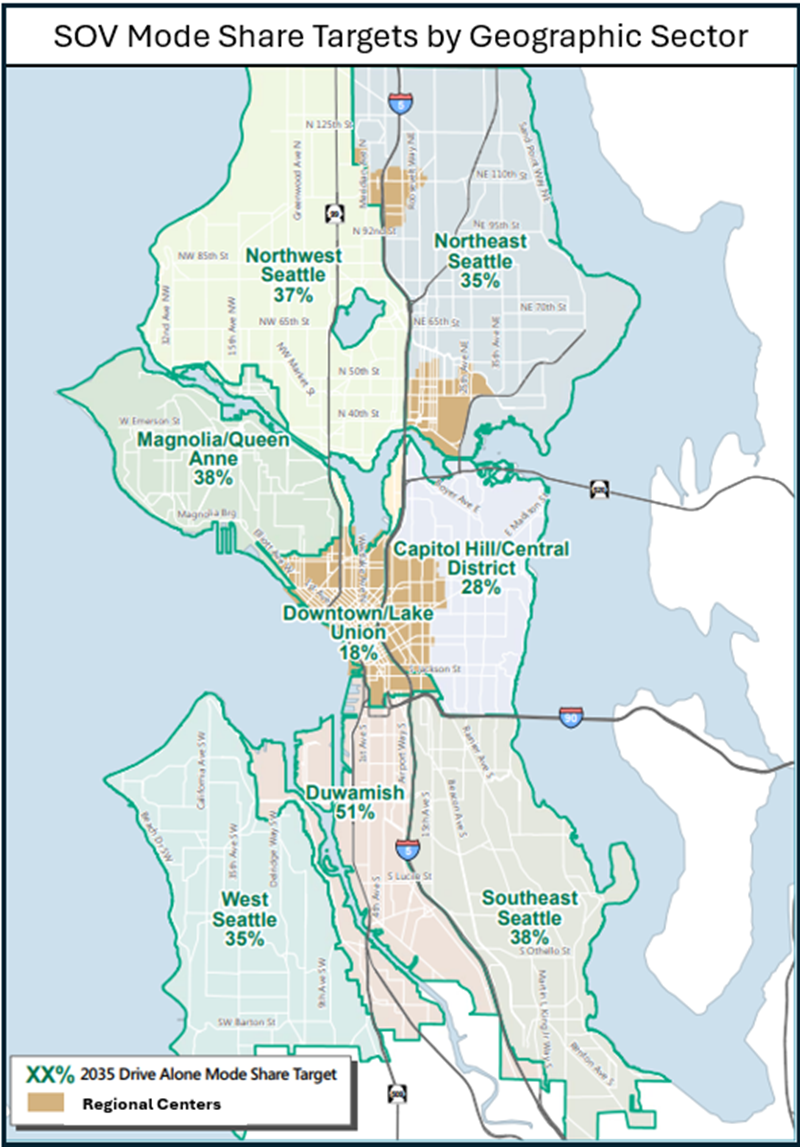
(Ord. 127375, § 84, 2025; Ord. 127228, § 18, 2025; Ord. 125757, § 3, 2019; Ord. 124887, § 2, 2015; Ord. 117383, § 9, 1994.)
23.52.006 - Effect of not meeting transportation concurrency LOS standards.
If a proposed use or development does not meet the LOS standards at one (1) or more applicable screenline(s), the proposed use or development may be approved if the Director concludes that an improvement(s) will be completed and/or a strategy(ies) will be implemented that will result in the proposed use or development meeting the LOS standard(s) at all applicable screenline(s) at the time of development, or that a financial commitment is in place to complete the improvement(s) and/or implement the strategy(ies) within six (6) years. Eligible improvements or strategies may be funded by the City, by other government agencies, by the applicant, or by another person or entity.
(Ord. 117383, § 9, 1994.)
23.52.008 - Applicability of this Subchapter II
A.
Applicability. The requirements of this Subchapter II apply to proposed new development as described in Table A for 23.52.008. This type of impact analysis is not required for development located within a regional center, or major transit service area, or that is subject to SEPA environmental review per Chapter 25.05.
B.
Transportation impact analysis required. Applicants for proposed development shall submit with the development permit application an analysis of potential transportation impacts that may result from the proposed development, including but not limited to impacts on the roadway system, transit system, and bicycle and pedestrian networks. The transportation impact analysis must contain the following:
1.
Number of additional daily and peak hour vehicular trips;
2.
Likely distribution of project traffic and effects on traffic operations;
3.
Availability and expected usage of transit;
4.
Existing vehicular, pedestrian, and bicycle conditions, including access and connections to transit and bicycle facilities; and
5.
Collision history.
C.
Impact mitigation
1.
Based upon the results of the transportation impact analysis, the Director may condition permit approval, as a Type I decision, to mitigate or prevent transportation impacts.
2.
Required mitigation may include, but is not limited to:
a.
Changes in access;
b.
Changes in the location, number, and size of curb cuts and driveways;
c.
Provision of transit incentives, including transit pass subsidies;
d.
Bicycle parking, and shower facilities for bicycle commuters;
e.
Signage, including wayfinding;
f.
Improvements to vehicular, pedestrian, and bicycle facilities or operations including signalization, turn channelization, right-of-way dedication, street widening, pedestrian and bicycle facilities improvements, and lighting;
g.
Transportation management programs;
h.
Parking management strategies including, but not limited to, unbundling parking from building-space leases, reserved parking spaces for vanpools, and reduction in the amount of parking to be provided;
i.
Participation in a transportation mitigation payment program or transportation management association, where available; and
j.
Support for enhanced public transportation service, ride-sharing programs, demand management, transportation systems management strategies, or other similar strategies, either as part of or separately from a transportation management program or transportation mitigation payment program.
(Ord. 127392, § 9, 2026; Ord. 127375, § 85, 2025; Ord. 126157, § 41, 2020; Ord. 125757, § 4, 2019; Ord. 125291, § 36, 2017; Ord. 124378, § 53, 2013; Ord. 123939, § 13, 2012)
23.52.010 - Transportation Management Program requirements
Transportation management programs (TMP) are a type of transportation demand management strategy that encourages the use of efficient transportation modes rather than single-occupant vehicle (SOV) modes. TMPs aid in managing congestion in transportation networks especially during peak times. Strategies may include, but are not limited to ridesharing, vanpooling, promotion of bicycling, walking and use of public transportation, transportation-efficient parking and land use policies, and high-occupancy vehicle subsidy programs. TMPs are required as indicated in this Section 23.52.010, and applicable rules promulgated by the Director.
A.
Non-residential use thresholds for TMPs
1.
An applicant who proposes non-residential use development or mixed-use development exceeding the thresholds in Table A for 23.52.010 in zones where a TMP is required, or is otherwise required by code provisions or Director's Rule, shall prepare and include in their Master Use Permit application a TMP.
2.
Compliance with TMP requirements does not supplant the responsibility of any employer to comply with Seattle's Commute Trip Reduction (CTR) Ordinance requirements in Chapter 25.02.
B.
Residential use thresholds for TMPs. An applicant who proposes development with multifamily residential uses exceeding 250 dwelling units in zones where a TMP is required, or is otherwise required by code provisions or Director's Rule, shall prepare and include in their Master Use Permit application a TMP.
C.
TMP requirements
1.
Non-residential development. For purposes of measuring attainment of SOV-related goals for non-residential development, the proportion of SOV trips shall be calculated for the p.m. hour in which an applicant expects the largest number of vehicle trips to be made by employees, and students if applicable, at the site (the p.m. peak hour of the generator). The proportion of SOV trips shall be calculated by dividing the total number of employees, and students if applicable, using an SOV to make a trip during the expected peak hour by the total number of employee and student person trips during the expected peak hour.
2.
Residential development. For purposes of measuring attainment of SOV-related goals for residential development, the proportion of SOV trips shall be calculated for the p.m. hour in which an applicant expects the largest number of vehicle trips to be made by residents of the site (the p.m. peak hour of the generator). The proportion of SOV trips shall be calculated by dividing the total number of residential trips made by SOV during the expected peak hour by the total number of residential person trips.
3.
In addition to meeting the requirements in this subsection 23.52.010.C, a TMP shall comply with all applicable rules promulgated by the Director.
4.
Building owners shall continue to implement the TMP, submit post-occupancy performance reporting, and conduct enforcement in accordance with any applicable Director's Rules.
5.
The TMP shall be approved by the Director if, after consulting with the Seattle Department of Transportation, the Director determines that the TMP measures are likely to achieve the mode-share targets for trips made by travel modes other than driving alone shown in Map A for 23.52.004, or otherwise defined in relation to Commute Trip Reduction goals or long-term planning goals and policies in the Comprehensive Plan, in accordance with any applicable Director's Rules.
(Ord. 127392, § 10, 2026.)
23.52.012 - Construction management plan requirements
A.
A construction management plan is required if a development application:
1.
Contains 25 or more dwelling units;
2.
Contains 25,000 square feet or more gross floor area in non-residential use, not including gross floor area in accessory parking use; or
3.
Requires a shoring permit.
B.
A construction management plan shall address:
1.
Traffic management arrangements in the site vicinity;
2.
Safe pedestrian connections during the construction period;
3.
Utility connections and site preparations such as utility relocations;
4.
Truck access routes and haul routes;
5.
Time limits for large truck movements, to address congestion during peak traffic hours;
6.
Construction-related parking, pursuant to Section 23.42.044;
7.
Strategies for minimizing noise disruption pursuant to Chapter 25.08; and
8.
A notification plan to the neighborhood.
(Ord. 127392, § 10, 2026.)

