
Seattle City Zoning Code
CHAPTER 23
54 - QUANTITY AND DESIGN STANDARDS FOR ACCESS, OFF-STREET PARKING, AND SOLID WASTE STORAGE9
Editor's note— Ord. 123495, § 68, of 2011 amended the title of Ch. 23.54.
23.54.015 - Required vehicular parking and maximum vehicular parking limits
A.
Required parking. The minimum number of off-street motor vehicle parking spaces required for specific uses is set forth in Table A for 23.54.015 for nonresidential uses other than institutional uses, Table B for 23.54.015 for residential uses, and Table C for 23.54.015 for institutional uses, except as otherwise provided in this Chapter 23.54. Required parking is based upon gross floor area of a use within a structure minus gross floor area in parking uses, and the square footage of a use when located outside of an enclosed structure, or as otherwise specified. Maximum parking limits for specific uses and specific areas are set forth in subsection 23.54.015.C. Exceptions to motor vehicle parking requirements set forth in this Section 23.54.015 are provided in subsections 23.54.015.B and 23.54.015.C and in Section 23.54.020. This Chapter 23.54 does not apply to parking for construction activity, which is regulated by Section 23.42.044.
B.
Required parking for specific zones and areas
1.
Parking in downtown zones is regulated by Chapters 23.49 and 23.66, and not by this Section 23.54.015.
2.
Parking in the MPC-YT zone is regulated by Section 23.75.180 and not by this Section 23.54.015.
3.
Parking for major institution uses in the Major Institution Overlay District is regulated by Sections 23.54.015 and 23.54.016.
4.
The Director shall adopt by rule a map of frequent transit and major transit service areas based on proximity to a transit station or stop served by a frequent transit route or a major transit service. The determination whether a proposed development site is in a scheduled frequent transit or major transit service area shall be based on the map adopted by rule that exists on the date a project vests according to the standards of Section 23.76.026, provided that a rule that takes effect on a date after the project vests may be applied to determine whether the site is in a scheduled frequent transit or major transit service area, at the election of the project applicant in accordance with subsection 23.76.026.F.
C.
Maximum parking limits for specific zones or areas
1.
In the Stadium Transition Area Overlay District certain uses are subject to a maximum parking ratio pursuant to subsection 23.74.010.A.1.b. When there are multiple uses on a lot, the total parking requirement for all uses subject to a maximum ratio cannot exceed the aggregate maximum for those uses under Section 23.74.010.
2.
In all commercial zones, except C2 zones outside of urban centers, no more than 145 spaces per lot may be provided as surface parking or as flexible-use parking.
3.
In all Neighborhood Residential and multifamily zones, commercial uses are limited to no more than ten parking spaces per business establishment.
4.
In the Northgate Overlay District, the Director may permit parking to exceed applicable maximum parking limits as a Type I decision pursuant to Chapter 23.76 if:
a.
The parking is provided in a structure according to a joint-use parking agreement with King County Metro Transit; and
b.
It can be demonstrated to the satisfaction of the Director through a parking demand study that the spaces are only needed to meet evening and weekend demand or as overflow on less than ten percent of the weekdays in a year, and the spaces shall otherwise be available for daytime use by the general public.
5.
Notwithstanding the minimum parking requirements set out in Table A for 23.54.015, in the Industry and Innovation zones, the maximum parking ratio for all uses is one space per 1,000 square feet of gross floor area.
D.
Parking waivers
1.
No parking is required for the first 3,000 square feet of each business establishment.
2.
No parking is required for ground level nonresidential spaces in mixed-use structures.
E.
Fleet vehicles. Notwithstanding any other provisions of this Section 23.54.015, off-street parking shall be provided for all fleet vehicles and those parking spaces will not be counted toward the parking requirements of Table A for 23.54.015, Table B for 23.54.015, or Table C for 23.54.015.
F.
Use and reuse of schools. For non-school uses permitted to locate in a former or existing public school, parking requirements will be determined by school use pursuant to criteria adopted according to Chapter 23.78.
G.
Changes of use
1.
New nonresidential uses in existing structures. Except as otherwise provided in this subsection 23.54.015.G, up to 20 required parking spaces are waived for a new nonresidential use established in an existing structure or the expansion of an existing nonresidential use entirely within an existing structure. Existing required parking shall remain.
2.
Residential uses in existing structures. No parking is required for a change of use from a nonresidential use to a residential use in an existing structure.
3.
Commercial uses in existing structures. No parking is required for a change of use to a commercial use in an existing structure.
4.
For purposes of this Section 23.54.015, "existing structure" means a structure that was established under permit, or for which a building permit has been granted and has not expired, at least two years prior to the application to establish the new use or expand the use.
5.
Parking spaces required for loading and unloading of passengers are not eligible for the waiver under this subsection 23.54.015.G.
H.
Uses not shown on parking tables. In the case of a use not shown on Table A for 23.54.015, Table B for 23.54.015, or Table C for 23.54.015, the requirements for off-street parking will be determined by the Director based on the requirements for the most comparable use. Where, in the judgment of the Director, none of the uses on Table A for 23.54.015, Table B for 23.54.015, and Table C for 23.54.015 are comparable to a proposed use, the Director may base a determination as to the amount of parking required for the proposed use on detailed information provided by the applicant. The information required may include, but not be limited to, a description of the physical structure(s), identification of potential users, and analysis of likely parking demand.
I.
Uses in multiple parking table categories. If an entire use or structure, or the same portion of a use or structure, falls under more than one category in Table A for 23.54.015, Table B for 23.54.015, or Table C for 23.54.015 then, unless otherwise specified, the category requiring the smallest number of parking spaces applies except as expressly set forth on such tables.
J.
Existing parking deficits. Existing legal parking deficits of legally established uses are allowed to continue even if a change of use occurs. This subsection 23.54.015.J will not be construed to permit a parking deficit caused by the failure to satisfy conditions of a reduced parking requirement for any use or structure.
(Current text's ordinance history:
2020s
Ord. 127376, § 59, 2025 [substantively amended title, A, B, C, D, and G and Tables A, B, and
C; nonsubstantively amended E, F, H, I, and J]; Ord. 127375, § 87, 2025 [amended C and Tables A, B, and C]; Ord. 127228, § 19, 2025 [cross-reference update in B; Ord. 127219, § 26, 2025 [amended Table B]; Ord. 127099, § 46, 2024 [amended Tables A and C]; Ord. 127098, § 5, 2024 [amended Table B]; Ord. 126862, § 12, 2023 [amended C and Table A]; Ord. 126858, § 4, 2023 [amended Table C]; Ord. 126855, § 39, 2023 [amended Table B]; Ord. 126685, § 42, 2022 [corrected a cross-reference in B and substantively amended Table B];
Ord. 126509, § 76, 2022 [zone name change in Tables A, B, and C]; Ord. 126452, § 2, 2021 [amended Table A]; Ord. 126157, § 42, 2020 [amended A and D and Table B].
2010s
Ord. 125791, § 86, 2019 [amended Table B]; Ord. 125603, § 60, 2018 [amended Table B]; Ord. 125558, § 42, 2018 [amended title, A, B, and C and Tables A, B, and C]; Ord. 125272, § 48, 2017 [amended B]; Ord. 124770, § 9, 2015 [amended D and deleted Table D]; Ord. 124747, § 3, 2015 [amended Table A]; Ord. 124608, § 10, 2014 [amended Table B]; Ord. 124378, § 57, 2013 [substantively amended B, C, and G, nonsubstantively amended A and Table
A, and updated a cross-reference and style in Table B]; Ord. 123963, § 20, 2012 [amended
B]; Ord. 123939, § 14, 2012 [amended A and B and Tables A, B, and C]; Ord. 123649,
§ 38, 2011 [amended B, D, and G and Tables C and D]; Ord. 123495, § 64, 2011 [amended
Tables A, B, and C]; Ord. 123378, § 23, 2010 [amended B];
2000s
Ord. 123209, § 54, 2009 [amended B and Tables B and C and created Maps A and B]; Ord.
123046, § 65, 2009 [renamed charts to tables]; Ord. 122935, § 13, 2009 [amended B,
D, and G, and Charts A and B]; Ord. 122823, § 10, 2008 [amended B]; Ord. 122670, § 3, 2008 [amended A]; Ord. 122411, § 8, 2007 [amended Chart A]; Ord. 122311, § 68, 2006.)
Ordinance 122311 replaced the entire text, although much of the text had been in the prior version.
Generally:
Current subsection A's material was covered by the prior subsection A;
Current H was covered by prior B;
Current I was covered by prior C;
Current J was covered by prior D;
Current D.2 was covered by prior E;
and Current F was covered by Prior H.
It also created multiple tables for different topics; the prior version of this section used a single Chart A.
The prior version's ordinance history is divided into ordinances that amended Chart A and ordinances that amended subsections; a few ordinances are therefore listed in both histories.
Amended Chart A:
(Ord. 122273, § 5, 2006; Ord. 122208, § 3, 2006; Ord. 121792, § 1, 2005; Ord. 121828, § 11, 2005 [re-enacted Chart A to incorporate prior amendments]; Ord. 121782, § 30, 2005; Ord. 121476, § 14, 2004; Ord. 121359, § 7, 2003; Ord. 121196, § 24, 2003; Ord. 121145, § 14, 2003; Ord. 120953, § 1, 2002; Ord. 120541, § 1, 2001; Ord. 120004, § 4, 2000; Ord. 119972, § 9, 2000; Ord. 119969, § 1, 2000; Ord. 119715, § 2, 1999; Ord. 119239, § 29, 1998; Ord. 119238, § 8, 1998; Ord. 118624, § 2, 1997; Ord. 118414, § 40, 1996; Ord. 117869, § 1, 1995; Ord. 117202, § 10, 1994; Ord. 116168, § 1, 1992; Ord. 116146, § 2, 1992; Ord. 115043, § 12, 1990; Ord. 114875, § 14, 1989; Ord. 114623, § 15, 1989; Ord. 113710, § 1, 1987; Ord. 113658, § 7, 1987; Ord. 113464, § 2, 1987; Ord. 113263, § 26, 1986; Ord. 112777, § 32, 1986.)
Amended subsections:
(Ord. 122054, § 73, 2006 [cross-reference update in A to refer to new standards]; Ord. 121145, § 14, 2003; Ord. 120541, § 1, 2001; Ord. 119972, § 9, 2000; Ord. 119239, § 29, 1998; Ord. 115719, § 1, 1991 [removed a subsection that was shown in Ord. 113710 but had never been adopted]; Ord. 115002, § 13, 1990; Ord. 114875, § 13, 1989; Ord. 113263, § 26, 1986; Ord. 112777, § 32, 1986.)
23.54.016 - Major Institutions—Parking and transportation
Except in the MPC-YT zone, Major Institution uses are subject to the following transportation and parking requirements:
A.
General provisions
1.
Minimum requirements for parking quantity are established in subsection 23.54.016.B.
2.
The maximum number of spaces provided for the Major Institution use shall not exceed 135 percent of the minimum requirement, unless additional spaces are approved through administrative or Council review as provided in subsection 23.54.016.C. For a Major Institution use in a regional center or Station Area Overlay District, the maximum limit shall not exceed 135 percent of the minimum parking requirements calculated pursuant to subsection 23.54.016.B.2.
3.
Parking requirements for Major Institutions with more than one type of institutional use (for example, a hospital and a university), if applicable, shall be calculated for each use separately, and then added together to derive the total number of required spaces.
4.
When a permit application is made for new development at an existing Major Institution and the new development is a hospital or located outside a regional center or Station Area Overlay District, parking requirements shall be calculated both for the entire Major Institution and for the proposed new development. If there is a parking deficit for the entire institution, the institution shall make up a portion of the deficit in addition to the quantity required for the new development, according to subsection 23.54.016.B.3. If there is a parking surplus above the maximum allowed number of spaces for the institution as a whole, required amounts of parking for new development will first be applied to the surplus in the required ratio of long-term and short-term spaces. Additional parking shall be permitted only when no surplus remains.
5.
When determining parking requirements, individuals fitting into more than one category (for example, a student who is also an employee or a faculty member who is also a doctor) shall not be counted twice. The category requiring the greater number of parking spaces shall be used.
B.
Parking quantity required
1.
In regional centers and Station Area Overlay Districts, no parking is required for Major Institution uses, except for hospitals.
2.
For all other Major Institutions the minimum number of parking spaces required is as follows:
a.
Long-term parking
1)
Medical institutions. A number of spaces equal to 80 percent of hospital-based doctors; plus 25 percent of staff doctors; plus 30 percent of all other employees present at peak hour;
2)
Educational institutions. A number of spaces equal to 15 percent of the maximum students present at peak hour, excluding resident students; plus 30 percent of employees present at peak hour; plus 25 percent of the resident unmarried students; plus one space for each married student apartment unit.
b.
Short-term parking
1)
Medical institutions. A number of spaces equal to one space per six beds; plus one space per five average daily outpatients;
2)
Educational institutions. A number of spaces equal to five percent of the maximum students present at peak hour excluding resident students.
c.
Additional short-term parking requirements. When one of the following uses is a Major Institution use, the following additional short-term parking requirements shall be met. Such requirements may be met by joint use of parking areas and facilities if the Director determines that the uses have different hours of operation according to subsection 23.54.020.G:
1)
Museum. One space for each 250 square feet of public floor area;
2)
Theater, auditorium, or assembly hall. One space for each 200 square feet of audience assembly area not containing fixed seats, and one space for every ten seats for floor area containing fixed seats;
3)
Spectator sports facility containing fewer than 20,000 seats. One space for each ten permanent seats and one space for each 100 square feet of spectator assembly area not containing fixed seats;
4)
Spectator sports facility containing 20,000 or more seats. One space for each ten permanent seats and one bus space for each 300 permanent seats.
d.
Bicycle parking. Bicycle parking meeting the development standards of subsections 23.54.037.B through 23.54.037.G and subsection 23.54.016.D.2 shall be provided in the following quantities:
1)
Medical institutions. A number of spaces equal to two percent of employees, including doctors, present at peak hour;
2)
Educational institutions. A number of spaces equal to ten percent of the maximum students present at peak hour plus five percent of employees.
If at the time of application for a master use permit, the applicant can demonstrate that the bicycle parking requirement is inappropriate for a particular institution because of topography, location, nature of the users of the institution, or other reasons, the Director may modify the bicycle parking requirement.
3.
Parking deficits. In addition to providing the minimum required parking for a new structure, five percent of any vehicular or bicycle parking deficit as determined by the minimum requirements of this subsection 23.54.016.B, existing on May 2, 1990, shall be supplied before issuance of a certificate of occupancy.
C.
Requirement for a Transportation Management Program
1.
When a Major Institution proposes parking in excess of 135 percent of the applicable minimum requirement for short-term parking spaces calculated pursuant to subsections 23.54.016.A and 23.54.016.B, or when a Major Institution prepares a master plan or applies for a master use permit for development that would provide 20 or more parking spaces or increase the Major Institution's number of parking spaces by 20 or more above the level existing on May 2, 1990, a transportation management program shall be required or an existing transportation management program shall be reviewed and updated. The Director shall assess the traffic and parking impacts of the proposed development against the general goal of reducing the percentage of the Major Institution's employees, staff, and/or students who commute in single-occupancy vehicles (SOV) during the peak period to 50 percent or less, excluding those employees or staff whose work regularly requires the use of a private vehicle during working hours.
2.
Transportation management programs are prepared and implemented in accordance with the Director's Rule governing Transportation Management Programs. The Transportation Management Program shall be in effect upon Council adoption of the Major Institution master plan.
3.
If an institution has previously prepared a transportation management program, the Director, in consultation with the Director of Transportation shall review the Major Institution's progress toward meeting stated goals. The Director shall then determine:
a.
That the existing program should be revised to correct deficiencies and/or address new or cumulative impacts; or
b.
That the application will not be approved until the Major Institution makes substantial progress toward meeting the goals of its existing program; or
c.
That a new program should be developed to address impacts associated with the application; or
d.
That the existing program does not need to be revised.
4.
Through the process of reviewing a new or updated transportation management program in conjunction with reviewing a master plan, the Council may approve in excess of 135 percent of the minimum requirements for long-term parking spaces, or may increase or decrease the required 50 percent SOV goal, based upon the Major Institution's impacts on traffic and opportunities for alternative means of transportation. Factors to be considered shall include, but not be limited to:
a.
Proximity to a street with frequent transit service;
b.
Air quality conditions in the vicinity of the Major Institution;
c.
The absence of other nearby traffic generators and the level of existing and future traffic volumes in and through the surrounding area;
d.
The patterns and peaks of traffic generated by Major Institution uses and the availability or lack of on-street parking opportunities in the surrounding area;
e.
The impact of additional parking on the Major Institution site;
f.
The extent to which the scheduling of classes or work shifts reduces the transportation alternatives available to employees or students or the presence of limited carpool opportunities due to the small number of employees; and
g.
The extent to which the Major Institution has demonstrated a commitment to SOV alternatives.
5.
The provision of short-term parking spaces in excess of 135 percent of the minimum requirements established in subsection 23.54.016.B.2 may be permitted by the Director through preparation or update of a Transportation Management Program. In evaluating whether to allow more than 135 percent of the minimum, the Director, in consultation with the Director of Transportation, shall consider evidence of parking demand and opportunities for alternative means of transportation. Factors to be considered shall include but are not necessarily limited to the criteria contained in subsection 23.54.015.D.1.b and the following:
a.
The nature of services provided by Major Institution uses which generate short-term parking demand; and
b.
The extent to which the Major Institution manages short-term parking to ensure its availability to meet short-term parking needs.
Based on this review, the Director shall determine the amount of additional short-term parking to be permitted, if any.
6.
When an institution applies for a permit for development included in its master plan, it shall present evidence that it has made substantial progress toward the goals of its transportation management program as approved with a master plan, including the SOV goal. If substantial progress is not being made, as determined by the Director in consultation with the Seattle Department of Transportation and metropolitan King County, the Director may:
a.
Require the institution to take additional steps to comply with the transportation management program; and/or
b.
Require measures in addition to those in the transportation management program which encourage alternative means of transportation for the travel generated by the proposed new development; and/or
c.
Deny the permit if previous efforts have not resulted in sufficient progress toward meeting the SOV goals of the institution.
D.
Development Standards for Parking.
1.
Long-term Parking.
a.
Carpools and vanpools shall be given guaranteed spaces in a more convenient location to the Major Institution uses they serve than SOV spaces, and shall be charged substantially less than the prevailing parking rates for SOVs.
b.
There shall be a charge for all noncarpool/vanpool long-term parking spaces.
2.
Bicycle Parking.
a.
Required bicycle parking shall be in a convenient location, covered in the same proportion as auto parking spaces and provided free of charge.
b.
Bicycle rack designs shall accommodate locking of the bicycle frame and both wheels with chains, cables, or U-shaped bicycle locks to an immovable rack or stall.
3.
Joint use or shared use of parking areas and facilities shall be encouraged if approved by the Director according to the standards of Section 23.54.020 G.
4.
The location and design of off-street parking and access to off-street parking shall be regulated according to the general standards of Chapter 23.54 and the specific standards of the underlying zone in which the parking is located.
(Ord. 127376, § 60, 2025; Ord. 127375, § 88, 2025; Ord. 125558, § 43, 2018; Ord. 123963, § 21, 2012; Ord. 123939, § 15, 2012; Ord. 122311, § 69, 2006 [cross-reference and style update]; Ord. 121477, § 31, 2004 [department name change]; Ord. 118409, § 200, 1996 [department name change]; Ord. 118362, § 8, 1996; Ord. 115165, § 1, 1990 [renumbered from 23.54.015.K and amended]; Ord. 115002, § 13, 1990.)
23.54.020 - Parking quantity exceptions
The motor vehicle parking quantity exceptions set forth in this Section 23.54.020 apply in all zones except downtown zones, which are regulated by Section 23.49.019, and Major Institution zones, which are regulated by Section 23.54.016.
A.
Adding units to existing structures in Multifamily and Commercial zones.
1.
For the purposes of this Section 23.54.020, "existing structures" means those structures that were established under permit, or for which a permit has been granted and has not expired as of the applicable date, as follows:
a.
In multifamily zones, August 10, 1982;
b.
In commercial zones, June 9, 1986.
2.
In locations in a multifamily or commercial zone where there is a minimum parking requirement, one dwelling unit may either be added to an existing structure or may be built on a lot that contains an existing structure without additional parking if both of the following requirements are met:
a.
Either the existing parking provided on the lot meets development standards, or the lot area is not increased and existing parking is screened and landscaped to the greatest extent practical; and
b.
Any additional parking shall meet all development standards for the zone.
3.
In locations in a multifamily or commercial zone where there is a minimum parking requirement, the Director may authorize a reduction or waiver of the parking requirement as a Type I decision when dwelling units are proposed to be added either to an existing structure or on a lot that contains an existing structure, in addition to the exception permitted in subsection 23.54.020.A.2, if the only use of the structure will be residential and one of the following conditions is met:
a.
The topography of the lot or location of existing structures makes provision of an off-street parking space physically infeasible in a conforming location; or
b.
The lot is located in a residential parking zone (RPZ) and a current parking study is submitted showing a utilization rate of less than 75 percent for on-street parking within 400 feet of all lot lines.
B.
Tandem parking in multifamily structures. Off-street parking required for multifamily structures may be provided as tandem parking, as defined in Section 23.54.030. A tandem parking space counts at a rate of one space for every 20 linear feet of depth excluding required access aisles.
C.
Parking Exception for Landmark Structures. The Director may reduce or waive the minimum accessory off-street parking requirements for a use permitted in a Landmark structure, or when a Landmark structure is completely converted to residential use according to Sections 23.42.108 or 23.45.506, or for a use in a Landmark district that is located in a commercial zone, as a special exception pursuant to Chapter 23.76, Procedures for Master Use Permits and Council Land Use Decisions.
1.
In making any such reduction or waiver, the Director will assess area parking needs. The Director may require a survey of on- and off-street parking availability. The Director may take into account the level of transit service in the immediate area; the probable relative importance of walk-in traffic; proposals by the applicant to encourage carpooling or transit use by employees; hours of operation; and any other factor or factors considered relevant in determining parking impact.
2.
The Director may also consider the types and scale of uses proposed or practical in the Landmark structure, and the controls imposed by the Landmark designation.
3.
Such a reduction or waiver may be allowed, for conversion of structures to residential use, only if the Director also determine that there is no feasible way to meet parking requirements on the lot.
D.
Expansion of Existing Nonresidential Uses in Commercial Zones. In commercial zones additional parking spaces for nonresidential uses are not required for the expansion of existing structures if the minimum parking requirement would not be increased by more than ten percent. If the minimum parking requirement would be increased by more than ten percent, the parking spaces required for the entire expansion shall be provided. This exception may be used only once for any individual structure.
E.
RESERVED
F.
Reductions to required parking
1.
When parking is required, reductions permitted by this subsection 23.54.020.F will be calculated from the minimum required parking in Section 23.54.015. Total reductions to required parking as provided in this subsection 23.54.020.F may not exceed 50 percent.
2.
Transit reduction
a.
In multifamily and commercial zones, the minimum required parking for all uses is reduced by 50 percent if the property is located within a frequent transit service area, and the property is not located in a regional center, an urban center, or a Station Area Overlay District.
b.
In industrial zones, the minimum parking requirement for a nonresidential use is reduced by 15 percent if the use is located within a frequent transit service area.
3.
For new or expanding offices or manufacturing uses that require 40 or more parking spaces, the minimum required parking may be reduced by up to a maximum of 40 percent by the substitution of alternative transportation programs, according to the following provisions:
a.
For every carpool space accompanied by a cash fee, performance bond, or alternative guarantee acceptable to the Director, the total required parking will be reduced by 1.9 spaces, up to a maximum of 40 percent of the parking requirement.
b.
For every vanpool purchased or leased by the applicant for employee use, or equivalent cash fee for purchase of a van by the public ridesharing agency, the total required parking will be reduced by six spaces, up to a maximum of 20 percent of the parking requirement.
c.
If transit or transportation passes are provided with a 50 percent or greater cost reduction to all employees in a proposed structure for the duration of the business establishment(s) within it, or five years, whichever is less, and if transit service is located within one-quarter mile (1,320 feet), the required parking shall be reduced by ten percent. With a 25 percent to 49 percent cost reduction, and if transit service is located within one-quarter mile (1,320 feet), the parking requirement shall be reduced by five percent.
d.
For every two covered long-term bicycle parking spaces provided, the total parking requirement shall be reduced by one space, up to a maximum of 20 percent of the parking requirement, provided there is access to an arterial over improved streets.
G.
Reductions in required parking for shared parking
1.
General provisions for required parking when it is shared parking
a.
Shared parking is allowed between two or more uses to satisfy all or a portion of required off-street parking for those uses as provided in subsections 23.54.020.G.2 and 23.54.020.G.3.
b.
Shared parking to satisfy required parking is allowed between different categories of uses or between uses with different hours of operation, but not both.
c.
A use for which an application is being made for shared parking must be located within 800 feet of the parking.
d.
No reduction to required parking may be made if the proposed uses have already received a reduction through the provisions for cooperative parking, subsection 23.54.020.H.
e.
Reductions to required parking permitted through shared use of parking will be determined as a percentage of the parking requirement as modified by the reductions permitted in subsections 23.54.020.A though 23.54.020.F.
f.
An agreement providing for the shared use of parking to satisfy required parking, executed by the parties involved, must be filed with the Director. Shared parking privileges will continue in effect only as long as the agreement, binding on all parties, remains in force. If the agreement is no longer in force, then required parking must be provided as otherwise required by this Chapter 23.54.
2.
Shared required parking for different categories of uses
a.
A business establishment may share required parking according to only one of the subsections 23.54.020.G.2.b, 23.54.020.G.2.c, or 23.54.020.G.2.d.
b.
If an office use shares required parking with one of the following uses, the required parking for the non-office use may be reduced by 20 percent, provided that the reduction will not exceed the minimum required parking for the office use:
(1)
General sales and services;
(2)
Heavy sales and services uses;
(3)
Eating and drinking establishments;
(4)
Lodging uses;
(5)
Entertainment;
(6)
Medical services;
(7)
Animal shelters and kennels;
(8)
Automotive sales and services; or
(9)
Maritime sales and services.
c.
If a residential use shares required parking with one of the following uses, the required parking for the residential use may be reduced by 30 percent, provided that the reduction does not exceed the minimum required parking for the non-residential use:
(1)
General sales and services;
(2)
Heavy sales and services uses;
(3)
Medical services;
(4)
Animal shelters and kennels;
(5)
Automotive sales and services; or
(6)
Maritime sales and services.
d.
If an office and a residential use share required off-street parking, the required parking for the residential use may be reduced by 50 percent, provided that the reduction does not exceed the minimum required parking for the office use.
3.
Shared required parking for non-residential uses with different hours of operation
a.
For the purposes of this Section 23.54.020, the following uses will be considered daytime uses:
(1)
Commercial uses, except eating and drinking establishments, lodging uses, and entertainment uses;
(2)
Storage uses;
(3)
Manufacturing uses; and
(4)
Other similar primarily daytime uses, when authorized by the Director.
b.
For the purposes of this Section 23.54.020, the following uses will be considered nighttime or Sunday uses:
(1)
Auditoriums accessory to public or private schools;
(2)
Religious facilities;
(3)
Entertainment uses, such as theaters, bowling alleys, and dance halls;
(4)
Eating and drinking establishments; and
(5)
Other similar primarily nighttime or Sunday uses, when authorized by the Director.
c.
Up to 90 percent of the required parking for a daytime use may be supplied by the off-street parking provided by a nighttime or Sunday use and vice-versa, when authorized by the Director, except that this may be increased to 100 percent when the nighttime or Sunday use is a religious facility.
d.
The applicant must show that there is no substantial conflict in the principal operating hours of the uses for which the sharing of parking to satisfy required parking is proposed.
e.
The establishment of a park and ride facility use is permitted subject to use allowances in the zone, provided that it will not use spaces required by another use if there is a substantial conflict in the principal operating hours of the park and ride use and the other use.
H.
Reductions in required parking for cooperative parking
1.
Cooperative parking to satisfy required parking is permitted between two or more business establishments that are commercial uses according to the provisions of this subsection 23.54.020.H.
2.
Up to a 20 percent reduction in the total number of required parking spaces for four or more separate business establishments, 15 percent reduction for three business establishments, and ten percent reduction for two commercial uses may be authorized by the Director under the following conditions:
a.
No reductions to required parking may be made if the proposed business establishments have already received a reduction through the provisions for shared parking in subsection 23.54.020.G.
b.
Each business establishment for which the application is being made for cooperative parking is located within 800 feet of the parking, and the parking is located in a commercial or residential-commercial zone or the Seattle Mixed (SM) zone.
c.
The reductions to required parking permitted through cooperative parking will be determined as a percentage of the minimum parking requirement as modified by the reductions permitted in subsections 23.54.020.A through 23.54.020.F.
d.
An agreement providing for the cooperative use of parking to satisfy required parking must be filed with the Director when the facility or area is established as cooperative parking. Cooperative parking privileges will continue in effect only as long as the agreement to use the cooperative parking remains in force. If the agreement is no longer in force, then required parking, as applicable, must be provided as otherwise required by this Chapter 23.54. New business establishments seeking to meet required parking by becoming part of an existing cooperative arrangement must provide the Director with an amendment to the agreement stating their inclusion in the cooperative parking facility or area.
I.
Reductions to Minimum Parking Requirements for Department of Parks and Recreation (DOPAR) Community Centers.
1.
When family support centers are located within DOPAR community centers, the Director may, upon request by DOPAR, lower the combined parking requirement for the community center and the family support center up to a maximum of fifteen (15) percent.
2.
The parking requirement may be reduced only if the reduction is supported by a recommendation of the Project Advisory Committee formed to review the DOPAR community center, and the Director determines and makes written findings that:
a.
The lower parking requirement is necessary to preserve existing natural features or recreational facilities deemed significant by DOPAR and the Project Advisory Committee formed to review the DOPAR community center, and the reduction is the minimum necessary to preserve such features and/or facilities; and
b.
The surrounding streets can accommodate overflow parking from the combined community center and family support center or, alternatively, any adverse parking impacts on the neighborhood from the combined community center and family support center will be mitigated.
J.
Reductions in required parking for City-recognized car-sharing programs
1.
For any development, one space or up to five percent of the total number of required spaces, whichever is greater, may be used to provide parking for vehicles operated by a car-sharing program. The number of required parking spaces will be reduced by one space for every parking space leased by a car-sharing program.
2.
For any development requiring 20 or more parking spaces under Section 23.54.015 that provides a space for vehicles operated by a car-sharing program, the number of required parking spaces may be reduced by the lesser of three required parking spaces for each car-sharing space or 15 percent of the total number of required spaces. In order to gain this exception, an agreement between the property owner and a car-sharing program must be approved by the Director and the agreement, along with a notice that the agreement is the basis for this exception to the parking requirement, must be recorded with the title to the property before a Master Use Permit is issued.
K.
Peat Settlement-prone Environmentally Critical Areas. Except in Neighborhood Residential and Lowrise zones, the Director may reduce or waive the minimum accessory off-street parking requirements to the minimum extent necessary to offset underground parking potential lost to limitations set forth in Section 25.09.110 on development below the annual high static groundwater level in peat settlement-prone areas. In making any such reduction or waiver, the Director will assess area parking needs. The Director may require a survey of on- and off-street parking availability. The Director may take into account the level of transit service in the immediate area; the probable relative importance of walk-in traffic; proposals by the applicant to encourage carpooling or transit use by employees; hours of operation; and any other factor or factors considered relevant in determining parking impact.
L.
Director discretion. As a Type I decision pursuant to Chapter 23.76, Procedures for Master Use Permits and Council Land Use Decisions, the Director may reduce required parking for any proposed uses in any zone, except Downtown zones, to a level not less than the amount needed to serve parking demand to be generated by those uses as demonstrated to the satisfaction of the Director by a parking demand study performed by a licensed professional engineer and submitted by the applicant.
(Ord. 127376, § 61, 2026; Ord. 127375, § 89, 2026; Ord. 127219, § 27, 2025; Ord. 126509, § 77, 2022 [zone name change]; Ord. 125558, § 44, 2018; Ord. 124770, § 10, 2015; Ord. 123939, § 16, 2012; Ord. 123495, § 65, 2011; Ord. 123209, § 55, 2009; Ord. 123046, § 65, 2009 [renamed charts to tables]; Ord. 122935, § 14, 2009; Ord. 122835, § 5, 2008; Ord. 122738, § 4, 2008; Ord. 122311, § 70, 2006; Ord. 122054, § 74, 2006; Ord. 121782, § 32, 2005; Ord. 120691, § 16, 2001; Ord. 120535, § 1, 2001; Ord. 120293, § 9, 2001; Ord. 119239, § 30, 1998; Ord. 118794, § 41, 1997; Ord. 118362, § 9, 1996; Ord. 118302, § 14, 1996; Ord. 117869, § 2, 1995; Ord. 117263, § 51, 1994; Ord. 114196, § 17, 1988; Ord. 113710, § 2, 1987; Ord. 113658, § 8, 1987; Ord. 113263, § 27, 1986; Ord. 112777, § 32, 1986.)
23.54.025 - Off-site required parking
A.
Where allowed
1.
Off-site parking provided to fulfill required parking may be established by permit on a lot if the parking proposed is otherwise allowed by the provisions of this Title 23 on the lot where the off-site parking is proposed or is already established by permit on the lot where the off-site parking is proposed.
2.
The standards in this Chapter 23.54 that apply to parking accessory to the use for which the parking is required shall be met on the lot where off-site parking is proposed, if new parking spaces are proposed to be developed. Existing parking may be used even if nonconforming to current standards provided it is not required for a use on the lot that is the site of the off-site parking.
3.
If parking and parking access, including the proposed off-site parking, are or will be the sole uses of a site, or if surface parking outside of structures will comprise more than one-half of the site area, or if parking will occupy more than half of the gross floor area of all structures on a site, then a permit to establish off-site parking may be granted only if flexible-use parking is a permitted use for the lot on which the off-site parking is located.
B.
Development standards
1.
Off-site parking shall satisfy the screening and landscaping requirements and other development standards applicable where it is located, except to the extent that it is legally nonconforming to development standards prior to establishment of the off-site parking use. Unless otherwise provided, development standards regarding the relation of parking to structures apply to off-site parking in the same manner as they apply to parking accessory to the uses in such structures.
2.
Parking allowed only as temporary surface parking does not qualify as off-site parking.
3.
Parking provided to fulfill required parking shall not be established as off-site parking for more than one use unless authorized to be shared according to the shared parking provisions of this Chapter 23.54.
4.
If maximum parking limits apply to a use, off-site parking permitted for that use shall count against the maximum limit unless otherwise expressly stated in the provisions of this Title 23 applicable to the lot where the use requiring parking is located.
C.
Permit requirements.
1.
When all or part of the required parking for a use is to be provided on a lot other than the lot on which the use requiring parking is located, a permit must be obtained to establish off-site parking for the use requiring parking as a use on the off-site parking lot.
2.
The permit application must be submitted by or on behalf of the owner of the off-site parking lot along with written consent of the owner of the lot on which the use requiring parking is located, or such owner's authorized representative.
3.
The permit may be issued only after the applicant has demonstrated that the off-site parking complies with all applicable requirements of this Title 23. An application to establish off-site parking, or to change the use for which off-site parking is provided, may be considered as part of the application to establish, expand or change the use requiring off-site parking.
D.
Required notice.
1.
When off-site parking is required parking for a use on any lot, notice of this off-site parking arrangement shall be recorded with the King County Recorder for both lots. The notice shall:
a.
include legal descriptions of both the lots on which the use requiring parking is located and the off-site parking lot; and
b.
identify by an attached drawing the number and location of spaces established as off-site parking for the use requiring parking;
2.
A copy of the notice, with attached drawing, shall be submitted as part of any permit application for any use for which the off-site parking is to be used to satisfy all or part of the parking requirement. Once the permit application is complete in every other respect, a copy of the notice, with attached drawing and a recording number assigned by the King County Recorder, shall be submitted prior to issuance of the permit.
E.
Termination, change, or suspension of off-site parking use
1.
Except as otherwise provided in subsection 23.54.025.F, a change of use permit is required to terminate any off-site parking use, or to establish a new use for which off-site required parking is to be provided on the off-site parking lot. Such a change of use permit shall not be issued unless:
a.
The owner of the lot on which the use requiring parking is located has been notified in writing of the change of use; and
b.
The off-site parking is not required for any reason, which may include one or more of the following:
1)
The use requiring parking has been discontinued or reduced in size;
2)
The parking is no longer required by this Title 23;
3)
Other parking meeting the requirements of Title 23 has been provided for the use requiring parking and, if it is off-site parking, established by permit; or
4)
A variance allowing the use requiring parking to continue without all or part of such off-site parking has been granted.
2.
If the owner of a lot where off-site parking is established plans to improve the lot and continue to provide off-site parking for the use requiring parking after completion of the improvements, the owners of such lot and the lot on which the use requiring parking is located, or such owners' authorized representatives, may apply for a temporary suspension of the off-site parking use, by submitting to the Director:
a.
A plan, with attached drawings showing the number and location of parking spaces, for providing interim parking for the use requiring parking, satisfying all applicable requirements of this Title 23, until improvements to the off-site parking lot are completed;
b.
A plan, with attached drawings showing the number and location of parking spaces, for the provision of permanent parking for the use requiring parking, satisfying all applicable requirements of this Title 23, when the improvements are completed; and
c.
Such other materials as the Director may require to evaluate the proposal.
3.
If the Director approves the plans for purposes of subsection 23.54.025.E.2, then the Director may authorize the suspension of the off-site parking use pending the completion of the proposed improvements, conditioned upon issuance of a building permit for the proposed improvements, issuance of any permits necessary to establish the interim parking use, and the actual provision of the other off-site parking in accordance with applicable development standards.
4.
If a use requiring off-site parking is suspended as a result of fire, act of nature, or other causes beyond the control of the owners, or for substantial renovation or reconstruction, then subject to the applicable provisions in the zone or district where the off-site parking is located, the Director may approve the temporary use of the off-site parking to serve one or more other uses, or as flexible-use parking, for a period not to exceed 180 days, subject to extensions for not more than 180 days if at the end of the initial period or any extension the use requiring parking has not recommenced.
5.
No permit for the demolition of a structure including off-site parking, established under this Section 23.54.025, or of any portion thereof necessary for such off-site parking, shall be issued, except in case of emergency, unless the off-site parking use has been terminated or temporarily suspended pursuant to this subsection 23.54.025.E. If any such structure, or such portion thereof, is destroyed as a result of fire, act of nature, or other causes beyond the control of the owners, then the owner of the off-site parking lot may obtain a change of use permit. Upon such destruction of off-site parking, the lot with the use requiring parking will be subject to subsection 23.54.025.G.
F.
Off-site parking established by covenant
1.
Off-site parking established by a covenant or other document approved by the Director and recorded in the King County real property records consistent with this Section 23.54.025 as in effect immediately prior to April 19, 2011, if that date is after either the date of vesting under Section 23.76.026 of the Master Use Permit application with which the covenant was submitted or the date when such covenant or other document was approved, may be used as required parking for the use(s) identified in such covenant to the extent consistent with the Master Use Permit and any other conditions of the Director's approval, without compliance with subsections 23.54.025.C and 23.54.025.D, so long as such off-site parking use is not discontinued for a period of 90 days, and subject to compliance with any applicable development standards. The owner of any such off-site parking spaces and the owner of the use requiring parking are each responsible for notifying the Director should the use of any or all of those spaces as off-site parking for the use requiring parking cease.
2.
When maximum parking limits apply to a use requiring off-site parking, off-site parking permitted for that use under this subsection 23.54.025.F shall count against the maximum limit unless otherwise expressly stated in the provisions of this Title 23 that apply to the lot where the use requiring parking is located.
3.
Off-site parking established by covenant or other document approved by the Director, and not by permit establishing off-site parking use, is not subject to the requirements of subsection 23.54.025.E.
4.
Any replacement off-site parking established by covenant in compliance with subsection 23.54.025.G.1.e shall be considered to have been established as described in subsection 23.54.025.F.1.
G.
Effect of loss of required off-site parking
1.
If, for any reason, any off-site parking used to satisfy required parking for any use requiring parking is not available for off-site parking for such use in conformity with the applicable use permit, then it shall be unlawful to continue the use requiring parking unless:
a.
Other parking meeting the requirements of this Title 23 is provided on the same lot as the use requiring parking within 30 days;
b.
Other off-site parking is secured, a permit is applied for to establish the off-site parking use within 30 days, such permit is obtained within 180 days, and the other off-site parking is completed in accordance with all applicable requirements and is in use within 180 days unless the Director, upon finding that substantial progress toward completion has been made and that the public will not be adversely affected by the extension, grants an extension in writing;
c.
The loss of off-site parking is caused by damage to or destruction of a structure, and either:
1)
The owners of the off-site parking and of the lot of the use requiring parking apply for a permit to establish other existing spaces on the off-site parking lot as parking for such use within 90 days, and such permit is granted within 180 days; or
2)
The owner of the off-site parking lot applies for any permit necessary to repair or rebuild the structure so as to provide the off-site parking within 90 days, the off-site parking is completed in accordance with all applicable requirements within 180 days, unless the Director, upon finding that substantial progress toward completion has been made and that the public will not be adversely affected by the extension, grants an extension in writing, and if the location on the lot of the off-site parking is modified, the owner executes and records within 180 days an amendment to the notice identifying the location of the off-site parking in the rebuilt or repaired structure; or
d.
A variance is applied for within 30 days and subsequently granted; or
e.
The off-site parking was exempt, under subsection 23.54.025.F, from the requirements of subsections 23.54.025.C, 23.54.025.D, and 23.54.025.E, and within 30 days substitute off-site parking, on a lot where such parking is permitted by the provisions of this Title 23 and consistent with all applicable development standards, is provided and established by recorded parking notice or covenant consistent with the terms of this Section 23.54.025.
2.
Unless a variance is applied for within such 30-day period and not denied, upon the expiration of any applicable period in subsections 23.54.025.G.1.a, 23.54.025.G.1.b, or 23.54.025.G.1.c without the completion of the action or actions required, the use requiring parking shall be discontinued to the extent necessary so that the remaining parking for that use satisfies the applicable minimum parking requirement. Upon the denial of a variance from parking requirements the use requiring parking must be discontinued to that extent, unless the conditions of subsection 23.54.025.G.1.a, 23.54.025.G.1.b, 23.54.025.G.1.c, or 23.54.025.G.1.e are then satisfied. Each period stated in this subsection 23.54.025.G runs from the first date upon which spaces established as off-site parking are not available for use as off-site parking.
H.
Signage. Signage for off-site parking is required, subject to the applicable restrictions in the zone or district, both on the same lot as the use requiring parking and on the off-site parking lot, as follows:
1.
One or more signs, each of a size and at a location to be approved by the Director, must be placed on the same lot as the use requiring parking indicating the address of the off-site parking and that it is available to one or more user groups (e.g., customers, employees, residents).
2.
One or more signs, each of a size and at a location to be approved by the Director, must be placed on the off-site parking lot identifying the use(s) served by the parking spaces, and sufficient signage shall be provided to clearly specify the spaces that are reserved for each use requiring parking and, if applicable, the days and times when the spaces are so reserved.
3.
The Director may allow the use of temporary signage for off-site parking serving spectator sports facilities.
I.
Management and operation of off-site parking. If a party other than the owner of the off-site parking lot is responsible for its management and operation, the Director may require verification from the owner of the off-site parking lot that the party responsible for its management and operation has been apprised of the requirements of this section 23.54.025 and any applicable permits.
(Ord. 126157, § 43, 2020; Ord. 125558, § 45, 2018; Ord. 124843, § 49, 2015; Ord. 124378, § 58, 2013; Ord. 123495, § 66, 2011 [replaced entire text]; Ord. 112777, § 32, 1986.)
23.54.026 - Flexible-use parking
A.
Flexible-use parking is allowed according to this Chapter 23.54, other applicable chapters, and the provisions of each zone, provided the parking is not required parking for another use or subject to a recorded parking notice or covenant according to Section 23.54.025.
B.
Except as described in other applicable chapters and the provisions of each zone, flexible-use parking may be used as short- or long-term parking.
C.
Legally established accessory parking may be converted to flexible-use parking without a use permit or approval when meeting the provisions of the zone and subsection 23.54.026.A. Any lawfully existing nonconformities as to development standards may be maintained.
D.
Except where it is a prohibited use, flexible-use parking is allowed in a garage within the Station Area Overlay District if the total gross floor area of all parking uses on the lot is less than the total gross floor area of all non-parking uses on the lot.
(Ord. 125558, § 46, 2018.)
23.54.027 - Public use of accessory parking
A.
Legally established parking that is not required parking and is accessory to residential uses may be used as off-site parking for other residential uses, without a separate use permit or approval.
B.
Legally established parking that is accessory to residential or non-residential uses may be made available to the public as short-term parking without a separate use permit or approval, regardless of nonconformities of parking uses that may be present.
(Ord. 125558, § 47, 2018.)
23.54.030 - Parking space and access standards
All parking spaces provided, whether required by Section 23.54.015 or not, and required barrier-free parking, shall meet the standards of this Section 23.54.030.
A.
Parking space dimensions
1.
"Large vehicle" means the minimum size of a large vehicle parking space shall be 8 feet in width and 19 feet in length.
2.
"Medium vehicle" means the minimum size of a medium vehicle parking space shall be 8 feet in width and 16 feet in length.
3.
"Small vehicle" means the minimum size of a small vehicle parking space shall be 7.5 feet in width and 15 feet in length.
4.
"Barrier-free parking" means a parking space meeting the following standards:
a.
Parking spaces shall not be less than 8 feet in width and shall have an adjacent access aisle not less than 5 feet in width. Van-accessible parking spaces shall have an adjacent access aisle not less than 8 feet in width. Where two adjacent spaces are provided, the access aisle may be shared between the two spaces. Boundaries of access aisles shall be marked so that aisles will not be used as parking space.
b.
A minimum length of 19 feet or when more than one barrier-free parking space is provided, at least one shall have a minimum length of 19 feet, and other spaces may be the lengths of small, medium, or large spaces in approximate proportion to the number of each size space provided on the lot.
5.
"Tandem parking" means a parking space equal to the width and two times the length of the vehicle size standards in subsections 23.54.030.A.1, 23.54.030.A.2, and 23.54.030.A.3 for the size of the vehicle to be accommodated.
6.
No wall, post, guardrail, or other obstruction, or lot line, is permitted within the area for car door opening. Columns or other structural elements may encroach into the parking space a maximum of 6 inches on a side, except in the area for car door opening 5 feet from the longitudinal centerline, or 4 feet from the transverse centerline of a parking space (see Exhibit A for 23.54.030).
7.
If the parking space is next to a lot line and the parking space is parallel to the lot line, the minimum width of the space is 9 feet.
Exhibit A for 23.54.030
Encroachments Into Required Parking Space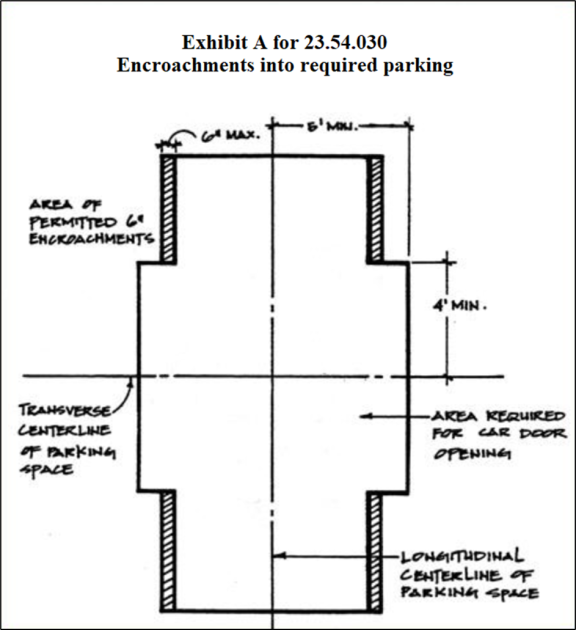
B.
Parking space requirements. The required size of parking spaces shall be determined by whether the parking is for a residential, live-work, or nonresidential use. In structures containing residential uses and also containing either nonresidential uses or live-work units, parking that is clearly set aside and reserved for residential or live-work use shall meet the standards of subsection 23.54.030.B.1. Parking for all other uses within the structure shall meet the standards of subsection 23.54.030.B.2. All uses shall provide barrier-free accessible parking if required by the Seattle Building Code or the Seattle Residential Code.
1.
Residential uses
a.
When five or fewer parking spaces are provided, the minimum required size of a parking space shall be for a medium vehicle, as described in subsection 23.54.030.A.2, except as provided in subsection 23.54.030.B.1.d.
b.
When more than five parking spaces are provided, a minimum of 60 percent of the parking spaces shall be striped for medium vehicles. The minimum size for a medium parking space shall also be the maximum size. Forty percent of the parking spaces may be striped for any size category in subsection 23.54.030.A, provided that when parking spaces are striped for large vehicles, the minimum required aisle width shall be as shown for medium vehicles.
c.
Assisted living facilities. Parking spaces shall be provided as in subsections 23.54.030.B.1.a and 23.54.030.B.1.b, except that a minimum of two spaces shall be striped for a large vehicle.
d.
For an individual garage serving an individual dwelling unit, the minimum required size of a parking space shall be for a medium vehicle, as described in subsection 23.54.030.A.
2.
Nonresidential uses
a.
When ten or fewer parking spaces are provided, a maximum of 25 percent of the parking spaces may be striped for small vehicles. A minimum of 75 percent of the spaces shall be striped for large vehicles.
b.
When between 11 and 19 parking spaces are provided, a minimum of 25 percent of the parking spaces shall be striped for small vehicles. The minimum required size for these small parking spaces shall also be the maximum size. A maximum of 65 percent of the parking spaces may be striped for small vehicles. A minimum of 35 percent of the spaces shall be striped for large vehicles.
c.
When 20 or more parking spaces are provided, a minimum of 35 percent of the parking spaces shall be striped for small vehicles. The minimum required size for small parking spaces shall also be the maximum size. A maximum of 65 percent of the parking spaces may be striped for small vehicles. A minimum of 35 percent of the spaces shall be striped for large vehicles.
d.
The minimum vehicle clearance shall be at least 6 feet 9 inches on at least one floor, and there shall be at least one direct entrance that is at least 6 feet 9 inches in height for all parking garages accessory to nonresidential uses and live-work units and for all flexible-use parking garages.
3.
Live-work uses. The first required parking space shall meet the parking standards for residential use. Additional required parking for a live-work use shall meet the parking standards for nonresidential use.
C.
Backing distances and moving other vehicles
1.
Adequate ingress to and egress from all parking spaces shall be provided without having to move another vehicle, except in the case of multiple spaces provided for a dwelling unit or in the case of tandem parking authorized under subsection 23.54.020.B.
2.
Except for lots with fewer than three parking spaces, ingress to and egress from all parking spaces shall be provided without requiring backing more than 50 feet.
D.
Driveways. Driveway requirements for residential and nonresidential uses are described below. When a driveway is used for both residential and nonresidential parking, it shall meet the standards for nonresidential uses described in subsection 23.54.030.D.2.
1.
Residential uses
a.
Driveway width. Driveways less than 100 feet in length that serve 30 or fewer parking spaces shall be a minimum of 10 feet in width for one-way or two-way traffic.
b.
Except for driveways serving one dwelling unit, driveways more than 100 feet in length that serve 30 or fewer parking spaces shall either:
1)
Be a minimum of 16 feet wide, tapered over a 20 foot distance to a 10 foot opening at the lot line; or
2)
Be a minimum of 10 feet wide and provide a passing area at least 20 feet wide and 20 feet long. The passing area shall begin 20 feet from the lot line, with an appropriate taper to meet the 10-foot opening at the lot line. If a taper is provided at the other end of the passing area, it shall have a minimum length of 20 feet.
c.
Driveways of any length that serve more than 30 parking spaces shall be at least 10 feet wide for one-way traffic and at least 20 feet wide for two-way traffic.
d.
Driveways for two attached dwelling units may be paired so that there is a single curb cut providing access. The maximum width of the paired driveway is 18 feet.
e.
Driveways with a turning radius of more than 35 degrees shall conform to the minimum turning path radius shown in Exhibit B for 23.54.030.
Exhibit B for 23.54.030
Turning Path Radius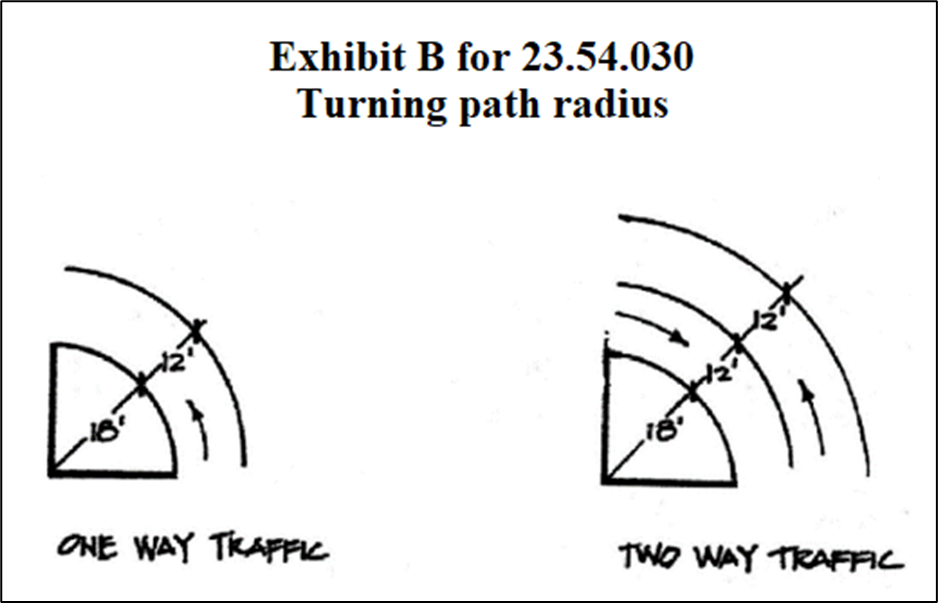
f.
Vehicles may back onto a street from a parking area serving five or fewer vehicles, provided that either:
1)
The street is not an arterial as defined in Section 11.18.010; or
2)
For a lot with one dwelling unit or one parking space, the Director may permit backing onto an arterial based on a safety analysis that addresses visibility, traffic volume, and other relevant issues.
g.
Nonconforming driveways. The number of parking spaces served by an existing driveway that does not meet the standards of this subsection 23.54.030.D.1 shall not be increased. This prohibition may be waived by the Director after consulting with the Director of the Seattle Department of Transportation, based on a safety analysis.
2.
Nonresidential uses
a.
Driveway widths
1)
The minimum width of driveways for one-way traffic shall be 12 feet and the maximum width shall be 15 feet.
2)
The minimum width of driveways for two-way traffic shall be 22 feet and the maximum width shall be 25 feet.
b.
Driveways shall conform to the minimum turning path radius shown in Exhibit B for 23.54.030.
c.
For driveways that provide access to a solid waste management use the Director may allow both a maximum driveway width greater than the limits set in subsection 23.54.030.D.2.a and appropriate turning path radii, as determined necessary for truck maneuvering.
3.
Driveway slope for all uses. No portion of a driveway, whether located on a lot or on a right-of- way, shall exceed a slope of 15 percent, except as provided in this subsection 23.54.030.D.3. The maximum 15 percent slope shall apply in relation to both the current grade of the right-of-way to which the driveway connects, and to the proposed finished grade of the right-of-way if it is different from the current grade. The ends of a driveway shall be adjusted to accommodate an appropriate crest and sag. The Director may permit a driveway slope of more than 15 percent if it is found that:
a.
The topography or other special characteristic of the lot makes a 15 percent maximum driveway slope infeasible;
b.
The additional amount of slope permitted is the least amount necessary to accommodate the conditions of the lot; and
c.
The driveway is still useable as access to the lot.
E.
Parking aisles
1.
Parking aisles shall be provided according to the requirements of Table A for 23.54.030 and Exhibit C for 23.54.030.
Exhibit C for 23.54.030
Parking Aisle Dimensions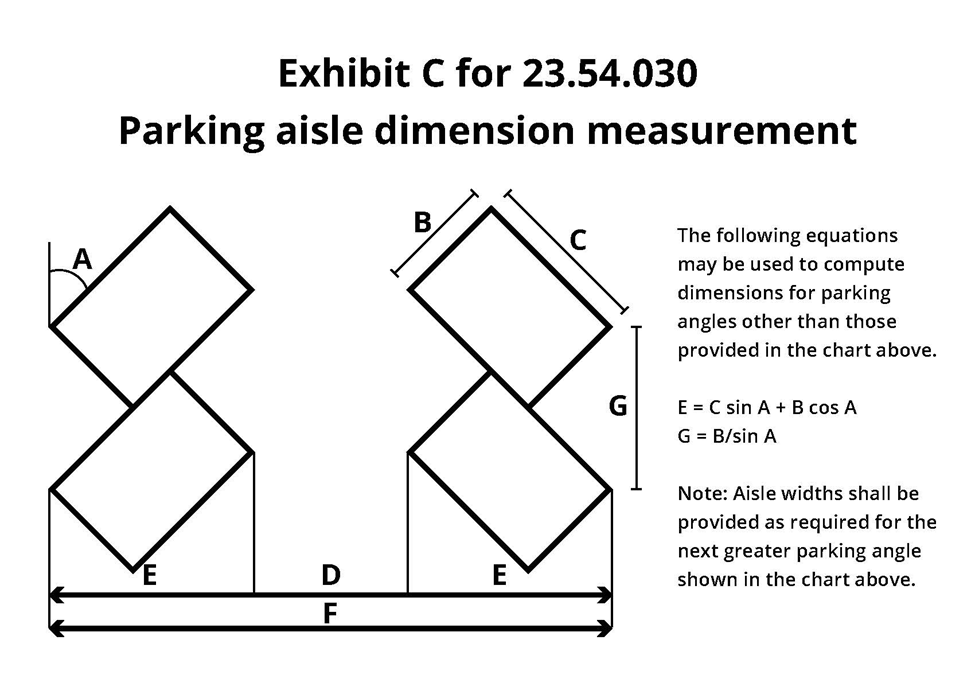
2.
Minimum aisle widths shall be provided for the largest vehicles served by the aisle.
3.
Turning and maneuvering areas shall be located on private property, except that alleys may be credited as aisle space.
4.
Aisle slope shall not exceed 17 percent provided that the Director may permit a greater slope if the criteria in subsections 23.54.030.D.3.a, 23.54.030.D.3.b, and 23.54.030.D.3.c are met.
F.
Attendant parking. In downtown zones, any off-street parking area or structure providing more than five parking spaces where automobiles are parked solely by attendants employed for that purpose shall have parking spaces at least 8 feet in width, and 15 feet in length. Subsections 23.54.030.A, 23.54.030.B, 23.54.030.C, 23.54.030.D, and 23.54.030.E shall not apply, except that the grade curvature of any area used for automobile travel or storage shall not exceed that specified in subsection 23.54.030.D.3. Should attendant operation be discontinued, the provisions of subsections 23.54.030.A, 23.54.030.B, 2054.030.C, 23.54.030.D, and 23.54.030.E shall apply to the parking.
G.
Off-street bus parking. Bus parking spaces, when required, shall be 13 feet in width and 40 feet in length. Buses parked together shall not be required to have adequate ingress and egress from each parking space.
H.
The Director may, as a Type I decision, modify any required dimension or distribution percentage of parking spaces identified in subsections 23.54.030.A or 23.54.030.B to allow more efficient use of a surface parking area or parking garage, when the parking area or parking garage provides adequate and safe circulation.
(Ord. 127376, § 62, 2026; Ord. 127219, § 28, 2025; Ord. 127099, § 47, 2024; Ord. 126685, § 43, 2022; Ord. 126682, § 10, 2022; Ord. 125558, § 48, 2018; Ord. 124843, § 50, 2015; Ord. 124378, § 59, 2013; Ord. 123872, § 6, 2012; Ord. 123649, § 39, 2011; Ord. 123495, § 67, 2011; Ord. 123209, § 56, 2009; Ord. 122311, § 71, 2006 [amended one "shall" to "must"]; Ord. 121477, § 32, 2004 [department name change]; Ord. 121476, § 15, 2004; Ord. 121196, § 25, 2003; Ord. 119238, § 9, 1998; Ord. 118409, § 201, 1996 [department name change]; Ord. 117432, § 39, 1994; Ord. 117263, § 52, 1994; Ord. 115568, § 9, 1991; Ord. 115326, § 28, 1990; Ord. 113710, § 3, 1987; Ord. 113658, § 9, 1987; Ord. 113279, § 30, 1987; Ord. 113263, § 28, 1986; Ord. 112777, § 32, 1986.)
23.54.031 - Curb cuts
The number of permitted curb cuts is determined by whether the parking served by the curb cut is for residential or nonresidential use, and by the zone in which the use is located. If a curb cut is used for more than one use or for one or more live-work units, the requirements for the use with the largest curb cut requirements shall apply.
A.
Residential uses
1.
Number of curb cuts
a.
For lots not located on a principal arterial as designated by the Seattle Department of Transportation, curb cuts are permitted according to Table A for 23.54.031:
b.
For lots on principal arterials as designated by the Seattle Department of Transportation, curb cuts are permitted according to Table B for 23.54.031:
c.
On a lot that has both principal arterial and non-principal arterial street frontage, the total number of curb cuts on the principal arterial is calculated using only the length of the street lot line on the principal arterial.
d.
If two adjoining lots share a common driveway, the combined frontage of the two lots will be considered as one in determining the maximum number of permitted curb cuts.
2.
Curb cut width. Curb cuts shall not exceed a maximum width of 10 feet except that:
a.
For lots on principal arterials as designated by the Seattle Department of Transportation, the maximum curb cut width is 23 feet;
b.
One curb cut greater than 10 feet but in no case greater than 20 feet in width may be substituted for each two curb cuts permitted by subsection 23.54.031.A.1;
c.
A greater width may be specifically permitted by the development standards in a zone;
d.
If subsection 23.54.030.D requires a driveway greater than 10 feet in width, the curb cut may be as wide as the required width of the driveway; and
e.
A curb cut may be less than the maximum width permitted but shall be at least as wide as the minimum required width of the driveway it serves.
3.
Distance between curb cuts
a.
The minimum distance between any two curb cuts located on a lot is 30 feet, except as provided in subsection 23.54.031.A.3.b.
b.
For attached dwelling units, the minimum distance between curb cuts is 18 feet (See Exhibit A for 23.54.031). For attached dwelling units located on abutting lots, the minimum distance between curb cuts is 18 feet.
Exhibit A for 23.54.031
Paired driveways for attached units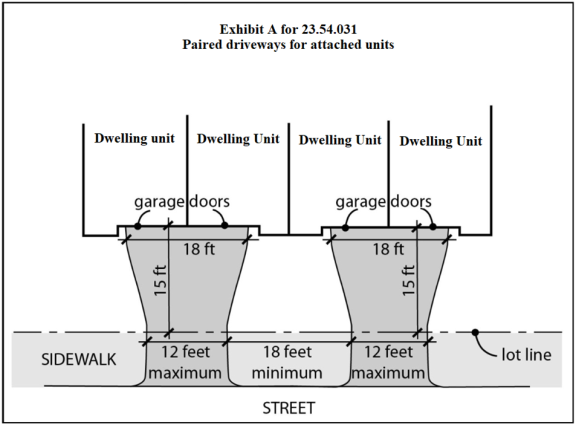
B.
Nonresidential uses in all zones except industrial zones
1.
Number of curb cuts
a.
In all residential zones, RC zones, and within the Major Institution Overlay District, two-way curb cuts are permitted according to Table C for 23.54.031:
b.
The Director may allow two one-way curb cuts to be substituted for one two-way curb cut, after determining, as a Type I decision, that there would not be a significant conflict with pedestrian traffic.
c.
The Director shall, as a Type I decision, determine the number and location of curb cuts in C1 and C2 zones and the location of curb cuts in SM zones.
d.
In downtown zones, a maximum of two curb cuts for one-way traffic at least 40 feet apart, or one curb cut for two-way traffic, are permitted on each street front where access is permitted by subsection 23.49.019.H. No curb cut shall be located within 40 feet of an intersection. These standards may be modified by the Director as a Type I decision on lots with steep slopes or other special conditions, to the minimum extent necessary to provide vehicular and pedestrian safety and facilitate a smooth flow of traffic.
e.
For public schools, the Director shall permit, as a Type I decision, the minimum number of curb cuts that the Director determines is necessary.
f.
In NC zones, curb cuts shall be provided according to subsection 23.47A.032.A, or, when subsection 23.47A.032.A does not specify the maximum number of curb cuts, according to subsection 23.54.031.B.1.a.
g.
For police and fire stations the Director shall permit the minimum number of curb cuts that the Director determines is necessary to provide adequate maneuverability for emergency vehicles and access to the lot for passenger vehicles.
2.
Curb cut widths
a.
For one-way traffic, the minimum width of curb cuts is 12 feet, and the maximum width is 15 feet.
b.
For two-way traffic, the minimum width of curb cuts is 22 feet, and the maximum width is 25 feet, except that the maximum width may be increased to 30 feet if truck and auto access are combined.
c.
For public schools, the maximum width of a curb cut is 25 feet. Development standard departures may be granted or required pursuant to the procedures and criteria set forth in Chapter 23.79.
d.
For fire and police stations, the Director may allow curb cuts up to, and no wider than, the minimum width necessary to provide access for official emergency vehicles that have limited maneuverability and that must rapidly respond to emergencies. Curb cuts for fire and police stations are considered curb cuts for two-way traffic.
e.
If one of the following conditions applies, the Director may require a curb cut of up to 30 feet in width, if it is found that a wider curb cut is necessary for safe access:
1)
The abutting street has a single lane on the side that abuts the lot; or
2)
The curb lane abutting the lot is less than 11 feet wide; or
3)
The proposed development is located on an arterial with an average daily traffic volume of over 7,000 vehicles; or
4)
Off-street loading berths are required according to Section 23.54.035.
3.
The entrances to all garages accessory to nonresidential uses or live-work units and the entrances to all flexible-use parking garages shall be at least 6 feet 9 inches high.
C.
All uses in industrial zones
1.
Number and location of curb cuts. The number and location of curb cuts will be determined by the Director.
2.
Curb cut width. Curb cut width in industrial zones shall be as follows:
a.
Except as set forth in subsection 23.54.031.C.2.d, if the curb cut provides access to a parking area or structure, it must be a minimum of 15 feet wide and a maximum of 30 feet wide.
b.
If the curb cut provides access to a loading berth, the maximum width may be increased to 50 feet.
c.
Within the minimum and maximum widths established by this subsection 23.54.031.C, the Director shall determine the size of the curb cuts.
d.
If the curb cut provides access to a solid waste management use, the Director may determine the maximum width of the curb cut.
D.
Curb cuts for access easements
1.
If a lot is crossed by an access easement serving other lots, the curb cut serving the easement may be as wide as the easement roadway.
2.
The curb cut serving an access easement shall not be counted against the number or amount of curb cuts permitted to a lot if the lot is not itself served by the easement.
E.
Curb cut flare. A flare with a maximum width of 2.5 feet is permitted on either side of curb cuts in any zone.
F.
Replacement of unused curb cuts. When a curb cut is no longer needed to provide access to a lot, the curb and any planting strip must be replaced.
G.
Curb cuts are not allowed on streets if alley access to a lot is feasible but has not been provided.
(Ord. 127376, § 63, 2026 [renumbered from 23.54.030.F and amended]; Ord. 126685, § 43, 2022; Ord. 126157, § 44, 2020; Ord. 125603, § 61, 2018; Ord. 125558, § 48, 2018; Ord. 125272, § 49, 2017; Ord. 124378, § 59, 2013; Ord. 123872, § 6, 2012; Ord. 123649, § 39, 2011; Ord. 123495, § 67, 2011; Ord. 123209, § 56, 2009; Ord. 123047, § 2, 2009; Ord. 122935, § 15, 2009; Ord. 122816, § 5, 2008; Ord. 122311, § 71, 2006; Ord. 122054, § 75, 2006 [cross-reference update]; Ord. 121782, § 33, 2005; Ord. 121196, § 25, 2003; Ord. 120691, § 17, 2001; Ord. 118414, § 41, 1996; Ord. 118302, § 15, 1996; Ord. 117432, § 39, 1994; Ord. 115326, § 28, 1990 [renumbered from 23.54.030.E and amended]; Ord. 113658, § 9, 1987; Ord. 113263, § 28, 1986; Ord. 112777, § 32, 1986.)
23.54.032 - Sight triangles
A.
For exit-only driveways and easements, and two-way driveways and easements less than 22 feet wide, a sight triangle on both sides of the driveway or easement shall be provided, and shall be kept clear of any obstruction for a distance of 10 feet from the intersection of the driveway or easement with a driveway, easement, sidewalk, or curb intersection if there is no sidewalk, as depicted in Exhibit A for 23.54.032.
Exhibit A for 23.54.032
Sight triangle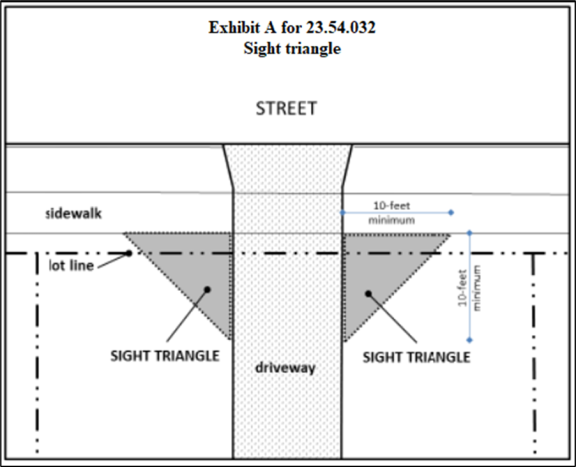
B.
For two-way driveways or easements 22 feet wide or more, a sight triangle on the side of the driveway used as an exit shall be provided, and shall be kept clear of any obstruction for a distance of 10 feet from the intersection of the driveway or easement with a driveway, easement, sidewalk, or curb intersection if there is no sidewalk. The entrance and exit lanes shall be clearly identified.
C.
The sight triangle shall also be kept clear of obstructions in the vertical spaces between 32 inches and 82 inches from the ground.
D.
When the driveway or easement is less than 10 feet from the lot line, the sight triangle may be provided as follows:
1.
An easement may be provided sufficient to maintain the sight triangle. The easement shall be recorded with the King County Recorder's Office; or
2.
The driveway may be shared with a driveway on the neighboring lot; or
3.
The driveway or easement may begin 5 feet from the lot line, as depicted in Exhibit B for 23.54.032.
Exhibit B for 23.54.032
Sight triangle exception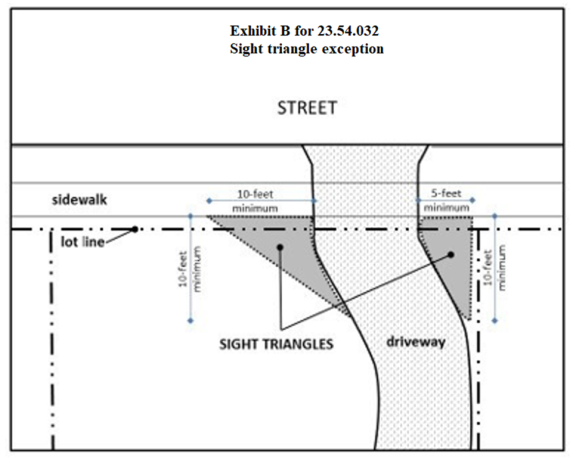
E.
An exception to the sight triangle requirement may be made for driveways serving lots containing only residential uses and fewer than three parking spaces, when providing the sight triangle would be impractical.
F.
In all downtown, industrial, Commercial 1, and Commercial 2 zones, the sight triangle at a garage exit may be provided by mirrors and/or other approved safety measures.
G.
Sight triangles are not required for one-way entrances into a parking garage or surface parking area.
H.
Sight triangles are not required when access to parking is provided from an alley.
(Ord. 127376, § 63, 2026 [renumbered from 23.54.030.G and amended]; Ord. 125272, § 49, 2017; Ord. 124378, § 59, 2013; Ord. 123649, § 39, 2011; Ord. 123495, § 67, 2011 [department name change/relettered an exhibit]; Ord. 123209, § 56, 2009; Ord. 115326, § 28, 1990 [renumbered from 23.54.030.F and amended]; Ord. 113279, § 30, 1987; Ord. 112777, § 32, 1986.)
23.54.033 - Pedestrian access to garage
Pedestrian access to garage. For new structures that include a garage, in a zone where flexible-use parking is permitted, at least one pedestrian access walkway or route shall be provided between a garage and a public right-of-way, which may be an alley, including a side-hinged door for pedestrian use. A fire exit door, or other access through lobbies, may serve this purpose if the access route and doors are accessible for ingress and egress by garage users.
(Ord. 127376, § 64, 2026 [renumbered from 23.54.030.K]; Ord. 125558, § 48, 2018.)
23.54.034 - Electric vehicle (EV) charging infrastructure
New parking spaces provided on a lot when a new building is constructed shall be EV-ready as specified in this Section 23.54.034. The required number of EV-ready parking spaces shall be determined by whether the parking is for a residential or nonresidential use. Parking that is clearly set aside and reserved for residential use shall meet the standards of subsection 23.54.034.A; parking for all other uses within the structure shall meet the standards of subsection 23.54.034.B.
A.
Residential uses
1.
Private parking for individual dwelling units. When parking for any individual dwelling unit is provided in a private garage, carport, or parking area, separate from any parking facilities serving other units, at least one parking space for each unit in that garage, carport, or surface parking area shall be EV-ready.
2.
Surface parking for multiple dwelling units. When parking for multiple dwelling units is provided in a surface parking area serving multiple dwelling units, the number of parking spaces that shall be EV-ready shall be as follows:
a.
When up to 25 parking spaces are provided, the first 12 parking spaces shall be EV-ready; and
b.
When more than 25 parking spaces are provided, 45 percent of all parking spaces shall be EV-ready.
3.
Parking garages for multiple dwelling units. When parking for multiple dwelling units is provided in a parking garage serving multiple dwelling units, a minimum of 45 percent of those parking spaces shall be EV-ready.
B.
Nonresidential uses
1.
When parking is provided for nonresidential uses, a minimum of 30 percent of those spaces shall be EV-ready, except as provided in subsection 23.54.034.B.2 and subsection 23.54.034.B.3.
2.
For the uses listed in subsection 23.54.034.B.3, the following requirements apply:
a.
Where fewer than ten parking spaces are provided for the use, one EV-ready space is required.
b.
Where ten or more parking spaces are provided for the use, 10 percent of parking spaces shall be EV-ready.
3.
The following uses are subject to the alternative requirements in 23.54.034.B.2:
a.
The following institutional uses:
1.
Community club or center;
2.
Child care center;
3.
Community farm;
4.
Library;
5.
Museum;
6.
Private club;
7.
Religious facility; and
8.
School, elementary or secondary;
b.
Entertainment uses;
c.
Eating and drinking establishments;
d.
Automotive sales and services;
e.
Multipurpose retail sales;
f.
Heavy sales and services, except heavy commercial services; and
g.
Marine sales and services.
C.
Rounding. When calculating the number of required EV-ready parking spaces, any fraction or portion of an EV-ready parking space required shall be rounded up to the nearest whole number.
D.
Reductions
1.
The Director may, in consultation with the Director of Seattle City Light, reduce the requirements of this Section 23.54.034 as a Type I decision if there is substantial evidence that the added electrical load that can be attributed to meeting the requirements will:
a.
Alter the local utility infrastructure design requirements on the utility side of the legal point of service, so as to require on-property power transformation; or
b.
Require an upgrade to an existing residential electrical service.
2.
In cases where the provisions of subsection 23.54.034.D.1 have been met, the maximum quantity of EV charging infrastructure required to be installed shall be reduced to the maximum service size that would not require the changes to transformation or electrical service in subsection 23.54.034.D.1. The Director may first reduce the required level of EV infrastructure at EV-ready parking spaces from 40-amp to 20-amp circuits. If necessary, the Director may also then reduce the number of required EV-ready parking spaces or otherwise reduce the level of EV infrastructure at EV-ready parking spaces.
3.
The Director may establish by rule the procedures and documentation required for a reduction request.
E.
All EV charging infrastructure shall be installed in accordance with the Seattle Electrical Code. Where EV-ready surface parking spaces are located more than 4 feet from a building, raceways shall be extended to a pull box or stub in the vicinity of the designated space and shall be protected from vehicles.
F.
Accessible parking. Where new EV-ready parking spaces and new accessible parking are both provided, parking facilities shall be designed so that at least 20 percent of the accessible parking spaces or two accessible parking spaces, whichever is greater, shall be EV-ready. The accessible parking EV-ready infrastructure may also serve adjacent parking spaces not designated as accessible parking. The EV-ready accessible parking spaces, rounded up to the next whole number, are allowed to be included in the total number of electric vehicle parking spaces required under 23.54.034.A. and 23.54.034.B.
G.
Nothing in this Section 23.54.034 shall be construed to modify the minimum number of off-street motor vehicle parking spaces required for specific uses or the maximum number of parking spaces allowed, as set forth in Section 23.54.015 or elsewhere in this Title 23.
H.
This Section 23.54.034 does not require EV supply equipment, as defined by Article 100 of the Seattle Electrical Code, to be installed.
(Ord. 127376, § 64, 2026 [renumbered from 23.54.030.L and amended]; Ord. 127219, § 28, 2025; Ord. 125815, § 4, 2019.)
23.54.035 - Loading berth requirements and space standards
A.
Quantity of Loading Spaces.
1.
The minimum number of off-street loading berths required for specific uses shall be set forth in Table A. (See Table A for Section 23.54.035.)
2.
For uses not listed on Table A the Director shall determine the loading berth requirements. Loading demand and loading requirements for similar uses shall be considered in determining such requirements.
3.
Existing deficits in the number of required loading berths shall be allowed to continue if a change of use occurs.
4.
Uses shall be considered low-demand uses, medium-demand uses and high-demand uses, as follows. (See Table for 23.54.035 A.)
5.
When a lot contains more than one (1) business establishment within the same category of low-, medium- or high-demand use, the square footage of the business establishments within the same category shall be added together in order to determine the number of required loading berths.
B.
Exception to loading requirements
1.
For uses with less than 16,000 square feet of gross floor area that provide a loading space on a street or alley, the loading berth requirements may be waived by the Director if, after review, the Director of the Seattle Department of Transportation finds that the street or alley berth is adequate.
2.
Within the Downtown and South Lake Union Regional Centers and within the MPC-YT zone, loading berth requirements may be waived or modified if the Director finds, after consultation with and approval by the Director of the Seattle Department of Transportation, that the number of loading berths in Table A for 23.54.035 is not required and that the modified number will be sufficient. The applicant shall submit specific information addressing the following criteria, upon which the Director's determination shall be based:
a.
All loading is proposed to occur on-site or any loading that is proposed to occur in a public right-of-way can take place without disrupting pedestrian circulation or vehicular traffic;
b.
Additional evidence relating to the size, character, and operation of the building and likely tenancy; and
c.
Where loading occurs at a central loading facility, goods can be distributed to other buildings on-site without disrupting pedestrian circulation or vehicular traffic.
C.
Standards for Loading Berths.
1.
Width and Clearance. Each loading berth shall be not less than ten (10) feet in width and shall provide not less than fourteen (14) feet vertical clearance.
2.
Length.
a.
High-demand Uses. Each loading berth for a high-demand use shall be a minimum of fifty-five (55) feet in length unless reduced by determination of the Director as provided at subsection C2c.
b.
Low- and Medium-demand Uses. Each loading berth for low- and medium-demand uses, except those uses identified in subsection C2d, shall be a minimum of thirty-five (35) feet in length unless reduced by determination of the Director as provided at subsection C2c.
c.
Exceptions to Loading Berth Length. Where the Director finds, after consulting with the property user, that site design and use of the property will not result in vehicles extending beyond the property line, loading berth lengths may be reduced to not less than the following:
(i)
High-demand Uses. Thirty-five (35) feet when access is from a collector arterial or local access street; and forty-five (45) feet when access is from a principal or minor arterial street;
(ii)
Low- and Medium-demand Uses. Twenty-five (25) feet.
d.
Multipurpose convenience stores, sales, service and rental of major durables, and specialty food stores may be required by the Director to increase the length of required loading berths; however, these uses shall not be required to provide loading berths in excess of fifty-five (55) feet. The review of loading berth length requirements for these uses shall focus on the size of vehicles that frequently serve the business and the frequency of loading activity that will extend beyond the lot line during daytime hours (six (6:00) a.m. to six (6:00) p.m.). Large-truck loading occurring on a daily basis shall generally require longer loading berths; when such activity occurs on at least a weekly basis, it will be evaluated regarding the amount of traffic disruption and safety problems potentially created; such activity occurring on less than a weekly basis shall generally not require longer loading berths.
3.
For uses not listed in Table A, the Director shall determine the loading berth length requirements. Loading demand and loading requirements for similar uses shall be considered.
4.
Maneuvering Space for Loading Berths. In addition to the length of the loading berth, additional maneuvering space may be required by the Director in the following cases:
a.
For any uses with over ten thousand (10,000) square feet of gross floor area with loading berth access from a principal or minor arterial street;
b.
For high-demand uses with over ten thousand (10,000) square feet of gross floor area with loading berth access from a collector arterial or local access street, especially if located across the street from another high-demand use. When required, the additional maneuvering space shall be designed and arranged to allow the most efficient use of all required loading berths by motor vehicles of the types typically employed by the activities served.
(Ord. 127375, § 90, 2026; Ord. 124680, § 12, 2015; Ord. 123963, § 22, 2012; Ord. 123649, § 40, 2011; Ord. 123046, § 65, 2009 [renamed charts to tables]; Ord. 121477, § 33, 2004 [department name change]; Ord. 121359, § 8, 2003; Ord. 119238, § 10, 1998; Ord. 118409, § 202, 1996 [department name change]; Ord. 117432, § 40, 1994; Ord. 113658, § 10, 1987.)
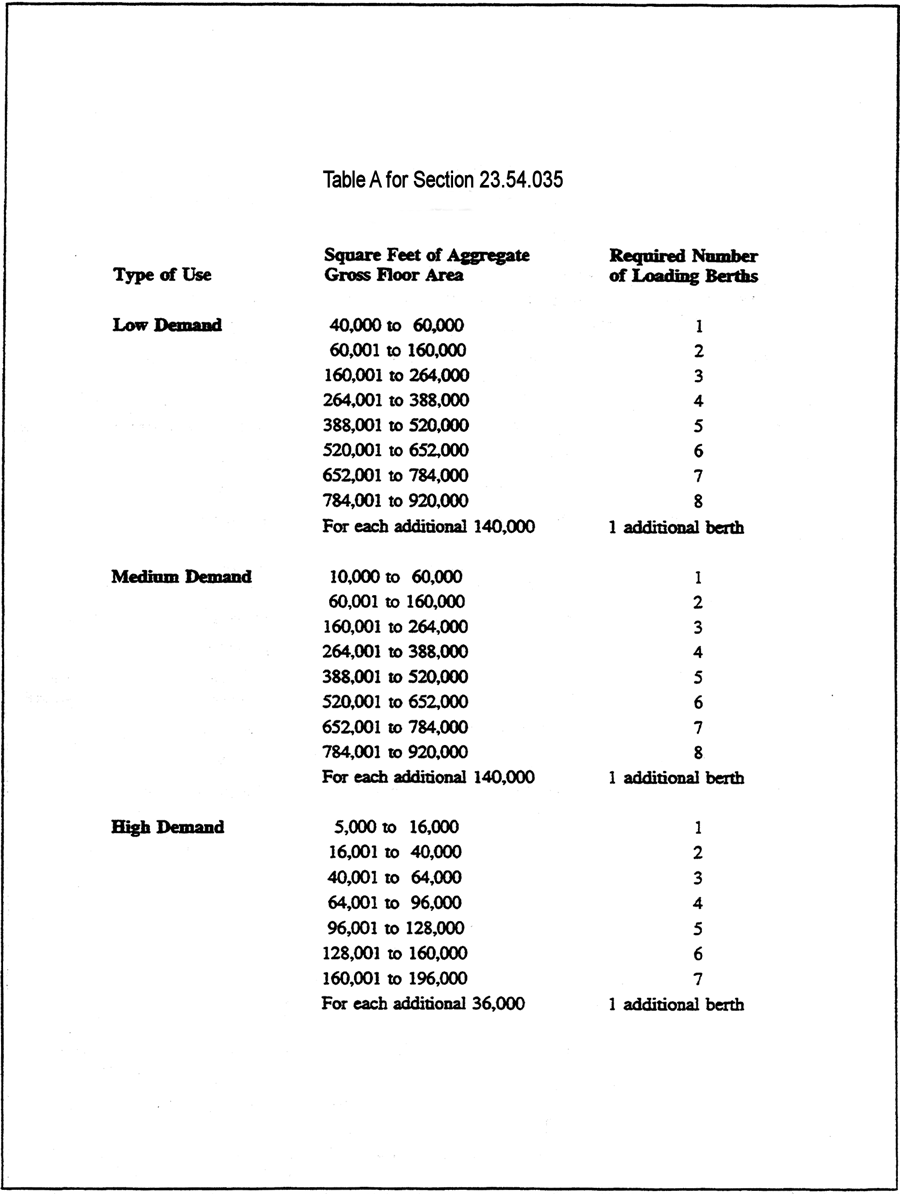
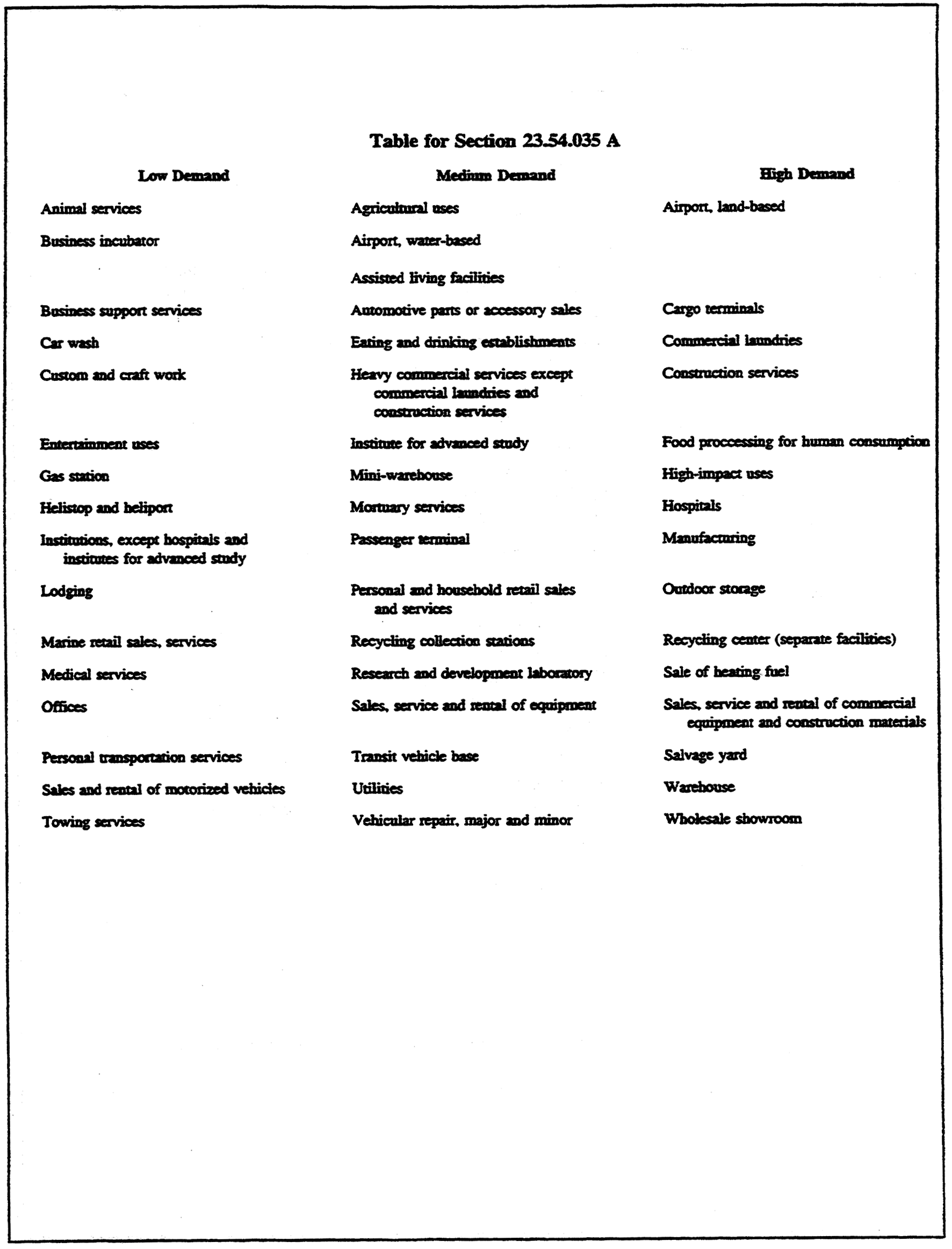
23.54.037 - Bicycle parking
A.
Number of spaces
1.
The minimum number of parking spaces for bicycles required for specified uses is set forth in Table A for 23.54.037.
2.
Long-term parking for bicycles shall be for bicycles parked four or more hours. Short-term parking for bicycles shall be for bicycles parked less than four hours. In the case of a use not shown on Table A for 23.54.037, one bicycle parking space per 10,000 gross square feet of either short- or long-term bicycle parking is required.
3.
The minimum requirements are based upon gross floor area of the use in a structure minus gross floor area in parking uses, or the square footage of the use when located outside of an enclosed structure, or as otherwise specified.
4.
Rounding. For long-term bicycle parking, calculation of the minimum requirement shall round up the result to the nearest whole number. For short-term bicycle parking, calculation of the minimum requirement shall round up the result to the nearest whole even number.
B.
Performance standards. Provide bicycle parking in a highly visible, safe, and convenient location, emphasizing user convenience and theft deterrence, based on rules promulgated by the Director of the Seattle Department of Transportation that address the considerations in this subsection 23.54.037.B.
1.
Provide secure locations and arrangements of long-term bicycle parking, with features such as locked rooms or cages and bicycle lockers. The bicycle parking should be installed in a manner that avoids creating conflicts with automobile accesses and driveways.
2.
For a garage with bicycle parking and motor vehicle parking for more than two dwelling units, provide pedestrian and bicycle access to long-term bicycle parking that is separate from other vehicular entry and egress points or uses the same entry or egress point but has a marked walkway for pedestrians and bicyclists.
3.
Provide adequate lighting in the bicycle parking area and access routes to it.
4.
If short-term bicycle parking facilities are not clearly visible from the street or sidewalk or adjacent on-street bicycle facilities, install directional signage in adequate amounts and in highly visible locations in a manner that promotes easy wayfinding for bicyclists.
5.
Provide signage to long-term bicycle parking that is oriented to building users.
6.
Long-term bicycle parking shall be located where bicyclists are not required to carry bicycles on exterior stairs with more than five steps to access the parking. The Director, as a Type I decision, may allow long-term bicycle parking for rowhouse and townhouse development to be accessed by stairs with more than five steps, if the slope of the lot makes access with five or fewer steps infeasible.
7.
Where practicable, long-term bicycle parking shall include a variety of rack types to accommodate different types of bicycles.
8.
Install bicycle parking hardware so that it can perform to its manufacturer's specifications and any design criteria promulgated by the Director of the Seattle Department of Transportation, allowing adequate clearance for bicycles and their riders.
9.
Provide full weather protection for all required long-term bicycle parking.
C.
Location of bicycle parking
1.
Long-term bicycle parking required for residential uses shall be located on-site except as provided in subsection 23.54.037.C.3.
2.
Short-term bicycle parking may be provided on the lot or in an adjacent right-of-way, subject to approval by the Director of the Seattle Department of Transportation, or as provided in subsection 23.54.037.C.3.
3.
Both long-term and short-term bicycle parking for residential uses may be provided off-site if within 600 feet of the residential use to which the bicycle parking is accessory and if the site of the bicycle parking is functionally interrelated to the site of the residential use to which the bicycle parking is accessory, such as within a unit lot subdivision or if the sites are connected by access easements, or if a covenant or similar property right is established to allow use of the off-site bicycle parking.
D.
Long-term bicycle parking required for small efficiency dwelling units and congregate residence sleeping rooms is required to be covered for full weather protection. If the required, covered long-term bicycle parking is located inside the building that contains small efficiency dwelling units or congregate residence sleeping rooms, the space required to provide the required long-term bicycle parking shall be exempt from floor area ratio (FAR) limits. Covered long-term bicycle parking that is provided beyond the required bicycle parking shall not be exempt from FAR limits.
E.
Bicycle parking facilities shared by more than one use are encouraged.
F.
Except as provided in subsection 23.54.015.G, bicycle parking facilities required for nonresidential uses shall be located:
1.
On the lot; or
2.
For a functionally interrelated campus containing more than one building, in a shared bicycle parking facility within 600 feet of the lot; or
3.
Short-term bicycle parking may be provided in an adjacent right-of-way, subject to approval by the Director of the Seattle Department of Transportation.
G.
For nonresidential uses on a functionally interrelated campus containing more than one building, both long-term and short-term bicycle parking may be located in an off-site location within 600 feet of the lot, and short-term public bicycle parking may be provided in a right-of-way, subject to approval by the Director of the Seattle Department of Transportation. The Director of the Seattle Department of Transportation may consider whether bicycle parking in the public place shall be sufficient in quality to effectively serve bicycle parking demand from the site.
H.
Bicycle commuter shower facilities. Structures containing 100,000 square feet or more of office use floor area shall include shower facilities and clothing storage areas for bicycle commuters. Two showers shall be required for every 100,000 square feet of office use. They shall be available in a manner that results in equal shower access for all users. The facilities shall be for the use of the employees and occupants of the building, and shall be located where they are easily accessible to bicycle parking facilities, which may include in places accessible by elevator from the bicycle parking location.
I.
Bicycle parking spaces within dwelling units or on balconies do not count toward the bicycle parking requirement, except if the bike parking spaces are located:
1.
In a private garage; or
2.
Within the ground floor of a dwelling unit in an attached dwelling unit.
(Current text
Ord. 127376, § 59, 2026 [renumbered from 23.54.015.K]; Ord. 127228, § 19, 2025; Ord. 127219, § 26, 2025; Ord. 126855, § 39, 2023; Ord. 126682, § 9, 2022; Ord. 126509, § 76, 2022 [zone name change]; Ord. 126287, § 10, 2021; Ord. 126157, § 42, 2020; Ord. 125558, § 42, 2018; Ord. 125272, § 48, 2017; Ord. 124843, § 48, 2015; Ord. 124770, § 9, 2015; Ord. 124608, § 10, 2014; Ord. 123046, § 65, 2009 [renamed charts to tables]; Ord. 122311, § 68, 2006 [replaced entire text and functionally renumbered from 23.54.015.I].
Prior text
Ord. 121828, § 10, 2005 [re-enacted to incorporate prior amendments]; Ord. 121782,
§ 31, 2005; Ord. 121477, § 30, 2004 [department name change]; Ord. 121196, § 23, 2003;
Ord. 121145, § 14, 2003; Ord. 120609, § 13, 2001; Ord. 118409, § 199, 1996 [department name change]; Ord. 118302, § 13,
1996; Ord. 113263, § 26, 1986 [renumbered from 23.54.015.H and amended]; Ord. 112777,
§ 32, 1986.)
23.54.040 - Solid waste storage, access, and collection
A.
General provisions. For the purposes of this Section 23.54.040, compostable materials, garbage, recyclable materials, and solid waste are as defined in Chapter 21.36. "Solid waste" refers to compostable materials, garbage, and recyclable materials.
1.
Except as otherwise provided in this Section 23.54.040, solid waste storage space shall be provided as shown in Table A for 23.54.040 and Table B for 23.54.040 for:
a.
All new principal structures and detached accessory dwelling units;
b.
An addition of more than 5,000 gross square feet of non-residential use(s) to an existing structure;
c.
A change of use of more than 10,000 gross square feet of non-residential use(s) in an existing structure;
d.
Existing structures to which two or more live-work units are added;
e.
Existing structures to which two or more dwelling units are added; and
f.
Existing structures to which four or more sleeping rooms are added.
2.
Residential development shall provide one solid waste storage space with minimum dimensions of 2.5 feet by 6 feet for each dwelling unit, unless they provide solid waste storage space according to subsection 23.54.040.A.3.
3.
Residential development for which a home ownership association, or other single entity, exists or will exist as a sole source for utility billing may meet the standards in subsection 23.54.040.A.2, or the standards in Table A for 23.54.040.
4.
Except as otherwise provided in this Section 23.54.040, non-residential development shall meet the standards in Table B for 23.54.040.
5.
Solid waste storage spaces, solid waste staging areas, and solid waste collection locations shall meet contractor safety standards promulgated by the Director of Seattle Public Utilities.
6.
Each solid waste storage space shall include solid waste containers for compostable materials, garbage, and recyclable materials.
7.
A solid waste storage space may also serve as a solid waste staging area and/or solid waste collection location if the storage space meets the requirements for such area(s).
B.
Mixed use development that contains both residential and non-residential use shall meet the minimum solid waste storage space area requirements shown in Table A for 23.54.040 for residential development or as modified by subsection 23.54.040.C, plus 50 percent of the solid waste storage space requirement for non-residential development shown in Table B for 23.54.040. In mixed use developments, solid waste storage space may be located together.
1.
Residential and non-residential uses may share containers for garbage.
2.
Residential and non-residential uses shall use separate containers for recycling and compostable materials.
C.
For development with more than 100 dwelling units, the required minimum area for residential solid waste storage space shown in Table A for 23.54.040 may be reduced by 15 percent, if the area provided as residential solid waste storage space has minimum horizontal dimensions (width and depth) of 20 feet.
D.
Solid waste storage space required by Table A for 23.54.040 shall meet the minimum dimensional requirements in Table C for 23.54.040, Table D for 23.54.040, and Table E for 23.54.040, according to type of uses present.
1.
The floor of the solid waste storage space shall be level and hard-surfaced, and the floor beneath garbage or recycling compactors shall be made of concrete; and
2.
If located outdoors, the solid waste storage space shall be screened from public view and designed to minimize light and glare impacts.
E.
The location of all solid waste storage spaces shall meet the following requirements:
1.
The solid waste storage space shall be located on the lot of the structure it serves and, if located outside the principal structure, shall not be located between a street-facing facade of the structure and the street (development permitted for unit lot subdivision may designate a shared solid waste storage space within the parent lot of the unit lot subdivision);
2.
The solid waste storage space shall not be located in driveways, parking aisles, or parking spaces;
3.
The solid waste storage space shall not block or impede any fire exits, any public rights-of-way, or any pedestrian or vehicular access;
4.
The solid waste storage space shall be located to minimize noise and odor impacts on building occupants and beyond the lot lines of the lot; and
5.
The solid waste storage space shall not be used for purposes other than solid waste storage and access to or movement of solid waste containers.
F.
Solid waste staging areas and solid waste collection locations
1.
Solid waste staging areas located within a planting strip may not conflict with required landscaping, including but not limited to street trees, and other required public right-of-way characteristics. Evaluation of consistency with this subsection 23.54.040.F.1 shall be in consultation with the Director of Transportation.
2.
The Director may allow staging of solid waste containers in the right-of-way in consultation with the Director of Transportation.
3.
Solid waste staging areas and solid waste collection locations shall not be within a bus stop or within the street right-of-way area abutting a vehicular lane designated as a sole travel lane for a bus.
4.
A minimum 14-foot overhead clearance shall be provided at the solid waste collection location, except as otherwise specified in subsection 23.54.040.G.
5.
Solid waste carts shall be staged within 8 feet of the solid waste collection location unless an alternative staging location is approved by Seattle Public Utilities.
6.
Solid waste staging and solid waste collection areas for dumpsters shall be paved with asphalt or concrete.
G.
Access to solid waste containers for solid waste service providers and solid waste collection vehicles shall meet the following requirements:
1.
For dumpsters 2 cubic yards or smaller:
a.
Dumpsters to be manually transported for collection by a solid waste service provider, shall be staged no more than 50 feet from the solid waste collection location, in a manner that provides access to each container for service;
b.
The slope of the solid waste staging area and solid waste collection locations for dumpsters shall not exceed a grade of six percent;
c.
The slope of access paths used to move dumpsters to the solid waste collection location shall not exceed a grade of six percent;
d.
An enclosed solid waste staging area for dumpsters shall have an access door or opening that is at least 6 feet wide;
e.
Paths and corridors through which dumpsters are transported shall be at least 6 feet wide and shall be paved with asphalt or concrete; and
f.
Any gates or access routes for solid waste collection vehicles shall be a minimum of 12 feet wide.
2.
For containers larger than 2 cubic yards, any container to be loaded for service by the front of the solid waste collection vehicle, and all containers storing compacted materials:
a.
Direct access to the containers shall be provided at the solid waste collection location;
b.
The slope of the solid waste collection location and solid waste staging area shall not exceed two percent;
c.
Any gates or access routes for solid waste collection vehicles shall be a minimum of 12 feet wide;
d.
Paths and corridors through which containers are transported shall be a minimum of 6 feet wide and shall be paved with asphalt or concrete;
e.
In locations where a compactor will be placed, the solid waste storage space shall accommodate a minimum 2 feet of clearance around all sides of the compactor(s);
f.
The solid waste collection location for front-load dumpsters shall have a 24-foot overhead clearance; and
g.
Solid waste collection locations shall be located such that solid waste service providers do not need to reposition containers larger than 4 cubic yards or containers that store compacted materials.
3.
For roll-off dumpsters (uncompacted and compacted solid waste):
a.
Gates or access routes for solid waste collection vehicles shall be a minimum of 12 feet wide;
b.
Direct access to the dumpsters by solid waste collection vehicles shall be provided at the solid waste collection location;
c.
Overhead clearance (floor to ceiling) for a low-profile roll-off dumpster shall be a minimum of 14 feet;
d.
Overhead clearance (floor to ceiling) for a roll-off dumpster of standard height shall be a minimum of 16 feet; and
e.
Overhead clearance (floor to ceiling) if the container is not stored on a dock shall be a minimum of 18 feet.
H.
The solid waste storage space, access, solid waste staging area, and solid waste collection location specifications required in this Section 23.54.040, including the number, volume, and dimensions (width and depth) of containers and the type of solid waste, shall be included on the plans submitted with the permit application for any development subject to the requirements of this Section 23.54.040.
I.
Ramps to accommodate solid waste container access
1.
A solid waste access ramp to the street that is not more than 5 feet in width may be approved by the Director of Transportation if:
a.
Access to solid waste containers is not from an alley;
b.
No on-site parking is provided;
c.
The lot contains solid waste containers that are 1 cubic yard or larger; and
d.
There are no existing solid waste access ramps or other curb cuts within 150 feet of the street lot line, as measured parallel to the street lot line. For purposes of this subsection 23.54.040.I.1.d, curb ramps at crosswalks are not considered existing ramps for solid waste access.
2.
The standards of subsections 23.54.040.I.1.a through 23.54.040.I.1.d may be modified by the Director of Transportation where unusual topography, inability to temporarily stage solid waste containers in a parking lane, or other local conditions present significant challenges for accommodating solid waste container access.
J.
If the requirements of this Section 23.54.040 cannot be met, the Director, after consultation with the Director of Seattle Public Utilities, may approve alternative arrangements. Such measures may be approved as a Type I decision in relation to any requirement of this Section 23.54.040, except subsection 23.54.040.I. Alternative staging arrangements may be approved as a Type I decision by the Director after consultation with the Director of Seattle Public Utilities and the Director of Transportation. Approval of alternative arrangements is at the discretion of the Director and does not obligate the Director to grant relief from any requirement or obligate the Director to provide any improvements within a right-of-way. The Director may consider, but is not limited to considering:
1.
Whether adequate areas exist on the lot or in the right-of-way for staging or collecting solid waste containers;
2.
Whether the solid waste requirements adequately accommodate the needs of a particular development type, such as:
a.
Affordable housing;
b.
Small efficiency dwelling units;
c.
Congregate housing; or
d.
Development using compaction of solid waste;
3.
Whether alternative solid waste arrangements would result in one or more additional dwelling units being constructed; and
4.
The effect on the efficiency of collection services such as:
a.
Minimizing the number of days for collection service;
b.
Providing safe access to the solid waste collection area; or
c.
Providing an efficient route between the solid waste storage space and the solid waste collection location.
(Ord. No. 127285, § 2, 2025; Ord. 126157, § 45, 2020; Ord. 125791, § 87, 2019; Ord. 125272, § 50, 2017; Ord. 124608, § 11, 2014; Ord. 123963, § 23, 2012; Ord. 123495, § 69, 2011.)

