
Saint Petersburg City Zoning Code
SECTION 16
20.015.- NEIGHBORHOOD TRADITIONAL MIXED RESIDENTIAL DISTRICTS "NTM"
16.20.015.1.- Purpose.
To provide a variety of urban housing choices in low to medium density building types that reinforce the walkability of the neighborhood, provide a variety of attainable housing choices, establish appropriate transition zones from mixed-use corridors to single-family housing, support neighborhood-serving retail and service uses adjacent to this zoning category, and support public transportation and other multi-modal alternatives.
Development standards reinforce the traditional development pattern. Street standards preserve the alley system as a mechanism for providing limited access to parking and utility functions in the rear of the site.
(Ord. No. 405-H, § 4, 12-12-2019)
16.20.015.2. - Applicability.
Uses in this district shall be allowed as provided in the Matrix: Use Permissions and Parking Requirements.
A.
Applicable to locations that transition from a mixed-use corridor, center or Future Major Street to a single-family neighborhood. The most effective application of this district is in a linear configuration when located within 175-feet of the centerline of a designated Future Major Street.
1.
Qualified properties shall be adjacent to a public alley.
2.
Applicable to neighborhoods where the subject property:
a.
Retains direct connectivity to one or more adjoining Future Major Streets; and
b.
A minimum of 75% of the property is outside of the designated Coastal High Hazard Area ("CHHA"), and in no case shall the density in the CHHA be increased.
(Ord. No. 405-H, § 4, 12-12-2019; Ord. No. 540-H, § 3, 3-23-2023)
16.20.015.3. - Introduction to the NTM-1 district.
The standards for the NTM-1 district are intended to allow for renovations and redevelopment within the traditional neighborhoods, while respecting the existing development pattern and unique character of these areas.
This district will allow for a variety of building typologies with a maximum of 4-units per building. These building typologies, commonly referred to as "Missing Middle" housing types, reinforce urban, walkable neighborhoods with a combination of single-family and multi-family residential units located near daily destinations. These units provide attainable life-cycle housing to a diverse group of residents including first-time homeowners, families, couples, retirees, adults with disabilities, and car-free households.
This district will allow density up to 30-units per acre, not to exceed four dwelling units per building. Accessory dwelling units, such as garage apartments, are allowed, subject to compliance with density standards, building setbacks, parking and other applicable requirements. The design guidelines are intended to ensure compatibility with the existing character and pattern of these neighborhoods by requiring compatible building design and driveways, garages, and utility uses are limited to the rear of the property.
(Ord. No. 405-H, § 4, 12-12-2019; Ord. No. 611-H, § 6, 7-10-2025)
16.20.015.4. - Maximum development potential.
Achieving maximum development potential will depend upon market forces, such as minimum desirable unit size, and development standards, such as minimum lot size, parking requirements, height restrictions, floor area ratios, maximum building and impervious surface ratios, and building setbacks.
TABLE 16.20.015.4.a: Minimum Lot Standards and Lot Coverage
Preservation of neighborhood character is critical to any successful renovation or redevelopment. For this reason, floor area ratio ("FAR") standards are applied to new construction. Design standards may be incorporated to increase the maximum FAR, where such design standards help achieve compatibility between the proposed renovations and redevelopment with neighboring houses.
TABLE 16.20.015.4.b: Maximum Density and Maximum Intensity
(Ord. No. 405-H, § 4, 12-12-2019; Ord. No. 540-H, § 3, 3-23-2023; Ord. No. 611-H, § 7, 7-10-2025)
16.20.015.5. - Building envelope: height, setback, and width.
TABLE 16.20.015.5.a: Maximum Building Height
TABLE 16.20.015.5.b: Minimum Building Setbacks
TABLE 16.20.015.5.c: Maximum Building Width
(Ord. No. 405-H, § 4, 12-12-2019; Ord. No. 540-H, § 3, 3-23-2023; Ord. No. 611-H, § 8, 7-10-2025)
16.20.015.6. - Setbacks and FAR consistent with established neighborhood patterns.
There are building setback and FAR characteristics of existing neighborhoods related to front yard setbacks, FAR, and alignment of buildings along the block face. Minimum yard setback and FAR characteristics of neighborhoods may differ from the requirements of this district. The POD may approve, without a variance, residential development that meets these setback and FAR characteristics. Approval shall be based on the following:
1.
Front yard setbacks will be based on predominant building setbacks established in the block in which the development is proposed.
2.
FAR will be based on predominant building FAR established in the block in which the development is proposed based on the Property Appraiser's Records.
3.
Predominant shall mean equal to or greater than 50%.
4.
These are administrative approvals appealable only by the property owner.
(Ord. No. 405-H, § 4, 12-12-2019)
16.20.015.7. - Entrances.
The number and location of entrances can have a consequential impact on the compatibility of multi-family housing with surrounding single-family housing. These standards are intended to reinforce the residential character of the surrounding neighborhoods.
TABLE 16.20.015.7: Entrances1, 2
(Ord. No. 405-H, § 4, 12-12-2019; Ord. No. 540-H, § 3, 3-23-2023; Ord. No. 611-H, § 9, 7-10-2025)
16.20.015.8. - Building and site design.
The following design criteria allow the property owner and design professional to choose their preferred architectural style, building form, scale and massing, while creating a framework for good urban design practices.
Site layout and orientation. The City is committed to creating and preserving a network of linkages for pedestrians.
Local and national historic districts.
1.
Where a property is individually listed or located within a historic district in the National Register of Historic Places or St. Petersburg Register of Historic Places, the addition of dwelling units shall be allowed when adaptively established within the existing principal structure or within an addition or accessory building that is designed subordinate to the principal structure.
Building layout and orientation.
1.
For nonresidential uses, all service areas and loading docks shall be located behind the front façade line of the principal structure. For residential uses with three or more units, a 3-foot by 3-foot paved pad shall be provided adjacent to the alley for placement of a solid waste container. Dumpsters shall be located in an enclosure that is finished with material that is consistent with the architecture of the principal structure and include opaque gates (chain link with slats is prohibited). The enclosure shall be located behind the front façade line of the principal structure.
2.
All mechanical equipment, utility functions (e.g. electrical conduits, meters and HVAC equipment) shall be located behind the front façade line of the principal structure. Mechanical equipment that is visible from the primary street shall be screened with a material that is compatible or consistent with the architecture of the principal structure, landscaping, or a 6-foot-tall decorative fence or wall.
3.
Accessory structures (including sheds) shall be located behind the front façade line of the principal structure.
Landscaping. For up to four units on a property, refer to landscaping regulations for the development and redevelopment of new one- and two-unit residential properties (currently section 16.40.060.2.1.1). For non-residential and projects exceeding four units, refer to the landscape regulations for development and redevelopment of non-residential and multi-family property (currently Section 16.40.060.2.1.3).
Vehicle connections and parking.
1.
All parking shall be accessed from a public alley. For residential uses with three or more units, the alley shall be paved. If an existing alley is unpaved, the applicant shall be responsible for paving the alley behind the property to the nearest street.
2.
Garage doors shall face the alley.
3.
All parking spaces shall be located behind the plane of the front building face.
4.
Required parking shall comply with 16.10.020.1, but in no case shall there be less than one parking space per unit.
5.
Notwithstanding the foregoing, non-conforming front or side street driveways and parking may remain when additional units are added to a building or if existing buildings are retained on site, provided that all parking and driveways meet the design standards of 16.40.090, parking spaces be separated from the sidewalk and screened with a fence and a minimum 3-foot landscape buffer, and any additional parking be accessed from a public alley. Further, where an existing driveway is providing access to a single-family garage, the driveway may remain regardless of the number of units added to the site, provided any parking for the additional units is accessed from the alley.
Porches and pedestrian connections.
1.
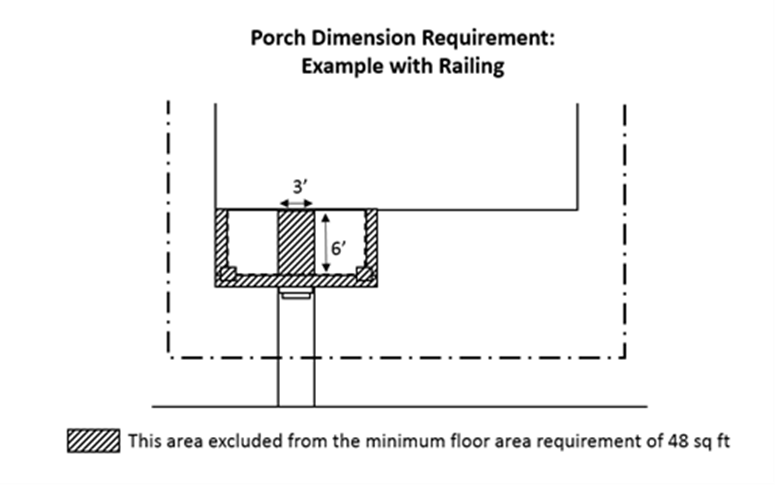
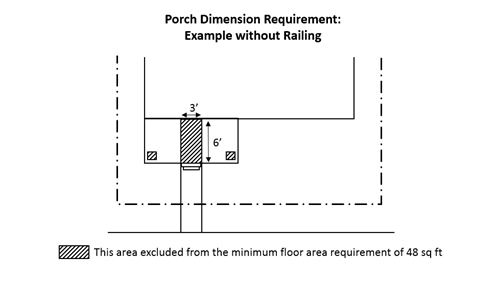
Principal entries shall include a porch, with a minimum usable depth of 6-feet (measured from the front façade line of the structure to the interior side of the railing or, if there is no railing, the furthest edge of the floor) and 48 square feet of total floor area, excluding a three-foot wide walkway to the primary entrance and the floor area of any column. Where a railing exists, only the floor area within the interior side of the railing shall count towards the minimum floor area. The POD may approve a reduction in the minimum size requirement or other entry alternatives such as a stoop or portico if consistent with certain architectural styles.
2.
Existing public sidewalks shall be repaired to City standards. Where no public sidewalk exists, a public sidewalk shall be constructed in accordance with the requirements of the subdivision section.
Building and architectural design standards. All buildings should present an inviting, human scale façade to the streets, internal drives, parking areas and surrounding neighborhoods. The architectural elements of a building should give it character, richness and visual interest.
Building style.
1.
New construction shall utilize an identifiable architectural style which is recognized by design professionals as having a basis in academic architectural design philosophies. See the Architecture and Building Design Section.
2.
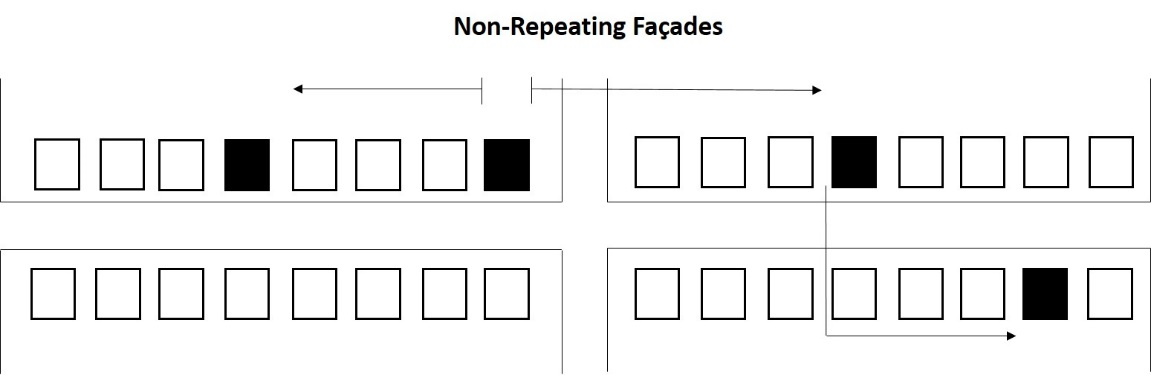
Design of buildings within the same block face on either side of the street or within an adjacent block face on either side of the street shall be varied, such that a substantially similar design will not be replicated. Bungalow courts are exempt from this non-repeat standard. Other creative layouts involving multiple buildings on a single parcel may be approved at the discretion of the POD.
There shall be a minimum separation of three parcels in every direction before a substantially similar design can be repeated. Variation is not required for homes with a different number of habitable stories. Variation shall include at least three of the following five elements: 1) architectural style, 2) roof form (principal or porch), 3) materials, 4) architectural details (doors, windows, columns and porches), and 5) front façade height and front façade width.
3.
Renovations, additions and accessory structures shall utilize the architectural style of the existing structure, or the entire existing structure shall be modified to utilize an identifiable architectural style which is recognized by design professionals as having a basis in academic architectural design philosophies.
Building form.
1.
The front porch shall be elevated at least 12 inches above the abutting finished grade level as measured abutting the porch at the front entry and include a minimum of two risers.
2.
The front façade of a building shall create a width-to-height ratio of no more than 1:1. Buildings that exceed the width-to-height ratio of 1:1 shall feature architectural fenestration creating a bay system that divides the building design into a maximum ratio of 1:1. This may be done through pilasters, arcades, building line and roof line off-sets, materials and other appropriate architectural features.
Wall composition and transparency. Wall composition standards ensure that ground-level storefronts and multifamily and single-family residential buildings offer attractive features to the pedestrian. Wall composition standards also mitigate blank walls and ensure that all sides of a building have visual interest. Transparency enhances visual connections between activities inside and outside buildings, thereby improving pedestrian safety. The following criteria shall not apply to accessory structures.
1.
Doors, windows and other appropriate fenestration, architectural details, and features shall be incorporated into all sides of a building. There shall be no blank façades, and no portion of a façade shall contain a blank area greater than 16 feet in width, except as otherwise provided herein. Interior side and rear façades on principal structures and all façades on accessory structures located in the rear one-half of the lot may contain a blank area up to 20 feet in width, provided that the façade is not visible from a right-of-way, excluding alleys. Garages located at the rear one-third of the lot may have blank façades but not on the street side.
2.
At least 30 percent of primary and secondary street façades shall consist of fenestration or architectural details and features. At least 20 percent of the front two-thirds of interior side façades shall consist of fenestration or architectural details and features. At least ten percent of the rear façade on corner lots and through lots shall consist of fenestration or architectural details and features. At least 50 percent of the required fenestration shall be transparent (i.e., window glass). For yards on through-lots see the Dimensional Regulations and Lot Characteristics Section.
3.
Structures which are situated on corner lots, through lots, or, by the nature of the site layout have a façade which is clearly visible from rights-of-way, shall be designed with full architectural treatment on all sides visible from rights-of-way, excluding alleys. Full architectural treatment shall include roof design, wall materials, trim, and door and window openings. While it is recognized that buildings have primary and secondary façades, the construction materials and detailing should be similar throughout. Windows on the street side façades shall be evenly distributed in a consistent pattern, unless a different proportion is permitted or required by an identifiable architectural style.
Refer to Section 16.90.020 for the definition of fenestration and architectural details.
4.
Window sashes and glass shall be square or vertical, unless a different proportion is permitted or required by an identifiable architectural style.
5.
Windows recessed less than three inches shall feature architectural trim including a header, sill and side trim or decorative shutters. Windows recessed three inches or more shall feature a window sill. Trim including a header, sill and side trim are not required if not consistent with the architectural style, i.e. Modern or Mediterranean Revival.
6.
Where the required design elevation is equal to or greater than 48 inches above finished grade, an articulated base is required to delineate the first-floor level. The base may consist of a different material or decorative band, depending on the architectural style.
Roofs. Rooflines add visual interest to the streetscape and establish a sense of continuity between adjacent buildings. When used properly, rooflines can help distinguish between residential and commercial land uses, reduce the mass of large structures, emphasize entrances, and provide shade and shelter for pedestrians. Buildings shall provide a pitched roof or a flat roof with a decorative parapet wall compatible with the architectural style of the building.
Building materials. Building material standards protect neighboring properties by holding the building's value longer, thereby creating a greater resale value and stabilizing the value of neighboring properties. Building materials shall be appropriate to the selected architectural style and shall be consistent throughout the structure except for one story covered patios or screen enclosures located at least ten feet behind the front façade of the principal structure. If multiple materials are used in a building façade, the visually heavier materials shall be located below the lighter materials, e.g. brick or stone shall be located below stucco or siding materials, unless they are used as architectural features.
Accessory structures and ancillary equipment and carports. Accessory structures shall reinforce the pedestrian character of the City. Above-ground utility and service features, accessory storage structures, and carports shall be located and designed to reduce their visual impact upon the streetscape. See use specific standards in the Accessory Structures and Ancillary Equipment Section. Detached accessory structures, such as garages and garage apartments shall be consistent with the architectural style, materials, and color of the principal structure. For multi-story buildings, no portion of an exterior wall on any floor may contain a blank area greater than 16-feet in width except as allowed herein for garages.
(Ord. No. 405-H, § 4, 12-12-2019; Ord. No. 540-H, § 3, 3-23-2023; Ord. No. 611-H, § 10, 7-10-2025)

