
Saint Petersburg City Zoning Code
SECTION 16
30.030.- ARTIST ENCLAVE
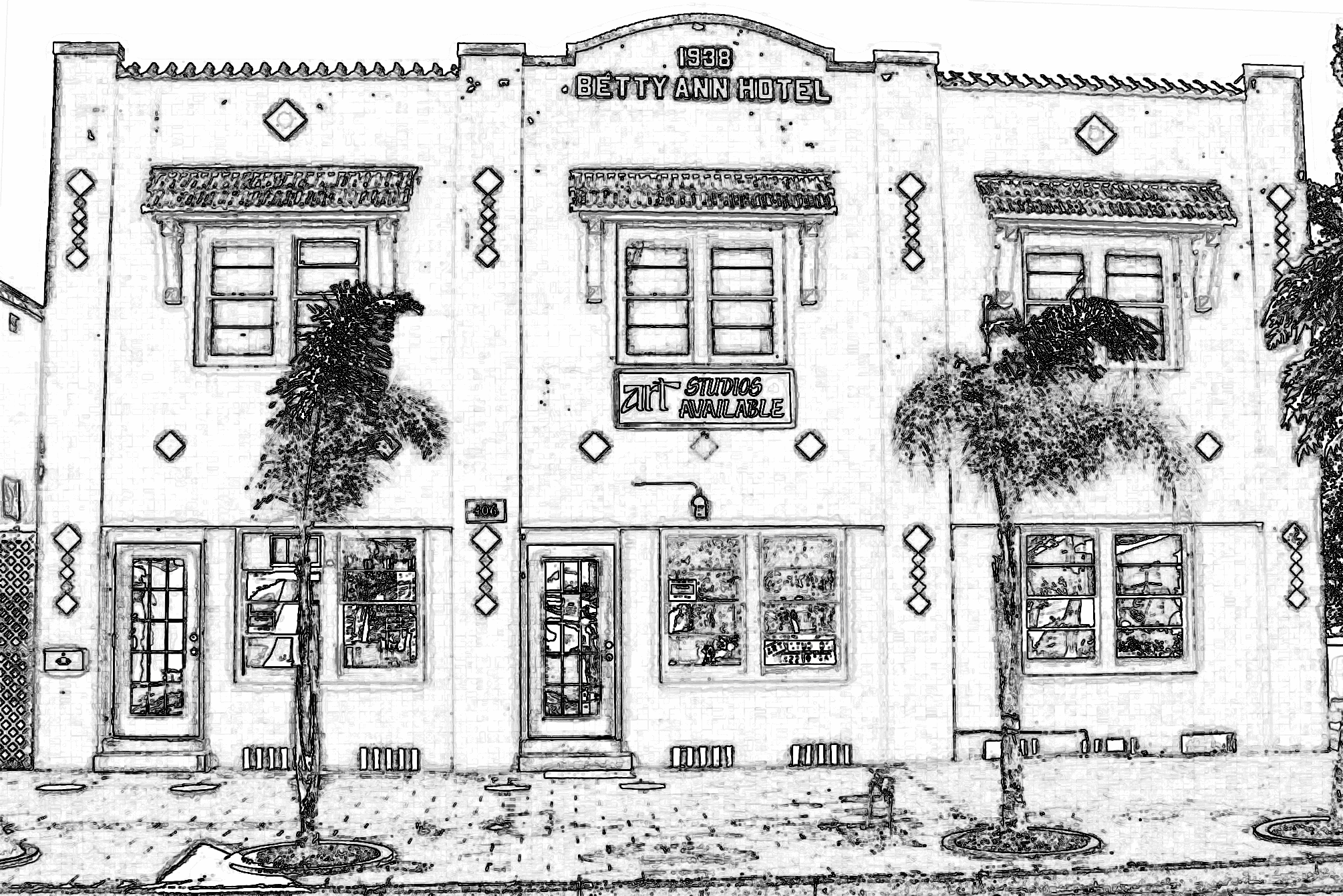
Existing Artist Live-Work Studios
Sections:
16.30.030.1 - Applicability.
This section applies to any property within an approved Artist Enclave Overlay District (AEOD).
(Ord. No. 1007-G, § 16.30.030.1, 12-16-2010)
16.30.030.2. - Purpose.
The visual, performing and cultural arts in the City of St. Petersburg include a valuable inventory of museums, galleries, performing arts venues, activities for families and children, special events and programs. These assets have contributed significantly to the City's economic base, overall quality of life, and growing reputation as a home for artists and art facilities.
The purpose of the Artist Enclave Overlay District (AEOD) is to encourage a mix of small-scale, home business uses oriented toward or supporting the visual, performing, and cultural arts, while maintaining the residential character of the underlying residential neighborhood. This overlay district establishes enclaves predominantly within single-family residential neighborhoods where artists may live, create work, and market their art. Regulations are established to promote and achieve optimal conditions for artist functions, while maintaining adequate protection for the adjacent properties.
(Code 1992, § 16.30.030.1; Ord. No. 1007-G, § 16.30.030.2, 12-16-2010)
16.30.030.3. - Establishment of overlay district.
A.
The AEOD may be applied to the zoning districts identified in section 16.30.030.5 of the City Code.
B.
Procedures. Request for adoption of an AEOD shall follow the application and procedures for amendments to the Official Zoning Map.
C.
Demonstration of support. In addition to all other requirements, the applicant shall submit a written petition for approval of the district from the owners of at least two-thirds of the properties within the proposed district. The POD may initiate an application without a petition for approval.
D.
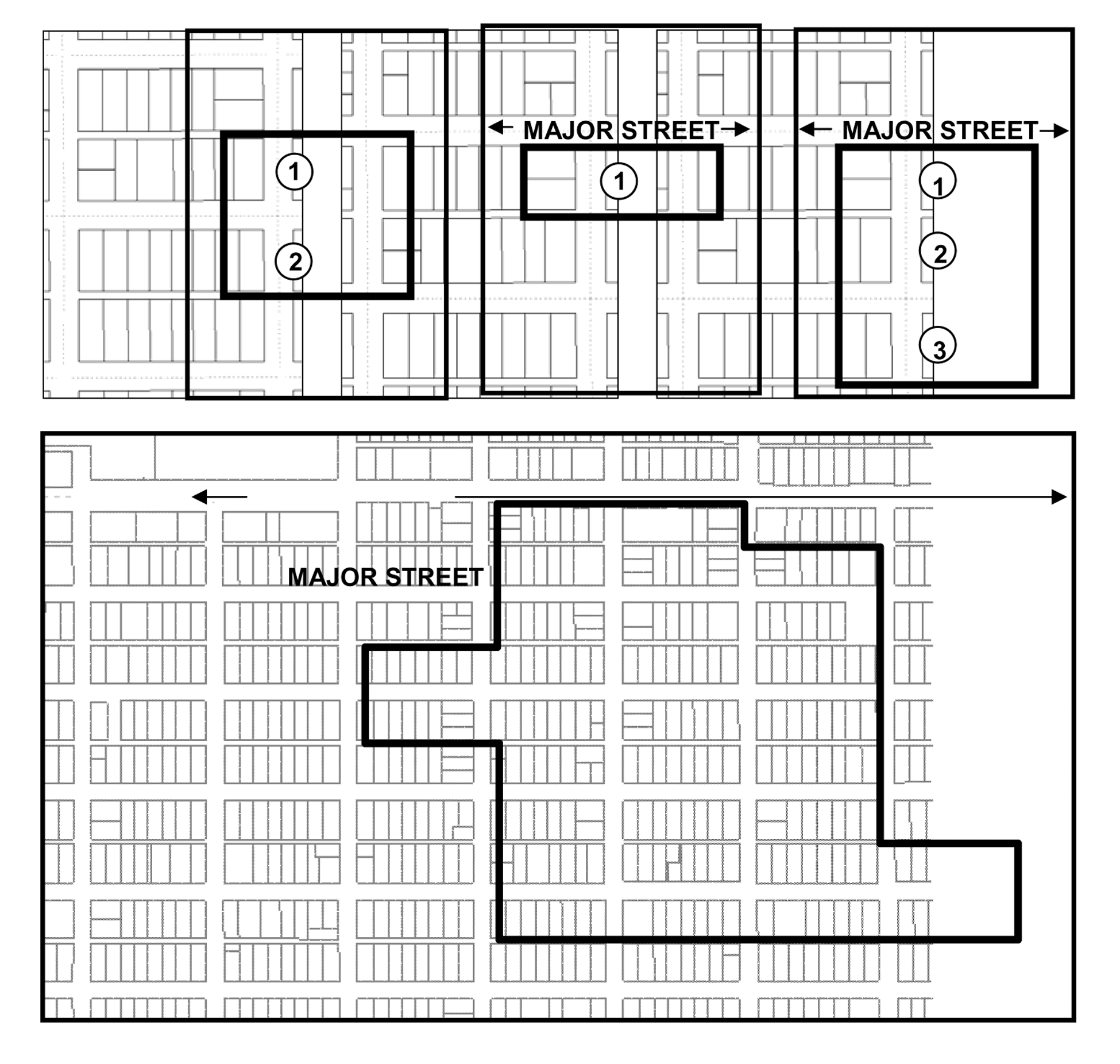
Minimum district size. The district boundary shall include a minimum of one roadway segment containing two opposing block faces; or, where the roadway segment is a major street as identified on Future Major Streets Map (currently Map 20) of the Comprehensive Plan, only one block face is required. Only full block faces may be part of an AEOD. The following graphics provide examples of permissible AEOD boundaries:
(Ord. No. 1007-G, § 16.30.030.3, 12-16-2010)
16.30.030.4. - Definitions.
For the purposes of this section, the term "artist" means an individual who practices one of the fine, design, graphic, musical, literary, computer, or performing arts; or an individual whose profession relies on the application of the above-mentioned skills to produce a creative product. The term "artist" includes, but is not limited to, individuals who practice the following:
(1)
Visual arts, such as painters, print makers, drawers, sculptors, potters, jewelry makers, glass makers, craft artists, and photographers;
(2)
Performing arts, such as musicians, composers, playwrights, choreographers, and dancers;
(3)
Literary arts, such as creative writers and literary translators;
(4)
Architecture and design, such as architects, landscape architects, engineers, urban designers and planners, interior designers and decorators, industrial designers, graphic designers, and fashion designers; and
(5)
Media arts, such as filmmakers, video and audio artists, and web-based designers.
(Ord. No. 1007-G, § 16.30.030.4, 12-16-2010)
16.30.030.5.1. - Principal and accessory land use types.
The Use Permissions and Parking Regulations Matrix establishes the allowable uses in each zoning district. In an AEOD, artist related uses shall be allowed as shown on the following table. Any additional use allowed by this table in an AEOD shall be primarily artist related and shall be consistent with the purposes of this section.
(Code 1992, § 16.30.030.4; Ord. No. 1007-G, § 16.30.030.5.1, 12-16-2010)
16.30.030.5.2. - Land use restrictions.
A.
The AEOD is an overlay district and shall overlay all other zoning districts within its boundaries. Any uses permitted in the zoning district shall be permitted subject to all provisions applicable to the zoning district.
B.
When located in an NT-1 or NT-2 zoning district, an AEOD home business use shall be an accessory use to any single or multi-family dwelling units where a residence is considered the principal use. The residence shall be occupied by the proprietor, or an assistant, of the AEOD home business use. In NT-1 or NT-2 zoning districts:
1.
General office and neighborhood-scale retail uses.
a.
Shall be by scheduled appointment only.
b.
Appointments are prohibited between the hours of 7:00 p.m. and 9:00 a.m., except as may be allowed during district-wide special events.
2.
For instruction and tutoring uses, classes must be purely incidental to the principal use of the property.
C.
High-hazard uses, as identified in the Florida Fire Prevention Code, are prohibited in NT zoning districts.
(Ord. No. 1007-G, § 16.30.030.5.2, 12-16-2010; Ord. No. 611-H, § 17, 7-10-2025)
16.30.030.5.3. - Status of land use types.
A.
The City Clerk shall maintain a map identifying all designated AEODs. Approval of any action to establish or terminate an AEOD shall be shown on the map.
B.
The right to use a property for the purposes allowed in an AEOD is not a vested right and exists only as long as the property remains within an AEOD. Upon termination of an AEOD, there shall be no grandfathered rights, and the legal uses of a property formerly located in such AEOD will be determined by the property's zoning district and Future Land Use Map designation.
(Ord. No. 1007-G, § 16.30.030.5.3., 12-16-2010)
16.30.030.6.1. - Maximum number of assistants, hired or non-hired.
When an AEOD is located in an NT-1 or NT-2 zoning district, two assistants who are not residents of the dwelling unit shall be permitted to be at the property. The number of assistants is not restricted in any other AEODs.
(Ord. No. 1007-G, § 16.30.030.6.1, 12-16-2010; Ord. No. 611-H, § 18, 7-10-2025)
16.30.030.6.2. - Parking.
When an AEOD is located in an NT-1 or NT-2 zoning district, or in other AEODs when the artist use is an accessory use to any single or multi-family dwelling units, no additional parking spaces are required for an AEOD home business.
(Ord. No. 1007-G, § 16.30.030.6.2, 12-16-2010)
16.30.030.6.3. - Signage.
When located in an NT-1 or NT-2 zoning district, or in other AEODs when the artist use is an accessory use to any single or multifamily dwelling units:
A.
Dimensions. An AEOD home business use may display a window sign, wall sign, or projecting sign. The sign shall not exceed four square feet in area. All property owners shall obtain a sign permit.
B.
Total number. No more than one sign per dwelling unit shall be placed on a lot. When there are two or more dwelling units within a single building on a lot, no more than one sign shall be displayed per building.
C.
Illumination. The signs shall not be internally illuminated.
D.
City Council may establish sign theme. At the time of approval of the AEOD, the City Council may establish a sign theme or character with which each sign shall comply.
When not located in an NT-1 or NT-2 zoning district and when not an accessory use to a single or multi-family dwelling unit, signage for an AEOD home business use shall be governed by the Sign Code (currently section 16.40.120).
(Ord. No. 1007-G, § 16.30.030.6.3, 12-16-2010)
16.30.030.6.4. - Outdoor display.
A.
Outdoor display, generally. Outdoor display of finished products for sale or unfinished products is prohibited. Finished products that are not for sale shall be displayed in accordance with Section 16.40.120. Such finished products are specifically exempt from the definition of "artwork" in that Section.
B.
Outdoor display, temporary. Finished products may be temporarily displayed for sale during the time of an approved AEOD wide special event.
(Ord. No. 1007-G, § 16.30.030.6.4, 12-16-2010)
16.30.030.6.5. - Special events.
A.
Frequency. Not more than 12 arts-related, AEOD wide special events may be held in any one calendar year. Arts-related, AEOD wide special events are prohibited Mondays through Thursdays, excluding national holidays and the evenings before national holidays, but may be subject to further restrictions. For the purpose of this section, at least 11 of the 12 arts-related, AEOD wide special events permitted in one calendar year shall not exceed one day each. One of the 12 arts-related AEOD wide special events permitted each calendar year may be approved as a multi-day event not to exceed three consecutive days or, when a national holiday is scheduled on Thursday or Monday, four consecutive days. One day special events shall not be sequenced on consecutive days to result in a multiday events. The City shall issue permits for arts-related, AEOD wide special events on a first-come, first-served basis upon receipt of completed temporary use permit applications. Applications for special events for each calendar year will not be accepted prior to 8:00 a.m. on the first business day of the October preceding the calendar year during which the event is to occur. The administration shall develop procedures for proper submission of the applications.
B.
Standards. Conditions shall be imposed to reasonably mitigate any adverse impacts resulting from noise, lighting, vehicular traffic, vehicular parking, pedestrian traffic, solid waste collection, and other such matters and effects as may be expected from the occurrence of such special events.
C.
Process. Arts-related, AEOD wide special events shall obtain a temporary use permit in accordance with the criteria for temporary uses and procedures identified in the Applications and Procedures section.
(Ord. No. 1007-G, § 16.30.030.6.5, 12-16-2010)
16.30.030.6.6. - Hours of operation and noise limitations.
A.
Art-related activities, whether individually or as part of any arts-related, AEOD wide special event, shall comply with the Noise Ordinance in Chapter 11.
B.
Outdoor activities, when part of any arts-related, AEOD wide special event, are prohibited Mondays through Thursdays, excluding national holidays or the evenings before national holidays; after 10:00 p.m. on Mondays through Thursdays when such day is a national holiday; after 10:00 p.m. on Sundays, except Sunday evenings before national holidays; and after 11:00 p.m. on Fridays, Saturdays, and the evenings before national holidays.
(Ord. No. 1007-G, § 16.30.030.6.6, 12-16-2010)
16.30.030.6.7. - Production techniques.
A.
Kilns. The total volume of kiln space shall not exceed 24 cubic feet and no individual kiln shall exceed eight cubic feet. Kilns may be located outside. Outside kilns shall be set back from the lot line of any abutting property with NT, NS, or CRT zoning by at least ten feet. A solid fence or wall at least five feet in height is required on sides of the property abutting such zoning districts.
B.
Power tools. The use of hand tools is encouraged; the use of small power tools is allowed. All tools shall comply with the Noise Ordinance in Chapter 11.
(Code 1992, § 16.30.030.5;Ord. No. 1007-G, § 16.30.030.6.7, 12-16-2010)
16.30.030.7. - Terminating Artist Enclave Overlay District.
A.
Procedures. Request for termination of an AEOD shall follow the application and procedures for amendments to the Official Zoning Map.
B.
Demonstration of support. In addition to all other requirements, the applicant shall submit a written petition for termination of the district from the owners of at least two-thirds of the properties within the AEOD proposed to be terminated. The POD may initiate an application without a petition for termination.
(Ord. No. 1007-G, § 16.30.030.7, 12-16-2010)

