
Saint Petersburg City Zoning Code
SECTION 16
40.090.- PARKING AND LOADING, DESIGN STANDARDS
Sections:
16.40.090.1.- Applicability.
Parking requirements shall be met at the time any building or structure is erected, enlarged or increased in density or intensity, or a change of use results in an increase in the minimum number of parking spaces required. The standards in this section shall apply to the increase in requirements for the new use or portion of the enlarged building or structure only and not to the existing building or structure. Any existing paved parking lot which is to be either restriped in a manner different from that previously approved or resurfaced shall also be subject to the standards in this section.
(Code 1992, § 16.40.090.1; Ord. No. 203-H, § 15, 11-23-2015)
16.40.090.2. - Purpose and intent.
This section establishes standards for the amount, location and development of motor vehicle parking, standards for bicycle parking and standards for on-site loading areas. The parking regulations are designed to avoid parking shortages, to encourage compact development patterns and mixed uses and to encourage parking configurations that do not disrupt the City's traditional streetscape.
(Code 1992, § 16.40.090.2)
16.40.090.3.1. - General regulations.
A.
Permit. Off-street parking or loading spaces shall not be created, constructed, located, relocated or modified without first obtaining a permit.
B.
Occupancy. All required parking areas must be completed and landscaped prior to occupancy of any building or structure.
C.
Use of required parking spaces. Required parking spaces shall be available for the use of residents, customers or employees. Required parking spaces may not be used for the sale, repair or servicing of any motor vehicle or the parking of fleet vehicles and equipment or storage of goods. Required parking spaces shall not be assigned to the use of another site, except in accordance with the approval criteria for joint-use, shared or off-site parking facilities. Loading spaces and berths and spaces at gasoline pumps and bays for motor vehicle service and repair are not counted toward the minimum parking required.
D.
Calculations for required parking spaces.
1.
When computing parking spaces based on floor area, areas used for parking are not counted.
2.
The minimum number of required parking spaces is computed based on the primary, and in some cases, accessory uses on site. When there are two or more separate primary uses on a site, the required parking for the site is the sum of the required parking for the individual primary uses. See joint-use or shared parking section.
3.
When more than 20 percent of the floor area on a site is in an accessory use, the required parking is calculated separately for the accessory use. For example, for a 20,000 square foot building with a 15,000 square foot warehouse and a 5,000 square foot accessory office area, the required parking shall be computed separately for the office and warehouse uses.
4.
When units or measurements determining the number of required off-street parking spaces result in a fractional space, then such fraction equal to or greater than one-half shall require a full off-street parking space.
E.
Elimination of required parking spaces. Once an off-street parking or loading space has been provided which wholly or partially meets the regulations of this Code, such off-street parking or loading space shall not thereafter be reduced, eliminated or made unusable in any manner except as authorized by this Code.
F.
Maintenance. All required parking areas shall be permanently maintained and remain free and clear of litter and debris.
(Code 1992, § 16.40.090.3.1)
16.40.090.3.2. - Minimum number of parking spaces required.
A.
Minimum number of parking spaces required. The minimum number of parking spaces required for any use or building type is established in the Matrix: Use Permissions and Parking Requirements. Parking requirements may be met by one or more of a combination of the following methods:
1.
Providing on-site, off-street parking spaces. Only spaces that are designed consistent with this section are counted toward the minimum parking required.
2.
Providing off-site, off-street parking spaces. Parking spaces may be provided in a joint-use, shared or off-site parking facility in accordance with subsection C of this section.
B.
Determination of unlisted uses. The POD shall determine the minimum required off-street parking spaces for uses not listed in the Matrix: Use Permissions and Parking Requirements. In reaching such determination, the POD shall be guided by the requirements for similar uses, the number and kind of vehicles likely to be attracted to the proposed use and studies of the parking requirements of such uses in other jurisdictions.
C.
Administrative adjustment of standards. The purpose of this subsection is to provide flexibility in reducing or modifying parking standards for certain uses. An adjustment to a parking standard or requirement may be approved based on a determination by the POD that the adjustment is consistent with the purpose and intent of the parking standards and requirements. The POD's final determination may be appealed to the Development Review Commission.
1.
Joint use/shared parking. Joint use of required nonresidential parking spaces may occur where two or more uses on the same or separate sites are able to share the same parking spaces because their parking demands occur at different times. Joint use of required nonresidential parking spaces is allowed when either of the following conditions applies:
a.
Two or more owners or operators of buildings or uses requiring off-street parking may share a parking facility if the total minimum number of required spaces conforms to the Matrix: Use Permissions and Parking Requirements when computed separately for each use or building type.
b.
Two or more owners or operators of buildings or uses requiring offstreet parking that share a parking facility may reduce the total amount of required parking spaces in accordance with the following methodology:
(1)
Determine the minimum parking requirements in accordance with the Matrix: Use Permissions and Parking Requirements for each land use as if it were a separate use;
(2)
Multiply the required minimum number of parking spaces for each separate use by the percentages for each of the nine time periods set forth in the following tables;
(3)
Add the resulting required minimum number of parking spaces in each of the 18 vertical columns of the table;
(4)
Select the vertical column with the highest total; and
(5)
Use this number as the required minimum number of parking spaces.
c.
The following documentation shall be submitted as part of a building or zoning permit application or land use review:
(1)
The names and addresses of the uses and of the owners or tenants that are sharing the parking.
(2)
The location and number of parking spaces that are being shared.
(3)
An analysis showing that the peak parking times of the uses occur at different times and that the parking area will be large enough for the anticipated demands of both uses. Calculations for the shared parking ratios table shall be included.
(4)
If the parking is not on the same site as one or more of the uses, a legal instrument satisfactory to the City Attorney and recorded with the Clerk of the Circuit Court of Pinellas County, Florida, providing that the parking area will not be disposed of except in conjunction with the sale of the use or the building the parking area serves, so long as the parking is required. The owner shall bear the expense of recording the instrument and agrees that the instrument shall bind all heirs, successors and assigns. Such instrument shall be recorded prior to approval of any certificate of occupancy.
2.
Off-site locations. If off-street, on-site parking, in whole or in part, cannot be provided on the same lot or parcel of land as a nonresidential use, parking spaces may be located off-site, subject to the following:
a.
The off-street, off-site parking area shall be located within the same zoning district as the use or within a zoning district which permits the proposed parking area as a principle use.
b.
Where the use is subject to special exception approval, the off-site parking area shall be considered an expansion of the use and is also subject to special exception approval.
c.
The off-site parking area shall not be more than 1,000 feet in downtown center zoning districts and 300 feet in all other zoning districts serving non-residential uses from the entrance of the principle use. The off-site parking area for Sports Stadium, Indoor and Outdoor; Performing Arts Venue, Indoor and Outdoor; and Convention Center shall not be more than one-half mile in downtown center zoning districts from the entrance of the principal use. Off-site parking areas serving residential units shall be located within 100 feet of the entrance of the dwelling unit they will serve. The distance shall be measured along the most direct pedestrian connection.
d.
An identifiable and lighted pedestrian connection shall be provided between the off-site parking area and the use. The pedestrian connection shall require no crossing of a street, except at a controlled location. The pedestrian connection may cross an alley.
e.
The continued availability of the off-site parking spaces, necessary to meet the requirements of this section, shall be ensured by a legal instrument satisfactory to the City Attorney and recorded with the Clerk of the Circuit Court of Pinellas County, Florida, providing that the parking area will not be disposed of except in conjunction with the sale or the use of the building the parking area serves, so long as the parking is required. The owner shall bear the expense of recording the instrument and agrees that the instrument shall bind all heirs, successors and assigns. Such instrument shall be recorded prior to approval of any certificate of occupancy.
f.
If the property which contains the off-site parking spaces is disposed of, or committed to some other use which displaces or reduces the required parking then the certificate of occupancy for the principal use shall be revoked.
3.
Compact parking. Compact parking spaces may be provided subject to the following. Accessible parking spaces shall not be used for compact parking spaces.
a.
Ratios. Compact parking spaces may be provided for up to 25 percent of the minimum required parking for all uses. Where a particular use may have a low turn-over parking ratio, such as a corporate or industrial land use, the POD may approve up to 100 percent compact parking. Low turn-over parking, means parking that typically turns over not more than once every four hours.
b.
Dimensions. Compact parking spaces shall measure eight feet in width by 18 feet in length.
c.
Identification. Compact parking spaces shall be identified or designated as such through the use of signage or pavement markings. In order to reduce sign clutter, pavement marking is recommended.
4.
Tandem parking. Shall mean a space where one automobile parks behind another, so that one automobile must be moved before the other can be accessed. Accessible parking spaces shall not be used for tandem parking spaces.
a.
Residential uses. Tandem parking spaces shall be allowed for single-family, duplex and townhome residential uses.
b.
Multifamily residential uses. Tandem parking spaces shall be allowed for condominium and multifamily residential uses, subject to the following conditions:
(1)
The tandem spaces shall be reserved for and assigned to dwelling units which are required to have two or more parking spaces.
(2)
At least ten percent of the total parking spaces provided on the site must be unassigned spaces which are available for the use of visitors. These spaces shall be provided as single, non-tandem spaces.
c.
Commercial uses. Tandem parking spaces shall not be allowed for new commercial construction. Tandem parking spaces shall be allowed for existing commercial buildings or existing buildings subject to a change of use (e.g., residential to commercial), subject to the following conditions:
(1)
The spaces shall be reserved for use by employees. Such spaces shall be identified or designated for employee parking through the use of signage or pavement markings.
(2)
At least 50 percent of the required parking spaces shall be single, non-tandem spaces. For example, a lot is required to have eight parking spaces. At least four of the spaces shall be single, non-tandem spaces.
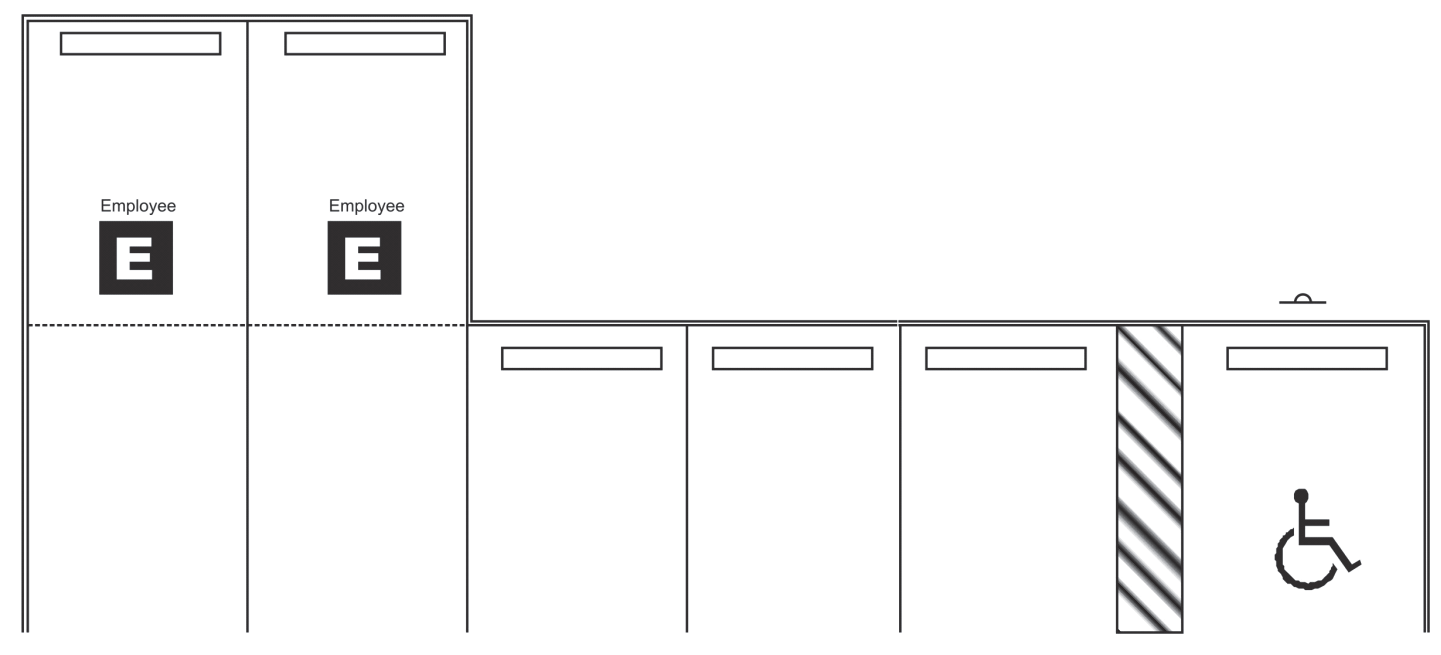
Tandem Spaces
5.
Motorcycle/scooter parking, reduction. Motorcycle and scooter parking may substitute for required parking spaces for nonresidential uses. Existing parking may be converted to take advantage of this provision.
a.
Ratios. Motorcycle and scooter parking may substitute for up to five automobile spaces or five percent of the required parking spaces, whichever is less. For every four motorcycle parking spaces provided, the automobile parking requirement is reduced by one space.
b.
Dimensions. Motorcycle and scooter parking spaces shall measure at least four feet in width by eight feet in length.
c.
Identification. Motorcycle and scooter parking spaces must be identified or designated through the use of signage or pavement markings.
6.
Tree preservation, reduction. Where specimen trees exist within a proposed parking area for a nonresidential use, the POD shall allow a reduction of up to five percent of the number of required parking spaces, an increase of compact parking up to 30 percent of the required parking spaces, or a combination thereof which is necessary to preserve existing specimen trees. In cases where less than ten parking spaces are required, the POD shall allow the number of required parking spaces to be reduced by one if existing specimen trees are preserved.
7.
Drainage and surface water management, reduction. When accommodating drainage and surface water management features, a variance to the number of required parking spaces may be allowed. See general development standards for drainage and surface water management.
8.
Bicycle parking, reduction. Bicycle parking may substitute for up to 20 percent of required motor vehicle parking as set forth herein. For every six bicycle parking spaces above the minimum number of required spaces that meet the bicycle parking standards, the motor vehicle parking requirement is reduced by one space.
9.
Workforce and affordable housing, reduction. Where committing at least 50-percent of the total number of dwelling units for occupancy as Certified Affordable/Workforce Housing, the minimum number of parking spaces required may be reduced by 10 percent. For Certified Affordable/Workforce Housing units that are also classified [senior age-restricted], the minimum number of parking spaces required may be reduced an additional 5 percent for a combined 15 percent reduction.
10.
Proximity to High-Frequency Transit Routes. Where a property, in whole or part, is located within ⅛-mile of a high frequency transit route, defined as a route with a scheduled weekday peak hour headway of 35-minutes or better, the minimum number of parking spaces required may be reduced by 10 percent. High frequency transit routes located on the Interstate 275 do not qualify for this adjustment. This 10 percent reduction may be combined with the reductions allowed for Certified Affordable/Workforce Housing and senior age restricted housing.
11.
Accessory Dwelling Unit (ADU). Where an ADU is less than 600 square feet, within ⅛-mile (660-feet) of high frequency transit route, located on an alley, with all required parking spaces for the single-family home accessed from the alley and there is no front-loaded driveway, there shall be no required parking for the ADU.
(Code 1992, § 16.40.090.3.2; Ord. No. 985-G, § 49, 7-15-2010; Ord. No. 203-H, §§ 16, 17, 11-23-2015; Ord. No. 246-H, §§ 8, 11, 12, 10-20-2016; Ord. No. 375-H, § 5, 9-5-2019; Ord. No. 396-H, § 10, 11-14-2019; Ord. No. 509-H, § 3, 7-14-2022; Ord. No. 566-H, § 4, 12-14-2023)
16.40.090.3.3. - Development standards for private one- and two-family properties.
Parking.
1.
Location. Required parking spaces shall be located on the same lot as the use.
2.
Driveways. Driveways shall be designed in a manner that minimizes disruption of pedestrian corridors and the streetscape. Driveway locations shall be provided as required in the zoning district, except that no such driveways shall be allowed when a one- or two-family residential property abuts an alley and is located in a DC district.
3.
Variances. Where unique conditions related to existing buildings, dimensional aspects of platted lots, or a lack of available space preclude strict compliance with these requirements, the POD may adjust the minimum requirements in accordance with the standards of review for the granting of a variance.
4.
Visibility triangle. The visibility triangle is an area which has certain restrictions to allow for safe visibility when operating a motor vehicle or bicycle or for pedestrian movement. Driveways may encroach into the visibility triangle within the public right-of-way; however, driveways shall not encroach into the visibility triangle within the boundary of the private property.
5.
Setbacks. Portions of a driveway located in the right-of-way shall meet a minimum setback of two feet in traditional zoning districts and three feet in suburban zoning districts from the extended interior and streetside property line.
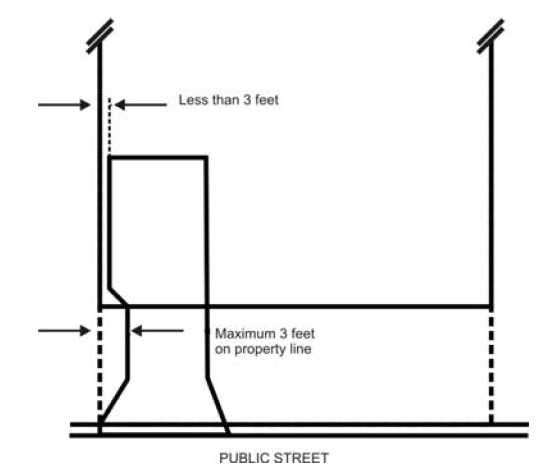
6.
Dimensions. Parking spaces shall be located completely on private property to prevent vehicles from overhanging into and obstructing the public right-of-way. Parking spaces shall be a minimum of 9 feet in width and 18 feet in length and completely on private property.
a.
Standard driveway. Driveways shall measure no less than ten feet in width and no more than 20 feet in width, no more than 20 feet as the driveway crosses the property line and no more than 26 feet at the curb, which includes a three-foot by seven-foot triangular flare. The required minimum length for the portion of the driveway on the private property is 19 feet, measured from the property line.
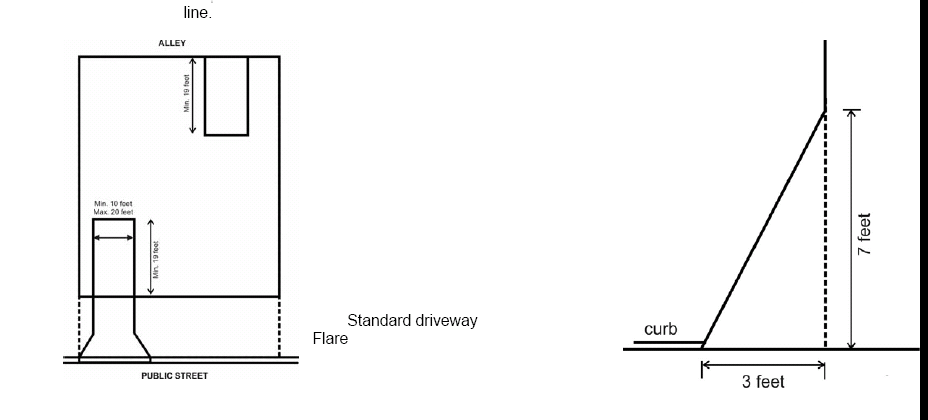
b.
Circular driveway. The circular portion of a driveway shall measure no less than ten feet in width and no more than 14 feet in width, no more than 14 feet as the driveway crosses the property line and no more than 20 feet at the curb, which includes a three-foot by seven-foot triangular flare. Circular driveways are not allowed on lots less than 60 feet wide.
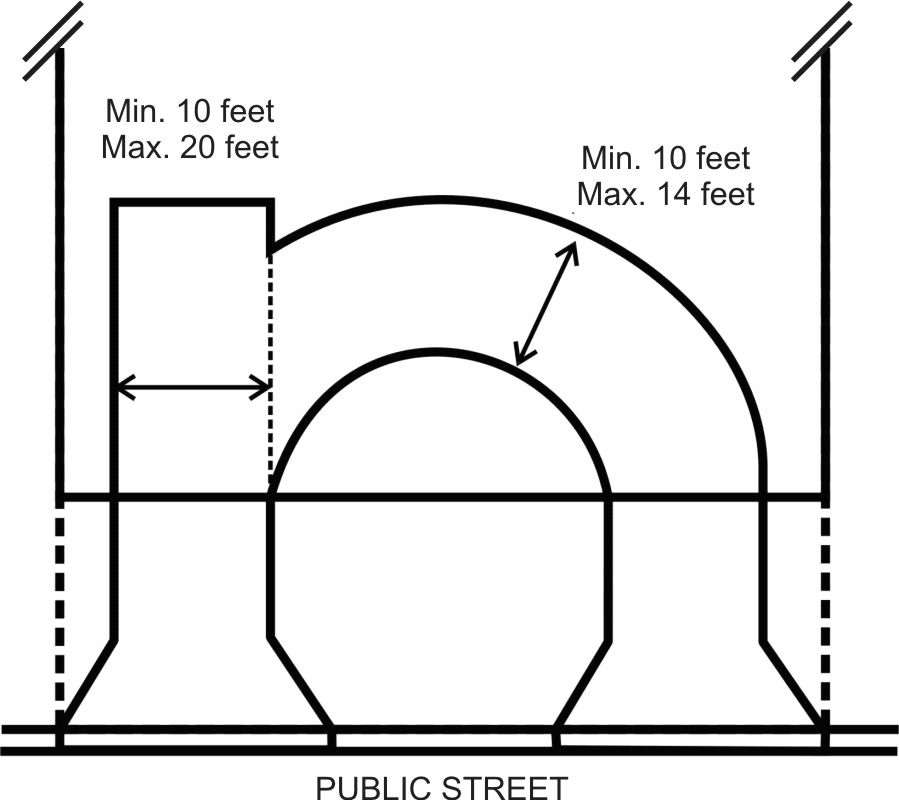
Circular Driveway
c.
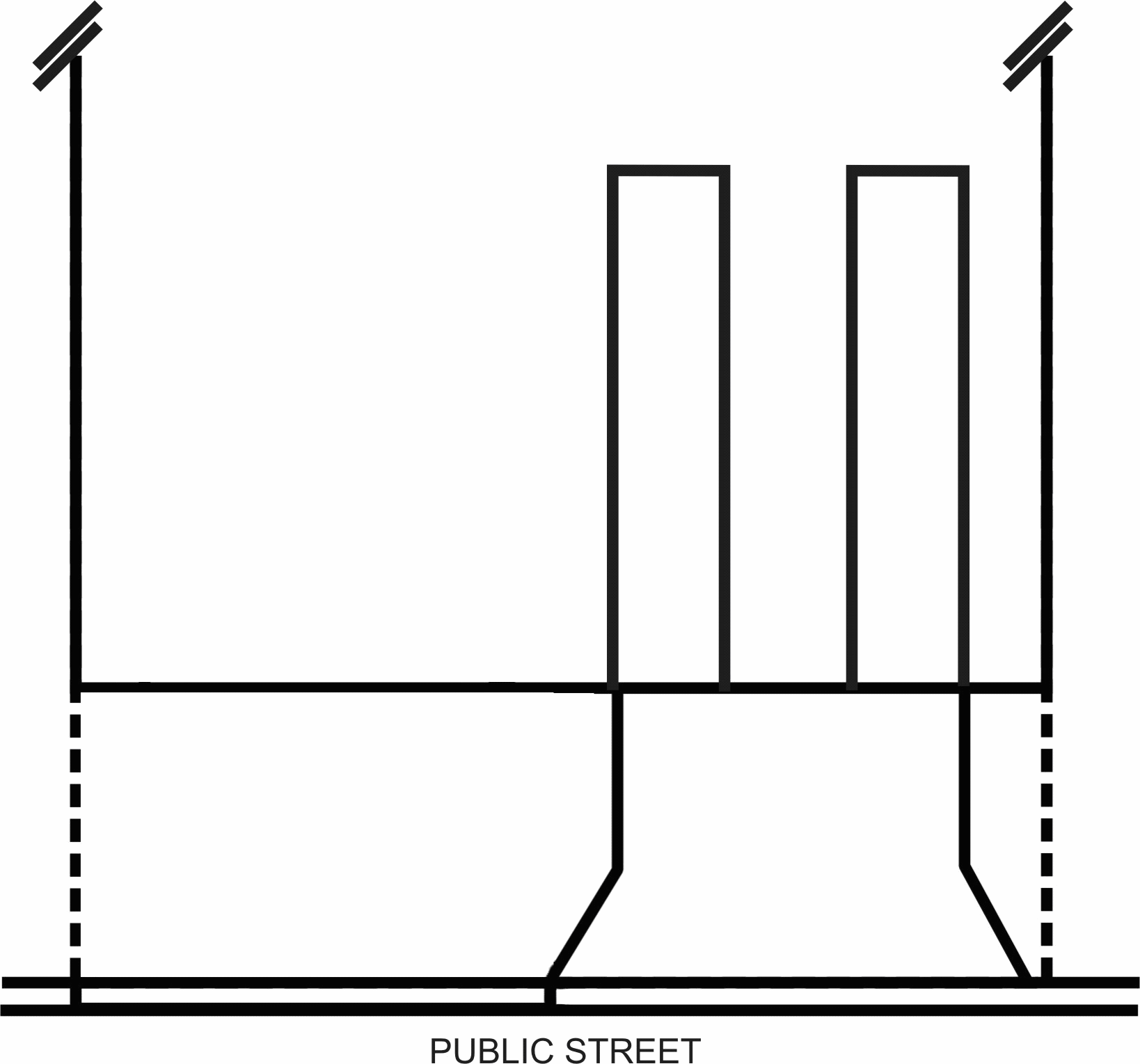
Ribbon driveway. Ribbon driveways are an acceptable alternative to standard driveways, reducing the overall impervious surface coverage. Ribbon driveways are subject to the same maximum dimensional standards as standard driveways. Individual "ribbons" are only permitted within the property (not the right-of-way) and shall measure between 1½ and 2½ feet in width.
Ribbon Driveway
d.
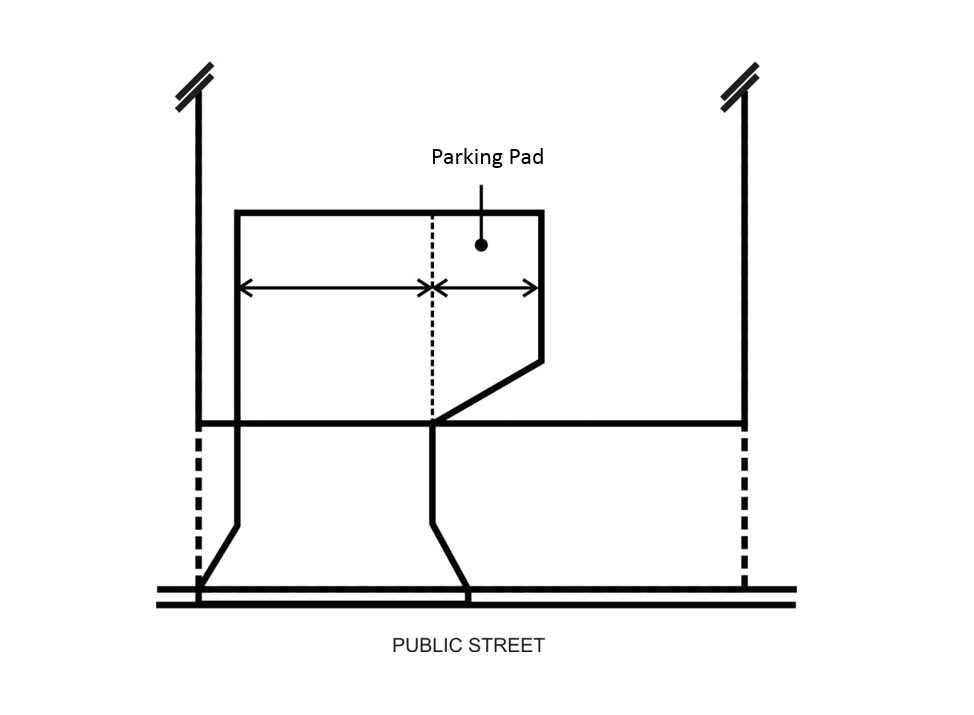
Accessory parking pad. An accessory parking pad no wider than ten feet and not exceeding 400 square feet in area may be installed contiguous to a legally recognized driveway, subject to the condition that the parking surface area is located wholly within the property and no closer than three feet to the interior or street side property lines. See zoning district criteria for specific dimensions for parking pads.
Accessory Parking Pad
e.
Zoning specific criteria.
1.
When a property is located within a traditional zoning district, any new, reconstructed or reconfigured driveway shall be no wider than 20 feet within the property boundaries, 12 feet as the driveway crosses the property line and 16 feet at the curb, which includes a two-foot by seven-foot triangular flare. Circular driveways within the front or street side yards are prohibited, except as otherwise allowed by the building design standards of the zoning district. Where a circular driveway is permitted, the circular portion of the driveway shall measure no less than ten feet in width and no more than 12 feet in width, no more than 12 feet as the driveway crosses the property line and no more than 16 feet at the curb, which includes a two-foot by seven-foot triangular flare.
2.
When property is located within a suburban zoning district, one driveway (inclusive of one portion of a circular driveway that extends to the curb) shall be no wider than 20 feet within the property boundaries, 20 feet as the driveway crosses the property line and 26 feet at the curb. All additional driveways (inclusive of one portion of a circular driveway that extends to the curb) shall be no wider than 14 feet within the property boundaries, 14 feet as the driveway crosses the property line and 20 feet at the curb. See also dimension requirements for circular driveways.
7.
Sidewalks located within adjoining right-of-way.
a.
In traditional districts, where a driveway intersects a sidewalk located within the right-of-way, the portion of the sidewalk that crosses the driveway shall have a consistent finish and color as the abutting sidewalk and be visually delineated with expansion joints.
b.
In suburban districts, where a driveway intersects a sidewalk located within the right-of-way, the portion of the sidewalk that crosses the driveway shall be visually delineated with a change in color or material or with expansion joints. The abutting property owner shall be responsible for maintaining the sidewalk in good condition and repair with no cracks or voids larger than one inch.
c.
In a National Register Historic District, if the existing sidewalk is hexagon block, the sidewalk and the portion of the sidewalk that crosses the driveway shall remain hexagon block except where an existing driveway is replaced and the portion of the sidewalk that crosses the driveway is not hexagon block provided the new driveway is delineated by control joints.
8.
Impervious surface coverage. The maximum impervious surface ratio is limited to those areas within the boundary of the private property and does not include the public right-of-way. For interior lots, no more than 45 percent of the land area between the front property line and front building setback line may be paved or covered with impervious surface materials. For corner lots, no more than 25 percent of the land area between the front and street side property lines and front and street side building setback lines may be paved or covered with impervious surface materials. Impervious surface materials include the surface materials identified in subsection 9 of this section.
9.
Surface materials. The portion of the driveway located within the right-of-way shall be constructed of asphalt or concrete material, brick or decorative pavers. The portion of the driveway and all required parking spaces located within the property boundaries shall be constructed of asphalt or concrete material, brick or decorative pavers, grid pavers, crushed stone, rock, gravel or other materials approved by the POD. Crushed shell is prohibited. The abutting property owner shall be responsible for maintaining the surface in good condition and repair with no cracks or voids larger than one inch.
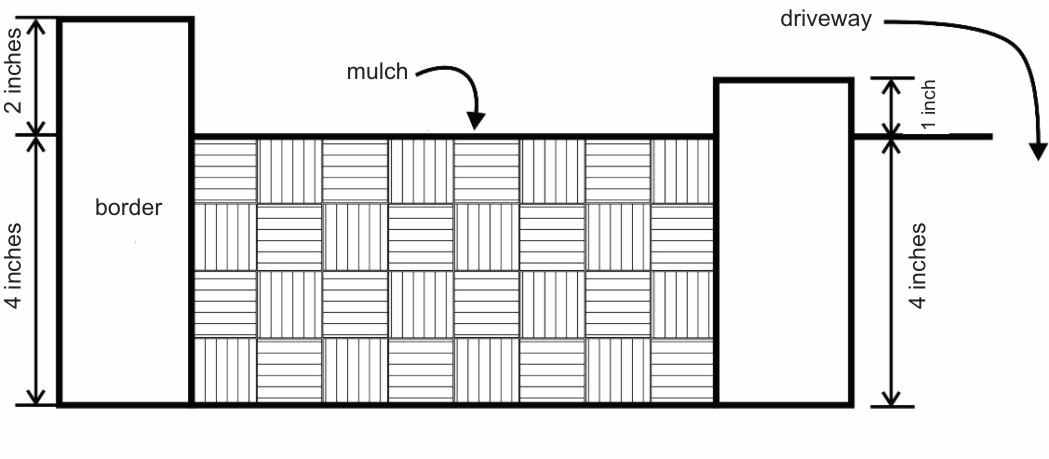
For accessory parking pads, organic mulch is also an approved surface material and is subject to the following minimum technical standards. Mulch shall be at least four inches deep. The parking pad shall be bordered with a solid border at least four inches below the surface and extending at least two inches above the surface of the mulch on all sides except the driveway side, where it shall extend at least one inch above the mulch surface.
Mulch Parking Pad
(Code 1992, § 16.40.090.3.3; Ord. No. 893-G, § 36(16.40.090.3.3.3), 9-4-2008; Ord. No. 985-G, §§ 49, 50, 7-15-2010; Ord. No. 1029-G, § 33, 9-8-2011; Ord. No. 287-H, § 14, 7-20-2017; Ord. No. 611-H, § 25, 7-10-2025)
16.40.090.3.4. - Development standards for all other uses.
A.
Parking area locations; on-site locations. The required off-street parking spaces shall be located on the same lot or parcel of land as the use they serve, except as specifically allowed by this section.
B.
Design standards. The design and installation of pedestrian walkways affect such matters as pedestrian and vehicular safety, pedestrian convenience, healthy living factors and the general appearance and livability of the City. The design and installation of pedestrian walkways within all multifamily and commercial developments to provide for a minimum amount of safety and connection is a matter of City-wide concern and shall be provided as required by this subsection.
1.
Surface parking lots containing 100 parking spaces or more shall provide pedestrian walkways through the parking area. Walkways shall connect pedestrian activity such as, but not limited to, public sidewalks, public recreation trails, transit stops, street crossings, bicycle parking facilities, buildings and store entry points, and central features and community spaces.
a.
Location.
(1)
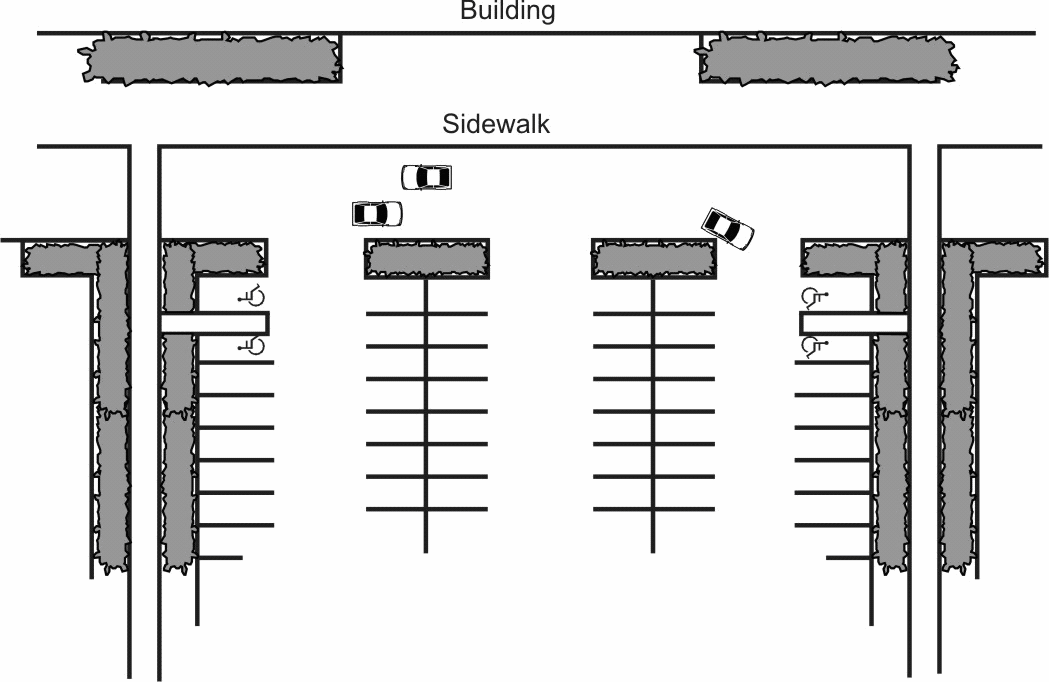
For parking rows perpendicular to the principal building front façade, pedestrian walkways shall be located at a minimum of one pedestrian walkway every 200 feet.
Parking: Perpendicular
(2)
For parking rows parallel to the principal building front façade, pedestrian walkways shall be incorporated adjacent to a series of aligned landscape islands with a minimum of one walkway for every 21 parking spaces.
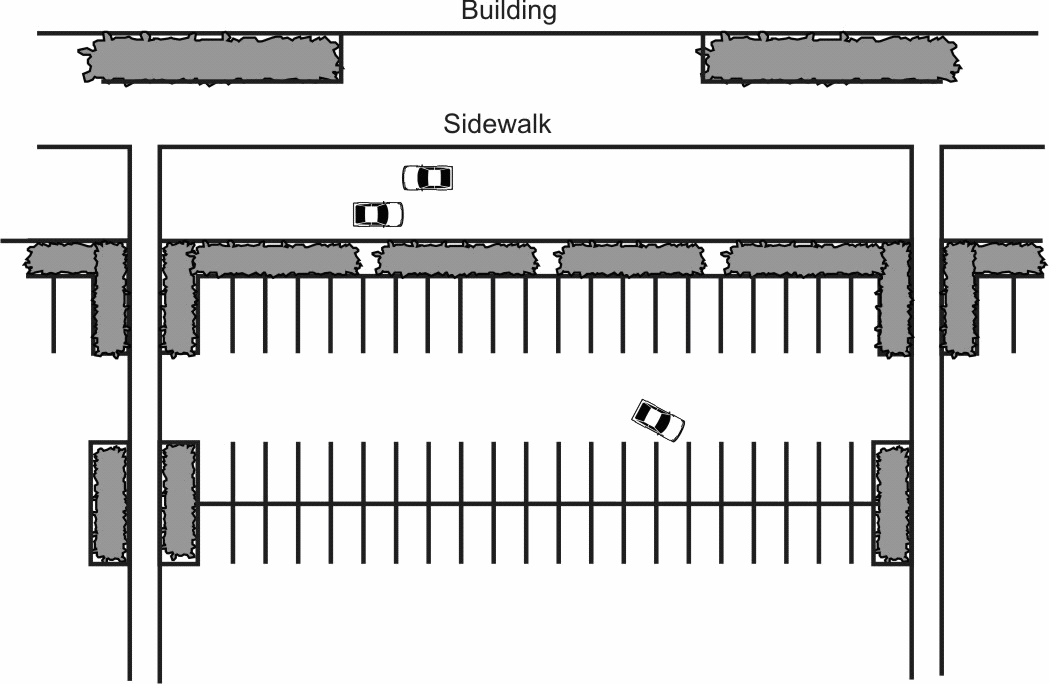
Parking: Parallel
b.
Dimensions. Pedestrian walkways required by this subsection shall be a minimum of six feet in width. The six-foot width shall not include any vehicle overhangs. A landscaped area not less than five feet wide shall abut the entire length of the walkway and shall include one shade tree per 30 linear feet, shrubs, accent plants and groundcovers.
c.
Identification. Pedestrian walkways shall be clearly identified. Pedestrian benches along the walkways are recommended, but not required. Pedestrian walkways which cross vehicular aisles or driveways shall be distinguished by a contrasting paving material such as pavers, bricks, stamped asphalt, or scored concrete.
d.
The POD may modify the pedestrian walkway standards if the applicant can demonstrate that some other form of pedestrian circulation would be suitable for the site and would provide equivalent pedestrian safety.
2.
Access.
a.
All parking areas shall be designed to allow vehicles to enter and exit the street in a forward motion except where parking is provided abutting an alley.
b.
The POD shall approve the location of entrance and exit points. Acceleration-deceleration lanes may be required if, based upon review of on-street traffic volumes, posted speed limits, pedestrian safety, sight distance, and traffic control medians, they are necessary for vehicular safety.
c.
Entrance and exit points are discouraged from being located directly across from a dwelling with one or two units. Where an entrance or exit point is located directly across from a dwelling with one or two units, mitigation of the vehicular impacts may be required including, but not limited to, automated gates, restricted access times and landscape enhancements.
d.
Where a drive lane intersects a sidewalk located within the adjoining public rights-of-way, the sidewalk shall be delineated with expansion joints or contrasting surface materials.
3.
Dimensions. The minimum dimensional requirements for parking spaces and drive lanes shall be as set forth in the following table.
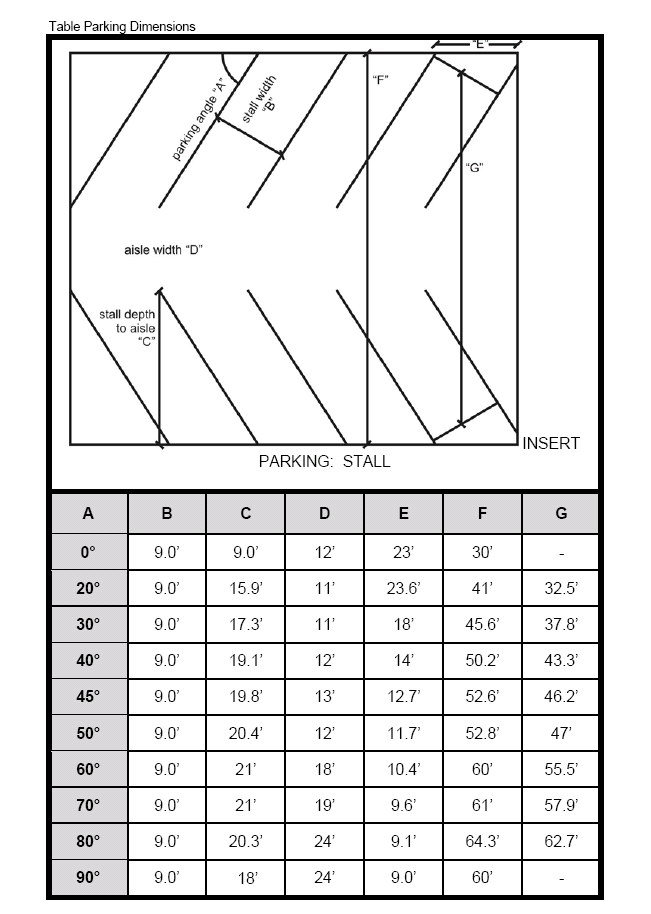
4.
Accessible parking. Accessible parking requirements are established by the State. The term "accessible parking" means parking designed and marked for the exclusive use of those individuals who have been issued a disabled state parking permit or license plate. The parking standards contained in this section are identical to those established by the State at the time of the adoption of this Code. Any change in the State's accessible parking requirements shall pre-empt the affected requirements in this section. Variances to this State requirement cannot be processed by the City.
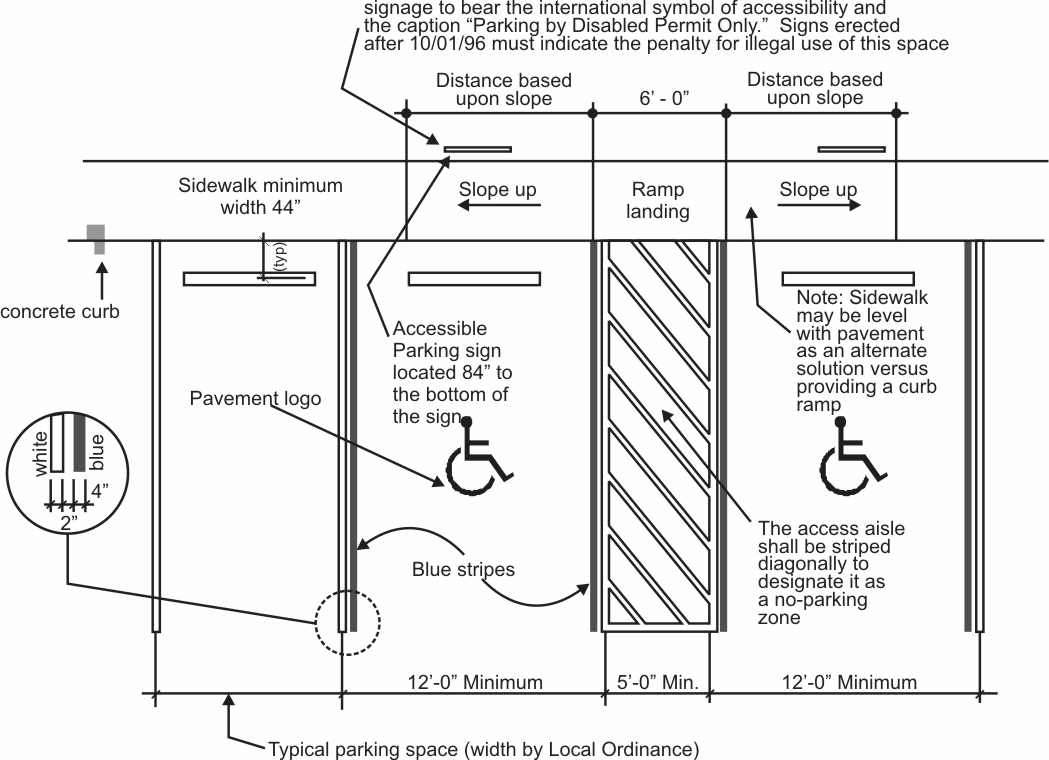
Table Minimum Number of Accessible Parking
5.
Carpool/vanpool parking. Car pooling and van pooling is an arrangement whereby several participants travel together in one vehicle, in particular for commuting to work.
a.
Carpool/vanpool parking shall be required for nonresidential buildings exceeding 100,000 square feet in gross floor area. At least one percent of the parking spaces shall be designated for carpool/vanpool parking;
b.
Carpool/vanpool parking spaces shall be located as close as practical to the main entrance of the building without displacing accessible parking spaces;
c.
Carpool/vanpool parking spaces shall be clearly designated for exclusive use by carpool and vanpool vehicles between specified times. The spaces shall be identified or designated as such through the use of signage or pavement markings.
6.
Stacking spaces for drive-through facilities. These spaces shall be as specified in the use development standards for drive-through facility or use w/drive-through service.
7.
Surface materials.
a.
Permanent surface. Except as otherwise permitted in this section, all parking spaces, drive lanes and driveways shall be paved with asphalt or concrete material, brick or decorative pavers. The surface must be maintained in good condition and repair with no cracks or voids larger than one inch.
b.
Grass surface. The POD may approve up to 25 percent of the required parking area to be a grass surface. In making a determination to approve grass parking, the POD shall find that grass parking would not create erosion, barriers to pedestrian access or adverse affects on the site or abutting parcels. A request for more than 25 percent of the required parking to be designed using a grass surface may be approved by the DRC as a variance, which shall impose appropriate safeguards and conditions to minimize negative impacts associated with unpaved parking areas.
(1)
All grass parking spaces shall be stabilized using drought tolerant sod and shall include parking wheel stops and landscape barriers to protect landscaping within interior and terminal landscape islands and perimeter landscape buffers.
(2)
If the grass parking spaces are not maintained in a clean and neat manner, the POD may require the property owner to pave the spaces in accordance with City standards.
(3)
Developers of commercial centers of 100,000 square feet or larger shall provide grass parking spaces along the perimeter for the parking area or the parking area most distant from the entrances to the building. The grass spaces shall be a minimum of five percent of the required number of spaces.
8.
Striping. All paved parking areas shall be striped in conformance with the parking standards of this section and any required conditions of approval. When restriping an existing parking lot (whether after repaving, sealing, or any other reason), the restriping shall match the striping required in the most recent approval for the site which addressed striping, or the site shall be striped in conformance with this section, if possible. When state or federal laws require that additional disabled parking spaces be provided, the striping pattern may be adjusted to provide for the additional disabled parking spaces. The striping plan for the required number of parking spaces may be modified to allow for the additional disabled parking space, but should conform to the original plan to the greatest extent possible. Where the requirement for additional disabled parking spaces reduces the number of available parking spaces to a number less than the minimum required number of parking spaces for the site and the minimum number cannot be provided, this shall not require a variance, but this number shall become the minimum number of parking spaces required for this site until it is rehabilitated.
9.
Curbing. Concrete curbs shall be provided within all parking areas to prevent vehicles from overhanging required plantings, sidewalks, rights-of-way or adjacent property. Wheel stops may be substituted at the closed end of parking stalls where they abut required plantings or sidewalks.
a.
Curbing or wheel stops may be placed within the parking space up to 2.5 feet from the front of the space. When curbing is utilized, the 2.5-foot wide strip may be landscaped when abutting green space.
(1)
Landscaping shall be low-growing to accommodate the vehicular overhang.
(2)
The landscaped area within the parking space counts toward parking lot interior landscaping requirements and toward any overall site landscaping requirements. This landscaped area shall not count toward green yard, perimeter landscaping or divider median requirements.
b.
All wheel stops shall be anchored or secured to the ground to prevent movement from their approved location.
10.
Buffering requirements. A solid masonry wall or decorative wood or vinyl fence which shall be painted or stained shall be erected when parking areas abut NT districts and residential uses. Such buffering shall be at least five feet in height.
11.
Lighting. Lighting shall comply with the general development standards.
12.
Landscaping. Landscaping shall comply with the general development standards.
13.
Cart return corrals. When the use provides shopping carts for the use of customers, a minimum of one cart return corral measuring a minimum 180 square feet shall be provided for every 100 parking spaces. In no event shall any parking space be located further than 200 feet from a cart return corral. Cart return corrals shall be of durable, non-rusting, all season construction, and shall be designed and colored to be compatible with the building and parking lot light standards. Cart storage adjacent to the building entry shall be within the building, or within designated, walled enclosures measuring a minimum of four feet in height. The design of the walled enclosure shall be compatible with the primary building by incorporating similar fenestration and construction materials. Sidewalks necessary for pedestrian use shall not be permitted for cart storage.
14.
Sidewalks located in adjoining right-of-way. In traditional and downtown center districts, where a driveway intersects a sidewalk located within the adjoining right-of-way, the sidewalk shall have a consistent finish and color as the abutting sidewalk and be visually delineated with expansion joints. In suburban districts, where a driveway intersects a sidewalk located within the adjoining right-of-way, the sidewalk shall be visually delineated with a change in color or material or with expansion joints.
15.
Failure to construct and continuously maintain aprons, driveways and approved parking areas in compliance with all location, dimensional and materials requirements of the code is a violation of the Code. Regardless of whether the surface materials were installed before or after the effective date of this section, failure to comply with any of the design or maintenance requirements regarding aprons, driveways and parking areas is a violation of the Code.
(Code 1992, § 16.40.090.3.4; Ord. No. 893-G, §§ 30, 36(16.40.090.3.4.B.14), 9-4-2008; Ord. No. 985-G, § 51, 7-15-2010; Ord. No. 1029-G, § 36, 9-8-2011; Ord. No. 166-H, § 6, 5-21-2015; Ord. No. 278-H, § 3, 5-18-2017; Ord. No. 287-H, §§ 37, 38, 7-20-2017)
16.40.090.3.5. - Parking garages.
Parking garages generally include such structures as single-level garages with ground-level parking beneath the upper levels containing habitable floor area, multi-level garages with ramps leading to at least one elevated parking deck, and other structures whose purpose in whole or in part is to accommodate parked motor vehicles. Although significantly more expensive than surface parking lots, parking garages are already common throughout the downtown and are expected to spread to corridors and centers as development rights and the price of land increase.
With regard to maximum development potential and urban design, parking garages are more efficient than surface parking and facilitate a compact urban form that is common in the City. Parking garages screen the view of parking areas and, when designed properly, can be more attractive than a surface parking lot.
1.
Design standards. The following requirements shall apply to parking garages:
a.
Minimum setbacks: Parking garages shall comply with the minimum setbacks for principle structures in the zoning district in which they are located.
b.
Maximum height: Parking garages shall comply with the maximum height for structures in the zoning district in which they are located.
c.
Minimum parking stall dimensions: Shall comply with this section.
d.
Minimum drive aisle widths: Shall comply with this section.
e.
Floor area ratio: Parking garages shall not be counted toward the allowable floor area ratio for a site unless specifically required by the zoning district.
f.
Vehicular accessibility: Vehicular access shall be designed in a manner that minimizes disruption to pedestrian corridors and the streetscape.
(1)
When providing parking for less than 25 motor vehicles, vehicular ingress and egress shall be provided from the alley if there is an alley.
(2)
When providing parking for 25 or more motor vehicles, vehicular ingress and egress shall be provided from the alley or secondary street.
(3)
When alley access or secondary street access is not possible, then vehicular ingress and egress shall be permitted from the primary street.
(4)
The width of a driveway intersecting a public sidewalk shall not exceed 24 feet.
g.
Minimum vehicle stacking requirements for parking garages:
(1)
Free flow entries means an entry into a parking garage without controls, such as attendants or automatic ticket dispensing controls: one vehicle space per entry point.
(2)
Automatic ticket dispensing entries means an entry into a parking garage controlled by a machine dispensing tickets for garage use: two vehicle spaces per entry point.
(3)
Manual ticket dispensing entries means an entry into a parking garage controlled by a person manually dispensing tickets for garage use: four vehicle spaces per entry point.
(4)
Manual key card entries means an entry into a parking garage controlled by a key card for garage use: two vehicle spaces per entry point.
(5)
Other parking garage entry technology means any other method of entry into a parking garage that requires the use of a mechanical or electronic device: two vehicle spaces per entry point. Examples of such technology include, but are not limited to, remote driver-controlled devices such as key fobs and garage door openers, bar code reader and scanning access, telephone entry systems, and car elevators.
(6)
Stacking shall not be required for parking spaces in parking garages for which there are ten parking spaces or less beyond an entry point.
h.
Orientation: In order to orient parking structures to the interior of development sites, parking garages shall:
(1)
Include residential dwelling units, retail storefronts or office façades along all first floor façades adjacent to a street (excluding alleys) except where driveways exist; or
(2)
Shall be screened with ornamental grillwork, artwork or similar architectural features.
i.
Architectural design: Parking structures shall be compatible with abutting structures.
j.
Lighting: Light poles on top of parking garages shall be limited to a maximum height of 20 feet. Lighting on top of parking garages is prohibited between the hours of 11:00 p.m. and sunrise, except that lighting is allowed while the parking facility is open to the public. Security lighting is excluded from this prohibition.
(Code 1992, § 16.40.090.3.5; Ord. No. 147-H, § 1, 12-4-2014; Ord. No. 246-H, § 13, 10-20-2016; Ord. No. 396-H, § 11, 11-14-2019; Ord. No. 611-H, § 26, 7-10-2025)
16.40.090.3.6. - Parking, surface, accessory within any neighborhood zoning district.
A.
The following requirements apply to all surface parking lots identified in the Matrix: Use Permissions and Parking Requirements as "parking, surface, accessory" which are accessory to a commercial use and which are within any neighborhood zoning district.
1.
General regulations.
a.
The parking lot shall be located on property which abuts the use it serves or be located immediately across an alley.
b.
The continued availability of the off-site parking spaces necessary to meet the requirements of this section shall be ensured by a legal instrument satisfactory to the City Attorney and recorded with the clerk of the Circuit Court of Pinellas County, Florida, providing that the parking area will not be disposed of except in conjunction with the sale or the use of the building the parking area serves so long as the parking is required. The owner shall bear the expense of recording the instrument and agrees that the instrument shall bind all heirs, successors and assigns. Such instrument shall be recorded prior to approval of any certificate of occupancy.
c.
When the principal use is not open for business, the parking lot shall not be used for parking.
2.
Design standards.
a.
Ingress and egress shall be from an alley, or the abutting use.
b.
An identifiable, decorative and lighted pedestrian connection shall be provided between the parking lot and the principal use.
c.
The landscaping shall comply with the landscaping and irrigation section. The depth of the required green yard shall be equal to the minimum front yard setback required for the abutting residential use.
d.
A solid masonry wall or decorative vinyl fence shall be erected where the parking lot abuts "Neighborhood" districts and residential uses. The wall shall be at least five feet in height.
e.
There shall be no movement of vehicles between the hours of 10:00 p.m. and 7:00 a.m. Access to the parking lot shall be physically prohibited during restricted hours.
f.
There shall be no sales or service activities on the parking lot.
g.
There shall be no parking or storage of recreational vehicles, domestic or commercial equipment or fleet vehicles on the parking lot.
h.
Solid waste containers on the parking lot are prohibited.
i.
The parking lot shall not be used to comply with the minimum number of stacking spaces required for any drive-through facility.
(Code 1992, § 16.40.090.3.6; Ord. No. 924-G, § 6, 4-2-2009; Ord. No. 1029-G, § 34, 9-8-2011)
16.40.090.3.7. - Surface parking; principal use.
The following requirements apply to all surface parking lots identified in the Matrix, Use and Permission Parking Requirements as parking, surface, principal use.
1.
Design standards. The parking lot shall meet the design standards of the development standards for all other uses of this section (currently section 16.40.090.3.4.B).
(Ord. No. 924-G, § 3, 4-2-2009)
16.40.090.3.8. - Temporary parking lots associated with Tropicana Field.
A.
Temporary parking lots shall be allowed on properties in the following area, the boundaries of which shall be, starting at 22nd Street and 1st Avenue N., thence south to 5th Avenue S., thence east to 19th Street, thence south to 7th Avenue S., thence east to 17th Street, thence south to 9th Avenue S., thence east to 16th Street, thence north to 7th Avenue S., thence east to Dr. Martin Luther King, Jr. Street, thence north to 5th Avenue S., thence east to 6th Street, thence north to 1st Avenue N., thence west to Dr. Martin Luther King, Jr. Street, thence north to Arlington Avenue, thence west to 13th Street N., thence north to Burlington Avenue, thence west to 16th Street, thence north to 5th Avenue N., thence west to I-275, thence south to Burlington Avenue, thence east to 17th St., thence south to 1st Avenue N., thence west to 22nd Street. These properties shall include properties that have existing, direct vehicular access to the streets that form the foregoing boundary and shall include existing paved areas which are associated with an existing principal use which are used as a parking lot for principal use. These properties may be used for commercial parking purposes from March 20 through November 10 of each year to provide parking for events occurring at Tropicana Field, provided the following design guidelines are complied with:
1.
Parking lot layout and dimensions shall conform with this section.
2.
Driveway aprons on the right-of-way shall be constructed in accordance with City specifications.
3.
Required accessible parking spaces shall be accessible, shall be paved and shall comply with all other regulatory requirements.
4.
Acceptable surfaces shall include asphalt, concrete, grass, shell, gravel or other similar surfaces that do not cause erosion, barriers to pedestrian access, or adverse effects to abutting parcels. When a grass or similar surface is used, the spaces shall be stabilized using drought tolerant sod. If drive grass aisles or parking spaces are not maintained in a clean and neat manner or the grass is not alive, thereby causing erosion or excessive amounts of dust, the POD may require that the drive aisles and the parking spaces be surfaced with a surface that is sufficiently durable to withstand the use.
5.
Each parking space shall have a wheel stop to define the parking space location. On paved surfaces stripping may be used to define the parking space location in lieu of wheel stops. Wheel stops and striping shall be located so that vehicles do not over hang lot lines or drives aisles.
6.
The property shall meet all drainage standards required by the Code or other regulatory authority.
7.
For property abutting a residential use, or across the alley from a property with a ground floor residential use, or a property with an unexpired site plan approval which includes a ground floor residential use, a six-foot masonry wall, or decorative wood, vinyl or other comparable material fence which shall be stained and painted and not less than five feet in height, shall be erected along the entire side of the property abutting or facing the residential use.
B.
Parking lots approved pursuant to this subsection shall be allowed to be open and operate between November 11 and March 19 only for events at Tropicana Field which are reasonably expected to have more than 20,000 attendees.
C.
Parking lots located within a boundary beginning at 1 st Avenue North and Dr. Martin Luther King Jr. Street North, thence south to 1 st Avenue South, thence west to 16 th Street South, thence north to 1 st Avenue North, thence east to the point of beginning, may be used for commercial parking purposes year round, not related to Tropicana Field events and subject to the above design guidelines. This exemption shall be on an interim basis through June 19, 2020, to allow for the development and implementation of parking solutions that address the long term needs of this area.
D.
Enforcement. Each vehicle not parked in a defined parking space shall be a violation of this section by the property owner, tenant or operator of the parking lot unless the parking lot is in compliance with the following. When the parking lot is not in use, the property owner, tenant or operator shall barricade all vehicular entrances and access to the property in such a manner as to prohibit all vehicular access. The property owner, tenant or operator shall also post a sign at each entrance which shall state that the parking lot is closed and no parking is permitted. A defined parking space shall be a parking space which is within the parking lot and which is either striped or has a wheel stop.
E.
Failure to maintain any required design standard or to violate any approved maintenance plan shall be a violation of this subsection.
F.
A parking area which was the subject of an approved site plan relating to an existing legally operating business shall be deemed to meet the conditions of this subsection if the property is in compliance with the conditions of approval that were originally imposed by the City.
G.
Prior to the commencement of the use of a property for a parking lot, a scaled site plan showing the lot dimensions and configurations of spaces shall be submitted to the POD for review. The submittal shall also include a maintenance plan.
H.
The allowance of temporary parking pursuant to this subsection shall not prohibit the POD from issuing a temporary use permit for parking in any zoning district.
(Ord. No. 924-G, § 4, 4-2-2009; Ord. No. 170-H, § 1, 6-4-2015; Ord. No. 273-H, § 1, 5-18-2017)
16.40.090.3.9. - Temporary parking lots in DC zoning districts east of 3rd Street and all zoning districts between the interstate and 3rd Street from feeder to feeder.
A.
New temporary parking lots are a prohibited use on property in a DC zoning district east of 3rd Street and on property in any zoning district between 3rd Street and Interstate 275 and between Interstate 175 and Interstate 375, excluding the Tropicana Field temporary parking area.
B.
Existing temporary parking lots in the DC zoning districts east of 3rd Street shall be deemed unlawful as of May 16, 2010, unless the property:
1.
Has or obtains an approved site plan for the development of the site, and
2.
The temporary lot is in conformance with all other applicable standards, including the design standards of this section, prior to this expiration date.
No extension to this date shall be granted for these existing temporary parking lots. For these existing temporary parking lots with an approved site plan, the temporary parking lots use shall be lawful until June 18, 2017 as long as the temporary parking lot continues to comply with the design standards in this section and any other special conditions of approval related to corner and perimeter landscaping, wheelstops, lighting, drainage and surface condition.
C.
Existing temporary parking lots located between 3rd Street and Interstate 275 and between Interstate 175 and Interstate 375 which are outside the Tropicana Field temporary parking area shall be deemed unlawful as of March 1, 2012, unless the property:
1.
Has or obtains an approved site plan for the development of the site and
2.
The temporary lot is in conformance with all other applicable standards, including the design standards of this section, prior to this expiration date.
No extension to this date shall be granted for these existing temporary parking lots. For these existing temporary parking lots with an approved site plan, the temporary parking lot use shall be lawful until April 2, 2019 as long as the temporary parking lot continues to comply with the design standards in this section and any other special conditions of approval related to corner and perimeter landscaping, wheelstops, lighting, drainage and surface condition.
D.
Temporary parking lots are allowed when located within the Tropicana Field temporary parking area which is not associated with Tropicana Field. Such temporary parking lots are a prohibited use on property in a DC zoning district abutting, or across an alley from, a property with an existing residential use or a property with an unexpired site plan approval for a residential use. Such temporary parking lots shall meet the following conditions:
1.
General regulations. The POD may approve temporary parking lots that are not part of a site plan or special exception subject to DRC review. Such approval shall be subject to the times for duration of approvals. When the approval, and any extension thereof, expires the temporary parking lot shall conform to the regulations for permanent parking lot, or cease being used as a parking lot, or cease being used as a parking lot where surface parking lots are not permitted as a principal use. Where a temporary parking approval has expired, all vehicle entrance(s) shall be modified to prevent access onto the property, such as with bollards, barricades, chain or similar method, and a sign shall be posted at each vehicle entrance stating that no parking is allowed.
2.
Design standards.
a.
The applicant shall submit a scaled plan showing parking layouts, traffic lanes, ingress/egress and landscaping and a maintenance plan which includes provisions for trash removal, erosion management, and landscape maintenance. The temporary lot shall conform to the plan and this section.
b.
A five-foot perimeter landscape buffer shall be provided along streets excluding alleys. The buffer strip shall be protected from impacts by vehicles and shall provide for landscaping as required for vehicular use areas in the landscaping and irrigation section. A landscape feature shall be provided at all street corners. Each corner landscape feature shall be a minimum 100 square feet and shall be densely planted with trees, tall shrubs, low shrubs and ground cover to meet the planting standards provided in the landscaping and irrigation section.
c.
A masonry wall or decorative wood or vinyl fence which shall be stained or painted and not less than five feet in height, shall be erected when parking areas are across an alley from a residential use.
d.
Surface shall include grass, shell or gravel or other similar surface. Drive aisles may be required to be grass, shell, gravel or other similar surface. Where a grass surface is used, if the grass parking spaces are not maintained in a clean and neat manner or the grass is not alive, the POD may require the property owner to pave the spaces in accordance with City standards.
e.
The landscaping shall be watered through an automated irrigation system or other acceptable watering system or program.
f.
Each parking space shall have a wheel stop to define the parking space location. Striping may be provided on paved surfaces to define the parking space location in lieu of wheel stops. Wheel stops and striping shall be located so that no vehicles overhang lot lines or drive aisles.
g.
The lot shall meet all drainage standards required by City Code or other regulatory authority.
h.
Parking lot layout and dimensions shall conform to this section. Driveway aprons on City right-of-way shall be constructed in accordance with City specifications.
i.
All handicapped parking spaces shall be accessible, paved and comply with all regulatory requirements.
j.
All temporary parking lots shall post a sign at the entrance which identifies the temporary parking lot and the number of permitted spaces within the lot. Such sign shall be of a type approved by the POD.
k.
For temporary parking lots in the DC zoning districts, the POD shall consider the impacts of hours of operation of the lot upon residential uses and may impose any reasonable condition on an approval, including limiting the hours of operation to reduce impacts.
l.
Failure to maintain any design standard or any violation of a maintenance plan shall be a violation of the City Code.
(Code 1992, § 16.40.090.3.7; Ord. No. 893-G, § 36(16.40.090.3.3.7), 9-4-2008; Ord. No. 924-G, § 2, 4-2-2009; Ord. No. 963-G, § 1, 12-17-2009; Ord. No. 971-G, § 1, 3-18-2010; Ord. No. 1029-G, § 35, 9-8-2011)
16.40.090.3.10. - Temporary parking lots not in a DC zoning district.
For properties not in a DC zoning district, (including those within the Tropicana Field temporary parking area which are not in a DC zoning district and not associated with Tropicana Field), temporary parking shall be allowed subject to the following conditions:
1.
The property shall meet all the design guidelines set forth in this subsection for temporary parking lots.
2.
The property shall meet the following additional design guideline which shall be that a five foot wide perimeter landscape buffer shall be provided along all abutting streets (not alleys) which shall be protected by wheel stops. The landscape buffer shall consist of a continuous hedge with one shade tree every 35 linear feet, or portion thereof. An automated irrigation system or other acceptable watering system shall be provided.
3.
Temporary parking shall not replace any required parking. Such approval shall be subject to the times for duration of approvals.
(Ord. No. 924-G, § 5, 4-2-2009; Ord. No. 1029-G, § 35, 9-8-2011)
16.40.090.4. - Bicycle parking.
The bicycle parking requirements of this section are intended to encourage the use of bicycles as a means of transportation in the City by providing safe and convenient places to park bicycles. These regulations ensure adequate short and long-term bicycle parking based on the demand generated by the different use categories and on the level of security necessary to encourage the use of bicycles for short and long term stays. These requirements shall apply to all new construction, and additions and expansions or a change of use that results in an increase in the minimum number of bicycle parking spaces required. Bicycle parking requirements shall only apply to the increase in bicycle parking requirements of the new use, and the new construction or the portion of the enlarged building or structure only and not to the existing building or structure.
(Code 1992, § 16.40.090.4; Ord. No. 203-H, § 18, 11-23-2015)
16.40.090.4.1. - Minimum number of bicycle spaces required.
A.
Bicycle spaces shall be provided as required in the following table.
Table of Bicycle Parking Spaces
B.
Exemptions.
1.
No long-term bicycle parking is required for a building with less than 2,500 square feet of gross floor area.
2.
Payment in lieu of bicycle parking:
a.
Payment of $83.00 is required for each required short- or long-term bicycle parking space that is not provided on site, including any site for which a variance is granted, in addition to any other conditions.
b.
New construction shall provide all required bicycle parking and may not make a payment in lieu of providing such required parking without a variance.
c.
If a site which has a change of use, or an addition or expansion is unable to provide all the required bicycle parking, it may use this option if the available buildable area after approval of the building permit or change of use is too small to provide all the required parking. The site must still provide as much on site bicycle parking as can physically fit on the remaining buildable area or in unused portions of the building (for long term parking). The POD may allow up to 10 percent of the required motor vehicle parking spaces to be converted to bicycle parking. The POD may allow up to five percent of other impermeable areas on site to be converted to bicycle parking if it does not impede pedestrian movement.
d.
Fund use and administration. Payments in lieu shall only be used to install bicycle parking and associated improvements in the right-of-way within a reasonable distance of the property making the payment in order to ensure that the bicycle transportation impacts which may be created by the business are mitigated.
(Code 1992, § 16.40.090.4.1; Ord. No. 203-H, § 18, 11-23-2015; Ord. No. 566-H, § 5, 12-14-2023)
16.40.090.4.2. - Development standards.
A.
Short-term bicycle parking. Short-term bicycle parking encourages shoppers, customers and other visitors to use bicycles by providing a convenient and readily accessible place to park bicycles. Short term bicycle parking should serve the main entrance of a building and should be visible to pedestrians and bicyclists. Short term bicycle parking shall comply with the following locational standards:
1.
Provided in racks permanently affixed to the ground.
2.
Publically accessible at all hours.
3.
At the same grade as the abutting sidewalk, or at a location that is ADA accessible.
4.
Within the following distances of the main entrance:
a.
Building with one entrance. For a building with one main entrance, the bicycle parking shall be within 50 feet of the main entrance to the building as measured along the most direct pedestrian access route.
b.
Building with more than one main entrance. For a building with more than one main entrance, the bicycle parking shall be distributed along all façades with a main entrance and shall be within 50 feet of at least one main entrance on each façade as measured along the most direct pedestrian access route.
c.
Sites with more than one building. For sites with more than one primary building, the bicycle parking shall be distributed to serve all primary buildings and shall be within 50 feet of a main entrance for each building as measured along the most direct pedestrian access route.
B.
Long-term bicycle parking. Long-term bicycle parking provides employees, students, residents, commuters and others who generally stay at a location for several hours, a secure and weather-protected place to park bicycles. Long term bicycle parking shall comply with the following:
1.
Bicycle parking, as required by this section, shall be provided on-site and may be inside buildings, under roof overhangs or awnings, in bicycle lockers, or within or under other structures. Where the required bicycle parking is not within a building or locker, up to 50 percent of the spaces may be uncovered. Any covering shall be:
a.
Permanent, cloth awnings are allowed so long as the framing is permanent;
b.
Designed to protect the bicycle from exposure to sun and rainfall; and
c.
At least eight feet above the floor or ground.
2.
Where the required bicycle parking is within a building, any lockers or racks shall be securely mounted on the floor, wall, or ceiling.
3.
Long term bicycle parking areas shall provide the ability to lock individual bicycles within the secure space.
4.
Long term bicycle parking may be provided in purpose-built racks that stack or hang bicycles so long as the racks meet the manufacturer's recommended installation and spacing.
5.
If the required bicycle parking is to be located off-site, it shall be provided in a building and the entrance shall be no more than 300 feet from the entrance to the building on the site which is required to provide the bicycle parking. The property owners shall comply with the declaration of unity of title requirements to ensure that this parking will permanently remain with the properties.
6.
Secure. To provide security, long-term bicycle parking must be in at least one of the following locations:
a.
In a locked room;
b.
In an area that is enclosed by a fence with a locked gate. The fence must be either eight feet high, or be floor-to-ceiling;
c.
In a bicycle locker;
d.
In an indoor area that is visible from employee work areas or monitored by a security camera.
7.
Any outdoor fencing shall comply with the fence, wall and hedge section and shall be finished to match the building.
8.
Bicycle parking areas required by this section shall only be used for the parking of bicycles. Any other use of these areas is a violation of this Code.
C.
Additional standards.
1.
Bicycle racks.
a.
Ground or floor mounted bicycle racks shall be designed to allow contact and support of a bicycle frame in at least two places and shall allow locking of the frame and one or both wheels with a U-shaped lock. The inverted "U" style bicycle rack that can hold two bicycles is the preferred type of rack (also known as a "staple", "hoop", or "U" rack).
b.
Bicycle racks shall be securely anchored.
c.
Bicycle rack design shall include materials and forms that are consistent with any required streetscape furnishings.
d.
Bicycle racks shall be constructed using durable finishes that are not damaged by the constant abrasion from the bicycles.
e.
Bicycle racks shall not be placed closer than 30 inches from each other and not closer than 36 inches from walls or any other obstructions.
2.
Parking and maneuverability. Applicable to both short and long term parking.
a.
Each required bicycle parking space shall be accessible without moving another bicycle.
b.
Each space shall be at least six feet long with a minimum vertical clearance of seven feet.
c.
An access aisle at least five feet wide shall be provided and maintained beside or between each row of bicycle parking.
d.
Each required bicycle parking space shall be on a hard surface constructed of asphalt or concrete material, brick, decorative pavers or similar materials.
Bicycle Parking Diagram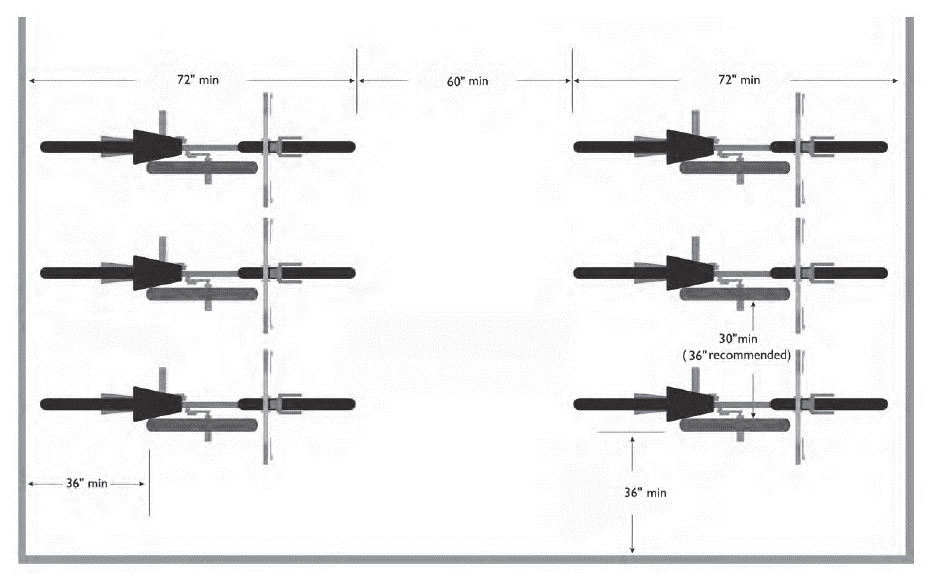
(Code 1992, § 16.40.090.4.2; Ord. No. 203-H, § 18, 11-23-2015)
16.40.090.5.1. - Minimum number loading spaces required.
Where off-street loading space is required, loading spaces or berths shall be provided for standing, loading and unloading operations, either inside or outside a building and on the same or adjoining premises:
Loading Space Table
(Code 1992, § 16.40.090.5.1)
16.40.090.5.2. - Design standards.
A.
Location. In no case shall the use of a loading space or berth hinder the movement of vehicles and pedestrians over a street, alley or sidewalk.
B.
Dimensions.
1.
Loading space. Shall be the width and length of a standard parking space.
2.
Loading berth for local delivery trucks. Shall have a minimum width of ten feet, minimum length of 25 feet and a minimum vertical clearance of 16 feet above finished grade.
3.
Loading berth for semi-trailers. Shall have a minimum width of ten feet, minimum length of 60 feet and a minimum vertical clearance of 16 feet above finished grade.
C.
Screening. A solid masonry wall or decorative wood or vinyl fence shall be erected where a loading berth or space is located directly across a street from a dwelling with one or two units. Where a loading space or berth is located directly across from a dwelling with one or two units, mitigation of the vehicular impacts may be required including, but not limited to, restricted loading and unloading times and landscape enhancements.
(Code 1992, § 16.40.090.5.2; Ord. No. 1029-G, § 37, 9-8-2011)

