
Saint Petersburg City Zoning Code
SECTION 16
40.060.- LANDSCAPING AND IRRIGATION; TREE PROTECTION13
Sections:
Editor's note— Ord. No. 195-H, § 1, adopted Sept. 17, 2015, changed the title of § 16.40.060 from "Landscape and Irrigation" to "Landscape and Irrigation; Tree Protection."
16.40.060.1.1. - Purpose.
The purpose of this section is to improve the appearance, environment, character and value of the total urban area within the City by protecting, promoting and maintaining a healthy, diverse and mature canopy of native and naturalized hardwood and evergreen tree species and by requiring the installation and maintenance of vegetation in a manner which conserves water.
Implementation of these requirements reduces water consumption, stormwater runoff, impervious surface area, 'heat island' effects, paved surfaces, vehicular use areas and the visual impact of large building masses; increases the urban canopy, improves environmental and water quality, provides a more pedestrian friendly environment, and enhances the overall aesthetic appearance and value of the City, thereby promoting the public health, safety and general welfare. Water conservation shall be achieved by the selection of appropriate plant materials, the removal of nuisance and invasive vegetation, the use of water-efficient landscaping and irrigation systems, the use of low impact development landscape designs and appropriate maintenance.
It is also the intention of this section to encourage the design and use of plant materials which reduce watering requirements, for example, with less St. Augustine sod and with more planting beds of drought tolerant plant materials. To that end, this section provides incentives for increasing the use of drought tolerant sod or planting beds and decreasing the use of St. Augustine sod.
(Code 1992, § 16.40.060.1; Ord. No. 934-G, § 1(16.40.60.1.1), 7-23-2009; Ord. No. 195-H, § 1, 9-17-2015)
16.40.060.1.2. - Interpretations and definitions.
For the purposes of this section only:
Landscaping, landscape and landscape materials shall include any kind of vegetation and shall be used interchangeably unless the context clearly contemplates otherwise.
Multifamily is defined in the Use Permissions and Parking Matrix.
Non-residential shall mean any use other than multifamily and one- and two-unit residential properties.
Streetscape plan shall mean a plan approved by the POD for the right-of-way of an area of the City.
All landscape materials shall comply with the visibility at intersection requirements.
(Ord. No. 195-H, § 1, 9-17-2015)
Editor's note— Ord. No. 195-H, § 1, adopted Sept. 17, 2015, renumbered the former § 16.40.060.1.2 as § 16.40.060.1.3 and enacted a new § 16.40.060.1.2 as set out herein. The historical notation has been retained with the amended provisions for reference purposes.
16.40.060.1.3. - Ground cover incentives.
A.
Non-residential, multifamily and residential construction permit applications are eligible for a partial refund of the permit fees if the landscaping as installed does not include any St. Augustine sod.
1.
For new one- and two-unit residential construction, the City will refund $150.00 of the permit fee paid.
2.
For non-residential and multifamily construction, the City will refund $300.00 of the permit fee paid.
3.
The determination of the eligibility for the refund shall be made upon the final inspection by the City.
B.
Non-residential and multifamily construction permit applications are eligible for a waiver of the following landscape requirements if the landscape plan does not include any St. Augustine sod. A condition of the permit approval shall be that St. Augustine sod shall not be planted, or allowed to grow, on the permitted property.
1.
For non-residential or multifamily construction, one required interior landscape island shall be waived.
(Ord. No. 934-G, § 1(16.40.60.1.2), 7-23-2009; Ord. No. 195-H, § 1, 9-17-2015)
Note— See the editor's note to § 16.40.060.1.2.
16.40.060.2.1. - Landscaping.
Existing Florida-native plant material shall be given priority for preservation in the development and redevelopment of a property and existing healthy native trees and palms and other vegetation should be protected and preserved, and integrated into landscape plans.
(Ord. No. 195-H, § 1, 9-17-2015)
16.40.060.2.1.1. - Development and redevelopment of new one- and two-unit residential properties.
New one- and two-unit residential properties shall meet the following landscape requirements prior to issuance of the certificate of occupancy:
1.
A minimum of two shade trees shall be located on the lot. The POD may allow one understory tree to be substituted for one shade tree where there are site constraints such as, but not limited to, existing above ground or underground utilities or the presence of tree canopy from adjacent properties that limit the available shade tree planting area. Palm trees shall not be subsitituted for shade trees.
2.
A minimum of ten shrubs, accent plants or ornamental grasses a minimum of 18 inches in height, shall be located in the front yard.
3.
Existing protected vegetation shall be eligible to meet this requirement.
4.
Each property shall have an irrigation system for all landscaped areas.
5.
All required yards not abutting streets shall be maintained as permeable landscaped vegetative green space with the exception of driveways, walks, patios and similar paved areas and non-organic mulch areas.
6.
When the property exceeds the minimum lot size requirements of the zoning district, the tree requirements herein shall be increased proportionally based on the size of the property or portion thereof in excess of the minimum. For example, the minimum lot size in NT-2 is currently 5,800 square feet and requires two approved trees. If the property is 11,600 square feet, this would be equivalent to two lots of minimum lot size and therefore four approved trees would be required.
7.
Variances. The approval of any variance shall be conditioned on installation and maintenance of the greatest amount of required landscaping determined to be reasonable.
(Code 1992, § 16.40.060.2.1.3; Ord. No. 149-H, § 2, 12-18-2014; Ord. No. 195-H, § 1, 9-17-2015; Ord. No. 611-H, § 20, 7-10-2025)
Editor's note— Ord. No. 195-H, § 1, adopted Sept. 17, 2015, renumbered the former § 16.40.060.2.1.3 as § 16.40.060.2.1.1 as set out herein. The historical notation has been retained with the amended provisions for reference purposes.
16.40.060.2.1.2. - Additional requirements for new and existing one- and two-unit residential properties.
A.
Required permeable green space for yards abutting streets. Required front yards and required side yards abutting streets shall be maintained as permeable landscaped vegetative green space with the exception of driveways, walks, patios, porches and similar paved areas, which areas combined shall not exceed 25 percent of the required front and street side yard areas for corner lots and 45 percent of the required front yard area for inside lots. Facilities constructed to achieve compliance with ADA requirements shall be exempt from this surface calculation. Yards abutting streets which do not conform to the provisions herein and which existed as of August 25, 1977, are grandfathered and exempt from this subsection.
B.
Ground cover, private property. Permeable portions of private property including required yards shall be maintained with an herbaceous layer of sod or ground cover plant material. Installation of St. Augustine sod turf at a property with a new structure which receives construction permits is limited to a maximum of 50 percent of the permeable area of the lot.
C.
Ground cover, rights-of-way. Permeable portions within the adjoining rights-of-way shall be maintained in accordance with an approved streetscape plan or, where an approved streetscape plan does not exist, with an herbaceous layer of sod or ground cover plant material. Where landscaping material is used in the right-of-way within four feet of the curb or road edge and there is no approved landscape plan, the landscaping materials, excluding sod, shall not exceed 24 inches in height above the top of the adjacent curb, or if there is no curb, the road bed, provided that the landscaping material does not result in a hazard or impairment to public vehicular or pedestrian traffic or violate the visibility at intersection section.
D.
Mulch. Organic mulch is a beneficial addition to landscaping in many situations including providing a surface covering under shrubs, or where ground cover material is maturing. The intention of these regulations is to allow mulch within a landscape design while not allowing an entire yard to only be covered with mulch. The use of cypress mulch is discouraged.
1.
Installation standards. Where used in lieu of sod or ground cover plant material, mulch shall be placed to a minimum depth of three inches. The top level of the mulch shall not exceed the height of the immediately adjacent ground surface. Mulch shall not be placed directly against a plant stem or tree trunk, or in a required drainage area. Non-organic mulch including rubber, decorative gravel, shell or crushed stone shall be allowed only in planting areas (e.g., in gardens or hedge areas).
2.
Limits on installation on one- and two-unit residential properties.
a.
Organic mulch may be used without limit underneath ground cover, accent plants, shrubs and trees, provided the ground cover, accent plants, shrubs and trees or a combination thereof are planted and maintained at a cumulative ratio of at least one shrub or tree, planted within the mulch per each ten square feet of organic mulched area;
b.
No more than 50 percent of the required front and street side yards may be covered only with organic mulch and no landscaping; organic mulch can be used without limit in the buildable area, and interior side and rear yards.
c.
Where a mulch parking surface has been permitted pursuant to the parking and loading design section, a separation consisting of an herbaceous layer of sod or ground cover of not less than eight feet in width shall be provided between the parking area and any adjacent mulch area allowed pursuant to this section.
3.
Limits on installation in rights-of-way. Organic mulch may be used in permeable areas of the right-of-way to keep moisture in the soil while other forms of approved ground cover plant material are maturing. Mulch is prohibited within four feet of the curb or road edge if there is no curb. Mulch in the right-of-way must be contained within borders sufficient to prevent flotation of mulch into the roadway. With the exception of permitted driveway or sidewalk materials, the use of shell, rock or other similar hardened non-organic mulch in the right-of-way is prohibited.
E.
Irrigation, existing one- and two-unit residential properties. A permanent irrigation system is not required for existing one- and two-unit residential properties; however, where one is installed, it shall be designed to avoid runoff, overspray or other similar conditions where water flows onto or over adjacent property, non-irrigated areas, walkways, roadways or structures. Irrigation systems shall be maintained so there are no broken irrigation heads or leaks. Automatic sprinkler systems shall install a rain sensor device or switch which will override the irrigation cycle of the sprinkler system when adequate rainfall has occurred.
F.
Vegetation, existing one- and two-unit residential properties. Any one- or two-unit residential property that meets or exceeds the tree and/or shrub standards set forth in the previous section for new one or two unit residential properties, shall maintain the minimum standards for the property. This does not mean that existing one- or two-unit residential properties that do not meet the requirements set forth in the previous section for new one- or two-unit residential properties are required to install vegetation to meet those requirements.
G.
Landscaping adjacent to mechanical equipment on site. Mechanical equipment, (e.g. backflow preventers, utility cabinets, air conditioners, etc.) visible from streets, excluding alleys, shall be landscaped with a continuous hedge comprised of shrubs planted no more than 30 inches on center or a decorative fence or architectural feature. Landscaping shall be installed no less than three feet from the equipment to allow for access, maintenance and required air flow.
H.
Landscaping adjacent to fences, walls, or dumpster enclosures. The exterior of any opaque fence or wall which exceeds 150 linear feet in length, visible from any street (not alley) shall be landscaped with a minimum of one shrub for every three linear feet and one under-story tree for every 25 linear feet.
I.
Decorative objects, including, but not limited to, rocks and planter beds, shall not be located within four feet of the curb of the street or where there is no curb, the road edge.
(Code 1992, § 16.40.060.2.1.4; Ord. No. 893-G, § 44(16.40.060.2.1.4), 9-4-2008; Ord. No. 9347-G, § 3, 7-23-2009; Ord. No. 149-H, § 3, 12-18-2014; Ord. No. 195-H, § 1, 9-17-2015; Ord. No. 287-H, § 13, 7-20-2017; Ord. No. 611-H, § 21, 7-10-2025)
Editor's note— Ord. No. 195-H, § 1, adopted Sept. 17, 2015, renumbered the former § 16.40.060.2.1.4 as § 16.40.060.2.1.2 as set out herein. The historical notation has been retained with the amended provisions for reference purposes.
16.40.060.2.1.3. - Development and redevelopment of non-residential and multi-family property.
A.
Applicability. The following requirements shall apply to all development and redevelopment of non-residential and multi-family properties:
1.
Development means for the purposes of this section, the construction of a new building or any new parking area.
2.
Redevelopment means for the purposes of this section, any proposed construction which:
a.
Requires Development Review Commission, Community Planning and Preservation Commission, or Community Redevelopment Agency review and approval;
b.
Requires additional parking;
c.
Seeks to expand the gross floor area of an existing building by more than 15 percent; or
d.
Requires a building permit based on the value for interior or exterior work or a combination thereof, equal to or exceeding the percentage shown in the following table (the term "appraised value" means the total value for ad valorem tax purposes according to the Property Appraiser of Pinellas County, Florida):
2.
Existing properties which do not have an approved landscape plan and which perform exterior (building, site, or a combination thereof) work that requires a permit from the City, but which do not meet the definition of "development" or "redevelopment" shall provide landscaping which is at least ten percent of the value of the permitted work. These landscape materials shall meet one or more of the landscape specifications in this section. A landscape permit is required.
B.
Landscape permit required. A landscape permit is required for the alteration, installation or replacement of any landscape required by this section. For the purposes of this section, alteration means any modification to existing landscaping which was required as part of a previously approved landscape plan or is necessary to meet the minimum standards of the Code. A permit is not required to replace dead landscaping materials with like materials unless a tree removal permit is required.
1.
A landscape plan shall be submitted in accordance with this section.
2.
An irrigation plan showing the use of an automatic low-volume irrigation system designed specifically for the proposed landscape installation shall also be provided. This plan shall include a site plan using a readable and defined scale, illustrating the proposed irrigation zones and delineating micro-irrigation zones and areas utilizing irrigation techniques other than micro-irrigation.
C.
Installation of landscape materials. Installation of landscape materials shall be in accordance with the approved landscape plan and shall be installed in a sound, workmanlike manner and in accordance with ANSI A300 Standards.
D.
Minimum landscape requirements.
Minimum Landscape Requirements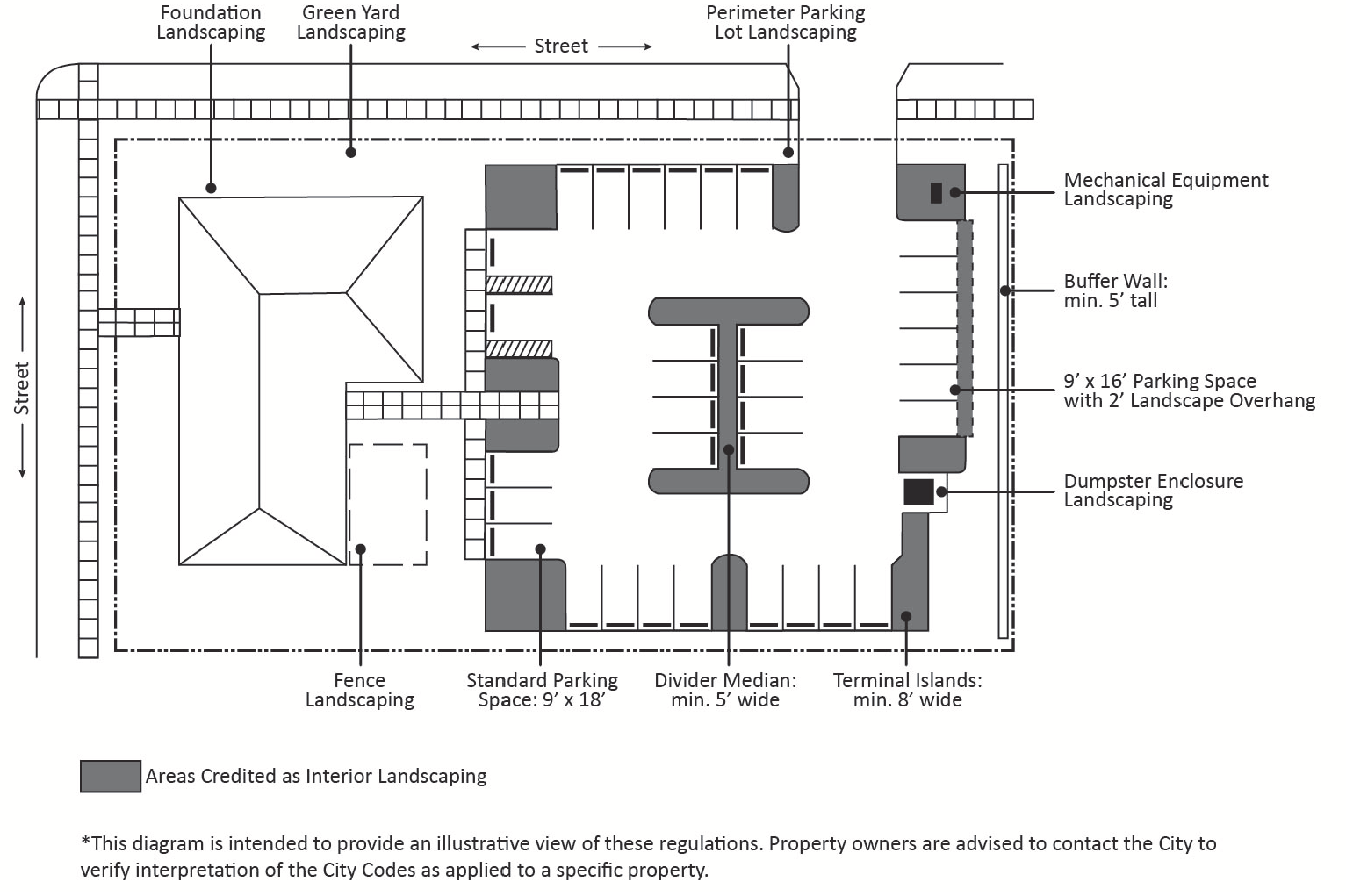
1.
Green yard, exterior. Green yards shall be provided in all yards abutting streets. Except for surface parking lots, if the required setback is smaller than the required green yard, the required green yard shall be the depth of the required front yard. For sites with irregular frontage, the POD may allow the green yard to vary in width, but it shall extend for the entire frontage and provide the equivalent square feet of green yard along the same frontage. Green yards shall be landscaped as follows:
2.
Green yard, interior. Interior green yards, when not abutting vehicular use areas, shall be provided along all interior property lines and property lines abutting alleys. The minimum width of all interior green yards shall be five feet unless the required side or rear yard is smaller, in which case the required green yard shall be the depth of the required interior side or rear yard. A minimum of one shade tree per 50 linear feet or fraction above half thereof is required. Under-story trees may be substituted for shade trees on a 1½ for one basis. The POD may allow the interior green yards to vary in width if additional green yards are expanded to provide the equivalent square footage of green yards on the site.
3.
Foundation landscaping.
a.
A minimum of one foundation plant is required for each three linear feet, and one under-story tree is required for each 30 linear feet (or portion thereof), of the exterior building perimeter. Foundation plantings may be comprised of shrubs, accent plants, ornamental grasses, and ground cover in any combination; provided that no less than 50 percent of the total required materials are shrubs, accent plants and/or ornamental grasses.
When calculating the minimum number of required plants, the linear distance of openings for overhead or loading area doors, motor vehicle bays or entrances to the building, or the perimeter of attached or detached canopies shall be excluded. Foundation plants may be planted in groupings so long as the minimum number of required plants is provided. The foundation landscaping shall be required on all building sides except those sides facing an alley. Foundation landscaping shall abut the building (while allowing the necessary space for growth) and shall be used or installed in such a manner so as to screen mechanical equipment attached to or adjacent to the building, provide direction to and enhance entrances and walkways, and provide visual breaks along monotonous building façades.
b.
Properties located within the CRT, CCT, IT, NTM, and DC-1, D-2, and DC-3 districts. The base of buildings, or portions of buildings, not visible from the street, excluding alleys, are not required to have foundation landscaping. Where reduced building setbacks along streets physically prevent the installation of foundation landscaping, it shall not be required.
4.
Vehicular use landscaping/screening requirements. Vehicular use areas shall meet the following additional requirements:
a.
Perimeter parking lot landscaping. A minimum of one shade tree per 35 linear feet (or portion thereof) shall be planted around the perimeter of vehicular use areas. A continuous hedge comprised of shrubs planted not more than 30 inches on center shall be planted around the perimeter of the vehicular use area. The pervious area for perimeter parking lot landscaping shall be at least five feet in width, measured from the inside of the curb, sidewalk or other paved surface abutting the pervious area. Additional landscaping is not required for the perimeter parts of the vehicular use area adjacent to the building.
(1)
Properties located within the CRT, CCT, IT, NTM, and DC-1, DC-2, and DC-3 districts. Parking lots or portions of parking lots not visible from the street, excluding alleys, are not required to install perimeter landscaping. Where a parking space is designed perpendicular to the street, excluding alleys, such that the front of the space allows the headlights to shine onto the street, a minimum three-foot high solid masonry wall or decorative fence shall be erected to prohibit headlights from shining onto the streets.
b.
Interior parking lot landscaping. Interior parking lot landscaping shall be provided as follows:
(1)
Required square footage of landscape area. For all vehicular use areas with more than ten parking spaces, a minimum of ten percent of the vehicular use area shall be devoted to interior landscaping. In calculating this percentage, the area shall include both pervious and impervious portions of the vehicular use area. Terminal and interior islands and divider medians shall be used to comply with required interior parking lot landscaping. For redevelopment of properties in the CRT, CCT, IT, NTM, and DC-1, DC-2, and DC-3 zoning districts, the POD may reduce the required landscape down to five percent where existing site constraints (e.g. insufficient permeable area) make compliance impracticable or where such reduction will allow preservation of existing Protected and/or Grand trees.
(2)
Terminal islands. Each row of parking spaces shall end with terminal islands to separate parking from adjacent drive lanes. Each terminal island shall measure at least eight feet in width by 18 feet in length, measured from the inside of the curb. The POD may reduce the required width by up to three feet (minimum width five feet) where existing site constraints (e.g. small site) make compliance impracticable or where such reduction will allow preservation of existing Protected and/or Grand trees. Within terminal islands, one shade tree shall be required for every 150 square feet (or fraction above one-half thereof), with a minimum of one shade tree required per terminal island. Terminal islands shall be landscaped with shrubs, accent plants, ornamental grasses and ground cover, excluding sod, which is planted to provide 100 percent coverage within two years. Landscaping in islands adjacent to parking spaces shall be set back a minimum of two feet behind the back of the curb to provide for pedestrian access to parked vehicles.
(a)
Properties located within the CRT, CCT. IT, NMT, and DC-1, DC-2 and DC-3 districts. Parking lots or portions of parking lots not visible from the streets excluding alleys, shall not be required to install terminal islands.
(3)
Interior islands. Each interior island shall measure at least eight feet in width by 18 feet in length, measured from the inside of the curb. The POD may reduce the required width by up to three feet (minimum width five feet) where existing site constraints (e.g. small site) make compliance impracticable or where such reduction will allow preservation of existing Protected and/or Grand trees. Interior islands less than five feet in width, measured from the inside of the curb, shall not be credited towards interior landscaping unless a variance is granted. Within interior islands, one shade tree shall be required for every 150 square feet (or fraction above one half thereof), with a minimum of one shade tree required per interior island. Landscaping in islands adjacent to parking spaces shall be set back a minimum of two feet behind the back of the curb to provide for pedestrian access to parked vehicles.
(4)
Divider medians. Landscaped divider medians shall form a continuous landscaped strip between abutting rows of parking areas or access drives. The minimum width of a divider median shall be five feet, measured from the inside of the curb. One shade tree or two under-story trees shall be required for each 30 linear feet of divider median (or fraction above one half thereof). Shrubs shall be planted in divider medians which separate parking areas from access drives to form a continuous hedge the full length of the divider median.
(5)
Tree species diversity. It is important to provide a mix of tree species on larger sites. When the required number of trees is: less than ten, one or more species shall be provided; less than 20 trees, two or more species shall be provided; more than 20 trees, three or more species shall be provided.
(6)
Tree placement. Trees shall not be located adjacent to free-standing sign faces or below wall sign faces where the tree will create a visual obstruction at the time of planting or in the future. Shade trees shall not be located below overhead utility lines where the tree will contact the line at the time of planting or in the future. Shade trees shall not be located over underground utility lines. Clustering of perimeter trees is permitted to prevent the obstruction of sign faces and conflicts with overhead or underground utility lines. The POD may allow required shade trees to be substituted with native palms and/or understory trees on a three per one basis to prevent such conflicts. Where site constraints limit planting of required trees, larger trees at least four-inch minimum dbh, may be substituted for required trees on a two for one basis.
c.
Curbing. Nonmountable concrete curbing shall be provided within all parking areas to prevent vehicles from encroaching onto and overhanging required plantings, sidewalks, rights-of-way or adjacent property. Wheel stops may be substituted at the closed end of parking stalls where they abut required plantings or sidewalks.
(1)
Curbing may be placed within the parking space up to two feet from the closed end of the parking stall. When curbing is utilized, the two-foot-wide strip may be landscaped when abutting green space.
(a)
Landscaping shall be low-growing to accommodate the vehicular overhang.
(b)
The landscaped area within the parking space counts toward parking lot interior landscaping requirements and toward any overall site landscaping requirements. However, the landscaped area does not count toward green yard, perimeter landscaping or divider median requirements.
(2)
Wheel stops shall be located up to two feet from the closed end of the parking stall. Wheel stops shall have a minimum height of six inches above finished grade of the parking area and shall be properly anchored and maintained in good condition.
d.
Screening abutting residential uses. Where vehicular use areas abut a one- or two-unit residential property, a minimum five-foot high solid masonry wall or decorative fence shall be installed in such a manner so as to screen the vehicular use area from the adjacent one- or two-unit residential property. Where this wall or fence requirement is applied to properties with existing mature shade trees, the wall or fence may be truncated and supplemented with trees and shrubs to achieve such screening.
e.
Low Impact Development Landscaping Plan. A Low Impact Development (LID) Landscaping Plan may be approved by the POD as part of a stormwater management plan in lieu of some of the requirements of this subsection for the area in which it is implemented.
5.
Landscaping adjacent to fences, walls, or dumpster enclosures. The exterior of any opaque fence, wall, or dumpster enclosure visible from any street shall be landscaped with a minimum of one shrub for every three linear feet and one under-story tree for every 25 linear feet.
6.
Landscaping adjacent to mechanical equipment on site. Mechanical equipment, (e.g. backflow preventers, utility cabinets, air conditioners, etc.) visible from streets, excluding alleys, shall be landscaped with a continuous hedge comprised of shrubs planted no more than 30 inches on center or a decorative fence or architectural feature. Landscaping shall be installed no less than three feet from the equipment to allow for access, maintenance and required air flow.
7.
Landscaping within the adjoining rights-of-way.
a.
Landscaping within the adjoining rights-of-way shall be provided in accordance with an approved streetscape plan or, where an approved streetscape plan does not exist, plantings shall be comprised of low growing shrubs, accent plants, ornamental grasses, ground cover or sod in any combination. Where landscaping material is used in the right-of-way within four feet of the curb or road edge and there is no approved landscape plan, the plantings, excluding sod, shall not exceed 24 inches in height above the top of the adjacent curb, or if there is no curb, the road bed, provided that the landscape material does not result in a hazard or impairment to vehicular or pedestrian traffic.
b.
Properties located within the CRT, CCT, IT, NTM, and DC-1, DC-2, and DC-3 districts. Within these districts, landscaping shall be provided in accordance with an approved streetscape plan or, where an approved streetscape plan does not exist, in accordance with the following: One shade tree per 30 linear feet. Where there is insufficient permeable area to support tree growth, trees should be planted in tree pits or planting strips. The POD may substitute shade trees with understory trees or native palms on a three per one basis if shade trees are not site appropriate. Ground cover plantings shall be comprised of shrubs, accent plants, ornamental grasses, ground cover or sod in any combination provided that no less than 25 percent of the total landscape area is planted with low growing shrubs, accent plants, ornamental grasses or ground cover.
8.
Protection of existing specimen trees.
a.
A percentage of Specimen trees existing on a site, other than properties located within CCT-2, CRT-2 and all DC districts, shall be preserved. The POD may reduce the required percentage by up to 25 percent to allow preservation of one or more Grand trees that are equal to or greater than the required total inches reduced. Existing Specimen trees may be used to satisfy the requirements for planting additional trees as follows: trees 18 inches dbh shall equal one required tree, trees 19 inches—26 inches dbh shall equal two required trees, trees 27 inches—36 inches dbh shall equal three required trees; trees over 36 inches dbh shall equal five required trees. The number of existing specimen trees to be preserved on a site shall be determined as follows:
b.
Existing trees which will remain on the property and which are identified on the landscape plan may satisfy some or all of the required landscaping provided that the trees meet the quantity, applicable species and size requirements. Trees determined to be in decline may not be used to satisfy required landscaping and the POD may require the removal of any tree determined to constitute a safety hazard.
c.
Existing trees to be preserved shall be protected from construction-related impacts by placement of suitable protective barriers, constructed to specifications issued by the POD, which shall remain in place until such time as the removal of the protective barrier is authorized by the POD. It is unlawful for any person to place solvents, material, construction machinery, or temporary or permanent soil deposits within six feet of the trunk or within two-thirds of the drip line, whichever is greater, of any tree identified on the landscape plan which is to remain on the site. No attachments or wires shall be attached to any protected tree. Barricade details shall be shown on the landscape plan and installed prior to the commencement of construction.
d.
Whenever a change of elevation takes place that raises or lowers the ground level elevation at or within the drip line of any existing tree, a method to preserve the existing ground elevation within the drip line shall be utilized. Such methods include but are not limited to tree wells, dry wells, retaining walls and terracing. The method of protection shall be shown on the landscape plan and is subject to approval by the POD. In addition to any other penalties, the direct or indirect destruction of existing trees by failure to comply with appropriate protection during construction shall be a violation of this section. Existing trees which are required to remain on site and are seriously damaged as a result of construction activities during development or work shall be replaced on a 2:1 ratio based on the number of inches at dbh.
9.
Protection of existing native plant communities.
a.
For vehicular use areas, where healthy, native vegetation exists on a site prior to its development, in part or in whole, the POD may adjust the requirements of this section to allow credit for such plant material (excluding any sick, topped or damaged trees, or any trees included on the unprotected and prohibited species tree lists) provided that the POD finds such an adjustment is in keeping with and will preserve the intent of this section and provides the equivalent or greater amount of plants or inches dbh of trees.
b.
Native vegetation shall be preserved using the largest contiguous and compact area reasonable. Preserved areas shall be included in the following calculations.
(1)
For residential and residential mixed-use developments within the coastal high hazard zone greater than 2½ acres and for residential and residential mixed-use developments outside of the coastal high hazard zone greater than 20 acres, not less than 25 percent of the native vegetation shall be preserved.
(2)
All other types of new development subject to special exception or site plan review shall preserve a portion of the native vegetation. For new development less than five acres, not less than ten percent of the native vegetation shall be preserved. For new development five or more acres, not less than 15 percent of the native vegetation shall be preserved.
(Code 1992, § 16.40.060.2.1.1; Ord. No. 876-G, § 19, 2-21-2008; Ord. No. 893-G, §§ 35, 44(16.40.060.2.1.1), 9-4-2008; Ord. No. 1029-G, § 31, 9-8-2011; Ord. No. 100-H, § 1, 12-19-2013; Ord. No. 195-H, §§ 1, 6, 9-17-2015; Ord. No. 611-H, § 22, 7-10-2025)
Editor's note— Ord. No. 195-H, § 1, adopted Sept. 17, 2015, renumbered the former § 16.40.060.2.1.1 as § 16.40.060.2.1.3 as set out herein. The historical notation has been retained with the amended provisions for reference purposes.
16.40.060.2.1.4. - Additional requirements for new and existing nonresidential and multifamily properties; ground cover, mulch.
A.
Permeable portions of property including required yards shall be maintained with an herbaceous layer of sod or ground cover plant material. Installation of St. Augustine sod at a property with a new structure which receives construction permits is limited to a maximum of ten percent of the permeable area of the property.
B.
Mulch. New and existing nonresidential and multifamily properties shall comply with the same mulch requirements established above for new and existing one- and two-unit residential properties.
(Code 1992, § 16.40.060.2.1.2; Ord. No. 934-G, § 2, 7-23-2009; Ord. No. 195-H, § 1, 9-17-2015)
Editor's note— Ord. No. 195-H, § 1, adopted Sept. 17, 2015, renumbered the former § 16.40.060.2.1.2 as § 16.40.060.2.1.4 as set out herein. The historical notation has been retained with the amended provisions for reference purposes.
16.40.060.2.1.5. - Utilities and utility easements.
No person shall plant a tree or shrub in a utility easement. Any vegetation planted in a utility easement shall be herbaceous vegetation and shall not interfere with the use of the easement for utility purposes which includes the maintenance and replacement of underground utilities.
(Code 1992, § 16.40.060.2.1.5; Ord. No. 195-H, § 1, 9-17-2015)
16.40.060.2.1.6. - Landscape specifications.
A.
Unless otherwise specified, all landscape materials shall meet the following specifications:
B.
Plant selection criteria. The species of required landscape materials shall be site appropriate and shall be selected based on the existing and neighboring vegetative communities, sun exposure, soil types, proposed function of the materials, cold tolerance, water use, fertilizer needs, existence of utilities or overhead power lines, and aesthetics.
C.
Unprotected trees. Due to their status as non-native species or invasive species, any unprotected or prohibited trees may be removed from private property and the abutting right-of-way without a permit unless they are part of an approved landscape plan, or otherwise required by this section, and shall not be used to meet the vegetation required by this section:
1 Note: Jacaranda and Royal Poinciana Trees over eight inches DBH and Banyan and Kapok over 30 inches DBH are signature trees and therefore may be required to obtain a permit before removing.
D.
Prohibited trees. It is unlawful to plant or cause to be planted, or to sell or offer for sale, within the City limits the following exotic and nuisance plant species. Any development or redevelopment which is required to obtain a landscaping permit or file a landscape plan shall remove all prohibited trees on the property and abutting right-of-way and shall include a plan to prevent re-growth prior to approval of a certificate of occupancy.
(Code 1992, § 16.40.060.2.1.6; Ord. No. 195-H, § 1, 9-17-2015; Ord. No. 611-H, § 23, 7-10-2025)
16.40.060.2.1.7. - Variances from required landscaping; appeals.
A.
Where unique conditions related to existing buildings, dimensional aspects of platted lots, or a lack of available space or water to support the required landscape materials preclude strict compliance with this section, or to provide for the preservation of protected or grand trees, the POD may adjust the requirements of this section as follows:
1.
Relocation of required landscape materials or landscape areas to other parts of the property or the abutting right-of-way;
2.
If it is not reasonably possible to comply with the planting requirements of this section, the POD may approve a payment in lieu of planting which shall be utilized to provide additional landscaping on public property or right-of-way. Such payment in lieu shall be $500.00 per tree and $150.00 per shrub or other vegetation and shall be placed in the environmental enhancement fund.
B.
Requests for variances shall be reviewed by the Development Review Commission (DRC).
C.
Variances from the "protection of existing native plant communities section" hereof for sites which cannot accommodate both the native vegetation requirement and the development or redevelopment shall only be granted with the condition that the following mitigation be performed. Mitigation on-site shall recreate a native plant community in all three strata (ground cover, under-story and trees), utilizing plant materials at least twice as large as normally required (to more quickly recreate the lost mature vegetation). Mitigation may be off-site if the mitigation enhances or enlarges existing large tract wildlife areas as shown on the biological resources map. No variance from this subsection shall be allowed.
D.
Decisions of the POD to approve or deny a landscape plan may be appealed by the property owner to the DRC, whose decision shall be deemed a final decision of the City.
(Code 1992, § 16.40.060.2.1.7; Ord. No. 195-H, § 1, 9-17-2015)
16.40.060.2.2. - Irrigation.
A.
Irrigation design and layout. Irrigation systems are required for the development and redevelopment of non-residential and multifamily properties. Irrigation systems shall comply with the following requirements:
1.
Irrigation systems shall be water efficient irrigation systems designed to provide no more than the minimum amount of water required by any specific landscape material to ensure survival of that material. Irrigation system piping shall be underground. Such systems shall utilize a combination of sprinkler mechanisms and zones to accommodate the individual irrigation requirements of each type of landscape material, including trees, shrubs, ornamentals and sod areas.
2.
Irrigation systems shall be designed to provide 100 percent coverage and to prevent overspray, runoff, low land drainage and other conditions where water flows onto or over adjacent property, non-irrigation areas, water features and impervious areas.
3.
Irrigation systems shall be operated by an automatic irrigation controller or timer which has sufficient programming flexibility to respond to the needs of the irrigation devices being used and is capable of irrigating high requirement areas on a different schedule from low water requirement areas (provided that separate zones exist), has program flexibility (to allow repeat cycles and multiple program capability) and battery backup (to retain programs).
4.
The design of the irrigation system shall include sprinkler heads and devices appropriate for the landscape material to be irrigated. Sprays and rotors shall not be on the same control value circuit and shall have matching application rates within each zone. Sprinkler spacing shall not exceed 55 percent of the sprinkling diameter of coverage.
5.
Irrigation systems shall be designed with low trajectory heads, micro irrigation or low-volume water distributing devices in order to prevent overspray onto impervious areas. Micro irrigation systems shall not be used to irrigate sod areas. Sprinkler heads in and adjacent to lawn areas shall be designed to be flush with the ground surface when not in use.
6.
Irrigation systems shall be designed to place high water demand areas, such as lawns, on separate zones from those areas with reduced water requirements.
7.
A rain sensor device or switch shall be installed to regulate the controller's operation that will override the irrigation cycle of the sprinkler system when one-half to three-quarter inch of rainfall has occurred on any day.
8.
Irrigation application rates and controller duration times for each zone shall be calculated and noted on the irrigation plans.
9.
A permanent irrigation system shall not be required for areas within an approved low impact design landscape plans.
B.
Irrigation system maintenance. The irrigation system shall be maintained and managed to ensure water efficiency and prevent wasteful practices. This shall include, but not be limited to resetting the automatic controller according to the season, flushing the filters, testing the rain sensor device and replacing malfunctioning sensors, monitoring adjusting, and repairing irrigation equipment such that the efficiency of the system is maintained, repairing broken irrigation heads and leaks.
(Code 1992, § 16.40.060.2.2; Ord. No. 195-H, § 1, 9-17-2015)
16.40.060.3.1. - Maintenance of trees and vegetation for all properties within the City.
A.
The owner of record of the property and occupant of the property are responsible for the maintenance of trees and vegetation on the property and in abutting rights-of-way. Vegetation shall comply with all codes including visibility at intersections and requirements for hedges. Where support staking of vegetation is provided at the time of installation, the staking system shall be installed properly, avoid harming the vegetation, and be removed no later than one year after installation to prevent damage to the vegetation, unless such staking is necessary for permanent support of the plant.
B.
Vegetation shall be maintained in good condition so as to present a healthy, neat and orderly appearance and shall be kept free from refuse and debris. All plant materials shall be maintained free from physical damage or injury arising from lack of water, chemical exposure, insects, disease, blight or other cause. Exceptions regarding damage due to lack of water shall be made when water consumption is limited by emergency orders or declarations by state or local agencies.
C.
Except for those tree species listed as unprotected or prohibited, it shall be unlawful for any person to damage, top, poison or in any manner injure or cause to be injured any tree regardless of condition.
1.
Trees shall be trimmed or pruned in such a manner so as to not alter their natural form, growth habit or character and shall not be pruned into "unnatural" shapes, including but not limited to, circles, ovals, or squares.
2.
Not more than one-quarter of the tree canopy shall be trimmed or pruned in any year unless it is dead.
D.
Sod (including turf and turfgrass) or other herbaceous growth other than ground cover species shall be maintained at a maximum overall height of ten inches or less; ground cover plant material shall be maintained at an overall height not to exceed 24 inches. Property designated as a preservation area shall not be required to meet these standards. Property owners who employ Florida-Friendly Landscaping TM or wildlife habitat management principles such that their private property or adjacent right-of-way does not meet these criteria shall have a management plan and demonstrate active, ongoing maintenance. Maintenance shall employ accepted Florida-friendly management practices, Examples of activities addressed in maintenance plans include routine pruning, mowing, edging, weeding, fertilizing, pest control, irrigation system adjustments, seeding and replanting. Florida-friendly management plans shall also address these principles:
1)
Vegetation plan and design;
2)
Analyze and amend the soil;
3)
Limit sod to active use areas;
4)
Select appropriate plant species;
5)
Irrigate efficiently;
6)
Use mulch; and
7)
Maintain the landscape appropriately.
Wildlife habitat areas shall consist of native and introduced plant species designed, planted and maintained to provide food source, cover, roosting and nesting habitat for specific species.
E.
Vegetation which is a hazard to public safety is prohibited in the right-of-way. Hazardous vegetation with pronounced thorns (such as Spanish bayonet, century plant, bougainvilla, and lime trees) shall not be closer than two feet to a sidewalk or walkway. Hedges are prohibited in the right-of-way except as allowed by the fences, walls and hedges section.
F.
Vegetation adjacent to public sidewalks and public streets shall not encroach onto the sidewalk or street surface except that sod and ground cover should be kept trimmed to the edge of the sidewalk or street surface but may encroach up to six inches. The branches of trees and shrubs which grow above sidewalks shall provide a minimum of eight feet of vertical clearance and above streets and alleys, a minimum of 14 feet of vertical clearance.
G.
It is unlawful for the owner or occupant of property to permit to remain on any property, including the abutting rights-of-way, any tree or tree branch that is in such diseased or dead condition so as to be in danger of falling upon any right-of-way or the property of another.
H.
It shall be unlawful to dispose, deposit, drop, or place grass clippings, tree trimmings and other vegetative material in the right-of-way or on the property of another or upon any street or alley or into waters within the City or directly or indirectly into the municipal storm sewer system. This section shall not be construed to prohibit the use of mulching lawn equipment. A violation of this section is transient in nature and irreparable. Any person in violation of this section may be cited immediately upon observation of the violation.
1)
Each property owner or occupant of property where activities that violate this subsection occur may be cited for each violation of this subsection.
2)
Any person who maintains or removes yard vegetation on behalf of any other person for compensation (e.g. lawn care and lawn maintenance companies, including any and all supervisors and employees) shall be subject to a fine of $500.00 for each violation of this subsection.
I.
It shall be unlawful for any owner or occupant of property, including the abutting right-of-way, to allow to exist upon the property or abutting right-of-way vegetation or trees which violate this section.
J.
Unless approved by the POD, rights-of-way shall be maintained at a level and even grade.
K.
The removal of vegetation or trees required by this section and the failure to replace required vegetation or trees when such vegetation or tree dies or is removed, shall be unlawful. Replacement vegetation or trees shall meet the size and grade requirements of this section.
(Code 1992, § 16.40.060.3.1; Ord. No. 163-H, § 1, 5-7-2015; Ord. No. 195-H, § 1, 9-17-2015; Ord. No. 448-H, § 3, 2-11-2021; Ord. No. 611-H, § 24, 7-10-2025)
16.40.060.3.2. - Clearance of lots in preservation areas.
No person shall clear, disturb or remove any vegetation or dead or living plant life located within any preservation area without a permit issued by the POD for such work.
(Code 1992, § 16.40.060.3.2)
16.40.060.4.1. - Notice of violation; definitions.
A.
If the POD finds and determines that vegetation that violates the maintenance standards in this section exists on a parcel of property, that a hive of bees, wasps, yellow jackets or other stinging insects exists upon a parcel of property in violation of chapter 4, or that some other violation of the City Code exists for which the Code specifically authorizes the City to perform lot clearing activities, and if the POD determines that the City should correct the violation in order to protect public health and safety if the owner(s) do not cause the violation to be corrected timely, the POD shall notify the owner(s) of record of the property in writing and demand that such owner(s) cause the violation to be remedied.
(1)
The notice shall be given by first class mail, addressed to the owner(s) of record of the property as their name(s) and address are shown upon the records of the County Property Appraiser. Service of the notice shall be deemed complete and sufficient when so addressed and deposited in the United States mail with proper postage prepaid. Notice shall also be posted upon the property on which the violation exists. Notice may be served by hand delivery to the owner(s) of record of the property in lieu of mailing.
(2)
As used in this section, a "repeat violation" is a violation which is alleged to occur on property which was the site of the same violation within the preceding 12 months, at a time when the property was under the same ownership, and the preceding violation was not corrected by the owner but required the City to take corrective action.
B.
The notice shall be substantially in the following form:
NOTICE OF VIOLATION (OR, NOTICE OF REPEAT VIOLATION)
Date ________
I inspected your property (describe property) on or about (date) and found the following conditions (describe conditions) that are a violation of Section(s) [insert applicable City Code section numbers], [of the] City Code. You are hereby notified that you must correct these violations by (date). If you fail to either correct the above-stated City Code violations by that date or to file an appeal as described below, you will have given implied consent for the City, or its designee, to go onto your property, including into fenced yards, to cut, trim, and clear vegetation and/or to apply pesticides and/or remove insect hives to correct the violations of the City Code. To properly perform this maintenance, the City may also remove articles of junk, rubbish or garbage stored out-of-doors on the property in violation of City Code when the removal of that junk, rubbish, or garbage is reasonably necessary to correct the violation. The cost of this work, advertising costs, administrative costs and other expenses will be imposed as a special assessment lien on the property described. You can appeal the finding that there is a violation by filing a written appeal to the City Clerk within ________ days of the date of this notice.
City of St. Petersburg
By:___________
POD
(Code 1992, § 16.40.060.4.1; Ord. No. 892-G, § 2(16.40.060.1), 9-4-2008; Ord. No. 945-G, § 1(16.40.060.4.1), 9-3-2009; Ord. No. 13-H, § 2, 1-12-2012)
16.40.060.4.2. - Appeals.
A.
Within ten calendar days after the date service of the notice, the owner or the designated agent of the owner may file an appeal to show that the violation alleged in the notice does not exist. However, if the violation is a repeat violation, the time in which to file an appeal shall be five calendar days from the date of receipt of the notice by the owner or designated agent of the owner. The appeal shall be in writing and must be filed with the City Clerk.
B.
The appeal shall be heard by a hearing officer. The hearing shall be conducted at a reasonable time and place, following notice of the hearing to the appellant. If the alleged violation is a repeat violation, the hearing shall be conducted not more than ten calendar days from the date of filing of the appeal. The hearing shall be informal and the strict rules of evidence shall not be applicable, but the minimal requirements of due process shall be observed. The objective of the hearing shall be to render a decision which is fair and just under the circumstances. At the hearing, the POD and the owner or the designated agent of the owner may introduce such evidence as is deemed necessary. The decision of the hearing officer shall be final and the owner shall be deemed to have exhausted all administrative remedies.
(Code 1992, § 16.40.060.4.2; Ord. No. 892-G, § 2(16.40.060.2), 9-4-2008; Ord. No. 945-G, § 1(16.40.060.4.2), 9-3-2009; Ord. No. 100-H, § 11, 12-19-2013; Ord. No. 177-H, § 3, 6-11-2015)
16.40.060.4.3. - Authority of City to remedy prohibited condition by lot clearance.
If the violations of City Code are not corrected by the property owner by the date stated in the notice of violation and no appeal has been made or, if made, a hearing has been held and has concluded adversely to the owner and the violation is not corrected within five days following the date of the hearing, the POD shall have authority to cause the violation to be corrected. By receiving the notice of violation in section 16.40.060.4.1 and failing to correct the violation or file an appeal (or to correct the violation within five days of an unsuccessful appeal), the property owner shall have given implied consent for the City, or its designee, to go onto the owner's property, including into fenced yards, to correct the violation(s). The POD shall have authority to cause the cutting and removal of vegetation, the application of pesticides to active hives of bees, wasps, yellow jackets or other stinging insects and/or the removal of such hives, and/or other appropriate lot clearing action as specifically provided by the City Code, including the removal of any and all junk, rubbish, or garbage on the property, when such work is necessary to correct the violation. The costs of such work, as well as such administrative and other costs as are necessary to correct the violation, shall be charged against the property as a special assessment lien as provided in this section.
(Code 1992, § 16.40.060.4.3; Ord. No. 13-H, § 3, 1-12-2012; Ord. No. 177-H, § 4, 6-11-2015)
16.40.060.4.4. - Assessment and lien for costs of lot clearance.
A.
Preliminary assessment roll. After causing the violation to be corrected, the POD shall determine the costs incurred by the City in correcting the violation, including all administrative and other costs as are necessary to correct the violation (administrative costs shall include the lien recording and releasing fee set forth in Chapter 12), and shall determine the proportionate costs that each property should bear if violations on more than one property were corrected. The POD shall cause a preliminary assessment roll to be prepared containing a complete list of the properties and of properties abutting street right-of-way upon which violations were corrected, setting opposite each property the cost of doing said work, which shall be submitted to City Council.
B.
Public hearing. The City Council shall hold a public hearing on the preliminary assessment roll after publication of notice. One notice shall be published in a daily newspaper of general circulation at least five days prior to the public hearing. Notice shall be mailed to each owner listed on the preliminary assessment roll by first class mail and shall be deemed complete and sufficient when mailed. The notice shall be in substantially the following form:
NOTICE OF PUBLIC HEARING
You are hereby notified that the City of St. Petersburg, Florida, has corrected the following violations [insert applicable City Code section numbers], of the City Code on properties in the City of St. Petersburg and has determined the amount to be assessed against each of said properties to defray the cost thereof. A list of said properties upon which violations were corrected and the amount to be assessed against each of said properties is on file and open for inspection in the office of the City Clerk of the City of St. Petersburg, Florida.
You are further notified that the City Council of the City of St. Petersburg will hold a public hearing on the ________ day of ________, at ___ ___m., or as soon thereafter as it may be held, in the Council Chambers at the City Hall in the City of St. Petersburg, Florida, for the purpose of hearing any and all objections that any affected party may wish to offer as to why said assessments should not be made final.
C.
Approval of preliminary assessment roll. The City Council shall meet on the date and at the place specified in the notice and hear any and all objections that any person affected by said proposed assessment wishes to offer as to why said assessments should not be made final and shall correct any and all mistakes or errors appearing upon said preliminary assessment roll. The City Council shall then confirm the preliminary assessment roll, as submitted or as corrected, and the assessment roll shall then be final.
D.
Amounts assessed to constitute lien. When the preliminary assessment roll is confirmed by the City Council and made final, the amounts assessed against the respective properties shall, from the date of said confirmation, be and constitute a special assessment lien against the respective properties superior in dignity to all other liens and encumbrances of whatever kind and character save and except ad valorem taxes levied and assessed by the state, county or City and shall be of equal dignity with such taxes and shall remain a special assessment lien against the properties until paid. Upon confirmation of the assessment roll by the City Council, the POD shall immediately cause the assessment roll to be filed in the office of the City Clerk, and it shall be kept there for public inspection during business hours. The POD may file and record, in the office of the clerk of the circuit court, notice of the special assessment liens against the said properties, showing thereon the amount and nature of the lien and a legal description of the property.
E.
Interest on special assessment liens. The principal amount of all special assessment liens under this section which remains unpaid after 30 days from the date of confirmation of the special assessment by council shall bear interest at the rate of eight percent per annum from the date of confirmation through the period of time which is one year after the date of confirmation. Interest at 12 percent, rather than at eight percent, shall be charged on the principal amount for the period of time beginning one year from the date of confirmation of the special assessment by council until the principal and interest are paid in full. All interest shall also constitute a lien against the property assessed of equal dignity to the principal amount of the lien.
F.
Records of liens and interest due. The POD shall keep complete records relating to the amount payable for the liens and interest and may from time to time send a statement of the principal and interest due upon such liens to the record owners of the property upon which the liens exist.
G.
Enforcement of liens. At any time after the expiration of 30 days from the date of confirmation of the assessment roll, the liens may be foreclosed by the City in the manner provided by Florida Statutes for the foreclosure of mortgages on real property (currently F.S. ch. 702) or as otherwise permitted by law.
(Code 1992, § 16.40.060.4.4; Ord. No. 13-H, § 3, 1-12-2012; Ord. No. 53-H, § 4, 11-1-2012; Ord. No. 246-H, § 8, 10-20-2016; Ord. No. 420-H, § 3, 3-12-2020)
16.40.060.4.5. - Action to abate cumulative to other penalties, remedies.
Any action taken in regard to the disposal, abatement or removal of a violation of the maintenance standards shall be considered cumulative and in addition to penalties and to other remedies provided elsewhere by ordinance or law.
(Code 1992, § 16.40.060.4.5)
16.40.060.5. - Tree protection.[14]
State Law reference— Mangrove trimming and preservation act, F.S. § 403.9321 et seq.
16.40.060.5.1. - Mangroves.
The City finds that mangroves, including red mangroves, black mangroves and white mangroves, are an essential component of the estuarine food chain, supporting the commercial and recreational fisheries of Tampa Bay. The State of Florida currently prohibits the City from regulation in this area; however, that prohibition could change in the future. Therefore, if at any time there is no preemptive state legislation regarding mangroves, then the trimming or cutting of mangroves is hereby prohibited.
(Code 1992, § 16.40.150.1; Ord. No. 195-H, § 2, 9-17-2015)
Editor's note— Ord. No. 195-H, § 2, adopted Sept. 17, 2015, renumbered §§ 16.40.150.1—16.40.150.2.4 as § 16.40.060.5.1 and §§ 16.40.060.5.3—16.40.060.5.6 as set out herein. The historical notation has been retained with the amended provisions for reference purposes.
16.40.060.5.2. - Definitions.
The definitions of Grand trees, Protected trees, Signature trees, and Specimen trees are set forth in the definition section of these land development regulations (currently section 16.90.020.3).
(Ord. No. 195-H, § 2, 9-17-2015)
16.40.060.5.3. - Tree removal and trimming permits for Grand, Protected and Signature trees.
A.
A permit is required for the removal of any Grand, Protected or Signature tree.
B.
A permit is required for the removal of any native palm which has four feet or more of clear trunk as measured from the base of the lowest green frond to the ground.
C.
A permit is required to trim any branch eight inches or greater in diameter of any Grand tree as measured at the branch collar.
D.
The applicant shall submit to the POD an application in such form as required by the POD and pay the fee established by City Council. All fees and other monies received as a result of this section shall be paid to the City's environmental enhancement fund.
E.
If a tree has been removed from a property without the issuance of a required tree removal permit, no development permits shall be issued until a tree restoration plan has been submitted to and approved by the POD. A tree restoration plan shall specify the type, specification and location of trees to be planted on the property.
F.
For one- and two-unit residential properties, for each tree removed which makes the property under the minimum required tree standard, one shade tree shall be planted on the property from which the tree was removed. If it is not reasonably possible to comply with the planting requirements of this section, the POD may approve a payment in lieu of planting which shall be utilized to provide additional landscaping on public property or right-of-way. Such payment in lieu shall be $500.00 per tree and shall be placed in the environmental enhancement fund.
G.
In emergencies such as hurricane, windstorm, flood, freeze or other disaster, the requirements of these regulations may be waived by the POD upon a finding that such waiver is necessary so that public or private work to restore order in the City will not be impeded.
H.
A tree removal permit is not required to remove unprotected or prohibited trees.
(Code 1992, § 16.40.150.2.1; Ord. No. 882-G, § 1, 8-10-2008; Ord. No. 893-G, § 40, 9-4-2008; Ord. No. 149-H, § 1, 12-18-2014; Ord. No. 195-H, § 2, 9-17-2015)
Note— See the editor's note to § 16.40.060.5.1.
16.40.060.5.4. - Factors for evaluation of a tree removal or trimming permit application.
A.
After an application is filed to remove a tree and all applicable requirements are complied with, a permit shall be issued if one or more of the following criteria is met:
1.
Removal of Grand trees. A Grand tree may be removed if:
a.
The Grand tree presents a safety hazard to public or private property due to proximity to an existing structure. The applicant may provide a written report bearing the signature of a licensed engineer to support the application; or
b.
The Grand tree is diseased, injured, or in declining condition with no reasonable assurance of regaining vigor, and the applicant provides a written report bearing the signature of a certified arborist; or
c.
The Grand tree is located in an area where a structure or improvement will be placed, or which serves as an access point to a site, according to an approved plan and the applicant provides a written report bearing the signature of a licensed architect, licensed landscape architect, or licensed engineer providing a determination that the proposed structure, improvement, or access point cannot be reasonably redesigned to preserve the Grand tree.
2.
Removal of other trees. A tree which is required to obtain a permit may be removed if:
a.
The tree is located in an area where a structure or improvements will be placed according to an approved plan;
b.
The tree is located in an area which serves as the access point for a structure or improvement according to an approved plan, or is located in an area which presents an imminent hazard to an existing or proposed structure;
c.
The tree is diseased, injured, or in declining condition with no reasonable assurance of regaining vigor; or
d.
The tree is within a site which has the minimum number of trees required by this section and removal of the tree will allow the site to be used in a manner which is consistent and compatible with properties of the same use and similar size in the abutting blocks of the same zoning district.
e.
The removal of the tree is reasonably necessary to allow solar access for the efficient operation of solar dependant technologies including solar collection and solar hot water systems. The applicant shall provide supporting documentation from a solar collection and solar hot water system installer, or other credible source, such as a government agency with expertise in solar dependent technologies or licensed architect, licensed landscape architect or licensed engineer, confirming there is no reasonable alternative location for the equipment or reasonable option to trim the trees.
f.
In addition to the above criteria for tree removal applications, where a property exceeds the minimum lot size in the zoning district in which it is located (whether vacant or occupied by a structure or use) the minimum number of trees required to remain on site shall be equivalent to the number of minimum lots, or portions thereof, which could be created from the property. For example, the minimum lot size in NT-1 is 5,800 square feet and requires two trees. If the property is 11,600 square feet, this would be equivalent to two lots of minimum lot size and therefore four trees would be required.
3.
Decisions of the POD to approve or deny a permit may be appealed by the property owner to the DRC, whose decision shall be deemed a final decision of the City.
B.
After an application is filed to trim a Grand tree and all applicable requirements are complied with, a permit shall be issued if one or more of the following criteria are met:
1.
The limb, or limbs, proposed for removal is diseased, injured, in declining condition, creates a danger of damaging an existing structure or improvement, creates an unsafe line of sight on a right-of-way or other vehicular use area, or creates a hazardous situation; or
2.
Removal of a specific limb, or limbs, is necessary to promote the general public health, safety or welfare or the health of the tree.
3.
Trimming permits for Grand trees shall be subject to the condition that all related work be done in a manner consistent with ANSI A300 standards The POD may allow variations from these standards if the variation reduces the amount of trimming otherwise required pursuant to ANSI A300 standards and will not adversely affect the health of the tree being trimmed or the public health safety or welfare.
(Code 1992, § 16.40.150.2.2; Ord. No. 1029-G, § 40, 9-8-2011; Ord. No. 149-H, § 1, 12-18-2014; Ord. No. 195-H, § 2, 9-17-2015)
Note— See the editor's note to § 16.40.060.5.1.
16.40.060.5.5. - Application of section to tree removal companies; construction companies; tree removal; permits.
All provisions of this section shall apply to all persons, including but not limited to any person who removes, cuts down, irreparably damages, poisons, destroys or causes to be destroyed any trees on behalf of any other person, including all tree removal companies, construction companies or persons in the business of removing trees or construction. It shall be unlawful for any person to remove or cause to be removed any tree, unless a valid permit therefore is in effect; such removal shall constitute a violation of this section and shall subject the person violating this section to all penalties provided in this section for such violation, both civil and criminal.
(Code 1992, § 16.40.150.2.3; Ord. No. 195-H, § 2, 9-17-2015)
Note— See the editor's note to § 16.40.060.5.1.
16.40.060.5.6. - Penalties.
Any person who violates any provision of this section shall be subject to the following penalties:
1.
The penalty for each conviction of a violation shall be a fine of $500.00.
2.
Any person who removes or causes to be removed a tree without first obtaining the required permit may be issued an after-the-fact permit. An after-the-fact permit shall be issued if the applicant can demonstrate that the factors for removal would have been met at the time the tree was removed. All requirements for replacement trees shall apply to property issued an after-the-fact permit. The fee for an after-the-fact permit shall be established by City Council. If the applicant cannot demonstrate that the criteria for removal would have been met, then no after-the-fact permit shall be issued and the person shall be in violation of this section. If another violation of this section occurs by a person previously issued an after-the-fact permit or on a site on which an after-the-fact permit was issued within five years of the date of the second violation, a second after-the-fact permit shall not be issued.
3.
Replacement trees shall be required as mitigation when there are insufficient trees on the site to meet the requirements of this chapter. The number and size of the replacement trees will be not less than the number of trees necessary to meet the requirements of this chapter and shall be equivalent to the total estimated inches in dbh of the largest illegally removed tree.
4.
In lieu of replanting trees, the total value of those trees illegally removed or damaged, as computed using the Trunk Formula Method established by the Council of Tree and Landscape Appraisers, may be paid to the City. Any such payment shall be paid to the City's environmental enhancement fund.
5.
A combination of money and tree replacement of total value equal or greater than the minimum penalty may be allowed.
(Code 1992, § 16.40.150.2.4; Ord. No. 882-G, § 2, 8-10-2008; Ord. No. 149-H, § 1, 12-18-2014; Ord. No. 195-H, § 2, 9-17-2015)
Note— See the editor's note to § 16.40.060.5.1.
16.40.060.5.7. - Relocation of existing trees.
The relocation of existing trees is not required but is an alternative to clearing/removal.
1.
Tree removal permit. A tree removal permit is required for tree relocation. The tree removal permit fee may be waived if ANSI standards are implemented to ensure a reasonable chance of survival. A tree relocation plan prepared by a certified arborist or licensed landscape architect shall be submitted with the tree removal application and the plan shall identify appropriate relocation measures which may include but are not limited to provision of adequate water before, during and after relocation, pruning of limbs, root pruning well in advance of relocation, protection of root mass, trunk, branches, and foliage during relocation, relocation to an appropriate planting location, preparation of the new planting pit, and maintenance after completion of the relocation.
2.
Value. Relocated trees transplanted onto the same site will be counted as existing trees of the same size when determining compliance with minimum tree requirements.
3.
If any relocated tree which has been used to determine compliance with the minimum tree requirements does not survive, the tree shall be replaced within 90 days with a like number of trees.
(Ord. No. 195-H, § 2, 9-17-2015)

