
Saint Petersburg City Zoning Code
SECTION 16
20.120.- DOWNTOWN CENTER DISTRICTS "DC"
Sections:
16.20.120.1.- Introduction to the downtown center.
The downtown is the traditional gathering center of the City. Since its inception, it has been the regional center which attracts residents and visitors for recreation, socialization, shopping and business. It is also a vibrant residential neighborhood offering a variety of housing types and locations. The City is fortunate to have created and maintained a strong pedestrian-oriented streetscape, with its grid street pattern, wide sidewalks and buildings at a typically two- to four- story scale along its sidewalks. Although high rise buildings, including those which occupy a full City block, have been added to the downtown, the high-rise building is the exception, and most maintain the pedestrian character at the sidewalk. The 100-foot wide rights-of-way have allowed ample room for both vehicles in the street travel lanes as well as on-street parking and pedestrian sidewalks. The pedestrian scale is a key asset in the downtown. Future development should recognize and reinforce the pedestrian scale by protecting the right-of-way, through selection and location of pedestrian-oriented businesses at the street level, and building articulation providing shade, gathering areas and visual interest.
(Code 1992, § 16.20.120.1)
16.20.120.2. - Purpose and intent.
The downtown has been an area of purposeful growth and transition for many years and continues to evolve into a vibrant urban scale, mixed-use, walkable district. The growth and transition has been guided by redevelopment plans and the land development regulations, and incentivized by strategic public investment in infrastructure, amenities and economic development. DC development regulations allow a variety of uses, building heights, and architectural styles that promote an eclectic and dynamic development pattern.
Development regulations for the downtown require the base of all buildings to create and maintain a strongly defined street edge, while allowing and encouraging larger and taller buildings to be constructed above and stepped back into the property. By reinforcing the street edges, providing active uses, concealing parking areas, and requiring streetscape improvements, vibrant activity will continue at the street level, which reinforces the unique pedestrian scale of the downtown.
(Code 1992, § 16.20.120.2; Ord. No. 396-H, § 2, 11-14-2019)
16.20.120.3. - Introduction to the DC districts.
The downtown center districts are the DC-C, DC-1, DC-2, DC-3 and DC-P districts. The districts recognize the unique flavor of each area and scale down developments as they leave the intense core of the downtown and approach the neighborhoods to the north, south and west.
16.20.120.3.1. Downtown Center-Core (DC-C).
The Downtown Center-Core District is the most intensive district in the City's schedule of regulations. The purpose of this district is to create a diverse and vibrant downtown which serves as a center for employment, entertainment and retail activity. This district, hugging Central Avenue, allows the highest densities, intensities and building height. Development in this district provides appropriate pedestrian amenities, pedestrian linkages, ground level retail, and cultural activities. The design of buildings and streetscaping (both hardscape and landscape improvements) promotes a successful people-oriented downtown area as defined in the intown redevelopment plan. Residential uses are allowed as a secondary use within the district. Uses that do not require a central location or those requiring a vehicular emphasis are less appropriate in this location and are discouraged.
16.20.120.3.2. Downtown Center-1 (DC-1).
This district provides for intense mixed-use development which creates a strong mixture of uses that enhance and support the core. Office and other employment uses are highly encouraged. Development in this district provides appropriate pedestrian amenities, pedestrian linkages, ground level retail, and cultural activities. Buildings and streetscaping (both hardscape and landscape improvements) are designed in a manner that promotes a successful people-oriented downtown area as exemplified and defined in the intown and intown west redevelopment plans.
16.20.120.3.3. Downtown Center-2 (DC-2).
This district provides for intense residential development that still allows for a mixture of uses that enhance and support the core and surrounding neighborhoods, including the domed stadium. The district also allows support retail and office uses which assist the residents with the daily needs of living within this highly urbanized neighborhood. The district establishes performance standards and design guidelines appropriate to urban form residential buildings. Heights in this district begin to taper down as development sites become less proximate to the core and transition to surrounding neighborhoods. However, base setbacks still apply, creating a pedestrian-scale environment at the sidewalk level.
16.20.120.3.4. Downtown Center-3 (DC-3).
This district encourages development of residential, offices, hotels, specialty retail and permitted mixed uses compatible with the waterfront area with special emphasis for pedestrian-oriented development at the street level. Additional setbacks above the base level of the building encourage an intimate village scale along Beach Drive. Taller buildings are required to step back from the waterfront park system.
16.20.120.3.5. Downtown Center-Park (DC-P).
This district denotes Williams Park, Mirror Lake, and the lands which are public parks, or development located within public parks, east of Beach Drive. In these areas, heights and development intensities will be limited and setbacks will be generous to maintain a sense of open space adjacent to the public spaces.
(Code 1992, § 16.20.120.3; Ord. No. 876-G, § 12, 2-21-2008)
16.20.120.4. - Approval process.
Development projects shall be reviewed using an approval procedure which is determined by the proposed intensity of the building. There are three approval procedures available throughout the downtown center (DC) districts:
1.
Base approval.
2.
Bonus approval, streamline.
3.
Bonus approval, public hearing.
Base approval shall be allowed by right. Bonus approval, streamline, requires compliance with specific criteria, and bonus approval, public hearing, requires compliance with specific criteria and a public hearing. All approvals must evaluate the objective criteria set forth in this section, including, but not limited to, allowable FAR (with bonuses and exemptions, if requested), height, and setbacks. Additionally, bonus approvals must also evaluate the site plan review criteria in these land development regulations.
16.20.120.4.1. Base approval.
The base approval is allowed by right without public notice or public hearing if the project complies with the enhanced street requirements, maximum building height, minimum building setbacks, minimum ground level open space, building design requirements and other applicable requirements without a variance.
16.20.120.4.2. Bonus approval, streamline.
The bonus approval, streamline process reviews projects that exceed the limits of the base approval standards allowing for an increased FAR, building height, or both. To qualify, a project shall incorporate pre-described bonus provisions which mitigate the secondary impacts of the development, and provide public benefit at the ground level or address issues relevant to downtown development or the City, such as historic preservation and workforce housing.
16.20.120.4.3. Bonus approval, public hearing.
The bonus approval, public hearing process reviews projects that exceed the limits of the bonus approval, streamline standards allowing for an increased FAR, building height, or both. To qualify, a project shall incorporate pre-described bonus provisions above and beyond those required for the bonus approval, streamline process. After all bonuses are utilized, additional criteria is placed upon the development which will also address the secondary impacts of the project.
16.20.120.4.4. Variances.
Variances to the maximum intensity may not be approved when another mechanism is available to obtain the approval of a project, e.g., FAR bonus provisions.
16.20.120.4.5. Demolition of Buildings.
A.
Purpose. Vacant lots along certain streets within the DC-C, DC-1, DC-2, DC-3, or DC-P (DC zoning districts) are detrimental to the goal of promoting a pedestrian oriented downtown area. Vacant lots which are not maintained to certain minimum standards promote visual blight, property maintenance concerns and erosion of soil into the public stormwater management system. The purpose of this section is to minimize the creation of vacant land parcels and ensure the proper treatment and maintenance of any vacant parcels resulting from voluntary demolition within the DC zoning districts.
B.
Definition(s). For the purposes of this section, the term "structure of general public interest" means the existing primary or principal building or buildings on any land parcel within the DC zoning districts. Accessory structures, structures over submerged land or structures within right-of-way are not included in this definition.
C.
Issuance of demolition permit for a structure of general public interest (SGPI). A demolition permit may be issued for a SGPI, if a site plan has been approved, any pre-demolition conditions of the approval have been complied with and a complete application for building permits has been submitted. However, a demolition permit may be issued without meeting any of the foregoing requirements if the Building Official determines that a building is structurally unsafe.
D.
Vacant lots resulting from demolition. Vacant lots created in the DC zoning district after September 8, 2011 shall be improved and maintained subject to the following standards:
1.
Sites not fronting A or B streets. Vacant lots resulting from a demolished building within the DC zoning district not abutting the A or B streets as designated on the Streetscape Requirements Map shall comply with the following:
a.
Fence requirements. A fence shall surround the entire site.
(1)
Materials. All fences shall be constructed entirely of metal with a maximum opacity of 25 percent. Alternative fencing materials, such as wood or PVC, are prohibited.
(2)
Design and height. Fences shall be either vinyl-coated, chain-link or a decorative metal design. Chain-link fences shall be a minimum height of three feet, a maximum height of four feet. Decorative metal fences shall be a minimum height of three feet and maximum height of six feet.
b.
Landscaping.
(1)
The applicant shall submit a scaled plan showing the vacant lot layout, the proposed landscaping and irrigation, and the proposed maintenance plan which shall include provisions for trash removal, erosion management, and landscape maintenance.
(2)
Surface shall include grass or other living ground cover, in any combination, provided that the total site is covered. A five foot wide perimeter landscape buffer shall be provided along all streets which shall consist of a continuous row of foundation landscaping and one shade tree for every 35 feet, or portion thereof, along the street. A corner landscape feature shall be provided at each street corner which shall be a minimum of 100 square feet and shall be densely planted with trees, low shrubs and ground cover to meet the planting standards provided in the landscaping and irrigation section.
(3)
Irrigation shall be provided consistent with the applicable standards for such systems as described in this chapter.
2.
Sites with frontage along A or B streets. Vacant lots abutting A or B streets as designated on the Streetscape Requirements Map resulting from a demolished building within the DC zoning district shall comply with the following:
a.
Fence requirements. All fences shall be decorative and shall be a minimum height of three feet and a maximum height of six feet. Required fences shall be of an "Open" design and shall not exceed the maximum opacity standard of 25 percent as defined in the fence regulations section.
b.
Landscaping. The landscaping standards for these sites shall be the same as the standards for sites not fronting A or B streets.
3.
Permit and inspections required. A permit and inspections of the required improvements to the vacant lot are required.
4.
Guarantee required. Prior to and as a condition of issuance of a demolition permit, the applicant shall furnish to the City a performance bond or an irrevocable and unconditional letter of credit, cash, or a combination thereof, or other instrument acceptable to the City, in the amount sufficient to insure that the requirements set forth in this section are met.
5.
Recorded notice required. Prior to and as a condition of issuance of a demolition permit, the applicant shall execute and record in the public records a notice, which shall be provided by the City, identifying the required site improvements and associated conditions of approval.
6.
Posted sign. A sign identifying a 24-hour contact person's name, address and telephone number for the site shall be posted on the site. The sign shall be designed in accordance with the standards of the City's sign regulations. Such person shall be the owner or site manager and shall have the authority to make decisions concerning the property.
E.
Procedure if demolition permit is denied for a SGPI. If an application for a demolition permit within the DC zoning district is denied, the applicant may request an exemption according to the procedures and criteria provided under section 16.70.040.1.9 "Exemptions, Demolition of Structures of General Public Interest within DC and CCT-2 Zoning Districts."
F.
For demolition applications involving designated historic landmarks or structures within designated local landmark historic districts, where demolition requires certificate of appropriateness (COA) approval, this section 16.20.120.4.5 shall not apply.
(Code 1992, § 16.20.120.4; Ord. No. 893-G, § 41, 9-4-2008; Ord. No. 1029-G, § 62, 9-8-2011; Ord. No. 81-H, §§ 3, 4, 9-19-2013; Ord. No. 396-H, § 3, 11-14-2019)
16.20.120.5. - Permitted uses and use regulations.
16.20.120.5.1. Permitted uses.
Uses in these districts shall be allowed as provided in the Matrix: Use Permissions and Parking Requirements.
16.20.120.5.2. Use regulations.
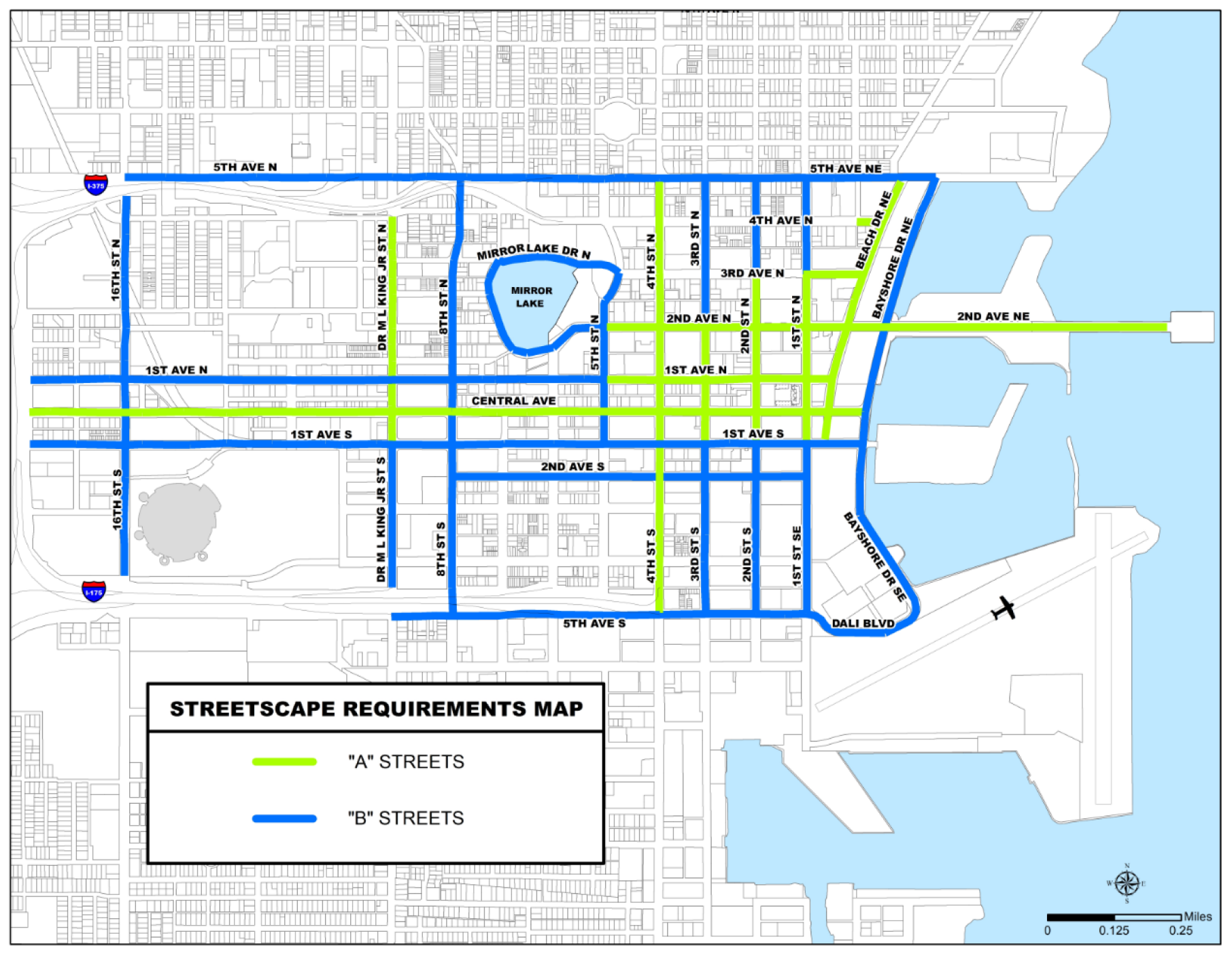
16.20.120.5.2.1. Pedestrian level "A" streets within DC-C and DC-1.
Developments abutting these streets shall provide nonresidential, pedestrian-oriented uses and hardscape and landscaping improvements consistent with the landscaping and hardscape standards established for downtown St. Petersburg by the City.
1.
Uses. Appropriate nonresidential, pedestrian-oriented uses shall include, but not be limited to, retail sales, service establishments, museums, restaurants and bars, hotel lobbies, studios, and residential lobbies. Such pedestrian-oriented uses shall be incorporated into no less than 75 percent of the linear building frontage abutting all pedestrian level "A" Streets. Each of the pedestrian-oriented uses shall have a minimum average depth of 40 feet and shall meet all requirements of the design guidelines.
2.
Streetscape improvements. The abutting public sidewalk shall be improved in compliance with the streetscape treatment plan identified in the Plaza Parkway Design Guidelines, a City approved plan, or an equivalent improvement as determined by the POD.
16.20.120.5.2.2. Pedestrian level "A" streets within DC-2.
Developments abutting these streets shall provide nonresidential, pedestrian-oriented uses and hardscape and landscaping improvements consistent with the landscaping and hardscape standards established for downtown St. Petersburg by the City.
1.
Uses. Appropriate nonresidential, pedestrian-oriented uses shall include, but not be limited to, retail sales, service establishments, restaurants and bars, offices, hotel lobbies, studios, and residential lobbies. Such pedestrian-oriented uses shall be incorporated into no less than 60 percent of the linear building frontage abutting all pedestrian level "A" streets. Each of the foregoing pedestrian-oriented uses shall have a minimum average depth of 30 feet and shall meet all requirements of the design guidelines.
2.
Streetscape improvements. The abutting public sidewalk shall be improved in compliance with the streetscape treatment plan identified in the Plaza Parkway Design Guidelines, a City approved plan, or an equivalent improvement as determined by the POD.
16.20.120.5.2.3. Pedestrian level "A" streets within DC-3.
Developments abutting these streets are required to provide nonresidential, pedestrian-oriented uses and hardscape and landscaping improvements consistent with the landscaping and hardscape standards established for downtown St. Petersburg by the City.
1.
Uses. Appropriate nonresidential, pedestrian-oriented uses shall include, but not be limited to, retail sales, service establishments, museums, commercial recreation, restaurants and bars, hotel lobbies, studios, and residential lobbies. Such pedestrian-oriented uses shall be incorporated into no less than 75 percent of the linear building frontage abutting all pedestrian level "A" streets and 50 percent of the intersecting streets up to a 200-foot distance westward from Beach Drive. Each of the foregoing pedestrian-oriented uses shall have a minimum average depth of 40 feet and shall meet all requirements of the design guidelines.
2.
Streetscape improvements. The abutting public sidewalk shall be improved in compliance with the streetscape treatment plan identified in the Plaza Parkway Design Guidelines, a City approved plan, or an equivalent improvement as determined by the POD.
16.20.120.5.2.4. Pedestrian level "B" streets within all districts.
Appropriate nonresidential, pedestrian-oriented uses shall include, but not be limited to, retail sales, service establishments, museums, commercial recreation, restaurants and bars, hotel lobbies, residential lobbies and studios. Such pedestrian oriented uses shall be incorporated into no less than 20 percent of the linear building frontage abutting all pedestrian level "B" streets. Each of the foregoing pedestrian-oriented uses shall have a minimum average depth of 20 feet and shall meet all design guidelines.
The abutting public sidewalk shall be improved in compliance with the streetscape treatment plan as identified in the Plaza Parkway Design Guidelines, a City approved plan, or an equivalent improvement as determined by the POD.
16.20.120.5.2.5. All other streets.
The abutting public sidewalk of all other streets shall be improved in compliance with the streetscape treatment plan identified in the Plaza Parkway Design Guidelines, a City approved plan, or an equivalent improvement as determined by the POD.
(Code 1992, § 16.20.120.5; Ord. No. 985-G, §§ 26—31, 7-15-2010; Ord. No. 396-H, § 4, 11-14-2019)
16.20.120.6. - Development potential.
Development potential of property in the districts is appropriate for the character of each area. Achieving maximum development potential will depend upon market forces, such as minimum desirable unit size, and development standards, such as minimum lot size, parking requirements, height restrictions, and building setbacks.
Each property has a base intensity defined by the "base approval" row within the maximum intensity table. Development proposals may increase above the base intensity by adding allowed FAR bonuses, and certain areas of a structure may be eligible for FAR exemptions. The total FAR requested, with bonuses and exemptions, shall determine whether the project requires streamline or public hearing approval. The plan allows additional FAR pursuant to a multiplier in activity centers; however, in all the DC zoning districts, no additional FAR pursuant to the multiplier is allowed. Only the FAR specifically provided for in the following maximum intensity table, the FAR bonus table and the FAR exemptions table are allowed in the DC zoning districts.
Maximum Intensity
16.20.120.6.1. - Exemptions from FAR calculations.
All areas of a structure are counted to determine the FAR including gross floor area (GFA) associated with stair and elevator towers and all enclosed common areas, unless noted otherwise. Principle Use, Stand alone parking garages, even with mixed use on the first floor, shall also be calculated toward FAR except those floors of the garage that are entirely underground.
(Code 1992, § 16.20.120.6.1; Ord. No. 985-G, § 32, 7-15-2010; Ord. No. 396-H, § 5, 11-14-2019)
16.20.120.6.2. - Bonuses to FAR calculations.
All projects within the downtown center districts may utilize bonuses to receive greater development rights. These bonuses are specifically written to provide public amenities and to mitigate secondary impacts associated with the additional development rights. Sites receiving bonus FAR shall not exceed the maximum intensity allowed for the site. Certain bonuses are only applicable to specific districts.
To qualify for bonuses:
• A project shall comply with all minimum use requirements of the zoning district. (See use regulations chart.)
• New construction shall comply with the requirements of the building envelope for the district.
• New construction shall comply with the minimum parking standards.
Bonus priority:
Projects that qualify for bonus use, and provide a minimum of 50 percent gross floor area of office use, may utilize any combination of the bonus provisions listed in this subsection to attain the desired development rights, except as otherwise limited by these regulations.
For projects required to follow the streamline process for additional FAR, the following priorities shall apply:
• If the project involves an on-site designated local landmark, a listing in the National Register Historic of Places, or a contributing resource to a local historic district or a National Register of Historic Places district, then the first 0.5 bonus FAR shall be historic preservation, and the next 1.0 bonus FAR shall be workforce housing.
• For all other projects, the first 1.0 bonus FAR shall be workforce housing. Thereafter, any bonus or combination of bonuses is allowed, except as otherwise limited by these regulations.
For projects required to follow the public hearing process for additional FAR, the first 0.5 bonus FAR shall be for historic preservation. This priority is in addition to the streamline bonus priorities described above.
FAR Bonuses
(Code 1992, § 16.20.120.6.2; Ord. No. 893-G, § 17.1, 9-4-2008; Ord. No. 396-H, § 5, 11-14-2019; Ord. No. 747-L, § 1, 12-9-2021)
16.20.120.7. - Building envelope: Maximum height and minimum setbacks.
16.20.120.7.1. Maximum building height.
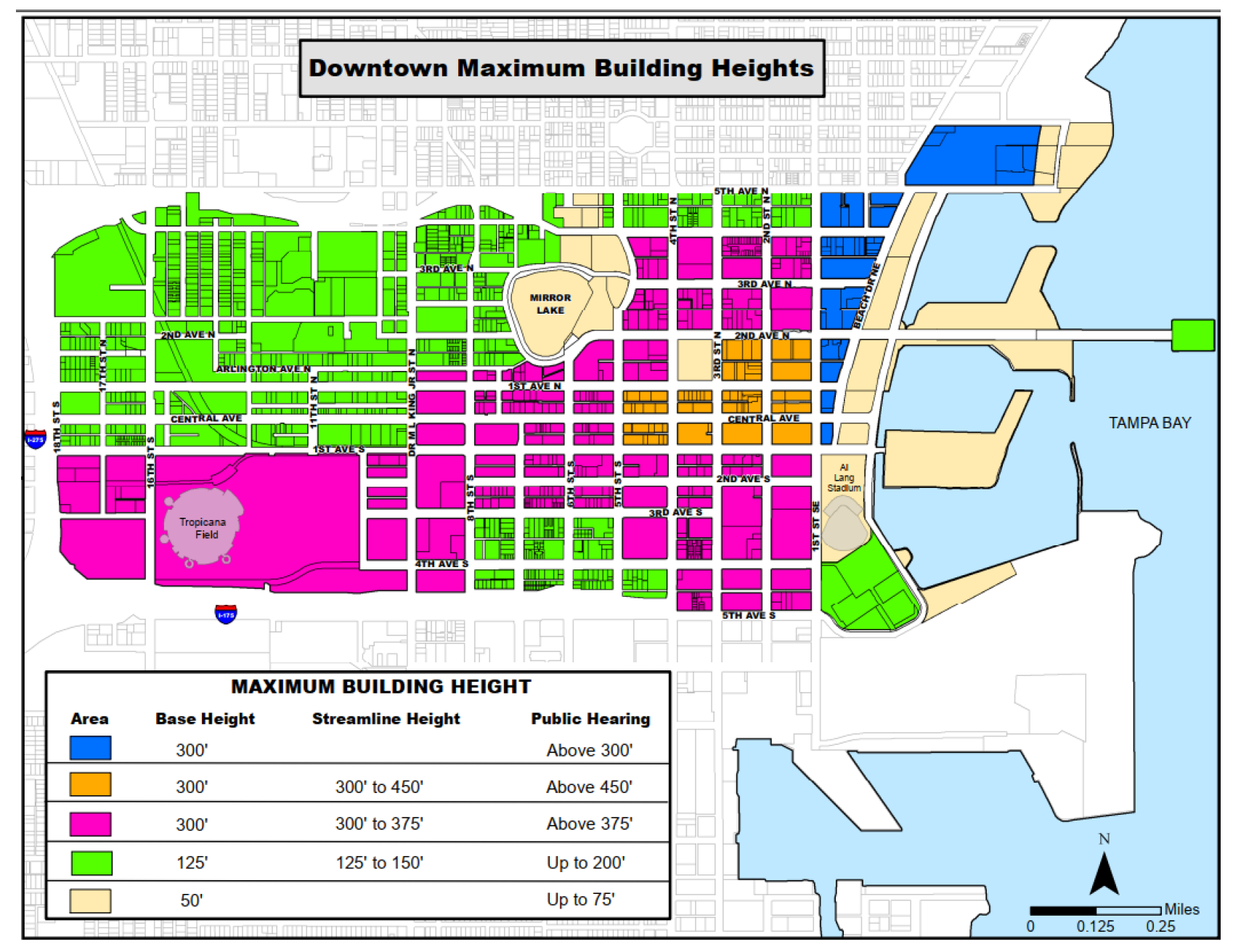
Height restrictions are based upon the approval process sought by the applicant and the location of the property. Additionally, bonus approvals must also evaluate the site plan review criteria in these land development regulations.
The height restrictions do not correlate directly to the zoning districts. They are designed to concentrate heights within the core area of the downtown and then step down toward the surrounding neighborhoods. The height map establishes the specific locations of height restrictions. In addition to the height restrictions limits specified on the map, the following criteria shall apply:
Buildings shall not exceed FAA height limitations unless approval is obtained from the FAA.
All buildings receiving additional height using the bonus approval, streamline process shall have a decorative crown feature compatible with the architectural style of the building.
All buildings receiving additional height using the bonus approval, public hearing process shall have a decorative crown feature compatible with the architectural style of the building and are encouraged to have decorative up lighting and crown lighting.
Height Restrictions Map
16.20.120.7.2. Minimum building setbacks.
A.
The downtown center allows the most intensive development within the City. Conversely, the downtown retains the charm and scale of a small city. To maintain the small-scale character, all buildings should create a strong presence at the sidewalk edge consistent with development within the traditional downtown. Buildings should be constructed within a building envelope, stepping back from the street or provide for a smaller floor plate. Either method creates space between buildings to allow light and air at the sidewalk level. Buildings which create blank walls along all edges of the development, without breaks, are discouraged.
B.
The massing of buildings will be regulated by setbacks, distance between buildings, maximum floor plates and in some districts building width. The rationale for each regulation is described as follows:
1.
Building setbacks from public streets. The charm of downtown St. Petersburg is derived from its wide rights-of-way and small scale feel generally consisting of two- to four-story buildings. While high-rise buildings have been built throughout all development periods including the 1920s, the predominant scale respects a ratio of height to street width of no more than 1:1. To protect this ratio, larger buildings are required at certain heights to step back from the street. This break in height reinforces the pedestrian feel at the street, assists with creating a strong base to each building and furthers the charm and character that distinguishes St. Petersburg from other larger cities.
2.
Distance between buildings. Buildings should be designed and situated to allow for air and light circulation between adjacent buildings on site and off site. In some cases, this separation requirement will be accommodated through existing rights-of-way, including alleys. In other cases, buildings with internal lot lines and development proposals with multiple buildings on a single site should be designed and situated accordingly.
The width of rights-of-way shall be included within the distance between buildings measurement. The minimum distance between buildings shall be split equally along a shared property line to determine the minimum building setback required. For example, when an existing building on a neighboring property is located within its half of the split distance, the proposed building is only required to provide a minimum distance between buildings equal to one-half of the required distance between buildings regardless of whether the resulting distance between buildings is less than the requirement stated in the following table. Building and life safety regulations may require additional building setbacks. When new construction is proposed that abuts an existing structure with a window wall facing the new construction (where window wall means a wall with more than 50 percent glazing), if the property owner of the existing structure provides an irrevocable, sworn statement of "no objection" to allowing the new construction to be closer to the window wall than is allowed, then no "blank wall to window wall" setback shall be required. The sworn statement, shall include the legal description of the property, shall be in a form approved by the POD, and shall be recorded in the public records.
3.
The maximum floor plate. To maintain an appropriate scale conducive with quality development and within the character of the City, larger projects may require multiple towers versus a single tower of a substantially larger size.
4.
Shared elevator and stair banks. Elevator banks and stair banks may be shared. Such elements shall create a visible break between buildings.
Building Massing and Form Table
16.20.120.7.3. Minimum ground level open space.
A.
Ground level open space shall be required in all DC districts. The minimum ground level open space shall be at least five percent of the total land area of the site. This ground level open space shall not have any portion of a building above it and shall be at least 50 percent pervious. Up to 50 percent of the required open space may be covered by architectural features (e.g. balconies, awnings, etc.), and does not require a vacation of air rights. The architectural features shall begin no lower than 12 feet above the abutting grade level. Ground level open space shall be adjacent to the right-of-way, shall be linked to the right-of-way, and shall be available for use by the public during the hours the building is accessible to the public. When a building has at least 50 percent gross floor area of residential uses, the ground level open space may be secured for the exclusive use of the occupants of the building, but shall remain visible to pedestrians along all abutting public sidewalks. Open space includes but is not limited to ground-level courtyards, plazas, sidewalks, and landscaped areas, but does not include parking spaces, driveways, alleys, and other vehicular use areas, nor does it include required vehicular use landscaping areas.
B.
In lieu of providing open space, a payment of one percent of total construction cost may be made into the City's downtown open space fund that will provide for the purchase of new park property, improvement of an existing park or right-of-way in the DC districts, or a study or planning project related to the creation or amendment of land development regulations for open spaces within the DC districts.
The process to request money from the downtown open space fund is as follows:
1.
A City Council member or the Mayor makes a request in writing to City Council that purchase of new park property, improvement of an existing park or right-of-way within the DC districts, or a study or planning project related to the creation or amendment of land development regulations for open spaces within the DC districts, be referred, subject to City Council approval, to the Budget, Finance and Taxation Committee for discussion and consideration of funding from the downtown open space fund.
2.
If referred to the Budget, Finance and Taxation Committee, the Committee determines whether to recommend to City Council use of money from the downtown open space fund for the purchase of new park property, improvement of an existing park or right-of-way within the DC districts, or a study or planning project related to the creation or amendment of land development regulations for open spaces within the DC districts. The Committee may also elect to defer action on the request and leave the project on the Committee's pending and continuing referrals list.
3.
If the Budget, Finance and Taxation Committee recommends approval for money from the downtown open space fund for the request, City Council shall consider such recommendation. Appropriation of money from the downtown open space fund is subject to City Council approval.
4.
Applicable contracts for the purchase of new park property, improvement to an existing park or right-of-way within the DC districts, or a study or planning project related to the creation or amendment of land development regulations for open spaces within the DC districts may be considered by City Council at a future date, in accordance with City Code and Council procedures then in effect.
(Code 1992, § 16.20.120.7; Ord. No. 876-G, § 13, 2-21-2008; Ord. No. 936-G, § 1, 6-18-2009; Ord. No. 937-G, § 1, 6-18-2009; Ord. No. 50-H, § 1, 10-18-2012; Ord. No. 123-H, § 1, 8-28-2014; Ord. No. 396-H, § 6, 11-14-2019; Ord. No. 524-H, § 1, 10-13-2022; Ord. No. 566-H, § 3, 12-14-2023)
16.20.120.8. - Building design.
The following design criteria allow the developer to choose their preferred architectural style, building form, scale and massing, while creating a framework for good urban design practices which create a positive experience for the pedestrian.
Site layout and orientation. The City is committed to creating and preserving a network of linkages for pedestrians. Consequently, pedestrian and vehicle connections between public rights-of-way and private property are subject to a hierarchy of transportation, which begins with the pedestrian.
1.
Buildings shall be constructed to the right-of-way line or create outdoor areas that integrate into the public sidewalk utilizing sound urban design.
2.
Surface parking, ancillary equipment, loading and service operations shall be placed to the rear or internal to the property and shall not be visible from streets (not alleys).
3.
Detention and retention ponds and drainage ditches shall be located behind the principal building to the rear of the property. Detention and retention ponds and drainage ditches shall comply with the design standards set forth in the drainage and surface water management section.
4.
For any lot, public improvements (e.g. sidewalks, right-of-way, etc.) shall be provided to service the lot in accordance with the subdivision section.
5.
Public sidewalk neck-outs shall be incorporated at street intersections for all developments that consist of a minimum of a half a block.
Vehicle connections.
1.
No curb cuts shall be allowed on Central Avenue, Beach Drive, or 2nd Avenue North east of Fifth Street.
2.
Access to parking shall be as follows:
a.
For parcels abutting an alley or secondary street, access shall be from the alley or secondary street. For all other parcels, access shall be from the primary street.
b.
For multi-unit structures, driveways shall serve the entire complex, not individual units, and shall not be wider than one lane in each direction.
c.
For parking garages located east of 1st Street between 5th Avenue North and 1st Avenue South which contain more than 100 spaces, alley access is prohibited.
Building and architectural design standards. All buildings should present an inviting, human scale façade to the public roadway, internal drives, parking areas and surrounding neighborhoods. The architectural elements of a building should give it character, richness and visual interest.
Building style.
1.
New construction shall utilize an identifiable architectural style.
2.
Renovations and additions shall utilize the architectural style of the existing structure or shall create a complete and compatible new architectural style. Additions to historic buildings are exempt from this regulation but shall comply with all other applicable regulations.
3.
Building materials and finishes shall be consistent throughout the building.
4.
The exterior of a parking structure shall utilize the same architectural style, fenestration and detailing as the principal structure or be encased by a liner building that utilizes the same architectural style, or combination of both. Exterior openings in a parking structure, excluding vehicle entrances, shall provide screening that diffuses lighting including vehicular lights.
Principal use; parking structures and surface parking lots.
1.
Parking structures shall utilize a recognized architectural style.
2.
The ground level of all parking structures located within the Downtown Center-Core (DC-C), and the ground level of all parking structures located within any Downtown Center (DC) zoning district abutting Beach Drive or Central Avenue, shall have nonresidential, non-vehicular uses with a minimum average depth of at least 40 feet on all streets, excluding alleys. For all other locations, the ground level of all parking structures shall have nonresidential, non-vehicular uses with a minimum average depth of 20 feet on all streets, excluding alleys and vehicular entry areas.
3.
The exterior of a parking structure shall utilize an identifiable architectural style which includes fenestration and detailing appropriate for that architectural style or be encased by a liner building that utilizes an identifiable architectural style, or combination of both. Exterior openings in a parking structure, excluding vehicle entrances, shall provide screening that diffuses lighting including vehicular lights.
4.
Surface parking lots which are visible from the street (not alleys) shall provide a solid knee wall not less than 36 inches high.
Pedestrian building edge and store fronts (non-residential uses).
1.
The first floor of big box buildings shall be edged with a use liner containing any permitted use (e.g., retail, restaurant, residential) or the entire wall shall include architectural details such as fenestration, large false (or real) display windows, natural finishes and other architectural features to eliminate blank façades visible from the street (not alley).
2.
Ground level façades along primary streets shall have at least 50 percent transparency at the ground level. Ground level façades along secondary streets shall have at least 30 percent transparency at the ground level.
3.
The bottom of windows shall begin no higher than two feet above grade level, and the top of all windows and doors shall be no lower than eight feet above grade level. Taller windows are encouraged.
4.
The base of buildings, where the building meets the sidewalk and entryway, should be constructed of high-quality, hardened materials.
Building fenestration (residential and non-residential uses).
1.
Buildings shall be equally detailed on all façades visible from a street (not alleys).
2.
All façades for floors above first and second floor storefronts shall have at least 30 percent total fenestration. At least two-thirds of this requirement shall be transparent (i.e., window glass). This percentage applies to all sides of buildings.
3.
A zero lot line building or buildings that have interior façades or portions thereof that cannot provide glazing due to building and fire code regulations are exempt from providing fenestration on any exempt portion of the building. Portions of these façades which are not exempt shall have fenestration and architectural detailing consistent with the design style of the building which shall comprise at least 20 percent of the façade. Permanent, durable architectural features such as shutters, tile mosaics, medallions, Trompe L-oiel, or other items are acceptable.
4.
No floor of any street façade shall have a blank area greater than 36 feet in width and the height of the floor. All façades shall include fenestration and/or architectural features.
5.
Window fenestration on the street façades shall be organized in a rational pattern.
Accessory structures and equipment. Accessory structures shall reinforce the pedestrian character of the City.
1.
Above-ground utility and service features shall be located on private property and designed to reduce their visual impact upon the streetscape.
2.
Mechanical equipment and utility functions shall be screened if visible from the public right-of-way.
(Code 1992, § 16.20.120.4; Ord. No. 876-G, § 13, 2-21-2008; Ord. No. 985-G, § 33, 7-15-2010; Ord. No. 1029-G, § 25, 9-8-2011; Ord. No. 287-H, § 35, 7-20-2017; Ord. No. 396-H, § 7, 11-14-2019)
16.20.120.9. - Public art.
Public art shall be provided as an integral part of the pedestrian-level sidewalk area for all new construction and building additions. The value shall be equal to one-half of one percent of the total construction cost up to $100,000.00 and shall be reviewed and approved by the POD of Cultural Affairs prior to issuance of the first certificate of occupancy. All public art shall be visually accessible to the public. In lieu of providing the public art, the applicant may provide financial support to the City's downtown public art program equal to one-quarter of one percent of the total construction cost, up to $50,000.00.
(Ord. No. 396-H, § 8, 11-14-2019)
16.20.120.10. - Building construction.
A construction action plan shall be required to be submitted to the POD for review and approval prior to initiation of construction activity requiring site plan review, which shall address construction methods, staging, pedestrian and bicycle connections, construction worker parking, closing of right(s)-of-way, business and neighbor communication plan.
(Ord. No. 396-H, § 9, 11-14-2019)

